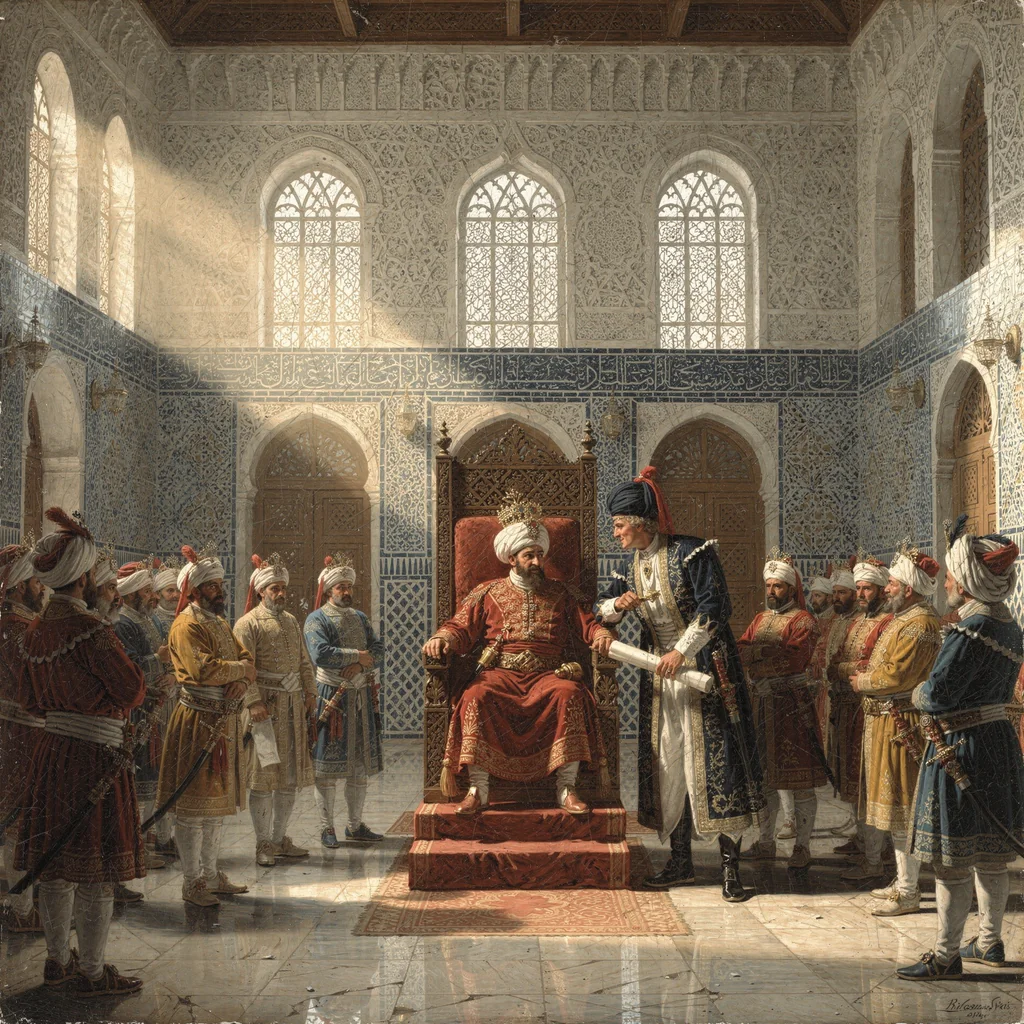
The deathbed chamber smelled of myrrh and sickness.
Lamplight flickered on walls glazed with ceramic tiles — Tunisian work from the workshops of the capital, geometric patterns in blue and white. The tiles covered the lower half of the walls, while the upper half rose to a vaulted ceiling where the shadows of the night seemed to pool.
Ḥammūda sat at the bedside. He was twenty-three years old, and his father was dying.
The room was hot, despite the evening breeze beyond the lattice screens. Incense burners released clouds of myrrh that hung in the still air, sweet and cloying, unable to mask the smell that was beginning to rise beneath — the smell of a body shutting down.
Eighteen beys waited in the antechamber beyond the silk curtains. Ḥammūda could hear them shifting on their heels, the rustle of silk robes, the occasional clink of scabbards against stone. They were waiting for the old Bey to draw his last breath. They were waiting to see what the son would do.
Ḥammūda watched his father’s face. Ali Pacha Bey’s skin had gone gray, the gray of parchment left too long in the sun. His beard, once the black of authority, was now streaked with white. He looked smaller than he had looked a week ago, a month ago. A year ago.
Ḥammūda’s hand found his father’s wrist. The pulse was faint beneath the skin, like a distant drumbeat fading into silence.
The myrrh hung thick in the air. The lamp flame flickered, casting shadows that danced on the blue-and-white tiles like memories refusing to settle.
Ali’s eyes opened again. They were clearer this time, the milky film receding for a moment.
“You were ten,” Ali whispered. The sound of his breathing was a rattle in his chest, each inhale a struggle, each exhale a surrender. “We rode to Cap Bon together. You asked me why the olive trees were old while the men were young.”
Ḥammūda remembered. The ride to the peninsula, the sea on both sides, the olive trees that had stood for centuries while dynasties rose and fell. He had asked: Father, why do the trees outlive the kings?
Ali’s fingers twitched on the blanket. From beneath his pillow, he withdrew something small — a single prayer bead, worn smooth by decades of use. It was amber, warm from his hand, with a single inclusion that looked like a drop of gold suspended in time.
“My father gave me this,” Ali said. “His father gave it to him. It is from the mosque of Kairouan, from the time when scholars, not soldiers, ruled the city of Islam.”
He pressed the bead into Ḥammūda’s palm. The amber was warm, almost hot, as if it held the warmth of three generations of hands.
“The trees outlive the kings,” Ali said, his breath coming shorter now, “because the trees do not think themselves eternal. The trees put down roots. They feed the soil. They give fruit for the gathering, not for themselves. Men who think themselves eternal cut down the forest to build a throne. Men who know their time plant trees whose shade they will never sit under.”
His hand tightened on Ḥammūda’s wrist, grip surprising in its strength.
“The beys will ask you to choose,” Ali said. “The Mamluks will demand purges. The notables will demand submission. Choose neither. Put down roots. Feed the soil. Give fruit. Let the shade come later.”
He released Ḥammūda’s wrist. His hand fell back to the blanket, fingers curling around nothing.
The bead lay in Ḥammūda’s palm — amber, ancient, warm. A single bead from a rosary that had passed through three generations of Husaynid hands, from Kairouan to Tunis, from the time of scholars to the time of soldiers.
Ḥammūda felt what was coming — the change already pressing against his ribs. For five years, since 1777, he had been the designated heir. He had sat in council meetings. He had received petitions. He had learned the art of nodding, of listening, of saying nothing that could be used against him. He had learned to watch.
But watching was not ruling. And nodding was not deciding.
Ali Pacha Bey’s eyes opened. They were clouded, filmed over with the milky haze of approaching death, but they found Ḥammūda’s face.
“The sea,” his father whispered. The word came with effort, a dry rattle in his throat. “The beys wait. The Sultan in Istanbul waits. Listen to them all. Trust none of them.”
“I will,” Ḥammūda said. His voice sounded strange in his own ears — too young, too uncertain, too small for the room that suddenly felt too large.
Ali’s gaze drifted to the small table beside the bed. On it lay the seal — a heavy disc of gold, the state seal of Tunis, the mark of authority that passed from father to son. Ali’s hand moved toward it, trembling.
The hand that had held the reins of power for thirty-two years. The hand that had signed decrees and confirmed sentences and granted favors. The hand that had worn the seal until the gold had warmed against his skin.
Now it was cold again. Now it moved toward Ḥammūda.
“Take it,” Ali said.
Ḥammūda lifted the seal. The gold was cold against his palm. It was heavier than he expected, not in weight but in what it represented. Thirty-two years his father had worn it. Now it passed to him.
For a moment, Ḥammūda could not breathe. The seal was real. The authority was real. The power was real. And the fear was real.
He fastened the chain around his neck. The gold settled against his chest, cold and final. The weight of it pressed against his breastbone, the weight of a state, the weight of a future he did not know how to shape.
Ali Pacha Bey closed his eyes. His breathing slowed. The rattle in his chest grew quieter, then quieter still.
Then there was only silence.
Ḥammūda sat with the seal in his hand. His father was dead. He was Bey of Tunis.
The silk curtains parted. A slave entered — not a Mamluk, a household slave, eyes lowered, face neutral. A man of the Andalusian community that had served the Husaynid dynasty for generations.
“The beys ask,” the slave said, “whether they should enter.”
Ḥammūda stood. The chain at his neck dragged at him, heavier now that his father’s breath had stopped. He adjusted his chechia — the red cap of Tunis, not the turbans of Istanbul, as his father had taught him by example. He walked toward the door.
He paused at the threshold. He was leaving his father’s body behind him. He was leaving the boy he had been and entering the man he must become.
Ḥammūda turned back. His father’s face was peaceful now. The struggle was over. The pain was gone. The man who had ruled Tunis for thirty-two years was gone, leaving only the seal around Ḥammūda’s neck.
Ḥammūda bowed to his father. Not as a subject to a king, but as a son to a father. Then he turned and faced the silk curtains.
“I will see my mother first,” Ḥammūda said. “Then the beys may enter.”
The women’s quarters lay in the heart of Bardo Palace, a maze of courtyards and screened chambers that no man entered unbidden. The air here was different — scented with orange blossom and rosewater, thick with the whispers of women who had watched kings rise and fall for generations.
Ḥammūda stood at the lattice gate. A eunuch guard bowed and opened the carved cedar door.
His mother awaited him in the inner courtyard.
Fatma binti Ali was sixty years old, daughter of a Tunisian notable, wife of a Bey, mother of a ruler. She sat on a divan beneath an orange tree, her face framed by the white haik that covered her hair. Around her, the women of the household waited — wives, concubines, female slaves, all of them watching Ḥammūda with eyes that measured what the Mamluks could not see.
“You wear the seal,” Fatma said. Her voice was steady, the voice of a woman who had learned to speak without being heard.
“My father is dead,” Ḥammūda said.
“I know. I heard the death rattle from the women’s mosque. I knew what it meant before you did.”
She gestured to the space beside her on the divan. Ḥammūda sat. The cushions were soft, embroidered with silk thread in patterns of flowers and arabesques. The courtyard around them was alive with the sound of water — a fountain in the center, flowing into channels that watered the orange trees and the jasmine vines that climbed the walls.
“Your cousin Mahmoud,” Fatma said, “sends messages from his villa. He asks whether the succession is secure. He asks whether the pension promised in 1777 will continue. He asks whether the title ‘dean of the family’ still means anything.”
Ḥammūda’s fingers tightened on the tea cup. He had not known of these messages.
“The notables,” Fatma continued, “send their daughters. They send their sisters. They send gifts of silk and jewelry. They ask whether the new Bey will honor the marriages his father arranged. They ask whether their sons will keep their posts in the divan.”
“The Mamluks,” Ḥammūda said, “demand payment.”
“The Mamluks always demand payment,” Fatma said. “Your father paid them. His father paid them. The Mamluks are the sword you wear at your belt — sharp, useful, and dangerous to the hand that holds them.”
She poured tea from a silver pot. The steam rose in the evening air, carrying the scent of mint.
“Your father balanced them,” Fatma said. “He gave the Mamluks their stipends. He gave the notables their tax farms. He gave the tribes their subsidies. He gave everyone something, and no one everything. This is how peace is kept.”
“What would you have me do?” Ḥammūda asked.
“I would have you survive,” Fatma said. “Mahmoud waits in the shadows. He has waited since 1777. He will wait thirty years if he must. But he watches.”
She handed him the tea cup. The porcelain was warm against his fingers.
“The women of the harem,” Fatma said, “have their own networks. We hear what the divan does not say. We know which notables hoard grain. We know which merchants deal with Algiers. We know which Mamluks whisper with Venice.”
“Use them,” she said.
“How?”
“Ask,” she said. “The women will tell you what the men will not. The men see the throne and want to sit upon it. The women see the throne and know who sits upon it next.”
She rose. Around her, the other women rose with her — the wives in their silks, the concubines in their cottons, the slaves in their simple whites. A sea of eyes watching him.
“Go to the beys,” Fatma said. “Speak to them as your father spoke. But remember — the beys serve the throne. The throne serves the state. And the state serves God.”
She touched his cheek. Her hand was warm, her fingers rough from years of prayer beads.
“You are Bey now,” she said. “Rule well. Rule justly. Rule long.”
Ḥammūda stood. He bowed to his mother. Then he turned and walked back through the lattice gate, leaving the women’s quarters behind him.
The eunuch closed the cedar door.
Ḥammūda adjusted the chain at his neck. The gold felt different now — not just heavy, but connected. Connected to his father. Connected to his mother. Connected to the network of women who watched from behind the lattice screens.
“The beys,” Ḥammūda said to the guard. “They may enter.”
Evening came to Bardo Palace. The sun dipped below the walls, painting the sky in shades of violet and gold. In the harem, the day’s business shifted from public to private.
Fatma binti Ali remained in the courtyard after her son departed. The orange tree’s shadow lengthened across the tiles. She poured more tea and waited.
The women arrived one by one, slipping through the lattice gates like shadows, their footsteps muffled by thick carpets.
First came Aisha’s mother — Khadija binti Omar, wife of a Sousse merchant. She was forty-five years old, with eyes that had watched ships sail into Sousse harbor for three decades. She wore silk of deep blue, the color of the Mediterranean.
Second came Hamida’s mother — Fatma binti Mustafa, wife of a Tunis notable. She was fifty, her face lined with years of smiling at the right moments and frowning at the wrong ones. Her robes were green, the color of the prophet’s family.
Third came the slave woman who worked in the Divan — Mariya, captured in the wars with Algeria, sold into the household, now trusted with the copying of state documents. She was in her forties, her hair streaked with gray, her hands stained with ink.
“Sit,” Fatma binti Ali said.
They sat. The tea was poured. The cakes were served. For a moment, there was only the sound of cups touching saucers, of spoons stirring sugar, of women breathing in the rare air of freedom.
“My husband,” Khadija said, “spoke of the Mamluks last night. He could not sleep. He paced the courtyard. He said the officers gather in the coffeehouses after dark, three nights running now. They speak of pay arrears, of new honors denied, of promotions that never come.”
Fatma binti Ali nodded. “And what else?”
“They speak of positions,” Khadija said. “They speak of titles. They speak of reorganizing the Mamluk corps, of creating new ranks for Turkish commanders, of restructuring the very army that protects Tunis.”
“Not just pay,” Mariya said. Her voice was soft, the voice of a woman who learned to speak without being heard. “In the Divan, I copy the documents they think I do not understand. The arrears are real. But the conversations—when the beys think the scribes are only servants—those conversations speak of ambition.”
“What do they say?” Fatma binti Mustafa asked.
“They say that Ḥammūda is young,” Mariya said. “They say that he is untested. They say that he is not his father. They ask themselves why a young Bey should command men who have served the state for thirty years.”
“And what do they answer?” Khadija asked.
“They answer in many ways,” Mariya said. “Some say: wait. Some say: watch. Some say: the time for change is coming. The time for new men to rise is coming.”
Fatma binti Ali touched the prayer beads at her wrist, her fingers moving from bead to bead. The beads were smooth from years of use, each one a prayer, each one a hope, each one a fear.
“And the notables?” she asked.
“My husband,” Fatma binti Mustafa said, “fears the Mamluks. He hears them counting positions, counting titles, counting power. He remembers what happened in Algiers last year—how the Janissaries there seized power, how they deposed the Dey, how they ruled the city for months before order was restored.”
“They will not try that here,” Khadija said.
“Not yet,” Fatma binti Mustafa said. “But if the Mamluks are not paid… if they are not honored… if they feel that their service is forgotten…”
“Then what?” Fatma binti Ali asked.
“Then the balance breaks,” Khadija said. “The Mamluks take power by force. The notables resist. The tribes choose sides. The city burns.”
Fatma binti Ali nodded. This was what she had feared. This was what she had watched from behind the lattice for thirty years—the factions that could tear Tunis apart, the interests that could destroy the dynasty, the ambitions that could end the peace her husband had built.
“My son must know this,” she said.
“He will hear it from his ministers,” Khadija said.
“He will hear what they want him to hear,” Fatma said. “The officers will demand payment. The notables will warn of military ambition. Each will speak their truth. Each will serve their interest. My son must hear what serves the maslaha — the public welfare.”
“And what is the maslaha?”
“Neither,” Fatma said. “Give each enough to stay quiet. Give none enough to rule. That is what serves Tunis.”
She poured more tea. The steam rose in the evening air.
“How will you tell him?” Khadija asked.
“Through you,” Fatma said.
She looked at each woman.
“You, Khadija—your husband will speak to Ḥammūda of trade, of ships, of the Sousse merchants’ concerns. When he does, he will also speak of what the Mamluks say in the coffeehouses. He will speak as if it is mere gossip, mere worry. But Ḥammūda will know to listen.”
“You, Fatma binti Mustafa—your husband will speak of the notables’ fears. He will speak of Algiers, of what happened there. He will speak as if it is mere concern, mere caution. But Ḥammūda will know to hear.”
“You, Mariya—you will continue your work in the Divan. You will copy the documents. You will hear what the beys say when they think no one listens. You will bring Ḥ�ammūda what you learn.”
Mariya nodded. “And when will I bring this?”
“Not in public,” Fatma said. “Not in the Divan where eyes watch. In the women’s quarters, where you come to deliver documents to my household. In the courtyard, where we speak of embroidery and weather and children. There, you will say what you have learned. There, Ḥammūda will come to hear it.”
Khadija smiled. “The women’s network.”
“The method,” Fatma said. “Your husbands think they rule. Your sons think they command. But we—we listen. We remember. We connect what men think is separate.”
She stood. The other women stood with her.
“Go now,” Fatma said. “Speak to your husbands. Speak as you always speak—of small things, of daily concerns, of household matters. But remember what is said. Remember who speaks to whom. Remember what is plotted in the coffeehouses and the Divan chambers.”
The women bowed. They slipped away through the lattice gates, shadows returning to shadows.
Fatma binti Ali remained in the courtyard. The evening breeze carried the scent of jasmine. The fountain murmured. The orange tree’s leaves whispered.
She touched the prayer beads at her wrist. One bead for her husband, dead. One bead for her son, young and untested. One bead for Tunis, the city that had sheltered her people for generations.
The courtyard was empty now. From the direction of the palace library came the faint sound of a boy’s voice reciting Turkish, the language of the empire that ruled but did not understand.
Fatma listened. Ḥammūda had been nine when Ahmed Efendi, the Turkish scholar from Istanbul, had taught him the Ottoman tongue. Mülk, the boy had learned. Dominion. Lahul mulku illa lah. There is no dominion but God’s. But here it was in Turkish, the language of the fermans and the decrees, the language of the empire that claimed Tunis while never quite ruling it.
The tutor’s lessons had continued for years — Arabic poetry, Turkish legal codes, the difference between what Istanbul demanded and what Tunis could bear. Ḥammūda had learned to read the Sultan’s letters without a translator. He had learned to understand what was written between the lines.
The evening call to prayer echoed from the minarets. Fatma rose, her joints stiff. In the distance, the boy’s voice had gone quiet. The lesson was done for the day. She returned to the harem, where the orange blossoms shed their petals on the stone.
Two days later. The women’s courtyard was quiet at this hour — the late afternoon when the household retired for rest, when even the slaves found moments of stillness between duties.
Ḥammūda sat with his mother beneath the orange tree. The fountain murmured in the center of the courtyard, its water catching the golden light of late afternoon. The scent of jasmine hung in the air, heavy and sweet.
A shadow fell across the lattice gate.
Ḥammūda looked up. A woman entered — not a eunuch, not a household slave, but the document copier from the Divan. Mariya carried a leather portfolio beneath her arm, her hands stained with ink, her face composed.
She bowed to Fatma first, then to Ḥammūda.
“I bring the account books from Sfax,” Mariya said. “As requested.”
She set the portfolio on a low table beside the fountain. The leather was worn, the brass fittings dull from use.
Ḥammūda nodded. “Leave them. My vizier will review them.”
Mariya did not leave immediately. She stood beside the table, her hands clasped before her, her eyes lowered.
“There is something else,” she said.
Fatma rose. “I will check on the evening meal.” She bowed to her son and slipped through the lattice gate, leaving Ḥammūda and Mariya alone beneath the orange tree.
Mariya waited until the courtyard was empty.
“In the coffeehouses near the Divan,” she said, her voice low, “the Mamluk officers gather after prayers. They speak of pay arrears. They speak of positions denied. They speak of the need for new leadership.”
Ḥammūda set the portfolio on the table. His mother had warned him of this. The women’s network had already reported the whispers.
“They speak of more than pay,” Mariya continued. “They speak of reorganizing the Mamluk corps. Of creating new ranks for Turkish commanders. Of restructuring the army that protects Tunis.”
She looked up, meeting Ḥammūda’s eyes for the first time.
“Some say: wait. Some say: watch. Some say: the time for change is coming.”
Ḥammūda studied her. She was in her forties, her hair streaked with gray, her hands rough from years of labor. A slave captured in the Algerian wars, sold into the household, trusted with copying state documents.
“How do you hear this?” Ḥammūda asked. “You are a scribe. You copy documents. You do not sit in council chambers. You do not drink coffee with officers.”
Mariya’s expression did not change.
“I copy the documents they think I do not understand,” she said, “I sit in the corner of the Divan with my ink and my parchment. They speak as if I am furniture. They speak as if I cannot hear.”
She touched the ink stains on her fingers — black marks that would not wash away.
“They speak the truth when they think no one listens,” Mariya said. “In the Divan, where the scribes are only servants, they say what they would never say to your face. They say that you are young. They say that you are untested. They say that you are not your father.”
Ḥammūda felt the office settle onto his shoulders.
“Why tell me this?” he asked. “You risk much by speaking. If the beys discover—”
“The beys will not discover,” Mariya said. “To them, I am the woman who copies documents. They do not see me. They do not hear me. I am part of the furniture of their power.”
She bowed again, deeper this time.
“I serve the state,” she said. “Not the Divan. The state.”
Ḥammūda understood. This was what his mother had meant. The women’s network. The hidden channels that served the state while men argued in the Divan.
“Come to the women’s quarters,” Ḥammūda said. “Bring your documents. Speak to my mother. She will ensure you are seen only as a servant delivering papers.”
Mariya nodded. She bowed once more and turned toward the lattice gate. At the threshold, she paused.
“They speak of purges,” she said, without turning. “Some say that purges are necessary. Some say that mercy is weakness.” She looked back over her shoulder. “But they have never seen a brother’s name on a death list. They have never had to explain to a niece why her uncle died.”
She slipped through the gate and was gone.
Ḥammūda sat alone beneath the orange tree. The fountain murmured. The jasmine scent hung thick in the air. He touched the seal at his throat, then the amber prayer bead in his pocket — his father’s gift, his grandfather’s bead, three generations of Husaynid hands.
The women hear what the men will not say, he thought. And the men do not hear because they do not listen.
He rose and adjusted his chechia. The beys waited in the antechamber. It was time to face them.
The antechamber was a vaulted hall of marble floors and stuccoed ceilings, the air thick with the scent of unwashed bodies, expensive perfumes, and the metallic tang of weapons worn too close to skin. The rustle of silk robes filled the space as beys shifted on their heels, the clink of scabbards against stone marking their impatience. Torchlight flickered on the tiled walls, casting shadows that moved like thoughts across their faces.
The beys filled the space. They wore silk robes dyed in deep colors — crimson and emerald and indigo — each color marking a faction, each faction marking a claim on the state. The crimson faction served the Georgian officers, the military elite. The emerald faction served the Tunisian-born notables, the merchant class. The indigo faction served the tribal confederations, the desert warriors who guarded the borders.
Ḥammūda emerged from the deathbed chamber.
The beys rose as one. Their eyes measured him. Their minds calculated: Would he purge? Would he yield? Who would he favor?
Ḥammūda walked through them, and they parted.
He could feel their gaze. It was physical, like heat against his skin. They were looking for weakness. They were looking for fear. They were looking for any sign that the boy who had watched for five years would now tremble when called to decide.
Let them look, Ḥammūda thought. Let them see what they will see.
Mustapha Khodja, Dey of the army, stepped forward. He was a Mamluk of Georgian origin, broad-shouldered, scarred from campaigns against Algerian raiders. A white streak ran through his beard where an Algerian saber had come too close.
“My condolences,” Mustapha said. “Your father maintained peace. He maintained order. But he did not resolve the tensions that divide us.”
Ḥammūda said nothing.
The first lesson, Ḥammūda thought. Speak first, and you reveal what you value. Speak first, and you show what you fear.
“The troops are restless,” Mustapha said. “Three months unpaid. The notables sleep on silk while the army watches its children hunger.”
Ḥammūda heard the threat beneath the words. Pay us, or we will take what we are owed.
Ibrahim El Sahib, the eldest of the beys, moved to intercept. He was a Mamluk of Tunisian birth, a man who remembered the purges of the 1750s, when Ali I Pasha had eliminated the Janissaries who had grown too powerful. Ibrahim had been a boy then, but he remembered the bodies hanging from the Bardo gates.
Ibrahim’s face was lined with sixty-five years of survival. His beard was white, his hands spotted with age, but his eyes were sharp — the eyes of a man who had outlived his rivals by watching them.
“The Mamluks grow arrogant,” Ibrahim said. His voice carried the weight of memory. “They seize power. They demand privileges. They forget that they are slaves who were given freedom, not masters who were born to rule. The notables pay the taxes that feed your treasury. The notables fund the waqf that feed your poor. Purge the Mamluks, strip their military privileges, and the notables will fill your treasury.”
Ḥammūda heard the counter-threat. Starve the army, and the merchants rule.
But there was something else in Ibrahim’s voice — not just threat, but fear. The fear of a man who had seen bodies hanging from gates. The fear of a man who remembered the 1750s.
A third bey stepped forward — Sultan Mamluk, named ironically for the empire itself. He was young, ambitious, caught between the Georgian and Tunisian factions. He saw opportunity in crisis.
“Is it just that the notables feast on couscous while the people starve?” Sultan said. “Is it right that the soldier goes unpaid while the merchant grows fat? The city strains against both. The notables oppress the people with taxes. The Mamluks oppress the notables with threats. The tribes starve while the city feasts. The divan is paralyzed by faction. When will the state serve those who bleed for it? Purge them all. Start fresh. A new Bey, a new council, a new order.”
Ḥammūda looked from one to the next.
He saw Mustapha’s scars and the greed beneath them. He saw Ibrahim’s age and the fear beneath it. He saw Sultan’s youth and the ambition beneath it.
They wanted him to choose. They wanted him to destroy their enemies for them. They wanted him to become the hammer that crushed their rivals.
He remembered his father’s last words.
Listen to them all. Trust none of them.
He remembered his mother’s counsel.
Ask the women. They hear what the divan does not say.
Ḥammūda walked past Mustapha Khodja. He walked past Ibrahim El Sahib. He walked past Sultan Mamluk. He walked past all eighteen beys without stopping.
The beys turned, watching him go. Their eyes were calculating. They wanted a decision. Ḥammūda gave them nothing.
Let them wait, Ḥammūda thought. Let them wonder.
At the door to the corridor, he paused. The gold disc hung cold against his breastbone. He had never made a decision that could send men to their deaths. He had never given an order that could not be undone.
He turned back to the room. The beys stood silent, waiting.
“I have buried my father,” Ḥammūda said. “I will bury no one else today. Not without cause. Not without hearing all the facts. As the Quran teaches: Inna Allaha ya’muru bil-‘adli wal-ihsan — God commands justice and goodness.”
His voice was steady. He was surprised by how steady it was.
“Return tomorrow,” Ḥammūda said. “Bring me your grievances. Bring me your accounts. Bring me the truth of what you claim. I will hear all of it. And then I will decide.”
He continued through the door. Behind him, the beys stood in silence.
That evening. Mustapha Khodja walked through the courtyard of his home, the sounds of the palace still echoing in his ears. The confrontation in the antechamber had left him restless — the demands for war, the notables’ warnings of submission, the young Bey’s refusal to choose.
He needed to forget the palace for a few hours. He needed to remember why he fought.
Aisha ran to him as he entered the family courtyard. She was eight years old, with her mother’s smile and her father’s fierce spirit.
“Baba!” she cried, throwing her arms around his legs.
Mustapha laughed and lifted her into his arms. The heavy silk robes of the Dey of the army fell away as he held his daughter. Here, he was not a Mamluk commander, not a representative of Georgian faction, not a man who carried the weight of soldiers’ lives.
Here, he was just Baba.
“Did you miss me?” Mustapha asked.
“Always,” Aisha said. She reached up and touched the white streak in his beard — the scar from the Algerian saber, the mark of the battles he had fought. “Did the bad men try to hurt you today?”
Mustapha set her down gently. “What bad men?”
“The men in the Divan,” Aisha said. “Mother says they argue. She says they want you to fight.”
Mustapha knelt so he could look his daughter in the eyes. “Sometimes… sometimes men argue because they want what is best. But they disagree on what that is.”
“Like when I want honey and Mama says I must eat bread first?”
Mustapha smiled. “Exactly like that.”
“Who won?” Aisha asked.
Mustapha thought of Ḥammūda standing before the eighteen beys, refusing to choose, refusing to destroy, refusing to submit.
“No one won today,” Mustapha said. “And no one lost. The young Bey… he chose to wait.”
“To wait for what?”
“To wait for wisdom,” Mustapha said. “Wisdom is worth waiting for.”
Aisha considered this with the solemnity of an eight-year-old. Then she took his hand.
“Come,” she said. “I learned a new surah. Will you listen?”
Mustapha let his daughter lead him to the cushion where she studied. He sat and listened as she recited the Quran — her voice clear, her Arabic perfect, her heart innocent of the conflicts that consumed the palace.
For a moment, Mustapha forgot the Mamluks’ demands. He forgot the Venetian threat. He forgot the factional struggles that divided Tunis.
He listened to his daughter. And he remembered what he fought for — not for glory, not for power, but for moments like this. Moments where children could learn in peace. Moments where fathers could listen without fear. Moments where wisdom could wait while love remained.
When she finished, Mustapha kissed her forehead.
“Mashallah,” he said. “You learned well.”
“Will you teach me to use a sword?” Aisha asked. “Like you?”
Mustapha’s heart caught. “You want to learn the sword?”
“I want to be strong,” Aisha said. “Like you, Baba.”
Mustapha gathered his daughter into his arms. “You are already strong,” he said. “The strongest strength is not swords or armies. The strongest strength is here” — he touched her chest — “and here” — he touched her forehead.
Aisha looked at him, solemn and serious.
“Then I will be strong,” she said. “And I will protect you.”
Mustapha held her tighter. The Mamluks wanted war. The notables wanted submission. But Mustapha wanted this — moments of peace in a world of conflict, moments of love in a life of duty.
“You already protect me,” he whispered.
Aisha yawned and pressed her face into his robe. The last light of evening faded from the courtyard walls.
- Ḥammūda stood in the corridor outside the Divan chamber, the stone floor cool beneath his boots. The beys had departed, leaving silence in their wake. Youssef stood at his right, as he always stood — still, composed, waiting.
Ḥammūda looked at his vizier. The Moldavian vizier stood at his right, as he always had since their first meeting. His green eyes were calm, his fair hair catching the torchlight from the corridor walls. He wore the robes of his office, but his bearing remained that of a man who had survived the journey from the Balkans to the Bosphorus by learning to watch without being seen.
One year, Ḥammūda thought. One year since Bakkār al-Jallālī brought him to the palace. One year since I looked into those green eyes and saw… what?
He saw it again — the memory surfacing unbidden, as memories do in times of crisis.
The year was 1781. Ḥammūda was twenty-two years old.
Bardo Palace was quiet that morning — the quiet of late summer, when the heat drove even the bureaucrats to their homes. Ḥammūda sat in the council chamber, reviewing the account books from Sfax. The olive harvest had been good that year. The Venetian buyers had paid well. The treasury was full.
A servant entered — not a slave, but a free man, a notable from the southern coast. Bakkār al-Jallālī, one of the wealthiest merchants of Sfax, wore a kaftan of silk embroidered with gold thread, his beard hennaed in the style of the south.
“Excellence,” Bakkār said, bowing. “I bring a gift. From the markets of Constantinople.”
Ḥammūda looked up from the ledger. “Sfax has already paid its tribute. The Venetians have already paid for the oil. What more does the south owe?”
“It is not money I bring,” Bakkār said. “It is a man.”
He gestured to the doorway. A man entered — a Mamluk, purchased in the slave markets of Istanbul. He was a man grown, though hardship had marked him, with fair hair that caught the sunlight, eyes the color of emeralds, and the bearing of someone who had survived the journey from the Balkans to the Bosphorus.
“This,” Bakkār said, “is Youssef Khodja. Purchased in Constantinople, educated in the palace schools. He speaks three languages, reads and writes in all of them. And he knows the value of a barrel of Sfax olive oil better than any Venetian.”
Ḥammūda studied the young man. The Mamluk stood straight, his hands clasped behind his back, his face composed. There was no fear in those green eyes. No deference, either. Only assessment.
Ḥammūda had seen many Mamluks. Most were fierce warriors, loyal to their paymasters, brutal in battle, simple in thought. This one was different. This one had the stillness of a man who had seen too much too young.
“What were you before?” Ḥammūda asked.
“Before,” Youssef said, “I was a boy in Moldavia. The harvest failed two years running. My father had debts. He sold me.”
He said it without bitterness, as one states a fact about the weather.
“To whom?” Ḥammūda asked.
“A traveling merchant from Iași. My father took three silver coins and a document signed by the magistrate. I stood in the courtyard while the merchant examined my teeth, my hands, my legs. Other children stood there too — the sons of families who had nothing left to sell but their children. The merchant chose four of us. My father did not look at me when I walked away.”
Bakkār al-Jallālī studied him. “And what do you remember of Constantinople, Moldavian?”
Youssef was silent for a moment. The question caught him off guard. Men asked about skills—languages, numbers, the ability to read and write. No one asked about memories.
“I remember one house,” Youssef said. “In the Eminönü district, near the Egyptian Bazaar. A merchant named Suleiman bought me from the slave traders. He was a man of honor—he treated me like a son, not property. His house smelled of cinnamon and old paper, of account books and tea. He gave me the name Youssef. He taught me Turkish at his table.”
He paused. The memory was vivid, almost painful in its clarity.
“Suleiman had two daughters,” Youssef continued. “Aisha and Fatima. They were girls then, perhaps ten and twelve. They taught me that not all Ottomans were cruel. They gave me figs from the garden when I was hungry. They taught me that I was a person, not property.”
Bakkār was silent. He had not expected this story.
“What happened?” Ḥammūda asked.
“Suleiman fell into poverty,” Youssef said. “The illness took his strength. The creditors came. I was sold again—this time to a different merchant, one who brought me to the slave markets where Bakkār al-Jallālī found me.”
He looked at the merchant from Sfax. “You bought me from that market. You brought me here.”
Bakkār nodded. “I did.”
“I have often wondered,” Youssef said quietly, “what became of them. Suleiman’s daughters. The girls who treated me like a brother when I was a slave.”
Something moved behind the Mamluk’s eyes — not anger, not ambition. Something older. Quieter.
“You will never see them again,” Ḥammūda said.
“I know,” Youssef said. “But I remember them. And the memory… it reminds me that kindness exists. Even in a city of cruelty.”
He looked up, meeting Ḥammūda’s eyes. “This is why I serve well, Excellence. Not because I was trained to serve. Because I was treated with kindness when I had nothing to offer in return. Suleiman’s daughters taught me this. And I have never forgotten.”
Bakkār al-Jallālī stepped forward, his expression changed. “He is expensive, Excellence. But he is worth it. The Sfax oil trade needs someone who can negotiate with the Italians, someone who understands their numbers and their ways. This one does.”
Ḥammūda looked at the merchant. “You could have kept him in Sfax. You could have used him yourself. Why bring him to me?”
Bakkār’s expression was carefully neutral. “Sfax is a city of merchants. We have no throne. We have no seal. We have no army. When the Venetians dispute our prices, when the Algerians raid our coasts, we have only our wits and our alliances. A vizier in Tunis is worth more than a manager in Sfax.”
It was truth, but not all the truth. Ḥammūda could hear what Bakkār did not say: Sfax needs protection. Sfax needs the Bey’s favor. A gift of a valuable Mamluk buys goodwill. A gift of a valuable Mamluk buys protection.
Ḥammūda turned back to the young Mamluk. “You were purchased in Constantinople. You were educated in the palace schools. You were trained to serve the empire. Why should I believe you will serve Tunis?”
“Because Tunis is where I am,” Youssef said. “Because I am not a Georgian, loyal to the Mamluk faction. I am not a Tunisian, loyal to the notables. I am not an Arab, loyal to the tribes. I have no faction. I have no family. I have only the service you give me.”
Ḥammūda studied the young man’s face. This was more than he expected from a Mamluk. This was a man who understood the problem of faction, who understood that the greatest threat to a ruler came from the men closest to him.
“The beys,” Ḥammūda said, “demand money. The notables demand influence. The tribes demand subsidies. My father balances them all. He gives everyone something, and no one everything. This is how peace is kept.”
“And when he is gone?” Youssef asked.
The question hung in the air. Ḥammūda’s father’s health was failing. The succession was on everyone’s mind, though no one spoke of it openly.
“My father will live many years,” Ḥammūda said.
“God willing,” Youssef said. “But all men die. And when the Bey dies, the factions will rise. The Georgians will demand their due. The Tunisians will demand theirs. The tribes will demand theirs. Someone must stand between them. Someone must balance.”
“Are you offering to be that someone?” Ḥammūda asked.
“I am offering to serve,” Youssef said. “I have no tribe. I have no faction. I have no ambition but to serve well. Test me. Use me. If I serve well, keep me. If I do not, sell me to another. I am a Mamluk. I know what I am.”
Ḥammūda looked at Bakkār al-Jallālī. The merchant was watching with carefully concealed interest. The gift had been given. The transaction had begun. Now it was Ḥammūda’s choice.
“He will be my Saheb al-Tabaa,” Ḥammūda said. “Keeper of the Seal.”
Bakkār bowed. “A wise choice, Excellence. The Sfax merchants will remember this.”
Youssef did not bow. He did not smile. He only nodded once, sharply, and took his place beside the throne.
Ḥammūda returned to the ledger from Sfax. The numbers swam before his eyes — barrels of oil, prices in ducats, profits in sequins. But his mind was elsewhere.
He had found something unexpected. A Mamluk with no faction. A servant with no ambition but to serve well. A man who understood that balance was the only way to survive.
Ḥammūda closed the ledger. The seal was still new — he had worn it for only a year as his father’s deputy. The weight of it reminded him of what was coming.
“What do you know of my father’s approach?” Ḥammūda asked.
“I know what I have seen,” Youssef said. “The Mamluks receive their stipends. The notables receive their tax farms. The tribes receive their subsidies. No one is satisfied. But no one rebels. This is balance.”
“And if balance fails?”
“Then there is war,” Youssef said. “And in war, everyone loses. The Georgians win, the notables lose. The notables win, the tribes lose. The tribes win, the trade collapses. Your father found a way to make peace profitable. This is wisdom.”
Ḥammūda turned the ledger’s pages without reading them. In the year since he had begun sitting at his father’s right hand, he had watched the councils, the petitions, the endless complaints. He had seen the tensions that simmered beneath the surface. He had wondered how long the peace could last.
Now he had someone who could help him maintain it.
“The oil from Sfax,” Ḥammūda said, “is the best in the Mediterranean. The Venetians know it. The Genoese know it. The French know it. Yet we sell it for less than it is worth.”
“Because we sell through middlemen,” Youssef said. “Because we have no direct trade with Livorno. Because we have no ships that sail under our flag. Because we accept whatever price the Europeans offer.”
“What would you do differently?” Ḥammūda asked.
“I would sell directly,” Youssef said. “I would send our ships to Livorno, to Marseille, to Genoa. I would let the Italians taste our oil, let them see its quality. I would make them bid against each other. When there is competition, prices rise. When there is no competition, prices fall.”
Ḥammūda acknowledged this with a small gesture. This was what his father had taught him. The art of balance was not just about factions. It was about markets. It was about making Tunis indispensable while remaining independent.
“And the profits?” Ḥammūda asked.
“The profits would endow a madrasa,” Youssef said. “A library. A hospital. Institutions that survive when men die.”
Ḥammūda looked at the young Mamluk with new eyes. This was not just a servant. This was a partner. This was someone who understood systems, not men. Institutions, not power.
“You will begin with the Livorno trade,” Ḥammūda said. “But you will also learn the ways of the divan. You will learn to read the faces of the beys as well as you read the ledgers of the merchants. You will learn to balance factions as well as you balance books.”
“I will learn,” Youssef said.
“Then begin,” Ḥammūda said. “Bakkār al-Jallālī has bought you for the palace of Tunis. But from this day forward, you serve the state. Not the merchant. Not the faction. The state.”
Youssef nodded once. “I serve the office.”
The words hung in the air between them. I serve the office. Not the man. The office survives when men die.
September 1782. Ḥammūda stood again in the corridor outside the Divan chamber. Youssef stood at his right, as he always stood — the Mamluk with no faction, the servant who served the office, the man who understood that institutions survive when men die.
Ḥammūda’s father was dead. The beys waited for decisions he did not know how to make.
But he was not alone.
“The women’s quarters,” Ḥammūda said. “My mother waits.”
Youssef nodded. “And after?”
“After,” Ḥammūda said, “we face what comes.”
September 1777. The water trickled over mosaic tiles, a soft continuous sound that filled the silence of the harem garden. Stone benches circled the fountain, their surfaces worn smooth by generations of women who had sat here waiting, watching, whispering.
Mahmoud sat on one of these benches. He had been sitting there for an hour, unmoving, his hands clasped so tightly that the knuckles had gone white.
The evening sky had turned the color of pomegranate juice. The scent of jasmine and orange blossoms drifted through the garden, heavy and sweet, overlaid with the faint smell of charcoal from the kitchens below. The call to prayer had echoed from the minarets minutes before, but the sound had faded into the gathering dark.
Amina stood at the garden entrance, watching him.
She was eighteen years old, born the same year as her brother Ḥammūda, twins or close enough that no one remembered the difference. Her emerald silk dress caught the last light of day, the Georgian silk shot through with gold thread, a fabric that had come from her mother’s trousseau. At her throat, a ruby pendant caught the light — deep red, like a heart made visible.
She did not speak immediately. She let the silence stretch until Mahmoud felt it.
“You agreed.”
Mahmoud did not look up. His hands remained clasped, white-knuckled, on his knees.
“You stepped aside,” Amina said. “For a boy of eighteen.”
Mahmoud’s jaw tightened. “He is my cousin. He is Ali Pasha’s son.”
“He is younger than you.” Amina walked into the garden, her silk making no sound on the stone path. “He has less experience. The council chose him over you. The council chose… weakness.”
Mahmoud looked up then. He was thirty-eight years old, his face lined with years of waiting, with humiliations borne in silence. But beneath the exhaustion, something else burned.
“He is my uncle’s choice,” Mahmoud said. “He is the Bey’s designated heir. This was decided in 1777.”
“And so you accept it?” Amina stood before him now. “You step aside. You wait. You watch while a boy of eighteen wears what should have been yours.”
“What would you have me do?” Mahmoud stood, his kaftan sweeping the stone path. “Challenge him? Start a civil war? Have cousins killing cousins? Is that what you want?”
“I want what is mine,” Amina’s voice was steady. “What should have been yours in 1777.”
Mahmoud paced the small garden. The walls rose around them, the walls of the harem that had confined him for eleven months, since the triple wedding that had bound him to this Georgian daughter of Ali Pasha.
“My cousin is wise,” Mahmoud said. “He has good counsel. Youssef Saheb Ettabaa serves him well. The state will prosper under his rule.”
“Your cousin builds bridges,” Amina said. “Your cousin balances factions. Your cousin thinks that if he is good enough, fair enough, wise enough… everyone will love him and no one will betray him.”
She turned back to him. Her face was in shadow.
“He is wrong.”
Mahmoud stopped pacing. “Is it not?”
Amina walked to him. She took his hands in hers. Her skin was soft, but her grip was firm.
“No. Balance is weakness, Mahmoud. Balance means no one is fully loyal to you. Balance means everyone has a reason to betray you. Balance means… this.”
She gestured to the garden around them — to the harem walls, to the life of exile, to thirty-two years ahead of the same.
“Thirty-two years,” Mahmoud said quietly. “That is how long your father ruled. Thirty-two years of balance. And where were you? Waiting. Sitting in gardens like this. Watching while another man ruled. Is that what you want? Another thirty-two years of… this?”
Amina touched the silk of her sleeve. The emerald fabric was shot through with gold thread, fine Georgian silk that had come from her mother’s trousseau. Her mother, Lalla Mahbuba “the Georgian,” had died when Amina was twelve, but her lessons remained.
“My mother told me of Carthage,” Amina said. “Did you know that Carthage stood here, where Tunis stands now? A great city. A powerful empire.”
“I know of Carthage,” Mahmoud said. “Every child in Tunis knows of Carthage.”
“But do you know why it fell?”
“The Romans. Scipio. The siege.”
“Yes,” Amina said. “The Romans. But why did the Romans win, Mahmoud? Why did Carthage fall?”
Mahmoud’s jaw worked. “I… I do not know.”
“Because Carthage had kings,” Amina said. “But it also had a senate. It had a council. It had… balance. And when the crisis came, the king could not act. The council debated. The senate deliberated. While Carthage talked, Rome acted. While Carthage balanced, Rome conquered.”
Mahmoud was silent for a long moment. Then: “Carthage talked while Rome acted.”
“And lost,” Amina said. “Every time.”
“You speak like a scholar,” Mahmoud said.
“I speak like a woman who sees her husband humiliated year after year,” Amina said. “I speak like a sister who sees her brother give away what should be kept. I speak like someone who understands that the man who shares power will soon have no power to share.”
She released his hands and walked to the fountain, trailing her fingers through the cool water.
Mahmoud looked at his wife — really looked at her, for the first time seeing the Georgian features, the high cheekbones, the almond-shaped eyes, the way she carried herself as if she wore a crown that no one could see.
“He is my cousin, Amina. My uncle’s son. We were raised together. We played together as boys. He does not deserve… this.”
“Deserve?” Amina’s voice was sharp. “What does deserve have to do with power? Did your uncle Ali Pasha deserve to rule for forty years? Did the Ottomans deserve to rule the world? Deserve is for children, Mahmoud. Power is for men and women who take it.”
“And you?” Mahmoud asked. “What do you want?”
“I want what is mine,” Amina’s voice softened, but the steel beneath remained. “What is ours. What our children will inherit.”
“Our children?” Mahmoud was incredulous. “We have been married eleven months, Amina. We have no children yet.”
“We will,” Amina’s certainty was absolute. “And they will inherit what you could not take. What your cousin took from you. What I will help you take back.”
She smiled. It was not a kind smile. It was not a cruel smile either. It was the smile of someone who sees further than others.
“We will see, Mahmoud. We will see.”
Mahmoud looked at this woman he had married eleven months ago. He had thought her young, obedient, a Georgian bride who would bring prestige to his household.
Amina smoothed her silk dress. The emerald fabric caught the last light of day. She adjusted the ruby at her throat.
“Come, husband,” she said. “The night grows cold. And we have much to discuss.”
“What is there to discuss?” Mahmoud asked.
“The future, Mahmoud,” Amina said. “The future.”
She turned and walked toward the harem entrance. Mahmoud followed. He was still uncertain, still processing what she had said, still grappling with the impossibility of what she suggested. But he followed.
They passed through the harem gate into the main courtyard.
Above them, on a balcony, Ḥammūda stood.
He was surrounded by councilors — men in silk robes, men who mattered, men who served. He was laughing at something someone said, his head thrown back, his joy visible even from this distance. He looked young. He looked confident. He looked like a man who believed the world was good.
Amina stopped. She watched him.
My brother, she thought. You think everyone loves you because you are good. You think balance will protect you because balance is fair.
You are wrong.
Balance is not protection. Fairness is not armor. Goodness is not a shield.
Someday you will understand. Or you will fall.
Mahmoud caught up to her. He saw Ḥammūda on the balcony too. He looked at his cousin, then at his wife. He looked at his hands. They were steady. He did not know why this surprised him.
“He looks happy,” Mahmoud said.
“He does,” Amina said.
“He looks like a Bey.”
“He does.”
Amina took Mahmoud’s arm. She led him away from the balcony, away from Ḥammūda, toward their chambers.
“Come, husband,” she said. “The future waits.”
“The future?”
“The future. Our future.”
Amina and Mahmoud disappeared into the harem corridors, their shadows merging with the darkness.
Above them on the balcony, Ḥammūda still laughed.
Later that night. Mahmoud sat in the courtyard of his villa, the sounds of Bardo Palace faded behind the walls. Here, in the home he had been given after the triple wedding, there was only silence and the small sounds of family.
Hussein sat across from him, twelve years old, his face a mirror of his father’s — the same brow, the same eyes that watched and waited. Salem was younger, eight, restless as boys that age are, shifting on his cushion, reaching for the sweetmeats that the slave had set between them.
“Patience,” Mahmoud said gently. He reached out and stopped Salem’s hand with his own. “The sweets will still be there in a moment. Wait.”
Salem pouted but withdrew his hand. Hussein watched his father, his eyes solemn.
“Why must we wait?” Salem asked. “The sweets are here. We are here. Why not eat?”
Mahmoud considered how to answer. How to explain a lesson he had learned through thirty-eight years of waiting, through humiliations borne in silence, through watching while others ruled.
“Because,” Mahmoud said, “the one who waits understands what the one who rushes does not.”
“What does he understand?” Hussein asked. His son was already old enough to sense the weight behind his father’s words.
“He understands that the best outcomes ripen slowly,” Mahmoud said. “He understands that what is built quickly, falls quickly. But what comes with patience… that remains.”
Salem looked at the sweetmeats, then back at his father. “But if I wait… someone else might eat them first.”
Mahmoud nodded. This was the fear that had driven his entire adult life. The fear that if he waited, if he was patient, he would lose everything to someone less scrupulous, someone faster, someone willing to seize what they wanted.
“Sometimes,” Mahmoud said, “that happens. Sometimes another eats the fruit. Sometimes another takes the prize.” He looked from Salem to Hussein, meeting his older son’s eyes. “But the man who rushes for every prize loses something more important than fruit.”
“What?” Hussein asked.
“His dignity,” Mahmoud said. “His honor. His self-respect. The man who seizes without patience becomes a man who cannot trust his own hands. He becomes a man who must always watch for others who would seize from him. He becomes a man who cannot rest.”
Mahmoud took a sweetmeat and placed it before Salem.
“Now,” he said. “You may eat.”
Salem popped the sweet into his mouth, smiling. But Hussein did not reach for the sweetmeats. He watched his father, his brow furrowed in thought.
“Baba,” Hussein said. “Did you… did you wait for something once? And lose it?”
Mahmoud’s hands curled on his knees. The question cut close to the bone. The throne of Tunis. The position that should have been his. The cousin who had been chosen over him.
“Yes,” Mahmoud said.
“And was it worth it?” Hussein asked.
Mahmoud looked at his sons — Hussein who watched and thought, Salem who ate and smiled. Two boys who would inherit the legacy of his patience. Two boys who might one day understand what their father had chosen.
“I do not know yet,” Mahmoud said honestly. “I am still waiting.”
“Still waiting for what?”
“Still waiting to see,” Mahmoud said, “whether patience bears fruit… or whether patience is just waiting dressed in fine clothes.”
He touched Hussein’s shoulder. “This much I know, my son. The man who waits with dignity can live with himself. The man who seizes without honor… he carries his own chains.”
Salem finished his sweetmeat and reached for another. But Hussein did not move. He sat watching his father, his brow furrowed, his hand resting on the cushion where the uneaten sweet lay between them.
Outside, the stars had come out over Tunis.
Two days later, September 1782. Ibrahim El Sahib entered Ḥammūda’s private chamber unannounced.
The eldest of the beys was sixty-six, his face lined with decades of watching power shift and settle. He carried a rolled parchment — not a petition, not a demand, but something else. His hands trembled slightly as he held it.
“Your grandfather had my uncle killed,” Ibrahim said without preamble.
Ḥammūda looked up from his desk. “Ibrahim?”
“You heard stories of the 1750s purges,” Ibrahim said. “Your father told you of the Janissaries who threatened the state. What he did not tell you was the cost.”
He unrolled the parchment on Ḥammūda’s desk. It was a death list — thirty names, dated 1757, signed by Ali I Pasha. Ḥammūda’s grandfather.
Ibrahim’s hand shook as he pointed to one name. “My uncle. Yusuf al-Sahib. A good man. A pious man. He taught me to read the Quran. He taught me that justice without mercy is cruelty. His crime was supporting the Janissaries. Your grandfather had him executed.”
Ḥammūda looked at the old man’s trembling hands. He had heard stories of the purges, but never this. Never the names. Never the personal cost.
“I remember the day,” Ibrahim said, his voice thick with memory. “I was twelve. My mother screamed when they brought the news. She fell to the floor and would not rise for three days. My father — Yusuf’s brother — stopped speaking. He lived for ten more years, but he never spoke again. The grief took his tongue.”
Ibrahim looked at Ḥammūda, and for the first time, the young Bey saw fear in the old man’s eyes.
“I am afraid, Ḥammūda,” Ibrahim said. “I am afraid of the Mamluks. They speak of purges as if they are solutions. They speak of killing as if it is governance. But they have never seen a mother scream. They have never seen a father lose his tongue to grief. They have never seen the ghosts that haunt the survivors.”
“Why tell me this now?” Ḥammūda asked.
“Because you face the same choice,” Ibrahim said. “The Mamluks demand purges. The notables demand submission. I want you to know: purges are easy to order, hard to forget.”
He touched the parchment, his finger tracing his uncle’s name.
“The ghosts of the men you kill will haunt your reign,” Ibrahim said. “They will haunt your nights. They will haunt your heirs. Your grandfather thought he was buying peace. He was buying fear. And fear… fear is not peace. Fear is only fear waiting to become hate.”
Ḥammūda looked at the death list. Thirty names. Thirty men executed. Thirty families grieving. Thirty sets of ghosts.
“I understand,” Ḥammūda said.
“Do you?” Ibrahim asked. “The Mamluks say purges are necessary. They say mercy is weakness. But they have never seen a brother’s name on a death list. They have never had to explain to a niece why her uncle died. They have never looked into the eyes of a child and seen the future they destroyed.”
He rolled the parchment and tucked it into his sleeve.
“I ask you to remember,” Ibrahim said. “Not for my sake. For yours. For the sake of the man you will become. For the sake of the children who will not have to scream as I screamed.”
He turned to leave, then paused at the door. His shoulders slumped, as if the weight of sixty-six years had suddenly become too much to bear.
“There is another way,” Ibrahim said. “Your father found it. Harder than purges. Harder than submission. You must listen to men you would rather destroy. You must bear the presence of men you would rather punish. But it leaves fewer ghosts.”
He looked back at Ḥammūda, and his eyes held something genuine — not political calculation, not factional maneuvering.
Ibrahim touched the rolled parchment in his sleeve. “I carry my uncle’s name in here,” he said. “For twenty-five years. The easy path put it there. Your father’s path would have left him alive.”
Ḥammūda signaled his understanding. “I will remember.”
Ibrahim left. Ḥammūda sat alone with the memory of the death list, the ghosts of thirty men hanging between the lines.
One week later, September 1782. The Divan chamber was crowded.
The chamber itself was a masterpiece of Ottoman-Tunisian architecture — a vaulted hall of marble floors and stuccoed ceilings, the walls hung with tapestries from the royal workshops of Tunis. Light filtered through screened windows, casting geometric patterns across the floor. The air smelled of coffee and incense, of dust from the desert and sea-salt from the harbor.
Mamluks in silk robes. Notables in Tunisian finery. Tribal chiefs in desert dust. All of them waited for Ḥammūda to speak.
A week had passed since Ali Pacha Bey’s death. A week of petitioners, of pleas, of demands. A week of factions testing the young Bey’s resolve.
Today, the crisis was real.
“Venice refuses,” Mustapha Khodja said. “The merchants of Sousse demand satisfaction. The fleet waits for your word.”
Ḥammūda sat on the raised throne, Youssef standing to his right. He did not feel young. Every decision, every word, every pause pressed against his ribs.
He did not speak immediately.
Ibrahim El Sahib spoke next. “Bombardment? You would risk Sousse again? You would invite the destruction you survived in ‘70?”
He speaks from fear, Ḥammūda thought. He remembers 1770, when the Venetians bombarded Sousse. He remembers the burning harbor.
A tribal chief spoke — a man of the Ounifa confederation, dust still on his robes from the road south. His face was weathered by sun and wind, his hands scarred by the work of survival. “The Algerians watch. They wait for us to bleed. Then they offer protection — at the usual price.”
He speaks from experience, Ḥammūda thought. The Ounifa have paid Algerian tribute before. They know what vassalage tastes like.
All eyes turned to Ḥammūda.
The throne felt too high. The room felt too large. The silence felt too heavy.
What would my father do? Ḥammūda wondered. He would balance. He would give everyone something. He would give no one everything.
But Ḥammūda did not know how to balance yet. He only knew how to watch.
“Can we hold them?” Ḥammūda asked.
Mustapha Khodja understood. “Against six ships of the line? Not in open water. Not in harbor.”
Ḥammūda turned to the tribal chief. “And the Algerian price?”
The chief’s face hardened. “A third of customs. Garrisons in our ports.”
That is the price of survival, Ḥammūda thought. That is the price of becoming a vassal state.
“And when did the Sultan last send a fleet to Tunis?” Ḥammūda asked.
Silence.
The silence stretched. The notables looked at each other. The Mamluks shifted on their heels. The tribal chiefs watched the ceiling.
Ḥammūda looked at Youssef. Youssef’s expression did not change, but Ḥammūda knew his vizier was listening, calculating, weighing.
He knows, Ḥammūda thought. He has known for years. He has been waiting for me to realize it.
Ḥammūda looked around the room — at the Mamluks with their hands on sword hilts, at the notables with their calculating eyes, at the tribal chiefs watching from the shadows.
He stood. The Divan went stiller.
“I will not make this decision today,” Ḥammūda said. “I will not make this decision unadvised. I will not make this decision without understanding all the consequences.”
“You are the Bey,” Mustapha Khodja said. “The decision is yours.”
“The decision is mine,” Ḥammūda agreed. “But the wisdom that guides it belongs to all of us. Return in three days. Bring me intelligence. Bring me options. Bring me solutions that serve Tunis, not your factions.”
He turned and left the Divan. The beys watched him go. They wanted orders. He had given them a process.
In the corridor beyond, Youssef waited.
“You did not choose,” Youssef said.
“I chose not to choose rashly,” Ḥammūda said. “Venice trades with France. France opposes Algiers. The enemy of my enemy is my lever. I need to know how to use it.”
Youssef nodded approval. “The young Bey learns faster than the old one.”
That night. Private chamber. Maps spread on the table. Candlelight flickered on parchment — charts of Venetian ports, Algerian territories, French trade routes. The wax dripped onto the table, pooling and hardening, as the hours passed.
Only Ḥammūda and Youssef.
“The chronicles preserve the Köprülü viziers,” Ḥammūda said. “They purged corruption. The Ottoman center became strong.”
He touched the map of Istanbul, the black ink of the Bosphorus running through the paper like a wound.
“For four generations,” Youssef said.
Ḥammūda looked up. “Explain.”
Youssef poured wine into two cups. “The founder was genuine. His son was worthy. Their descendants carried the name without the discipline. The approach became inheritance, not practice. By the fourth generation, the Köprülüs had become form without content.”
He slid a cup across the table.
Ḥammūda considered this. “And the alternative?”
“Build institutions. Build waqf. Build systems that survive when men die.” Youssef gestured to the maps on the table. “The Venetians depend on trade — merchants, shippers, artisans. If we pressure their commerce, their government must yield.”
Ḥammūda studied the map. Venice. France. Algiers. Tunis.
Venice, he thought. The republic that has lasted a thousand years. The republic that trades with everyone and trusts no one.
“The Algerians,” Ḥammūda said, “depend on conquest. The Dey commands, and the army obeys. But they are overextended. They cannot hold what they seize.”
“Algiers is a fortress built on sand,” Youssef said. “The Dey rules through force. When the force fails, the fortress falls.”
“The French oppose their enemies through their merchants and their navy,” Ḥammūda said.
Youssef nodded. “They oppose Algiers when it threatens trade. They oppose Venice when it threatens interests. No permanent friends. Only permanent interests.”
“So if I offer French merchants better terms than Venice offers,” Ḥammūda said, “France will pressure Venice on my behalf.”
“And if I allow the French ambassador to believe that an independent Tunis serves French interests better than an Algerian vassal,” Youssef added, “France will demonstrate its naval power against Algiers.”
Ḥammūda considered this. “And Venice? Alone against France and Algiers?”
“Venice will choose survival over pride,” Youssef said. “They will pay what they owe. They will offer gifts. They will seek peace.”
Ḥammūda looked at his vizier. “This will take years.”
“Nine years,” Youssef said. “Perhaps more. But at the end, Tunis will have its reparations, its autonomy, and its pride.”
“And the cost?”
“Trade with France will require concessions. The French will expect access to Tunisian ports. They will expect most-favored-nation status. But they will pay for it.”
Ḥammūda turned the wine cup in his hands. He had expected to rule. He had not expected to calculate.
“And the tribute to Istanbul?” Ḥammūda asked. “The Sultan expects his annual payment. The imperial treasury is empty. The Janissaries in Constantinople demand their pay. If I withhold tribute, the Sultan will send a fleet he does not have to punish a province he cannot defend.”
Youssef was silent for a moment. He poured more wine into both cups.
“The tribute will continue,” Youssef said. “For now. But our strategy will change.”
“How?”
“We will pay on time,” Youssef said. “Every year. Without fail. But we will remind the Sultan that Tunis pays while Algiers rebels. We will remind the Sultan that Tunis is a loyal province while the Barbary coast grows rebellious. We will make Tunis the model province — the one that pays, the one that obeys, the one that does not require garrisons or governors.”
“And then?”
“And then,” Youssef said, “when the Sultan needs to demonstrate his authority, he will point to Tunis. He will grant us honors. He will confirm our titles. He will give us the imperial seal of approval that makes Algiers the rebel and Tunis the loyal son.”
“Autonomy through loyalty,” Ḥammūda said.
“Autonomy through loyalty,” Youssef agreed. “The Sultan gets the tribute. We get the freedom to rule as we choose. The French get the trade. Venice gets the peace. And everyone gets something.”
Ḥammūda picked up his wine cup. The liquid swirled, catching the candlelight.
“What if I fail?” Ḥammūda asked. “What if the balance collapses?”
Youssef did not answer immediately. He looked at the maps, at the interconnected lines of trade and power that stretched across the Mediterranean.
“Then you will have tried something different,” Youssef said. “And you will have learned what the purgers never learn — that destruction is easy, and building is hard.”
Ḥammūda drank. The wine was bitter, then sweet.
Outside, the call to the night prayer rose from the minarets. The candle on the table guttered, wax pooling around the map’s black ink.
Dawn. Ḥammūda stood at the window of Bardo Palace, looking north. The palace was quiet at this hour — the slaves moving silently through the corridors, the guards standing watch at the gates, the city of Tunis still asleep beyond the walls.
The sea was silver in the dawn light, stretching endlessly to the north. Ships moved on the water — merchant vessels from France, fishing boats from the islands, and somewhere beyond the horizon, the Venetian warships that waited.
Beyond the water lay Crete, where his grandfather had been born — a Cretan Muslim in a Venetian world, a man who understood mixed populations and balanced governance. Ali Turki had come from Crete to Tunis in 1705, bringing his military knowledge and his experience of living between worlds. He brought the knowledge of how to survive when empires fall.
Beyond Crete lay Istanbul, where the Sultan sat on a throne that was no longer his. The Köprülü viziers had tried to save the empire through purges. Thirty-six thousand executions. The center had held for a generation. Then it had collapsed.
Ali Turki had brought knowledge, not a system. He had brought military expertise, not a philosophy of rule. He had brought the idea of balance, but not the means to maintain it.
Ḥammūda touched the seal around his neck. The gold was no longer cold. It pressed against his chest as it always had — the burden of what he must build.
My father maintained the balance, Ḥammūda thought. He gave everyone a place at the table. He made sure no one was excluded, and no one dominated. But he did not build institutions. He did not create systems that would survive him.
What happens when I am gone?
The question hung in the dawn light, unanswered.
Behind him, in the courtyard below, the Andalusian olive saplings his father had planted were still standing. They were young yet — slender trunks, sparse branches, roots still digging into the Tunisian soil. They would need years to mature. They would need decades to produce fruit.
But they were growing.
Ḥammūda turned from the window. The sun had risen. The day had begun.