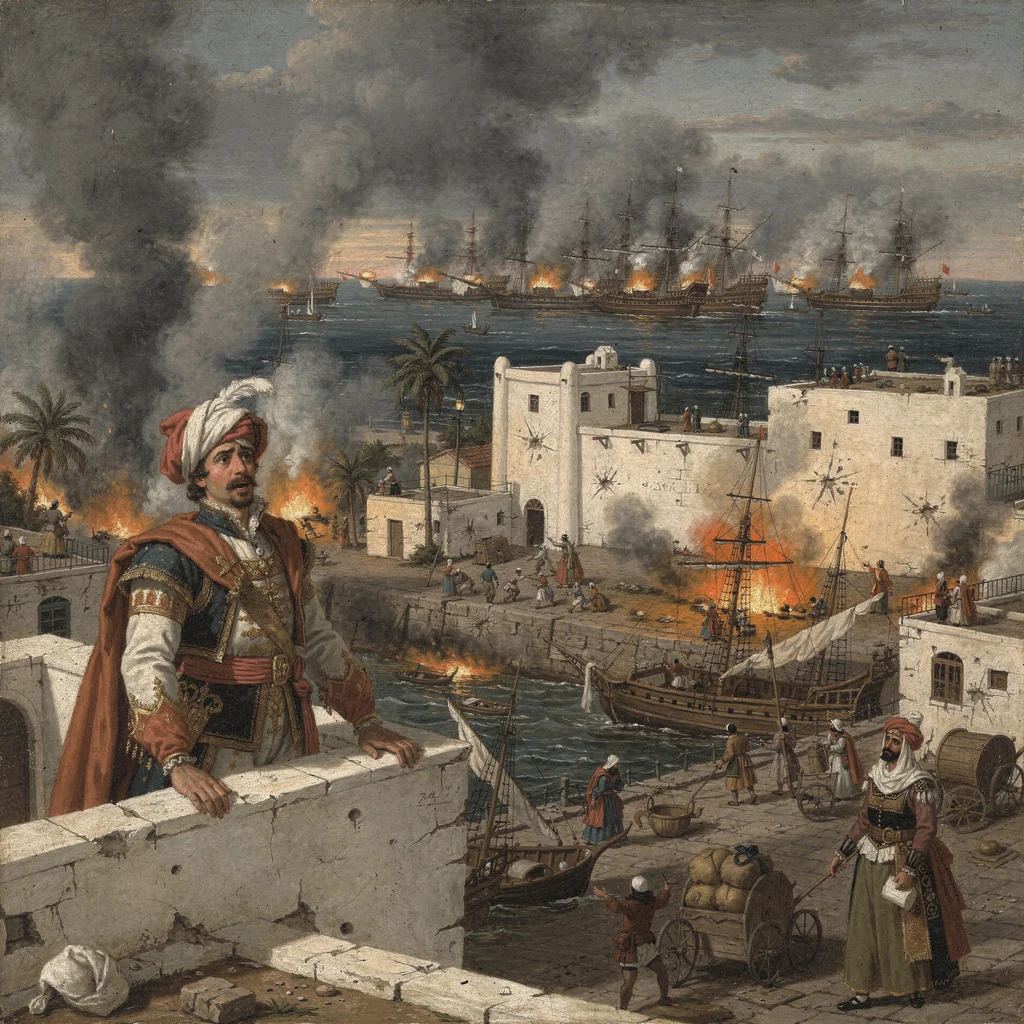
1783. Tunis.
Morning light filtered through the Divan chamber’s high windows, catching dust motes that drifted in shafts of gold. The air smelled of beeswax polish and old stone, of incense burned to mask the scent of too many bodies in too small a space.
The merchants from Sousse stood before the Divan, their silk robes stained with harbor dust.
They were three men — heavy-set, prosperous, worried. Behind them, slaves spread leather-bound ledgers on the marble floor, opening them to pages filled with neat columns of numbers and ink-stained calculations. The leather crackled as the ledgers opened, the sound like dry leaves in autumn.
Ḥammūda sat on the raised throne, its cushion embroidered with gold thread that caught the morning sun. The chamber stretched around him — marble floors polished by generations of slippered feet, walls tiled in geometric patterns of blue and white, a ceiling of stucco arabesques that seemed to spiral upward into shadows. Somewhere beyond the thick stone walls, the city of Tunis stirred — the distant cry of a muezzin, the rattle of a cart, the murmur of a million lives that depended on what happened in this room.
He was twenty-four now, one year into his reign. The disc at his throat had warmed to his body.
Youssef stood to his right, silent, watching.
The eldest merchant stepped forward. His name was Faruq al-Susi, a man whose family had traded in the Mediterranean for three generations.
“My lord Bey,” Faruq said. “We bring a grievance that touches all Tunis.”
Ḥammūda nodded. “Speak.”
Faruq opened his hands, gesturing to the ledgers on the floor. “Three ships. The Fatima, the Yusuf, the Amina. All owned by Sousse merchants. All flying Tunisian flags. All carrying Tunisian cargo.”
He paused.
“Two hundred chests of olive oil. Fifty bolts of wool from the interior. Dried figs, dates, almonds — the wealth of our harvest. The goods were loaded onto Venetian ships in the harbor of Sousse. The captains received our cargo. They signed our manifests. They sailed away.”
Faruq’s voice dropped.
“And then they disappeared.”
Ḥammūda was silent. “Disappeared?”
“Our agents in Venice made inquiries,” Faruq said. “The ships never arrived. The captains never reported. The cargo never appeared. Venetian authorities claim the ships were lost at sea — but our captains saw them sailing north under full canvas. The weather was fair. The sea was calm.”
Ḥammūda looked at Youssef. Youssef’s expression did not change, but Ḥammūda sensed the vizier’s attention sharpening.
“The value,” Ḥammūda said.
Faruq named a figure.
Mustapha Khodja, Dey of the army, stepped forward before Ḥammūda could respond. He was a Mamluk of Georgian origin, broad-shouldered, scarred from campaigns against Algerian raiders. His white-streaked beard twitched with suppressed anger.
“Theft,” Mustapha said. “Plain and simple.”
“The Venetians claim the ships were lost at sea,” Faruq said. “They offer no compensation. They admit no fault.”
“Lies,” Mustapha said. “Seize their ships. Hold their merchants. Make them pay.”
Ibrahim El Sahib, the eldest of the beys, moved to intercept. He was a man who remembered the purges of the 1750s, when Ali I Pasha had eliminated the Janissaries. He had been a boy then, but he remembered the bodies hanging from the Bardo gates.
“You would risk Sousse again?” Ibrahim said. “You would invite the destruction you survived in ‘70? Venice has a hundred warships. Tunis has twelve. They will not pay. They will bombard.”
“Let them come,” Mustapha said. “We fight. We win. Or we die trying.”
“Our coastal batteries will die,” Ibrahim said. “Venice has fought the Ottomans to a standstill. Venice has fought the Spanish to a draw. What makes you think Tunis can do what empires cannot? Patience, as the ancients said, is the weapon of the strong.”
The two beys faced each other, hands on their sword belts. The merchants from Sousse watched, frightened. The slaves who had spread the ledgers now knelt on the marble floor, eyes downcast, waiting for the command to flee.
Ḥammūda sat on the throne.
He was twenty-four. One year since his father’s death.
The Mamluks want war, Ḥammūda thought. They want glory. They want the songs that the poets will sing.
The notables want safety. They want their sons to inherit what their fathers built.
Neither asks what serves Tunis.
He thought of his mother’s council — the women who listened where men did not, who heard what the beys forgot. Mariya, the scribe who copied documents in the Divan, had brought word to the harem that morning. The Mamluks were restless, she said. They spoke of war in the coffeehouses.
Ḥammūda stood.
The Divan went still.
“You ask for war,” Ḥammūda said to Mustapha. “You ask me to seize Venetian ships, to hold Venetian merchants, to provoke a war that Tunis cannot win.”
He turned to Ibrahim.
“You ask for submission. You ask me to accept Venetian theft, to swallow Tunisian pride, to let powerful nations take what they please because we are too weak to stop them.”
Ḥammūda looked at the merchants from Sousse. Faruq al-Susi watched him, hope and fear warring in his eyes.
“You ask for war,” Ḥammūda said. “You ask for submission. I ask what serves Tunis.”
He paused. The gold disc warmed against his breastbone.
“The merchants will be paid,” Ḥammūda said. “Tunisian property will be compensated. Venetian dishonesty will be answered.”
Mustapha stepped forward. “My lord Bey — if not war, then how? If not submission, then what?”
“Diplomacy,” Ḥammūda said. “Patience. Persistence.”
“Patience!” Mustapha spat the word. “While Venetians laugh at Tunisian weakness!”
“While Tunis prepares its response,” Ḥammūda said. His voice was quiet, but it carried through the Divan chamber. “I will obtain your reparations, Merchant Faruq. But I will not buy them with Tunisian blood.”
He turned to Youssef.
“Send word to the Venetian envoy. I will receive him in three days. Bring me intelligence on Venetian trade routes. Bring me knowledge of Venetian vulnerabilities. Bring me options that do not begin with Tunisian bodies washing onto Sousse’s beaches.”
Ḥammūda turned back to the merchants.
“Your grievance is heard. Your loss is registered. Return to Sousse. Tell your merchants that Tunis stands with them. Tell them that justice will come — but justice will be bought with wisdom, not with rashness.”
The merchants bowed. Faruq al-Susi looked up at Ḥammūda, and for a moment, the merchant’s eyes held something like relief.
“We obey, my lord Bey,” Faruq said.
They gathered their ledgers. The slaves rolled the parchments and closed the leather bindings. The three men in silk robes stained with harbor dust turned toward the door.
Before they could reach it, the doors burst open.
A man stood in the doorway — not a merchant, not a petitioner. He wore silk that cost more than most Tunisians earned in a lifetime, embroidered with gold thread, rings heavy on every finger. His face was the face of a man who had never been told no by someone who mattered.
Marco Tiepolo, scion of a Venetian family that had sent doges to the council and admirals to the fleet, had arrived unannounced. He had served in Constantinople, in Vienna, in Madrid. He knew how empires worked. He knew who mattered and who did not.
He did not bow.
The merchants from Sousse froze in the doorway, caught between departure and this interruption. They looked from the Venetian envoy to the Bey, uncertain whether to withdraw or witness.
“The Republic of Venice sends greetings,” Tiepolo said, his eyes sweeping past the merchants to fix on Ḥammūda. “We regret the unfortunate loss of three ships in recent months. Storms, they say. Bad weather. The Mediterranean is treacherous.”
Faruq al-Susi turned back. The merchant’s face darkened.
Ḥammūda sat straighter on the throne. The chain of office bit into his neck.
“The merchants were leaving,” Ḥammūda said. “They had presented their grievance. They had heard my response. You interrupt.”
“The Republic of Venice sends greetings,” Tiepolo said again, as if Ḥammūda had not spoken.
“Then greet,” Ḥammūda said. “And speak.”
Tiepolo’s smile was practiced, polite, and utterly devoid of respect.
“The captains who carried your cargo were Venetian,” Tiepolo said. “Private men, contracted by your merchants. Not naval vessels. Not Republic ships. If these private captains chose to… divert their cargo — that is a matter between your merchants and theirs. The Republic cannot be held responsible for every sailor who breaks his contract.”
“You speak boldly for a man who stands in a foreign court,” Ḥammūda said.
“I speak truth,” Tiepolo said. “The captains acted without orders. If they chose to steal Tunisian cargo, that is a matter for the courts — if the captains can be found.”
“And if they cannot be found?” Ḥammūda asked.
“Then the loss is unfortunate,” Tiepolo said. “But Venice cannot pay for what it did not take.”
Faruq al-Susi stepped forward, his hands trembling. “My lord Bey — they lie. Our captains saw them sailing north under full canvas. The weather was fair. The sea was calm.”
Tiepolo glanced at the merchant, then dismissed him. “Storms, they say.”
Mustapha Khodja stepped forward, his hand going to his sword belt. “My lord Bey — shall I remove him?”
“Venice has a hundred warships,” Tiepolo said, his voice casual. “Tunis has twelve. We could bombard your ports into submission. We could destroy your cities. We could demand compensation for the privilege of surrender.”
Ḥammūda did not flinch. He looked at the Venetian envoy, then at the merchants who still stood in the doorway, then at Youssef.
“You could,” Ḥammūda said. “And while your ships bombard our ports, French ships would stop calling at Venetian harbors. The trade that feeds your treasury would cease. Tell me: Can Venice afford to lose France for the sake of Tunisian olive oil?”
Tiepolo stiffened. “France would never…”
“France opposes Algiers,” Ḥammūda said. “Algiers offers us protection — for a price. The price of tribute is the price of vassalage. If we accept Algerian protection, French ships will not distinguish between Venetian and Algerian harbors. You know this. That is why you are here.”
Tiepolo was silent.
From his place beside the throne, Youssef spoke. “The Republic of Venice trades with France. French merchants buy Venetian glass, Venetian silk, Venetian luxury goods. French ships carry Venetian cargo across the Mediterranean. If France decides that Venetian aggression against Tunis threatens French interests — well. Venice would feel the loss.”
Tiepolo turned to Youssef. “You threaten the Republic?”
“I state facts,” Youssef said. “If Tunis accepts Algerian protection, France will respond. Will French ships continue to call at Venetian ports? Will French merchants continue to buy Venetian goods? Or will France decide that Venice has chosen the wrong side?”
Tiepolo’s face had gone still. The practiced smile was gone.
“France would never attack Venice,” he said.
“No,” Youssef said. “France would simply stop trading with you. No French ships in Venetian harbors. No French cargo in Venetian holds. The loss would be… significant.”
“Significant,” Tiepolo said. “Yes.”
Ḥammūda leaned forward on the throne.
“So you see my position,” Ḥammūda said. “If I fight Venice, I lose ships I cannot replace. If I surrender, I lose sovereignty I cannot regain. But if I accept Algerian protection — well. Venice loses France. And France loses a market that Algiers would close.”
Tiepolo’s jaw tightened.
“The Bey drives a hard bargain,” he said.
“I drive no bargain,” Ḥammūda said. “I state facts. Tunisian merchants lost their goods. Venetian ships disappeared. Venice denies responsibility. But Venice depends on French trade. And France opposes Algerian expansion.”
Ḥammūda stood.
“Return to Venice,” he said. “Tell your council what I have said. Tell them that Tunis seeks friendship with all nations — but that Tunis will not be preyed upon. Tell them that if Venetian ships ‘disappear’ with Tunisian cargo again, I will not wait three years for justice.”
“Three years?” Tiepolo said.
“Or however long it takes,” Ḥammūda said. “I am twenty-four. I have time.”
Tiepolo bowed. This time, the bow was deeper.
“I will convey your message to the council,” Tiepolo said.
“See that you do,” Ḥammūda said.
The Venetian envoy withdrew in a flutter of silk and suppressed anger.
Faruq al-Susi still stood in the doorway, his face transformed by what he had witnessed. The grievance was the same. The man who had brought it was not.
Ḥammūda nodded to him. No more words were needed. Faruq bowed — deeply this time — and withdrew with his companions.
Mustapha Khodja remained. Ibrahim El Sahib remained. Eighteen Mamluk beys stood in a semicircle, watching Ḥammūda.
They wanted a decision. Ḥammūda had given them a process — and a confrontation.
“Young Bey,” Mustapha said. “The Mamluks grow restless. The soldiers wait for glory. If you will not give them war with Venice, they will find another enemy. Or they will become one.”
“Let them wait,” Ḥammūda said. “Let them learn that glory is cheap, and survival is expensive.”
He turned from the throne and walked from the Divan. Youssef followed.
1785. Bardo Palace.
The harem was alive with preparation.
Ḥammūda stood at the lattice gate, watching the women work. Slaves moved through the courtyards with bolts of silk and baskets of jasmine. Eunuchs guarded the doorways, their faces impassive, their hands resting on the hilts of curved knives.
His mother approached, her steps soft on the stone floor.
“You are nervous,” Fatima said.
Three years on the throne. He had faced Venetian envoys, Algerian threats, Mamluk demands. But this was different.
“She is from the notables,” Ḥammūda said. “From Sousse. Her father is one of the merchants who lost his ships.”
“A strategic match,” Fatima said. “A message to the commercial class. Their daughter will be Bey. Their grandchildren will rule.”
“This is marriage,” Ḥammūda said. “Not politics.”
Fatima laughed. It was a dry sound, like leaves rustling. “My son. In this palace, marriage is always politics. Your father married me because my father was a notable of Tunis. Your grandfather married a Cretan woman because her father brought military knowledge. Every marriage in the Husaynid line is a bridge between factions.”
She touched his arm.
“But that does not mean it cannot be more,” she said. “Your father loved me. In his way. And I loved him.”
“Did you?”
“We made a life together,” Fatima said. “We raised children. We buried them. We ruled a state. Love is… complicated.”
The call to prayer echoed from the mosques of Tunis. The evening prayer, maghreb. The sun was setting.
“It is time,” Fatima said.
Ḥammūda followed his mother into the harem. The women’s quarters were decorated with tapestries and hangings, with bowls of rosewater and platters of sweetmeats. In the center of the courtyard, beneath the orange trees, stood the bride.
Aisha bint Faruq al-Susi.
She was eighteen years old, the daughter of the merchant whose ships had been stolen by Venice. She wore a dress of white silk embroidered with gold thread. Her hair was covered with a veil of delicate lace. Her eyes were downcast.
Ḥammūda approached her. The court watched — eunuchs and slaves, female relatives and servants, all of them measuring this moment, this union, this bridge between factions.
“Aisha,” Ḥammūda said.
She looked up. Her eyes were dark, like the olives that grew in the groves of Cap Bon. Her face was grave, but not afraid.
“My lord Bey,” she said.
“Ḥammūda,” he said. “In this room, I am Ḥammūda.”
She nodded. “Ḥammūda.”
He took her hand. Her fingers were warm, her palm soft. She had known a life of comfort — the daughter of a wealthy merchant, raised in silk and educated by tutors. She knew how to read. She knew how to calculate accounts. She knew how to manage a household.
She would need all of these skills.
“My father sends greetings,” Aisha said. “He sends gratitude for the honor you do our family.”
“Your father has lost much,” Ḥammūda said. “Tunis will make it right.”
“Justice,” Aisha said. “My father speaks of justice. My mother speaks of alliances. My aunts speak of children. They all speak as if marriage is a contract.”
“And what do you speak of?”
She looked up at him. For a moment, the gravity of her face cracked, and he saw something else — curiosity, perhaps. Or hope.
“I speak of partnership,” Aisha said. “My father taught me that a merchant cannot succeed alone. He needs partners who are trustworthy. Partners who are loyal. Partners who share the risk and share the reward.”
She squeezed his hand.
“I am that to you,” Aisha said. “Not your subject. Not your property. Your partner in what comes.”
Ḥammūda looked at this young woman — this daughter of Sousse, this merchant’s child, this bridge between factions. He saw something in her face that he had not expected. Her jaw was set. Her shoulders did not bend beneath the weight of silk and ceremony. Her eyes met his without flinching.
“Partners,” Ḥammūda said.
“Yes.”
“Then let us begin.”
The marriage ceremony began. The imam recited the opening chapter of the Quran. The contract was signed. The witnesses testified. The court watched.
When it was done, Ḥammūda led his bride to the marriage chamber. The door closed behind them.
He looked at Aisha. She stood by the bed, her veil removed, her dark eyes watching him.
“You are Bey of Tunis,” she said.
“I am.”
“And I am the daughter of a merchant whose ships were stolen by Venice.”
“Yes.”
“What will you do about Venice?” Aisha asked.
Ḥammūda set down his cup. The question caught him off guard — not from his bride, not on their wedding night.
“I will persist,” Ḥammūda said. “I will wait. I will use the networks that Youssef speaks of — the French connection, the trade routes, the leverage that makes Venice vulnerable.”
Aisha nodded. She sat on the bed, the silk rustling beneath her.
“My father says that persistence is weakness,” she said. “He says that a man who waits is a man who surrenders.”
“Your father is a merchant,” Ḥammūda said. “He knows that some investments take time. Some ships return years after they depart. Some profits cannot be rushed.”
“Then why does he doubt you?”
Ḥammūda considered this.
“Because he has not seen what I have seen,” Ḥammūda said. “He has not seen the maps that Youssef shows me. He has not seen the French ambassador’s letters. He has not seen the networks that connect Venice to France, and France to Algiers, and Algiers to Tunis.”
He sat beside her on the bed. The mattress was soft, stuffed with wool and feathers.
“But he will see,” Ḥammūda said. “Someday, he will see.”
Aisha looked at him. She reached out and took his hand again.
“Then I will wait with you,” she said.
They lay together in the marriage chamber, while beyond the lattice screens, the harem bustled with preparation and celebration, while beyond the palace walls, the city of Tunis slept, while beyond the city, the Mediterranean waited.
1784. Sousse.
The military camp smelled of horses and sweat.
Ḥammūda walked through the rows of tents, his boots sinking into the sandy soil. The camp was located outside Sousse, within sight of the harbor where Venetian ships rode at anchor. Soldiers watched him pass — Mamluks in silk armor, Tunisian cavalry in wool caftans, tribal irregulars in desert robes.
Mustapha Khodja’s tent was larger than the others, but not by much. The Dey of the army did not indulge in luxury at the front.
Ḥammūda entered.
Mustapha was bent over a map table, studying the coastal defenses of Sousse. He looked up as Ḥammūda entered, and for a moment, the Dey’s face showed surprise. Then he straightened and bowed.
“My lord Bey. I had not expected you.”
Ḥammūda looked around the tent. Weapons hung on the canvas walls — scimitars, muskets, pistols. A bedroll lay in the corner, neatly rolled. A small brazier provided heat against the evening chill.
“You asked for command of the coastal defenses,” Ḥammūda said. “I wished to see how you prepared.”
Mustapha gestured to the map table. “Sousse’s harbor is vulnerable from the south. The Venetians have longer range than our coastal batteries. If they bombard, they can stand beyond our reach.”
“And your solution?”
Mustapha pointed to a location on the map — a hill overlooking the southern approach to the harbor.
“I will position mobile batteries here,” Mustapha said. “We will drag cannon up the hill at night. The Venetians will not know they are there until they open fire.”
Ḥammūda studied the map. He was twenty-five now, two years into his reign. He had learned much about war in those two years — most of it from men like Mustapha.
“You have fought Algerians before,” Ḥammūda said.
“Yes.” Mustapha’s hand went to his beard, to the white streak where an Algerian saber had come too close. “The Algerians fight with courage. They fight with skill. But they fight for plunder. Tunisian soldiers fight for something else.”
“What?”
“For home,” Mustapha said. “The Mamluks were brought to Tunis as slaves. We were given freedom. We were given land. We were given places in the Bey’s guard. We fight for the Bey who freed us. We fight for the homes we have built. We fight for the children we have raised.”
He looked at Ḥammūda.
“The Algerians fight for what they can take. Tunisians fight for what they have made.”
Ḥammūda studied the scarred warrior before him. The Dey was usually all anger and demands, all shouts for war and glory. This was something different.
“Why do you demand war with Venice?” Ḥammūda asked.
Mustapha’s face hardened. “Because Venetian aggression cannot go unanswered. Because if Tunis allows its ships to be stolen, its merchants to be robbed, its people to be humiliated — then Tunis is no longer a state. It is a prey.”
“War with Venice means death,” Ḥammūda said. “For soldiers. For sailors. For civilians in Sousse.”
“I know what war means,” Mustapha said. “I have seen men die. I have seen cities burn. I have seen what happens when a state cannot defend itself.”
He stepped closer to Ḥammūda.
“My lord Bey — I do not seek war for glory. I do not seek war for honor. I seek war because the alternative is surrender. And surrender is worse than death.”
Ḥammūda looked at the Dey of the army. He saw the scars on Mustapha’s face, the white streak in his beard, the lines of experience around his eyes. This was a man who had seen war. This was a man who knew what he asked for.
“You are a good soldier,” Ḥammūda said. “Tunis is fortunate to have you.”
Mustapha’s hand went to his robe, to something hidden beneath. He withdrew it — a crude doll made from scraps of cloth and wood, its face stitched with rough thread.
“My daughter,” Mustapha said. “She is seven. She lives in Constantine with my sister.”
Ḥammūda looked at the doll, then at the scarred warrior who held it.
“The Algerians raided my sister’s village two years ago,” Mustapha said. “They killed her husband. They took everything. My sister brought the girl to me with nothing but this doll.”
He showed Ḥammūda the crude toy, made with love by hands that had known hardship.
“I fight,” Mustapha said, “because I could not protect her. I fight because I never want her to see the smoke of burning cities again. I fight because… because if I am strong enough, perhaps she will be safe.”
Ḥammūda looked at the doll, then at Mustapha. He saw not a warrior’s bloodlust, but a father’s love.
“And if I give you peace instead of war?” Ḥammūda asked. “If I negotiate instead of fight?”
Mustapha was silent for a long moment. He touched the doll’s stitched face.
“Then she will be safe,” Mustapha said. “And I will serve you with honor. But know this, my bey: I will not ask for war for glory. I will only ask for war when it is the only way to protect what matters.”
He tucked the doll back into his robe, next to his heart.
A shout from outside.
Mustapha and Ḥammūda turned simultaneously.
A soldier burst into the tent, his face pale. “My lord Bey! Dey Mustapha! Ships — Venetian ships — they’re moving into position!”
Ḥammūda and Mustapha ran from the tent.
Dawn had broken while they talked. The sea was painted in shades of gray and gold. And on the horizon, Venetian ships were spreading their sails, running out their guns.
“Take cover, my lord Bey!” Mustapha shouted.
The first cannonball struck before Ḥammūda could move.
It smashed into a warehouse at the harbor’s edge. Stone shattered. The building collapsed. Dust rose in a great cloud.
Then came the sound — a roar that shook the ground beneath Ḥammūda’s boots.
Fire on the water.
Ḥammūda had never seen war.
He had heard descriptions of war. He had studied military maps. He had listened to Mamluk beys boast of campaigns and tribal chiefs recount battles. But he had never seen cannonballs smash through stone walls. He had never watched buildings collapse while the sun rose.
The bombardment continued.
Ḥammūda stood frozen as the second shell struck the harbor district. A fountain of stone and dust erupted. Through the haze, he saw people running — men carrying wounded children, women dragging possessions from ruined homes, old men stumbling through the rubble.
The smell hit him then. Smoke. Burning wood. Burning wool.
He gripped the tent pole. His knuckles turned white.
Mustapha was at his side in moments. “My lord Bey, we must take shelter!”
Ḥammūda shook his head. He watched the destruction unfold.
A third shell struck closer — not the warehouses this time, but the residential quarter beyond. The sound was different this time: a sharper crack, then screams.
Ḥammūda moved before he knew he had moved. His legs carried him down the sandy path toward the smoke, toward the screams. Mustapha shouted behind him, but Ḥammūda did not stop.
He turned a corner into a street of narrow houses whitewashed and bright. Now one of them was gone — collapsed into rubble and dust. The smell hit him: burning wool, burning hair, the copper scent of blood.
A woman knelt in the rubble, pulling at stones with her bare hands. Her fingers bled. She made no sound, only pulled and pulled at the debris.
Ḥammūda ran to her. He fell to his knees beside her. Together they dug.
Beneath the broken beams and shattered stones, they found a child — a girl perhaps six years old, her hair still braided with ribbons, her dress torn but clean. Her face was peaceful, as if she had been sleeping when the ceiling came down.
The woman screamed — a sound that started in her chest and tore its way out, tearing the air, tearing Ḥammūda’s chest. She gathered the child into her arms, rocking back and forth, pressing the small face against her chest as if she could breathe life back into those still lungs.
Ḥammūda knelt in the dust of the collapsed house. The smell of burning wool filled his nose. The taste of ash coated his throat. He saw the child’s peaceful face, the mother’s broken hands, the red ribbons in the dark hair.
This was not a merchant’s warehouse. This was not a strategic target. This was a house where a family had slept. This was a street where children had played.
The Venetians had not aimed at this house. But the shell had fallen here anyway. The stone had crushed these walls anyway. The child had died anyway.
Ḥammūda looked up. Other houses stood untouched along the street — white walls, blue doors, flowers in clay pots. Somewhere in those houses, other families huddled. Somewhere, other children listened.
He saw the cost of what he had chosen. Not in abstract terms of lost revenue or damaged warehouses. But in the small crushed form of a child who would never grow old. In the broken hands of a mother who would never stop digging.
The woman screamed again, a sound of animal grief that Ḥammūda felt in his own chest, in his own throat, in the hands that had signed the orders that had brought these ships to these waters.
He stood. His legs were unsteady. His heart pounded against his ribs.
He walked back toward the camp, toward the tents and the soldiers, toward the maps and the strategies. But the taste of ash remained in his throat. The smell of burning wool remained in his nose. The image of the child’s peaceful face remained burned into his vision.
A merchant from Sousse — a man named Hassan, whose shop had been destroyed in the first wave — stumbled toward them. Hassan’s face was blackened with soot. His clothes were torn. Blood ran from a cut on his forehead.
“My son,” Hassan said to Ḥammūda. “He was in the warehouse. He is gone.”
Ḥammūda had no words.
“The Venetians,” Hassan said. “They call this war. They call this collecting debts. But this…” He gestured to the burning harbor. “This is murder.”
Ḥammūda looked at the smoke rising from Sousse. He saw the faces of the people — fear, grief, rage. He saw the cost of his decision to persist.
“I did not know what war looked like,” Ḥammūda said. “I did not know what this would cost.”
Hassan’s face crumpled. When he spoke, grief scraped his voice raw.
“Now you know,” Hassan said. “Now you must choose.”
Mustapha stepped forward. “My lord Bey — give me the order. Let me lead the Mamluks against the Venetian landing parties. Let me make them pay for this.”
Ḥammūda looked at the harbor. Venetian ships were landing troops — small boats filled with soldiers, coming ashore to secure the bombardment’s gains.
“If you attack,” Ḥammūda said, “they will bring more ships. They will bring more cannon. They will destroy Sousse completely.”
“If we do not attack,” Mustapha said, “they will destroy Sousse anyway. Piece by piece. Shell by shell.”
Ibrahim El Sahib joined them, having emerged from his quarters nearby. The eldest bey had seen war before — he remembered the purges of the 1750s, the bodies hanging from the Bardo gates.
“My lord Bey,” Ibrahim said. “Surrender. Accept their terms. Pay what they ask. Save what remains of the city.”
Ḥammūda looked from one to the next.
Mustapha wanted war. Ibrahim wanted surrender. The people of Sousse wanted revenge.
And Ḥammūda wanted none of it.
“Return fire,” Ḥammūda said. “Do not surrender. Do not escalate. Hold.”
He walked toward the city, leaving the beys to stare at his back, leaving the merchant to mourn his son, leaving the burning harbor to its destruction.
In his private chambers that night, Ḥammūda sat alone.
He had never seen war before that morning.
The screams from the streets below continued through the night. The smell of burning drifted through the window.
Youssef entered the chamber. His face was lined with years of service.
“You saw the city,” Youssef said.
“I saw it,” Ḥammūda said.
“You saw the cost,” Youssef said.
“I saw it,” Ḥammūda said again.
“And do you still believe in patience?” Youssef asked.
Ḥammūda’s throat worked. Then he spoke.
“Patience is not easy,” Ḥammūda said. “The alternative is surrender.”
He looked at Youssef.
“And surrender is worse than burning.”
Youssef nodded. He understood.
“This way of governing,” Youssef said. “It is not easy. It is not cheap. It is not bloodless.”
“But it works,” Ḥammūda said.
“Does it?” Youssef asked.
Ḥammūda did not answer. He looked out the window at the burning city. Smoke rose from the harbor. Flames licked the warehouse roofs. Families huddled in the rubble, their faces scarred, their homes gone.
1787. Bardo Palace.
Ḥammūda stood at the lattice gate, listening.
“Three years of bombardments,” his mother Fatima said. “Three years of waiting.”
“My father’s ships are gone,” Aisha’s voice rose. “The warehouses are empty. The creditors demand payment.”
“Patience!” Aisha’s voice cracked. “Patience has cost him everything.”
Ḥammūda pushed open the cedar door and entered the courtyard. “The French ambassador sends word that Paris is losing patience with Venetian aggression. The balance shifts.”
He took her hands. “I need you to trust me.”
“I trust you,” Aisha said. “But my father cannot wait.”
“He sold the grove,” Aisha said. “The grove at Korbous. The trees my grandmother planted.”
Ḥammūda closed his eyes. He knew the grove — ancient trees on the slopes of Cap Bon, olives that had fed the family for generations.
“The oldest were planted before the French came to Algeria,” Aisha said. “My grandmother’s grandmother planted them with her own hands. I climbed those trees as a child. She said the trees were family. She said: What you plant, you tend. What you tend, loves you back.”
Tears spilled from her eyes. “Now a stranger owns the trees my grandmother watered. My father says justice will come. But the trees are gone. And the trees were justice.”
Ḥammūda had no answer. He stood in the courtyard, the scent of orange blossoms thick around him, and felt the weight of what patience cost.
1788. Tunis.
The French ambassador’s message came by private courier.
“Paris is losing patience,” Count de Villeneuve said in the small room off the Divan chamber. “The Venetians disregard our protests. They ignore our trade concerns. But you… you offer something France needs.”
Ḥammūda sat still. “And what is that?”
“An independent Tunis,” Villeneuve said. “A Tunis that trades freely, that protects French shipping, that serves as a buffer against Algiers. An independent Tunis serves French interests better than Algerian vassalage.”
“Diplomatic pressure on Venice?” Ḥammūda asked.
“Naval demonstrations against Algiers,” Villeneuve said. “Trade access. Most-favored-nation status.”
“In exchange for Tunisian ports open to French merchants,” Ḥammūda said.
Villeneuve smiled. “We have an agreement — if you can hold out until we are ready to move.”
Ḥammūda nodded. He could hold out. He had learned patience in the bombardments of Sousse. He had learned that waiting was not surrender.
“I will hold,” Ḥammūda said.
1788. Off Algiers.
The French squadron appeared off Algiers in June.
Seventeen ships of the line. Frigates. Transports. The French navy had come to demonstrate what happened when Algiers threatened French shipping in the Mediterranean.
The Algerian Dey watched from the ramparts of Algiers as the French fleet sailed past. He did not fire. He did not challenge. He watched.
In Tunis, Ḥammūda received the report.
“The Dey has seen the French fleet,” Youssef said. “He has seen what happens when Algiers threatens French trade.”
“Will he withdraw his offer of protection?” Ḥammūda asked.
“He will reconsider,” Youssef said. “The balance shifts.”
Ḥammūda looked toward the east, toward Algiers, toward the power that had humiliated Tunis for thirty-one years. The tribute was not yet ended. But the balance was shifting.
“The Algerians will not forgive this,” Ḥammūda said.
“Let them remember,” Youssef said.
The years passed.
In 1788, the French ambassador wrote to Paris. Tunis offered trade access. Algiers threatened French ships. Paris dispatched a fleet.
In 1789, the French minister in Venice protested aggression. Venice depended on French trade. Venetian merchants worried.
In 1790, a French squadron sailed past Algiers. The Dey received the message.
In 1791, Venice requested negotiations. Algiers withdrew its offer of protection.
March 1792. Tunis.
The news came in March.
Ḥammūda sat in the council chamber, reading the dispatch. Youssef stood at his side. Outside, the spring rain fell on the palace roofs.
“Angelo Emo is dead,” Ḥammūda said.
Youssef nodded. He had read the dispatch already.
“Died in Malta,” Ḥammūda continued. “March first. After a long illness.”
“Eight years,” Youssef said. “Eight years of bombardments. Eight years of rafts and mortars and firework-like nights. And now he dies before seeing the end.”
Ḥammūda set down the dispatch. He was thirty-three now. Nine years had passed since the merchants from Sousse had spread their ledgers on the Divan floor. Nine years of bombardments and persistence and diplomatic maneuvering.
“What happens now?” Ḥammūda asked.
“The Venetian Senate has appointed a new commander,” Youssef said. “Tommaso Condulmer. A man of… different temperament.”
“Different how?”
“Less aggressive,” Youssef said. “More inclined to diplomacy. The Senate feared Emo’s nature. They feared that his aggression would prevent peace.”
Ḥammūda nodded. He understood this. Angelo Emo had been the Sword of the Republic — the man who never lost, never retreated, never surrendered. But against Tunis, he had found an enemy he could not defeat. And it had broken him.
“So peace is possible now,” Ḥammūda said.
“It is,” Youssef agreed.
“The wolf is dead,” Ḥammūda said.
Youssef nodded once.
The door opened. Mahmoud entered.
Ḥammūda’s cousin was forty-five now. His hair had grayed at the temples. His face had lined with age. But his eyes were the same — dark, watchful, waiting.
“You have heard?” Mahmoud asked.
“Emo is dead,” Ḥammūda said.
“Dead,” Mahmoud said. He walked to the window, looking out at the rain. “The wolf is dead. The flock can breathe.”
He turned back to Ḥammūda. There was something in his face — cynicism, perhaps. Or maybe just exhaustion.
“You wanted war,” Ḥammūda said to Mahmoud. “You wanted glory. You wanted the honor of leading men into battle. Did you find it?”
“I found eight years of burned harbors and sunken ships,” Mahmoud said. “I found eight years of bombardments and negotiations and stalemate. I found that war is not glory. War is just… expensive.”
“Expensive in lives,” Ḥammūda said.
“Expensive in everything,” Mahmoud said. “Gold, ships, men, time. And for what? Venice could not defeat us. We could not defeat Venice. Eight years, and nothing changed.”
“Something changed,” Ḥammūda said.
“What?”
“Venice learned that Tunis would not surrender,” Ḥammūda said. “And Tunis learned that Venice could not be forced to pay. Both sides learned the limits of power. That is something.”
Mahmoud’s gaze did not waver from his cousin’s face.
“You are thirty-three,” Mahmoud said. “I am forty-five. Twelve years ago, you took the throne that should have been mine. Twelve years ago, you promised that we would rule together.”
“We have ruled together,” Ḥammūda said.
“I have waited,” Mahmoud said. “I have advised. I have watched. And I have learned.”
“Learned what?”
“That patience works,” Mahmoud said. “I did not believe it. I thought patience was weakness. I thought that a ruler who would not fight was a ruler who would not lead. But I was wrong.”
He paused. His chin lifted.
“In the years of waiting, I have built something. My sons — Hussein and Mohamed — they are twenty now. I have trained them myself. They know statecraft. They know command. They are ready.”
Ḥammūda’s fingers found the seal at his throat. He had not expected this from Mahmoud — not after twelve years of waiting, not after eight years of war.
“You gave me a choice,” Mahmoud said. “Rule together, or wait for the throne to age. I chose to wait. I thought the throne would age quickly. I thought you would fail. I thought the Mamluks would demand a warrior, and the notables would demand a strongman, and the people would demand a savior.”
He paused.
“Instead,” Mahmoud said, “they got you. And they got patience. And they got endurance. And somehow, it worked.”
“Somehow,” Ḥammūda agreed.
“The throne does not age,” Mahmoud said. “But the man who sits on it does. You are thirty-three. I am forty-five. How long will you rule, Cousin? How long until the throne becomes mine?”
Ḥammūda looked at his cousin. Mahmoud had waited twelve years. He had watched while Ḥammūda faced Venetian bombardments, Algerian threats, Mamluk demands, notable petitions. He had waited while Ḥammūda chose patience over war, persistence over glory, endurance over conquest.
And he was still waiting.
“Tunis is not mine to give,” Ḥammūda said. “Serve Tunis. Make yourself indispensable. Service to Tunis does not care about blood.”
“The people endure,” Mahmoud said. “And you rule. And I wait.”
“Then wait,” Ḥammūda said. “Or do not wait. Build something. Serve Tunis. Make yourself useful. Make yourself necessary.”
“I have tried,” Mahmoud said. “But you are the Bey. And I am only the cousin.”
“You are the dean of the family,” Ḥammūda said. “You are the eldest. You are the advisor. You have power, Mahmoud. Use it.”
Mahmoud was silent. He looked at Ḥammūda, and for a moment, Ḥammūda saw something in his cousin’s eyes — not hatred, not resentment, but something more complicated.
“I will wait,” Mahmoud said. A smile touched his lips. The smile did not reach his eyes.
He bowed — slightly, the bow of an equal to an equal, not a subject to a ruler.
Then Mahmoud walked from the room, his boots echoing on the marble floors, his figure disappearing through the cedar doors.
Ḥammūda watched his cousin go. Something had changed in Mahmoud’s stillness. Something in the way he spoke of sons and succession and what endures.
Ḥammūda could not name it.
He did not tell Youssef.
1792. Bardo Palace.
The Venetian envoy stood before Ḥammūda’s throne.
He was not Marco Tiepolo, the arrogant envoy of 1783. This was a new man — younger, humbler, wearing silk that was expensive but not ostentatious. His name was Andrea Contarini, and he carried the weight of a republic that had learned its mistake.
“The Republic of Venice regrets the misunderstandings of recent years,” Contarini said. “We offer 40,000 sequins in compensation for Tunisian losses. We offer rich gifts for the Bey’s court. We offer renewed friendship and trade.”
Ḥammūda sat on the throne. The gold sequins on the Divan table caught the light from the high windows.
“And the bombardments?” Ḥammūda asked.
“A tragic error,” Contarini said. “Which will not be repeated.”
“And our merchants’ goods?”
“Will be compensated. In full.”
Ḥammūda looked at the Mamluks, the notables, the tribal chiefs who filled the Divan. They watched him, waiting. Mustapha Khodja stood among the Mamluks, his beard now white, his face scarred by eight years of defending the coast. Ibrahim El Sahib stood among the notables, his face lined by age, his eyes sharp with wisdom.
“You asked for war,” Ḥammūda said to the room. “You asked for submission. I chose persistence. The merchants will be paid. The treasury will be enriched. Tunisian autonomy will be preserved.”
He turned back to Contarini.
“Your offer is accepted,” Ḥammūda said. “But know this: If Venetian ships ‘disappear’ with Tunisian cargo again, we will not wait nine years for justice.”
Contarini bowed. Deep and sincere.
“The Republic understands,” Contarini said.
The Venetian envoy withdrew. The Divan emptied until only Ḥammūda and Youssef remained.
“Forty thousand sequins,” Ḥammūda said.
“Plus the gifts,” Youssef said.
“It’s enough?”
“It’s enough to fund the institutions,” Youssef said. “The waqf. The academy. The navy. The fortresses. The things that survive when men die.”
Ḥammūda nodded. He stood from the throne and walked to the window of Bardo Palace. The Mediterranean stretched before him, blue and endless.
Nine years ago, he had watched Venetian ships on the horizon, waiting for war. Today, he watched Venetian ships departing peacefully.
“We did not defeat Venice,” Ḥammūda said. “We outlasted them.”
Youssef picked up the dispatch from Malta that had been waiting on the desk.
He thought of Angelo Emo — the admiral who had spent thirty-eight years winning, only to spend his final eight years failing against a Beylik that would not surrender. Emo had died in Malta, frustrated and exhausted, never knowing that his death would enable the peace he had fought to prevent.
“Emo wanted surrender,” Ḥammūda said. “He thought that if he bombed our cities enough, if he destroyed our warehouses enough, if he killed enough of our people — we would surrender.”
“He was wrong,” Youssef said.
“Not entirely,” Ḥammūda said. “He understood that power matters. He understood that force is real. He understood that bombs break things.”
He paused.
“What he did not understand,” Ḥammūda said, “is that some things cannot be broken by bombs. Some things cannot be destroyed by force. Some things can only be broken by surrender.”
“And Tunis did not surrender,” Youssef said.
“No,” Ḥammūda said. “Tunis did not surrender.”
The seal around his neck was no longer cold. It was the weight it had always been — gold against his chest, heavy and solid.
Youssef nodded and picked up the treaty document to seal.
Ḥammūda looked at Youssef. The forests of his childhood had burned, but in Tunis, he had built something different.
“What’s next?” Ḥammūda asked.
“The institutions,” Youssef said. “The systems. The structures that survive when we are gone. We have nine years and forty thousand sequins. Let us build wisely.”
Ḥammūda nodded. He turned from the window. The sun had risen. The day had begun.
On the horizon, Venetian ships departed. Their sails caught the morning light, white against blue, shrinking as they carried the treaty and the gifts and the apologies back to the republic that had learned — after nine years — that Tunis would not surrender.
He walked to the door, then stopped. He looked back at Youssef.
“Did we win?” Ḥammūda asked.
Youssef considered. “We did not lose.”
“Is that winning?”
“It is when losing was the only alternative,” Youssef said.
Ḥammūda nodded. He walked from the room, leaving Youssef by the window, watching the Venetian ships depart.
The ships grew smaller on the horizon. The Mediterranean stretched blue and endless. The trees on the hills beyond Bardo Palace swayed in the breeze.
The olive branches moved in the evening wind.