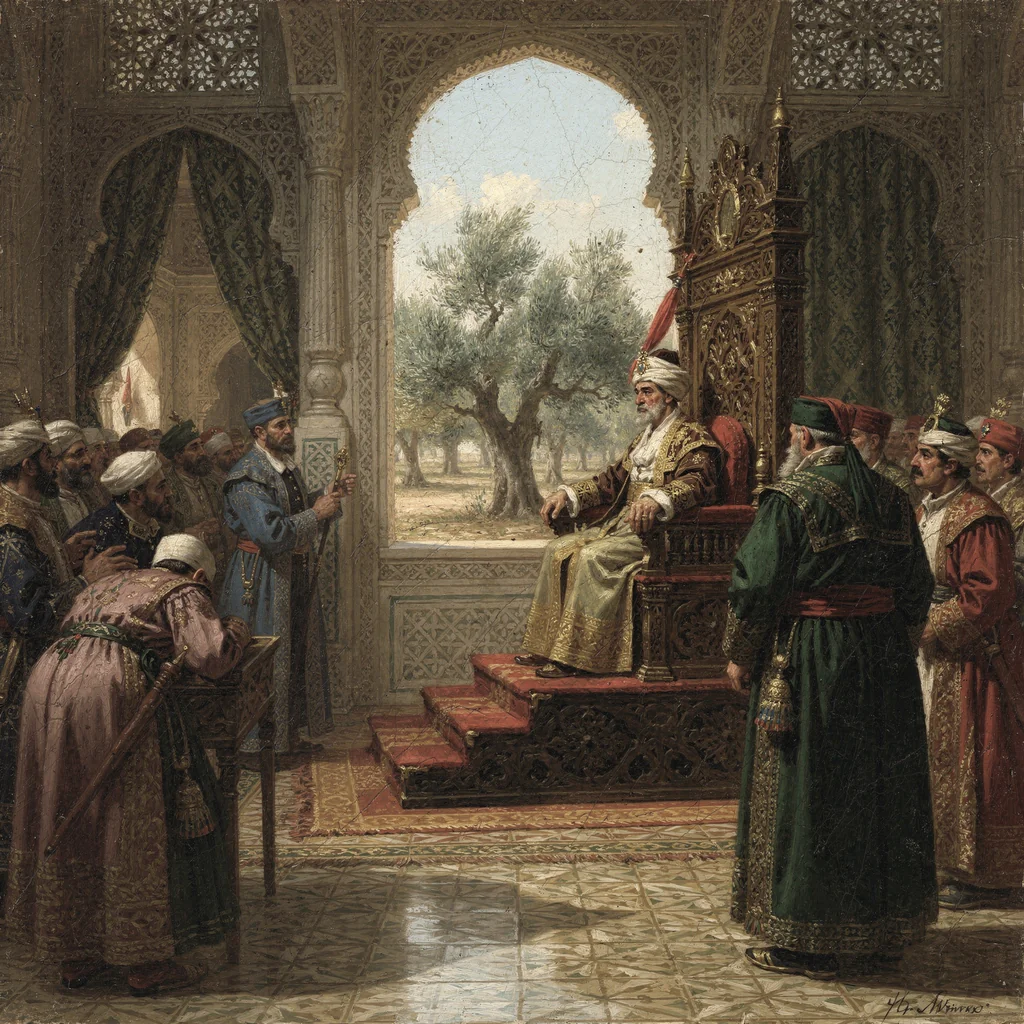
Ḥammūda walked through the gardens of Bardo Palace.
He was fifty-three now. Thirty years had passed since his father’s death.
The Andalusian olive saplings he had planted in 1796 were no longer saplings. They were young trees now, their trunks thickening, their branches spreading shade. Sixteen years of growth. Sixteen years of deepening roots.
He touched the bark of one tree. Rough. Alive. Independent.
The tree no longer needed him. It had roots of its own.
In the palace courtyard, the Janissaries stood at their posts. They did not threaten. They did not demand. They served like other soldiers, paid like other subjects.
Hamida Ghammed awaited him in the council chamber. The cheikh el medina was sixty-one now. His face had lined.
“The medina prospers,” Hamida said. “The merchants who armed themselves against the Janissaries have returned to their trade. The workshops are full. The souks are crowded. The city remembers, my bey.”
Ḥammūda nodded. “And the Janissaries?”
“Confined to their barracks,” Hamida said. “Their weapons stored. Their special privileges revoked. They grumble, but they do not revolt.”
“The strategy succeeded,” Ḥammūda repeated.
He had heard these words before. From Youssef. From the notables. From the merchants. From the city itself.
But something nagged at him.
Later that morning, he visited the madrasa funded by the waqf endowment. Students bent over texts, their voices rising in recitation. No swords here. No drums. Only the scratch of reed pens and the murmur of memorization.
The shaykh of the madrasa approached. He was seventy, a scholar who had studied in Al-Azhar before returning to Tunis.
“The waqf provides,” the shaykh said. “The students learn. The knowledge continues. When we are gone, others will teach. When they are gone, others will learn. The waqf does not die with men.”
Ḥammūda looked at the students. Young men. Boys, really. They would outlive him. They would teach others. The knowledge would continue.
Youssef found him in the gardens, standing beside the olive trees. His face was lined with decades of service. He walked with a slight stoop, but his eyes were still sharp.
“The treasury is stable,” Youssef said. “The institutions function. The system endures.”
Ḥammūda looked at the olive tree he had planted sixteen years ago.
“How long?” Ḥammūda asked.
Youssef was silent. “How long what, my bey?”
“How long do the trees stand without the planter?”
Youssef understood. He stood beside Ḥammūda, both men looking at the trees that had grown tall in the years since planting.
“The trees do not need the planter,” Youssef said. “They need rain. They need sun. They need soil. The planter is gone, but the trees remain.”
“The trees,” Ḥammūda said. “Yes.”
But he was thinking of something else. He was thinking of men who were not trees. He was thinking of institutions that needed men who understood them. He was thinking of a successor he did not have.
The harem was quiet.
Ḥammūda sat by the brazier, watching the flames dance. He was fifty-four now. The pain in his chest had returned — a dull ache that sharpened with exertion, with cold, with stress. The physicians worried. They prescribed rest. They prescribed herbs. They prescribed prayers.
Aisha sat beside him, mending a tunic for Princess Fatima, now sixteen. Her hair was streaked with gray. Her face had lined. Her eyes were sharp, her hands steady.
“The physicians say you must rest,” Aisha said. She did not look up from her mending.
“I have rested enough,” Ḥammūda said. “The institutions are built. The Janissaries are defeated. The Algerians are subdued. What remains?”
Aisha set down the tunic. She looked at her husband — the man she had married at eighteen, the Bey she had served for twenty-eight years.
“Time remains,” Aisha said.
Ḥammūda was silent.
“You are fading,” Aisha said. “Day by day. I see it. The physicians see it. The court sees it, though they do not speak of it.”
“I am fifty-four,” Ḥammūda said. “My father died at forty-nine. I have already lived longer than he.”
“Your father was assassinated,” Aisha said. “You are being… worn away. By the duty. By the worry. By the weight of thirty years.”
Ḥammūda looked at the brazier. The flames danced, consuming the charcoal, casting shadows on the walls.
“This way of governing is not a burden,” Ḥammūda said. “It is what I built. It is what I will leave behind.”
Aisha reached across the space between them and took his hand. Her hand was warm, her touch gentle.
“What will you leave behind?” Aisha asked. “Institutions? Waqf? Madrasas? These are paper and stone, my husband. They are not family. They are not love.”
“The institutions serve Tunis,” Ḥammūda said.
“They serve Tunis,” Aisha agreed. “But who serves you? Who mourns you? When you are gone, who remembers the man, not the Bey?”
Ḥammūda was silent. He had no answer.
“You have no son,” Aisha said. “Mohamed is gone. Fatima cannot inherit. When you die, the throne passes to your cousin. The dynasty continues. But your family… your family ends with you.”
She squeezed his hand.
“I will mourn you,” Aisha said. “Fatima will mourn you. The women of the harem will mourn you. But we are not part of your legacy. We are not part of what you built.”
Ḥammūda looked at his wife. She had been his partner for twenty-eight years. She had challenged him. She had supported him. She had buried her only son and found the strength to continue.
“You are part of everything,” Ḥammūda said.
“Then show me,” Aisha said. “Not the institutions. Not the waqf. Not the councils. Show me… us. Show me our life. Before the end.”
She paused. She looked at her husband — the Bey who had ruled Tunis for thirty years, the man who had built institutions and balanced factions, the father of her only son, now dead.
“The institutions will not mourn you, Ḥammūda.”
She did not say this to wound him. She said it because she had been thinking it for years and there was no time left to not say it. Quiet, not angry. Unprompted.
“They will function. They will teach children and heal the sick and train officers. They will continue. And they will not know your name.”
Ḥammūda was silent for a long moment.
Then he said: “Yes.”
Ḥammūda considered this. He had spent thirty years building institutions. He had spent thirty years balancing factions. He had spent thirty years thinking about Tunis.
What had he given to his family?
“What do you want?” Ḥammūda asked.
“Tomorrow,” Aisha said. “Come with me to the souks. Not as the Bey. As my husband. Walk with me. Talk with me. Remember what it was like before the throne, before this burden, before… before everything.”
She paused.
“Remember when we were young,” Aisha said. “When you were just Ḥammūda, the son of Ali Pasha. When I was just Aisha, the daughter of a merchant from Sousse.”
Ḥammūda remembered. He remembered their wedding day in 1785. He remembered the night he told her about the Venetian War, showing her the burning city from the palace window. He remembered the day Mohamed died, and her grief that had no tears.
“I remember,” Ḥammūda said.
“Then come with me tomorrow,” Aisha said. “Let us be young again. For one day. Before the end.”
Ḥammūda squeezed her hand back.
“Yes,” Ḥammūda said. “Tomorrow.”
They sat in silence as the night deepened, husband and wife, Bey and partner, bound by twenty-eight years of marriage, bound by the weight of what they had built, bound by the uncertainty of what remained.
Outside, the branches swayed in the wind.
The mosque rose from Halfaouine like a prayer made of stone.
Italian marble arches caught the morning light, white and luminous against the blue sky. The courtyard fountain whispered water over tiles that had been fired in kilns whose heat still echoed in the memory of the earth. The minaret climbed toward heaven, a finger of white stone pointing toward God.
Youssef Saheb Ettabaa stood at the entrance, welcoming the dignitaries of Tunis.
His face was lined with years of service. His hands trembled slightly, but his bearing was straight, his presence commanding.
“The Bey,” the herald announced.
Ḥammūda Pasha arrived with full procession. The Mamluk beys walked behind him, their silk robes rustling. The notables of Tunis followed, the merchants of Sousse and Sfax, the scholars of Zaytuna. The shaykhs of the religious orders. The commanders of the army. All of Tunis had come to see what Youssef had built.
Youssef bowed — not too deep, not too shallow. The bow of a vizier to his Bey, of a servant to his master, of a man who had given decades to the state.
“Excellence,” Youssef said. “The mosque is ready.”
Ḥammūda looked at the marble arches, the courtyard fountain, the minaret that reached toward heaven. “How much?”
“With olives,” Youssef said. “From Sfax. From trees that were old when the Romans came.”
He walked with Ḥammūda through the courtyard, pointing out the details. “The marble came from Livorno. Italian craftsmen carved the arches. Tunisian masons built the walls. The tiles were fired in kilns at Tunis. The fountain was dug by wells that have watered Halfaouine for centuries.”
“Abundance transformed,” Ḥammūda said.
“Abundance claimed,” Youssef corrected. “The olives grew in Sfax. They were harvested by men I knew. They were pressed into oil. They were shipped to Livorno. The Italians paid in marble. The marble returned to Tunis. The mosque rose from the wealth of our own land.”
They reached the mihrab — the prayer niche that indicated the direction of Mecca. It was inlaid with tiles of blue and white, geometric patterns that echoed the Alhambra, the Great Mosque of Córdoba, the architecture of a civilization that had once ruled half the world.
Youssef touched the tiles. “My father was a priest in Moldavia. He would not recognize this. He would not recognize me.”
“He would recognize a man of faith,” Ḥammūda said.
“He would recognize a man who built,” Youssef said. “He would not recognize the Moldavian slave who became the most powerful vizier in Tunis.”
Ḥammūda looked at his vizier — the man who had served him for thirty-three years, the man who had transformed the regency, the man who had ended tribute, built monuments, and balanced the factions with such skill that the purges never came.
“All Tunis is here,” Ḥammūda said. “The beys. The notables. The merchants. The scholars. They have come to see your mosque.”
“They have come to see what olives can build,” Youssef said.
“They have come to see you,” Ḥammūda said.
The call to prayer echoed from the minaret — Allahu akbar. Allahu akbar. God is great.
The courtyard fell silent. The dignitaries formed rows for prayer. Ḥammūda stood in the front row, as was his right as Bey. Youssef stood beside him, as was his right as vizier.
Together they prayed — Bey and vizier, Tunisian and Moldavian, master and slave, ruler and servant. All equal before God.
When the prayer ended, Ḥammūda turned to Youssef.
“The balance held,” Ḥammūda said softly. “Look at what you built.”
Youssef looked at the marble arches, the courtyard fountain, the faces of the notables who had come to honor him. He saw the respect in their eyes. He saw the acknowledgment of what he had achieved.
This was the ultimate consecration of his status. All the dignitaries were present — the Bey, the beys, the notables, the merchants, the scholars. All of Tunis had come to witness what the Moldavian slave had built.
“Effendi,” Youssef said, “the buildings outlast the architect.”
He looked at Ḥammūda, and something passed between them — a recognition of mortality, a knowledge that this moment was the peak before the fall. Both men were old now. Both were fading. The mosque would endure when they were gone.
“But,” Youssef said, “for now — the planter still stands. The architect still builds. And the trees… the trees grow strong.”
They walked from the mosque together, surrounded by the dignitaries of Tunis, surrounded by the marble arches that Italian craftsmen had carved, surrounded by the fountain that whispered water like the breath of God.
The olive trees in the courtyard swayed in the breeze. They were young trees, newly planted, their roots still shallow, their branches still thin.
But they were standing.
The report lay on Ḥammūda’s desk.
Sunlight poured through the council chamber’s windows, harsh and unforgiving, illuminating dust motes that swirled in the air like invisible witnesses. The chamber was warm — spring was coming to Tunis, and even the thick stone walls of Bardo Palace could not completely hold back the Mediterranean heat. The scent of blooming jasmine drifted in from the courtyard, mixing with the smell of ink and old parchment.
Ḥammūda sat in the carved wooden chair that had served three generations of Husaynid beys. The wood was smooth beneath his fingers, polished by decades of hands wrestling with decisions that shaped lives. Through the window, he could see the tops of olive trees swaying in the breeze, their silver-green leaves flashing in the sun like coins tossed in the air. Somewhere beyond the palace walls, the city hummed — merchants calling in the souks, donkeys braying, the distant splash of a fountain in the medina.
He was fifty-three. Thirty years on the throne.
“Korsi Essolah,” Ḥammūda said. “The Chair of God.”
Youssef stood at his shoulder. His hands trembled with age, but his mind was sharp.
“In Sidi Bou Said,” Youssef said. “A shrine on the hill above the sea. Pilgrims go there. They make sacrifices. They pray.”
“To what?” Ḥammūda asked.
“To strange divinities,” Youssef said. “To saints who were never saints. To powers that are not God. They slaughter animals. They burn offerings. They practice… innovations.”
Ḥammūda picked up the report. It was written by the cadi of Tunis, the chief judge, a man of learning and piety.
“The cadi says this is heresy,” Ḥammūda said.
“The cadi says it is shirk,” Youssef said. “Association. Placing partners beside God. The Prophet — peace be upon him — destroyed 360 idols at the Kaaba. He cleansed the house of God.”
Ḥammūda set down the report. “Send for the cadi. I would hear this from his own lips.”
The cadi arrived within the hour — Omar al-Muradi, a man in his seventies, with a beard like white cotton and eyes that had studied the Quran for fifty years. He wore the robes of a Maliki jurist, and he carried himself with the dignity of one who spoke for God.
Ḥammūda offered him a seat. The cadi declined.
“My place is to stand before justice,” Omar said.
“You speak of heresy at Korsi Essolah,” Ḥammūda said. “Tell me what you have seen.”
The cadi’s face hardened. “I have seen what no Muslim should see. I have seen animals slaughtered to stones. I have seen blood poured on earth as if it were an offering to God. I have seen pilgrims call upon saints and spirits, invoking beings who cannot hear them, who cannot help them, who have no power in heaven or earth.”
Ḥammūda was silent. He thought of the zawiyas — the Sufi lodges that dotted the Tunisian landscape, where seekers prayed and studied and found God through the guidance of sheikhs. He thought of Sheikh Ibrahim al-Riyahi, the man he respected, the teacher who had shown him that the path to God could be found through love as well as law.
“The Sufis,” Ḥammūda said carefully, “honor the saints. They visit the tombs of the righteous. They seek blessing through those whom God has favored.”
“The Sufis,” the cadi said, “honor those whom God honored. They visit the tombs of those who walked in the Prophet’s way. They do not slaughter animals to stones. They do not call upon spirits and strange divinities. They do not place partners beside God.”
Omar paused. His voice softened.
“There is a difference, my Bey, between seeking blessing through a righteous man and worshipping that man as if he were God. There is a difference between honoring a saint and sacrificing to a stone. The Sufis know this difference. The pilgrims at Korsi Essolah do not.”
Ḥammūda considered this. He had always balanced the Sufi orders against the orthodox ulama. He had respected the path of love even as he upheld the path of law. But this… this was different.
“You believe this is shirk,” Ḥammūda said.
“I know it is shirk,” the cadi said. “I know it is association. I know it is the very thing the Prophet — peace be upon him — fought against. The Prophet destroyed the idols at the Kaaba. He cleansed the house of God. Will you do less in Tunis?”
Ḥammūda felt the weight of the decision. Destroy the shrine, and he would be seen as a puritan, a destroyer of traditions, a man who did not respect the practices of his people. Allow it to continue, and he would be allowing heresy to flourish under his rule.
“I will think on this,” Ḥammūda said.
The cadi bowed. “Think quickly, my Bey. Every day the shrine stands, heresy spreads. Every day the sacrifices continue, God is dishonored.”
The cadi withdrew.
Ḥammūda sat alone with the report. He read it carefully. The practices at Korsi Essolah were old — pre-Islamic, perhaps, or Islamic innovations that had drifted far from orthodoxy. Pilgrims slaughtered animals and burned the meat as offerings. They poured blood on the stones. They called on spirits and saints who had no place in Islam.
It was heresy. It was shirk. It could not be tolerated.
But the people… they went there seeking blessing. Seeking comfort. Seeking help in a world that was hard and uncertain. Could he destroy what gave them solace?
“The Wahhabis,” Ḥammūda said, half to himself. “In Arabia. They destroy shrines. They burn tombs. They call it idolatry.”
Youssef had not left. “The Wahhabis destroy everything,” he said. “They destroy the shrines of saints. They destroy the tombs of the Prophet’s companions. They destroy the zawiyas where the poor seek shelter. They call it purity. I call it destruction.”
Ḥammūda nodded. He had heard reports of the Wahhabi movement in Arabia — puritanical reformers who rejected all innovation, all shrine veneration, all Sufi practices. The Ottomans fought them now. Egyptian troops marched to retake Mecca and Medina from the puritans.
But this was different. This was not Arabia. This was Tunis.
“I will go to Sidi Bou Said,” Ḥammūda said. “I will see this chair with my own eyes.”
“The Prophet — peace be upon him — destroyed 360 idols at the Kaaba,” Ḥammūda said. “He cleansed the house of God. I will destroy one chair in Sidi Bou Said.”
He sat at his desk and took up his pen. The nib scratched across the paper, a sound like insects walking in sand. Ink flowed black and permanent, marking words that could not be unsaid. He wrote the order in his own hand — clear, precise, unmistakable.
The shrine known as Korsi Essolah is to be destroyed. The practices of sacrifice and offerings are to end. The cadi shall supervise the destruction. The governor shall provide men for the work.
This shall be done within the week.
He signed the order. The seal of Tunis pressed into the wax, leaving the impression of authority that would send men to destroy what others had built. The wax cooled and hardened, sealing the fate of a shrine that had stood for generations.
Outside the window, the sun moved across the sky. The olive trees cast longer shadows. The city continued its rhythms, unaware of the decision that had been made within these walls.
“Send for Omar Mahjoub,” Ḥammūda said. “Send for Ismail Temimi. The scholars. The men of learning.”
Youssef nodded. “The ulama.”
“They will write refutations,” Ḥammūda said. “They will write against the Wahhabi heresy. They will write against the innovations at Korsi Essolah. They will write in defense of the Maliki way, the way of Tunis.”
He dipped his pen again.
“Their refutations shall be copied,” Ḥammūda said. “They shall be sent to every mosque in the regency. They shall be read at Friday prayers. The people shall know the truth.”
“The truth?” Youssef asked.
“The truth that Islam is one,” Ḥammūda said. “The truth that there is no god but God, no partners, no associates, no strange divinities. The truth that the Prophet — peace be upon him — brought a pure monotheism, not a religion of idols and sacrifices.”
He set the pen down.
“The Wahhabis will not find purchase here,” Ḥammūda said.
Ḥammūda stood. He walked from the council chamber, through the corridors of Bardo Palace, past rooms where he had made decisions that shaped Tunis for thirty years.
Youssef followed. “Where do you go, my bey?”
“To Sidi Bou Said,” Ḥammūda said. “I want to see this chair with my own eyes.”
They rode to Sidi Bou Said the next day.
The village was white on the hill, blue doors and windows, the Mediterranean stretching blue below. The shrine of Korsi Essolah stood on the highest point, a stone chair surrounded by offerings, bones, ashes.
Pilgrims were there — women in white, men with prayer beads, seekers of blessing and favor. They saw the Bey arrive and drew back, fearful.
Ḥammūda approached the chair. He saw the bones of slaughtered animals, the ashes of burnt offerings, the stones that had been anointed with blood.
This was not Islam.
He stood before the stone chair, the Mediterranean stretching blue below, the white village of Sidi Bou Said spreading up the hill behind him. Pilgrims watched from a distance, their eyes fearful, their whispers carried on the sea breeze.
Ḥammūda closed his eyes.
God, he prayed. You are One. You have no partners, no associates, no equals. You alone are worshipped. You alone are obeyed.
He thought of the people who came here — the poor, the desperate, the ones who sought blessing and comfort in a hard world. They did not know better. They had been taught these practices by their parents, who had been taught by theirs, back into the darkness before Islam.
Guide me, Ḥammūda prayed. Show me the path between mercy and justice. Show me how to destroy heresy without destroying the people who practice it. Show me how to uphold Your oneness without breaking the hearts of those who seek You.
He opened his eyes. The stone chair stood before him, covered with offerings that should have been given only to God.
The cadi’s words returned to him: The Prophet destroyed the idols at the Kaaba. He cleansed the house of God. Will you do less in Tunis?
Ḥammūda remembered the amber prayer bead his father had given him — the bead from Kairouan, from the mosque of Uqba ibn Nafi, where scholars had taught Islam for a thousand years. The bead that reminded him: Men who know their time plant trees whose shade they will never sit under.
This was not about shade. This was about light.
“Destroy it,” Ḥammūda said.
The workers came forward. They overturned the chair. They smashed the stones. They cleared away the bones and ashes. They purified the ground with water.
The pilgrims watched in silence.
Ḥammūda turned to them. He saw the fear in their eyes, the uncertainty.
“There is no god but God,” Ḥammūda said. “There are no partners. There are no associates. There is no shrine that can hear you. There is no saint that can help you. Prayer is for God alone.”
The pilgrims bowed their heads.
“The cadi will teach you,” Ḥammūda said. “The ulama will guide you. Return to the mosques. Return to the Quran. Return to pure monotheism.”
He walked from the shrine, the broken stones behind him.
Youssef joined him. “The Wahhabis destroy shrines everywhere.”
Ḥammūda looked at the broken stones, then at his vizier. “The refutations,” he said. “Are they ready?”
“Being copied,” Youssef said. “They will be in every mosque by Friday.”
Ḥammūda nodded. He rode back to Tunis, the white village of Sidi Bou Said receding behind him.
Broken stones lay scattered across the courtyard. The sea was visible from the hill, blue and indifferent, stretching north.
The call to prayer echoed across the rooftops of Tunis.
Ḥammūda walked from Bardo Palace to Zaytuna Mosque. He was fifty-four now. His steps were slower than they had been. The pain in his chest was a constant companion, a dull ache that sharpened with exertion.
He walked alone, save for two bodyguards. Aisha had wanted to come, but Ḥammūda had refused. This was a prayer for peace, not a family outing.
The streets were filled with men making their way to prayer. Merchants closed their shops. Artisans set down their tools. The city stopped for Friday.
Ḥammūda wore simple wool — a white tunic, a black cloak, a red chechia on his head. No silk. No jewels. No visible sign of the seal around his neck except the bulge beneath his tunic.
The mosque courtyard was crowded. Men stood in rows for prayer — scholars in robes of white, merchants in caftans of blue, laborers in clothes worn and patched. All of them stood equal before God.
The imam, an old man with a white beard and eyes that had seen ninety-seven years, recognized Ḥammūda and gestured to the front row.
Ḥammūda shook his head. He would not stand before the people. He would stand among them.
He took his place in the third row, between a merchant from Gabès and a farmer from the Medjerda Valley. They recognized him, but they did not bow. They were in the mosque of God. All were equal here.
The prayer began.
Allahu akbar. God is greatest.
Ḥammūda stood. He raised his hands. A thousand men rose with him, a thousand voices reciting the Fatihah, the sound rolling through the arches of the new mosque.
They bowed. They prostrated. They rose.
The prayer ended. The sermon began.
The imam stood on the minbar, the pulpit of carved wood where generations of scholars had spoken. His voice carried across the courtyard without effort.
“The Quran tells us,” the imam said, “that every soul shall taste death. Kullu nafsin tha’iqat al-mawt.”
He paused. The courtyard was silent.
“Death comes to all,” the imam said. “To kings and beggars. To the young and the old. To the strong and the weak. No one escapes.”
He looked out over the worshipers.
“The Prophet — peace be upon him — left no son,” the imam said. “He left no heir. He left only the Quran. He left only the example. And the Muslim community survived.”
Ḥammūda was silent. He had heard this before. But hearing it now, at fifty-four, with death approaching, it meant something different.
“The Prophet’s legacy was not blood,” the imam said. “His legacy was the Quran. His legacy was the example. His legacy was the community that continued after him.”
He looked directly at Ḥammūda.
“The Bey has built institutions,” the imam said. “The Bey has endowed waqf. The Bey has created systems that will survive when men die. But the Bey’s legacy is not his son. The Bey’s legacy is what he built.”
Ḥammūda felt something tighten in his chest. The imam was speaking of legacy, of what survives when men die. And Ḥammūda had no son. He had only institutions.
“The institutions will survive,” the imam said. “The waqf will continue. The madrasas will teach. The hospitals will heal. The academies will train. But the men who built them… the men are mortal.”
He paused.
“Prepare for death,” the imam said. “Not with fear, but with preparation. Leave behind what will benefit you. Leave behind knowledge that will be used. Leave behind charity that will continue. Leave behind institutions that will serve.”
Ḥammūda felt the words settle into his heart. He had built institutions. He had endowed waqf. He had created systems that would survive him. But had he prepared for death?
The prayer ended. The men dispersed.
Ḥammūda walked out of the mosque. The merchant from Gabès approached him — a man in his fifties, with gray in his beard and worry in his eyes.
“My lord Bey,” the merchant said. He did not bow. He stood as a Muslim addressing another Muslim.
“Speak,” Ḥammūda said.
“The imam spoke of death,” the merchant said. “He spoke of preparation. He spoke of legacy.”
“Yes,” Ḥammūda said.
“My father,” the merchant said, “he asks: Who will lead the institutions when the Bey is gone? Who will balance the factions? Who will keep the peace? Institutions are not enough. Men must lead them.”
Ḥammūda was silent for a long moment.
The charter was in Youssef’s desk, or perhaps Aisha’s cedar chest — he could not remember. He had written it the previous summer, a document proposing institutionalized succession: councils that would choose, processes that would endure, mechanisms that would prevent the very chaos the merchant feared. He had not signed it. He had known, even as he wrote it, that a document cannot compel men to honor its process when the process produces a result they dislike.
“I have trained men,” Ḥammūda said. “Youssef, who knows every document that passes through the state. Hamida Ghammed, who commands the city. Ali Mhaoued, who commands the suburbs. Mustapha Khodja, who leads the army. These men will lead.”
“But,” the merchant persisted, “they serve you. When you are gone, they will serve whom? The Mamluks will want one of their own. The notables will want one of theirs. The tribes will want one of theirs. Who will choose?”
Ḥammūda had no answer.
“The institutions will guide,” Ḥammūda said. “The waqf will endure. The systems will survive.”
“The institutions are tools,” the merchant said. “They are hammers and saws and planes. They do not build themselves. They do not use themselves. Men must use them. And men must lead them.”
Ḥammūda looked at the merchant. He saw the fear beneath the question — not fear for himself, but fear for Tunis.
“I have one year,” Ḥammūda said. “Perhaps more. In that time, I will build more. I will train more. I will strengthen the institutions until they can survive without any man.”
He walked back toward the palace, the red chechia on his head, the seal around his neck, the imam’s words in his ears.
Prepare for death. Leave behind what will benefit you.
The harem was deep in the palace, where no eunuch had just entered, where no messenger from the divan would interrupt. This was where the business of transition was really decided — not in the council chambers where men argued in loud voices, but in the quiet rooms where women spoke in whispers and dynasties rose and fell.
Amina stood by the window, looking out at the palace gardens where Ḥammūda had walked so often—past the olive trees he planted, the fountain he built, the pathways where he’d walked alone in the evenings. The gardens were dark now. The sun had set hours ago. Ḥammūda had died at midday, and the sun had been setting ever since.
The room was lit by a single oil lamp. Shadows danced on the walls — on the tapestries that depicted scenes from Persian courts, on the cushions where generations of Husseïnid women had sat, on the divan where Mahmoud now sat with his head in his hands.
Mahmoud was fifty-eight years old. He had waited thirty-seven of those years for this moment. But when the door opened and he entered, he did not look like a man whose moment had come. He looked like an old man who had just lost his brother.
He walked to the divan and sat without speaking. His hands trembled slightly — age, or emotion, or both.
“He is dead,” Mahmoud said.
Amina turned from the window. She was fifty-five years old, and she had waited almost as long as he had. She wore black — mourning for her brother, or celebration of his passing. Both. The ruby from her mother’s trousseau hung at her throat, joined now by a chain of pearls that had belonged to Mahmoud’s mother. Two families, two histories, joined in blood and stone.
“I know,” Amina said.
Mahmoud looked up. His eyes were red. “I held his hand. At the end. He looked at me and he… he smiled. He smiled, Amina. As if he forgave me. As if he understood that I waited. As if he understood that I should have been Bey.”
“Did he?”
“I do not know.” Mahmoud rubbed his face with both hands. “He was my cousin. We were raised together. We played together as boys. We learned to ride horses together. We grew up together. And then… 1777. Your father chose him. And I… I waited. Thirty-seven years, Amina. I waited while he ruled.”
He looked at his hands. The knuckles were swollen with age. “I watched while he built mosques. I watched while he built madrasas. I watched while he built institutions. I watched while he became… Ḥammūda the Great. And I waited.”
Amina walked to the divan. She did not sit. She stood before him, tall and straight, her black dress pooling around her like the darkness outside.
“Tell me about Uthman, Mahmoud.”
“What is there to tell? He is Ḥammūda’s brother. He is the logical choice. The council has agreed.”
“The council agreed in 1777 too.” Amina’s voice was soft, but it carried. “And then your uncle chose Ḥammūda instead of you. Do you remember?”
“I remember.”
“And so you should.” She moved closer. “Because the council’s agreement… is not agreement. It is submission. Until it is not.”
Mahmoud said nothing. He looked at the oil lamp, watching the flame flicker.
Amina spoke again, and this time her voice was different — softer, almost tender. “I remember when Hussein was born. Do you remember, Mahmoud?”
“I remember. 1784. Our first son.”
“I remember holding him. Nursing him. Watching him sleep.” Amina’s eyes unfocused, seeing a room thirty years in the past. “And thinking: This boy will be a pasha. This boy will be a bey. This boy will rule Tunisia.”
“And he will.” Mahmoud looked up. “In time.”
“When?” Amina’s voice sharpened. “When Uthman dies? When Uthman’s sons rule? When Uthman’s grandsons inherit? When will it be Hussein’s turn, Mahmoud? When will it be Mustafa’s? Answer me.”
Mahmoud opened his mouth, then closed it. He had no answer.
Amina moved closer. She took his hands. Her grip was firm. “Do you know what will happen? Uthman will rule. Uthman will name his own heir. And it will not be Hussein. It will not be Mustafa. It will be Salih, Uthman’s son. And Salih’s son after him. And your sons… your sons will wait forever.”
“This is speculation.” Mahmoud pulled his hands away. “You cannot know—”
“I know Ḥammūda ruled for thirty-two years.” Amina’s voice rose. “I know Ali Pasha ruled for forty. I know that once power is held, it is not released. I know that if we do not seize this moment — this precise moment when Ḥammūda is dead and Uthman is not yet Bey — then we lose forever. Your sons lose forever.”
“We cannot challenge Uthman.” Mahmoud stood. His legs shook, but he stood. “He is Ḥammūda’s choice. He is—”
“He is weak, Mahmoud.” Amina’s voice cut through his. “He has always been weak. He was weak in 1777, when your uncle chose Ḥammūda instead of you. He will be weak now. He can be… persuaded.”
Mahmoud went still. The word hung in the air between them like smoke.
“Persuaded?” he whispered. “How?”
“You know how.”
Mahmoud closed his eyes. “Amina. This is my nephew. My brother’s son. His sons… my brother’s grandsons.”
“And Hussein is your son.” Amina stepped closer, forcing him to look at her. “Mustafa is your son. Which matters more, Mahmoud? The nephew who stands between your sons and the throne? Or the sons you brought into this world?”
Mahmoud could not answer. He could not meet her eyes.
Amina pressed on. She named them now, making it real, not abstract. “Salih is thirty-two. Ali is twenty-five. They are men, Mahmoud. Men with claims. Men with ambition. Men who will challenge your sons. Men who will say ‘I am the grandson of Ḥammūda the Great. I am the son of Uthman the Bey. Who are you? You are the son of Mahmoud the… what? Mahmoud the waiter? Mahmoud the cousin who stepped aside?’”
“They would not—”
“They would. They will.” Amina’s voice was fierce now. “Unless they cannot. Unless the line ends. Unless Salih and Ali and all the others… are removed. So that your sons can rule without challenge. So that your grandsons can inherit without fear. So that the dynasty… continues.”
She paused. She looked at Mahmoud with eyes that saw everything, forgave nothing.
“Tell me, husband.” Her voice dropped to a whisper. “Tell me the truth. Would you rather Salih rules as your nephew’s son? Or Hussein rules as your son? Would you rather Ali’s children inherit as your cousin’s grandsons? Or Mustafa’s children inherit as your son’s children? Answer me. Tell me the truth.”
Mahmoud could not speak. He could not breathe. Because he knew she was right. Because he knew that once Uthman took power, he would never let it go. Because he knew that thirty-seven years of waiting were enough.
The room was silent for a long time. The lamp flickered. Shadows danced on the walls. Outside, the sounds of grief continued — weeping, shouting, Quran being recited. The palace was in chaos, but this room was still.
Finally, Mahmoud spoke. His voice broke.
“I am tired, Amina. I am so tired.”
“I know.”
“Thirty-seven years. Since 1777. Since your father chose him. I waited. I watched. I… I accepted.”
“You accepted. But you did not forget.”
Amina took his hands. She pulled him to his feet. She looked him in the eye. He was fifty-eight years old, his face lined with decades of waiting, but she saw something in his eyes — something that had been buried under thirty-seven years of humiliation.
“Then end it.” Her voice was fierce. “End the waiting. Take what is yours. Take what should have been yours from the beginning. Take what your sons deserve.”
Mahmoud looked at her. He looked at the door. He looked at his shaking hands. Then he nodded. Once.
“When?”
“Soon.” Amina’s voice was certain. “Tonight. Before Youssef can announce Uthman’s succession. Before the council can meet. Before anyone understands that Ḥammūda is dead and the world has changed.”
“And Uthman’s sons?” Mahmoud’s voice was barely audible. “Salih? Ali?”
“All of them.” Amina did not hesitate. “The line must end. The threat must be removed. Tonight.”
“And Youssef?”
“Him too.” Amina’s face was calm.
Mahmoud pulled away. He walked to the window, looked out at the dark gardens where Ḥammūda had walked—past the olive trees he planted, the fountain he built, the pathways where he’d walked alone in the evenings.
“This is murder, Amina.” His voice was thick. “Multiple murders. Uthman. His sons. Youssef. This is… this is massacre.”
“This is succession, Mahmoud.” She followed him to the window. “This is what dynasties do when they must survive. This is what the Ottomans did when they took power. This is what the Almohads did. This is what every dynasty that survived… did.”
“My mother told me of the sultans.” Amina’s voice took on the cadence of storytelling. “How they seized power. How they eliminated their brothers. How they killed their nephews. How they did what was necessary to ensure their sons ruled.”
“We are not Ottomans.” Mahmoud turned to face her. “We are not Georgians. We are Tunisians.”
“We are a dynasty, Mahmoud.” Amina’s voice was implacable. “And dynasties do what dynasties must do to survive. Ḥammūda forgot this. He thought he could build institutions that would survive without him. He was wrong. Institutions are nothing without the dynasty that protects them.”
“And we will be different?”
“We will remember.” Amina took his face in her hands. “We will remember that power is not institutions. Power is family. Power is sons. Power is blood.”
Mahmoud looked at her. He was fifty-eight years old, and his hands shook. But his eyes were hard. Thirty-seven years of waiting had hardened him. This was the moment he chose. This was the moment that changed everything.
“Tonight.”
“Tonight.”
Amina took Mahmoud in her arms. She held him like a mother holds a child. But she spoke like a general speaks to soldiers.
“You have waited long enough, husband. Tonight, we end the waiting. Tonight, your sons become heirs. Tonight, you become Bey.”
“And tomorrow?” Mahmoud’s voice was muffled against her shoulder. “What do we tell the world? What do we tell the council? What do we tell… God?”
“We tell them whatever we must.” Amina pulled back, looked him in the eye. “We tell them that Uthman was unfit. We tell them that Youssef betrayed the dynasty. We tell them that the dean of the family has taken his rightful place. We tell them whatever serves the family.”
“And they will believe us?”
“They will believe us because we will win.” Amina’s voice was fierce. “And winners write history, Mahmoud. Losers are forgotten.”
She looked him in the eye. This was the last moment of hesitation.
“We do this tonight. We do this for Hussein. We do this for Mustafa. We do this for your grandsons who are not yet born. We do this… for the dynasty.”
Mahmoud looked at her. He looked at the door. He looked at his hands. Then he nodded. Once. Firmly.
“Tonight.”
“Tonight.”
Mahmoud turned to leave, then paused. He turned back, and for the first time, Amina saw tears in his eyes.
“Ḥammūda was my brother, Amina.” His voice broke. “In all but blood, he was my brother. We played together as boys. We learned to ride together. We grew up together. What we do tonight… he would never have forgiven us.”
“I know.”
“Can we forgive ourselves?”
“We do not need to forgive ourselves, Mahmoud.” Amina walked to him. She took his face in her hands. “We need to survive.”
She looked him in the eye. “My brother built for everyone. He built institutions and mosques and hospitals and fountains. He built for the world. And the world will remember him as good.”
Her voice softened, just a little.
“But goodness does not rule forever, husband. Goodness does not protect your sons. Goodness does not ensure that your grandsons inherit. Only power does that. Only dynasty. Only… blood.”
She released him. She stepped back.
“Go now. Find Hussein. Find Mustafa. Tell them what must be done. Tell them to be ready. Tonight… we take everything Ḥammūda left behind.”
“And Uthman?” Mahmoud asked. “What do we say to him?”
“We say nothing.” Amina’s voice was final. “We do not warn him. We do not threaten him. We… remove him. Before he understands what is happening.”
Mahmoud nodded once more. He turned to the door. Then he paused again.
“Will God forgive us, Amina?”
Amina did not hesitate. “God forgives those who succeed, husband. The Ottomans built an empire. The Husseinites built a dynasty. Success is its own forgiveness.”
Mahmoud said nothing more. He opened the door. He walked out into the harem corridors. He walked toward his sons.
Amina stood alone in the room. The single lamp flickered. The shadows danced. Outside, the sounds of grief continued.
She walked to the window, looked out at the palace where Ḥammūda’s body lay.
“You built institutions, brother.” Her voice was a whisper in the empty room. “You built mosques and hospitals and madrasas. You built systems that outlast men. You thought this was wisdom.”
She rested her hand on the window frame, looking out at the palace where Ḥammūda lay, where Youssef prepared the announcement of Uthman’s succession, where Uthman mourned his brother, unaware that he had hours to live.
She turned from the window and touched the ruby at her throat.
“You were wrong, brother.”
She walked to the door and paused at the threshold, looking back one last time at the empty room.
“I choose my son.”
She opened the door. She walked out into the harem corridors.
Somewhere in the palace, a clock began to strike the hour.
In the council chamber, Youssef Saheb Ettabaâ sat at his desk, grieving, exhausted, determined to honor Ḥammūda’s legacy. He prepared the announcement of Uthman’s succession. He did not know that his own death had been decided.
In the harem, Uthman mourned his brother surrounded by his sons—Salih, thirty-two, and Ali, twenty-five, and the younger ones. They grieved together, unaware it was their last night.
In another wing of the palace, Hussein and Mustafa stood with their father. He told them what must be done. Their faces were pale but determined. They had been waiting since childhood. Tonight, the waiting would end.
One week after Amina’s words in the harem, Mahmoud sought a private audience with Uthman. The request was denied. Uthman listened to Mahmoud’s messenger, then named his son Salih heir before the messenger had finished speaking. The decision was announced in the Divan. The council ratified it. Mahmoud’s attempt at negotiation had lasted less than an hour.
That night, Mahmoud sent for his son Hussein. The messenger returned to report: Hussein’s room was empty. Mahmoud waited. At dawn, Hussein appeared at his father’s door, his face pale but his eyes steady. No speech passed between them. Hussein inclined his head, once. Mahmoud nodded in return. The decision was made.
Youssef sensed the change. The guards who had stood at their posts for years were suddenly elsewhere. The corridors where he had walked for three decades now echoed with footsteps that stopped when he approached. Conversations in the council chamber fell silent when he entered. He drafted a warning to Uthman — three pages, detailing the Guard shifts, the whispered conversations, the way Hussein and Mustafa moved through the palace with the confidence of men who knew they would rule.
He did not send it.
The draft letter lay on his desk, unsent, when the summons came: Ḥammūda was dying.
The night deepened.
Ḥammūda lay in his bed, Aisha holding one hand, Youssef holding the other. The pain in his chest had faded to numbness. A hollow space where something vital had been.
He was fifty-five. Thirty-two years on the throne. Thirty-two years of the method.
“Send for Uthman,” Ḥammūda whispered.
Youssef nodded and left the room. He returned moments later with Uthman Bey, who had been waiting in the antechamber. Uthman was fifty, Ḥammūda’s younger brother, a man of steady temperament and loyal service. He had served as commander of the cavalry. He had fought the Algerians. He had governed provinces.
Ḥammūda looked at his brother and saw the future.
“The seal will pass to you,” Ḥammūda said.
Uthman bowed. “My bey, you have many years…”
“The seal passes to you,” Ḥammūda whispered. “This night.”
Uthman was silent. He understood.
“The throne is yours,” Ḥammūda said. “The palace is yours. The treasury is yours. The army is yours.”
Uthman nodded. “And the way you have governed?”
“That does not belong to you,” Ḥammūda said. “It belongs to Tunis.”
Uthman was silent.
Ḥammūda did not answer with words. He pushed back the blanket and swung his legs off the bed.
“Help me stand,” he whispered.
With Aisha and Youssef supporting him, Ḥammūda rose from the bed. He walked slowly from the harem chambers, through the corridors of Bardo Palace, out into the night air.
“Where are we going?” Uthman asked, following.
“The trees,” Ḥammūda said.
They walked to the gardens.
The Andalusian olive trees were taller now — eighteen years since Ḥammūda had planted them as saplings. Their trunks were thick. Their branches spread wide.
Ḥammūda walked to the largest tree. He placed his hand on the bark, feeling the roughness, the life within.
Uthman stood beside him, watching.
“The roots go before the planter,” Ḥammūda said.
He turned from the tree. “The Divan will meet at noon tomorrow. You will preside. The seal will pass.”
“The throne does not age,” Ḥammūda said. “But the man who waits does. I waited. You will not have to wait.”
The Andalusian olive trees were taller now. Eighteen years since he had planted them as saplings. Their trunks were thick. Their branches spread wide. They provided shade in summer, oil in autumn.
He pressed his palm against the bark of the largest tree. The trunk was warm from the day’s sun. Eighteen years since he had dug the hole for this one, tamped the earth around its roots, wondered if it would take.
Ḥammūda walked from tree to tree, touching each one. Eight trees he had planted with his own hands. Eight trees that had grown deep roots.
He found a bench beneath the largest tree. He sat. The pain in his chest was sharp now, a blade twisting with each breath.
The scent of olive leaves surrounded him — sharp, green, alive. Beneath that was the smell of earth, of roots deep in the soil, of the garden he had tended for eighteen years.
From beyond the palace walls, he could hear the Mediterranean. The waves rolled onto the beach at La Goulette, a constant murmur that had lulled Tunis to sleep for centuries. The sound was faint here, carried on the evening breeze, but it was present.
The wind moved through the olive branches above him. The leaves rustled — dry, papery, whispering together.
Aisha sat beside him, holding his hand. Youssef stood a few paces away, giving them this moment.
Ḥammūda looked at Aisha’s hand in his — the hand that had held his for twenty-nine years, the hand that had smoothed his brow when the headaches came, the hand that had rested on his arm when the Divan grew contentious.
The weight of that hand brought back a memory from before the throne, before the seal, before he was Bey.
He was a boy again, twelve years old, sitting in the courtyard of the Bardo summer palace. His father Ali Pasha sat on the bench beside him, sorting documents — tax receipts from Sousse, grain shipments from the interior, petitions from the tribes. The summer air smelled of figs ripening in the courtyard, of the dust that coated everything in August, of the particular incense his father favored — myrrh and amber.
Ali Pasha did not speak. He worked through the documents in silence, occasionally pausing to dip his quill in ink, to shake the excess onto the ground, to return to the ledger. A fly landed on his wrist. He did not shoo it away. He let it walk, his breathing steady, his attention on the numbers before him.
Ḥammūda watched his father’s hands — the same hands that would sign the decree making him Bey, the same hands that would fasten the seal around his neck, the same hands that would die five years later on a bed much like this one. But the boy did not know that yet.
He only knew that his father’s hands were large and scarred and capable, that they moved with the certainty of a man who knew what he was doing, that they held the weight of a regency without trembling.
The fly flew away. Ali Pasha dipped his quill again. The ink shone black in the sunlight.
The weight of Aisha’s hand returned Ḥammūda to the olive garden, to the night air, to the pain in his chest.
“Thirty-two years,” Ḥammūda whispered.
“Yes,” Aisha said.
“Did I do right?” he asked.
Aisha squeezed his hand. “You built. You balanced. You kept the peace.”
The pain was fading now, replaced by cold. The cold of approaching death, the cold of shock, the cold of the September night.
“I am afraid,” Ḥammūda said.
“I know,” Aisha said.
“For the method,” he said. “For Tunis. For you.”
“I will be here,” Aisha said. “I will remember. I will…”
She could not finish. Tears filled her eyes.
Ḥammūda looked up at the olive branches silhouetted against the night sky. The stars were bright, distant, indifferent.
His last conscious thought was not of the method, not of institutions, not of legacy.
It was the smell of the olive tree — sharp and green and alive.
It was the sound of the Mediterranean — the waves rolling onto the shore, the breath of the world.
It was the warmth of Aisha’s hand in his.
“Aisha,” he whispered.
“I am here,” she said.
“Plant,” he said. “When I am gone. Plant more trees.”
“I will,” she said.
“Remember,” he whispered. “The roots…”
“What roots, my husband?”
“Roots outlast…” He could not finish.
“Aisha,” he whispered. “I have loved…”
“I know,” she said. “I have known.”
Ḥammūda closed his eyes.
The olive branches swayed above him. The Mediterranean murmured in the distance. Aisha held his hand as his breathing slowed, as the intervals between breaths grew longer, as the night deepened around them.
In the darkness behind his closed eyes, the branches swayed. The roots held. The trees endured.
The trees were still standing.
Youssef Saheb Ettabaa stepped out of the seraglio entrance, blinking in the bright afternoon sun.
Behind him, in the inner chamber, Ḥammūda Pasha’s body lay in state — candles, mourners, the silence of grief. The Bey was dead. Youssef knew this with the certainty of a man who had served him for thirty-three years, who had felt the final pulse cease that morning, who had closed the eyes that had seen Tunis built.
Youssef stepped into the courtyard carrying that knowledge in his body — the weight of a life’s service ending, the awareness that the protector was gone, the understanding that he now walked exposed.
He did not hide. He did not flee. He walked forward, each step a choice, into the light.
The palace courtyard stretched empty before him. The transition had to be managed. The council convened. The succession was protected.
He walked through the courtyard. He did not notice the figures in the shadows. He did not notice the glances between guards.
He reached the entrance to the seraglio — the great arched doorway. The sun blinded him for a moment. He stepped forward.
Three figures detached themselves from the shadows.
“Traitor!” one shouted. “The Moldavian traitor!”
Youssef turned, but not fast enough.
The first blade caught his left arm, slicing through the silk of his sleeve, biting into flesh. He recoiled, reaching for the dagger he always carried — the dagger that symbolized the boy who would not be owned, the slave who had survived Constantinople, the vizier who had survived the first assassination attempt in 1812.
But there were three of them. And they had planned this.
The second blade found his ribs, slipping beneath his guard, sinking deep into his side. The pain was hot and sharp, stealing his breath.
The third blade — the worst — thrust toward his throat.
Youssef dodged, but not enough. The blade grazed his neck, opening a line of fire across his throat.
He stumbled back. The wound burned. The stones of the palace entrance were hard against his knees. The afternoon light was too bright, searing white.
Too many. They have planned this. They have waited.
“For Ḥammūda!” one of the attackers shouted, trying to justify the unjustifiable. “For the purity of the dynasty! For the elimination of foreign influence!”
Youssef fell to his knees. The stones of the palace entrance were hard beneath him. The sun was bright, too bright. The pain was overwhelming.
“Traitor!” one of the attackers shouted.
Youssef looked up. His hand moved toward his inner pocket, toward the wooden icon that had lived there for forty years.
He tried to speak, but his throat was full of blood.
“Sfax,” he whispered.
They raised their blades to finish it.
“Stop!”
The voice came from the seraglio entrance — guards, officials, courtiers who had heard the commotion, who had come running.
The attackers hesitated. Then they fled, disappearing into the labyrinthine corridors of the palace, leaving Youssef bleeding on the stones.
Youssef lay on his back, staring up at the sky. The blue was so bright, so infinite. He could see the minaret of the Saheb Ettabaa Mosque in the distance, the mosque he had built with olive profits, with Italian marble, with the labor of men he had never met but whose abundance he had transformed.
He whispered one word: “Sfax.”
The pain was fading now, replaced by cold. The cold of approaching death, the cold of shock.
Footsteps hurried toward him.
“Effendi! Effendi!”
“Youssef! Stay with us!”
“Gather the physicians! Quickly! Now!”
He felt hands lifting him, carrying him back toward the palace. He felt the urgency, the fear, the grief.
His hand moved toward his inner pocket, toward the wooden icon that had lived there for forty years.
He closed his eyes as they carried him back through the seraglio entrance, past the spot where his blood stained the stones, back into the palace that would not protect him, back into the state that had betrayed him.
The zawiya. Remember the zawiya. The networks survive.
The darkness took him.
He did not die that day. He would take four months to die.
In the antechamber of the palace, the princes Hussein and Moustapha stood with Mohamed Larbi Zarrouk Khaznadar, watching as Youssef was carried past on a litter, his blood soaking through the cloths that covered him.
“Is he dead?” Prince Hussein asked.
“Not yet,” Zarrouk Khaznadar said. “But he will be soon.”
“The system?” Zarrouk Khaznadar smiled. “The balance died with Ḥammūda this morning, effendi. Youssef’s death this afternoon only confirms what we already knew. The era of balance is over. The era of the Husainid dynasty… continues. Under new management.”
He walked toward the treasury, toward the seats of power that would soon be his.
Behind him, Youssef Saheb Ettabaa, the architect of balance, the Father of Merits, the Moldavian vizier who had transformed a regency, lay bleeding on his litter.
His eyes were closed. His breathing was shallow.
The branches had fallen. The trunk had been cut.
But somewhere beneath the earth, the roots endured.
The pain did not leave him. It settled in his side, in his arm, in his throat. Youssef lay in a sickroom in the palace, his wounds wrapped in bandages that were always soaked through.
Outside the sickroom, the regency was transforming.
Youssef could hear it through the thin walls — the arguments, the bribes, the threats. He could see it from his window — new faces in the courtyard, men who owed their positions to the princes rather than to the state.
The council charter, ignored. The treasury, seized by Zarrouk Khaznadar.
The mob came at sunset.
They had been incited by rumors spread by Zarrouk Khaznadar’s creatures — whispers and lies designed to destroy Youssef’s legacy.
“Traitor!” they shouted in the streets. “Slave! Foreigner!”
The mob broke into the palace, overwhelming the guards. They found Youssef’s sickroom and burst inside, torches and weapons in hand, hatred on their faces.
Youssef lay on his bed, too weak to rise, too broken to defend himself.
He had served. He had built. He had given everything. And this was his reward.
The mob would have killed him then.
But others arrived.
The people of Halfaouine — the poor he had fed, the students he had educated, the neighbors he had served — they pushed through the mob. They surrounded Youssef’s bed, forming a human shield between the dying vizier and the enraged mob.
“This is Abu al-Mahasin!” one resident shouted. “This is the Father of Merits!”
“He built our hospital!” another cried. “He built our schools!”
“You will not touch him!”
The mob hesitated. The people of Halfaouine were not powerful, not wealthy, not armed. But they were many. And they were determined.
The mob’s anger faltered. Their bloodlust cooled. They could not attack the people Youssef had served.
Slowly, reluctantly, the mob retreated.
The people of Halfaouine remained. They guarded Youssef through the night, keeping vigil over the man who had given them everything.
The suffering continued.
Youssef lingered for four months, his body slowly failing, his strength fading day by day. The pain was constant, but it became background — a familiar companion.
From his bed, through the window, he could see the palace courtyard. He could see the officials coming and going — new faces, unfamiliar faces, men who owed their positions to the princes, not to merit. He could see Zarrouk Khaznadar’s power growing.
Youssef watched the doors close to old allies. He watched his life’s work dismantled piece by piece.
He lay still, unable to rise, unable to stop it.
Aisha came to visit him in those final days. She sat beside his bed, holding his hand, listening as he whispered his final thoughts.
“The mosque,” he said, his voice a shadow of what it had been. “The marble. The schools.”
“You remember,” Aisha said. “The zawiya. Where you built both.”
“I built the mosque,” Youssef whispered. “I built the zawiya.”
He closed his eyes.
“The olives ripen every autumn,” he whispered.
Aisha squeezed his hand. “They do.”
“In Sfax. In Halfaouine. Where they will bury me.”
He died on a cold January morning, with the smell of rain in the air and the sound of the call to prayer echoing from the minaret.
In his final moments, surrounded by those who loved him, he said the word once more — “Sfax” — and then his breathing slowed, and then it did not slow but stopped, and then he was gone.
Youssef Saheb Ettabaa — the Moldavian vizier, the architect of balance, the Father of Merits — was dead.
They carried him through the streets of Halfaouine on a bier of plain wood. They wrapped him in linen woven in Halfaouine, in cotton that smelled of the people he had served.
The procession formed slowly, then grew. First came the students of the madrasas he had endowed — young men with Qurans in their hands, tears on their faces. Then came the patients of the hospital he had funded — the sick he had healed, the poor he had treated without payment. Then came the neighbors of Halfaouine — the merchants whose shops he had protected, the families he had fed in famine years, the children he had blessed with coins and counsel.
They did not carry signs of mourning. They did not wail or lament. They walked in silence, their heads bowed, their hearts heavy.
They carried him to the mosque he had built.
The Saheb Ettabaa Mosque rose from Halfaouine like a prayer made of stone. Italian marble arches caught the afternoon light, white and luminous. The courtyard fountain whispered water over tiles that had been fired in kilns whose heat still echoed in the memory of the earth.
They laid Youssef Saheb Ettabaa to rest in the mosque he had built, beside the mihrab, facing Mecca, in the earth of the city he had served for thirty-two years.
They covered him with earth.
Outside, the olive trees swayed in the wind. They had been planted in the mosque courtyard — saplings when the mosque was built, now young trees casting shade over the graves.
The man who had turned olives into marble had returned to the earth that had made him wealthy.
The olive branches cast shade over his grave.
The sun set over Halfaouine. The mosque minaret cast a long shadow across the courtyard, touching the olive trees, reaching toward the zawiya.
The call to prayer echoed from the minaret — Allahu akbar. Allahu akbar. God is great. There is no god but God.
The sound rolled through the streets of Halfaouine, through the courtyards of the madrasas, through the wards of the hospitals, through the rooms of the zawiya.
The zawiya door stood open. Light spilled across the threshold.
Inside, one student bent over a text, reciting.
La ilaha illa Allah…