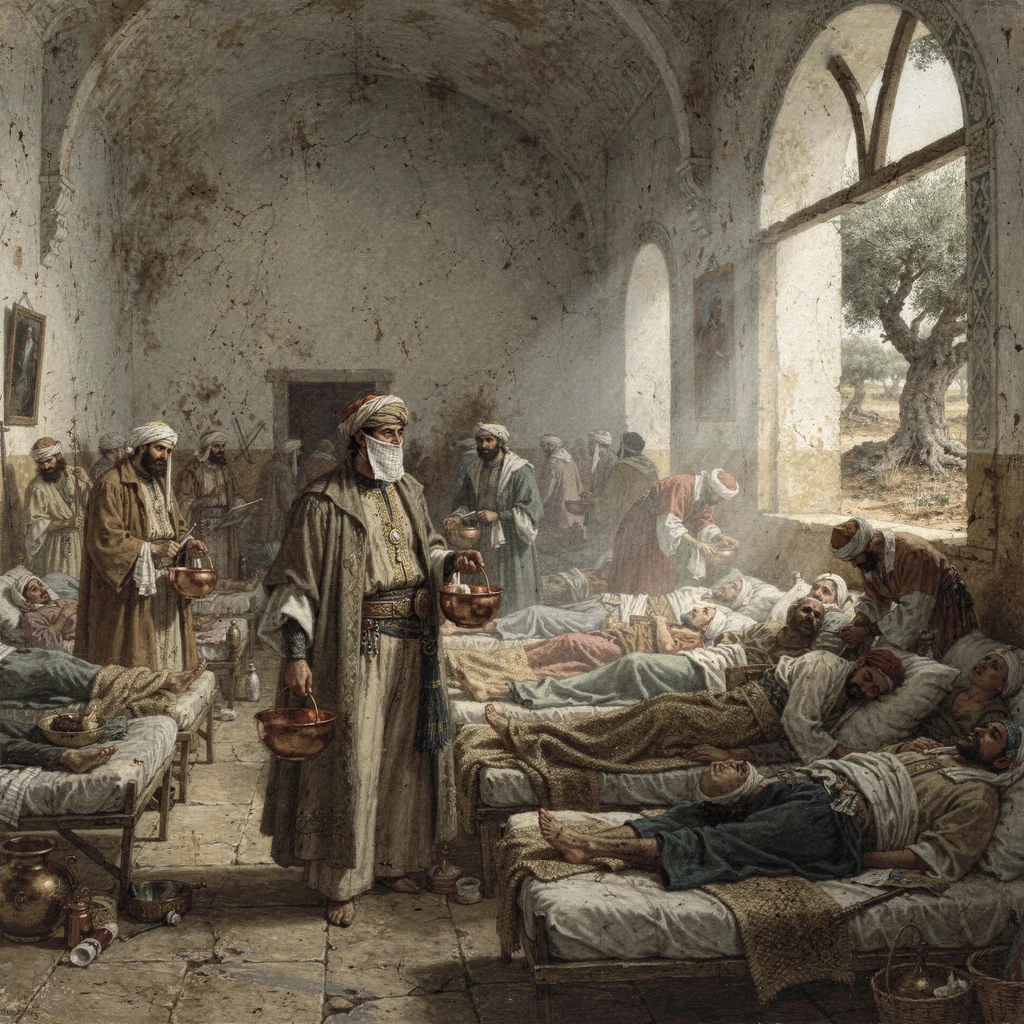
The Tunisian army encamped below the walls of Constantine.
Ḥammūda sat in his tent, studying the map. He was forty-eight now. Twenty-five years on the throne.
But this was different.
This was war.
“The Algerians hold the city,” the commander reported. “They have fortified the heights. They have cannon on the walls. They control the pass.”
Ḥammūda nodded. He traced the line of the pass on the map — the narrow defile that led to Constantine, the bridge city that controlled access to the interior of Algeria.
For twenty-five years of his reign, Tunis had paid Algerian tribute. His father had paid before him. The chain stretched back to Hussein I, who had bought peace at a price that compounded with each generation.
No more.
“The Algerians say they come to collect tribute,” Ḥammūda said. “They say they come to remind us of our obligations.”
“They come to humiliate us,” the commander said. “They come to show that Tunis is still a vassal, still weak, still subordinate.”
Ḥammūda stood. He walked from the tent and looked at the walls of Constantine, rising above the pass. The Algerian flag snapped from the highest tower.
“We are not here to collect tribute,” Ḥammūda said. “We are here to end it.”
He mounted his horse.
“The Algerians control the pass,” he said. “They have cannon on the walls. They have the high ground.”
“We have cannon too,” Ḥammūda said. “And we have something they do not.”
“What?”
“A reason to be here,” Ḥammūda said. “They fight for a post. They fight for a garrison. They fight because their Dey sent them to collect tribute. We fight for our country. Every soldier knows the difference.”
He drew his sword.
“Besiege the city,” he ordered. “Let the Algerians know. The days of Tunisian tribute to Algiers are over.”
The siege lasted three weeks.
The Tunisian cannon fired on the walls. The Algerian cannon fired back. The pass echoed with the sound of war — the crash of guns, the scream of shells, the cries of the wounded.
Ḥammūda rode the lines every day, encouraging his men, directing the fire, watching the walls of Constantine for signs of weakness.
He saw the Algerian commander on the walls — a man in Turkish uniform, surrounded by Janissaries, watching the Tunisian army with contempt.
The Algerians had besieged Constantine before. They had taken it before. They knew how to defend it. They expected to win.
But the Tunisian army did not break.
The Mamluks charged the pass, taking the heights. The Tunisian infantry held the line, returning fire with discipline. The tribal levies raided the Algerian supply lines, cutting off food and water.
The Algerians began to run low on ammunition. They began to run low on food. They began to wonder why the Dey of Algiers had not sent reinforcements.
Then came the news that changed everything.
The Algerians had counter-attacked. They had crossed into Tunisia, raiding the border towns, threatening the coastal cities. They expected Ḥammūda to lift the siege and rush home to defend his territory.
He did not.
“Let them raid,” Ḥammūda said. “Let them burn. When Constantine falls, they will have nowhere to retreat.”
The commander stared at him. “My bey — if we do not return, the Algerians will devastate the border.”
“They will,” Ḥammūda agreed. “And when we take Constantine, they will sue for peace. They will withdraw. They will pay for the damage.”
He was betting everything on one throw — that the Algerians could not hold Constantine if he did not break the siege, and that they could not continue the war if he took the city.
But it worked.
The Algerian commander surrendered.
The gates of Constantine opened. The Tunisian army marched into the city, flags flying, drums beating. The Algerian garrison laid down their weapons. The Algerian flag was lowered. The Tunisian flag was raised.
Ḥammūda stood on the walls of Constantine, looking out over the city he had taken.
And for the first time in twenty-five years, Tunis did not pay Algerian tribute.
The Algerian envoy came to Ḥammūda’s tent. He was a young man, arrogant and proud, dressed in the robes of the Dey’s court.
“The Dey sends greetings,” the envoy said. “He asks: What does Tunis want?”
“Tunis wants nothing from Algiers,” Ḥammūda said. “Tunis wants Algiers to leave Tunis alone.”
The envoy stiffened. “The Dey will not…”
“The Dey has no choice,” Ḥammūda said. “Constantine is ours. The border is closed. The tribute is ended.”
He stood.
“Return to Algiers,” Ḥammūda said. “Tell the Dey: Tunis is not for sale. Tunis is not for tribute. Tunis is free.”
The envoy withdrew. The terms were sent to Algiers. The Dey accepted.
Twenty-five years of Algerian tribute had ended.
Ḥammūda rode home at the head of his army. They passed through border towns that the Algerians had burned, past farms that had been raided, past villages that had suffered.
The people lined the road, cheering. They threw flowers. They sang songs. They hailed Ḥammūda as a liberator.
Tunis could fight. Tunis could win. Tunis could stand as an equal with any power in the Mediterranean.
Youssef waited in Bardo Palace. His face was lined with decades of service. He had watched Ḥammūda grow from a boy of eighteen to a man of forty-eight, from an uncertain heir to a victorious commander.
“You won,” Youssef said.
“I won,” Ḥammūda agreed.
“The Algerians will not forget this,” Youssef said. “They will not forgive this. They will wait for their revenge.”
“Let them wait,” Ḥammūda said. “Tunis is done waiting.”
He walked to the window of Bardo Palace, looking north toward Algiers, toward the power that had humiliated Tunis for thirty-one years.
The tribute was ended. The tutelage was over. Tunis was free.
Ḥammūda watched the Algerian envoy depart, his ship disappearing beyond the horizon.
Youssef approached from the doorway, unrolling a dispatch.
“News from Washington,” Youssef said. “The American president sends his regards. And another refusal of the frigate you requested.”
Ḥammūda smiled. “He refused twice now. He respects a man who knows what he wants.”
“And Consul Lear?”
“He arrived in January. A reasonable man.” Youssef placed the dispatch on the table. “We signed the renewal this morning. The treaty of 1797 stands. Equal terms between nations.”
Ḥammūda nodded. He walked to the window, toward the harbor where an American frigate rode at anchor, its flag snapping in the wind beside the Tunisian colors.
“The Americans fought their war with Tripoli,” Ḥammūda said. “They kept their peace with Tunis.” He turned from the window. “That is the difference between a neighbor and a master.”
He returned to the map on the table. The Algerian border was quiet now. But the Dey would not forget.
“The Americans understand reciprocity,” Ḥammūda said. “The Dey of Algiers understands only force.”
The Janissaries seized the port.
Ḥammūda stood at the window of Bardo Palace, watching the smoke rise from the harbor. Fifty years ago, the Janissaries had been the elite of the Ottoman army — the Sultan’s personal guard, the terror of Europe, the masters of the Mediterranean.
Now they were something else.
They were a shadow of former power. Once the elite of the Ottoman empire, now five hundred men who remembered glory but lived on declining stipends. Yet even shadows could darken the sun.
Half their number had forgotten Turkish. Half their number had married Tunisian women and forgotten what they were. Only the oldest remembered what it meant to be Janissary — and even they remembered better days.
“The port is closed,” the commander reported. “The customs house is seized. They demand their pay arrears. They demand their privileges.”
Ḥammūda was fifty-two. Twenty-nine years on the throne.
“Pay them,” Ḥammūda said.
“We have no cash,” Youssef said. His hands trembled with age, but his mind was sharp as ever. “The reserves are committed to the Algerian campaign. The treasury is empty.”
Ḥammūda turned from the window. “Then we do not pay them.”
“They have cannon,” the commander said. “They are trained soldiers. They are the Janissaries.”
“They are also outnumbered,” Ḥammūda said.
He walked to the map on the council table. Tunis was marked in red, the Janissary barracks noted, the neighborhoods that surrounded them.
“Hamida Ghammed?” Ḥammūda asked.
“The souks are closed,” Youssef said. “The merchants have armed their guards. The cheikh el medina is ready.”
“Ali Mhaoued?”
“Bab Souika is barricaded,” Youssef said. “The residents are manning the walls. The suburbs are ready.”
“And the tribes?”
“The Châren are riding,” Youssef said. “Ahmed Ben Ammar leads them. The Ounifa follow. They will be at the city walls by dawn.”
Ḥammūda nodded. He had spent twenty-nine years building networks — networks of merchants, networks of tribes, networks of urban authorities.
Now those networks would become an army.
“Send word to the Janissaries,” Ḥammūda said. “They can leave by ship. They can leave by land. They can leave alive. Or they can die in Tunis.”
“And if they refuse?”
“Then we will see,” Ḥammūda said, “how Tunisian cannon fire sounds.”
The Janissaries refused.
They expected the Bey to use the Mamluks. They expected a military confrontation. They expected to either win or die fighting like soldiers.
They did not expect the city to rise against them.
In the medina, Hamida Ghammed stood on the steps of the Zaytuna Mosque. He was sixty now, a merchant who had served the medina for forty years. He was cheikh el medina — the chief of the city, respected by every neighborhood, every souk, every guild.
The sound of men assembling with weapons brought it back, even though these men were merchants and artisans, not soldiers. Even though they carried clubs and knives, not swords and muskets. The sound was the same — the clink of metal, the murmur of voices, the readiness of violence.
He was six years old again.
It was 1756. Ali Pasha — the first of that name — had purged the Janissaries. Hamida’s father had carried him through the streets, rushing toward the safety of home. Low down from my shoulders, Hamida. Do not look.
He had looked.
Not at the bodies — he could not have named, then, what they were. He had looked at a shoe. A single yellow leather shoe, the kind the merchants wore, lying on its side in the gutter with the mud running into it. His father had stepped over it and kept moving, and Hamida had thought: someone will come back for that.
No one came back for it.
He knew this by the time they reached home, by some child’s mathematics of the irreversible.
The smell of the street had been wrong — blood and fear and the acrid smoke of burning buildings. The smell had stayed in his nose for days, for weeks, for years.
His father’s hands had been tight around him, carrying him past the horror, trying to shield him from what he had already seen.
Hamida had spent fifty-four years building a city where children do not need to be carried past the gates. He had built networks of merchants, systems of trade, relationships of trust that made Tunis strong without purges, without massacres, without blood in the streets.
This — what he was doing now, this morning, calling merchants and artisans to take up arms — was why.
The Janissaries thought they could return to 1756. They thought they could threaten and terrify and seize power again.
They were wrong.
Hamida called them to attention. His voice did not shake. He had been waiting fifty-four years to say what he said next.
“The Janissaries think they are the only army in Tunis,” Hamida said. “They are wrong.”
Men gathered around him — merchants, artisans, shopkeepers. Men who had never carried weapons. Men who had never fought. Men who had paid bribes to Janissaries for decades.
“Every merchant has a guard,” Hamida said. “Every workshop has an apprentice who can fight. Every neighborhood has men who remember how the Janissaries treated them. The time has come to remind them who really owns Tunis.”
The medina armed itself.
In the suburb of Bab Souika, Ali Mhaoued stood on the bridge that led to the city. He was forty-five, a grain merchant who had fought the Algerians in his youth. He was cheikh of the suburb — the man who controlled the approaches to Tunis.
“Hold the bridge,” Ali said to the men who gathered around him. “Block the roads. Let the Janissaries scream. Let them threaten. Let them try to move through streets that hate them. They will not reach the palace.”
The suburb armed itself.
The Janissaries found themselves surrounded.
They controlled the port. They controlled the customs house. They controlled the barracks. But they did not control the city.
The city controlled itself.
Ḥammūda watched from the palace. He watched the windows fill with faces. He watched the rooftops crowd with men. He watched the medina and the suburbs mobilize.
The city had become an army.
Youssef joined him at the window. “The Janissaries are trapped.”
“Tell them,” Ḥammūda said. “They can surrender. Or they can die.”
The Janissary barracks stood near the port, a fortified compound of white walls and red tiles where five hundred men lived with their families. Inside the commander’s quarters, Fatima al-Janissariya sat by the window, watching the smoke rise from the harbor.
Her husband Suleiman had left at dawn, leading five hundred Janissaries to seize the port and customs house. They had demanded their pay arrears. They had demanded their privileges. They had expected the Bey to negotiate, to compromise, to yield.
Instead, the city had armed itself.
Fatima was thirty-two years old, the daughter of a Tunisian merchant who had married into the Janissary corps when her father could no longer pay his debts. She had lived in these barracks for fifteen years, bearing four children, managing a household that grew poorer with each passing year. She had watched her husband’s pride curdle into bitterness as the stipends shrank, as the privileges eroded, as the glory of the Janissaries faded into memory.
She understood why he had seized the port. She understood why he had made demands. She did not understand why he had not anticipated what would happen next.
The door to her quarters opened. A woman entered — not a servant, not a neighbor, but someone Fatima had never seen before. She was dressed like a merchant’s wife from the medina, her veil modest, her manner assured.
“I come from the zawiya of Halfaouine,” the woman said without preamble. “With a message for the Janissary commander.”
Fatima stood. The mention of Halfaouine was significant — the Saheb Ettabaa Mosque, the zawiya attached to it, these were institutions of the Bey’s making, places where the poor were fed and the learned were supported.
“My husband is not here,” Fatima said. “He is at the port.”
“The message is for him,” the woman said. “But it must pass through you.”
Fatima was silent. She did not invite the woman to sit. She did not offer tea. This was not a social call.
“What message?”
The woman’s voice was calm, unhurried. “The city is prepared. The souks are armed. The suburbs have barricaded the roads. The tribes are riding toward the city walls. The Janissaries are five hundred men. The city is ten thousand.”
Fatima felt a coldness in her chest. She had suspected as much — she had seen the neighborhoods mobilizing, heard the sounds of preparation from her window. But to hear it stated so clearly, to know that her husband was walking into a trap…
“Who sends this message?”
“The message is not from the Bey,” the woman said. “The message is from those who remember what happens when soldiers make war on their own city.”
Fatima understood. This was not an official envoy. This was something else — a warning from the networks that ran through the city like threads through fabric, connecting merchants to mosques, households to souks, women to women in ways that men never saw.
“What does the message say?”
“It says that surrender is the only path,” the woman said. “It says that the Bey will be merciful if Suleiman chooses it. He will keep his life. He will keep his weapons. He will lose only his privileges.”
“And if he refuses?”
“Then the city will show no mercy,” the woman said. “The Janissaries will die in the streets, and their families will be left to bury them.”
Fatima’s hands trembled. She had four children. The youngest was three. The oldest was twelve. If Suleiman died…
“How do I know this is true?” Fatima asked. “How do I know the city will really rise?”
The woman looked at her, and for the first time, her expression softened. “I am from the medina, sister. My husband is a silk merchant. We have paid bribes to Janissaries for thirty years. We have watched our sons beaten by Janissary patrols. We have endured your husbands’ pride, your husbands’ demands, your husbands’ sense that they are entitled to what we have earned.”
She paused.
“But we do not want your husbands to die,” she said. “We do not want your children to starve. The message is true. The city is ready. The surrender offer is real. What Suleiman does with this truth… is between him and God.”
Fatima understood. This was not a threat. It was a lifeline — thrown across the chasm between two worlds, the world of the Janissaries who remembered glory, and the world of the Tunisians who had endured them.
“Where will you go?” Fatima asked.
“To the other households,” the woman said. “To the wives of the other officers. To the sisters who have married Janissaries. The message must reach them all.”
She turned to leave, then paused at the door. “There is one more thing.”
“What?”
“The message did not begin in the medina,” the woman said. “It began in the harem. The Bey’s wife sends word to the Janissary wives: we are all mothers, all daughters, all sisters. Let our husbands live. Let them surrender. Let them come home.”
Fatima felt the weight of this. The Bey’s wife. Aisha. She had never met her, but every woman in Tunis knew of her — the Circassian princess who had become a Tunisian mother, the woman who had borne Ḥammūda’s children and buried Ḥammūda’s sons, the woman who moved through the harem networks like a current through water.
“Tell her…” Fatima’s voice broke. “Tell her I will find my husband. I will tell him what you have said. I will…”
She could not finish.
The woman nodded once. She opened the door and disappeared into the corridor.
Fatima stood alone in her quarters. The smoke from the harbor darkened the window. The sounds of preparation drifted from the streets — the clatter of arms, the shouts of men, the nervous energy of a city that knew violence was coming.
She had to find Suleiman. She had to stop him before he did something that could not be undone.
She adjusted her veil. She walked to the door. She stepped into the courtyard where her children played, unaware that their father’s life hung on a message from a woman they would never meet, from a network they would never see, from a world that moved beneath the world of men.
The Janissary commander, Suleiman al-Janissari, came to the palace. He was surrounded by five hundred men, armed and trained, ready to fight.
But the city was armed against them.
“We demand payment,” Suleiman said.
“You are surrounded,” Ḥammūda said. “The medina has armed itself. The suburbs have blocked the roads. The Mamluks watch from their barracks. You have no allies. You have no escape.”
“We can fight our way out,” Suleiman said.
“You are five hundred,” Ḥammūda said. “The city is ten thousand. You can kill hundreds. You cannot kill everyone. And after you fall, after the city tears you apart, the Mamluks will finish what remains.”
Suleiman looked at the windows, the rooftops, the thousands of armed inhabitants. The palace was not a trap. The city was.
And the city had won without a single Mamluk sword.
“What do you offer?” Suleiman asked.
“Surrender,” Ḥammūda said. “Keep your lives. Keep your weapons. Lose your privileges. No more special treatment. No more back pay. You will be paid like other soldiers. You will serve like other subjects.”
He paused.
“Or you can die here.”
Suleiman was silent.
He had expected negotiations. He had expected threats. He had expected the Bey to bargain, to compromise, to yield.
He had not expected his own wife’s voice in his mind — the words she had whispered that morning, before he left the barracks. The city is ready. The message is true. Surrender is the only path.
He had not believed her. He had dismissed the women’s gossip, the whispers from the harem, the nervous stories from the other Janissary wives. He had told himself that men made war, not women.
But now he stood in the palace courtyard, surrounded by five hundred of his men, and everywhere he looked he saw the city — faces in windows, shadows on rooftops, the glint of weapons carried by men who were not soldiers.
“Has the city truly risen?” Suleiman asked. The question was not for Ḥammūda. It was for himself.
Hamida Ghammed had been six years old when Ali Pasha purged the Janissaries. He had seen the bodies at the gates. His father had lifted him so he would not see the blood, but he had seen it. He had never told anyone what it had cost him to organize this day. He stepped forward.
“We do.”
Ḥammūda did not need to answer.
The answer was everywhere — in the windows crowded with armed inhabitants, in the rooftops lined with men who had never fought before, in the faces of the Janissaries themselves, who understood suddenly that they were not facing an army. They were facing a city.
Suleiman closed his eyes for a moment. He remembered Fatima’s face that morning — pale, terrified, holding their youngest child, pleading with him to listen.
He opened his eyes.
The Janissaries looked at each other. They looked at the windows, the rooftops, the thousands of armed inhabitants. They realized: The Bey did not need to fight. The city would fight for him.
And the city would show no mercy.
“We surrender,” Suleiman said.
The Janissaries withdrew from the port. They surrendered their weapons. They accepted the loss of their privileges.
The city breathed.
In the coffeehouse near Bab Souika, Suleiman had not believed his wife’s message until the city was already armed against him.
The day after the surrender, Aisha asked for the location of Suleiman’s house.
“The Janissary commander?” Youssef had looked up from the dispatch he was reading. “He lives in the Bab Souika quarter, near the barracks. His family is there.”
“Bring me a basket,” Aisha said. “From the kitchen. Olives, bread, cheese. Enough for a family.”
Youssef had hesitated. “Excellence — Suleiman surrendered. He accepted the terms. The Janissaries are disbanded.”
“I know what he did,” Aisha said. “I know what he surrendered. His family did not surrender. They have no income now. They have no protection.”
“The guards —” Youssef began.
“I will not take guards,” Aisha said. “I will take one servant to carry the basket. That is all.”
Youssef had understood. He had given the order. The basket was prepared.
Aisha walked through the medina without the harem escort that always accompanied her. She had asked the guards to remain at the palace. She wanted to see the city as it was, not as the Bey’s wife saw it.
The medina was quiet after the tension of the revolt. Shopkeepers were reopening their stalls. Merchants were unpacking crates that had been barricaded in their cellars. The weapons that ordinary men had carried — clubs, knives, a few old muskets — were being put away, carried back into houses, hidden in courtyards.
She saw the truth of what Ḥammūda had built. The city had armed itself for him.
She turned down a narrow street, following the directions the servant had been given. The houses pressed close on either side, whitewashed walls bright in the morning sun. Laundry hung from balconies — bright fabrics drying in the air, the signs of ordinary life continuing.
Suleiman’s house was a modest building in a street of modest buildings. A two-story structure with a green door, the paint peeling at the edges. A house that had known better days, even before the surrender.
Aisha knocked.
The door opened. A woman stood in the doorway — not Suleiman, but his wife. Fatima al-Janissariya was forty perhaps, with a face that had been pretty once but was now drawn with exhaustion. Her eyes were red, as if she had been weeping. Her hands were rough, the hands of a woman who had worked all her life.
She recognized Aisha. Her eyes widened.
“Sayyida,” she said, and dropped into a curtsy.
“Please,” Aisha said. “Stand up. I am not here as the Bey’s wife. I am here as… a woman whose husband also made decisions.”
Fatima stood. She did not invite Aisha inside. She stood in the doorway, blocking the entrance, protecting what was left of her dignity.
“The basket,” Aisha said, and the servant set it down. “Food for your family. Olives from Mornaghia. Bread from the palace ovens. Cheese from the royal dairy. Enough for several days.”
Fatima looked at the basket. She did not say thank you.
“My husband tells me,” Aisha said, “that your husband surrendered. That he accepted the terms. That he will receive a pension.”
“He lives,” Fatima said. “He is not executed. He is not imprisoned.”
“He lives,” Aisha agreed. “And his family lives with him.”
Fatima was silent for a moment. She looked at Aisha, really looked at her, as if trying to understand what this woman wanted.
“Why?” Fatima asked. “Why do you come here?”
Aisha had prepared an answer. She had planned to speak of charity, of compassion, of the duty that the powerful owed to those who served them.
But what came out was something else.
“My husband won,” Aisha said. “Yours surrendered.”
Fatima’s face hardened.
“My children still have a father,” Fatima said. Her voice was flat, not accusing. Just true. “My husband is alive. He is disgraced, but he is alive. My sons will grow up with a father. Can you say the same?”
Aisha could not. Mohamed was gone.
“I do not say this to hurt you,” Fatima said. “I say it because it is true. Your husband’s mercy cost my husband his pride. But my husband’s pride did not cost my children their father.”
She looked at the basket. “We will take the food. We have no other income now. The pension is small. But we will live.”
She looked back at Aisha. “You did not have to come.”
Aisha thought of the women’s message that had passed through the harem, the message that Fatima herself had carried to her husband. The message that had armed the city against her husband’s own soldiers.
“Yes,” Aisha said. “I did.”
Fatima nodded. She understood. She understood that Aisha had worked against her husband’s men. She understood that the Bey’s wife had helped organize the city that defeated them.
“You are a strange woman,” Fatima said.
“Perhaps,” Aisha said.
“I will not forget what you did,” Fatima said. “But I will not thank you for it either. You saved my children’s father. But you broke my husband’s pride. These are the same thing. And they are not the same thing.”
She picked up the basket. It was heavy, but she did not ask for help.
“Salaam,” she said.
“Salaam,” Aisha replied.
The door closed.
Aisha walked back through the medina alone. The servant followed at a distance, carrying nothing now.
She saw the city differently than she had before.
She saw the weapons being put away — clubs carried back into houses, knives hidden in pockets, old muskets slipped behind doors. The threat was over, but the capacity remained. The city that had armed itself for her husband could arm itself again.
She saw the shopkeepers reopening their stalls — men selling spices, fabrics, hardware. They went about their business with the quiet determination of people who had faced death and survived.
She saw women at the fountains — filling water jars, washing clothes, talking in low voices. They had sent their husbands and sons and brothers into the streets with clubs and knives. They had waited to hear who would live and who would die.
This was what Ḥammūda had built.
Not the institutions. Not the treaties. Not the waqf endowments.
This — the city that could choose to arm itself, that could choose to surrender, that could choose to live.
Aisha looked at her hands as she walked. They were the hands that had organized the harem message, the hands that had touched the cedar chest where Ḥammūda’s charter lay unread, the hands that had managed the Mornaghia estate accounts for thirty years.
Her hands, roughened by garden work, lined with age.
They were not the method. They were not the institutions.
They were the hands that made the network work.
She walked through the Bab Souika gate, back toward the palace, back toward the husband who had won and the life that would continue.
Ḥammūda and Youssef sat in the private council chamber. Maps of Cairo and Tunis lay on the table, their edges curling slightly in the damp night air. The candle burned low, its flame flickering as drafts seeped through the stone walls, casting shadows that danced across the maps like cities on fire.
The chamber was small — a windowless room deep in the palace’s heart, where secrets were kept and decisions were made away from the watching eyes of the Divan. The air was still, heavy with the scent of old paper and beeswax. Somewhere far beyond the walls, a dog barked at the darkness. Nearer, the palace slept — the soft breathing of slaves in their quarters, the creak of settling wood, the occasional murmur of a night guard walking his rounds.
“Muhammad Ali faced the same problem,” Ḥammūda said.
Youssef nodded. “Four hundred and seventy Mamluks. Citadel Massacre. March 1, 1811. Three weeks ago.”
He touched the map of Cairo. “Muhammad Ali invited the Mamluks to the citadel, promised them amnesty, sealed the gates, and had them killed. He rules Egypt alone now.”
Ḥammūda was silent. “And here?”
Youssef moved his finger to the map of Tunis. “The Janissaries gather at the Bab Souika. Five hundred men. They meet in the coffeehouses after prayers. They speak of arming themselves, of occupying the city gates, of demanding payment at swordpoint.”
He looked up at Ḥammūda. “They are not yet in open revolt. But they are close.”
Ḥammūda studied the map. The Janissary barracks in the northern quarter. The Bab Souika gate they would seize. The main souks they would occupy. The approaches to the palace they would block.
“They would control the city,” Ḥammūda said.
“They would control the streets,” Youssef said. “They would not control the people.”
Ḥammūda looked up. “Explain.”
“The medina,” Youssef said. “The neighborhoods. The guilds. Hamida Ghammed has organized them. The cheikh el medina has five thousand men who can take up arms — merchants, artisans, students. They are not soldiers. But they know every alley. Every courtyard. Every rooftop.”
He traced the streets of the medina on the map. “If the Janissaries occupy the city, the medina becomes a weapon. The streets become traps. The rooftops become killing grounds.”
Ḥammūda was silent for a long moment. He thought of the civilians — the merchants who would die, the families who would lose their homes, the children who would be caught in the fighting.
“How many?” Ḥammūda asked.
Youssef understood what he was asking. “If the medina fights… hundreds. Perhaps more. The Janissaries will not discriminate between combatant and civilian.”
Ḥammūda turned to the window. The night was dark, but in his mind, he saw fires burning. He saw bodies in the streets.
“Muhammad Ali chose massacre,” Ḥammūda said. “He killed four hundred and seventy men to secure his power.”
“He did,” Youssef said.
“I will not be Muhammad Ali,” Ḥammūda said.
“Then what will you be?”
Ḥammūda turned from the window. “I will be the Bey who trusts his people. Hamida Ghammed says the medina will fight. Let them fight — but not for me. For themselves.”
He touched the map of Tunis. “If the Janissaries revolt, the medina defends itself. Not for the Bey. For their homes. For their families. For their city.”
“And if they refuse?” Youssef asked.
“Then I pay the Janissaries,” Ḥammūda said. “I bankrupt the treasury if I must. But I will not butcher five hundred men in a citadel. I will not turn Tunis into Cairo.”
Youssef bowed. When he straightened, his eyes held something Ḥammūda had rarely seen — respect.
Ḥammūda rose from the table and left the chamber.
Youssef stood alone. The candle flame guttered on the table. The maps of Cairo and Tunis lay spread before him.
He walked to the map of Cairo. His finger traced the Citadel — the fortress where four hundred and seventy Mamluks had died. Men like him. The world he came from, extinguished in a single night.
He was the last of a kind.
Then he closed the map.
He walked to the window and looked out over the palace grounds. In the distance, beyond the walls, the zawiya’s lamp still burned — Sheikh Ibrahim al-Riyahi’s lodge, where students recited the Quran through the night.
The lamp flickered in the darkness.
Youssef watched the light. The window held the dark between two flames: the one outside, still going; the one on his desk, waiting.
Mahmoud Bey stood on the balcony of his villa in the Tunis suburbs. The year was 1812.
From his balcony, he could see the city celebrating. Ḥammūda had defeated the Janissaries the year before. The medina was full of joy, full of relief, full of praise for the Bey who had broken the Ottoman stranglehold without blood.
Mahmoud watched the banners wave. He watched the crowds cheer.
Thirty-five years had passed since 1777. Thirty-five years since he stood at his father Ali Pasha’s deathbed and heard the words that changed his life. Ḥammūda is more accustomed to the management of affairs.
Thirty-five years of waiting.
Below the balcony, the villa courtyard was full. Not full of Mamluks who served the Bey. Not full of notables who sought favor at Bardo Palace. Full of men who had been overlooked, men who had been passed over.
Mahmoud had built something in these thirty-five years. Not institutions, like Ḥammūda. Not monuments, like Youssef. He had built a network of loyalty.
“Excellence,” a voice said from below.
Mahmoud looked down. A Mamluk officer stood in the courtyard — Ali al-Turki, a man who had served the Husaynid dynasty for thirty years, a man who had been passed over for promotion three times.
“Come up,” Mahmoud said.
The officer climbed the stairs to the balcony. He was forty years old, his face lined with frustration, his bearing still proud despite the humiliations.
“The Dey position,” Ali al-Turki said. “Ḥammūda gave it to a younger man. A man with ten years of service, compared to my thirty.”
Mahmoud nodded. He knew this story. He had heard it a dozen times.
“Ḥammūda promotes based on merit,” Mahmoud said. “He promotes based on ability. He does not promote based on years served.”
“Merit,” Ali al-Turki said bitterly. “The younger man is Ḥammūda’s favorite. He is Ḥammūda’s creature. He is Ḥammūda’s spy in the corps.”
“Perhaps,” Mahmoud said. “But Ḥammūda is the Bey. His favor is what matters.”
“Is it?” Ali al-Turki asked. “I have served thirty years. I have fought in three campaigns. I have led men into battle. And now—now I am passed over for a boy of twenty.”
Mahmoud touched the silk of his robe. Emerald green. The same color he had worn in 1777, when he stood at his father’s deathbed and heard the words that passed him over.
“Loyalty without reward,” Mahmoud said, “is… difficult.”
He looked at the Mamluk officer. “You know what it is to wait. My grandfather knew it. An Albanian from Roshnik, taken by the Ottomans, brought to Tunis in chains. He waited twenty years before he became Bey. He waited for the world to recognize what he already knew — that the throne belongs to those who endure.”
Ali al-Turki’s eyes widened. He understood what Mahmoud was offering.
“Excellence,” he said, “I have no pension. I have no promotion. I have only my sword and my service.”
“You have more than that,” Mahmoud said. “You have my ear. You have my favor. You have the promise of reward when the time comes.”
“And when will that time be?”
Mahmoud looked toward Bardo Palace in the distance. The white walls glowed in the evening light.
He looked at the celebrating city, at the crowds cheering for Ḥammūda, for the victory.
“The throne does not age,” Mahmoud said. “But men do. Ḥammūda is fifty-three. The crown grows heavier each year.”
He turned back to Ali al-Turki. “For now—serve me. Bring me the grievances of those who have been overlooked. Bring me the concerns of those who have been passed over. Bring me the loyalty of those who feel forgotten.”
“And in return?”
“In return,” Mahmoud said, “you will have what Ḥammūda will not give you. You will have reward for loyalty. You will have recognition for service. You will have a place in the court that serves those who serve you.”
Ali al-Turki bowed. “Excellence.”
He descended the stairs, and Mahmoud watched him go. Another man added to the network. Another loyalty purchased with promises.
The courtyard filled again. This time, a notable from Sfax — a man whose tax farm had been given to a rival family.
“Excellence,” the notable said. “My family has served Tunis for three generations. We have paid our taxes. We have supported the beys. And now—now Ḥammūda gives our tax farm to the Djelloulis.”
“Ḥammūda balances factions,” Mahmoud said. “He gives to those who opposed him. He rewards those who resisted him. He builds peace through the distribution of favor.”
“My family supported him,” the notable said. “We did not resist. We did not oppose. We stood with him from the beginning.”
“And therefore,” Mahmoud said, “he takes you for granted. He gives his attention to those who opposed him, not to those who have always been loyal.”
“This is not justice,” the notable said.
“This is balance,” Mahmoud said. “Ḥammūda’s approach. But it is not mine.”
“Your approach, Excellence?”
“I strengthen my friends,” Mahmoud said. “I reward those who have always been loyal. I give to those who have earned through service, not through resistance.”
The notable bowed. “Excellence, my family remembers who stood with them. We remember who rewarded loyalty.”
“Ḥammūda balances factions,” Mahmoud said. “I strengthen my friends. The difference is this—Ḥammūda’s approach makes peace. Mine will make power.”
As the notable descended the stairs, Mahmoud’s sons joined him on the balcony—Hussein and Mustafa, now grown men, their eyes watching the courtyard, their minds understanding what their father was building.
“How many?” Hussein asked.
“Men are not bought,” Mahmoud said. “They are… invested in. I invest in their grievances. I invest in their loyalty. I invest in their belief that I will reward them when the time comes.”
“And when will the time come?”
Mahmoud looked at the celebrating city, at the banners waving for Ḥammūda, at the cheering crowds.
“When Ḥammūda dies,” Mahmoud said. “The man who sits on it does not. And when the man dies—my investments will mature.”
Mustafa looked at the courtyard below, at the Mamluk officers and the notables and the representatives of foreign powers.
“This is a court,” Mustafa said. “Not the Bey’s court, but… a court.”
“It is the shadow court,” Mahmoud said. “Ḥammūda rules in the light. I rule in the shadows. He balances the factions that oppose him. I strengthen the factions that support me.”
“Different worlds,” Hussein said.
“Different approaches,” Mahmoud agreed.
He touched the emerald silk of his robe. “When I am Bey, I will return the tax farm at Monastir to the Khaznadar family. Their grandfather lost it when Ibrahim purged the Janissaries. I will restore what was taken.”
He looked at Hussein. “I will hold the naval promotion for your cousin Ali. He has served as lieutenant since you were boys. He deserves the command you seek.”
He looked at Mustafa. “And for you — the governorship of Sfax, when the time comes. Not as a gift, but as earned trust.”
His sons understood. Their father was not speaking of abstract philosophy, but of specific rewards for specific loyalties. He was showing them how power would be distributed when he ruled.
“The man who waits prepares,” Mahmoud said to his sons. “And while he waits—he builds.”
He looked at his sons, at the men who would inherit the throne he had not yet received.
“Learn this lesson,” Mahmoud said. “Patience is not emptiness. Waiting is not passivity. To wait is to prepare. To wait is to build. To wait is to invest in the moment when opportunity becomes necessity.”
His sons nodded. They understood. They were learning the philosophy of waiting—the art of building power in the shadows, of cultivating loyalty in the margins, of being ready when the time came.
Mahmoud turned back to the city. The sun was setting now, painting the sky in shades of violet and gold. In the distance, Bardo Palace glowed white against the evening.
The city celebrated Ḥammūda’s victory.
Mahmoud watched from his villa.
Ḥammūda sat at his desk in Bardo Palace, the summer sun streaming through the windows. Before him lay a document — four pages of parchment, covered in his own careful handwriting.
Youssef Saheb Ettabaâ stood across the desk, reading.
Youssef was silent as he read. His eyes moved down the page, then back up, then down again. When he finished, he set the parchment gently on the desk.
“A council,” Youssef said. “To choose the Bey.”
“By merit, not blood,” Ḥammūda said. “The notables would select the most capable candidate from among the Husaynid princes. Military service. Administrative experience. Character witnesses. They would debate. They would vote. The winner would be Bey.”
He looked at Youssef. “The succession would be institutionalized. What we have built would survive beyond me.”
Youssef was still silent. He looked at the parchment, then at Ḥammūda, then at the parchment again.
“The Mamluks,” Youssef said quietly.
Ḥammūda waited.
“The Mamluks have swords,” Youssef said. “They have cannons. They have fortresses. They have been the military elite of Tunis for two centuries. They believe power belongs to those who can seize it.”
Ḥammūda nodded. “The charter would require them to accept the council’s decision.”
“Would it?” Youssef asked. He looked up from the document. “Excellence — this parchment says the Mamluks must honor the council’s choice. But what if they refuse? What if the council chooses Prince A, and the Mamluks prefer Prince B, and they simply… decline to accept the council’s authority?”
Ḥammūda was silent.
“The charter designates a process,” Youssef said. “It does not compel obedience. A piece of parchment cannot make armed men submit to a decision they dislike. The council can choose the most capable candidate. But the council cannot make that candidate Bey if the Mamluks refuse to recognize him.”
Ḥammūda looked at the charter. The words he had written so carefully seemed to shimmer on the page.
“Then what do we do?” Ḥammūda asked.
Youssef had no answer.
Youssef stood at the desk, looking at the document that promised to solve everything. He saw what Ḥammūda saw — a brilliant system, a rational process that would ensure competence and prevent civil war.
And he saw what Ḥammūda now saw — that institutions could be designed, but will could not be manufactured.
“The charter requires the factions to value the process over their preferences,” Youssef said finally. “It requires them to accept a loss. It requires them to honor a decision they dislike. Excellence — when have men ever done this?”
Ḥammūda said nothing.
“The notables will support the council when it chooses their candidate,” Youssef said. “The Mamluks will accept the process when it produces their preferred outcome. But the moment the council chooses against their interests — they will denounce the charter as invalid. They will claim the council was corrupted. They will reach for their swords.”
He paused.
“The charter assumes that all factions value the state more than their own power,” Youssef said. “But you and I know the truth. Men value their interests. And when the process conflicts with their interests — they will choose their interests.”
Ḥammūda looked at the olive branch that lay on his desk — a gift from the Sfx merchants, brought after the agreement that had transformed their city. The branch was dry now, the leaves brittle, but it lay beside the inkwell and the seal, a reminder of what was possible when men chose abundance over extraction.
The charter lay beside the olive branch.
Youssef waited. He had served Ḥammūda for thirty years. He had seen the institutions function. He had seen what balance could achieve.
Now he saw the limit.
Ḥammūda picked up the parchment. He looked at it one last time — the careful provisions, the elegant language, the brilliant system that would never work.
He set the charter draft aside on the corner of his desk, beside the olive branch from Sfax.
His hand rested on the parchment for a moment — the rough texture of vellum beneath his palm, the ink still faintly damp where he had scratched out the first clause that morning.
He remembered writing that first line. It had been spring. The council chamber had smelled of orange blossoms through the open windows, of beeswax from the candles, of the particular scent of old stone that held centuries of decisions. He had dipped the quill in ink, watched the black liquid pool, and begun: Let it be known that the succession of this regency shall be determined by merit, not by blood.
The ink had flowed easily. The idea had seemed so clear then. Institutions could solve what dynasties could not. Systems could endure where men failed.
His hand moved from the parchment to the olive branch — dry now, the leaves brittle, but still holding the shape of what it had been when the Sfax merchants brought it. He touched the rough bark at the branch’s end, felt the texture of a tree that grew in soil watered by institutions, not by favor.
The olive branch lay across the parchment, covering the words he had written.
He stood and walked from the chamber, leaving the charter on the desk.
The message arrived at Mahmoud’s villa at midday.
Ḥammūda requested his presence. A private consultation. Matters of state.
Mahmoud read the note twice. He was sixty-six now. Thirty-six years since Ali Pasha’s deathbed. Thirty-six years since the words that had defined his life: “Ḥammūda is more accustomed to the management of affairs.”
He folded the note. He summoned his sons.
Hussein was thirty-five, serving on the Divan, learning the accounts. Salem was thirty-two, commanding cavalry, leading from the front. Both were grown men. Both had sons of their own.
“The Bey summons me,” Mahmoud said.
Hussein exchanged a glance with his brother. “Again?”
“He summoned me three months ago,” Mahmoud said. “To discuss the Algerian victory. To reminisce about the old campaigns.”
“And now?” Salem asked.
“Now I do not know,” Mahmoud said.
He dressed carefully. Silk robes — emerald green, the color he had worn at Ali Pasha’s deathbed, the color he had worn when he accepted primogeniture in 1777. The color of waiting.
His valet adjusted the collar. Mahmoud examined himself in the mirror. White hair. Lined face. Eyes that had watched thirty-six years pass while his cousin ruled.
“The carriage waits,” Hussein said.
“No,” Mahmoud said. “I will walk.”
“My father —”
“I will walk,” Mahmoud repeated. “The Bey invited me to his palace. I will arrive as one who knows the way.”
He left the villa without a carriage. He walked through the gardens that surrounded his home on the hill — olive trees, pomegranates, rose beds that would bloom in spring. Now, in autumn, the leaves were turning gold. The air was crisp with coming winter.
The walk to Bardo Palace took an hour. Mahmoud had walked it many times. He had walked it as a young man, when his father Ali Pasha ruled. He had walked it as Ḥammūda’s cousin, when the succession was decided. He had walked it as the dean of the family, the man who would never be Bey.
Thirty-six years.
The guards at Bardo Palace recognized him. They bowed. They opened the gates without announcement.
Mahmoud walked through the courtyards he knew as well as his own home. The Andalusian olive trees Ḥammūda had planted. The marble arches brought from Carrara with Sfax oil money. The fountains that whispered of abundance transformed.
He found Ḥammūda in a private courtyard, sitting on a stone bench beneath an olive tree. The Bey was fifty-five now. His hair was white. His face was lined. He moved slowly, carefully, as if his body were made of glass.
“Cousin,” Ḥammūda said. He gestured to the bench beside him. “Sit.”
Mahmoud sat.
“The olives are heavy this year,” Ḥammūda said.
“They are,” Mahmoud agreed.
“The trees remember what the land gives.”
“They do,” Mahmoud said. “And they give back.”
He reached up and touched the olive branch above them. His fingers moved over the bark, over the fruit hanging heavy in the autumn air. The gesture was possessive — measuring, not admiring.
Ḥammūda was silent for a moment. He watched the leaves sway in the autumn breeze.
“I wanted to consult you,” Ḥammūda said. “About the succession.”
Mahmoud’s heart beat faster. After thirty-six years, after decades of waiting, after a lifetime of patience —
“The notables speak of a council,” Ḥammūda continued. “A body that would choose the next Bey. Not by blood. Not by primogeniture. By merit. By capability.”
Mahmoud was silent. He had heard rumors. He had not believed them.
“I am considering this charter,” Ḥammūda said. “I am considering institutionalizing this system. Ensuring that the succession does not depend on one man’s choice. Ensuring that Tunis has institutions that survive when I am gone.”
He looked at Mahmoud.
“What do you think, Cousin?”
Mahmoud considered his words carefully. Thirty-six years of waiting had taught him caution. Had taught him to speak in layers.
“Tunis has prospered,” Mahmoud said. “You have built institutions that function. You have created networks that endure. The merchants are content. The notables are satisfied. The army is paid.”
He paused.
“But institutions are tools,” Mahmoud said. “They are hammers and saws. They do not build themselves. Men must use them. And men must lead them.”
Ḥammūda nodded. “Youssef would guide the council. Hamida Ghammed would speak for the city. Ali Mhaoued would speak for the suburbs. Mustapha Khodja would speak for the army. Every faction represented. Every interest balanced.”
“And the family?” Mahmoud asked. “What place does the Husaynid dynasty have in this council?”
Ḥammūda was silent.
“The Husaynids have ruled Tunis since 1705,” Mahmoud said. “For over one hundred years, the Bey has been a Husaynid. The people expect this. The Mamluks expect this. The tribes expect this.”
He paused.
“My sons are capable men,” Mahmoud said. “Hussein understands the accounts. Salem commands the cavalry. They have been trained for service. They have been trained for leadership.”
“I know,” Ḥammūda said.
“Do they have a place in this council?” Mahmoud asked. “Or will the Husaynid dynasty end with you?”
Ḥammūda was silent for a long moment. He watched the olive leaves sway.
“The council will choose the most capable,” Ḥammūda said. “Regardless of blood. Regardless of lineage. If Hussein or Salem prove themselves the most capable, the council will choose them.”
“And if the council chooses someone else?” Mahmoud asked. “Someone not Husaynid? Someone not of Ali Pasha’s line?”
“Then that is the will of the council,” Ḥammūda said.
Mahmoud was silent. He understood what Ḥammūda was saying. The throne that had waited for thirty-six years would wait forever. The council would choose. And blood would mean nothing.
“This council,” Mahmoud said carefully, “has served Tunis well.”
“It has,” Ḥammūda agreed.
Mahmoud looked at his cousin. Ḥammūda’s face was lined, his eyes tired. The Bey was fading. The physicians worried. Everyone knew it.
“There are other ways to rule,” Mahmoud said. “Ways that served the Ottomans for centuries. Ways that served your father. Ways that served Ali Pasha.”
“The old ways,” Ḥammūda said, “led to civil war. The old ways led to purges. The old ways led to blood in the streets.”
“And yet,” Mahmoud said, “the old ways produced strong rulers. Decisive rulers. Rulers who did not hesitate.”
He paused.
“How long until the throne, Cousin?”
Ḥammūda looked at him. “What?”
“How long until the throne?” Mahmoud repeated. “I am sixty-six. I have waited since 1777. My sons have waited. My grandsons are growing. How long must we wait?”
Ḥammūda was silent. He saw the question beneath the question — the demand beneath the courtesy.
“Serve Tunis,” Ḥammūda said. “Make yourself indispensable. What serves the state endures.”
Mahmoud nodded. He heard the message beneath the words. Wait forever. The throne will never come to you by right. It will never come to you by blood.
“I will wait,” Mahmoud said.
He smiled. The smile did not reach his eyes.
“You have built well, Cousin,” Mahmoud said. “The institutions function. The factions balance. The city prospers.”
He stood. He smoothed his green silk robes.
“I will take my leave,” Mahmoud said. “My sons expect me.”
“Stay for tea,” Ḥammūda said. “We have not spoken in months.”
“The evening grows late,” Mahmoud said. “And I have far to walk.”
He bowed — slightly, the bow of an equal to an equal, not a subject to a ruler.
“Assalamu alaykum, Cousin.”
“Wa alaykum assalam, Mahmoud.”
Mahmoud walked from the courtyard. He walked through the palace gates. He walked down the hill toward his villa.
The sun was setting. The last light of day caught his emerald green robes, bright against the darkening landscape.
Ḥammūda watched from the courtyard. He watched his cousin walk away, green silk fading into twilight, a figure moving steadily toward a villa on a hill.