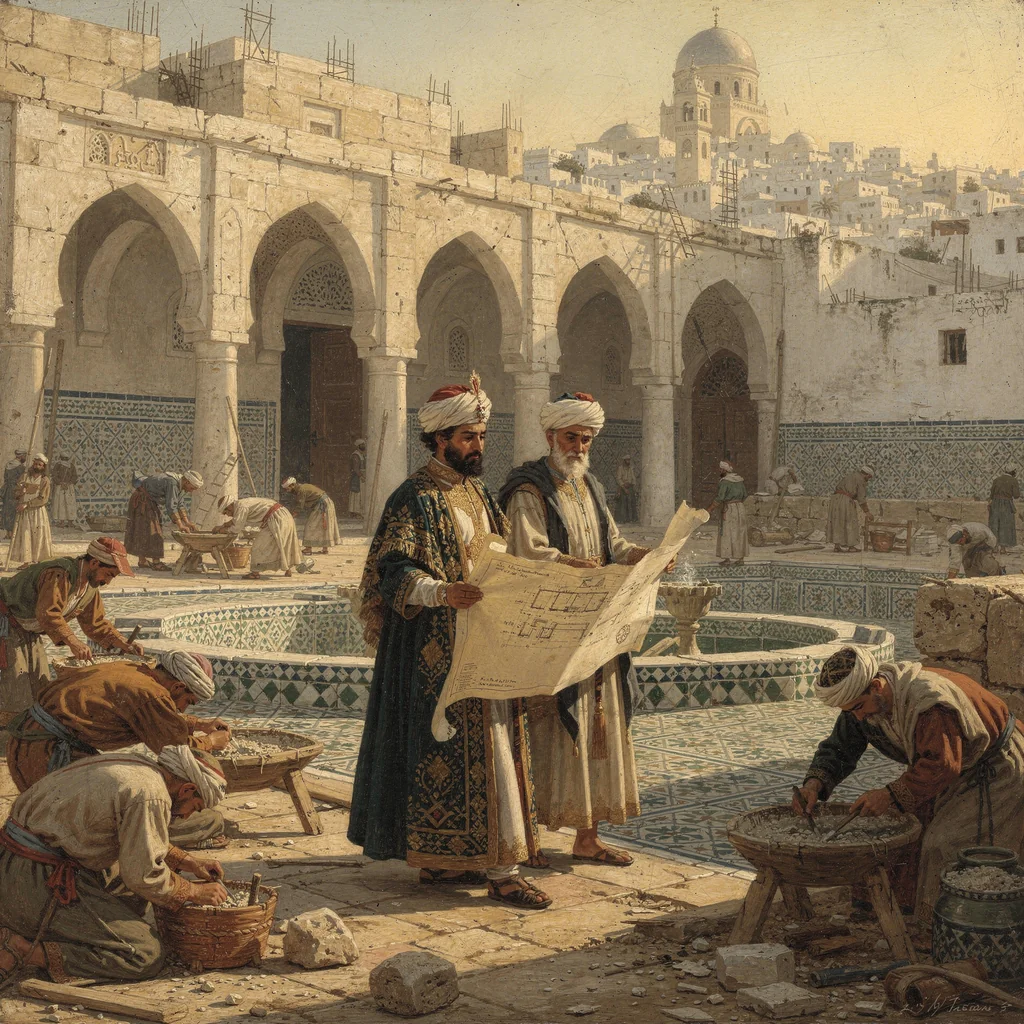
1793. Bardo Palace, Tunis.
Gold on the Divan table.
Ḥammūda sat on the throne, watching the light catch on the stacked coins. Venetian sequins — forty thousand of them — piled in neat mounds on the marble surface. The air smelled of mint and metal, of fresh ink and polished stone. Through the chamber’s high windows, afternoon sun slanted across the gold, making the coins glitter like fragments of captured sunlight.
The Divan chamber was cool, its thick stone walls insulating against the Mediterranean heat outside. Dust motes floated in the light shafts, settling on the marble floor where generations of beys had stood. The ceiling’s stucco arabesques cast intricate shadows — spirals and starbursts that seemed to rotate as the sun moved across the sky. Beyond the windows, the sounds of Bardo Palace drifted in: the distant splash of a fountain, the rhythmic clack of a guard’s boots on stone, the murmur of servants in corridors that branched like veins through the building’s heart.
He was thirty-four now. One year since the Treaty of 1792. One year since Venice had paid, and the bombardments had ended.
The merchants from Sousse stood below the throne, their harbor-dusted silk replaced by new robes. Faruq al-Susi, the eldest merchant, smiled as the gold was counted.
“Forty thousand sequins,” Faruq said. “As agreed. Venetian honesty — enforced by Tunisian persistence.”
Ḥammūda nodded. “The merchants will be compensated?”
“In full,” Faruq said. “With interest. The Venetian payment has restored what was lost. And more.”
Mustapha Khodja, Dey of the army, stepped forward. He was forty now, his white-streaked beard gone fully white, his scars faded but still visible. The Mamluks had waited nine years for glory. They had watched Venetian ships bombard Sousse. They had waited for the command to ride, to fight, to prove their worth.
The command had never come.
Ḥammūda had chosen persistence. Venice had paid. The 40,000 sequins sat in the treasury. Tunisian honor was intact. But the Mamluks had not had their war.
“My lord Bey,” Mustapha said. “The army asks: What becomes of the gold?”
Ḥammūda said nothing. He felt the familiar weight of the seal against his chest.
“The gold belongs to Tunis,” Ḥammūda said. “Why do you ask?”
“The gold should fund the army,” Mustapha said. “We bled. We waited. We demand our share.”
Ibrahim El Sahib, the eldest of the beys, spoke next. He was sixty-six now, his face lined with decades of watching power shift and settle. The notables had waited nine years for commerce to return. They had watched their ships burn in Venetian bombardments. They had waited for the safety that submission would have bought — safety that Ḥammūda’s persistence had secured without surrender.
“The notables ask,” Ibrahim said, “what becomes of the gold?”
“The gold belongs to Tunis,” Ḥammūda said again.
“The gold should fund commerce,” Ibrahim said. “Build warehouses. Subsidize ships. Make Tunis the trade hub of the Mediterranean.”
Ḥammūda looked from one to the next. The Mamluks wanted glory. The notables wanted wealth. Each faction wanted what served itself, not what served Tunis.
“You ask me to spend,” Ḥammūda said to the room. “The Mamluks ask me to fund the army. The notables ask me to fund commerce. Each faction asks me to fund its own power.”
He stood. The Divan went still.
“But I ask: What happens when I am gone? When the gold is spent? When the victory is forgotten?”
Mustapha and Ibrahim were silent. The beys watched, waiting.
“If I spend this gold on the army,” Ḥammūda said, “the Mamluks will seize the throne when I am gone. If I spend it on commerce, the notables will buy it.”
Ḥammūda walked down from the throne and approached the gold on the Divan table. The sequins glittered in the slanting light.
“I will not spend this gold,” Ḥammūda said. “I will invest it. I will build institutions that survive when men die.”
From the shadows behind the throne, Youssef spoke. His face was lined with years of service. The Moldavian who had been enslaved at twelve, who had marched to the sea in chains, who had risen to become the most powerful man in Tunis, stepped forward.
“Waqf,” Youssef said. “Naval academy. Military schools. Fortresses. Libraries. Things that cannot be stolen. Things that cannot be forgotten. Things that outlast the men who built them.”
Ḥammūda nodded. “The Venetian gold will not fund factions. It will fund Tunis. It will fund the future.”
Mustapha stepped forward. “My lord Bey — the army requires…”
“The army has its budget,” Ḥammūda said. “The army has its stipends. The army has its weapons. This gold will not buy swords. It will buy stones.”
“Stones?”
Ḥammūda touched the sequins on the table. “This gold will become walls,” Ḥammūda said. “Roofs. Schools. Hospitals. Academies. Things Tunisian children will use a hundred years from now.”
He turned back to the room.
“The merchants will be compensated. The treasury will be enriched. But the gold itself — this gold will build something that lasts.”
The beys were silent. They had expected gold to be divided, spent, scattered. They had not expected gold to be turned into stone.
“Return tomorrow,” Ḥammūda said. “Youssef will present the plans. You will see what the peace dividend builds.”
He turned from the Divan and walked to the private council chamber. Youssef followed.
The corridor stretched before them, lit by windows that looked out onto the palace gardens. Through the glass, Ḥammūda could see the olive trees he had planted — still young, still putting down roots, their silver-green leaves catching the afternoon sun. The scent of orange blossoms drifted in from the courtyard, sweet and heavy, masking the smell of old stone and older power.
In private, with the heavy cedar door closed, the council chamber became a different world. The sounds of the Divan faded — the rustle of silk, the shuffle of feet, the murmured conversations of men who wanted what they could not have. Here there was only the quiet scratch of paper moving, the soft hiss of candle flames, the measured breathing of two men who had learned to speak without words.
Ḥammūda sat at the table and rubbed his temples. The seal pressed against his chest, heavy and familiar.
“Will they accept it?” Ḥammūda asked.
“They will grumble,” Youssef said. “They will complain. They will say the gold should be divided.”
“And then?”
“And then they will see the buildings rising,” Youssef said. “They will see the schools filling with students. They will see the hospitals healing the sick. And they will understand that this gold has bought something more precious than swords or ships.”
Ḥammūda nodded. He was thirty-four. The Venetian War was over. Now came the harder part — building something that would last.
“What institutions?” Ḥammūda asked.
“Madrasas,” Youssef said. “Islamic schools, funded by waqf, endowed to God. The scholars will teach Quran, law, mathematics, astronomy. The children of Tunis will learn what their fathers learned, and more.”
“Hospitals,” Ḥammūda said.
“Hospitals,” Youssef agreed. “Funded by waqf, endowed to God. The poor will come for treatment. They will pay nothing. They will receive care. And when they ask who built this place, the answer will be: Tunis.”
“Naval academy,” Ḥammūda said.
“Naval academy,” Youssef said. “Dutch engineers will teach shipbuilding. Tunisian officers will learn navigation. We will not depend on foreign ships. We will build our own.”
“Fortresses,” Ḥammūda said.
“Fortresses,” Youssef said. “Along the coast. In the mountains. At the borders. Tunis will defend itself. Tunis will not depend on the Sultan’s ships or the Dey’s armies.”
Ḥammūda considered this. “How many waqf?”
“How many can we endow?” Youssef said. “The gold is enough for four. Perhaps five. But we must begin.”
“Begin,” Ḥammūda said. “And let the beys grumble. Let them complain. When they see what we build, they will understand.”
Youssef picked up the pen to begin drafting the endowment deeds.
1793. Bardo Palace, Tunis.
The council chamber was quiet, save for the rustle of parchment. Ḥammūda Pasha sat at his desk. Before him lay two things: a branch of olives from the first Sfax harvest, and a document on fine vellum — the endowment deed for the Halfaouine mosque.
Youssef Saheb Ettabaa stood beside him, a small cylinder of Italian marble on the desk between them.
“The olives sail to Livorno,” Youssef said. “The marble sails back. The trees of Sfax become the columns of Halfaouine.”
Ḥammūda picked up the marble cylinder — white veined with gray, cool beneath his palm. Then he picked up the olive branch, rough with bark, heavy with fruit.
“Two ships of our best oil,” Youssef said. “That was the tribute to Algiers. To light their mosques while ours stood dark.”
Ḥammūda looked up. “You ended it.”
“I sent the oil to Livorno instead,” Youssef said. “To anyone who would pay. And with the profits, I bought cannons. I bought marble. I built a mosque from the wealth of our own land.”
“Commerce is a weapon,” Ḥammūda said.
“A weapon that does not kill,” Youssef agreed.
He touched the olive branch. “These olives grew in Sfax. Men I knew harvested them — men who taught me Arabic, who taught me the Quran. When the oil returns as marble, their labor returns to them.”
Ḥammūda set down both branch and marble. “And the waqf?”
“The endowment is ready,” Youssef said. “The deed. The plans. The samples. When the day comes to build, everything will be prepared.”
Ḥammūda nodded. He picked up the olive branch again, turning it in his fingers. “Abundance transformed.”
“Abundance claimed,” Youssef said. “What grows from our land should feed our children first.”
Outside the window, the sun set over the palace gardens. In the groves of Sfax, in the orchards of Halfaouine, the olive trees waited. They had waited for centuries. They would wait for centuries more.
1796. Bardo Palace, Tunis.
The private reception room at Bardo Palace did not look like a place where power was exercised. There was no throne, only a divan raised slightly higher than the surrounding cushions. There were no guards standing at attention, only servants who moved silently with silver trays of coffee and Turkish delight. There were no council chambers with high ceilings and echoes of argument, only a room of moderate size whose walls were covered in Venetian mirrors that reflected candlelight into infinity.
But there were Persian carpets covering the floor — red with gold patterns, imported through Livorno at enormous expense. There were silver trays etched with the Husseïnid crest. There was incense of oud that masked the metallic scent of coins changing hands.
And there were petitioners.
They came not because Ḥammūda Bey had sent them. They came because they understood something about power that the Bey did not. Power was not only what was exercised in the open court, in the divan where factions balanced and deliberated and nothing was decided without hours of debate. Power was also what flowed in the shadows, in the private chambers of the women who bore the sons who would rule.
Amina sat on the raised divan, wearing crimson silk embroidered with gold thread. The ruby from her mother’s trousseau hung at her throat, now joined by pearls that had belonged to Mahmoud’s mother. She was thirty-seven years old, and she had learned that legitimacy was not only given — it was performed.
Behind her stood her sons. Hussein was twelve, tall for his age, his Georgian features already marked with the seriousness of a boy who understood too much. Mustafa was ten, smaller, watchful, learning from his brother as their brother had learned from their father.
The first petitioner approached — a merchant from Sfax, his kaftan dusty from travel, his eyes darting between Amina and the guards who stood near the door but did not stand too near.
“Mother of Pashas,” he said, bowing low. “Blessing upon you and your house. And upon your sons, the future beys.”
Amina did not smile. She inclined her head slightly, a gesture that acknowledged the title he had used — not given by her brother, not recognized in any official document, but real nonetheless because men like this merchant believed it was real.
“Rise,” she said. “What brings you to my court? The Bey’s court is in the main palace. My brother hears petitions every day, and he judges with justice.”
The merchant straightened, but he did not meet her eyes. “The Bey is… slow, effendi. The Bey has sent investigators. He has called the qaid to Tunis. He says justice will be done. But justice takes years. My family cannot wait years.”
He hesitated, then plunged forward. “My son was taken by the qaid’s men. For a crime he did not commit. The qaid demands payment for his release. Payment I cannot make, for he has taken my goods as well. I went to the Bey’s officials. They said: ‘Make a complaint. It will be investigated. Come back in six months.’ Six months, effendi. My son cannot eat investigations. My wife cannot wait six months to see her boy.”
He looked up, and Amina saw the desperation in his eyes. “I come to the Mother of Pashas. I come to the sister of the Bey. I come to the one who… understands.”
Amina let the silence stretch. She had learned this from her mother, who had learned it in the courts of Tiflis: the person who speaks first in a negotiation loses. The merchant shifted, wiped sweat from his forehead, glanced at the sons who stood behind her like young cedars.
“And so you come to me,” Amina said at last. “Not for justice. For speed.”
“For my son,” the merchant said. “Justice or speed — either will serve.”
Amina touched the ruby at her throat. The stone was warm against her fingers. “Go to the qaid of Sfax. Tell him that Mother of Pashas asks about him. Tell him that justice comes from many places, not only the Bardo. Tell him that when the Bey dies — and all men die — the qaid who served the family of the next Bey will be rewarded. And the qaid who did not…” She let the sentence hang.
The merchant’s eyes widened. He understood. “And will the Mother of Pashas remember the merchant who came to her? When her sons rule?”
Amina did not promise. Promises were for the weak. “Speed and certainty,” she said. “This is what I offer. Not justice. Justice is my brother’s domain. It is slow, it is careful, it is… fair. But you do not want fairness. You want your son.”
“Yes,” the merchant whispered. “Yes.”
“Then go,” Amina said. “And tell the qaid what I said.”
The merchant bowed — lower this time, a bow that acknowledged not only her rank but her power. He backed away, turned, and left the room.
Amina nodded to the servant by the door. “Next.”
Mahmoud had been sitting in the corner of the room, watching. He was fifty-seven now, his face lined with nineteen years of waiting. He had been waiting since 1777, since the day he stepped aside for his cousin Ḥammūda, who was eighteen and confident and had the support of the divan.
He rose now and approached the divan. The petitioners had been dismissed; the room was empty except for family.
“You build a court within the court, wife,” Mahmoud said. His voice was mild, but there was something beneath it — unease, perhaps, or admiration he did not want to name. “My cousin will not like this.”
Amina signaled for coffee. A servant brought it on a silver tray, the tiny cup filigreed with gold. “My cousin builds mosques,” she said, taking the cup. “My cousin builds madrasas. My cousin builds awqaf and hospitals and fountains. He builds for everyone.”
“This is good,” Mahmoud said. “This is what a ruler should do.”
“It is what a builder does.” Amina set the cup down on the tray. The porcelain clinked softly against the silver. “Not what a ruler does. A ruler builds for his family. A ruler builds what endures beyond him. A ruler builds…” She paused. “Dynasty.”
She gestured to the room around them — to the Persian carpets that covered the floor, to the Venetian mirrors that reflected candlelight into infinite regresses, to the silver trays that bore coffee and sweets. “My cousin thinks these things are decoration. He thinks they are vanity. He thinks that if he lives simply, if he wears wool instead of silk, if he eats local food instead of imported delicacies, then the people will love him.”
“Do they not?” Mahmoud asked.
“They respect him,” Amina said. “They obey him. But they do not fear him. And without fear, Mahmoud… there is no true loyalty. Only the appearance of loyalty. And appearances can change.”
She rose from the divan, walked to the window. Beyond it, the palace gardens glowed with evening light. Somewhere in those gardens, Ḥammūda walked, thinking of balance, of institutions, of the common good. He did not know that his sister stood at a different window, looking out at the same gardens and seeing a different world.
“My mother told me of the sultans in Istanbul,” Amina said, her back to her husband. “How they rule. How their sons wait in the shadows while their fathers rule. How each son has a harem, a court, a household.”
“And this creates…” Mahmoud began.
“Options, Mahmoud.” She turned to face him. “When the sultan dies, the sons are ready. They have armies. They have allies. They have courtiers who owe them everything. The sultan dies, but the dynasty continues. Because the sons were never waiting. They were always preparing.”
“This is the Ottoman way,” Mahmoud said. “This is not our way.”
“Is it not?” Amina walked to her sons, placed a hand on Hussein’s shoulder, then on Mustafa’s. “Your grandfather Husseïn Ben Ali — he founded this dynasty by taking power. He did not wait for the Ottomans to give it to him. He seized it. He built a court. He built alliances. He built…” She looked at her husband. “A dynasty.”
She gestured to the room around them — to the petitioners who had come, to the sons who watched, to the power that flowed through her like water through an aqueduct. “We do the same. We build in the shadow. We prepare while Ḥammūda rules. We wait…” She smiled, and there was something in that smile that Mahmoud had not seen before — something cold and calculated and utterly certain. “And we prepare.”
“Hussein,” she said. “Mustafa. Come forward.”
The boys approached. Hussein was tall for his age, his face already showing the man he would become — serious, watchful, aware of everything. Mustafa was smaller, but his eyes were just as old. Both had their mother’s Georgian features: high cheekbones, almond-shaped eyes, the fair skin that marked them as different from the Tunisians they would one day rule.
“What did you learn today?” Amina asked.
Hussein spoke first. His voice was deep for a boy of twelve. “I learned that men will petition anyone who can help them. I learned that justice is slower than hunger. I learned that the Mother of Pashas can deliver what the Bey cannot.”
“And what is that?” Amina asked.
“Speed. Certainty. The promise of future favor.”
Hussein’s thoughts were elsewhere. I will not wait nineteen years, he thought, and the thought was so clear it might have been spoken aloud. I will be the sword that clears the path.
Uncle Ḥammūda rules. He builds mosques and hospitals. He balances factions. He is… good.
But goodness does not rule forever. My mother taught me this. My father showed me this. Nineteen years of waiting, watching while another man ruled. Nineteen years of humiliation.
I will not wait nineteen years. I will not wait nineteen months. When the time comes, I will be ready. I will be the sword that clears the path.
For the family. For the dynasty. For me.
Amina nodded, satisfied. “And you, Mustafa? What did you learn?”
Mustafa looked at his brother, then at his mother. “I learned that the Bey dies,” he said. “But the sister remains. And the sister’s sons…” He hesitated, searching for the words. ”…Inherit.”
Amina smiled. This time, the smile reached her eyes. “Good,” she said. “Both of you — good.”
She turned back to Mahmoud. “My cousin calls me only ‘Lalla Amina,’” she said. “He does not use my title.”
“Because he does not recognize it,” Mahmoud said gently.
“Because he does not understand titles.” Amina walked to the divan, sat again. The crimson silk pooled around her like blood. “He thinks they are decoration. He thinks they are vanity.”
“Are they not?”
“They are reality, Mahmoud.” She touched the ruby at her throat. “When I call myself ‘Mother of Pashas,’ I am not lying. My sons will be pashas. My grandsons will be beys. My great-grandsons…” She paused, and in that pause was the weight of dynastic ambition, the dream of generations. “Who knows? Kings, perhaps. Sultans. Emperors.”
She gestured to the room around them. “Look around you, Mahmoud. Do you think these things are decoration? Do you think the carpets and the mirrors and the silver are… frivolity?”
“I…” Mahmoud stopped. He looked at the Persian carpets, at the Venetian mirrors, at the silver trays with their etched crests. “Are they not?”
“They are proof.” Amina’s voice was fierce now. “They are evidence. When a petitioner enters this room, what does he see? He sees a woman who can afford Persian carpets. He sees a woman who can afford Venetian mirrors. He sees a woman whose favor is worth seeking.”
She rose, walked to the window again. Beyond it, the palace gardens glowed with the last light of sunset. Somewhere in those gardens, Ḥammūda walked with his councilors, discussing matters of state, balancing factions, weighing petitions.
“My brother builds institutions,” Amina said, her back to the room. “He builds mosques and madrasas. He builds things that serve everyone. This is his mistake.”
“His mistake?”
“When you build for everyone, no one fights for it.” She turned, and her face was illuminated by the last light of day. “When you build for your family, your family will fight to keep it. The mosques… anyone can pray in them. The hospitals… anyone can be healed in them. The institutions… anyone can benefit from them. But a palace?” She touched the ruby again. “A palace is for ONE family. And that family will fight to keep it.”
She looked at her sons, standing behind the divan where she had sat moments before. Hussein was nearly a man. Mustafa was not far behind. They were the future, and they knew it.
“My brother builds for eternity,” Amina said. “I build for my family. We will see which lasts longer.”
Mahmoud said nothing. There was nothing to say. He looked at his wife — this Georgian woman he had married nineteen years ago, this sister of the Bey he had been raised with as a brother, this mother of his sons who would one day rule what Ḥammūda had built.
Her hands were steady on the cushion. She did not look at him when she spoke of the future — she looked at her sons, measuring them the way a builder measures timber. He had thought, when he married her, that Georgian women were decorative. The ruby at her throat was real. The rest was not decoration.
She was not waiting. She had never been waiting. She had been building.
“Leave us,” Amina said to the servants. “All of you.”
The servants departed, the guards withdrew. The room became quiet. Only family remained: Mahmoud, Hussein, Mustafa.
“My sons,” Amina said. “Come closer.”
The boys approached. They were young, but their eyes were old. They had been learning this lesson their whole lives.
“You know what will happen when your uncle Ḥammūda dies,” Amina said.
“The council will choose the next Bey,” Hussein said. His voice was steady, certain.
“And who will they choose?”
“The man they can control,” Hussein said. “The man who will continue my uncle’s approach. The man who will share power with everyone and rule no one.”
“And will that man be you?”
Hussein’s face hardened. “It will not.”
“Why not?”
“Because I will not let it.”
Amina smiled. It was not a kind smile. It was the smile of a mother who sees her sons understanding the lesson, who sees the future taking shape before her eyes.
“Good,” she said.
She walked to the window one last time. Beyond it, the palace gardens glowed with evening light. Somewhere in those gardens, Ḥammūda walked with his councilors, thinking of balance, of institutions, of the common good.
He did not know that his sister stood at a different window, watching the same gardens, seeing a different future.
He did not know that she was preparing to take everything he had built.
1797. Bardo Palace, Tunis.
The justice hall of Bardo Palace smelled of coffee and fear.
Ḥammūda sat on the throne — not the simple walnut throne of daily business, but the ceremonial throne carved from the teeth of a whale that had been stranded on the Tunisian shore years ago. The ivory had been polished to a warm glow, pale as bone, hard as stone.
The hall was arranged with ceremonial precision. Four shatirs — footmen in red and silver striped costumes — stood at attention, their imposing statures marking the rank of a pasha. Above the throne hung two horsetails — the tuğ — signifying his rank as the sovereign of Tunis, highest in the regency, though below the three-tuğ viziers of Constantinople. Four shawishes al-salam — masters of ceremony — wore red fezzes with ostrich feathers that bobbed with every movement, tall copper canes gripped in white-gloved hands.
Ḥammūda was thirty-eight years old. Fifteen years on the throne. Fifteen years of daily court.
“The first case,” the senior shawish announced.
A prisoner was brought forward — a man from the coastal towns, his hands bound, his face battered. Behind him stood the accusers: three merchants from Sousse, their silk robes spotless, their expressions outraged.
“This man,” one merchant said, “broke into our warehouse. He stole goods worth five hundred sequins. He attacked our guards. He must die.”
Ḥammūda looked at the prisoner. The man’s left eye was swollen shut. His lip was split. Blood matted his beard. He said nothing, but his eyes pled.
“You are the merchant?” Ḥammūda asked.
“I am, my lord Bey. Faruq al-Susi, of the Sousse merchants.”
“And the goods?”
“Silk from Livorno. Spices from Marseille. Porcelain from China. All paid for, all documented, all stolen.”
Ḥammūda turned to the prisoner. “What do you say?”
The prisoner’s voice was rough with pain. “I took nothing, my lord Bey. I am a fisherman. The warehouse was unlocked. I entered seeking shelter from a storm. The merchants found me and called it theft. They called me a thief. They beat me. Now they demand my death.”
Ḥammūda looked at the merchants. “You say he broke in?”
“The door was forced,” the merchant said. “The locks were broken.”
“And the storm?”
“The storm was real,” the merchant admitted. “But the theft was real too. Five hundred sequins of goods are missing.”
Ḥammūda let the silence stretch. The hall waited. The shatirs stood motionless, red and silver statues. The shawishes waited with copper canes held ready.
“My lord Bey,” the merchant said, “the law is clear. Theft is theft. Breaking and entering is theft. The punishment for theft is death. Only the Bey can pronounce it. Only the Bey can spare.”
Ḥammūda nodded. This was the law. This was his father’s law. This was the Sultan’s law. Only the Bey could order death. Only the Bey could choose mercy.
“You,” Ḥammūda said to the merchant, “speak the truth. The door was forced. The locks were broken. But was anything taken?”
The merchant hesitated. “The goods were scattered. The floor was muddy from his feet. We could not sell them. We counted them as lost.”
“But you counted them as stolen,” Ḥammūda said. “You counted them as worth five hundred sequins.”
“They were worth five hundred before he touched them,” the merchant said.
Ḥammūda turned to the prisoner. “You entered without permission. This is true?”
The prisoner nodded. “Yes, my lord Bey. I sought shelter from the storm. I did not seek to steal.”
“You did not call for permission?”
“There was no one to call,” the prisoner said. “The storm had driven everyone indoors. I was cold. I was wet. I was afraid.”
Ḥammūda considered this. He had been ruling for fifteen years. He had learned that every case held nuance. He had learned that the truth was rarely simple.
“The merchants say you stole goods worth five hundred sequins,” Ḥammūda said. “What do you say to this?”
“I took nothing,” the prisoner said. “I slept in the corner. I left at dawn. They found me on the road, carrying nothing but my clothes.”
Ḥammūda turned to the senior shawish. “Was he searched when arrested?”
“He was, my lord Bey. He carried nothing but the clothes on his back. No goods. No money. No tools.”
“Then where are the stolen goods?” Ḥammūda asked the merchant.
The merchant shifted. “Scattered, my lord. Damaged. We cannot sell them now. They are worthless.”
“So they were not stolen,” Ḥammūda said. “They were only… troubled.”
The merchant’s face flushed. “My lord Bey, this man broke into our property. He violated our rights. If you let him live, you invite others to do the same. If you let him go, you encourage theft.”
The shawishes stepped forward. The copper canes tapped the floor — a warning. The merchants were speaking too freely. They were forgetting who stood before them.
Ḥammūda raised a hand. The shawishes stepped back.
“You speak of rights,” Ḥammūda said. “You speak of property. But you also speak of storms and shelter. A fisherman seeking refuge from a storm is not a thief. He is a man seeking to live.”
“He broke the door,” the merchant insisted.
“He broke no locks,” Ḥammūda said. “You admitted this yourself. The door was forced, but the locks were not broken. A forced door is not a broken lock.”
The merchant was silent.
Ḥammūda turned to the prisoner. “You will pay for the door you forced. You will pay for the goods you scattered. You will pay for the fear you caused.”
The prisoner’s eyes filled with tears. “My lord Bey, I have nothing. I am a fisherman. The storm destroyed my boat. I have no nets, no livelihood. How can I pay?”
“You will pay,” Ḥammūda said, “with service. You will work for the merchants until the debt is paid. One year of labor for the door, the goods, and the fear.”
He turned to the merchants. “Is this acceptable?”
The merchant hesitated, then nodded. “Service is acceptable, my lord Bey. One year of labor for five hundred sequins of damage.”
“Then it is decided,” Ḥammūda said.
He raised his hand. The shawishes stepped forward.
“This man will live,” Ḥammūda said. “He will work. He will learn. And perhaps, in time, he will become a man who buys rather than breaks.”
The prisoner collapsed to his knees, weeping. The merchants bowed, satisfied with labor rather than blood.
“The next case,” the shawish announced.
Ḥammūda settled back on the ivory throne. The whale teeth were warm beneath him.
A woman approached from the madina, carrying a clay pot of olive oil. Her footsteps echoed on the marble. The seal caught the lamplight.
The work continued.
1794. Tunis.
The army boarded ships in the harbor of Tunis.
Ḥammūda stood on the quay, watching the men climb the gangplanks. Five thousand soldiers — Mamluk cavalry, Tunisian infantry, tribal levies from the interior. They carried muskets and swords, spears and shields. They spoke in a dozen dialects, but they moved with one purpose.
They were going to war.
Not against Venice. Not against Algiers. Against something else.
“Ali Bourghol has taken Djerba,” Youssef said, joining Ḥammūda on the quay. “The renegade condottiere has seized the island. He threatens Tripoli. He threatens the balance.”
Ḥammūda nodded. He was thirty-five now. Eleven years on the throne. Eleven years of the Venetian War, of bombardments and persistence and diplomatic maneuvering. But now came a new test.
“The Karamanli bey,” Ḥammūda said. “The legitimate ruler of Tripoli. He asks for our help?”
“He asks,” Youssef said. “And the Sultan in Istanbul asks. And the balance requires it.”
Ḥammūda looked at the ships. They were Tunisian ships, built in the school of navigation that the Venetian gold would fund. They carried Tunisian soldiers, trained in the military schools that the waqf had endowed.
This approach had built an army. This approach had built a navy. Now it would use them.
“Will the Sultan send troops?” Ḥammūda asked.
“The Sultan sends no one,” Youssef said. “The Ottomans are fighting their own wars. The Balkans burn. The Caucasus bleeds. The Sultan cannot spare a single ship.”
“So we go alone,” Ḥammūda said.
“We go alone,” Youssef agreed. “But we go with the Sultan’s blessing. And when we return, the Sultan will know that Tunis is not a vassal. Tunis is a brother.”
Ḥammūda nodded. He boarded his flagship. The ships set sail.
Djerba fell in three days.
The Tunisian army landed on the island, overwhelming Ali Bourghol’s forces. The renegade condottiere had expected easy pickings — an island, a port, a base from which to raid the coast. He had not expected a Tunisian army.
He fled to Tripoli.
The Tunisian army followed.
They landed on the Libyan coast, marching east toward the city. The Karamanli bey met them outside the walls, embracing Ḥammūda as a brother.
“You have come,” the Karamanli bey said. “When no one else would come.”
“Tunis honors its friends,” Ḥammūda said.
Ali Bourghol was expelled from Tripoli. The Karamanli bey was restored to his throne. The Tunisian army prepared to return home.
But there was one more thing to do.
“You must go to Constantinople,” Youssef said. “You must make the amende honorable. You must demonstrate to the Sultan that Tunis acted without permission but not without respect.”
Ḥammūda nodded. He boarded a ship and sailed east, across the Mediterranean, to the capital of the empire.
Constantinople.
The city sprawled along the Bosphorus—white walls climbing the seven hills, golden domes piercing the sky, minarets numbering in the hundreds. The call to prayer echoed from a hundred minarets, a chorus of voices that had summoned the faithful for four centuries.
Youssef stood on the Galata Bridge, looking back at Topkapı Palace, the Ottoman seat of power. It was magnificent. It was ancient. It was dying.
And he was leaving it behind for the place he had chosen as home.
Thirty-three years ago, he had been a boy of thirteen sold in these markets, a piece of property passing from one hand to another. Now he returned as a vizier, as a representative of a Bey, as a man who spoke for himself.
He had learned Turkish in these streets. He had learned that the world was not just cruelty—that there were men of honor, men of kindness, men who treated slaves as sons. Those lessons had traveled with him to Tunis, where they had become the foundation of a life he could not have imagined in the slave markets of his youth.
Now he went ashore to make the amende honorable.
The harbor master’s boat approached Youssef’s galley.
“Lower your flag,” the harbor master shouted in Turkish. “You enter the Sultan’s port.”
Youssef stood at the rail. The Tunisian flag snapped in the wind—red with white crescent.
“I lower the flag for no man,” Youssef said in Turkish. “Not in Tunis. Not in Constantinople.”
“The Sultan—”
“The Bey is the Sultan’s brother,” Youssef said. “Not his son. His brother. Brothers do not lower their flags.”
He turned to his captain. “Full sail. Take us to the palace.”
Behind the galley, the harbor master’s boat rocked in the wake.
1794. Constantinople.
The reception hall was larger than the Divan in Bardo. Rows of officials in turbans and kaftans lined the path to the throne—chamberlains and scribes, accountants and judges, each rank marked by distinctive turbans and robes. Youssef had studied these ranks for years; he knew which turban marked which rank, which robe indicated which function. As he walked the path, officials whispered their titles—‘Chamberlain of the Gate,’ ‘Secretary of Correspondence,’ ‘Keeper of the Imperial Seal.’
Youssef kept his eyes forward. His chin was level. His step did not falter. Tunis had paid blood to be free. He would not bow to let them forget it.
The Grand Vizier waited on the throne. He was a man of sixty, his face lined with the weight of empire, his robes heavy with gold embroidery.
“The Bey of Tunis,” the Grand Vizier said. The word hung in the air. Not rebellious. Not defiant. Just… independent.
Youssef bowed—not too deep, not too shallow. “My Bey sends greetings to the Sultan. My Bey sends apologies for acting without permission. My Bey sends explanations.”
“Explanations,” the Grand Vizier said.
“Ali Bourghol threatened Djerba,” Youssef said. “He threatened Tripoli. He threatened the balance that the Sultan values. My Bey acted to restore that balance.”
“Without permission.”
“With the Sultan’s interests at heart,” Youssef said.
The Grand Vizier considered this. “And the Karamanli bey?”
“Restored,” Youssef said. “Protected by Tunisian arms. Ready to serve the Sultan again.”
“The tribute,” the Grand Vizier said.
“Is paid,” Youssef said. “On time. In full. As always.”
The Grand Vizier nodded slowly. “And when the Sultan calls for troops?”
“The Sultan has our loyalty. Our swords. Our lives. But not our autonomy.”
“A brother, then. Not a son.”
Youssef bowed again. “The Sultan has many sons. The Bey has brothers. But Tunisia is a daughter of the empire, not a child. We serve, but we are not subordinate.”
The Grand Vizier accepted this. He understood what Tunis was saying—the words between the words, the meaning beneath the diplomacy.
“The Sultan sends gifts,” the Grand Vizier said. “A frigate, fully armed. Cannon for the Tunisian fortresses. Robes of honor for Ḥammūda Bey and for Youssef Saheb Ettabaa.”
And a firman — an imperial decree — confirming the Karamanli bey as the legitimate ruler of Tripoli, with Tunisian support.
Youssef walked from the palace, the imperial firman in his robe. He had been born a Moldavian peasant, taken by the Ottomans, sold to Sfax, risen to vizier. Now he stood in the heart of the empire, recognized as an equal of men who ruled millions.
His hand pressed the firman against his ribs. The parchment crackled beneath his fingers.
Youssef boarded his ship. The frigate sailed from Constantinople, guns gleaming, Tunisian flag snapping from the mast.
Youssef returned to Tunis in triumph.
The frigate sailed into the harbor, guns gleaming, Tunisian flag snapping from the mast. The city cheered. The notables celebrated. The Mamluks nodded approval.
Ḥammūda stood on the quay, watching Youssef disembark. His face was lined with decades of service. He had been to Constantinople and returned with his head high, his flag flying, his honor intact.
“The Sultan sends gifts,” Youssef said. “And a firman.”
“Does he forgive us?” Ḥammūda asked.
“He forgives us,” Youssef said. “And he respects us.”
The ships unloaded. The soldiers returned to their homes. The frigate was docked in the harbor, a gift from the Sultan, a symbol of Tunisian autonomy.
1794. Tunis.
The merchants’ office smelled of olive oil and parchment. Windows overlooked the harbor where barrels lined the quay — Sfax oil, bound for Livorno, for Marseille, for the markets of the Mediterranean.
Youssef Saheb Ettabaa sat at the negotiation table. The gray in his beard matched the gray in his eyebrows. The robes of a vizier hung from his shoulders.
Across from him, two Italians in Venetian coats — representatives of the Livorno trading houses. One of them was older, his face lined by Mediterranean sun. The other was younger, his eyes sharp, his accent French.
“Twelve gold pieces per barrel,” Youssef said in Italian. “The price is set.”
The older Italian shook his head. “Ten gold pieces. The market is flooded. Egyptian oil. Greek oil. The prices fall.”
“Egyptian oil is for lamps,” Youssef said. “Sfax oil is for tables. There is a difference.”
The younger Italian leaned forward. “We know your oil, effendi. We have bought from Sfax for twenty years. My father knew your predecessor. He knew the Sfax merchants by name.”
He opened his ledger, running a finger down a column of names written in Italian script.
“Bakkār al-Jallālī,” the Italian read. “Ahmed al-Suwaydi. And here—” His finger stopped on a name written in fading ink, decades old. “Iosif of Iași. Sold in Constantinople, 1775. Purchased by Bakkār al-Jallālī for forty gold pieces.”
The office went silent.
Youssef did not move.
The Italian looked up from the ledger. “The records are old, effendi. But the name is clear. Iosif. From Moldavia. The boy who became—”
“Twelve gold pieces,” Youssef said. “The price is set.”
The younger Italian blinked. The older merchant cleared his throat.
“Eleven gold pieces,” he said. “A compromise.”
“Twelve,” Youssef said.
The Italians exchanged glances. They nodded.
“Twelve,” the older Italian agreed. “For the quality of Sfax.”
They signed the ledger. They counted out the coins. They bowed — not too deep, not too shallow — and took their leave.
The door closed behind them.
Youssef sat alone in the merchants’ office. The barrels waited on the quay below. The ledger lay open on the table. His finger rested on the faded ink: Iosif of Iași.
He had not heard that name in twenty-two years.
He opened the inner pocket of his robe and removed a small wooden icon — three inches tall, painted in crude colors, the Mother of God with a child on her knee. The paint had cracked in places. The wood was smooth from decades of handling.
He had carried it from Moldavia. Through the Tatar raid. Through the slave market in Crimea. Through the palace school in Constantinople. Through the stables of Bardo. Through thirty-six years of service to a Bey who had given him a new name.
Youssef held the icon in his palm. The wood was warm.
He was a boy again. A village in Moldavia. A wooden church. A mother’s hand pressing the icon into his palm before the horses came. Remember who you are.
He had forgotten who he was.
The office was silent. The harbor sounds drifted through the window — sailors calling, barrels rolling, the cry of gulls.
Youssef closed his fingers around the icon.
He returned it to the inner pocket of his robe. He picked up his pen. He dipped it in ink. He opened a fresh page in the ledger and began to write.
Outside, the barrels waited to be loaded.
1795. La Goulette.
The school of navigation stood on the coast at La Goulette, where the Mediterranean met the land in a constant rhythm of waves — a school funded by the Venetian gold, devoted to the art of the sea.
Ḥammūda walked the grounds with the academy commandant. It was spring 1795, two years after the Djerba-Tripoli expedition. The school had been built with Venetian gold, founded on the principle that Tunis would never again be at the mercy of foreign navies.
“The cadets,” the commandant said, “are the sons of notables. The sons of merchants. The sons of tribes. They come from every corner of the regency.”
Ḥammūda nodded. “And the curriculum?”
“They learn navigation,” the commandant said. “They learn artillery. They learn shipbuilding. They learn the mathematics of the sea. But most importantly — they learn to serve Tunis, not themselves.”
They entered the main building. A lecture hall was filled with young men — twenty, perhaps twenty-five years old. They sat at desks, taking notes as an instructor explained the principles of celestial navigation.
Ḥammūda stood in the doorway, watching. The instructor was a Tunisian scholar who had studied in Istanbul. The cadets were Tunisian-born, the future officers of a Tunisian navy.
“The Venetian War taught us,” the commandant said, “that we cannot depend on foreign protection. The Algerians take what they want. The Europeans interfere when it suits them. Only Tunisian ships, commanded by Tunisian officers, can guarantee Tunisian waters.”
Ḥammūda looked at the charts on the walls — maps of the Mediterranean, diagrams of ships, calculations of trajectories. This was knowledge made visible. This was power made accessible.
“My father,” Ḥammūda said, “relied on corsairs for naval defense. He relied on private captains, on mercenaries, on men who fought for profit.”
” corsairs serve themselves,” the commandant said. “An academy serves the state.”
They walked to the harbor where the academy’s training ships were docked. Two brigs — small, maneuverable vessels — bobbed at anchor. Cadets swarmed the rigging, practicing maneuvers, shouting commands.
“The ships were built in Tunisian shipyards,” the commandant said. “Tunisian wood. Tunisian sailcloth. Tunisian cannon, cast in foundries that the waqf endowed.”
Ḥammūda watched a cadet — a boy of perhaps twenty — climb the mast with confidence. The boy’s skin was browned by the sun, his hands calloused from rope and canvas. He was not a Mamluk. He was not a foreigner. He was Tunisian.
“What is his name?” Ḥammūda asked.
“Ahmed,” the commandant said. “Son of a merchant from Sousse. His father pays the tuition. The waqf covers the rest.”
Ḥammūda nodded. He watched the cadets drill on the academy grounds, their white uniforms bright against the blue Mediterranean.
“When will they graduate?” Ḥammūda asked.
“This summer,” the commandant said. “They will be commissioned as ensigns. They will serve on the frigates that patrol the coast. They will guard against Algerian raids. They will protect Tunisian shipping.”
“And in twenty years?”
“Twenty years,” the commandant said, “they will be captains. They will command the academy. They will teach the next generation. The knowledge will survive when we are gone.”
Ḥammūda looked at the cadets on the training ships. He looked at the charts on the walls. He looked at the Mediterranean beyond the harbor.
His eyes returned to the cadet in the rigging — Ahmed, son of a merchant from Sousse — climbing the mast with practiced ease. The boy moved hand over hand, foot after foot, ascending toward the crow’s nest. Ḥammūda watched him climb.
“Continue,” Ḥammūda said.
He walked back toward the palace, leaving the academy behind. The cadet climbed higher in the rigging. The Mediterranean stretched beyond the harbor.
1795. Bardo Palace, Tunis.
Youssef sat in the council chamber, surrounded by letters.
They had arrived that morning — dispatches from agents in Constantinople, in Malta, in Livorno, in Marseille. Each was sealed with wax, each written in cipher, each revealing another piece of the Mediterranean puzzle.
Ḥammūda entered the room, and Youssef rose.
“The news from Paris,” Youssef said, laying aside the first letter. “The Convention has fallen. Robespierre is dead. The Directory rules now — five men, none strong, all suspicious of each other. France is at war with Europe, and the war is not going well.”
He picked up the second letter.
“From Malta: The British are fortifying the harbor. They fear a French invasion. They seek allies in the Mediterranean. They look to Tunis as a potential friend against France.”
The third letter.
“From Algiers: The Dey is maneuvering. He knows France is distracted. He knows Britain is concerned. He sees an opportunity to raid the coasts while the great powers are elsewhere.”
Youssef set down the letters and looked at Ḥammūda.
“Tunis sits at the center,” Youssef said. “France wants our support. Britain wants our friendship. Algiers wants our weakness. We are connected to all of them, dependent on none.”
Ḥammūda looked at the letters on the table. Three powers, three ambitions, three threats.
“And the ships?” Ḥammūda asked. “The French frigates approaching La Goulette?”
“They arrive this morning,” Youssef said. “The British ship is already anchored. Both captains will demand precedence. Both will threaten consequences.”
Ḥammūda nodded. “Then we go to the harbor.”
1795. La Goulette.
Ḥammūda stood on the quay of La Goulette harbor, watching the horizon.
Three ships were approaching — frigates with full canvas, cutting through the Mediterranean swells with the grace of predators. The morning sun caught on their brass fittings, on the guns that lined their decks, on the officers who stood at their rails in uniforms bright as jewels.
“French ships,” the harbor master said. “Two of them. Frigates from Toulon.”
Ḥammūda was thirty-six now. Two years had passed since the Venetian gold had been counted on the Divan table. Two years of construction, of planning, of institutions rising from the Tunisian soil.
But today, the construction was forgotten.
“And the third ship?”
“British,” the harbor master said. “From Malta. They arrived an hour ago.”
Ḥammūda watched the French ships approach. They were beautiful — sleek and deadly, flying the tricolor that had become the symbol of revolutionary France. Red, white, and blue snapped in the Mediterranean breeze, bright as blood and bone and sky.
The British ship was already anchored, its Union Jack fluttering from the mast — crosses of red and white against a field of blue. The British captain stood on his deck, watching the French approach with eyes that measured distance and danger.
The French ships dropped anchor. Boats were lowered. Oars flashed as cutters raced toward the quay.
The first French officer came ashore — a man in his forties, with gold epaulets on his shoulders and a sword at his hip. He walked with the swagger of a man who knew his nation was at war with half of Europe and winning.
“Capitaine Pierre Dupont,” the officer said, bowing with exaggerated courtesy. “Of the Fraternité, flagship of the Toulon squadron.”
Ḥammūda nodded. “Bey of Tunis. You are welcome in my harbor.”
Dupont smiled — lips only. “Your harbor is most… accommodating, Excellence. But there is a matter of protocol that requires attention.”
He pointed to the British ship, where the Union Jack snapped in the wind.
“The British fly their flag,” Dupont said. “While our ships fly… nothing.”
Ḥammūda looked where the French captain pointed. The French ships’ masts were bare. No tricolor flew above La Goulette harbor.
“The British captain requested permission to fly his flag,” Ḥammūda said. “I granted it.”
“And ours?” Dupont’s voice was sharp now. “Does France not deserve the same honor? France supported you against Venice. France pressured the Venetians to pay what they owed. France is your oldest friend.”
Before Ḥammūda could respond, a boat approached from the British ship. A British officer came ashore — younger than Dupont, with pale skin that had never quite adjusted to the Mediterranean sun.
“Captain William Harrington,” the British officer said, bowing. “Of the HMS Indefatigable.”
Harrington turned to Dupont, nodded curtly, then addressed Ḥammūda.
“Excellence,” Harrington said. “I hope there is no misunderstanding. The British flag has flown in Tunis for decades. Our ships protect your coasts from Algerian raiders. Our merchants bring trade that feeds your city. We do not seek to cause offense.”
“But you seek precedence,” Dupont said. “You seek to deny France the honor that Britain claims.”
“I seek to maintain established protocol,” Harrington said coldly. “France may be at war with Europe, Captain Dupont. But Britain is not at war with Tunis.”
Dupont’s hand moved toward his sword hilt. “Are you suggesting that France cannot protect its friends?”
“Gentlemen,” Ḥammūda said.
Both officers turned to him.
“You stand in my harbor,” Ḥammūda said. “You argue over flags as if I am not here. You speak of friendship and protection, of support and alliance. But what I hear is two empires claiming precedence in a port that belongs to neither.”
Dupont stiffened. Harrington’s face hardened.
“Excellence,” Dupont said, “France demands that the tricolor fly above La Goulette. We demand precedence. We demand the honor that is our due.”
“And if I refuse?”
“Then the Fraternité will sail,” Dupont said. “And French merchants with her. And French support against Venice. And French friendship.”
Ḥammūda turned to Harrington. “And you, Captain Harrington? What does Britain demand?”
Harrington hesitated. He looked at the French captain, then at Ḥammūda.
“Britain requests… that the current arrangement continue,” Harrington said. “The Union Jack flies at La Goulette. The British flag flies at equal height with the Tunisian flag. This has been the custom for decades.”
“And if I fly the French flag?” Ḥammūda asked.
“Then Britain will… reconsider its protection,” Harrington said. “British ships will stop calling at Tunis. British merchants will find other ports. The Algerians will notice. The corsairs will return.”
Ḥammūda stood on the quay, surrounded by French and British officers, surrounded by demands and threats, surrounded by the consequences of a world that measured power in flags.
If I fly the French flag, Ḥammūda thought, Britain closes its ports. The Algerians raid. The balance collapses.
If I fly the British flag, he thought, France withdraws support. The Venetians repudiate the treaty. The balance collapses.
If I refuse both…
“Excellence,” Dupont said, “we await your answer.”
Harrington said nothing, but his hand rested on his sword hilt.
Ḥammūda turned. Youssef stood at his shoulder, watching the scene with a calm that Ḥammūda had learned to trust. He had appeared without sound, without notice, as he always did.
“There is always a third choice,” Youssef said, too softly for the French and British officers to hear.
“What?”
“Fly all three,” Youssef said. “Or fly none.”
Ḥammūda considered this. “Fly all three? That says Tunis is everyone’s vassal. It says we have no flag of our own.”
“Then fly none,” Youssef said. “And fly the Tunisian flag in the center, at equal height. France is our friend. Britain is our friend. But Tunis is not for sale.”
Ḥammūda looked at the harbor master. “Bring the Tunisian flag. And bring ladders. And bring men who know how to tie knots.”
The harbor master bowed and hurried away.
Dupont and Harrington watched, confused. “Excellence?” Dupont said. “What is happening?”
“You asked for a flag,” Ḥammūda said. “You shall have one.”
The harbor master returned with soldiers carrying a bundle of red-and-white silk. They scrambled up the ladders, fumbling with ropes and knots. The Tunisian flag unfurled — red crescent on white, the symbol of a dynasty that had ruled since 1705.
Ḥammūda pointed to the center mast. “Fly it there. At equal height with the French and British flags.”
The soldiers obeyed. Within minutes, three flags flew over La Goulette harbor.
The French tricolor fluttered from the left mast. The British Union Jack flew from the right. And from the center mast, at equal height, flew the Tunisian flag.
Dupont stared. Harrington stared. Both had expected to win. Both had expected the other to lose. Neither had expected this.
“What does this mean?” Dupont asked.
“It means that Tunis is friends with all nations,” Ḥammūda said. “It means that Tunis serves none. It means that the Tunisian flag flies at equal height with France and Britain.”
Dupont was silent for a moment. He looked at the three flags snapping in the breeze, at the red crescent between the tricolor and the Union Jack.
Then he smiled — a genuine smile this time.
“Diplomacy as art,” Dupont said. “The Directorate will hear of this. France accepts this arrangement.”
Harrington looked from the flags to Ḥammūda. The British captain’s expression was grudging respect.
“Britain… understands the honor done to our flag,” Harrington said. “We look forward to continued trade.”
Both officers bowed — Dupont with a flourish, Harrington with stiff formality — and returned to their ships.
Ḥammūda stood on the quay, watching the three flags snap in the Mediterranean breeze. The red crescent on white. The French tricolor. The British Union Jack. All three at equal height. All three fluttering in the Mediterranean wind.
Somewhere in the harbor, a seagull cried.
1796. Bardo Palace, Tunis.
The Divan chamber was quiet.
Ḥammūda sat at the council table, studying two documents. Both were petitions. Both were from the same family. Both asked for the same position.
And they could not have been more different.
“The al-A’ram family,” Ḥammūda said. “The bash katibs. The chief scribes of the Divan.”
Youssef stood at his shoulder. “The most powerful family in the bureaucracy. For three generations, the al-A’ram have controlled the documents that pass through the state. They write the fermans. They record the decisions. They know everything that happens in Tunis.”
Ḥammūda looked at the first petition. It was from Hasan al-A’ram, the eldest son of the current bash katib. The document was eloquent, precise, detailing Hasan’s qualifications — fluency in Turkish and Arabic, years of service in minor posts, connections to merchants and notables.
“He is competent,” Ḥammūda said. “He is educated. He is experienced.”
He looked at the second petition. It was from Mustafa al-A’ram, a cousin of Hasan. The document was shorter, less eloquent. It listed Mustafa’s qualifications — less education, less experience, fewer connections.
“He is less competent,” Ḥammūda said.
“Much less,” Youssef agreed. “Hasan is the obvious choice. The Divan expects Hasan. The notables expect Hasan. Even the Sultan’s envoy inquired about Hasan.”
Ḥammūda set both documents on the table. He understood what he was seeing.
The al-A’ram family had grown too powerful. For three generations, they had controlled the bureaucracy. They knew every decision. They had access to every secret. They could make or break beys with the documents they chose to write or withhold.
If he appointed Hasan — the competent one, the obvious choice — the al-A’ram family would grow stronger. They would become entrenched. They would become a power within the state that no Bey could control.
If he appointed Mustafa — the less competent one — he would weaken the family. He would introduce a rivalry between Hasan and Mustafa. He would create dissension within the al-A’ram clan.
“Appoint Mustafa,” Ḥammūda said.
Youssef nodded. He understood. “Hasan will be furious. He will feel cheated. He will resent Mustafa.”
“Exactly,” Ḥammūda said.
“The family will divide,” Youssef said. “Hasan’s supporters will oppose Mustafa. Mustafa’s supporters will fear Hasan. The al-A’ram will no longer speak with one voice.”
“Exactly,” Ḥammūda said again.
He picked up Mustafa’s petition — the weaker document, the weaker candidate.
“The bash katibs are the strongest family in the bureaucracy,” Ḥammūda said. “They control the documents. They know the secrets. If they are united, they are stronger than the Bey. If they are divided, they are weaker than the state.”
He signed Mustafa’s petition. The seal of Tunis pressed into the wax.
“Send for Mustafa,” Ḥammūda said. “Inform him that he is the new bash katib.”
“And Hasan?”
“Send for Hasan too,” Ḥammūda said. “Inform him that the Bey values… other qualities besides competence.”
Youssef understood. Ḥammūda was not just appointing a bash katib. He was weakening a family. He was creating dissension. He was practicing divide and rule.
“It is cruel,” Youssef said.
“It is necessary,” Ḥammūda said. “Balance requires that no family be strong enough to challenge the Bey. No faction should be united enough to defy the state.”
He looked at the documents on the table — two petitions from the same family, asking for the same position, with two very different outcomes.
“Hasan will wait,” Ḥammūda said. “He will watch. He will look for weakness in Mustafa. And Mustafa will fear Hasan. He will look for plots. He will guard against his own cousin.”
The al-A’ram family would never be united again. They would always be divided. They would always be weaker than the state.
Youssef said nothing. He picked up the petitions and placed them in the dispatch box.
He stood and walked from the council chamber. Outside, the palace was quiet. The sun was setting over Bardo. The flags of France and Britain and Tunis had been lowered for the night.
Tomorrow, Mustafa al-A’ram would become bash katib. Tomorrow, Hasan al-A’ram would begin his wait. Tomorrow, the al-A’ram family would begin its division.
The shadows lengthened across the courtyard. The palace settled into silence.
1797. Bardo Palace, Tunis.
The sun set over the minarets of Tunis.
Ḥammūda stood in the courtyard of Bardo Palace, watching the sky turn from gold to purple to blue. The palace was quiet — the harem preparing for iftar, the kitchens bustling with preparation, the slaves moving silently with trays of dates and water.
He was thirty-eight now. Five years since the Treaty of 1792. Five years of building institutions, of turning Venetian gold into walls and roofs and domes.
But today was not about building. Today was about Ramadan.
The call to prayer echoed from the mosques of Tunis. Allahu akbar. God is greatest.
Ḥammūda walked to the private dining hall. Aisha waited there, surrounded by female relatives and servants. The table was set — platters of dates, bowls of soup, loaves of bread, pitchers of water and juice. The smell of food filled the air, rich and tempting after a day of fasting.
Aisha rose as Ḥammūda entered. She was thirty now. Her cheekbones had grown sharper. Her eyes missed nothing.
“You are late,” Aisha said. There was no reproach in her voice, only statement of fact.
“The Divan,” Ḥammūda said. “The notables argue about the madrasa construction. The Mamluks complain about the military academy. Everyone wants more gold than exists.”
He sat at the table. The food waited.
“The sun has set,” Aisha said. “Will you break fast?”
Ḥammūda nodded. He took a date, tasting the sweetness. Then he drank water, feeling it cool his throat. Then he reached for the soup.
“Father!” A small voice called.
Mohamed ran into the hall, his nurse chasing him. The boy was six now, his eyes dark like his mother’s, his energy boundless.
“Sit,” Ḥammūda said. “Break fast with us.”
Mohamed climbed onto the cushion beside Ḥammūda. He reached for a date, then stopped, his hand hovering.
“May I eat?” Mohamed asked.
“You may,” Ḥammūda said. “God has given us food. God has given us fasting. God has given us breaking of fast. All are blessings.”
Mohamed ate the date, then reached for another. Aisha’s hand gently stopped him.
“One date first,” Aisha said. “Then water. Then the soup. This is the way.”
Mohamed nodded. He drank water. Then he reached for the soup.
Ḥammūda watched his son. The boy was six — old enough to understand, young enough to question. He would begin formal education soon. He would sit in the madrasa that the Venetian gold had built. He would learn from the scholars that the waqf had endowed.
“The madrasa,” Ḥammūda said to Aisha. “The construction goes well?”
“It goes,” Aisha said. She fed Princess Fatima, who sat on her lap, spooning soup into the toddler’s mouth. “The scholars say it will be the finest in Tunis. Perhaps the finest in all of North Africa.”
“And the hospital?”
“The hospital opens next month,” Aisha said. “The physicians are optimistic. They say they can treat five hundred patients a year.”
Ḥammūda nodded.
“What of the French?” Aisha asked. “My father writes that France is at war. Revolution. The king has been executed.”
Ḥammūda weighed these words. He had heard the rumors. The French Revolution had begun in 1789. The king had been executed in 1793. Europe was at war.
“France fights,” Ḥammūda said. “But trade continues. The French merchants in Tunis are nervous, but they stay.”
“And if France falls?” Aisha asked.
Ḥammūda considered this. “What we build does not depend on France. If France falls, another power will rise. Britain, perhaps. Or Austria. Or a new power that we cannot yet see.”
He ate the soup, savoring the warmth after a day of fasting.
Ḥammūda touched the stone wall beside them, solid and cool beneath his fingers. “Stone outlasts sand. What is built on endures.”
Aisha nodded. She had heard this before. But she did not fully believe it.
“You speak of bridges,” Aisha said. “But bridges can burn. The French taught us that. Their revolution burns everything — kings, churches, traditions. Nothing is safe.”
“Then we build stone bridges,” Ḥammūda said. “We build institutions. We build waqf. These things cannot burn. They endure.”
Mohamed tugged on Ḥammūda’s sleeve. “Father?”
“Yes, my son?”
“What is waqf?” Mohamed asked.
“A gift,” Ḥammūda said. “To God. So it cannot be taken back.”
Mohamed thought about this. “Like the olive trees?”
Ḥammūda set down his spoon.
“Yes,” he said. “Like the olive trees.”
The evening prayer call echoed from the mosques. Isha. The night prayer.
Ḥammūda stood. “I will go to the mosque. I will pray. Then I will return.”
Aisha nodded. She understood. The Bey prayed with the people. The Bey stood equal before God.
Ḥammūda walked from the palace, through the corridors, into the evening air. The city of Tunis was quiet — the streets empty, the shops closed, the people at home breaking their fast.
He walked to Zaytuna Mosque. The courtyard was filled with worshipers, breaking fast before prayer. Men sat in circles, eating dates and soup, speaking in low voices.
Ḥammūda took his place among them. He did not stand before. He did not seek honor. He sat in the third row, between a merchant and a farmer, equal before God.
The prayer began.
Allahu akbar. God is greatest.
Ḥammūda stood. He raised his hands. He felt the movement of a thousand men standing with him, the sound of a thousand voices reciting the opening chapter of the Quran.
They bowed. They prostrated. They rose.
The prayer ended. The imam ascended the minbar.
“Piety is not hunger,” the imam said. “It is fasting from anger, from greed, from envy — the fast that endures when the sun sets.”
The worshipers dispersed into the courtyard.
Ḥammūda walked back to the palace. The night was cool. The stars were bright.
He entered the harem. Aisha waited with the children. Mohamed was asleep, his head on a cushion. Fatima was asleep in her mother’s arms.
Ḥammūda sat beside them. In the lamplight, he touched his son’s sleeping face, gently, once.
1798. Bardo Palace, Tunis.
The letter arrived on a day of still heat — the kind that pressed against the palace walls, that made the air shimmer above the courtyard stones, that drove even the guards into the shade.
Youssef brought it to the council chamber. The seal was French.
“News from Alexandria,” Youssef said. “Napoleon has landed.”
Ḥammūda took the letter. The paper felt warm from the sun. “And?”
“He has defeated the Mamluks at Shubra Khit. He marches on Cairo.”
Ḥammūda broke the seal. The letter was from Devoize — the French consul, recalled to Paris the year before, now writing from Livorno with news that the Directoire could not have predicted.
General Bonaparte has landed with thirty thousand men, the letter said. He has defeated the Mamluks in battle. He claims to come as a friend of Islam, an enemy of the Mamluks who have oppressed Egypt. He asks: Will the Bey of Tunis remain neutral? Or will he join the war against the French Republic?
Ḥammūda set down the letter.
“The French consul asks,” Youssef said. “Will Tunis take a side?”
Ḥammūda walked to the window. The palace gardens were full of summer — the olive trees heavy with fruit, the orange blossoms gone to small green spheres that would ripen with autumn.
“What sides exist?” Ḥammūda said.
“The French,” Youssef said. “The Mamluks. The British, who will surely come. The Ottomans, who will demand we defend their province.”
“Four sides,” Ḥammūda said. “Each asking Tunis to die for its cause.”
He turned from the window. “Tell me of the Mamluks.”
“Two houses,” Youssef said. “Murad Bey and Ibrahim Bey. They have divided Egypt between them — Murad commands the army, Ibrahim commands the civil administration. They fight each other constantly. They assassinate each other’s supporters. They cannot agree on anything except that they both rule.”
“And the Sultan?”
Youssef was silent.
Ḥammūda nodded. “The Mamluks forgot something. They forgot that power comes from legitimacy. They forgot that a ruler who defies the Sultan cannot call on the Sultan when he is attacked. They forgot that a government built on force alone falls to greater force.”
He walked to the table where the treaties lay — the treaty with Venice, signed six years ago, the document that had ended nine years of bombardment.
“The Mamluks were great men once,” Ḥammūda said. “They defeated the Mongols when no one else could. They sheltered the Caliphs when Baghdad burned. But that was five hundred years ago. Now they are two houses fighting over a throne that exists only because the French allow it.”
He picked up Devoize’s letter.
“What does Devoize say of the French?”
“He asks nothing,” Youssef said. “He only reports. He writes that Napoleon claims to respect Islam. That he has promised to restore the authority of the Sultan in Egypt. That he has brought Arabic printers and scholars to prove his friendship to the Egyptian people.”
Ḥammūda’s mouth tightened. “Napoleon claims to serve the Sultan while invading the Sultan’s province. He claims to respect Islam while bringing thirty thousand men to enforce that respect.”
He set down the letter.
“The French consul asks if we will take a side,” Ḥammūda said. “Tell him: Tunis will trade with anyone. Tunis will sell grain to anyone. Tunis will allow any ship to resupply, provided it pays.”
“And the Mamluks?”
“The Mamluks made their choices,” Ḥammūda said. “They divided their country. They defied the Sultan. They built a government on force alone. Now Napoleon shows them what happens to men who build on sand.”
He walked to the window again. The sun was beginning to set, casting long shadows across the courtyard.
“And the British?”
“The British will come,” Youssef said. “They will not allow France to control Egypt. They will destroy the French fleet. They will trap Napoleon’s army.”
“Then let them come,” Ḥammūda said. “Let them fight the French for Egypt. Let them all fight.”
He turned to Youssef.
“Send for the grain merchants,” Ḥammūda said. “Tell them that French ships may come to La Goulette. Tell them they may buy grain. Tell them they may buy anything — provided they pay in gold.”
“And the treaty?” Youssef asked. “The treaty of 1792 with Venice — it guarantees our neutrality.”
Ḥammūda nodded. “The treaty guarantees that we may trade with anyone. That anyone may trade with us. The French may buy grain. The Venetians may buy grain. The British may buy grain. Gold knows no flag.”
He picked up his pen.
“There is another matter,” Ḥammūda said. “Devoize.”
Youssef waited.
“The Directoire has recalled him to Paris,” Ḥammūda said. “They accuse him of being an enemy of the Republic. They have sent a Jacobin to replace him — a man who destroys chapels, who speaks of revolutionary purity, who understands nothing of Tunisia.”
Ḥammūda paused. This was not the first time Paris had tried to recall Devoize, and he had not forgotten. The pattern was clear: revolutionary governments came, demanded purity, and learned that competence mattered more than ideology.
He dipped the pen in ink.
“Devoize has served Tunis,” Ḥammūda said. “He has served well. When French ships were seized by corsairs, he secured their release. When French sailors were imprisoned, he ransomed them. When we needed mediation, he provided it.”
He began to write.
“The Directoire asks if I will accept a new consul,” Ḥammūda said. “I will answer: I accept consuls who understand Tunisia. I accept consuls who honor the treaties. I accept consuls who know that peace is built on relationships, not on revolutions.”
He set down the pen.
“There is also the matter of the summer residence,” Ḥammūda said. “The property at Carthage. I granted it to Devoize for his use. I have not revoked this grant.”
Youssef understood. The summer residence was a visible gesture — a statement that the Bey valued the consul enough to give him land. If the Directoire wanted to replace Devoize, they would have to explain why the Bey of Tunis had more confidence in him than they did.
“Send the letter to Paris,” Ḥammūda said. “Send copies to the French merchants in Livorno. Let the word spread that the Bey of Tunis finds Devoize… useful.”
He stood and walked to the window.
Outside, the first stars were appearing in the darkening sky. The evening call to prayer echoed from the mosques of Tunis — the Zitouna, the Casbah, the countless small mosques that the waqf had built and maintained.
Ḥammūda listened. The call to prayer had sounded before him. It would sound after him.
He turned from the window.
“Let Napoleon fight the Mamluks,” Ḥammūda said. “Let the British fight Napoleon. Let the Ottomans demand what they cannot enforce. We will build.”
1798. Tunis.
Autumn came, and with it came the French ships.
They came to La Goulette not as invaders but as customers — three frigates flying the tricolor, their holds empty, their purses full of gold. They bought grain. They bought dates. They bought olive oil and leather and horses.
They paid in Spanish dollars, in Venetian sequins, in gold minted in Paris. They paid well.
Ḥammūda watched from the palace as the ships were loaded — the grain that had grown in the interior, transported to Tunis on roads that the waqf had maintained, sold by merchants who recognized the Bey’s authority.
The grain would sail east. It would feed Napoleon’s army in Egypt. It would feed the men who had conquered Cairo, who had defeated the Mamluks, who claimed to be friends of Islam.
Youssef stood beside him.
“Do the French know?” Youssef asked. “Do they know that the grain they buy feeds the army that may one day invade them?”
Ḥammūda watched the ships. “They know. They do not care.”
“Why?”
“Because they think they will win,” Ḥammūda said. “They think Napoleon will conquer Egypt. They think the British will be defeated. They think the Mediterranean will become a French lake.”
He turned from the window.
“They are wrong,” Ḥammūda said. “The British will come. The French fleet will be destroyed. Napoleon will be trapped in Egypt with no way home. And the grain we sold them will feed an army that cannot leave.”
He walked to the table where the maps lay — the map of the Mediterranean, the map of North Africa, the map of Egypt that showed the Nile Valley stretching like a green scar through the desert.
“Let them fight,” Ḥammūda said. “Let them all fight.”
He touched the map of Egypt.
“The Mamluks are dead men,” Ḥammūda said. “They just do not know it yet. But I know it. And the grain ships that sail east carry that knowledge with them.”
1799. Bardo Palace, Tunis.
The news came in spring: the British fleet had destroyed the French at Aboukir Bay. Napoleon was trapped in Egypt. The grain ships from Tunis had fed an army that could not go home.
Devoize’s letter arrived with the news. He had been reinstated as consul. The Directoire had withdrawn the accusations against him. The Jacobin envoy had been recalled.
The Bey of Tunis’s support had been noted in Paris. The summer residence at Carthage had not been revoked. The direct access to grain had not been forgotten.
Ḥammūda read the letter and set it aside.
“Devoize returns,” Youssef said.
“He returns,” Ḥammūda agreed.
“And the French?”
“The French are trapped in Egypt,” Ḥammūda said. “The British control the sea. The Ottomans are raising armies to reconquer their province. Napoleon will come home, but his army will not.”
He walked to the window. The spring sun was bright on the palace gardens. The olive trees were putting out new leaves.
“And what have we gained?” Youssef asked.
Ḥammūda looked at the treasury accounts — the gold from the French grain purchases, the gold that would fund the next waqf, the gold that would build the next academy.
“We have gained time,” Ḥammūda said.
“Time?”
“Time to build,” Ḥammūda said. “Time to endow. Time to create institutions that will survive when Napoleon is forgotten, when Devoize is dead, when the Mamluks are a memory in the books of scholars.”
He touched the seal at his chest.
“Let the Europeans fight,” Ḥammūda said. “Let them conquer and lose and conquer again. We will build.”
Outside, the wind moved through the olive trees. The leaves rustled like pages turning.
The Bey of Tunis turned from the window and returned to work.
1800. Tunis.
Construction scaffolds rose from the Tunisian soil.
Ḥammūda walked through the archway of the first madrasa, watching the masons carve stone. The walls were new, the mortar still wet, but the shape was already visible — a courtyard for study, a prayer hall for worship, classrooms for learning.
He was thirty-nine now. Three years of building. Three years of turning Venetian gold into walls and roofs and domes.
Youssef joined him in the courtyard. His face was lined with age, but his eyes still held the sharp intelligence that had guided Tunis through the Venetian War.
“The first waqf deed is written,” Youssef said. “In gold ink on parchment. It says: ‘This property is endowed to God, for the education of Tunisian children, forever.’”
“Forever,” Ḥammūda said. “Can a document bind the future?”
“Not bind,” Youssef said. “Guide. Under Islamic law, waqf cannot be seized. It is endowed to God. Only God can revoke it. And God does not speak through future rulers who would steal from the poor.”
Ḥammūda nodded. He walked through the courtyard, touching the new walls. The stone was cool against his fingers. This would last.
“When will the scholars come?” Ḥammūda asked.
“From Al-Azhar in Cairo,” Youssef said. “From Qayrawan. From Fez. They have heard of the madrasa. They know that Tunis endows learning. They will come.”
“And the students?”
“The children of Tunis,” Youssef said. “The poor, the rich, the Mamluks, the notables — all of them. The waqf pays for everything. No one pays to study here. No one is turned away.”
Ḥammūda looked at the courtyard. He imagined it filled with students — boys sitting in circles, reciting Quran, learning law, studying mathematics. The children of Tunis, educated at Tunisian expense, building a Tunisian future.
“The method builds bridges,” Ḥammūda said.
“The method builds institutions,” Youssef corrected. “Bridges can burn. Institutions endure.”
The years passed. Scholars from Al-Azhar came to teach. The hospital opened. The school of navigation was founded. The library opened.
1800: Ḥammūda stood in the courtyard of the madrasa, watching students study. The walls were no longer new. The stone had weathered. The sounds of children reciting Quran filled the air.
But something was missing.
Ḥammūda’s son, Prince Mohamed, should have been among the students. The boy was nine now, the same age as the children reciting Quran in the courtyard. But the boy was not there.
The boy lay in the sickroom.
Ḥammūda walked from the madrasa to the palace, his heart heavy. The physicians had come and gone. They had felt the boy’s pulse. They had examined the rash on his chest. They had prescribed infusions of willow bark and mint. They had recited prayers and applied poultices. They had done what physicians did when the fever was too strong and the body too weak.
They had shaken their heads and withdrawn.
Ḥammūda entered the sickroom. The room was hot, despite the evening breeze beyond the lattice screens. Incense burners released clouds of myrrh that hung in the still air, sweet and cloying, unable to mask the smell that was beginning to rise beneath — the smell of a body shutting down.
Aisha sat beside the bed, her hand on the boy’s forehead. She had not slept in three days. She had not eaten. She had not left the room.
She looked up as Ḥammūda entered. Her eyes were red, her face pale.
“The fever,” Aisha said. “It has not broken.”
Ḥammūda nodded. He walked to the bed.
The miniature portrait lay on the table.
It was small — no larger than a man’s hand — painted in watercolor on ivory. The boy in the portrait was nine years old, dressed in a silk caftan the color of sky, holding a falcon on his gloved wrist. The falcon’s eyes were painted with remarkable precision — fierce, golden, alive.
Ḥammūda sat beside the bed where his son lay.
The boy on the bed stirred. His breathing was shallow, a rattle in his chest that grew quieter with each hour.
“Father,” the boy whispered.
Ḥammūda leaned closer. “I am here.”
The boy’s eyes opened. They were cloudy, filmed over with the haze of fever, but they found Ḥammūda’s face.
“The falcon,” the boy said. “Will he hunt again?”
Ḥammūda’s throat tightened. “Yes. He will hunt again.”
The boy nodded, satisfied. “I will ride the Arabian stallion. When the fever breaks. I will ride to the sea.”
“Yes,” Ḥammūda said. “When the fever breaks.”
The boy’s eyes closed. His breathing slowed. The rattle in his chest grew quieter, then quieter still.
Ḥammūda sat with his son. He remembered the day the falcon had been given — a gift from the tribal chiefs of the interior, who had heard that the young prince loved to hunt. He remembered the day the Arabian stallion had arrived — a gift from the Bedouins, who had heard that the prince rode like the wind. He remembered the day the boy had recited the first juz of the Quran from memory — the pride in the madrasa shaykh’s voice, the smile on Youssef’s face.
The boy had been nine years old.
He had just learned to ride the Arabian stallion without assistance. He could recite the first juz of the Quran from memory. He knew the names of all the governors of Tunis by heart. He had begun to learn the art of governance, sitting beside Ḥammūda in the Divan, watching how his father balanced factions and built institutions.
The physicians said the fever had come from the water. They said the boy had drunk from a well in the countryside, during a visit to the agricultural estates at Mornaghia. They said the fever was in the water, in the soil, in the air of late summer.
Ḥammūda did not care what the physicians said. He cared only that his son was dying.
Aisha’s hand tightened on the boy’s. Ḥammūda covered her hand with his.
“He was nine,” Aisha said. Her voice was flat, empty of feeling.
“I know,” Ḥammūda said.
“He had just learned to ride the Arabian stallion,” Aisha said. “He could recite the first juz of the Quran from memory. He knew the names of all the governors.”
“I know,” Ḥammūda said again.
“The physicians say the water,” Aisha said. “They say the well at Mornaghia. They say the fever lives there.”
“We will fill the well,” Ḥammūda said. “We will bury it. We will plant nothing there.”
“It will not bring him back,” Aisha said.
“No,” Ḥammūda said. “It will not.”
Youssef entered the room. His face was lined with decades of service. He walked to the bedside and looked at the boy.
“My bey,” Youssef said softly.
Ḥammūda did not turn. “He was nine.”
“I know,” Youssef said.
“He had just learned to ride the Arabian stallion,” Ḥammūda said. “He could recite the first juz of the Quran from memory. He knew the names of all the governors.”
“I know,” Youssef said again.
Ḥammūda stood. He walked to the table and picked up the miniature portrait. The boy smiled from the ivory, his falcon on his wrist, his future bright and endless.
“I will not name another heir,” Ḥammūda said.
Aisha looked up. Her eyes were dry. She had no more tears.
“Every name I write becomes an epitaph,” Ḥammūda said. “Every son I raise becomes a body on a bed. The line ends with me.”
“My bey,” Youssef said. “Don’t.”
“I will not name an heir,” Ḥammūda said. “I will not have another son. I will not watch another child die.”
He turned from the table, the portrait still in his hand.
“The institutions will survive,” Ḥammūda said. “The waqf will continue. But there will be no more sons.”
He walked to the bed and looked down at his son for the last time. The boy’s breathing had stopped. The chest was still. The fever had taken him.
Aisha bowed her head. She did not weep. She did not scream. She sat in silence, her hand on her son’s chest, as if willing the heart to beat again.
Ḥammūda placed the miniature portrait face down on the table.
The boy in the portrait would never hunt again. The Arabian stallion would never carry him. The Quran he had memorized would remain in his head, unrecited.
The falcon would fly alone.
Ḥammūda bowed to his son. Not as a Bey to a prince, but as a father to a child.
Then he turned and walked from the room, leaving Aisha with the body, leaving Youssef to make the funeral arrangements, leaving the empty bed behind him.
In the corridor beyond, Youssef waited.
“The funeral,” Youssef said. “When?”
“Tomorrow,” Ḥammūda said. “Before the sun rises.”
“And the succession?”
“There is no succession,” Ḥammūda said. “The line ends with me.”
“My bey — the beys will ask. The notables will demand. The factions will…”
“Let them ask,” Ḥammūda said. “Let them demand. I will not name an heir. I will not have another son.”
He walked from the corridor, leaving Youssef standing in the shadows, leaving his minister to wonder what would become of Tunis when the Bey died without an heir.
But Ḥammūda did not wonder.
He knew.
The institutions would survive. The waqf would continue. The academy would train. The hospital would heal.
But there would be no more sons.
1800. Bardo Palace, Tunis.
The morning of Eid broke over Tunis.
Ḥammūda stood at the window of Bardo Palace, watching the sun rise. It had been two weeks since Mohamed’s death. Two weeks of funeral rites, of condolences, of tears.
Today was Eid al-Fitr. The feast of breaking the fast. The celebration of Ramadan’s end.
But there was no celebration in the palace.
Ḥammūda dressed in simple wool — white tunic, black cloak, red chechia. No jewels. No silk. No visible sign of mourning, but the weight was there, pressing against his chest like the seal.
He walked to the harem.
Aisha waited in the courtyard, dressed in white. She had not worn color since Mohamed’s death. She did not wear color today.
“Come,” Ḥammūda said. “The people wait.”
They walked from the palace together — the Bey and his wife, childless on the day of celebration.
The streets of Tunis were filled with people. Men, women, children — all dressed in their finest, all walking to the prayer ground. The air smelled of incense and sweets, of joy and celebration.
But when the people saw Ḥammūda, the cheers died.
They knew. Everyone knew. The prince was dead. The heir was gone. The line ended with the Bey.
The crowd parted. Ḥammūda walked through them, his head bowed, his steps heavy. Aisha walked beside him, her face veiled, her tears hidden.
They reached the prayer ground — an open field outside the city walls, where thousands had gathered. The imam stood on a wooden platform, waiting. The worshipers stood in rows, ready for prayer.
Ḥammūda took his place in the first row. He did not want to be there. He did not want to celebrate. But he was the Bey. He must show the people that life continued.
The prayer began.
Allahu akbar. God is greatest.
Ḥammūda stood. He raised his hands. But the words would not come.
His son should have been beside him. Mohamed should have been standing in the second row, learning the prayers, learning the rhythm of faith.
Mohamed was gone.
The prayer continued around him. A thousand voices recited the opening chapter of the Quran. Ḥammūda stood silent.
Then he felt a hand on his arm.
Aisha stood beside him. She had not joined the women’s prayer area. She stood with her husband, defying custom, defying tradition.
She lifted her veil. Her face was wet with tears.
“Say it,” Aisha whispered. “For him.”
Ḥammūda looked at his wife. He saw the grief in her eyes. He saw the strength. He saw the determination.
“Al-hamdu li’llahi rabb al-alamin,” Ḥammūda said. His voice was rough, broken. Praise be to God, Lord of the worlds.
Aisha squeezed his arm.
“Maliki yawmi al-din,” Ḥammūda continued. Master of the Day of Judgment.
The words came easier now. The rhythm returned. Ḥammūda recited the Quran, not for himself, but for his son. He prayed for the boy who would never pray again.
They bowed. They prostrated. They rose.
The prayer ended. The sermon began.
The imam stood on the wooden platform, looking out over the thousands of worshipers. He saw Ḥammūda in the first row. He saw Aisha beside him. He saw the grief that weighed on them both.
“The Quran tells us,” the imam said, “that God gives and God takes. Blessed is the name of God.”
He paused.
“We celebrate Eid today,” the imam said. “We celebrate the end of Ramadan. We celebrate the breaking of the fast. But some among us do not celebrate. Some among us mourn.”
The crowd was silent. Thousands of eyes turned to Ḥammūda.
“A child has returned to God,” the imam said. “A prince. A son. The heir of this dynasty.”
He looked directly at Ḥammūda.
“The Prophet — peace be upon him — lost children. He lost sons. He buried infants. He knew grief. And when his son Ibrahim died, the Prophet wept. He said: The eyes weep. The heart grieves. But we say only what pleases our Lord.”
The imam paused again.
“Eid is a celebration,” the imam said. “But it is also a reminder. Life is short. Death is certain. What endures is what we build for God. What endures is what we give to others. What endures is the legacy of good deeds.”
He gestured to Ḥammūda.
“Our Bey has built madrasas,” the imam said. “He has built hospitals. He has built libraries. He has built institutions that will outlast him. These are his legacy. These are his contribution to the future.”
The crowd nodded.
The prayer ended. The crowd dispersed.
But before they left, the imam made an announcement.
“Today,” the imam said, “the Bey distributes zakat al-fitr. The charity for the poor. The Bey has given double this year — in memory of his son.”
The crowd murmured. Ḥammūda had not announced this. He had not known.
But he accepted it.
He stood as the poor came forward — widows, orphans, the disabled, the elderly. He gave each one a coin. He gave each one a bag of grain. He gave each one a blessing.
“For Mohamed,” he said, over and over. “For the boy who returned to God.”
Aisha stood beside him, distributing to the women. Her tears had stopped. Her face was calm.
This was zakat. This was charity. This was duty.
But it was also healing.
When the last poor person had received their gift, Ḥammūda turned to Aisha.
“The imam spoke well,” Aisha said.
“He did,” Ḥammūda said.
“He said that the best legacy is institutions,” Aisha said. “Not sons who inherit power.”
“Yes.”
Aisha looked at her husband. “Do you believe him?”
Ḥammūda studied the scene for a long moment. He looked at the thousands of people dispersing across the prayer ground. He looked at the madrasas rising in the distance. He looked at the hospitals healing the sick.
“I believe him,” Ḥammūda said. “But I also miss our son.”
Aisha nodded. “As do I.”
She took his hand.
“Your balance holds,” Aisha said. “But balance does not heal grief.”
“No,” Ḥammūda said. “It does not.”
“Then what heals?”
Ḥammūda considered this.
“Time,” Ḥammūda said. “And faith. And the knowledge that we will see him again. In the next life. If God wills.”
Aisha squeezed his hand.
“Then let us go home,” she said. “And let us begin the waiting.”
They walked from the prayer ground, hand in hand, while the people of Tunis watched. The Bey and his wife, childless on the day of celebration, walking toward the palace, toward the empty rooms, toward the future without an heir.
1800. Halfaouine, Tunis.
The zawiya of Sheikh Ibrahim al-Riyahi stood in the Halfaouine quarter, whitewashed walls catching the morning sun. A simple building: a courtyard, a prayer hall, a well. No Italian marble. No ornate calligraphy.
Ḥammūda stepped through the gate. Youssef followed.
Inside the courtyard, the air smelled of old paper and dust. Sunlight filtered through the arcade, casting geometric shadows on the paved floor. The sound of recitation drifted from the prayer hall — not one voice, but many, layered like the movements of a composition.
A boy sat alone near the fountain, bent over a manuscript. He could not have been more than twelve. His finger traced the lines of text as his lips moved silently.
Ḥammūda approached. The boy did not look up.
“What do you read?” Ḥammūda asked.
The boy started. He looked up, eyes wide, then scrambled to his feet and bowed.
“My lord Bey.”
“What do you read?”
The boy’s hands trembled as he turned the manuscript toward Ḥammūda. The page was filled with neat Maghrebi script, vowels marked in red, marginal notes in a smaller hand.
Surah Al-Insan, the boy said. “The chapter of the human.”
Ḥammūda looked at the text. He recognized the letters, not the meaning.
“Read for me,” Ḥammūda said.
The boy hesitated. He looked at Youssef, who stood in the shadow of the arcade, watching.
“From the beginning,” Ḥammūda said.
The boy inhaled. His hands settled on the manuscript. His voice rose, clear and young, carrying across the courtyard:
Hal ata ‘ala al-insani hinun min al-dhikri…
“Has there come upon man a time when he was nothing to be mentioned?”
The sunlight moved across the courtyard. The water in the fountain trickled over stone.
Inna khalaqna al-insana min nutfatin amshajin nabtalihi…
“We created man from a mixed drop, to test him…”
The boy’s voice strengthened. The words filled the courtyard, rose past the whitewashed walls, disappeared into the sky above Tunis.
faj’alnahu sami’an basiran.
“So We made him hearing and seeing.”
Ḥammūda turned to go. He did not ask the boy’s name. He did not need to know it. The zawiya knew.
Behind him, the boy’s voice continued, not stopping because the Bey had gone.
1805. Mornaghia.
The sun beat down on the Mornaghia estate. The olive trees stood in rows, their leaves shimmering in the heat. The irrigation channels cut through the fields, carrying water from the springs to the crops.
Aisha sat in the estate office, reviewing the accounts. Her hands moved across the ledger, checking numbers, verifying entries. Ḥammūda was at the Divan in Tunis, settling a dispute between the merchant guilds. She had managed the estate in his absence for three days.
“Excellence!” Ahmed hurried into the office, his face flushed. “The farmers — they’re fighting at the canal.”
Aisha closed the ledger and stood. “Show me.”
They walked to the irrigation canal that fed the lower fields. Two farmers stood shouting at each other, their fists clenched, their neighbors watching nervously.
“The water is mine!” The first farmer, old Brahim, pointed at the canal. “My fields are closer! My father dug this canal with his own hands!”
“The water belongs to us all!” The second farmer, young Karim, stood his ground. “My family has worked this land for three generations! We have as much right as you!”
Aisha walked between them. The shouting stopped.
“Speak,” Aisha said to Brahim.
“Excellence,” Brahim said, “my father dug this canal. My fields lie closest to the source. The water reaches my land first. This man — he built a new channel last month. He steals the water before it reaches my trees. My olives will die.”
Aisha turned to Karim.
“Excellence,” Karim said, “my wife’s family lives with us. We are twelve mouths to feed. My brother’s children, my wife’s sister, her mother — all depend on this harvest. I built the channel to feed my family.”
Aisha looked from Brahim to Karim. She saw the desperation in both faces. She saw the fear in the watching neighbors.
“How many children, Brahim?” Aisha asked.
“Four,” Brahim said. “Two sons, two daughters.”
“And you, Karim?”
“Twelve,” Karim said. “My wife, my brother, his wife, their children, her mother — we are twelve.”
Aisha was silent. The canal glittered between the two men. Twelve mouths on one side. Four on the other. The water would not divide itself.
“The water flows to Karim’s fields,” Aisha said.
Brahim started forward. “Excellence —”
“But,” Aisha continued, “Karim will share the water with Brahim during the summer months, when the heat is greatest. Karim’s fields receive water every three days. On the fourth day, the water flows to Brahim’s trees.”
She looked at Karim. “Your family has many mouths. You need more water. But Brahim’s trees are older. They have fed this estate for years. You will not let them die.”
Karim was silent. He looked at Brahim, then at Aisha. He nodded.
“And you,” Aisha said to Brahim, “will help Karim repair the canal walls after the harvest. Both of you will work together. The canal belongs to the estate. The estate belongs to all who work it.”
The farmers looked at each other. They nodded.
“Yes, Excellence,” Brahim said.
“Yes, Excellence,” Karim said.
Aisha walked back to the office, Ahmed at her side.
“That was not the Bey’s way,” Ahmed said quietly. “He would have divided the water equally. He would have balanced both claims.”
Aisha opened the ledger. “The water cannot divide itself, Ahmed. Someone had to choose.”
“But this decision —”
“This decision balances claims,” Aisha said. “These are not factions. They are farmers. And families do not balance, Ahmed. Families survive.”
That evening, Ḥammūda returned from the Divan. He found Aisha in the garden, watching the sunset over the olive groves. She told him about the canal dispute, about her decision.
Ḥammūda was silent for a long moment.
“You did not balance,” Ḥammūda said.
“Sometimes choosing is balance,” Aisha said.
Ḥammūda looked at his wife. He had known her for twenty years. He had never heard her speak like this before.
“Choosing creates winners and losers,” Ḥammūda said.
“Not choosing creates drought,” Aisha said. “I chose the path that serves the most families.”
Ḥammūda was silent. The sun set over the olive groves. The trees stood in rows, their roots drinking from the soil.
1805. Mornaghia.
Ḥammūda walked through the fields at Mornaghia.
The agricultural estate stretched across the hills north of Tunis — olive groves and vineyards, wheat fields and fruit orchards. The soil was rich, the water abundant, the climate perfect for growing.
Ḥammūda had bought the estate with his own money, not with state funds. He had planted the olive trees with his own hands. He had dug the irrigation canals himself.
The olive trees were twelve years old, their trunks thickening, their branches spreading shade. They would need years more before they produced fruit in abundance. But they were growing.
“Excellency!” The estate manager hurried toward him, a young man named Ahmed from the village below. “I did not expect you today.”
Ḥammūda nodded. He visited Mornaghia often — once a week, when the affairs of state allowed. He walked the fields, inspected the crops, spoke with the workers.
He did not come as a Bey. He came as a farmer.
“The olives,” Ḥammūda said. “How do they grow?”
“Well,” Ahmed said. “The rain has been good. The sun has been kind. We will have a harvest this year, if God wills.”
“And the workers?”
“They are well,” Ahmed said. “They have food. They have shelter. They have wages.”
Ḥammūda nodded. He had established a system at Mornaghia that was different from the great estates of the notables. The workers were not slaves. They were free men, paid wages, given a share of the harvest.
Ḥammūda walked through the olive grove. He touched the bark of one tree, checking for pests. He examined the leaves, looking for signs of disease. He knew every tree on the estate. He knew which ones needed water, which ones needed pruning, which ones were struggling.
He knew the names of every worker.
Ahmed fell into step beside him. “The notables ask, Excellence: Why do you come here? Why do you work the land with your own hands? You are the Bey. You have slaves who can do this work.”
Ḥammūda watched the leaves rustle in the breeze, saying nothing.
“My father wore silk,” Ḥammūda said. “He wore robes from Livorno, from Venice, from Constantinople. He dressed like a pasha, like a ruler of the empire.”
He looked at his own robes — simple wool, spun and woven in Tunis.
“I wear only what Tunisian hands have made,” Ḥammūda said. “My court will do the same. Let the Italians keep their silk. We have our looms.”
Ahmed nodded. He had heard this before. Everyone in Tunis had heard it. The Bey’s austerity was famous — his refusal of foreign luxuries, his preference for local products, his insistence on supporting Tunisian craftsmen.
“It is not just austerity,” Ḥammūda said. “It is independence. If we depend on others for our clothes, for our food, for our luxuries — then we depend on others for our survival.”
He touched the olive tree.
“I eat what Tunisian hands grow,” Ḥammūda said. “I wear what Tunisian hands weave. I live in houses that Tunisian hands built. This is independence.”
He walked deeper into the grove. The workers paused in their labors, bowing as he passed. Ḥammūda nodded to each one, calling them by name — Ibrahim, Fatima, Mohamed, Aisha.
He knew them. He knew their families. He knew their struggles.
“The tribes,” Ḥammūda said. “The notables say I should not know them personally. They say the Bey should remain distant, aloof, above the people.”
He looked at Ahmed.
“How can I balance the tribes if I do not know the sheikhs?” Ḥammūda said. “How can I understand the countryside if I do not walk it? How can I govern Tunis if I do not know Tunisians?”
He stopped. A group of workers sat in the shade of an olive tree, eating their midday meal — bread, olives, cheese, figs.
Ḥammūda approached them. The workers scrambled to their feet, bowing.
“Sit,” Ḥammūda said. “Eat.”
He sat with them. He took a piece of bread, some olives. He ate with his workers.
“The harvest,” Ḥammūda said. “Will it be good?”
The workers looked at each other. One man — old Mohammed, who had worked the land for fifty years — spoke.
“If God wills,” Mohammed said. “The olives are good. The trees are healthy. We will have oil.”
“How much?” Ḥammūda asked.
“Enough for the estate,” Mohammed said. “Enough for the workers. Enough to sell in the market.”
“And the price?”
“The price is fair,” Mohammed said. “You pay fair wages. You give fair shares. The workers are content.”
Ḥammūda nodded.
He finished his meal and stood. The workers scrambled to their feet, bowing.
“Continue eating,” Ḥammūda said. “The day is long.”
He walked from the grove, Ahmed at his side.
“Send word to the palace,” Ḥammūda said. “I will return tomorrow. The crops are growing. The trees are healthy. The workers are content.”
“And the notables?” Ahmed asked. “What shall I tell them?”
“Tell them,” Ḥammūda said, “that the Bey was at Mornaghia. Tell them I walked the fields. Tell them I ate with the workers. Tell them I know every tree, every worker, every stone on this estate.”
He paused.
“And tell them this,” Ḥammūda said. “The man who does not know his people cannot rule them. The man who does not walk his land cannot govern it. The man who does not eat with his subjects cannot serve them.”
Ahmed nodded. He understood.
Ḥammūda walked toward the villa, the simple farmhouse that served as his residence when he visited Mornaghia. The workers returned to the grove, their shadows stretching across the harvested earth. The afternoon light caught the olive leaves, turning them silver in the dying sun.
1805. Mornaghia.
The workers departed. Ahmed returned to the village to oversee the evening inventory. The estate grew quiet.
Ḥammūda did not go to the villa.
He turned back toward the olive grove. The sun was lowering now, the shadows lengthening across the rows of trees he had planted with his own hands. Twelve years ago, these trees had been saplings. Now they were thick-trunked, their branches spreading, their leaves silver-green in the fading light.
He walked among them alone.
The others had left hours ago. The estate was empty but for the birds settling in the branches, the insects beginning their evening chorus, the distant sound of sheep bells from the hills beyond.
Ḥammūda stopped at the tree he had planted on the day Mohamed died.
It was taller than the others. He had given it extra water in those first years. He had pruned it himself. He had sat beside it in the evenings when the grief was too much for the palace, when the council chambers felt like tombs, when the faces of petitioners blurred together in a procession of demands he could not answer.
The boy would have been fourteen now.
Ḥammūda touched the bark. It was rough, weathered. In his mind, Mohamed remained frozen at the age he had been when the fever took him — thin, flushed, delirious, reaching for water that could not save him.
But there was another memory. One Ḥammūda had never spoken to anyone. Not to Aisha. Not to Youssef. Not even to God in his prayers.
Mohamed had been six, perhaps seven. They had ridden out from Bardo Palace toward Cap Bon, just the two of them, father and son on horseback under a sky so blue it hurt to look at it. The boy had been small for his age, serious in a way that worried Ḥammūda, quiet in a way that seemed old beyond his years.
They had stopped at a spring to water the horses. Mohamed had climbed down from his pony, his boots scuffing the earth, and walked to the water’s edge. He had knelt and splashed water on his face, then looked up at Ḥammūda with water dripping from his chin, grinning like any child.
“Father,” the boy had said, “when I am Bey, I will plant trees everywhere. Like you say. Trees that live longer than men.”
Ḥammūda had laughed. He had pulled the boy up, set him on the pony’s back, ridden the rest of the way to the cape with Mohamed’s small body warm against his chest.
He had never told anyone that story.
He had never told anyone that for years afterward, he had looked at his son and seen not the child who was, but the man who would never be — the Bey who would plant trees, the ruler who would build, the son who would outlive his father.
The fever had taken that future.
The physicians had said the well at Mornaghia. They had said the water was bad. They had said the fever lived in the soil. Ḥammūda had stopped coming here for three years. He could not look at the trees without seeing the boy. He could not walk the fields without remembering the ride to Cap Bon, the water dripping from Mohamed’s chin, the words he had never told anyone.
Then, one day, he had returned.
He had walked the rows. He had touched the bark. He had pruned the branches. And he had understood that the trees were not a monument to what was lost, but a promise to what remained.
The sun was lower now. The sky had turned the color of bruised plum. The first stars were appearing above Cap Bon — faint, distant, burning in the deepening blue.
Ḥammūda stood alone in the grove. His hand rested on the bark of the tree he had planted for Mohamed.
The bark was warm from the day’s sun. The wood beneath was alive, growing, reaching toward soil and sky in ways that men could not plan and could not stop.
He thought of the boy’s words, spoken across twenty years of silence: When I am Bey, I will plant trees everywhere.
The boy would never be Bey. But the trees were here.
Ḥammūda’s fingers tightened on the bark. He did not weep. He had wept enough in the years after the fever, enough to last a lifetime. The tears had dried, leaving only this: the weight of the bark under his hand, the smell of olive leaves in the cooling air, the first stars appearing above the horizon.
He stood there until the sun was gone. Until the only light came from the sky itself, from the stars that watched over Cap Bon, over the olive groves, over the estate that was his refuge and his burden and his private grief.
He did not pray. He did not speak. He stood with his hand on the tree his son would never see, and let the silence be enough.
1805. Tunis.
The medina of Tunis was a maze.
Ḥammūda walked through the narrow streets, his bodyguards trailing behind him. The passageways were barely wide enough for two men to walk abreast. The walls of houses rose on either side, whitewashed and windowless, hiding the lives within from public view.
He was forty-six now. Thirteen years since the Treaty of 1792. Thirteen years of building institutions, of turning Venetian gold into walls and roofs and domes.
But today, he was not visiting institutions. He was visiting the city.
“Excellency!” Hamida Ghammed emerged from a doorway, greeting Ḥammūda with a bow. “I did not expect you in the medina today.”
Hamida was fifty-three now, the sheikh el medina — the chief of the city. He was a man of medium height, with a gray beard and quick eyes. He wore a simple caftan of Tunisian wool, with a red chechia on his head. He carried no weapons. He needed none.
His authority was in his voice, in his bearing, in the respect that shopkeepers and merchants showed him as he passed.
“I wished to see the city,” Ḥammūda said. “Not from the palace windows. From the streets.”
Hamida nodded. He understood.
“This way,” Hamida said. “I will show you the medina as it lives.”
He led Ḥammūda through the souks — the markets that filled the heart of the city. The perfume market, where merchants sold bottles of rosewater and ambergris. The spice market, where mounds of cumin and coriander and cinnamon filled the air with scent. The cloth market, where bolts of silk and wool and cotton hung from wooden frames.
“The merchants send petitions to the Divan,” Hamida said as they walked. “They ask for lower taxes. They ask for protection from theft. They ask for fair weights and measures.”
Ḥammūda nodded. “And what do they say when I refuse?”
“They say the Bey does not understand commerce,” Hamida said. “They say the Bey favors the notables over the merchants. They say the Bey has never walked through a souk.”
He stopped at a bakery. The smell of fresh bread filled the air.
“This is Ahmed’s bakery,” Hamida said. “His father baked bread for your father. His grandfather baked bread for your grandfather.”
Ahmed emerged from the bakery, wiping flour from his hands. He was a heavy-set man, his face red from the oven’s heat. His eyes widened when he saw Ḥammūda.
“My lord Bey!” Ahmed bowed low. “I did not expect…”
“Your bread,” Ḥammūda said. “I smell it from the street. It is good.”
“It is good,” Ahmed said, confused. “Would you like… a loaf?”
Ḥammūda nodded. “Yes. How much?”
“A copper coin,” Ahmed said.
Ḥammūda reached into his purse and placed a silver coin on the counter.
“Your lordship,” Ahmed said. “This is too much.”
“Keep the change,” Ḥammūda said. “For the poor. Those who cannot pay.”
He took the loaf of bread. It was warm, fresh from the oven. He broke it and gave a piece to Hamida. He gave a piece to his bodyguards. He ate a piece himself.
“Good bread,” Ḥammūda said.
“Thank you, my lord Bey,” Ahmed said. He was beaming.
Hamida led Ḥammūda deeper into the medina. They passed the funduqs — the caravanserais where merchants from the interior stored their goods. They passed the hammams — the bathhouses where men and women came to wash and socialize. They passed the zawiya — the small mosques where Sufi worshippers gathered for dhikr.
At the corner of Bab Menara, Hamida’s step slowed. Ḥammūda noticed — a tightening of the jaw, a shadow across the sheikh’s face.
“I was six,” Hamida said, almost to himself. “When Ali Pasha purged the Janissaries. I saw the bodies at the gates. My father lifted me so I would not see the blood. But I saw.”
He did not stop. He did not elaborate. He continued walking, his pace quickening, as if leaving something behind.
“The city is divided,” Hamida said, his voice steady again. “Each neighborhood has its own mosque. Each neighborhood has its own fountain. Each neighborhood has its own identity.”
He pointed to the street ahead. “Bab Souika lies that way. The suburbs. The farmers sell their produce there. The tribes come there to trade.”
“And the people?” Ḥammūda asked. “Do they mix?”
“They mix in the souks,” Hamida said. “They mix in the hammams. They mix during Eid. But they live separate lives. The medina is the medina. The suburbs are the suburbs.”
He stopped at a fountain. Water flowed from a carved stone spout, filling a basin. Children filled jugs and carried them home. Women washed clothes on the stones.
“This fountain was endowed by your grandfather,” Hamida said. “Ali Turki. He built it after the plague of 1756. The people were dying. The city had no clean water. Your grandfather built this fountain, and the people survived.”
Ḥammūda touched the stone. It was cool, worn smooth by decades of hands.
“My grandfather built well,” Ḥammūda said.
“He built for the people,” Hamida said. “The notables build for themselves. The Mamluks build for the army. But your grandfather built for the people.”
He looked at Ḥammūda.
“You build institutions,” Hamida said. “Madrasas. Hospitals. Libraries. These are good. But the people ask: What have you built for the city?”
Ḥammūda was silent.
“They ask for wells,” Hamida said. “They ask for fountains. They ask for roads. They ask for streetlights. They ask for the things that make daily life better.”
“I cannot build everything,” Ḥammūda said.
“Build something,” Hamida said. “Build one thing. Then build another. The city is patient. The city will wait.”
Ḥammūda nodded. He understood.
“What does the city need most?” Ḥammūda asked.
“Water,” Hamida said. “The medina wells are drying. The population has grown. The water has not. We need new wells. We need new fountains. We need a cistern to catch rainwater.”
Ḥammūda considered this.
“Wells,” Ḥammūda said. “Fountains. A cistern. How much?”
“Five thousand sequins,” Hamida said. “Perhaps more.”
Ḥammūda nodded. It was a fraction of the Venetian gold. It was a fraction of what the notables demanded. It was a fraction of what the Mamluks wanted.
But it would buy something that the people needed.
“Build the wells,” Ḥammūda said. “Build the fountains. Build the cistern. Use the money from my personal treasury. Not from the state funds. From my own purse.”
Hamida’s eyes widened. “My lord Bey — that is… generous.”
“It is not generosity,” Ḥammūda said. “It is duty. The Bey serves the people. If the people need water, the Bey provides water.”
He walked to the fountain and touched the flowing water.
“My grandfather built this fountain,” Ḥammūda said. “I will build more. The city will have water.”
Hamida bowed. “The people will remember.”
“Do not build for memory,” Ḥammūda said. “Build for water. Memory is God’s concern.”
He walked from the fountain, continuing through the medina. The shopkeepers bowed. The merchants greeted him. The children pointed. The Bey was in their streets.
“What of the Janissaries?” Ḥammūda asked. “Do they cause trouble?”
Hamida was silent for a moment. He looked around to ensure no one was listening.
“The Janissaries grumble,” Hamida said. “They say the Bey favors the Mamluks. They say the Bey has given the Mamluks the army, the Mamluks the government, the Mamluks everything. They say the Janissaries are forgotten.”
Ḥammūda nodded. He had heard this before.
“The Janissaries were purged once,” Ḥammūda said. “In 1756. Ali Pasha — the first of that name, my great-uncle — had him executed.”
“They remember,” Hamida said. “They remember the bodies hanging from the Bardo gates. They remember the widows weeping. They remember the children asking for their fathers.”
“Will they revolt?” Ḥammūda asked.
“Not yet,” Hamida said. “But if the balance shifts too far… perhaps.”
He looked at Ḥammūda.
“The city watches,” Hamida said. “The medina watches. If you favor the Mamluks too much, the city will turn against you. If you favor the notables too much, the city will turn against you. The city wants balance.”
Ḥammūda nodded. He understood.
Hamida nodded. Ḥammūda walked from the medina, leaving Hamida at the fountain. The sheikh el medina watched him go, then turned to the children filling their jugs.
“The Bey builds wells,” Hamida said to them. “The Bey builds fountains. The Bey remembers the city.”
The children cheered. They had not cheered for Ḥammūda in years.
The medina would remember.
1803. Bardo Palace, Tunis.
The Tripolitan War raged across the Mediterranean.
Ḥammūda sat in the Divan chamber, holding the parchment. The seal was unfamiliar — an eagle with arrows and olive branch. The handwriting was precise, the language formal.
Youssef stood at his shoulder, watching.
“Who is Thomas Jefferson?” Ḥammūda asked.
“The President of the United States,” Youssef said. “A new nation. Former colonies of Britain. They fought for independence. They won. Now they fight Tripoli — and the war enters its second year.”
Youssef hesitated, then added: “The treaty of 1797 established our formal relations with the Americans — under their previous president. Jefferson writes to renew what Adams began.”
Ḥammūda broke the seal and unfolded the letter. The ink was black, the penmanship elegant.
To Ḥammūda Pasha, Bey of Tunis,
Great and Good Friend,
Your letter has been received, and I observe with pleasure that the stores and jewels sent you on our part have given entire satisfaction, and that you preserve for our nation those sentiments of friendship which we wish to cultivate and continue.
While Tripoli seizes our ships and enslaves our sailors — while the Dey demands tribute and makes war — you choose friendship. You do not seize our vessels. You do not imprison our men. When others test our resolve with threats, you treat us with honor.
We continue to recommend to your hospitality such of our vessels of war as may have occasion to enter your harbours for safety or supply, as well as our merchant vessels resorting to them for purposes of commerce with your subjects.
Done at the City of Washington this fourteenth day of April in the year of our Lord one thousand eight hundred and three.
Thomas Jefferson
Ḥammūda looked up from the letter. “He writes while the war burns.”
“He writes because the war burns,” Youssef said. “American ships sail through Tripolitan waters. Tunisian harbors offer safety. Tunisian neutrality protects them.”
Ḥammūda set the letter on the Divan table. Beside it lay the Venetian treaty, the British agreement, the French correspondence. From one side of the Mediterranean to the other, and now across the Atlantic — Tunis’s reputation was known.
“While Tripoli fights,” Ḥammūda said, “Tunis trades.”
“While Tripoli seizes,” Youssef said, “Tunis protects.”
“The American squadron battles in the east. Their ships seek refuge in our ports. Their merchants trade in our markets. And their President writes to ask that this continue.”
Ḥammūda stood and walked to the window. Beyond the palace gardens, the Mediterranean glittered. Somewhere beyond the horizon, American ships sailed. Somewhere beyond them, Tripolitan corsairs prowled.
“Write a response,” Ḥammūda said. “Tell the President that Tunis welcomes American merchants. Tell him that Tunis trades with all nations who come in peace. Tell him that Tunis does not seize ships. Tunis does not enslave sailors. Tunis does not demand tribute.”
“And the Barbary pirates?” Youssef asked. “Other North African states?”
“Tunis is not other states,” Ḥammūda said. “Tunis is Tunis. Our path is ours. Let others choose their own way.”
Youssef nodded. He picked up a quill and began to write.
Ḥammūda watched his minister work. Youssef had served him for twenty-four years. He had been enslaved at twelve, marched to the sea, sold in Tunis. He had risen to become the most powerful man in the kingdom. And he had never once tried to seize the throne.
“Do you ever think of Moldavia?” Ḥammūda asked.
Youssef did not look up from the letter. “I think of forests burning. I think of villages emptying. I think of the Ottomans coming and taking the strong and leaving the weak to starve.”
He dipped the quill in ink.
“Do I miss it? No. Moldavia is ashes. Tunis is alive. The forests burned there. Here, the olives ripen every autumn.”
Ḥammūda nodded. He looked at the American letter on the table. The President of the United States, fighting a war across the sea, had taken time to write to Tunis. Even across the Atlantic, they knew what Tunis had built.
“The path proves true,” Ḥammūda said.
“The path proves true,” Youssef agreed. He set down the quill.
1806. Tunis.
Ḥammūda stood on the ramparts of the new fortress, watching the Mediterranean sunset.
He was forty-seven. Seventeen years had passed since the Venetian gold had been counted on the Divan table. Seventeen years of building, of planning, of institutions rising from the Tunisian soil.
Below him, Tunis spread — white walls, green gardens, the blue Mediterranean beyond. The city had grown in seventeen years. The population had increased. The commerce had expanded.
Youssef joined him on the ramparts. His face was lined with age, but his eyes still held the sharp intelligence that had guided Tunis through the Venetian War.
“Do you remember?” Youssef asked. “The gold on the Divan table. The beys demanding their share.”
Ḥammūda nodded.
Youssef gestured to the city below — the domes, the minarets, the cisterns catching the last light.
Ḥammūda watched the sun dip below the horizon. The sky turned red and gold, painting the Mediterranean in fire.
“Seventeen years,” Ḥammūda said.
“The system works,” Youssef said.
“The system works,” Ḥammūda agreed.
He looked at the city below. The madrasas were full of students. The hospitals were full of patients. The academies were full of officers. The libraries were full of scholars.
Youssef walked from the ramparts without speaking. Ḥammūda watched him go. The sun completed its descent. The Mediterranean turned dark. The fortress walls were cool against Ḥammūda’s hand.