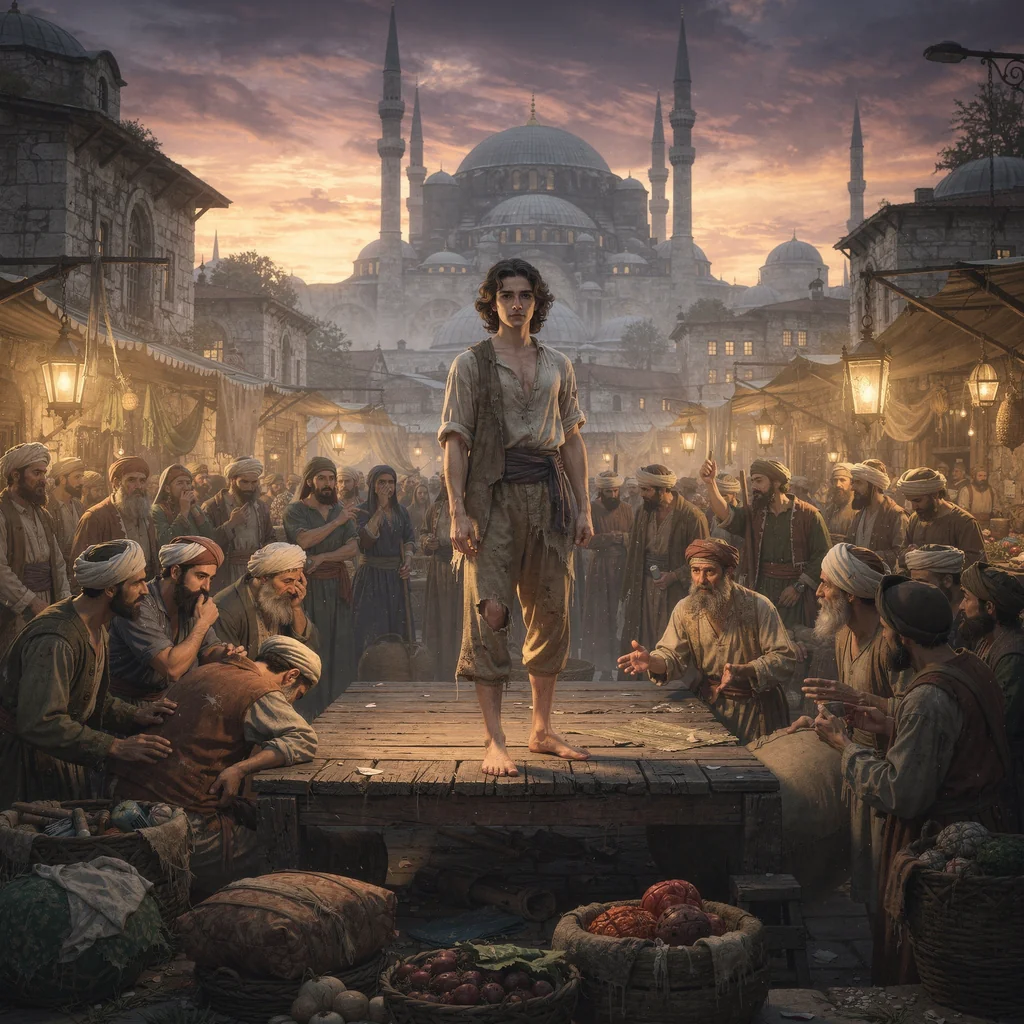
The boy stood at the window of the room that was now his.
Seventeen years old. Circassian. Sold twice before arriving here.
Beyond the gardens, the white houses of Tunis climbed the hill. At the garden’s far edge, olive trees caught the afternoon light, their silver leaves lifting in a breeze from the sea he could not yet see.
The chamberlain had called him Kheireddine — the name Ahmad Bey had given him when the purchase was arranged. The transaction happened in Istanbul, through agents who moved in the quiet channels connecting the Circassian families to the households of Tunis.
The room was better than anything he had known since the village burned. A proper bed. A desk. A window that looked onto the palace gardens.
Two books lay side by side on the wood. A French grammar primer, bound in blue leather. An Arabic Quran, its cover worn soft by hands he could not name.
The chamberlain had explained: Bardo military school opened next month. The Bey wanted soldiers who could read artillery manuals in French and legal arguments in Arabic.
The boy who was now Kheireddine looked from the books to the trees.
The French book smelled of new leather and ink. The Arabic book smelled of old paper and hands that had held it before him.
He reached for the Arabic text first.
Smoke. The smell of burning wood and wool and something else.
The boy — not yet Kheireddine, still the son of Hasan Leffch — crouched behind the stone wall of the animal pen. The goats were gone, taken or slaughtered, he didn’t know which. His mother had been here when the shooting started. Now she was not.
His father stood in the doorway of their house, the rifle he had carried since the wars against the Ottomans raised now against a different enemy. Russian soldiers advancing through the smoke, their gray uniforms visible between the burning houses.
Hasan Leffch fired. A Russian soldier fell.
The boy watched through the smoke. His father reloading. The Russians advancing. The shot that took his father in the chest, the red bloom spreading across the white wool of his tunic.
His father fell.
The boy did not scream. Did not move.
The Russians reached the house. Checked the body. Took the rifle. Moved on.
Someone took the boy by the arm. Not a Russian — a man from the next village, one who had survived the raids before and knew what happened next. The man pulled him toward the trees, away from the smoke.
They walked for three days. Through forests where the leaves were just beginning to turn. Along roads that led to Sukhum, the fort on the coast where men bought and sold what the raids produced.
The boy looked back once. The village was still burning. The trees were still standing.
The house stood in a district of Istanbul where the streets were narrow enough to touch both walls if you stretched your arms. The boy — now called Khair, the good one — had lived here for seven years.
Tahsin Bey was naqib al-ashraf, head of the Prophet’s descendants. His authority came from blood the boy did not have. He demanded service instead.
The Arabic tutor was a thin man with a beard that had begun to gray, who held a reed pen like a weapon and used it to correct the boy’s mistakes before the ink dried.
“Again,” the tutor said.
The boy bent over the paper. Arabic letters flowing from right to left, the reed scratching the surface. Bismillah al-Rahman al-Rahim. In the name of God, the merciful, the compassionate.
“You learn quickly,” the tutor said. “Language is the door to worlds. Your Arabic will be better than your Turkish soon. Better than the Circassian you have forgotten.”
The boy did not remember Circassian. Had not spoken it since the men took him from the forest. Had not needed it.
“Tahsin Bey prepares you for service,” the tutor said. “Not as a slave. As an elite of service. Men with no family, no tribe, no faction — men who serve the state alone. This is the Mamluk way.”
The boy wrote another line. The letter qaf, strong at the throat. The letter dad, heavy on the tongue.
“Service to whom?” the boy asked.
“To whoever holds power,” the tutor said. “Power changes. Service remains.”
Outside the window, the call to prayer rolled over Istanbul from a hundred minarets. The boy wrote another line. The Arabic took shape beneath his hand.
The Arabic tutor was already waiting, the reed pen scratching across paper. The boy sat across from him, the morning light falling through the window, illuminating the dust motes floating in the air.
“Today,” the tutor said, “we read Quran.”
The boy opened the book to where the tutor pointed. Surah Al-Baqara. The Cow.
The Arabic was beautiful — flowing, connected, the letters running into each other like water seeking the lowest point. He traced the words with his finger, sounding them out, the tutor correcting his pronunciation when his tongue stumbled over the emphatic consonants.
“La yukallifu Allahu nafsan illa wus’aha” — God does not burden a soul beyond its capacity.
The tutor looked up. “What does this mean?”
The boy thought. The Arabic was becoming easier, the words taking shape in his mind before he spoke them.
“God does not ask more than we can give,” the boy said.
The tutor nodded. “And if you are a slave? If you are far from home? If you do not know where your family is?”
The boy was quiet.
“Then,” the tutor said, “the burden is what it is. And you carry it, because that is what souls do. They carry.”
Persian grammar. Ottoman history. The names of sultans and viziers, of battles and treaties, of an empire that stretched from Vienna to Yemen, from Algiers to Baghdad.
Then the tutor closed the grammar book. Opened a new text — a slim volume of Islamic jurisprudence, fiqh, the study of what is permitted and what is forbidden.
“Today,” the tutor said, “we begin the law.”
The boy opened the book. The Arabic was denser than the Quran, more technical. Concepts of halal and haram, of wajib and mandub, of obligations and recommendations and prohibitions arranged in a system that had governed Muslim societies for centuries.
“The sharia,” the tutor said, “is not just rules. It is a method of reasoning. It is a way of thinking about justice, about equity, about the common good.”
The boy read the first lines: Justice is the foundation of governance. The purpose of law is to preserve five things: religion, life, intellect, lineage, and property.
He looked up. “These five — they can be protected?”
The tutor nodded. “They can. By institutions that enforce law fairly. By judges who are independent. By rulers who are bound by the same rules as their subjects.”
“Like Ḥammūda?” the boy asked. The tutor had mentioned the Bey’s name in passing.
The tutor was surprised. “You know of Ḥammūda Pasha?”
“I heard visitors speaking,” the boy said. “Men who came to Tahsin Bey’s house. They spoke of a Bey in Tunis who built courts, who appointed judges, who made the law equal for all.”
The tutor was quiet for a moment. Then he smiled — a small, rare expression.
“Ḥammūda Pasha understood what few rulers understand,” the tutor said. “He understood that justice is not arbitrary. Justice is a system. A method. A way of governing that survives beyond the men who build it.”
The boy looked at the fiqh text, at the words about justice and governance.
“The Köprülü era,” the tutor said, teaching him the names of viziers from the previous century. “They were Albanian, not Circassian, but the method was the same — slaves elevated to serve, bound to nothing but the state.”
The tutor wrote a word in Arabic: qantara — bridge.
“Köprülü means bridge-maker,” the tutor said. “The name came from the town where their ancestors lived, but the meaning is clear. They built bridges between what was dying and what might be born.”
He named one: Köprülü Mehmed Pasha, who saved the Empire in 1656 and died in office at eighty-one.
“Did he succeed?” the boy asked.
“He bought the Empire time,” the tutor said. “That is what all of them do, in the end.”
The village burning. The men who took him. The ship that carried him across the Black Sea.
The boy was quiet. Circassians who became Grand Viziers. Slaves who saved empires.
“Perhaps,” the tutor said, “you will follow their path.”
Tahsin Bey rose late, attended by servants who dressed him in the robes of his station. The Bey’s children — his sons, his daughters, his nephews — moved through the house with the confidence of people who had never known uncertainty.
From the doorway of his small room, the boy watched.
The Bey’s sons spoke Turkish with each other, Arabic with the tutors, French with the European visitors. They moved between languages the way the boy moved between shadows — unthinking, effortless.
She was twelve, dark-haired, dark-eyed.
“You are the Circassian,” she said.
“Khair,” he said. “The name they gave me.”
“Khair means good,” she said. “The good one. Did you know that?”
“I did not.”
She sat beside him on the stone bench. The evening was cool, the scent of jasmine rising from the garden.
“My father says you learn quickly,” she said. “He says your Arabic will be better than mine soon.”
“He is kind to say so.”
“He is not kind,” she said. “He is observant. You are lonely here. You have no family. No tribe. You are alone.”
The boy remained silent.
“I am sorry about your village,” she said. “About your parents. About — everything.”
She placed a hand on his arm. Her skin was warm against his.
“We are not all monsters,” she said.
The Bosphorus moved outside his window. The ships passed in the darkness, their lights flickering on the water. The city slept, the call to prayer silent until dawn.
The girl’s hand on his arm returned to memory. Her words: We are not all monsters.
His father in the doorway. His mother pulling him toward the trees. The smoke rising from the village.
The Arabic words learned that day: La yukallifu Allahu nafsan illa wus’aha. God does not burden a soul beyond its capacity.
Eyes closed. The sound of the water carrying him toward sleep.
The ship rolled in the Mediterranean swell. The boy — seventeen now, almost a man — stood at the rail, salt spray on his face. Behind him: Istanbul, the house of Tahsin Bey, the Arabic lessons, the reed pen scratching paper. Ahead: Tunis, Ahmad Bey’s court, the Bardo Palace.
He had been told: Ahmad Bey was different from the beys who came before. He wanted soldiers who knew French science and Arabic law. He wanted men who could read artillery manuals and argue before the ulama.
The ship’s captain had told him: The Bey had requested a Circassian Mamluk. Someone young enough to train, old enough to remember where he came from. Someone with no family in Tunis, no tribe, no faction. Someone whose loyalty could only be to the Bey.
Hands gripped the rail. Salt spray dried on his skin.
He was being passed from one master to another, that was true. But Tahsin Bey had given him something his father could not: the tools to survive the passing. Arabic. Persian. Ottoman history. Islamic law. The knowledge that a man with no family could serve any master who held power, and perhaps someday become one himself.
The coastline of Africa appeared through the haze. Tunis. The white city on the hill.
The boy who was now Kheireddine did not look back at Istanbul.
The ship entered the harbor of La Goulette.
The chamberlain found him in the corridor the next morning. Mahmud, with his gray beard and his voice that had spent thirty years explaining things to new arrivals.
“The Bey has granted you an audience,” Mahmud said. “This afternoon. But first — a man who wishes to meet you.”
He led Kheireddine through corridors that were becoming familiar, past the council chamber where the Bey would hold court later, into the gardens where the morning light caught the marble paths.
A man stood among the trees. Not young. His beard was gray, his face lined, his eyes sharp with intelligence.
“Mahmud Qabadu,” the man said. “I teach Arabic and Islamic sciences at the military school. You begin classes next month.”
“Kheireddine,” he said. “The name the Bey gave me.”
“I know who you are,” Qabadu said. “I know you came from Istanbul by way of the Caucasus. I know you learned Arabic in Tahsin Bey’s household. I know you are seventeen.”
Kheireddine waited.
“Do you know who Ḥammūda Pasha was?” Qabadu asked.
“A great Bey,” Kheireddine said. “The one who planted these trees.”
Qabadu nodded. “He understood something that men like Khaznadar have forgotten. A tree is not something you possess. It is something you tend. You plant it for your children, not for yourself.”
He looked at the trees in the garden, their leaves lifting in the breeze.
“Ḥammūda planted institutions the same way,” Qabadu said. “Schools. Courts. The council that advised him. He knew they would not bear fruit in his time. But he planted them anyway.”
Kheireddine looked at the trees. The morning light caught the silver leaves.
“And now?” Kheireddine asked.
“Now the men who inherited Ḥammūda’s garden are cutting down the trees to sell the wood,” Qabadu said. “They think the value is in the timber. They do not understand that the value is in the olives, year after year, generation after generation.”
Qabadu touched Kheireddine’s shoulder.
“Learn what the French officers teach you at the school,” he said. “But learn why they teach it. They do not teach you because they love you. They teach you because they need you to be useful to them. The question is: useful for what?”
Kheireddine did not have an answer.
Qabadu bowed slightly. Walked back toward the palace.
Kheireddine stood alone in the garden. The silver leaves lifted in the breeze. The palace walls rose white above him, stone upon stone.
The classroom smelled of chalk dust and ink, of wool uniforms and the sweat of forty boys from across the Regency. Tunisian sons of notable families. Circassian Mamluks like himself. One or two Turks, their fathers remnants of earlier administrative waves.
At the front: a French officer in a blue coat that had seen better days, his white gloves stained with chalk. He drew a diagram on the blackboard with precise strokes — a parabolic curve, the trajectory of a cannonball.
“La gravité,” the officer said. “Elle ne connaît pas les frontières.”
Kheireddine watched the curve take shape on the board. Gravity knew no borders. The words were in French, but the principle was universal.
“The same mathematics that governs the cannonball,” the officer continued, “governs the planets. The same laws that bring the rain to the olive groves of Tunis bring the ships to Marseille. There is no Muslim physics. There is no Christian physics. There is only physics.”
Kheireddine wrote the equation in his notebook. The Arabic numerals familiar from his studies with Tahsin Bey’s tutors. The French words unfamiliar but not incomprehensible.
Qabadu in the garden: You are learning from the men who may one day rule you. But what they teach you is not French. It is human knowledge that once passed through Baghdad and Cordova, through Samarqand and Qairawan, and now passes through Paris on its way back to you.
Kheireddine looked at the parabolic curve on the blackboard. He wrote the equation.
The harbor of La Goulette was a forest of masts. French merchant ships. Italian fishing boats. The Bey’s new steam frigate, the Nasr, smoke rising from its funnel even at anchor.
Kheireddine stood on the dock, twenty-five now, a brigade general in the Bey’s army.
Behind him: the customs house. Men in European coats counting crates. The ledgers showing what came in and what went out, the balance tilting further each year toward the import column.
“General Kheireddine.”
He turned. A man in a Turkish coat embroidered with gold thread. Mustafa Khaznadar. The Bey’s father-in-law. The Minister of Finance. The man whose signature was on every customs ledger, every loan agreement, every document that moved money from the treasury to somewhere else.
“Minister,” Kheireddine said.
“I hear you excelled at the military school,” Khaznadar said. “The French officers speak well of you. They say you understand their mathematics.”
Kheireddine waited.
“The Bey has decided,” Khaznadar said. “You will command the La Goulette garrison. You will oversee port security. You will work with the French consul on customs matters.”
“The port is secure,” Kheireddine said. “The garrison is well-trained. The customs matters are the province of the Finance Ministry.”
“The customs matters are the province of whoever can make them work,” Khaznadar said. “The French are demanding. They want favorable rates. They want their citizens exempt from local courts. They want the Bey to guarantee their loans.”
Kheireddine watched a French ship unload crates of textiles. The crates stamped with names from Marseille and Lyon.
“And what does the Bey want?” Kheireddine asked.
Khaznadar smiled. The smile did not reach his eyes.
“The Bey wants what every Bey wants,” Khaznadar said. “To modernize his army. To build palaces that impress the Europeans. To borrow money today and worry about repayment tomorrow.”
The balance ledger. Imports exceeding exports. The raw materials leaving Tunis — wool, olive oil, grain — and returning as finished goods priced ten times higher.
“What happens,” Kheireddine asked, “when the loans cannot be repaid?”
Khaznadar’s smile disappeared.
“Then the lenders take collateral,” he said. “Which is why the Bey needs men who understand the French. Men who can negotiate. Men who can delay the day of reckoning.”
“I am a soldier,” Kheireddine said.
“You are whatever the Bey needs you to be,” Khaznadar said. “That is the Mamluk way. That is why you were purchased. That is why you were educated. That is why you are here.”
Khaznadar turned back toward the customs house.
“Welcome to the port, General Kheireddine. Try not to look too closely at the crates.”
Eighteen years since he arrived at Bardo. The boy from the Caucasus was thirty-three now, stout and burly, his hair dyed deep black.
Ahmad Bey sat on the throne that had once been Ḥammūda’s. The Bey was fifty now, his face lined with worry, his hands restless. The psychological breakdown that historians would document was already visible in the small things — the way he checked the locks three times, the way he asked the same question twice, the way his eyes darted toward the door whenever someone entered.
“Kheireddine,” the Bey said. “You have served well at La Goulette. The French consul speaks well of you. The port is secure. The customs flow is — adequate.”
“Your Highness,” Kheireddine said. He did not bow. Mamluks did not bow; they stood straight, a reminder that they were property elevated to power, not subjects born to it.
“I have a new position for you,” Ahmad Bey said. “Minister of Navy.”
Kheireddine did not react. He waited.
“The fleet needs modernization,” the Bey said. “The ports need expansion. The passport system needs reform. There is talk of cholera in Alexandria. We need quarantine procedures. The French want to help. They want to sell us ships. They want to train our sailors. They want —”
“Your Highness,” Kheireddine said. “The Ministry of Navy requires substantial funds. The treasury is already —”
“The treasury is my concern,” the Bey said. His voice sharpened. “Do not speak of finances. That is Khaznadar’s domain. Yours is the sea. Your domain is ships and ports and sailors. Your domain is making Tunis a modern naval power.”
Kheireddine looked toward the window. The gardens stretched to the sea. Ḥammūda’s legacy, still visible.
“Your Highness,” Kheireddine said. “May I speak plainly?”
The Bey hesitated. Then nodded.
“A navy requires industry,” Kheireddine said. “Ships require shipyards. Shipyards require ironworkers. Ironworkers require iron mines. All of this requires a plan that spans decades, not years. The French can sell us ships. They cannot sell us the capacity to build them. If we purchase their ships, we become dependent on them for every replacement part, every repair, every improvement. We become a navy that exists only as long as the French allow it to exist.”
Ahmad Bey stood. He walked to the window, looked out at the gardens. At the trees Ḥammūda had planted.
“You sound like Ḥammūda,” the Bey said quietly. “He spoke of institutions. Of capacity. Of things that outlast the men who build them. He refused to purchase what he could build himself.”
“Ḥammūda is dead,” Kheireddine said. “His trees are still standing.”
The Bey turned from the window. His eyes were tired.
“Ḥammūda lived in a different time,” Ahmad Bey said. “The world has changed. The Europeans are stronger now. Their ships are faster. Their guns are more accurate. If we do not modernize, they will simply take what they want. If we do modernize, perhaps we can negotiate as equals.”
“Your Highness,” Kheireddine said. “Negotiation requires something to trade. What do we have that they cannot simply take?”
The Bey did not answer.
“I accept the position,” Kheireddine said. “Minister of Navy. I will modernize the ports. I will reform the passport system. I will establish quarantine procedures. But I will also begin the long work of building what we need to stand on our own.”
“Khaznadar will oppose you,” the Bey said. “He will say the costs are too high.”
“Khaznadar says the costs of everything are too high,” Kheireddine said. “Except the costs of borrowing.”
The Bey managed a faint smile.
“Then you will have an enemy,” the Bey said. “Khaznadar has been Minister of Finance for twenty years. His network is deep. His family is powerful. He is my father-in-law. Be careful, Kheireddine. The gardener who planted them is gone. The men who inherited the garden do not all share his vision.”
Kheireddine bowed slightly. The only Mamluk gesture of respect he allowed himself.
“I understand, Your Highness.”
When he left the room, he walked past the gardens. The stone paths were cool beneath his boots.
Kheireddine stood at the gate of Sadiki College. The courtyard was empty now, the students dismissed to their homes, the arched windows catching the last light of the autumn afternoon.
He touched the stone gatepost. The stone was cool beneath his hand.
He walked through the empty courtyard, his boots echoing on the tiles.