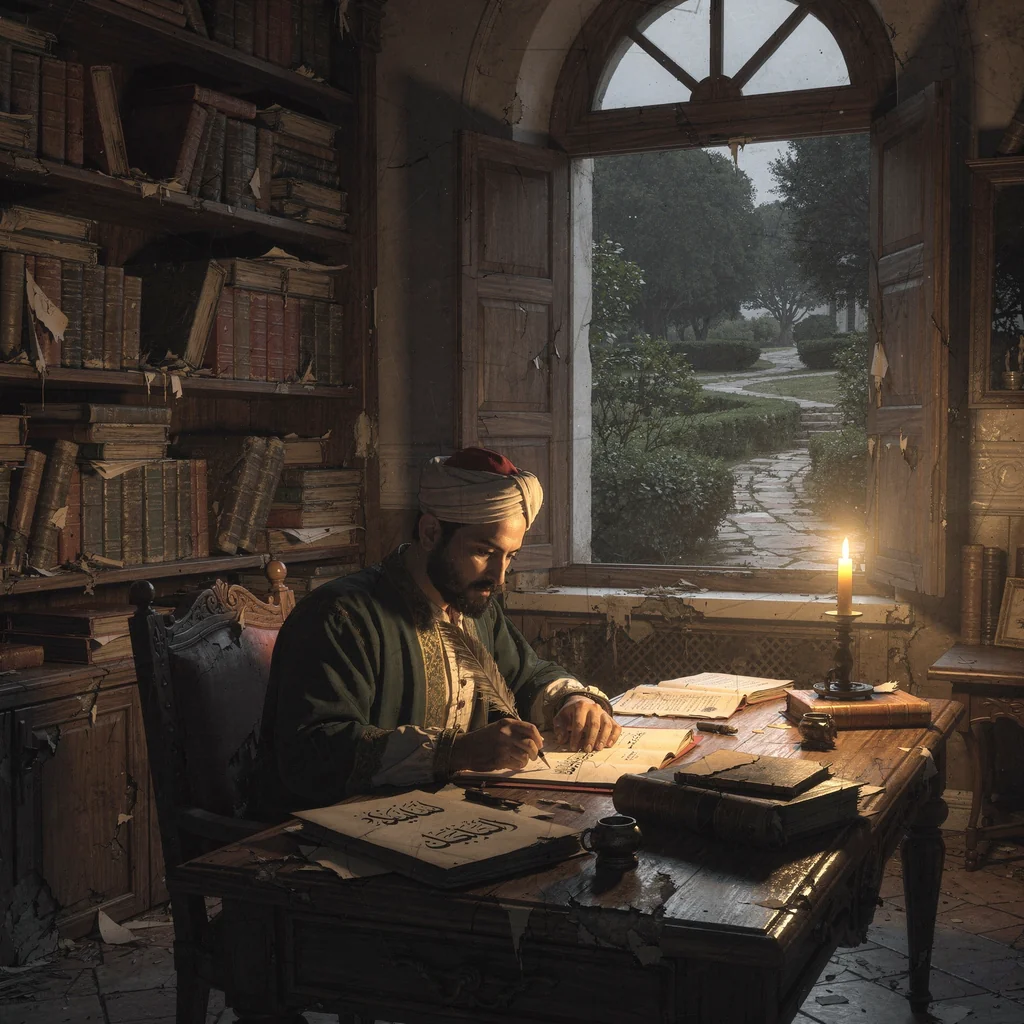
They sat in the study at La Manuba.
Mahmud Qabadu. Salim Bu Hajib — a scholar from Zaytuna. Muhammad Bayram V — another Zaytuna professor who had written about educational reform.
On the desk: a blank page. A pen. An inkwell.
“We have come,” Qabadu said, “to ask what you intend to do.”
Kheireddine gestured toward the blank page on his desk.
“I intend to write,” he said. “A book. A comprehensive argument for the reforms Tunisia needs. Not just a constitution. Not just a council. The whole system — the economic reform, the educational reform, the institutional reform. Everything.”
“In Arabic?” Bayram asked.
“In Arabic,” Kheireddine said. “For Tunisian readers. For the ulama. For the students. For anyone who will listen.”
“And for Europeans?” Bu Hajib asked.
Kheireddine paused.
“There will be a French translation,” he said. “But the primary audience is Muslim. I want to show that reform is not betrayal of Islam. I want to show that reform is retrieval of what Muslims once had. I want to show that the European strength comes from institutions that Muslims invented, then forgot, then must remember.”
Qabadu nodded. A slow, deliberate movement. Like a tree settling into the wind.
“We will help you,” he said. “Bu Hajib. Bayram. Myself. We will research. We will edit. We will provide the theological grounding you need.”
“Why?” Kheireddine asked. “I am a Mamluk. A Circassian. A slave who rose to power and then lost it. I have no tribe. No faction. No constituency. Why help me?”
Qabadu’s eyes crinkled with a faint smile.
“Because you are the only one who sees clearly,” the old Sufi said. “The notables — they see only their land. The Mamluks — they see only their salaries. The merchants — they see only their profit.”
He leaned forward. His voice dropped to the tone of a man sharing a secret.
“The tree that is attached to nothing can grow toward the light. The tree that is tied to a thousand ropes cannot move at all.”
He looked at Kheireddine.
“You have no family. No tribe. No property. You are free.”
“Free,” Kheireddine repeated.
“Free to speak the truth,” Qabadu said. “Free to do what must be done. Free to fall without taking anyone else with you.”
Kheireddine looked at the three men who had come to help him. Scholars of the establishment, men who had served the system, men who had benefited from it. They were risking their positions by associating with him.
And yet they had come.
“Then we begin,” Kheireddine said. “But this will take years. The research. The writing. The arguments. We are building not just a book — we are building an intellectual foundation for the next attempt.”
“When will it be published?” Bayram asked.
“When it is ready,” Kheireddine said. “When every argument is sound. When every citation is correct. When there is no weakness that Khaznadar can exploit, no error that the ulama can seize.”
He dipped his pen in the inkwell.
“The title,” Kheireddine said. “I have been thinking about the title.”
“What title?” Qabadu asked.
“Aqwam al-Masalik fi Ma’rifat Ahwal al-Mamalik,” Kheireddine said. “The Surest Path for Knowledge of the State of Nations.”
Qabadu repeated the title in Arabic. His eyes widened.
“The Surest Path,” he said. “You are saying there is only one path. And that you have found it.”
“I am saying,” Kheireddine said, “that the path is not imitation. The path is not blind borrowing. The path is retrieval of what Muslims once had. The path is reconstruction of what was lost.”
He touched the pen to the paper.
“The path,” he said, “is justice. Justice was the foundation of Islamic strength. Injustice is the cause of Islamic decline. Restore justice, and the rest will follow.”
The first words:
In the name of God, the merciful, the compassionate. The motive for a work is its true beginning. Therefore it is appropriate that we set out our motive in writing.
Kheireddine wrote. The three scholars watched. The pen moved across the paper, the ink drying black on white.
The study had become a research center. Books stacked on the floor. Papers spread across every surface. Maps of Europe pinned to the walls. Statistical tables of imports and exports, loans and repayments, tax revenues and expenditures.
Kheireddine worked with the methodical intensity of a man who had nothing but time.
He read the French economists — Say, Bastiat, the Saint-Simonians who argued that industry was the key to national power. He read the English philosophers — Locke on government, Montesquieu on the separation of powers, Bentham on utility.
He read the Islamic historians — Ibn Khaldun on the rise and fall of dynasties, al-Maqrizi on the fiscal crisis of the Mamluks, Ibn Kathir on the collapse of the caliphate.
He read the Ottoman reports — the Tanzimat decrees, the debates in Istanbul over constitutionalism, the struggles between the sultans and the Janissaries.
And everywhere, the same pattern:
Nations rose when justice prevailed. Nations fell when injustice became entrenched. The specific form of government mattered less than the underlying principle: that the ruler was bound by law, that the wealth of the community served the community, that the strong were restrained from preying on the weak.
A servant entered with news.
“Report from the interior,” the servant said. “The tax collectors have returned. The doubled tax is being collected. The prisons are full. The courts are overwhelmed.”
Kheireddine did not look up from his notes.
“And the uprising?”
“Crushed,” the servant said. “Ibn Ghadhahum is still in hiding. His followers have been arrested or killed. The notables have submitted. The tribes have paid.”
Kheireddine nodded. Made a note in the margin of the text he was reading.
The note read: This confirms the argument. Injustice creates resistance. The more the state presses, the more the people resist. The solution is not more force. The solution is less injustice.
Bu Hajib found him later that evening.
The scholar looked at the stacks of books, the maps, the tables of statistics.
“You have been reading for months,” Bu Hajib said. “When will you begin writing?”
“I have been writing,” Kheireddine said. “Every note is part of the argument. Every citation is a brick in the wall. I am not writing a pamphlet. I am writing a comprehensive defense of reform.”
“Khaznadar is still borrowing,” Bu Hajib said. “The debt grows. The French press for repayment. There are rumors that they will send warships if the next payment is missed.”
Kheireddine looked up.
“And what would you have me do? Return to the council? Argue before men who have already proven they will not listen? Watch as Khaznadar destroys the country while the Bey checks the locks on his doors?”
“No,” Bu Hajib said. “But I worry that by the time the book is finished, there will be nothing left to save.”
“Then we had better work quickly,” Kheireddine said.
He turned back to his notes. Bu Hajib watched him for a moment, then left.
Outside the window, the sun set over Tunis.
The city was unchanged. The same white houses climbing the hill. The same minarets calling the faithful to prayer. The same harbor where French ships rode at anchor. More of them each year.
He was writing for a future that might not arrive in time.
He wrote anyway.
The manuscript was growing. Chapter by chapter, argument by argument, the structure was emerging.
Kheireddine sat with Qabadu, reviewing what had been written.
“The first task,” Kheireddine said, “is to spur the reformers. To show the statesmen and scholars that there is a path forward. To demonstrate that reform is not betrayal of Islam, but fulfillment of its highest principles.”
He touched the pages of the manuscript.
“The second task is to warn the heedless. To show the Muslim masses that blind rejection of European knowledge is a mistake. To demonstrate that what Europeans have achieved is based on principles that Muslims once possessed, lost, and must now recover.”
Qabadu read the passage Kheireddine indicated.
“There is no reason to reject or ignore something which is correct and demonstrate simply because it comes from others, especially if we had formerly possessed it and it had been taken from us.”
The old Sufi looked up.
“This is the core argument,” Qabadu said. “Recovery, not imitation. We are not borrowing from Europe. We are taking back what was once ours.”
Qabadu nodded slowly.
“This will be controversial,” the old Sufi said. “The conservatives will say you are calling for innovation. They will say you are calling for blind imitation of Europe.”
“I am calling for neither,” Kheireddine said.
He dipped his pen in the inkwell.
“Write, Shaykh Qabadu. Edit. Research. We have work to do.”
Qabadu came for him at sunset.
“It is Thursday,” the old Sufi said.
Kheireddine knew what that meant. The Thursday dhikr circle — the weekly gathering where Qabadu’s order met to recite the prayers, to remember God, to maintain the network that Ḥammūda had understood but could not write into his institutions.
“I am not —,” Kheireddine stopped. “I am not like you. The prayers, the devotion — it does not come easily to me.”
“The circle is not for people like me,” Qabadu said. “It is for people like you.”
They walked through the medina.
The streets were narrow, the walls high. The call to prayer had just ended, and men were streaming out of the smaller mosques, heading home or to the market. Qabadu moved through the crowd with an easy familiarity — greeting a merchant here, nodding to a porter there, exchanging a word with a water seller.
Kheireddine followed, uncomfortable in his fine clothes, aware that he was recognized but not sure what people knew of him. The former minister. The man who had resigned. The reformer writing in exile.
The zawiya was a small building near Zaytuna Mosque.
A simple courtyard. A room for prayer. A space for gathering. No grand architecture, no ornamentation, nothing to announce its importance to anyone passing by.
Inside, twenty men waited. They sat in a circle on carpets that had been worn thin by years of use. Kheireddine saw the diversity of them — a farmer with calloused hands, a merchant in Turkish clothing, a scholar with ink-stained fingers, three laborers who carried the smell of the docks on their clothes, an old man who might have been a soldier in his youth.
They were not all educated. They were not all wealthy. They were not all from the same tribe or the same city. But they sat together as equals.
Qabadu took his place in the circle. Kheireddine sat beside him.
The dhikr began. The recitation — La ilaha illa Allah — repeated in rhythm, the voices blending together, the sound filling the small room. Kheireddine joined in, but his voice was stiff, his timing slightly off. He was an intellectual, a Mamluk officer, a man of arguments and institutions. The physical practice of devotion was foreign to him.
He felt the rhythm of the circle, the breathing, the movement of bodies swaying together. He felt the discomfort of being somewhere he did not fully belong. But he stayed.
An hour passed.
The dhikr ended. The men rose, stretching limbs grown stiff from sitting. They greeted each other, exchanged news, spoke of families and harvests and prices in the market.
Qabadu did not preach. He did not offer theological instruction. He simply participated — his presence in the circle was the teaching.
A farmer approached Kheireddine as they prepared to leave.
The man was old, his face weathered, his clothes simple. He did not bow or use formal titles.
“You are Kheireddine,” the farmer said.
“I am.”
“The minister who resigned when they doubled the tax.”
Kheireddine nodded.
“My brother’s son was in the revolt,” the farmer said. “When they doubled the tax. He fought against the tax collectors. He was killed.”
Kheireddine was quiet.
“My village remembers,” the farmer said. “We know who stood with us. We know who resigned.”
He touched his forehead and left.
Qabadu walked beside Kheireddine in the narrow street.
The old Sufi said nothing for a long moment. They moved through the cooling air of the medina, the shadows lengthening across the cobblestones.
“I taught a student once,” Qabadu said. His voice was calm, conversational. “A boy from the Sahel. Smart. Devout. I thought he would become a scholar.”
Kheireddine glanced at him.
“He became a tax collector instead,” Qabadu said. “Khaznadar recruited him. The salary was good. The authority was better. He was the one who doubled the tax in his district in 1864.”
Kheireddine was quiet.
“He led the raid that killed the farmer’s nephew,” Qabadu said. “The same nephew we just heard about. The boy I taught became the man who killed him.”
Qabadu stopped at a street corner. The call to prayer echoed from a distant minaret.
“I still see his face when I try to pray,” Qabadu said. “The boy he was. The man he became. Both true. Both my responsibility.”
He turned toward Kheireddine.
“This is what you must understand,” Qabadu said. “The network works. But it also fails. I have carried men through darkness, and I have carried men into darkness. Both are true. Both are the work of a teacher.”
He walked on, leaving Kheireddine with the weight of it.
Kheireddine stood in the courtyard.
The farmer had known his name. Had known he resigned. Had carried that knowledge from the Sahel.
The dhikr circles. The mosques. The spaces where power could not reach.
Qabadu waited at the door. The old Sufi said nothing. There was nothing to say.
They walked back through the medina.
The shops were closing now. The merchants were counting their day’s earnings. The streets were emptying. But the network remained — invisible, resilient, carrying knowledge through the darkness that was coming.
The economic argument was the most difficult. It required numbers. It required evidence. It required showing, not just telling, that the current system was destroying Tunisia’s wealth.
Kheireddine worked with customs records.
The import ledgers: French textiles, Italian soap, English tools. All entering Tunisia duty-free or at minimal rates.
The export ledgers: Raw wool, unprocessed olive oil, raw cotton. All leaving Tunisia at prices that barely covered the cost of production.
The calculation was brutal.
A Tunisian farmer sold wool to a French merchant for one franc per kilogram. The French merchant shipped the wool to Marseille, where it was processed into cloth. The same wool, now cloth, returned to Tunisia at ten francs per kilogram.
The value added by processing — nine francs — went to France. Tunisia received only the raw value.
Kheireddine wrote:
“In sum, we now get only the value of our land’s raw materials. We receive none of the increased value resulting from the manufacturing process, the basic means of creating abundance.”
He paused. Read the paragraph again.
Bu Hajib entered with documents.
“The figures on the debt,” Bu Hajib said. “Khaznadar has taken twelve new loans since 1864. The interest payments are now forty percent of the budget.”
Kheireddine took the papers. Scanned the numbers.
“The debt is not the problem,” Kheireddine said. “The debt is a symptom. The problem is the trade imbalance. We export raw materials and import finished goods. The difference is profit for Europe and poverty for Tunisia.”
He wrote another paragraph.
“The shepherd, the silk farmer, the cotton farmer — they spend the entire year in labor, sell the produce of their work to the European for a cheap price, and then in a short time buy it back, after it has been processed, at a price several times higher.”
Bu Hajib read over his shoulder.
“This will make people angry,” Bu Hajib said.
“It should make them angry,” Kheireddine said. “The situation is outrageous. The question is what they will do with their anger. Will they demand reform? Or will they blame the messenger?”
He looked at the figures on the debt.
“Forty percent of the budget,” Kheireddine said. “For interest payments. This cannot continue. The moment will come when the loans stop. When the French refuse to lend more. When the debt cannot be paid.”
“What happens then?”
“Then the French will offer a solution,” Kheireddine said. “They will offer to administer the Tunisian treasury directly. They will offer to collect the taxes directly. They will offer to guarantee that their loans are repaid.”
“And that will be the end of independence,” Bu Hajib said.
“Yes,” Kheireddine said. “Unless something changes.”
He wrote the closing of the economic chapter:
“The question is not whether we can avoid European domination. The question is whether we can meet the Europeans on equal footing, with institutions that protect our interests, with industries that process our own production, with schools that teach our children what they must know to survive in this age.”
“The surest path is not isolation. The surest path is not imitation. The surest path is retrieval of what we once had, combined with what we need now.”
The accountant spread the ledger on the desk. The book was large, bound in leather, the pages thick with handwritten entries in Arabic and French.
Kheireddine sat opposite the man, a functionary from the Ministry of Religious Endowments. The accountant’s fingers were stained with ink. His eyes were tired.
“The Zaytuna waqf,” the accountant said. “The largest in Tunis.”
He turned the pages.
“Four thousand hectares of land. Three hundred wells. Two bakeries. Twelve shops in the medina. The caravanserai near the French consulate. The olive groves at La Manuba. The income from all of it supports the university, the mosques, the schools for the poor.”
Kheireddine scanned the entries. The numbers were precise. The accounting was meticulous.
“The annual revenue?” Kheireddine asked.
“Two hundred thousand francs,” the accountant said. “All of it designated for specific purposes. Teacher salaries. Student stipends. Bread for the poor. Maintenance of the mosques. None of it can be diverted.”
Kheireddine nodded. “And the Bey?”
The accountant paused. His hands hovered over the ledger.
“The Bey has asked,” the accountant said carefully. “For a loan. From the waqf treasury. To be repaid from future customs revenues.”
“Has the loan been made?”
“No,” the accountant said. “The council of trustees refused. They said the waqf funds are religious endowments, given to God, and cannot be loaned to the state.”
Kheireddine looked at the ledger. The entries went back fifty years. Every revenue stream recorded. Every expenditure accounted for. The waqf was a universe unto itself, an economy that operated outside the state’s control.
“Can the Bey sell any of it?” Kheireddine asked.
The accountant looked up. “Sell what? The land? The buildings?”
“Any of it.”
The accountant shook his head. “No. It was given to God. The donor made the endowment perpetual. The property cannot be sold, cannot be mortgaged, cannot be confiscated. It belongs to God, not to the state.”
He pointed to the entry on the first page.
The Arabic script was clear: Waqf li-Allah — Endowment for God.
“This,” the accountant said, “is the commons that cannot be enclosed. The Bey cannot take it. The French cannot seize it. It remains, generation after generation, producing wealth for the community.”
Kheireddine touched the Arabic script. The ink was faded but still legible.
“The French delegation,” Kheireddine said. “I hear they have arrived with maps.”
The accountant’s face tightened. “Yes. They are surveying the coast. They are mapping the harbors. They are asking questions about property ownership. About titles. About what can be sold and what cannot be sold.”
“Do they know about the awqaf?”
“They will know soon,” the accountant said. “They are not stupid. They will discover that a third of the agricultural land in the Regency is waqf property. They will discover that it cannot be bought. They will discover that it cannot be enclosed.”
Kheireddine was quiet. The French could buy land from corrupt notables. They could buy concessions from desperate ministers. But the awqf — the religious endowments that constituted a third of the country’s wealth — were beyond their reach.
The commons that could not be enclosed.
“Protect this ledger,” Kheireddine said. “Make copies. Store them in different locations. The day may come when the French try to claim that the awqaf do not exist. When they come, you must have proof.”
The accountant closed the book. The leather cover was worn, the corners frayed.
“The ledger is safe,” the accountant said. “The awqaf are safe. They will outlast the Bey. They will outlast the French. They will outlast us all.”
He stood. Gathered his papers. Left the room.
Kheireddine remained at the desk.
He opened the ledger again. Turned to the first page. Touched the Arabic script: Waqf li-Allah.
The commons that cannot be enclosed. The wealth that cannot be stolen. The endowment that belongs to God, not to the state.
Outside the window, the garden at La Manuba caught the light. The stone walls rose around it.
Some things could not be taken.
The villa at La Manuba was silent. The servants had retired. Only Kheireddine remained awake, sitting at his desk with a single candle burning.
Janina stood in the doorway.
She was seven months pregnant with their second child. Her hand rested on the swell of her belly. In her other hand, she carried a lamp — a small clay vessel with a cotton wick, the flame sheltered by the curve of her palm.
“You have not slept,” she said.
Kheireddine looked up from the manuscript. “I will sleep when this chapter is finished.”
Janina stepped into the room. She set the lamp on the corner of his desk, beside the stack of papers covered in his cramped handwriting. She had seen the manuscript before — had read parts of it when he left the pages on the table, when he stepped out to the garden, when the children were asleep and she could not resist the temptation to understand what was consuming her husband’s nights.
“The chapter on the judiciary,” she said. “I read it.”
Kheireddine was quiet.
“You write that judges must be independent,” she said. “That they must serve the law, not the Bey. That this is an Islamic principle, not a European import.”
“It is,” Kheireddine said.
“My father reads the law differently,” she said. “He says that the Bey is the law. That judges who disobey are traitors.”
“Your father reads the law as it serves him,” Kheireddine said.
Janina’s hand tightened on the back of the chair. She looked at the manuscript, at the pages of argument and citation, at the book that would make her husband’s name famous and her father’s name infamous.
“The book will have consequences,” she said. “My father will not ignore it. The Bey will not ignore it.”
“I know,” Kheireddine said.
“Then you write it anyway.”
“Someone must write it,” Kheireddine said. “If not me, then who?”
Janina was quiet for a long time. The lamp flickered in her hand. The candle on the desk burned lower.
“Then I will not stop you,” she said at last. “But know this: I see what it costs. I see what it will cost our children. And I see that you would pay this price even if I asked you not to.”
She turned to leave, then paused at the door.
“The baby moved tonight,” she said. “While you were writing. A strong kick. A child who does not like to wait.”
She walked out, leaving the lamp on the desk. The flame joined the candle’s light, casting shadows across the manuscript pages.
Kheireddine sat alone again.
The manuscript of Aqwam al-Masalik lay spread before him. Three years of work. Three hundred pages of argument, of citation, of careful reasoning.
He read the opening lines again.
The motive for a work is its true beginning.
What was his motive?
Justice. Reform. The survival of Tunisia.
But tonight, in the silence of the villa, the question that would not let him sleep was not about justice. It was about cost.
Three years.
While he wrote, Khaznadar ruled. The debt doubled. The loans multiplied. The French pressure increased.
He had heard the reports from the interior. Farmers losing their land to tax collectors. Families selling their children to pay debts. Villages emptying as men fled to Algiers or Tripoli, anywhere but the crushing taxes of home.
And Kheireddine had done nothing.
He had written a book.
“A book,” he said aloud to the empty room. His voice sounded bitter.
A book could not feed a hungry family. A book could not stop a tax collector. A book could not prevent the French from seizing the customs houses.
Only power could do those things. And he had given up his power.
He stood and walked to the window.
The moonlight silvered the garden wall. The stone was cool, the shadows long.
Khaznadar at the desk. The rings on his fingers heavy with gold, the face impassive as Kheireddine accused him of corruption.
Prove it, Khaznadar had said.
And Kheireddine could not prove it. He had known the corruption was happening. He had seen the signs — the loans, the commissions, the unexplained wealth. But he had no documents. No witnesses willing to speak. No proof that would stand in a court.
So he had done the only thing he could do: he had resigned.
Had it been the right choice?
He did not know.
A knock at the door.
Kheireddine started. The candle flickered.
“Come in.”
A servant entered — the night watchman, an old man who had served the palace for forty years.
“Effendi,” the servant said. “There is a woman at the gate. She says she must speak to you.”
“At this hour?”
“She came from the interior,” the servant said. “Three days on the road. She will not leave until she speaks to you.”
Kheireddine hesitated. Then nodded.
“Show her to the receiving room. I will come.”
The woman was standing in the center of the room.
She was thirty years old, perhaps thirty-five. Her face was lined with sun and wind. Her clothes were dusty from travel. Her eyes were red from weeping.
“Effendi Kheireddine,” she said. “I am Fatima bint Ahmad. From the region of Sfax.”
Kheireddine knew the region. The agricultural country, where farmers had worked the same land for generations.
“What brings you here, Fatima?”
“My husband,” she said. “He was arrested by the tax collectors. They said he owed four hundred francs. We do not have four hundred francs. We do not have forty francs.”
She stopped. Her voice broke.
“They took him to the prison in Tunis. I came to ask for his release. I was told that you are a just man. I was told that you would help.”
Kheireddine was silent.
“I am not in the government,” he said. “I cannot order releases.”
“But you have influence,” Fatima said. “You were President of the Grand Council. You were Minister of Navy. Everyone knows your name.”
“That was years ago,” Kheireddine said.
“But you are still Kheireddine,” she said. “You are still the man who opposed the doubled tax. You are still the man who defended the Constitution.”
She looked at him with desperate eyes.
“My husband is innocent,” she said. “He cannot pay what he does not have. They will keep him in prison until he pays. But he cannot pay. So he will rot in prison until he dies.”
Kheireddine felt the weight of her words.
He had no power. He had no authority. He had no way to help her.
But he could not send her away.
“Write down your husband’s name,” Kheireddine said. “Write down the name of the prison. Write down the name of the tax collector who arrested him.”
Fatima’s face brightened with hope.
“You will help him?”
“I will try,” Kheireddine said. “I have no power. But I have friends. Men who still serve in the government. Men who might be persuaded to intercede.”
He did not tell her that his friends were few. He did not tell her that Khaznadar had made it dangerous to associate with him. He did not tell her that the possibility of success was small.
He wrote down the names. He promised to try.
When she had gone, Kheireddine returned to his desk. The candle had burned low. He blew out the candle.
Kheireddine sat at his desk. The printed book lay before him.
Three years of work. Three years of research, writing, revision. Three years of watching from the sidelines as Khaznadar’s debt mounted, as the doubled tax crushed the countryside, as the French grew more impatient.
Qabadu entered. The old Sufi was seventy-five now. His body was frail, but his mind was still clear.
“It is done,” Qabadu said.
“It is done,” Kheireddine agreed.
“What happens now?”
“Now the book is distributed,” Kheireddine said. “To the scholars at Zaytuna. To the students. To the reformers. To anyone who will read it.”
“And Khaznadar?”
“Khaznadar will ignore it,” Kheireddine said. “Or he will attack it. He will say I am a European agent. He will say I am calling for the abandonment of Islam. He will say I am a traitor.”
“Are you worried?”
Kheireddine looked at the book.
“I have written the truth,” he said. “I have shown that reform is Islamic. The capacity for justice, not as aspiration but as mechanism — as the load-bearing wall that holds societies upright.”
He touched the cover.
Outside the window, the sun set over Tunis.
The printed book lay on the desk. The candle had burned to its base. The smell of ink and tallow filled the room.
The fever had come suddenly. One day she was well, the next she could not stand. The doctors came — French, Italian, Tunisian — and they all said the same thing.
There was nothing to be done.
Kheireddine sat by the bed.
Janina lay against the pillows, her face pale, her breathing shallow. She was twenty-eight years old. She had been his wife for eight years. She had given him two daughters and a son.
The son had died with her.
“The baby,” she whispered.
Kheireddine did not want to tell her. The baby had died two days ago. The fever had taken them both.
“Rest,” he said.
Janina’s eyes searched his face. She knew.
“He is gone,” she said.
Kheireddine could not speak.
Janina was quiet for a long time.
“The fever,” she said. “It is the same fever that took my mother. It is the same fever that took my brother. It runs in my father’s family.”
She looked at Kheireddine.
“My father will blame you,” she said.
“He can blame me all he likes,” Kheireddine said.
“He will say that you worked me to death. He will say that your reforms, your struggles, your politics — they killed me.”
“Let him say what he likes.”
Janina’s hand reached for his.
Her fingers were thin. The fever had burned away her strength. But her grip was firm.
“I never asked you to stop,” she said. “I never asked you to choose between me and your work.”
“I know,” Kheireddine said.
“I asked you once,” she said. “I asked you why you fought him. I asked you why you could not leave my father in peace.”
“I remember,” Kheireddine said.
“You never answered me,” she said.
Kheireddine was quiet.
“I will answer you now,” he said. “I fought your father because he was destroying the country our children would inherit. I fought him because the loans, the debt, the corruption — they would lead to ruin. I fought him because someone had to.”
He looked at her.
“But I loved you,” Kheireddine said. “Whatever else I did, however I used our marriage for position, however I benefited from being Khaznadar’s son-in-law — I loved you.”
Janina’s eyes filled with tears.
“I know,” she said. “That was why it hurt. If you had been indifferent, I could have accepted it. But you loved me, and you used me, and you destroyed my father’s power all at the same time.”
She squeezed his hand.
“He would have been called Hasan,” she said. “After your father. After the village.”
Her voice was barely a whisper now.
“Tell me again,” she said. “Why you fought him.”
Kheireddine looked at her. She had asked this before. She had never been satisfied with the answer.
“I fought him,” Kheireddine said, “because the loans, the debt — they would destroy everything. Your father, me, the country, the children.”
Janina was quiet. Her eyes searched his face, looking for something she could not find.
“You loved me,” she said.
“Yes,” Kheireddine said.
“And you used me.”
“Yes.”
Her fingers loosened around his hand.
The hours passed.
Janina drifted in and out of consciousness. She spoke of her childhood in the palace, of riding horses in the gardens, of the days before Kheireddine had come into her life, before politics had divided their marriage.
She spoke of their daughters. “Take care of them. Do not let them be used as I was used.”
She spoke of her father. “He will not survive this. He loved me more than he loved power. When I am gone, he will have nothing left.”
In the evening, she died.
Kheireddine sat by the bed as the breathing slowed. He sat as the chest stopped rising. He sat as the room grew quiet.
He had lost a wife.
He had lost a son.
He had gained — what?
The freedom to finally move against Khaznadar? The ability to overthrow his father-in-law without worrying about Janina’s grief?
This was not a gain. This was a tragedy.
Kheireddine stood.
He walked to the window. The night was dark. The gardens of La Manuba stretched out before him, the stone walls silver in moonlight.
His eyes caught something in the moonlight — a carving in the stone above the doorway, Arabic words worn smooth by centuries of weather.
He moved closer, tracing the letters with swollen fingers.
No victor but God — dominion belongs to God, eternally.
Older than the villa. Older than the Beys.
Kheireddine traced the letters again.
What remained when crowns fell?
But the woman who had walked with him in those gardens was gone.
Khaznadar.
His father-in-law would receive the news tomorrow. The man who had controlled the treasury for twenty-three years, who had accumulated wealth beyond counting, who had treated the Regency as his private bank — he would receive the news that his daughter was dead.
Kheireddine should have felt satisfaction. He should have felt that justice had come to the man who had destroyed Tunisia’s economy.
He felt only grief.
He turned from the window.
The room was quiet. The body was still. The bed was empty.
Kheireddine walked to the door. Stopped in the doorway. Looked back one last time.
Then he walked out.
The door clicked shut. The latch caught.