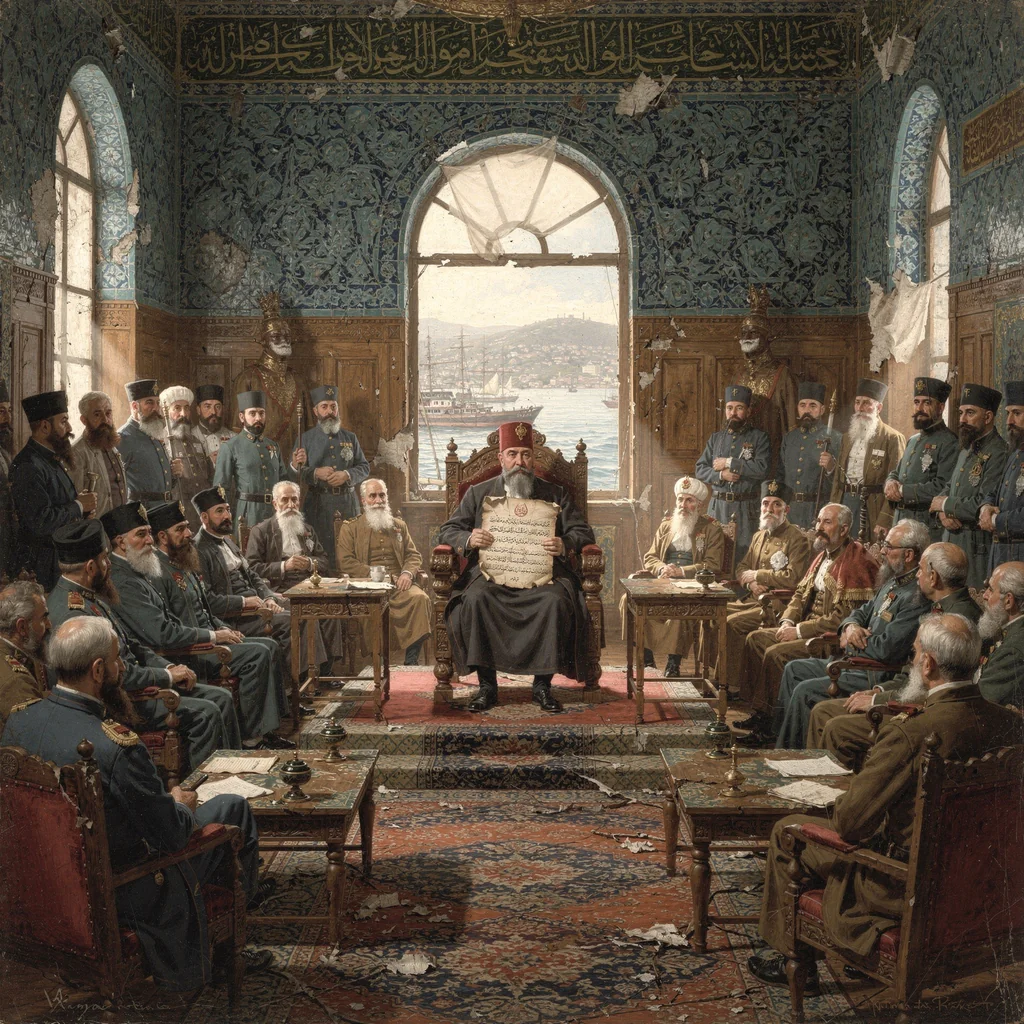
The letter arrived at La Manuba in the morning of November 1878. A courier on horseback from the port, carrying an envelope with the seal of the Ottoman Sultan.
Kheireddine broke the seal.
The letter was in French, the language of diplomacy. The handwriting was precise, the phrases formal.
“From the Sublime Porte of the Ottoman Empire, to His Excellency Kheireddine Pasha, former Prime Minister of the Regency of Tunis.”
“The Sultan, Caliph of the Muslims, Commander of the Faithful, Sovereign of the Sublime State of Osman, has learned of your services to the Tunisian people. He has read your book, The Surest Path, with appreciation. He has followed your reforms with interest.”
“He invites you to Istanbul. He has need of a man who understands both the Islamic tradition and the modern world. He offers you the position of Grand Vizier of the Ottoman Empire.”
Kheireddine read the letter again. Then a third time.
Grand Vizier.
The highest position in the Ottoman Empire. The Sultan’s deputy. The man who would govern an empire that stretched from Bosnia to Baghdad, from Crimea to Yemen.
An empire that was dying.
Qabadu arrived that afternoon. The old Sufi was eighty-six now. His body was frail, but his mind was still clear. He had to be carried to the chair in Kheireddine’s study.
“You have received the letter,” Qabadu said.
“I have,” Kheireddine said.
“You will go.”
“I will.”
“Why?” Qabadu asked. “Tunisia is where the work is. Sadiki College is just beginning. The reforms are just taking root. If you leave, who will protect them?”
“Mustafa ben Ismail will undo everything I have built,” Kheireddine said. “I know this. I accepted this when I refused to compromise.”
“Then why go to Istanbul?”
“Because,” Kheireddine said, “I cannot save Tunisia. But perhaps I can save something larger. Perhaps I can help the Ottoman Empire survive. If the Empire falls, Tunisia will fall with it. If the Empire stands, Tunisia may yet be saved.”
Qabadu was quiet for a long time.
“The Empire is dying,” the old Sufi said. “The Sultan knows this. That is why he has called you. He wants a man who can administer the decline. He wants a man who can make the end less painful.”
“Or,” Kheireddine said, “he wants a man who can reverse the decline.”
“Can you?” Qabadu asked.
“I do not know,” Kheireddine said. “But I must try.”
He looked at the letter in his hand.
“I would like to show the Bey of Tunis,” he said, “who thinks that anyone quitting his dominions would die of starvation, that one such person has become Grand Vizier.”
Qabadu’s eyes crinkled with a faint smile.
“Vengeance,” the old Sufi said, “is not an Islamic virtue.”
“No,” Kheireddine agreed. “It is not.”
“But?”
“But it feels satisfying anyway,” Kheireddine said.
Qabadu returned to La Manuba in December.
The winter had come early to Tunis. The sky was gray, the air sharp with cold. The garden gate clicked open, and the old Sufi came through, supported by two young men from the zawiya.
He was eighty-six. His body was failing — his breathing labored, his hands trembling, his steps slow. But his eyes were clear.
Kheireddine met him in the study.
The room was warm, the fire lit. Qabadu sat in the chair near the hearth, wrapped in a wool blanket. The young men left. The two old men were alone.
“You leave for Istanbul soon,” Qabadu said.
“Next week,” Kheireddine said.
“The Sultan waits.”
“He waits.”
Qabadu was quiet for a long time. The fire crackled. The wind moved the bare branches outside the window.
“You asked me once,” Qabadu said, “what Ḥammūda understood about institutions that cannot be written in a book.”
Kheireddine waited.
“We wrote the book,” Qabadu said. “The Surest Path. It is a good book. It argues what must be argued — that reform is Islamic, that justice is the foundation of strength, that institutions must be built to survive.”
He paused, his breathing shallow.
“But Ḥammūda understood something else,” Qabadu said. “He understood that institutions are not buildings. They are not documents. They are not laws written on paper.”
The old Sufi looked at the fire.
“Institutions are people,” Qabadu said. “Men who make decisions, day after day, according to a pattern they have learned. When the men die, the pattern dies with them — unless it has been transmitted to others.”
He turned to Kheireddine.
“The book transmits the argument,” Qabadu said. “It does not transmit the pattern. The pattern is transmitted from person to person, hand to hand, like fire passed from one candle to another.”
Kheireddine was quiet.
“You are going to Istanbul,” Qabadu said. “You will serve the Sultan. You will try to reform the Empire.”
“I will.”
Qabadu’s eyes found his.
“What will you do,” the old Sufi asked, “when the Sultan does what every sultan does?”
Kheireddine did not answer.
“Ḥammūda purged his enemies,” Qabadu said. “He killed men he had known for years. He killed men who had served his father. He killed men who were his friends. He did this because he believed it was necessary.”
The old Sufi’s voice was thin, but steady.
“Every sultan does this,” Qabadu said. “Power isolates. Power corrupts. Power turns men into suspects. The Sultan who calls you to Istanbul — he is young, he is pious, he means well. But he is a sultan.”
“What are you saying?” Kheireddine asked.
“I am saying,” Qabadu said, “that you will serve him. You will propose reforms. He will listen. Then he will begin to fear what your reforms create. He will fear independent institutions. He will fear men who cannot be controlled. He will fear you.”
Kheireddine looked at the fire.
“And when that day comes,” Qabadu said, “what will you do?”
“I will resign,” Kheireddine said.
“Will you?” Qabadu asked.
Kheireddine had no answer.
The old Sufi nodded slowly. He had expected this.
“The book is finished,” Qabadu said. “The school is built. The trees are planted. What remains cannot be written.”
He stood, his joints cracking. The blanket slipped from his shoulders. Kheireddine moved to help him, but Qabadu raised a hand.
“I can walk,” the old Sufi said.
He walked to the door slowly, each step deliberate. At the threshold, he stopped.
“Do not expect gratitude from sultans,” Qabadu said. “Do not expect loyalty from power. The tree that is attached to nothing can grow toward the light. The tree that is tied to a thousand ropes cannot move at all.”
He opened the door.
Qabadu walked through the garden alone.
The winter wind moved through the bare olive branches. The gate clicked shut behind him. Kheireddine watched from the study window — the old Sufi’s back bent with age, the white of his headscarf bright against the gray sky, the slow measured steps on the cold path.
It was the last time they would see each other.
The ship entered the Golden Horn at sunset. The minarets of Istanbul caught the last light. The dome of Aya Sofya glowed against the darkening sky. The Bosphorus stretched away toward the Black Sea, a ribbon of dark blue between Europe and Asia.
Kheireddine stood on the deck.
He had not seen Istanbul in forty years. He had left as a slave boy of seventeen. He returned as Grand Vizier of the Empire.
The city was still beautiful. But it was also — tired. The buildings were worn. The streets were dirty. The beggars were more numerous than he remembered. The soldiers in the streets looked hungry.
The welcoming party waited at the dock.
Ottoman officials in European coats. Soldiers in uniforms that had seen better days. A delegation from the Sublime Porte.
And at the center: a man in a black coat, his beard trimmed, his eyes watchful.
“Grand Vizier Kheireddine,” the man said. “I am the private secretary of Sultan Abdülhamid II. The Sultan welcomes you to Yıldız Palace.”
Yıldız Palace.
The new palace, built away from the old center of Istanbul. The palace where Sultan Abdülhamid II lived in fear of assassination, surrounded by gardens and walls and guards who had sworn to die for him.
The carriage ride through Istanbul took two hours.
Kheireddine watched the city pass. The bazaars where merchants sold goods from across the Empire. The mosques where the faithful prayed. The schools where children learned to read the Quran.
But he also saw the signs of decline. The buildings that had not been repaired. The roads that had not been paved. The poor who clustered in the shadows of great monuments to a past glory.
They arrived at Yıldız Palace as night fell.
The palace was vast. A complex of buildings surrounded by gardens. A wall separated the palace from the city. A gate separated the Sultan from his people.
Sultan Abdülhamid II waited in the audience chamber.
He was thirty-six, young for a Sultan who had ruled for two years. His beard was black. His eyes were dark. His manner was watchful, guarded, afraid.
“Grand Vizier Kheireddine,” the Sultan said. “Welcome.”
“Your Imperial Majesty,” Kheireddine said. He bowed.
On the Sultan’s desk, beside the state papers, lay a prayer rope — dark beads, well-worn, the kind a Sufi might use for dhikr. Kheireddine noticed it but said nothing.
“I have read your book,” the Sultan said. “The Surest Path. You write well. You argue that reform is Islamic. That nations rise on justice as foundations rise on stone. That institutions must be built to survive.”
He paused, his fingers moving on the prayer beads.
“You are not the first to make these arguments. Midhat Pasha argued for a constitution in 1876. Ahmed Cevdet Pasha codified the civil code. Ali Pasha, Fuad Pasha — they tried to modernize the Empire before you.”
Kheireddine waited.
“They failed,” the Sultan said. “Midhat was exiled. The constitution was suspended. The reforms were rolled back. The Empire continued its decline.”
He looked directly at Kheireddine.
“Why will you succeed where they failed?”
“I am not trying to create a constitution,” Kheireddine said. “Not yet. First, I must stabilize what remains. The currency. The treasury. The institutions that govern daily life.”
“And then?” the Sultan asked. “Once you have stabilized — what comes next?”
“Then,” Kheireddine said, “we must rebuild the foundations. The schools. The courts. The administration. The institutions that make self-government possible.”
“Like Midhat’s parliament?” the Sultan asked.
“Like Ḥammūda’s councils,” Kheireddine said.
The Sultan’s fingers stopped on the prayer beads.
“Ḥammūda Pasha,” the Sultan said. “The Bey who ruled Tunis before your time. The reformer who built institutions that survived him.”
“The same,” Kheireddine said.
He paused, and when he spoke again his voice had shifted — quieter, slower, the way men speak when they are about to name something that cannot be taken back.
“Everything passes,” the Sultan said. “Except what is given to God. That remains.”
“Your Majesty is too kind.”
“I have also heard of your work in Tunis,” the Sultan said. “The agricultural expansion. The tax reforms. The school. Sadiki College. An impressive achievement.”
“The school is just beginning,” Kheireddine said. “The reforms will take time to bear fruit.”
“Time,” the Sultan said. “That is what we do not have.”
He walked to the window. Looked out at the gardens, at the wall, at the city beyond.
“The Empire is surrounded by enemies,” the Sultan said. “The Russians to the north. The British in Egypt. The French in Tunisia. The Italians in Libya. They wait for us to fall. They wait for the moment when they can carve up what remains.”
He turned back to Kheireddine.
“I need a Grand Vizier who understands this danger. I need a man who can reform the Empire while protecting it from its enemies. I need a man who can make the hard choices that must be made.”
Kheireddine waited.
“The Russian war,” the Sultan said. “We lost. The Treaty of San Stefano took everything. The Balkans were lost. The Bulgarian state was created. The Empire was reduced to Anatolia and the Arab provinces.”
He was quiet for a moment.
“Then the Congress of Berlin changed everything. The Europeans intervened. They revised the treaty. They returned some territory. They prevented the total collapse.”
“But,” Kheireddine said.
“But,” the Sultan agreed, “the Empire is still weakened. The Treasury is empty. The army is demoralized. The refugees — four hundred thousand refugees from the lost provinces. They have nowhere to go. They have no food. They have no hope.”
He looked at Kheireddine.
“This is what you must address. The refugees. The Treasury. The army. The institutions. Everything.”
“I will serve,” Kheireddine said. “As I can.”
The Sultan studied him.
“You will serve,” the Sultan said. “But you will be disappointed. The Empire is too large. The problems are too deep. The opposition is too strong.”
He walked to the door. Stopped.
“One more thing, Grand Vizier. You are a Tunisian. You are a Circassian. You are not an Ottoman. Remember this. When you propose reforms, when you suggest changes — you are an outsider. The men you must work with will remind you of this.”
The Sultan left.
Kheireddine stood alone in the audience chamber. He could see the gardens of Yıldız Palace through the window. The gardens were not like the gardens of Tunis. The soil was wrong. The climate was wrong.
But they were still standing.
The villa had been a gift from the Sultan — a house on the European shore of the Bosphorus, in the district of Kuruçeşme, where the wealthy had built summer homes to escape the heat of Istanbul. Kheireddine had been in the city for three weeks. He had spent every day at Yıldız Palace, meeting with ministers, reviewing the disaster that was the Ottoman Treasury, preparing for the work ahead.
Now it was evening. The servants had gone. The house was quiet.
A knock at the door.
Kheireddine looked up from the correspondence on his desk. A servant stood in the doorway.
“Effendi. There is a woman to see you. She says she is Circassian.”
Kheireddine frowned. He knew no one in Istanbul. He had no family here. No tribe. No faction.
“Send her away,” he said.
“She says her name is Kamer,” the servant said. “She says she is the daughter of Ismail Pasha. She says you knew her father in Tunis.”
Kheireddine stood. Ismail Pasha — the Ottoman governor who had been stationed in Tunis twenty years before, when Kheireddine was a young Mamluk officer. The Pasha had treated him with kindness. Had spoken to him of Circassia, of the mountains, of the villages that no longer existed.
“Show her in,” Kheireddine said.
The woman who entered was younger than he expected.
Perhaps thirty. Dark hair uncovered, unusual for a married woman. Dark eyes that held intelligence and something else — defiance, perhaps. Or grief.
She wore simple Turkish clothing — a long coat of blue wool, a white headscarf that framed her face. No jewelry. No ornaments. The clothing of mourning.
“Kheireddine Pasha,” she said. Her Turkish was accented with Circassian.
“You have the advantage of me,” Kheireddine said.
“I am Kamer Hanım,” she said. “Daughter of Ismail Pasha, who served in Tunis when you were a young officer.”
“I remember your father,” Kheireddine said. “He was a good man. He spoke of home often.”
“My father is dead,” Kamer said. “He died in the war. The Russian war. Last year.”
Kheireddine was quiet. “I am sorry.”
“He spoke of you,” Kamer said. “In his letters. He said: Kheireddine is a Circassian who rose high. He serves the Bey of Tunis. He is a man to watch.”
She looked at him directly.
“My father said that if I ever needed help, if I ever found myself alone in the world, I should find you. That you would remember him. That you would help his daughter.”
Kheireddine was silent. He owed Ismail Pasha a debt. The Pasha had been kind to a young Circassian stranger in Tunis, had treated him like a son, had taught him that the world was larger than the village he had lost.
“What do you need?” Kheireddine asked.
“Nothing,” Kamer said. “I have a house. I have money. My father left me provided for.”
She paused.
“I came,” she said, “because I am alone. My father is dead. My mother died when I was a child. I have no brothers. No sisters. No husband.”
She looked at him with those dark eyes.
“I am the last of my family,” Kamer said. “And you — my father said you were Circassian. Like us. From the same mountains.”
“The village of my birth was destroyed,” Kheireddine said. “In 1829. The Russians came.”
“My father’s village too,” Kamer said. “In the 1830s. We left when I was a child. I do not remember it.”
She was quiet for a moment.
“My father married me to a Turkish officer,” Kamer said. “He was twenty years older than me. He died in the war. The same war that killed my father.”
“You are a widow,” Kheireddine said.
“I am alone,” Kamer said. “That is what matters.”
She walked to the window. Looked out at the Bosphorus.
“My father spoke of Tunis often,” she said. “He spoke of the school you founded. He spoke of the book you wrote. He spoke of the country you tried to save.”
She turned back to him.
“He said that you were a man who tried to do good,” Kamer said. “In a world where good is rare.”
Kheireddine did not know what to say. The woman’s directness unsettled him. Her beauty unsettled him more.
“Why have you come here?” he asked.
“Because my father told me to find you,” Kamer said. “Because I am alone. Because you are alone.”
She looked around the room. At the desk with its correspondence. At the empty chairs. At the silence that filled the house.
“You are Grand Vizier now,” Kamer said. “The most powerful man in the Empire. And yet you sit alone in an empty villa.”
Kheireddine was silent.
“My father said,” Kamer continued, “that Circassians must stand together. Because no one else will stand for us.”
She looked at him directly.
“I will go now,” Kamer said. “I have imposed enough.”
She walked to the door. Stopped. Turned back.
“If you ever need someone,” Kamer said, “who is not a minister. Who is not a courtier. Who is not an Ottoman. You will find me.”
She wrote an address on a piece of paper. Left it on the table.
“My house,” she said. “In Kuruçeşme. Near the mosque.”
She opened the door. Paused.
“My father was right about you,” Kamer said. “You are a good man.”
She left.
Kheireddine stood alone in the empty room.
He looked at the address on the table. He looked at the door through which she had disappeared.
He was fifty-eight years old. He had been married once, to Janina Khaznadar, in a marriage of political alliance. That marriage had ended in silence and distance.
He had not expected to marry again. Had not expected to love again.
But something about Kamer Hanım — the directness, the intelligence, the memory of her father’s kindness — something stayed with him.
The next week, he visited her house.
It was a small villa, modest compared to the grand homes along the Bosphorus. A garden in front, a fig tree, a view of the water.
Kamer opened the door herself. No servants. No attendants.
“Kheireddine Pasha,” she said. She was not surprised.
“I came,” he said, “to see how you are.”
“I am well,” she said. “Alone. But well.”
She invited him in. They sat in a room with windows looking onto the Bosphorus. She served him coffee — thick, black, sweet.
“My father told me about your first wife,” Kamer said. “Janina Khaznadar. The daughter of the Minister of Finance.”
“He told you much,” Kheireddine said.
“He wrote letters,” Kamer said. “Many letters. He saved them. I read them after he died.”
She looked at him.
“He wrote that your marriage was unhappy,” Kamer said. “That Khaznadar sabotaged you in Paris. That you discovered the truth about him.”
Kheireddine was silent. The betrayal still hurt.
“My father also wrote,” Kamer said, “that you are a man who endures. Who does not give up. Who continues to fight even when the battle is lost.”
“I do not know if the battle is lost,” Kheireddine said.
“The Empire is dying,” Kamer said. “Everyone knows this. The Russians. The British. The French. They wait for the end.”
She looked at the Bosphorus.
“Why do you stay?” she asked. “Why not return to Tunis? Why not serve the Bey who appointed you?”
“The Bey dismissed me,” Kheireddine said.
“Then you are free,” Kamer said. “You could go anywhere. You could retire. You could live in peace.”
“I could,” Kheireddine agreed.
“But you will not,” Kamer said.
“I cannot,” Kheireddine said. “Someone must try to save what can be saved.”
“You,” Kamer said. “One man.”
“One man,” Kheireddine said. “For now.”
She was quiet for a long time.
The sun set over the Bosphorus. The water turned dark. The ships passed, their lights flickering.
“My father said,” Kamer said, “that Circassians understand loss. That we understand what it means to lose everything — our homes, our families, our names.”
She looked at him.
“I lost my father,” Kamer said. “I lost my husband. I lost the home where I grew up. I am alone in the world.”
“You are not alone,” Kheireddine said. “You have your father’s name. You have his memory.”
“A name is not enough,” Kamer said.
She stood. Walked to the window. Looked out at the water. The evening light caught her profile — the straight nose, the jaw set firm, the dark eyes reflecting the strait.
“I did not come here only because my father told me to find you,” Kamer said. “I came because I read your book. I read it after my husband died. I read it three times.”
She turned back to him.
“You wrote that justice is the pivot upon which nations turn. That a man who serves justice serves God. I thought: I would like to meet a man who writes such things.”
Kheireddine was silent. He understood what she was saying. He understood what she was offering.
He was fifty-eight years old. His hands were swollen with arthritis. His health was failing. His future uncertain.
But he was not dead yet.
He stood.
Walked to the window. Stood beside her. Looked out at the Bosphorus.
“I would be a poor husband,” Kheireddine said. “I have no wealth. My health is failing. My work is dangerous. The Sultan could dismiss me at any moment.”
“I do not need wealth,” Kamer said. “I have my own. I do not need safety. Safety is an illusion.”
She looked at him.
“I need,” Kamer said, “a man who is good. A man who is honest. A man who endures.”
She took his hand. Her fingers were small, soft, unblemished. His were swollen, twisted, painful. She did not flinch.
Kheireddine looked at their hands together. The swollen joints, the soft fingers, the difference between them.
“I will ask,” Kheireddine said. “If you will have me.”
Kamer smiled — the first smile he had seen on her face. It transformed her.
“I will have you,” she said.
They married in the spring.
A simple ceremony at the mosque near her house. The imam who had known her father performed the nikah. Two witnesses — the gardener, the neighbor.
No grand celebration. No courtiers. No Sultan.
Just Kheireddine and Kamer, standing before God, promising to build a life together.
That night, in the villa at Kuruçeşme:
Kamer sat beside him on the terrace. The Bosphorus moved below them. The stars shone above.
“I am glad,” Kamer said, “that my father sent me to you.”
Kheireddine took her hand. The pain in his joints was constant, but her touch made it matter less.
“I am glad,” he said, “that you came.”
They sat together as the night deepened. Two Circassians, far from home, building something new in the ruins of an empire.
The Sublime Porte was the administrative center of the Ottoman Empire. A complex of buildings near the Topkapı Palace, where the Grand Vizier and his ministers conducted the business of government.
Kheireddine sat at the head of the council table.
Around him: the ministers of the Empire. The Minister of War. The Minister of Finance. The Minister of Foreign Affairs. Men who had served the Empire for decades. Men who had seen the decline, who had survived the purges, who had learned that survival meant not taking risks.
The Minister of Finance spoke.
“Two hundred million kaime in circulation,” he said. “Against gold reserves of twenty million lira. The paper is worthless. The markets have stopped. The question is what we do with it.”
The council was quiet. They all knew the numbers. They all knew there was no good answer.
“We must burn the paper money,” Kheireddine said.
The council was quiet.
“Burn it?” the Minister of Finance asked. “In public?”
“In Bayazit Square,” Kheireddine said. “In the center of Istanbul. Where everyone can see. Where everyone will know that the paper money is gone, that the debt it represented is gone, that we are starting fresh.”
“This will cause chaos,” the Minister of Foreign Affairs said.
“The chaos is already here,” Kheireddine said. “Burning the paper money will end the uncertainty. It will show that the government is taking action. It will allow the economy to restart.”
The next day, in Bayazit Square.
The word had spread through Istanbul: the Grand Vizier would burn the paper money. Thousands gathered — soldiers who had been paid in worthless notes, merchants whose savings had become paper, pensioners whose income had evaporated overnight. They stood in the square, shoulder to shoulder, watching the empty space at the center where the carts would come.
The carts arrived at midday.
Six wooden wagons, each loaded with stacks of paper money — kaime bearing the seal of the Ottoman Treasury, each note once promising gold that did not exist. Two hundred million kaime, representing ten times the gold reserves of the Empire. A lifetime of savings, reduced to paper that would become ash.
Kheireddine stood on the platform.
He was fifty-eight now. His hands were swollen with rheumatoid arthritis, hidden in gloves. His hair was still dyed the deep black that had become his signature. His face was heavy with the weight of a dying Empire.
He looked at the crowd. Soldiers in uniforms grown threadbare. Merchants in coats that had seen better days. Poor women in headscarves worn thin by years. Old men leaning on canes, their faces lined with worry.
These were the people whose savings he would burn.
“The paper money has lost its value,” Kheireddine said. His voice carried across the square, strong and clear. “It cannot be redeemed. There is not enough gold in the Treasury to give each note the value it promises.”
The crowd was silent. They knew this. They had lived this.
“We have three choices,” Kheireddine said. “We can pretend the paper still has value, and watch the economy stop completely. We can redeem some notes and not others, and create chaos as everyone rushes to be among the first. Or we can burn it all — every note, every kaime, every paper promise — and start again together.”
He paused. Let the words settle.
“We burn it all.”
A murmur moved through the crowd. Not anger — understanding. They had lived with the uncertainty for months. They had watched prices rise, wages fail, trade stop. They knew there was no other choice.
Kheireddine lit the torch.
His hands trembled, but the flame caught. He walked to the first cart, touched the torch to the paper. The flames rose quickly — paper burns, and there was so much paper, so tightly packed, so ready for fire.
The crowd watched in silence.
A soldier near the front wept.
He had served the Empire for twenty years. His pay had come in paper money for the last five years. He had saved carefully, planning to buy a shop when he retired. The savings were in the cart now, the flames consuming them.
Beside him, a merchant watched with hollow eyes. His warehouse was full of goods bought with paper money. His suppliers demanded gold. His customers had no gold. The burning of the paper money meant the burning of his business, the burning of his livelihood.
The flames climbed higher.
Smoke rose over Bayazit Square, carrying the smell of burning paper, the smell of ink, the smell of promises broken. The crowd breathed it in, breathed out the uncertainty of months past.
An old woman pushed through the crowd.
She was poor. Her clothes were worn, her headscarf faded gray. She had fought her way to the front of the crowd, pushing past soldiers, pushing past merchants, pushing past men who were taller and stronger.
She reached the edge of the platform.
“Grand Vizier,” she said.
Kheireddine looked down. The flames from the cart illuminated her face — the deep lines, the eyes that had seen too much, the mouth that had learned to expect disappointment.
“I had five thousand kaime,” she said. “It was my life savings. I kept it under the floorboards. My husband died five years ago. I have no children. The money was all I had.”
Her voice broke.
“It is gone now.”
The crowd around her grew quiet. The soldiers stopped weeping. The merchants stopped calculating. All eyes were on the old woman and the Grand Vizier.
Kheireddine wanted to say something comforting. He wanted to promise that she would be made whole, that the government would compensate her, that her sacrifice would not be forgotten.
But there was no money. The Treasury was empty. The Empire was dying. All he could offer was honesty.
“I am sorry,” he said.
The words were inadequate. They were always inadequate.
“I had five thousand kaime,” she said. “Now I have nothing.”
She looked at the ash beginning to form in the cart, the paper curling and blackening. Then she looked at Kheireddine, and there was no accusation in her eyes, only grief.
“But at least now I know. At least now there is certainty. Before, I did not know whether the money was worth anything. Every day, I worried. Every day, I wondered. Now I know it is worth nothing.”
She touched her forehead to the platform, a gesture of respect, of acceptance, of grief.
“May God guide you, Grand Vizier.”
She turned and walked back into the crowd. The people parted to let her pass. No one spoke. No one moved. There was only the sound of the flames consuming the paper money.
The second cart caught fire.
Then the third. The flames spread from cart to cart, until all six wagons were burning. The smoke thickened, rising in a dark column over Bayazit Square.
A young soldier stepped forward. Barely twenty. He reached into his coat, pulled out a stack of paper notes — his savings, his pay — and threw them onto the flames. He watched the fire consume them, then turned and walked away without a word.
The flames began to die.
Only ash remained, drifting across the square in the wind from the Bosphorus.
Kheireddine stepped to the edge of the platform. His hands trembled in his gloves.
“The economy will restart,” he said. “Gold will be the currency again. Trade will resume. The soldiers will be paid in gold. The pensioners will receive their due.”
He paused. Looked at the faces in the crowd — the grief, the relief, the uncertainty of what came next.
“But I will not lie to you,” he said. “The burden of this collapse will fall on all of us. The rich will lose their paper wealth. The poor will lose their paper savings. We will all start again together.”
He stepped down from the platform.
No one cheered.
No one clapped. No one shouted. There was only silence, and the sound of ash drifting on the wind, and the last of the smoke rising into the gray sky.
Kheireddine walked through the crowd.
The people parted to let him pass. They did not reach out to touch him. They did not call his name. They only watched him with eyes that had seen too much, that had lost too much, that wondered if there was anything left to believe in.
At the edge of the square, the old woman stood. Her hands were empty. Her life savings were gone. But she stood straight, her head held high, her eyes on the mosque at the edge of the square.
“Grand Vizier,” she said.
Kheireddine stopped.
“The money is gone,” she said. “But I am still here. My husband is gone. My children are gone. I have no one. But I am still here.”
She looked at him, and for the first time, there was something like peace in her eyes.
“We will start again,” she said.
Kheireddine had been Grand Vizier for four months. In those four months, he had done more than any Grand Vizier in years.
He had stabilized the currency. He had begun reforms to the tax system. He had proposed changes to the military. He had started investigations into corruption.
But he had also learned that the Sultan would not support him.
Sultan Abdülhamid II received him in the private audience chamber.
“Grand Vizier,” the Sultan said. “I have read your proposals.”
“Your Majesty.”
“The tax reform,” the Sultan said. “You want to increase taxes on the landowners. You want to reduce the tax exemptions for the notables. Is this correct?”
“It is,” Kheireddine said. “The Empire needs revenue. The landowners have not paid their fair share for generations.”
“The landowners are the foundation of this Empire,” the Sultan said. “They are the ones who provide the soldiers. They are the ones who maintain order. If you tax them too heavily, they will rebel.”
“They are already rebelling,” Kheireddine said. “They refuse to pay any taxes at all. If we collect what they owe, the Empire will have revenue to rebuild the army, to restore the institutions, to protect what remains.”
The Sultan was quiet.
“The military reform,” the Sultan said. “You want to reduce the number of officers. You want to increase the training time for soldiers. You want to modernize the weapons.”
“The army is too large,” Kheireddine said. “We have more officers than soldiers. We have more generals than battles. We must reduce the officer corps and increase the number of trained soldiers.”
“The officers are the Sultan’s supporters,” the Sultan said. “If you reduce their number, you reduce my power.”
“The officers are a drain on the Treasury,” Kheireddine said. “We cannot afford an army that does not fight, that does not win, that exists only to provide salaries to men who do not work.”
The Sultan stood. Walked to the window. Looked out at the gardens.
“You do not understand,” the Sultan said. “I am surrounded by enemies. The Europeans want to destroy me. The nationalists want to carve up the Empire. Even my own subjects want to overthrow me. The officers are the only men I can trust.”
“They are loyal to you because you pay them,” Kheireddine said. “But they are not loyal to the Empire. They do not serve the state. They serve themselves.”
“And what would you have me do?” the Sultan asked. “Disband the officers? Reduce the army? Leave myself defenseless?”
“Build a new army,” Kheireddine said. “An army that serves the state, not the Sultan. An army that is trained, that is professional, that can actually fight and win.”
The Sultan turned from the window.
“I have heard enough,” he said.
“Your Majesty,” Kheireddine said. “The Empire is dying. We both know this. The question is whether we try to save it, or whether we manage its decline.”
“I am managing its decline,” the Sultan said. “You are trying to save it. These are different things.”
“What is the difference?”
“The difference,” the Sultan said, “is that managing decline requires prudence. It requires caution. It requires knowing what cannot be changed and accepting it.”
He walked to the door.
“Your reforms are too bold, Grand Vizier. They will provoke resistance. They will create enemies. They may even lead to rebellion.”
“Then let them resist,” Kheireddine said. “Let them rebel. If the Empire is to survive, it must change. If it cannot change, then it deserves to fall.”
The Sultan stopped.
“You are a brave man, Kheireddine. But bravery is not wisdom. Sometimes the wisest course is to accept what cannot be changed.”
He left the room.
On the Sultan’s chair, the prayer beads lay where he had set them — dark wood, well-worn, the cord frayed at the knot.
The villa at Kuruçeşme was a gift from the Sultan. A small palace on the European shore of the Bosphorus. A place where the Grand Vizier could escape the heat of Istanbul in summer.
Kheireddine sat on the terrace.
His hands were swollen. His joints were stiff. The rheumatoid arthritis had been getting worse for years. Now it was making even simple tasks difficult.
Qabadu was not there. The old Sufi was in Tunis, too frail to travel, too old to make the journey across the Mediterranean. Kheireddine had received his last letter two months after arriving — a single page, the handwriting trembling, the words few.
He missed the old man. He missed the counsel. He missed the clarity that Qabadu had brought to every decision.
A servant brought tea.
Kheireddine tried to take the cup. His hands trembled. The pain shot through his wrists, his fingers.
He set the cup down. Could not lift it again.
He sat on the terrace and looked at the Bosphorus.
The water was dark blue in the summer light. Ships passed — freighters, fishing boats, the occasional naval vessel. The water that connected Europe to Asia, that connected the Black Sea to the Mediterranean, that connected the Ottoman Empire to the world.
He had been Grand Vizier for seven months.
In those seven months, he had burned the paper money. He had stabilized the currency. He had proposed reforms to taxes, to the military, to the administration.
But the Sultan had blocked every meaningful reform. The Sultan had listened politely and then done nothing. The Sultan had used Kheireddine to manage the decline while preparing to replace him.
A letter arrived from Tunis.
Kheireddine’s son Tahar had written it. Tahar was eighteen now, studying at Sadiki College, the school his father had founded.
The letter described the situation in Tunis. Mustafa ben Ismail was undoing everything Kheireddine had built. The agricultural expansion was slowing. The tax incentives were being ignored. The awqaf protection was being weakened.
And the French were watching. The French were waiting. The French were preparing.
Kheireddine read the letter with heavy hands.
He could not go back to Tunis. The Bey would not have him. The French would not allow it. The moment he had left, the moment he had accepted the Sultan’s invitation, he had made himself an exile.
He could only watch from a distance. He could only write letters. He could only offer advice that no one would take.
He set the letter down.
Looked at the Bosphorus. A freighter moved eastward toward the Black Sea, its wake cutting a white line across the dark water.
The pain in his hands was constant now. A dull ache that never went away, that made writing difficult, that made even holding a pen a challenge.
He was fifty-eight years old. He felt like eighty.
The pain had been getting worse. Some mornings, he could not hold a pen. His wrists were thick, distorted. The knuckles red, inflamed. The fingers beginning to curl. The doctors called it rheumatism and said there was no cure. Kheireddine called it the price of service and continued anyway.
The letter to Tahar was written, but Kheireddine did not send it. He could not send it yet, because the decision had not been made.
The meeting with the Sultan had been the day before.
Sultan Abdülhamid II had received him in the private audience chamber. No ministers. No secretaries. Just the two men.
“Grand Vizier,” the Sultan had said. “We need to discuss your future.”
Kheireddine had prepared himself. He had known this moment was coming. The constitutional project had stalled. The Sultan had stopped attending council meetings. The reforms were being implemented slowly, grudgingly, with resistance at every step.
“Your Majesty,” Kheireddine had said.
The Sultan had walked to the window.
Looked out at the gardens of Yıldız Palace. At the high walls that separated the palace from the city. At the guards who stood at every gate.
“You have served the Empire well,” the Sultan said. “The paper currency is stabilized. The Treasury is recovering. The refugees are being resettled. This is good work.”
“Thank you, Your Majesty.”
“But,” the Sultan said. “Your constitutional proposals. The parliament. The limits on my authority. These — these I cannot accept.”
Kheireddine had remained silent. He had expected this.
“The Empire is surrounded by enemies,” the Sultan said. “The Russians. The British. The French. They wait for us to show weakness. They wait for the moment when we are divided against ourselves.”
He turned from the window.
“A parliament will divide us,” the Sultan said. “Factions will form. Parties will emerge. The Empire will tear itself apart from within while enemies wait outside.”
“Your Majesty,” Kheireddine said. “The Empire is already divided. The division comes not from institutions — it comes from corruption. From arbitrary rule. From the lack of predictability in governance.”
“And you believe,” the Sultan said, “that a parliament will solve this?”
“I believe,” Kheireddine said, “that institutions are the only thing that can create unity. When everyone knows the rules, when everyone can predict the outcome of disputes, when grievances can be addressed through channels rather than violence — that is when unity emerges.”
The Sultan had studied him.
“You are an idealist,” the Sultan said. “You believe in principles. You believe in justice. You believe that right makes might.”
“Does it not, Your Majesty?”
The Sultan had smiled — a thin, weary expression.
“No,” the Sultan said. “Might makes right. Always has. Always will.”
He walked to the desk. Opened a drawer. Removed a document.
“This is a new decree,” the Sultan said. “It confirms your position as Grand Vizier. It grants you authority to continue your reforms. The economic projects. The military modernization. The administrative changes.”
He placed the document on the table between them.
“All of this,” the Sultan said, “if you abandon the constitutional project. No parliament. No written limits on my authority. In exchange, you will have real power. The power to govern. The power to rebuild what remains of the Empire.”
Kheireddine had looked at the document.
The offer was real. The power was real.
If he accepted, he could do so much good. He could stabilize the economy. He could reform the military. He could rebuild the institutions that mattered — the Treasury, the courts, the schools.
He would have to abandon the constitutional project. He would have to accept that the Sultan’s authority would remain unlimited. He would have to compromise the principles he had argued for in Aqwam al-Masalik.
“You have one week,” the Sultan said. “Consider carefully. This offer will not be repeated.”
The Sultan had left. Kheireddine had returned to Kuruçeşme Villa with the decision weighing on him.
Now he sat at his desk.
The letter to Tahar lay beside him. The decision remained unmade.
If he refused, he would be dismissed. If he accepted, he could do good — but he would abandon his principles.
He thought about Qabadu.
The old Sufi was in Tunis, thousands of kilometers away. But his voice remained in Kheireddine’s memory.
The tree that is attached to nothing can grow toward the light. The tree that is tied to a thousand ropes cannot move at all.
The pain in his hands flared.
He looked at his swollen wrists, his distorted knuckles. He had served for decades. He had given everything.
Except this.
Except the choice between power and principle. Between doing good and being good.
Kheireddine stood.
Paced the length of the room. Stopped at the bookshelf where his own volume stood between Cevdet Pasha’s code and a French translation of Ibn Khaldun.
The Surest Path. He had written it in exile. Now he was in exile again.
He returned to the desk.
Took a fresh sheet of paper. Dipped the pen in the inkwell. The pain shot through his hands, but he held the pen steady.
He did not write to the Sultan accepting the offer.
Instead, he finished the letter to Tahar.
“You will always have a choice.”
The finished letter lay on the desk. The lamp guttered. Kheireddine’s hands rested on either side — swollen at the joints, still on the paper. The morning light was beginning to show through the window.
The summons came in the morning. The Sultan wanted to see him.
Kheireddine went to Yıldız Palace.
His hands were swollen. His joints were stiff. But he dressed carefully. He dyed his hair black. He put on the formal coat of the Grand Vizier.
He would not appear weak. Not before the Sultan. Not before the Empire.
Sultan Abdülhamid II waited in the audience chamber.
“Grand Vizier,” the Sultan said. “Please sit.”
Kheireddine sat. The pain shot through his legs, his back. He did not show it.
“I have been considering your reforms,” the Sultan said. “The tax reform. The military reform. The administrative changes.”
“Your Majesty.”
“They are too bold,” the Sultan said. “They will provoke resistance. They may even lead to rebellion. I cannot accept this risk.”
“Then what does Your Majesty propose?” Kheireddine asked.
“I propose,” the Sultan said, “a different approach. A slower approach. A more cautious approach. An approach that does not threaten the foundations of the Empire.”
“There is no time for slow approaches,” Kheireddine said. “The Empire is dying. If we do not act boldly, if we do not act quickly, there will be nothing left to save.”
“The Empire will survive,” the Sultan said. “With God’s help, it will survive. But it will survive through prudence, not through boldness.”
He stood. Looked down at Kheireddine.
“I have accepted your resignation, Grand Vizier.”
Kheireddine looked up. “I have not offered my resignation.”
“You are offering it now,” the Sultan said. “Please. Do not make this difficult. Do not force me to dismiss you.”
Kheireddine was quiet.
He had known this was coming. He had known for months that the Sultan would not accept his reforms. He had known that his time as Grand Vizier was limited.
But he had hoped. He had hoped that he could change something. That he could save something. That he could leave a mark on the Empire that would outlast him.
He stood. His joints protested. His hands trembled.
“I accept Your Majesty’s decision,” he said.
“Thank you,” the Sultan said. “You have served the Empire well. You have stabilized the currency. You have begun reforms that my successor will continue.”
“Your Majesty’s successor,” Kheireddine said, “will manage the decline. He will not save the Empire.”
“The Empire does not need saving,” the Sultan said. “It needs time. It needs patience. It needs the wisdom to accept what cannot be changed.”
He walked to the door. Stopped.
“You will stay in Istanbul,” the Sultan said. “I will grant you a pension. I will give you a villa. You will live out your days in comfort.”
“I would prefer to return to Tunis,” Kheireddine said.
“That is not possible,” the Sultan said. “The Bey will not have you. The French would not allow it. Istanbul is your home now.”
The Sultan left.
Kheireddine stood alone in the audience chamber.
He looked out the window at the gardens. The soil was wrong. The climate was wrong. They were not the gardens of Tunis.
They were not his trees.
Kheireddine sat at his desk. The pain in his hands was constant. The swelling made writing difficult.
But he had to write this letter.
He dipped the pen in the inkwell.
“To my son Tahar, in Tunis.”
“I write to you from Istanbul, where I have served as Grand Vizier of the Ottoman Empire. I have resigned. The Sultan would not accept my reforms. He chose prudence over boldness. He chose decline over change.”
“I cannot return to Tunis. The Bey will not have me. The French would not allow it. I am an exile in the city where I was once a slave.”
“But you, my son — you are in Tunis. You are studying at Sadiki College, the school I founded. You are learning the things that will allow you to serve the Regency.”
“Listen to me carefully.”
“The French are coming. They are watching. They are waiting for the moment when the Regency becomes too weak to resist. That moment is approaching. The debt is too high. The government is too corrupt. The institutions are too weak.”
“When the French come, you will have a choice. You can serve them. You can collaborate. You can become wealthy and powerful by helping them rule.”
“Or you can resist. You can preserve your dignity. You can remember that you are the son of a man who tried to save his country.”
“I cannot tell you what to choose. I will not be there to see what you choose. But I tell you this: whatever you choose, live with it. Do not pretend that you had no choice. Do not pretend that you were forced. You will always have a choice.”
“Your father,”
“Kheireddine”
He set down the pen.
The pain in his hands was unbearable. The swelling was visible, his joints thick and distorted. He could barely hold the pen.
He stood. Walked to the window. Looked out at the Bosphorus.
The water moved. The ships passed. The sun set over Istanbul.
He had tried to save the Empire. He had tried to save the Regency. He had tried to save the institutions that Ḥammūda had built, that Qabadu had taught, that he had served.
He had failed.
But the school remained. Sadiki College was still open. The students were still learning. The next generation was still being prepared.
That was something. That was not nothing.
He looked at his hands.
Swollen. Twisted. Painful.
They were the hands of a man who had worked too hard, who had carried too much weight, who had tried to do alone what should have been done by many.
But they were also the hands of a man who had written the book. Who had founded the school. Who had served to the last of his strength.
Outside the window, the Bosphorus darkened.
The ships moved across the strait, their lights flickering on the black water, passing between the shores he could not leave and the shores he could not return to.