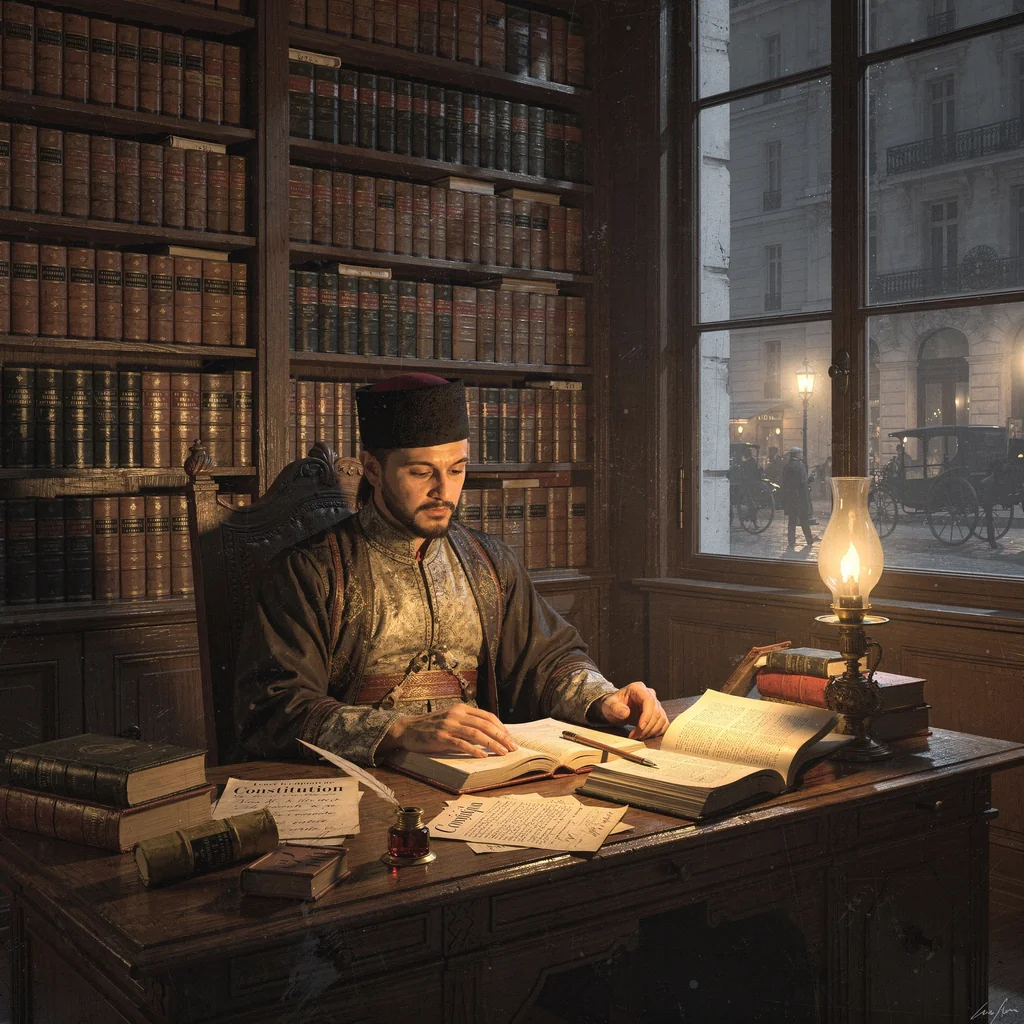
The courtroom smelled of old wood and paper, the specific cold of a Paris courtroom in March — a damp chill that settled in the bones regardless of how many coats you wore. The judges’ bench was elevated three meters above the floor, a wooden throne that required the litigants to look up to speak. The gallery behind was filled with French observers — men in dark coats, women in bonnets, citizens of a republic watching the colony’s case being heard.
Kheireddine looked down at his shoes. Leather from Tunis, made by a cobbler in the medina. He was the only man in the room whose shoes were not made in France. The bench beneath him was hard, the wood unforgiving through two hours of testimony. His hands were cold. His feet were cold. The cold was everywhere.
The judges entered.
Three men in black robes, moving through the door that led from their chambers. The room shifted — the rustle of coats rising, the gallery straightening, the collective inhalation of forty people adjusting to the presence of power.
Kheireddine stood with the others, a learned reflex. In his own court, the litigants stood when he entered.
The judges took their seats on the elevated bench. The room sat. Kheireddine returned to his chair. The wood creaked beneath him.
It was March 1855. Kheireddine was thirty-three years old, his burly frame filling the plaintiff’s chair. His hands rested on the documents before him — ledgers, receipts, letters, the accounting of twenty years of theft.
He had been in Paris for two years, pursuing Mahmud ben Ayyad through the French courts, pursuing the fortune that the former treasury official had stolen from the Tunisian people.
Across the aisle: Mahmud ben Ayyad.
The former senior official of the Tunisian treasury sat comfortably in a French suit, his face composed, his hands folded. He had been Tunisian once. Now he was French — naturalized in 1852, a citizen of the Republic that protected him from the consequences of his own crimes.
The presiding judge spoke:
“Monsieur ben Ayyad is accused of embezzling twenty million francs from the Tunisian treasury over the course of twenty years. He denies these accusations. He claims that the funds were legitimate compensation for his services. The court must determine the truth.”
Kheireddine stood. His French was precise but accented.
“Your Honor. The accused did not serve the Tunisian government. He plundered it. The ledgers show withdrawals of state funds for personal use. The letters show him threatening subordinates who questioned his accounts. The receipts show him purchasing properties in Paris with money that belonged to the Tunisian people.”
He placed a document on the judge’s bench.
“This is a record from 1848. The accused withdrew one hundred thousand francs from the treasury. The same week, he purchased a house in the eighth arrondissement. This is not compensation. This is theft.”
The judge examined the document.
“Monsieur ben Ayyad. How do you respond?”
Ben Ayyad stood with the ease of a man who had bought his safety.
“Your Honor. I was a loyal servant of the Tunisian government. The funds I received were authorized by the Minister of Finance, Mustafa Khaznadar. I have letters authorizing every withdrawal.”
He produced his own documents — letters bearing the seal of the Tunisian treasury, signed by Khaznadar. His hands were absolutely still as he placed them on the table.
Kheireddine’s hands on the table, absolutely still. His fingers rested on the wood, not trembling, not clenching — flesh and blood on French oak.
Kheireddine had never seen these letters.
He had requested full accounting records from Tunis before leaving for Paris. He had asked Khaznadar — his father-in-law, the Minister of Finance, the man whose daughter Janina he had married — for all documentation related to the ben Ayyad case.
The documents that had arrived were incomplete.
Kheireddine’s hands rested on the letters. His fingers traced the seal of the Tunisian treasury.
The judge continued:
“Monsieur ben Ayyad claims he had authorization. If the Minister of Finance approved these withdrawals, then they were legal. The Tunisian government cannot now prosecute him for acts that were authorized at the time.”
“Your Honor,” Kheireddine said. “The authorization was fraudulent. Khaznadar and ben Ayyad were conspirators. They divided the treasury between them. The letters prove nothing except that both men were corrupt.”
“And yet,” the judge said, “the letters exist. And they bear the seal of the Tunisian government.”
The judge looked at Kheireddine with something that was not quite sympathy — the look of a man who knows which outcome serves his nation’s interests.
“Monsieur Kheireddine. Your government seeks the return of twenty million francs. This is an enormous sum. Can you prove that every withdrawal was unauthorized?”
Kheireddine looked at the documents on his table. He looked at the ben Ayyad letters — the letters Khaznadar had never sent to Paris.
His father-in-law had not sent him to Paris to win.
His father-in-law had sent him to Paris to lose.
“Your Honor,” Kheireddine said. “I request a delay. I need to communicate with Tunis. I need to obtain additional documentation.”
The judge shook his head. “The case has already taken two years. We cannot delay further. We will render our decision based on the evidence presented.”
The letter from Tunis arrived three days after the hearing. Kheireddine sat by the window of his hotel room, looking out at the Paris street — the carriages, the pedestrians, the gas lamps, the city that felt so familiar and so foreign.
He broke the seal.
The letter was from a clerk in the treasury, a man he had bribed to search the archives.
“I found what you asked for. The ben Ayyad authorization letters — they exist. They were signed by Khaznadar in 1849, 1850, 1851. But there is more.”
Kheireddine read on.
“I also found the letters you requested — the ones asking for the accounting records. Khaznadar received your request. He wrote a response. I have copied it below.”
Kheireddine’s hand tightened on the paper.
“Send Kheireddine only the incomplete ledgers. Do not send the authorization letters. If he has the complete record, he might win. If he has only half, he will lose. The French judges will not rule against a French citizen without overwhelming evidence. Give him enough to show he tried, but not enough to succeed.”
The letter was signed.
“— Mustafa Khaznadar”
Kheireddine’s father-in-law. The man who had welcomed him into the family, who had treated him like a son.
The man who had sabotaged him.
Kheireddine sat in silence.
The window faced southeast. If he looked in that direction, if he followed the line of his gaze across the city, across the countryside, across the distance he could not see, he would eventually reach Tunis.
Khaznadar. The Minister of Finance’s office in Tunis. Signing documents. Sending his son-in-law to fight with one hand tied behind his back.
Kheireddine stood.
He walked to the table where his documents were spread — the incomplete ledgers, the partial records, the half-truths that Khaznadar had allowed him to bring.
He had spent four years in Paris. Four years arguing in French courts. Four years living in hotels, eating French food, speaking French, listening to French judges decide the fate of a country they had never seen.
He had believed he was fighting for Tunisia.
He had not known that Tunisia was fighting against him.
The case dragged through the French courts — appeals, delays, procedural objections. Kheireddine remained in Paris, his expenses paid by the Tunisian treasury, his time consumed by a battle he could not win because he had not been given the weapons to fight.
The letters from Tunis grew fewer. Janina wrote, but her letters were careful, saying nothing of her father, nothing of politics, nothing of the sabotage Kheireddine had discovered.
He wrote back, saying nothing of what he had learned. There would be time for that confrontation when he returned.
The tribunal’s final judgment came in the spring of 1857. Partial victory for Tunisia — twenty-four million francs recovered, the oil export permits revoked — but ben Ayyad kept what he had already taken, and the French citizenship that protected him remained intact.
Kheireddine walked the streets of Paris on his final evening in the city. The gas lamps were being lit, the soft yellow glow spreading along the boulevards. Carriages clattered over cobblestones. Couples strolled arm in arm, speaking in the soft French that Kheireddine had learned to hate.
He stopped at a café.
Sat at a table outside. Ordered coffee he did not want. Watched the city pass.
A French newspaper sat on the table beside him. He read the headline: TUNISIAN CASE CONCLUDED — PARTIAL VICTORY FOR FORMER OFFICIAL.
The story presented ben Ayyad as the victim — a loyal servant persecuted by a foreign government, exonerated by French justice.
Kheireddine folded the newspaper.
Khaznadar had sent him to Paris to fail. To create the appearance of trying without the risk of succeeding. If Kheireddine had recovered the twenty million francs, the accounting of Khaznadar’s own embezzlement might have been next.
Khaznadar had protected ben Ayyad to protect himself.
Janina. Khaznadar’s daughter. The woman whose father had sabotaged him.
Kheireddine finished his coffee. Paid. Stood.
The city was beautiful — the architecture, the avenues, the gaslight.
He left a coin on the table and walked toward his hotel.
Climbed the stairs to his room. Stood at the window one last time.
The gaslights of Paris glowed below. The city was preparing for night. In the morning, he would board a ship. He would sail across the Mediterranean. He would return to Tunis.
Kheireddine stood at the rail as the coastline of Tunisia appeared — the white houses of Tunis climbing the hill, the minarets of Zaytuna and the Kasbah, the harbor where French ships rode at anchor alongside Tunisian dhows.
He had been away for four years. The city looked the same. The medina walls were the same. The Bardo Palace on the hill was the same.
No crowds greeted him at the dock. No ceremony marked his arrival. The Bey did not receive him. Khaznadar did not come to welcome his daughter’s husband.
Only Janina waited, standing apart from the port officials, her face uncertain, her hands clasped before her.
She did not know what he carried in his luggage.
He embraced her. She was stiff in his arms.
“The journey?” she asked.
“Long,” he said.
“And the case?”
“We won,” he said. “And we lost.”
He would explain later. He would tell her everything. But not today. Not in the port, not among strangers, not before he had seen the Bey, not before he had confronted her father.
Summer heat settled over Tunis. The Mediterranean lay flat and silver under the sun. The hillsides waited for rain that would not come until autumn.
Kheireddine resumed his duties as Minister of Navy. He attended council meetings. He sat at Khaznadar’s table. He spoke to his father-in-law as if nothing had changed, as if the letter from Paris did not exist, as if the sabotage had not happened.
He waited for the right moment.
The moment came in September.
By September 1857, four months had passed since the tribunal’s judgment. The summer had been quiet, but the autumn would bring change.
The proclamation was posted at the Bab el-Bhar, the Sea Gate, where the road from the port entered the medina. Crowds gathered — Tunisians of the madina, Jewish merchants from the Hara, European consuls in their carriages watching from a distance.
Kheireddine stood at the edge of the crowd, thirty-four now, the Minister of Navy. His burly frame imposing in the Turkish coat that marked his rank.
The proclamation read aloud:
“In the name of God, the merciful, the compassionate. Muhammad Bey, ruler of Tunis, announces to all his subjects, Muslim and non-Muslim alike, that the following guarantees shall henceforth be the law of the Regency.”
The crowd grew quiet.
“First: The security of life and property is guaranteed to all inhabitants of the Regency, without distinction of religion.”
A murmur. The Jewish merchants exchanged glances.
“Second: No person shall be arrested or detained except according to due process of law.”
“Third: All subjects shall have the right to seek justice before the courts without obstruction.”
“Fourth: The property of foreigners shall be protected according to the treaties.”
The last point drew a different response. The Europeans in their carriages nodded. The Tunisians muttered. Equality with foreigners — what did that mean, except that foreigners had more rights than before?
Beside Kheireddine, a voice:
“A remarkable document.”
Kheireddine turned. A man in his sixties, with a white beard and eyes that had seen every council meeting for forty years.
Ahmad ibn Abi Diyaf. The chronicler. The man who had served Ḥammūda Pasha, who had documented the reigns of four beys, who had watched the method work and then begin to fail.
“Minister Kheireddine,” Ibn Abi Diyaf said. “I read your testimony to the constitutional committee. You spoke of limits on the Bey’s power.”
“I spoke of justice,” Kheireddine said. “Justice is the pivot upon which nations turn.”
“Justice,” Ibn Abi Diyaf said. “And yet the fourth point of this Pact — the property of foreigners — that is not justice. That is capitulation to European demands.”
“The Europeans demanded it,” Kheireddine said. “Muhammad Bey granted it to gain their support for his other reforms. The army. The schools. The ports.”
“Ḥammūda never granted such concessions,” Ibn Abi Diyaf said. “He negotiated with the French, with the English, with the Italians. He gave them nothing that weakened the Regency’s sovereignty.”
“Ḥammūda did not face this Europe,” Kheireddine said. “The Europe of steamships and railroads. The Europe that could land an army in Tunis in three days. Ḥammūda’s Europe sailed. This Europe steams.”
Ibn Abi Diyaf was quiet.
“Do you think this Pact will work?” Kheireddine asked.
“I think,” the chronicler said, “that Muhammad Bey believes it will work. I think Khaznadar believes it will bring him more loans from the French. I think the Europeans believe it is the first step toward making this Regency a protectorate in all but name.”
“And what do you believe?”
Ibn Abi Diyaf looked at the proclamation on the wall.
“I believe,” he said, “that rights written on paper are only as strong as the institutions that enforce them. Ḥammūda’s method worked because it was not written down. It was embodied in men. In practices. In networks of obligation that survived even the beys who forgot them.”
He looked at Kheireddine.
“You want to build institutions. That is good. But institutions are not documents. Institutions are men who have been trained to serve something larger than themselves. Where will you find these men?”
“The school,” Kheireddine said. “Sadiki College. When it is built.”
“When it is built,” Ibn Abi Diyaf agreed. “And until then? Until the students graduate? Until they take positions in the government? Until they learn to serve the law rather than the Bey?”
He gestured toward the proclamation.
“This Pact says that all subjects have the right to seek justice. But where will they find it? In the courts that Khaznadar controls? In the Bey’s council that his father-in-law dominates? In the French consulate that protects its own citizens?”
Ibn Abi Diyaf turned away.
“Write your laws, Minister Kheireddine. But remember: Ḥammūda did not issue a proclamation ordering someone else to plant the institutions that sustained this Regency. He built them with his own hands.”
The council chamber at Bardo Palace had not changed since Ḥammūda’s time. The same marble floor. The same carved wooden panels. The same brass lanterns hanging from the ceiling.
Muhammad Bey sat at the head, fifty-eight now. Mustafa Khaznadar to his right, Ibn Abi Diyaf with his pen, Mahmud Qabadu in the place of the ulama. Kheireddine, thirty-eight now, Minister of Navy.
Khaznadar pushed a document across the table.
Kheireddine picked it up. Read.
“Article Twelve,” Kheireddine said. “The Bey retains the authority to suspend the constitution in times of emergency.”
“Times of emergency,” Khaznadar said, “are not times for deliberation.”
“What defines an emergency?” Kheireddine asked.
“The Bey defines it,” Khaznadar said.
“The emergency clause gives the Bey power to suspend everything,” Kheireddine said. “Without limits on what constitutes an emergency, the constitution is a door that can be closed from the inside.”
“Without it,” Khaznadar said, “the Bey cannot act when the French arrive tomorrow. Which do you prefer — a constitution that can be suspended, or a country that has ceased to exist?”
Qabadu spoke:
“The sharia commands justice. Justice requires that the ruler be bound by law. This is not a European idea. The caliphs of the golden age were bound by sharia. The first Muslims pledged allegiance to Abu Bakr, and he accepted their pledge on condition that he would obey God and the Prophet. The ruler is not above the law.”
Khaznadar turned to Qabadu. “Shaykh Qabadu speaks of golden ages. We are not in a golden age. We are in an age of steamships and railroads and European armies that could reach Tunis in three days.”
Muhammad Bey listened, his eyes darting between the men.
“Your Highness,” Kheireddine said. “The constitution is not about limiting your power. It is about making your power durable. A Bey who rules by decree alone is vulnerable. When he dies, everything he built dies with him. But a Bey who rules through institutions — institutions that outlast him — that Bey’s work survives. Ḥammūda Pasha understood this.”
Muhammad Bey flinched at Ḥammūda’s name.
“Ḥammūda faced different times,” Muhammad Bey said.
“Ḥammūda faced the same Europe,” Kheireddine said. “He managed the balance without surrendering sovereignty. By building institutions that could negotiate from strength.”
Kheireddine gestured toward the gardens outside the window.
“The olive trees are still there. That is Ḥammūda’s legacy. Not the trees themselves — the system that planted them. The system that tended them, generation after generation, without needing a Bey’s permission.”
Khaznadar’s voice was soft, reasonable:
“Your Highness. The French are offering us the means to defend ourselves. Weapons. Railroads. Loans. Why refuse? Because of theoretical concerns about sovereignty?”
“Concessions once granted are never revoked,” Kheireddine said.
“All things change,” Khaznadar said. “Give them what they want. Take their weapons. Build their railroad. Then, when the army is strong — then we can renegotiate.”
“Then it will be too late,” Kheireddine said.
Muhammad Bey slammed his hand on the table.
“Enough!” He stood. Paced to the window. Looked out at the gardens.
“Write the constitution,” Muhammad Bey said. “Create the Grand Council. Give it the power to approve budgets and laws. But include the clause Khaznadar proposes. The Bey retains emergency powers. The Bey can suspend the constitution in times of crisis.”
“Your Highness,” Kheireddine said. “If the Bey can suspend the constitution whenever he chooses, then the constitution is meaningless.”
“It is better than nothing,” Muhammad Bey said. “And it is what you will get.”
He turned back to the table.
“Draft the document. Ibn Abi Diyaf will record the proceedings. Qabadu will provide the theological justification. Khaznadar will ensure the financial provisions are acceptable to our creditors. Kheireddine — you will write the articles on the Grand Council.”
He looked at each man in turn.
“Do not think I do not know what you are doing. You are building institutions that will outlast me. That is the point. That is why I allow it.”
Muhammad Bey looked at Khaznadar. Then at Kheireddine.
“Can either of you name three men who would put the constitution above their own interests?”
The silence stretched.
“Exactly,” Muhammad Bey said. “Now draft the document.”
Qabadu folded the papers he had brought — his theological citations, the sharia precedents — and placed them in his satchel with the deliberate care of a man who knows he will need them again.
The chamber had been prepared with care. New desks. New chairs. A raised dais for the Bey. Windows looking out onto the courtyard where the fountain caught the morning light.
The men arrived one by one.
Not just Mamluks. Not just Turks. Tunisians of the madina — merchants, scholars, landowners. Men whose families had lived in Tunis for generations. Men who had never been allowed inside the palace except as servants or petitioners.
Kheireddine stood at the front of the room, thirty-eight now, the President of the Grand Council. His burly frame filled the space behind the podium. His dyed black hair gleamed in the sunlight.
Behind him: Muhammad Bey, sixty now, his face lined with exhaustion. But today he would play his part.
“The session is called to order.” Kheireddine’s voice carried across the chamber.
“The first item before the Council: the budget for the coming year.”
A man stood in the audience.
A Tunisian in a white woolen cloak, his beard gray, his face weathered by the sun of the interior. Ali al-Ghardaqwa, a landowner from the Sahel region, the olive-growing country south of Tunis.
“Mr. President,” he said. “Council members. I wish to speak about the taxes.”
The room grew quiet.
“The head tax,” al-Ghardaqwa continued. “The mejba. It has been doubled in the last five years. My farmers cannot pay. The harvest was poor this year. The rains did not come. And yet the tax collector demands twice what was demanded five years ago.”
Khaznadar stood.
“The budget requires revenue,” Khaznadar said. “The army requires payment. The modernization of the ports requires investment. The loans from France must be serviced. Where will the money come from if not from taxes?”
“The money should come from economic growth,” al-Ghardaqwa said. “From expanding production. From processing our own raw materials rather than selling them to Europe and buying them back as finished goods. We sell wool to France. We buy back French cloth at ten times the price. We sell olive oil to Italy. We buy back Italian soap. This is not trade. This is theft.”
Kheireddine spoke:
“The council member from the Sahel raises a valid point. The budget before us proposes new loans from French banks at five percent interest. These loans will be used to pay the interest on previous loans. This is not a sustainable system.”
Khaznadar turned to Kheireddine.
“Minister Kheireddine speaks of sustainability. But what is the alternative? Should we refuse the loans? Should we default on our debts? Should we allow the army to go unpaid? Should we allow the French to seize the customs houses as collateral?”
“We should invest in agriculture,” Kheireddine said. “We should expand the cultivated land. We should build processing facilities for wool, for olive oil, for grain. We should keep the value of our production in Tunisia rather than sending it to Europe.”
“How long will that take?” Khaznadar asked.
“Five years,” Kheireddine said. “Ten years.”
“We do not have ten years,” Khaznadar said. “The loans are due now.”
The debate continued for hours.
Landowners complained about taxes. Merchants complained about customs fees. Scholars complained about the neglect of Zaytuna University. Mamluk officers complained about the delay in modernizing the army.
And through it all: Muhammad Bey sat on his dais, watching. Saying nothing. His eyes darting from speaker to speaker, his hands gripping the arms of his chair.
Near sunset, a vote was called.
The budget: approved with modifications. The head tax: reduced but not eliminated. The agricultural investment fund: created but underfunded.
The room exhaled.
After the session, in the corridor:
Ibn Abi Diyaf found Kheireddine standing by the window, looking out at the olive trees.
“It worked,” the chronicler said. “For one day, it worked.”
Kheireddine did not turn. “The budget passed. The tax was reduced. The investment fund was created. Yes.”
“But you are not satisfied,” Ibn Abi Diyaf said.
“Khaznadar got his loans,” Kheireddine said. “The investment fund is a fraction of what is needed. The tax reduction will be reversed next year, or the year after. The constitution is in place, but the men who implement it are the same men who ignored the law before.”
“This is the first meeting,” Ibn Abi Diyaf said. “It will take time for the culture to change. For the men to learn that the law is not the Bey’s whim. For the people to learn that they have rights that can be defended.”
Kheireddine turned from the window.
“But the men who tend them have forgotten why they were planted,” he said. “They see only the olives. They see only the profit. They do not see the system that makes the trees possible.”
He looked at the empty council chamber.
“This constitution is a piece of paper,” Kheireddine said. “It will only become real when men are willing to die for it. Not fight for it — die for it. When a governor refuses an unlawful order from the Bey because the constitution forbids it. When a tax collector returns money to a peasant because the law says he must. When a judge rules against the powerful because the law requires it.”
He walked toward the door.
“Until then,” Kheireddine said, “this is just a room where men argue.”
The room was small, lined with shelves of books. Quranic commentaries. Hadith collections. Histories of Tunis, biographies of the beys, tax records from the reign of Ḥammūda Pasha.
Ahmad ibn Abi Diyaf sat at his desk, his hand trembling slightly as he dipped his pen in the inkwell. He had served four beys. The light from the oil lamp caught the gray of his beard, the deep lines around his eyes.
He began to write:
“In the name of God, the merciful, the compassionate. This is the account of what was accomplished in the year 1278 of the Hijra, corresponding to the year 1861 of the Christian calendar, when the Grand Council was established and the constitution was proclaimed.”
He paused. Dipped the pen again.
“I have recorded the proceedings of the first council meeting. I have noted the speeches of the members from the interior, the complaints of the merchants, the objections of the scholars. I have noted that the budget was modified, that the head tax was reduced, that an investment fund was created.”
He looked up at the shelves. At the history of Tunis, written in dozens of volumes over centuries.
“Ḥammūda Pasha built institutions without writing them down. He built them in practices. In networks. In the training of men. In the balance of power between the Mamluks and the beldi, the Turks and the Tunisians, the palace and the zawiyas.”
“His successor Ahmad Bey has written institutions down. He has created a constitution. He has established a Grand Council. He has proclaimed rights and guarantees.”
“But the writing is not the thing. The map is not the territory. The description of the tree is not the tree itself.”
Ibn Abi Diyaf looked at the window. The night was dark. He could not see the olive trees in the garden. But he knew they were there.
“I have watched this reign since it began. I watched Ahmad Bey’s father, Husayn Bey, try to continue Ḥammūda’s method without understanding it. I have watched Ahmad Bey try to modernize without institutionalizing. I have watched Khaznadar turn the treasury into his private bank account.”
“And now I have watched Kheireddine — the Circassian, the Mamluk, the man with no family and no tribe — try to create something that will outlast them all.”
“He understands something that the others do not. He understands that institutions are not documents. Institutions are men. Men who have been trained to serve the law rather than themselves. Men who understand that the Bey is not the state. Men who understand that the state is larger than any man who rules it.”
“But where will these men come from?”
Ibn Abi Diyaf dipped the pen again. The ink was low. He would need to refill it soon.
“The school. Sadiki College. When it is built. When the first students graduate. When the first class of men trained in both the Islamic sciences and the European knowledge take their positions in the government.”
“That will be the test. That will be the moment when we know whether this constitution is real, or just words on paper.”
He looked at what he had written. The historian’s question: how to record a feeling that cannot be named?
“I am an old man,” he wrote. “I have seen four beys rule this Regency. I have seen Ḥammūda, who understood everything and wrote nothing. I have seen Ahmad Bey, who writes everything but understands little. I have seen Khaznadar, who understands only his own accumulation. And I have seen Kheireddine, who understands both the method and the writing, and tries to make them one.”
Ibn Abi Diyaf set down the pen. Blew on the wet ink to dry it.
The ink dried on the page. The book lay open on the desk.
Janina Khaznadar stood in her father’s study.
She was twenty years old, the Bey’s niece, Khaznadar’s daughter, the most eligible woman in Tunis. But she stood alone in the room where her father received ministers, reviewed accounts, conducted the business of the Regency.
She had come to ask about the marriage.
Her father had arranged it. Kheireddine had proposed. The Bey had approved. The wedding was in three days.
She had known Kheireddine since she was a girl. He had been her father’s protégé, the brilliant Circassian Mamluk who rose from slave to Minister of Navy. She had watched him from afar — his dark hair dyed black, his burly frame filling council chambers, his voice speaking words she did not always understand but always admired.
She thought he loved her.
She touched the papers on her father’s desk.
She should not be here. This was her father’s private study. The door should have been locked.
But she had needed to know. Needed to understand what she was stepping into.
The ledgers were open. She had seen them before — the official ones, with neat columns and balanced sums. But today she saw something else.
A second ledger, hidden beneath the first.
She opened it.
The numbers did not balance. Withdrawals of thousands, deposits of hundreds. Authorizations signed in her father’s hand, for purposes that were not specified.
Her heart beat faster.
She turned the page. More withdrawals. More unexplained purposes. More signatures.
“Janina.”
Her father’s voice from the doorway. She turned, the ledger still open in her hands.
Mustafa Khaznadar stood in the door. He was fifty-four now, his face heavy with age, his eyes watchful. He did not look angry. He looked tired.
“Baba,” she said. “What are these numbers?”
Khaznadar walked into the room. Closed the door behind him.
“You should not be in here,” he said.
“I came to ask about Kheireddine,” she said. “I came to ask — does he love me? Or is this another alliance?”
“The ledger,” Khaznadar said. “Close it.”
“Not until you answer me.”
Khaznadar was quiet for a long time. He looked at his daughter — the child he had raised, the child he had protected, the child who would marry a man who might destroy him.
“Kheireddine,” Khaznadar said, “loves what you represent.”
“What do I represent?”
“Connection to the Bey,” Khaznadar said. “Legitimacy. Access to the palace.”
Janina’s hands tightened on the ledger.
“That is all I am?”
“You are my daughter,” Khaznadar said. “You are the Bey’s niece. You are the most eligible woman in Tunis. You are many things.”
“But I am not loved.”
Khaznadar did not answer.
“You arranged this marriage,” Janina said. “You proposed it to Kheireddine. You convinced the Bey. Why?”
“Because,” Khaznadar said, “I need him to owe me. I need him to be family. I need him to be bound to me in ways that politics cannot break.”
“You bought him a wife,” Janina said. “Like you buy everything else.”
“I bought you security,” Khaznadar said. “Kheireddine is rising. He will be Prime Minister one day. When he is, his wife will be safe. His children will be safe. My grandchildren will be safe.”
“At what cost?” Janina asked. “If Kheireddine discovers what you have done — what you are doing — what happens to me then?”
Khaznadar was quiet.
“I am your father,” he said at last. “I have done everything for this family. The wealth. The position. The future. I have done what was necessary.”
“The money,” Janina said. “In the ledger. Is it necessary?”
“The Regency needs loans,” Khaznadar said. “The Europeans will not lend without guarantees. I provide those guarantees. I take my commission. This is how the world works.”
“And when Kheireddine finds out?”
“Then he will find out,” Khaznadar said. “But he will be your husband. He will be father to your children. He will be family. And family does not destroy family.”
“You believe that,” Janina said. “Do you?”
Khaznadar did not answer.
He walked to the desk. Gently took the ledger from her hands. Closed it. Slid it back beneath the official accounts.
“Do not speak of this,” he said. “To anyone. Not to Kheireddine. Not to your mother. Not to your sisters. This is our secret.”
“What will happen,” Janina asked, “when the truth comes out?”
Khaznadar looked at his daughter. For the first time, she saw fear in his eyes.
“Then,” he said, “I pray that your husband loves you enough to forgive me.”
The celebration lasted three days. The first day at Bardo Palace, the second in the gardens, the third at the home of the bride’s father — Mustafa Khaznadar, the Minister of Finance, the man whose embezzlement Kheireddine had documented in secret, whose corruption Kheireddine had sworn to expose.
Janina moved through the crowd, dark-haired, dark-eyed. She was twenty years old, the Bey’s niece, Khaznadar’s daughter.
She smiled at him across the room.
The guests divided along invisible lines. Khaznadar’s faction on one side, Kheireddine’s on the other.
And between them: the bride and groom, walking together, touching hands, exchanging looks that meant something different to each of them.
Ibn Abi Diyaf found Kheireddine standing alone on the terrace, watching the celebration through the open doors.
“The Minister of Navy,” the chronicler said. “The son-in-law of the Minister of Finance. A man of influence.”
“I have made a mistake,” Kheireddine said.
Ibn Abi Diyaf looked at him.
“You married her to advance your career. This is not news.”
“I married her to get close to her father,” Kheireddine said. “I thought that if I was family, Khaznadar would trust me. I thought that if I was family, I could learn where the money goes. I thought that if I was family, I could find the evidence I need.”
“And did you?”
Kheireddine was quiet.
“No,” he said. “Khaznadar does not trust family. Khaznadar trusts only himself.”
“Then why marry her?”
Kheireddine watched Janina across the room. She was laughing at something her father said, her face bright, her happiness genuine.
“Because I believed I could use the marriage to serve Tunisia,” Kheireddine said. “Because I believed that personal sacrifice for the public good was honorable.”
“And now?”
“Now,” Kheireddine said, “I wonder if there is any honor in using an innocent woman as a weapon against her father.”
Ibn Abi Diyaf was quiet for a long time.
“Ḥammūda Pasha would tell you,” the chronicler said, “that the man who plants trees for the next generation does not always live to sit in their shade.”
He looked at Kheireddine.
“But Ḥammūda would also tell you that the man who poisons the soil to kill the weeds destroys the garden along with them.”
Ibn Abi Diyaf walked away, leaving Kheireddine alone on the terrace.
The wedding gifts filled the room — silk from France, jewelry from Istanbul, a carpet from the Khaznadar estates. Janina sat among them, unable to touch any of it.
She was twenty years old, a bride of hours, a wife of a man she had known since childhood but had never truly known.
Her maid approached with a basin of water for washing the bride’s feet before the marriage was consummated. The woman was old, her face lined like a walnut, her hands rough with work.
Janina dipped her feet in the warm water.
“Mistress,” the maid said. “You are trembling.”
“The room is cold,” Janina said.
She had grown up with Kheireddine. He had been her father’s protégé, the Circassian Mamluk who rose from slave to minister. Her father had spoken of him often.
“Kheireddine will do great things,” her father had said. “He is the future of this Regency.”
She had believed him. She had smiled at Kheireddine across council chambers, at dinner parties, in the gardens of Bardo Palace.
She had thought he loved her too.
The maid dried her feet with a soft cloth.
“Your husband,” the maid said. “They say he is a good man. A reformer. A man of principle.”
Janina looked at the gifts around her — the silk, the jewelry, the carpet. Each one a testament to her father’s wealth, each one purchased from the treasury her husband now sought to reform.
She did not know where the money came from. She had never asked. She had never wanted to know.
But she was her father’s daughter, and she had eyes.
She had seen the ledgers. Not the ledgers Kheireddine had shown her — the official ones, with numbers that made sense. The private ones, the real ones, that her father kept in his study, with numbers that did not.
She had seen them once, by accident, entering her father’s study without knocking. The ledger had been open on the desk. She had seen the numbers — withdrawals of thousands, deposits of hundreds, all signed in her father’s hand.
She had not understood what she was seeing. She had only known that it was secret, that her father had hidden it, that no one was supposed to know.
Now she was married to the man who would destroy her father.
She stood from the basin.
The maid looked up, surprised. “Mistress? The night is young. The groom will be coming—”
“Leave me,” Janina said.
The maid hesitated, then bowed and left.
Janina walked to the window. The wedding celebration continued in the gardens below, the music and laughter drifting up through the open window. She could see Kheireddine on the terrace, standing with Ibn Abi Diyaf, his face turned away from the celebration.
She had seen that look before. When her father received a letter from the French banks, when the interest rates were renegotiated, when the debt climbed higher. The look of a man calculating the cost, weighing the options, choosing his next move.
Kheireddine had that look now.
Mustafa Khaznadar. Minister of Finance for twenty-three years. The man who had given her everything.
She touched the silk of her wedding dress, the fabric smooth against her fingers.
Her father had given her this dress. Her husband would take her home tonight.
She rested her forehead against the cold glass.
Below, the celebration continued. Above, the moon rose over Bardo Palace.
The moonlight caught the marble walls of the palace.
The news from the interior had arrived that morning — the revolt in the Sahel, the tax collectors attacked, the countryside in flames. The mejba tax had doubled, and the farmers could not pay, and now the Regency was burning.
Kheireddine sat at his desk, reading the reports. His hands were tight on the paper.
The door opened.
Janina entered. She was pregnant now, seven months along with their second child. Her face was pale, her eyes swollen.
She stood in the doorway. She did not enter fully.
“The news from the palace,” she said.
Kheireddine did not look up from the report.
“The taxes must be paid,” he said.
“Father says—”
“Father says many things.” Kheireddine turned the page of the report.
Silence stretched.
Janina crossed the room. Stood before his desk. Her hands rested on her swollen belly.
“Why do you fight him?”
Kheireddine looked up.
“The taxes—” he began.
“Not the taxes,” she said. “Him.”
Kheireddine was quiet.
“He talks about you,” she said. “At dinner. When you are not there. He says you are brilliant. He says you will be Prime Minister.”
“He says many things.”
“Then why—” She stopped. Her hands tightened on her belly. “Why do you work against him? Why do you block his proposals? Why do you—”
She could not finish.
Kheireddine looked at his wife.
“The loans,” he said. “From the French.”
“What loans?”
“The ones your father does not tell you about.”
Janina’s face changed. Something closed behind her eyes.
“You accuse him,” she said.
“I have seen the ledgers.”
“Ledgers can be read wrong.”
“Not these.”
She was quiet for a long time. The candle flickered on the desk between them.
“Report him,” she said. “If you have evidence. Report him to the Bey.”
“The Bey will not act.”
“Then why do you need evidence?”
Kheireddine did not answer.
Janina watched his face.
“You are waiting,” she said.
Kheireddine said nothing.
“You are collecting evidence. Building alliances. Waiting for—” She stopped. “For what?”
“For the moment,” Kheireddine said.
“What moment?”
“When the debt cannot be paid. When the loans stop. When the corruption can no longer be hidden.”
Janina’s hands trembled on her belly.
“You will destroy him,” she said.
Kheireddine looked at her. Really looked at her. At the woman who had trusted him with her heart, with her body, with the children growing inside her.
“The country your children will inherit,” he said, “cannot afford your father’s corruption.”
Janina began to weep.
Kheireddine stood. Went to her. Put his arms around her. She leaned into his chest, her tears soaking his tunic.
He felt the child moving inside her.
He held her while she wept.
“Go to sleep,” he said. “The baby needs rest.”
“Will you come?”
“Soon.”
Janina walked to the door. Stopped. Did not look back.
“I love my father,” she said. “But I love you too.”
She left.
Kheireddine stood alone in the room with the reports of revolt.
The candle on the desk burned down. The wax pooled. The flame flickered.
Kheireddine watched the light die.