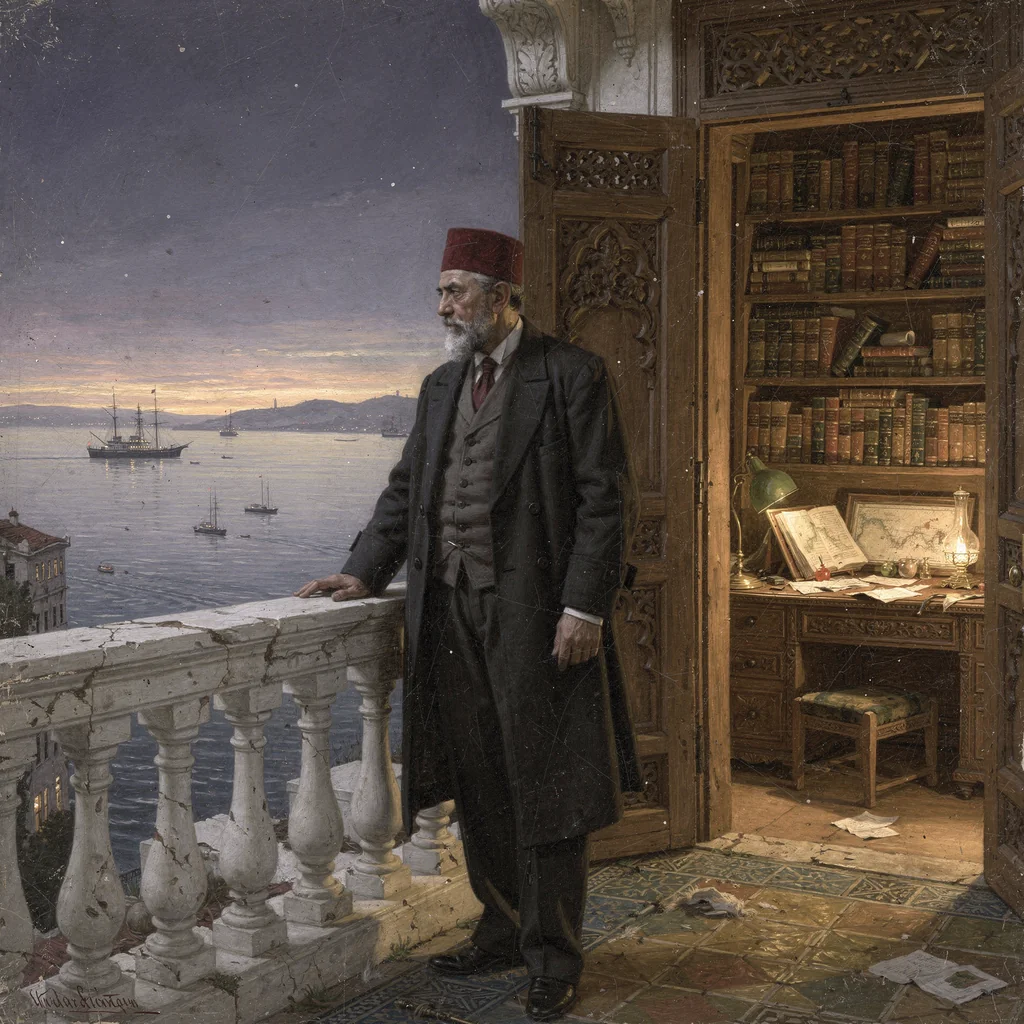
The Bey sat on his throne, sixty-seven now, his body thick with years of indulgence, his eyes calculating. Muhammad al-Sadiq Bey had dismissed Kheireddine as Prime Minister three years ago, dismissing the man who was “too economical and rigid” for Mustafa ben Ismail, who was neither.
Now the Bey was feeling nostalgic.
“Kheireddine Pasha,” Muhammad al-Sadiq Bey said. “You served this Regency well. You expanded the cultivated lands. You reformed the customs. You protected the awqaf from plunder.”
Kheireddine stood before the throne, sixty now, his hair still dyed the deep black that had become his signature. He had been out of power for three years, watching from the sidelines as ben Ismail reversed his reforms, as the debt climbed, as the French consuls grew bolder.
“I did my duty,” Kheireddine said.
“The Bey wishes to reward duty,” the Bey said. “I have signed a decree. A gift. One hundred thousand hectares of land between Sousse and Tunis. The Enfida estate.”
Kheireddine was quiet.
He knew the estate. He had seen it from horseback — vast seminomadic lands, barely cultivated even in the fertile central part, stretching sixty-five kilometers from north to south. It was a kingdom within a kingdom, a domain the size of a small European country.
“Your Highness,” Kheireddine said. “This is too generous.”
“The Bey insists,” the Bey said. “You have no property of your own. You have no family wealth. You have only your service. This estate will provide for your children. It will give you the income you deserve.”
Kheireddine heard what the Bey did not say.
“Your Highness is gracious,” Kheireddine said.
The Bey smiled.
“There is one condition,” the Bey said. “The estate cannot be sold. It can be passed to your children, but it cannot be sold to foreigners. This is the Bey’s command.”
Kheireddine understood.
The Bey was giving him land that could not be sold. Land that tied him to the soil — and to the Bey.
“I accept,” Kheireddine said. “With gratitude.”
The court erupted in whispers.
One hundred thousand hectares. The largest estate in Tunisia. A gift that made Kheireddine one of the wealthiest men in the Regency.
But as Kheireddine walked out of the throne room, he felt the weight of what he had accepted. He had spent his life fighting corruption. He had written a book about how states fall when leaders treat public resources as private property.
And now he owned the largest private estate in the country.
The trees were still standing in the Bardo gardens.
But the gardener had accepted a piece of the soil he was supposed to protect.
Kheireddine rode across the estate with the steward, a Tunisian who had managed the land for the Bey, who would continue to manage it for its new owner.
The land rolled out before them — olive groves, wheat fields, pasture for sheep, the semi-nomadic populations that moved with the seasons. One hundred thousand hectares. A domain the size of a small nation.
“The income,” the steward said. “Is substantial. Even with only the central portion fully cultivated, the estate produces enough to make you one of the wealthiest men in Tunisia.”
Kheireddine looked at the land. It was beautiful. It was productive. It was a gift that should have secured his family’s future.
“I will not be able to keep it,” Kheireddine said.
The steward was silent.
“Mustafa ben Ismail will seize it,” Kheireddine said. “The moment I am no longer in favor, the moment the Bey dies, the moment ben Ismail feels threatened — he will find a reason to take it. He will claim I mismanaged it. He will claim I owe back taxes. He will claim I violated some regulation that did not exist when I accepted the gift.”
“What will you do?” the steward asked.
“I will sell,” Kheireddine said.
“Who can buy?” the steward asked. “No Tunisian has the capital for an estate this size. No merchant has the credit. No landowner has the resources.”
Kheireddine was quiet.
He knew the answer. He had known it since he began making inquiries in Tunis, since he had sent discreet letters to potential buyers, since he had tested the market and found only one bidder with the capital to purchase one hundred thousand hectares.
“The French,” Kheireddine said.
The steward said nothing.
“There is a French company,” Kheireddine said. “Société Marseillaise de Crédit. They have the capital. They have the interest. They have offered to buy.”
“The Bey forbade selling to foreigners,” the steward said.
“The Bey will not live forever,” Kheireddine said. “And ben Ismail is already making inquiries about my assets. He has heard rumors that I am planning to sell. He is preparing to seize the estate before I can.”
Kheireddine looked at the land.
The stone walls. The wheat fields. The pastures where the sheep grazed. This was the soil of Tunisia. This was the land that had sustained the Regency for centuries. This was what he had fought to protect.
And now he would sell it to the French.
“He is already making inquiries about my assets,” Kheireddine said.
“Then you cannot sell,” the steward said.
“If I do not sell,” Kheireddine said, “ben Ismail will seize it. If I sell to a Tunisian, I will find no buyer. If I keep it, I will lose it when the Bey dies and the next Bey decides I have too much.”
Kheireddine turned his horse toward the estate house.
“There is no good path,” he said. “There is only the path that preserves something from the wreckage.”
He rode in silence.
The stone walls passed on either side. The wheat fields rippled in the wind. The sheep watched him from the pastures.
This was the land he had tried to save. This was the country he had served for forty years. This was the soil that would pass into foreign hands because he could not protect it from the corruption of his own government.
The sheep watched him pass, chewing slowly, indifferent to the names of their owners.
The meeting took place in a back room of a French café in Tunis, away from the consulates, away from the palace, away from the eyes that would report back to ben Ismail.
Kheireddine sat across from two men — representatives of Société Marseillaise de Crédit. They were French, they were businessmen, and they were offering him more money than he had ever seen.
“Monsieur le Pasha,” the first man said. He was older, with gray hair and a mustache carefully waxed. “We appreciate your discretion in this matter. Discretion is, shall we say, essential to all parties involved.”
“Of course,” Kheireddine said.
“The property in question,” the second man said. He was younger, crisp in his suit, precise in his manner. “One hundred thousand hectares. A most impressive domain. We understand that its current agricultural potential is only partially realized. Our company believes that with French investment, with French expertise, the estate could become — how shall I put it? — a model of modern cultivation.”
Kheireddine was quiet.
“The price,” the older man continued. “Twenty francs per hectare. Two million francs in total. A fair valuation, we believe. Reflecting both the current state of the property and its future potential under improved management.”
The numbers were fair. Generous, even. Enough to secure his family’s future for generations.
But the money was not what mattered. What mattered was the structure of the sale.
“The contract,” Kheireddine said. “Must be written in a way that prevents legal challenges.”
The second man nodded. He pulled a document from his case. Spread it on the table.
“We have given considerable thought to this matter,” he said. “The challenge, as we understand it, is the matter of preemption rights under Islamic law. The cheffaa, if I am pronouncing it correctly.”
“You are,” Kheireddine said.
“Quite. The challenge is that any co-owner has the right to match a sale price and acquire the property. A most — interesting legal tradition. One that creates certain — complications.”
“We have addressed these complications,” the older man said. “The solution is rather elegant, if we may say so. You will create a company. A société anonyme. The company will own the estate. You will sell the shares of the company to us. This bypasses the preemption law entirely.”
Kheireddine read the document. He had spent months studying French property law, consulting lawyers in Tunis, corresponding with legal experts in Paris. He knew exactly what he was looking at.
“The preemption right,” Kheireddine said. “Applies to land. Not to corporate shares.”
“Exactly,” the second man said. “You are selling corporate shares, not land. The land remains — technically — under Tunisian ownership. The company that owns it simply has French shareholders.”
“A distinction,” Kheireddine said, “without a difference.”
“A distinction with legal consequences,” the younger man corrected gently. “And that is what matters.”
“And the registration?” Kheireddine asked.
“The sale will be recorded in Paris,” the older man said. “Not in Tunis. The French courts will have jurisdiction. The Tunisian courts will not.”
“And the Bey?”
“The Bey,” the older man said, “will have no say. The transaction is between private parties. A French company purchasing shares from a Tunisian national. Entirely a matter of French law.”
Kheireddine looked at the contract. He looked at the two Frenchmen.
“I have one concern,” Kheireddine said.
The Frenchmen waited.
“The sale must be final,” Kheireddine said. “No reversals. No claims of fraud. No challenges in Tunisian courts. Once the shares are transferred, the ownership is absolute.”
“Of course,” the older man said. “Our company requires — certainty. Stability. The permanence of property rights is essential to investment. Without it, how can any enterprise plan for the future?”
Kheireddine dipped his pen in the inkwell. His hand hovered over the document.
The nib touched the paper.
He signed.
“A pleasure doing business,” the older man said. He extended his hand.
Kheireddine shook it. The Frenchman’s grip was firm, confident, the grip of a man who had gotten exactly what he wanted.
“We believe,” the younger man said, carefully gathering the document, “that this arrangement will benefit all parties. French capital. Tunisian land. French expertise. A most — productive collaboration.”
He smiled. A small, polite smile that hid everything.
Kheireddine watched them leave — two men in dark suits walking out the back door of the café, into the Tunisian sunlight, carrying the document that would change everything.
He looked down at his signature on the contract. The ink was still wet.
Outside the window, the call to prayer rolled from the minarets, the sound that had marked time in this city for centuries. The Frenchmen did not look up. They kept walking.
The letter arrived on a morning in late May 1881, carried by a courier from the French embassy. Kheireddine broke the seal in his study in Istanbul, where the Bosphorus caught the morning light through the window. The paper was crisp, the ink black. He read the French text first, then the Arabic translation below it.
Treaty of Bardo. May 12, 1881. Protectorate. French troops at La Goulette. The signature of Muhammad al-Sadiq Bey.
Kheireddine’s hands rested on the paper. The arthritis had stiffened his fingers, but he could still feel the texture of the document — the same paper, the same ink, the same seal that had appeared on the Enfida sale contract seven months before.
The Enfida sale.
The estate he had sold to protect from political seizure, the land he had surrendered to French capital to prevent ben Ismail from taking it, the hundred thousand hectares that were now the instrument of the domination he had spent his life trying to prevent.
He stood at the window of his study. Below him, the Bosphorus carried ships toward the Black Sea, toward the Mediterranean, toward Tunis. The water was the same water that flowed past La Goulette. The distance was not in the water but in the power that now controlled it.
He placed his hand on the glass. The cold seeped into his palm. Somewhere beyond the horizon, French soldiers were raising their flag over the Bardo Palace. The palace walls were still standing. The men who walked within them were no longer Tunisian.
The servant entered. “Pasha? There is more news.”
Kheireddine did not turn from the window. “Tell me.”
“Your son. Tahar. He is at Sadiki College. The French have praised the school. They say it produces men who can serve as intermediaries between the French administration and the Tunisian population.”
Kheireddine was quiet for a long time.
“They have offered him a scholarship,” the servant continued. “To study in Paris.”
Kheireddine turned from the window. His face was unreadable.
“Tell him to accept the scholarship,” Kheireddine said. “Tell him to learn what the French can teach. Tell him to remember who he is.”
The servant bowed and left.
In the villa’s study, Kamer sat at the desk.
She had not heard the servant’s report. She had not heard Kheireddine’s response. She was writing a letter to her cousin in Istanbul — the cousin who had married the merchant, who had children now, who lived in a world that had not fallen apart.
Dear Fatima, she wrote. I hope this letter finds you well. I hope your children are growing. I hope your husband’s business prospers.
She paused. The pen hovered over the paper.
I wanted to ask about your father’s grave, she wrote. Has anyone tended it? Has anyone visited? I do not know if he has a headstone. I do not know if he has a name.
She set down the pen. Read what she had written.
She did not mention the Treaty of Bardo. She did not mention the French occupation. She did not mention that her husband was an exile, that her son was being offered a scholarship to serve the conquerors, that everything she had believed about the future was now in question.
She folded the letter. Sealed it.
Then she opened the drawer of the desk. Inside lay a stack of letters — twenty, thirty, more. All sealed. All addressed. All unsent.
She placed the new letter on top of the stack. Closed the drawer.
Kheireddine sat on the terrace.
The Bosphorus moved. The ships passed. The sun set over Istanbul.
Tahar sat on the stone bench in the courtyard.
The tile floor was cool beneath him. The arched windows of the college classrooms rose on three sides, filled with afternoon light. Above, the sky was the deep blue of autumn, clear and endless.
He held the letter in his hands. The paper was worn where he had folded and unfolded it a dozen times. The handwriting was familiar — the precise, careful script of his father, written from Istanbul.
“My son,” the letter began. “I write to you from exile, from the villa on the Bosphorus where I watch the ships pass between Europe and Asia. The news has reached me here — that the French have established their protectorate, that Tunis is no longer free, that the school I founded now trains intermediaries for the colonial administration.”
Tahar had read this paragraph a dozen times. Each time, the words hit him differently.
“I have heard,” the letter continued, “that you have been offered a scholarship. That the French have recognized your talent. That they wish to send you to Paris, to study in their universities, to prepare for a career in their service.”
A shadow fell across the courtyard.
Tahar looked up. A Frenchman stood there — not in uniform, but in the suit of a civilian administrator. Monsieur Leclerc, the education liaison. A man who had visited the college three times in the past month, who had spoken with Tahar about the scholarship, who had treated him with a courtesy that Tahar had not expected from a representative of the occupying power.
“Monsieur Tahar,” Leclerc said in Arabic, accented but fluent. “May I join you?”
Tahar folded the letter. Slipped it into his pocket.
“Of course,” Tahar said.
Leclerc sat on the bench beside him. The Frenchman’s face was lined, his hair graying. He looked like a man who had worked in colonies for decades, who had seen the pattern repeat itself in Algeria, in Senegal, in now Tunisia.
“I have the paperwork,” Leclerc said. He held a folder in his hand. “The scholarship is confirmed. Departure for Paris in January. The École Normale Supérieure — one of the finest institutions in Europe. You will study law, administration, perhaps economics. Whatever you choose.”
He set the folder on the stone bench between them.
Tahar looked at the folder. He looked at the arched windows of the college, where the classrooms were empty, where the students had gone home for the day.
“My father,” Tahar said. “Does not approve.”
Leclerc was quiet. He looked out at the courtyard, at the tile floor reflecting the sky.
“Your father,” Leclerc said, “is a great man. I have read his book — Aqwam al-Masalik. A most remarkable work. He understands what France can offer, but he also understands what must be preserved.”
Leclerc turned to look at Tahar.
“You are not your father,” Leclerc said. “You are a different man, in a different time. The protectorate exists. Tunisia cannot change this fact. The question is: who will serve the Tunisian people in this new reality? Men who understand both worlds? Or men who understand only one?”
He tapped the folder with one finger.
“The scholarship is genuine,” Leclerc said. “The education is excellent. When you return — if you return — you will have skills that no Tunisian has ever possessed. You will be able to navigate the French system from within. You will be able to protect your people in ways that your father never could.”
He stood. Brushed off his suit.
“Think about it,” Leclerc said. “The offer stands until December.”
He walked away across the courtyard, his footsteps echoing on the tile.
Tahar sat alone.
He reached into his pocket. Unfolded the letter.
“Whatever you choose,” his father had written, “live with it. Do not choose for me. Do not choose for Tunisia. Choose for yourself, and accept the consequences.”
Tahar refolded the letter. The paper was soft now from the handling.
The folder lay on the bench beside him. The scholarship to Paris. The career in the French service. The chance to serve his people by working within the system that had conquered them.
He stood. He left the folder on the bench.
The courtyard was empty.
The arched windows caught the last light of the afternoon. The tile floor reflected the deepening blue of the sky. Tahar walked toward the gate, his hands empty, his choice unmade.
Behind him, on the stone bench, the folder waited.
A letter arrived from Tunis. Kheireddine could not open it himself. A servant opened it, read it aloud.
“My father.”
“I write to you from Paris, where I have completed my studies. The French have been kind. They have offered me a position in the colonial administration. I will serve as an interpreter, as a liaison between the French and the Tunisian people.”
“Some will say that I am a collaborator. Some will say that I have betrayed your legacy. But I remember what you taught me: that wisdom is the goal of the believer, that we must take knowledge wherever we find it.”
“I have found knowledge in Paris. I have found skills that will serve Tunisia. I will use them to protect what can be protected. I will work within the system to ease the burden on our people.”
“I hope you understand. I hope you forgive me.”
“Your son,”
“Tahar”
Kheireddine sat in silence.
He had warned Tahar. He had written in the letter from Kuruçeşme that collaboration was a choice, not a necessity. He had said that whatever Tahar chose, he should live with it.
But he had hoped. He had hoped that his son would choose differently.
“What should I tell him?” the servant asked.
“Tell him,” Kheireddine said, “that I understand. Tell him that I do not judge him. Tell him that the world is harder than we want it to be, and that men must make choices they wish they did not have to make.”
He paused.
“And tell him this: that the school he attended, the knowledge he gained, the skills he learned — these were not given to him so he could serve the French. They were given to him so he could serve Tunisia. Whatever he does, wherever he serves, he must remember this.”
The servant bowed. Left.
Kheireddine sat on the terrace.
The sun set over the Bosphorus. The water darkened. Ships moved across the strait — European vessels with flags of France, Britain, Italy, each passing under the watchful gaze of the palaces on both shores.
Kheireddine watched the bridges span the water — stone arches carrying people across the divide, Europe on one bank, Asia on the other. The bridges connected what geography had separated.
He thought of his name. Not the name given at birth — Hasan Leffch of Circassia. The name that history would write: the reformer, the Grand Vizier, the man who tried to build institutions that would outlast him.
But his name would also be written in another lineage: the Köprülü viziers, also Circassian slaves who rose to power through the Mamluk system. Köprülü Mehmed, who saved the Ottoman Empire in the 17th century. Köprülü Fazıl Ahmed, who continued the reforms.
Köprülü meant bridge-maker, the tutor had said once, in the house near the Bosphorus, when he was still the boy from the village.
The name had been given to men who built connections between east and west, between tradition and reform, between the old world and the new.
Kheireddine had never met a Köprülü. Had never known their faces. But he had followed their path. Slave to minister. Outsider to insider. Circassian to reformer.
And now he watched the same bridges they had known, spanning the same Bosphorus they had governed, connecting the same shores they had served.
The water darkened. The ships moved across the strait, their lights flickering in the gathering dark. Kheireddine’s hands rested in his lap, swollen and still. The letter from Tahar lay on the table beside him.
The autumn rain fell on the Bosphorus. Cold drops drumming on the terrace tiles, streaming down the glass doors of the villa. Inside, a fire burned in the hearth.
Kheireddine sat in his armchair.
His hands were swollen, his joints stiff. The rheumatoid arthritis had taken everything — his ability to write, his ability to hold a pen, even his ability to dress himself.
But he had Kamer.
Kamer Hanım moved through the room.
She was younger than him — much younger — but her hair was beginning to silver now. The years had worn on her too. The years of watching him decline. The years of caring for a man who could no longer care for himself.
She brought him tea. Held the cup to his lips because his hands could not grasp it.
“You are cold,” she said.
“The cold does not bother me,” he said.
“You are lying,” she said. “You are always cold now. Your hands, your feet, your blood — everything is cold.”
She adjusted the blanket over his legs. Tucked it around him. The fire crackled in the hearth.
Kamer sat on the footstool beside his chair.
She had been thirty when they married — much younger than him, a woman from an Istanbul family that had expected her to make a more practical match. Her sisters had married merchants, officials, men with futures in Istanbul. She had married an exiled Tunisian minister who could offer her nothing but his name.
She had not regretted it. Not once.
“The boys are coming to visit,” she said. “Mohamed Salih. Your son.”
Kheireddine’s eyes brightened at the name. Mohamed Salih — their son, born in the exile years, the child who had grown up between two worlds.
“When?”
“This afternoon,” she said. “He brings news from Tunis. From Sadiki College. From the school.”
Kheireddine nodded. The school — the institution that still taught his book, still trained men in the methods he had developed. It was the one part of his legacy that the French had not dismantled.
“Will he stay long?”
“He will stay as long as you need him,” Kamer said.
Kamer took his hands.
Her hands were warm. His were cold. The contrast was sharp after twelve years of watching the arthritis take him, joint by joint, season by season.
She remembered the men who had courted her before Kheireddine. Younger men. Men with positions in the Ottoman bureaucracy. Men who could offer her a house on the Bosphorus, servants, security.
She had chosen the man who asked her opinion on governance. Who treated her as an equal. Who valued her mind as much as her presence.
“I remember,” she said, “when you proposed. Do you remember?”
Kheireddine smiled. “I had just been dismissed. I had lost everything — the position, the power, the ability to save Tunisia. I was broken.”
“You were not broken,” she said. “You were humbled. There is a difference.”
“I proposed to you three weeks later,” he said. “Everyone said it was too soon. Everyone said I was still grieving for Janina. Everyone said I was making a mistake.”
“They were wrong,” Kamer said. “I said yes.”
“Why?” Kheireddine asked. “You knew I had nothing. You knew I was an exile. You knew I might never return to Tunis. Why marry a man with no future?”
Kamer looked at him. She saw what he could not see — the courage in the swollen hands that reached for a pen every morning despite the pain. The pen that he could no longer hold. The book that he could no longer write.
Most men would have given up. Most men would have retreated into bitterness, into regret, into the comfort of saying that the world had defeated them.
He reached for the pen anyway. Every morning.
“Because,” she said, “I had watched you for years. I had seen how you served. I had seen how you fought. I had seen how you refused to compromise, even when it cost you everything.”
She squeezed his hands gently. The knuckles were distorted now. The fingers curled. The hands that had signed treaties, that had written the book, that had shaped the future of Tunisia — gone.
But the man remained.
“I remember the morning you could not hold the pen,” she said. “You had asked for it — a fresh sheet, the inkwell moved closer. The pen was set beside your hand, but you could not close your fingers around it. You sat for perhaps ten minutes. Then you reached for it again.”
She looked at his hands.
“Another woman would have left the room. I stayed to watch. I knew then what kind of man I had married.”
Kheireddine was quiet.
“I have failed you,” he said. “I could not give you wealth — the Enfida sale was seized by the French. I could not give you position — I was dismissed, exiled. I could not give you a home in Tunisia — the French would not allow my return.”
“You gave me yourself,” she said. “That was enough.”
“The tutor told me once,” Kheireddine said, “when I was a boy in Istanbul. He told me of the Köprülüs — the Albanian viziers who saved the Ottoman Empire when it was dying. He said they bought time. That was all they could do.”
He looked at his swollen hands.
“Köprülü meant bridge-maker,” he said. “I built institutions. I built schools. I built a bridge between the old world and the new. But the bridge was not enough. The French crossed it and took everything.”
“You bought Tunisia time,” Kamer said. “Like the Köprülüs bought the Empire time. That is what bridge-makers do.”
“The arthritis,” he said. “I cannot hold a pen. I cannot write. I cannot even dress myself. I am a burden.”
“You are not a burden,” she said. “You are my husband. You are the father of my children. You are the man I chose.”
She leaned forward. Kissed his forehead.
“I would choose you again,” she said. “Knowing everything I know now. Knowing the pain, knowing the exile, knowing the failure. I would choose you again.”
Kheireddine closed his eyes.
Kamer watched him. The pain in his hands was constant. The swelling was visible. The future was dark.
But he was not alone. She was here.
The rain fell on the terrace.
The fire crackled in the hearth. The tea cooled on the table.
Kamer sat with him. Her hand in his. Weight. Warmth despite swelling. The Bosphorus below. They had not spoken in several minutes and neither minded.
Ahmed ibn Yusuf climbed the hill to the villa. A cloth merchant from Tunis, he had made his fortune partly through the customs reform Kheireddine implemented in 1874. He came to Istanbul twice a year. He had been visiting Kheireddine for five years.
The wind from the Black Sea cut through his coat. The villa was silent.
The servant met him at the door. “The Pasha is not well today. He cannot see visitors.”
Ahmed nodded. “I will wait. I will not leave until I have seen him.”
The servant hesitated, then stepped aside.
Ahmed entered the bedroom. Kheireddine lay against the pillows, his face gray, his breathing shallow. His hands were swollen, the knuckles distorted, the fingers curled with rheumatoid arthritis. Sixty-eight years old, and he looked like a man who had lived a hundred.
“Ahmed,” Kheireddine whispered.
“I came from Tunis yesterday,” Ahmed said, pulling a chair to the bedside. “I brought news.”
Kheireddine’s eyes flickered. He tried to sit up, but his body would not obey.
“And Omar,” Kheireddine said. “Your son. Is he still at the college?”
“He is,” Ahmed said. “In his third year. He studies Arabic and French. The teachers say he has your mind, Pasha.”
Kheireddine’s lips moved. A faint smile.
“Tell me,” he whispered. “The college. What do you see when you visit?”
Ahmed sat beside the bed. “I see the courtyard. The arched windows. The boys in their blue robes. They argue about everything — politics, philosophy, the French. They argue like they own the future.”
“Good,” Kheireddine whispered. “They should.”
Ahmed was quiet. He did not tell Kheireddine that Omar had been speaking of independence, that the students were organizing, that the French were watching them closely. He did not know if he would be believed.
“I would like,” Kheireddine whispered, “to write to him.”
Ahmed found paper. Found a pen. Sat beside the bed.
Kheireddine’s hands were too swollen to hold the pen. His fingers curled like claws around the empty air. Ahmed would have to write.
“To Omar,” Kheireddine said. “Begin.”
Ahmed dipped the pen. Wrote: To my son’s friend, Omar ibn Ahmed, student at Sadiki College.
Kheireddine spoke slowly. His voice was weak, but the words were clear.
“I write to you from Istanbul, where I have lived in exile for ten years. I have watched from afar as the French took control of Tunisia. I have watched as the institutions I built were absorbed into the colonial system.”
He paused. His breath came shallow. Ahmed waited, pen hovering over the paper.
“But I have also watched,” Kheireddine continued, “as the school I founded continued to teach. I have watched as students learned both Arabic and French, both Quran and science, both tradition and modernity.”
He stopped. Gathered strength.
“The French are strong. You cannot defeat them with force. Not yet. Not now.”
Another pause. The room was quiet except for the wind against the window.
“But you can defeat them with institutions. You can build schools that outlast their rule. You can build networks of obligation that survive their control. You can build a memory of what Tunisia was, and what Tunisia can be again.”
He was quiet for a long time. Ahmed waited, pen ready.
“The school is the bridge,” Kheireddine whispered. “Between the past and the future. You are the bridge.”
He tried to continue. His lips formed words that would not come.
“Justice,” he whispered. “Is the pivot upon which nations turn. The —”
His voice faded. The breath stopped. The eyes closed.
Ahmed sat beside the bed. The pen was still in his hand. The paper before him showed the incomplete letter. The last sentence trailed off: Justice is the pivot upon which nations turn. The —
He looked at Kheireddine. The chest was still. The breathing had stopped.
Ahmed did not finish the sentence. He set the pen down on the incomplete letter. He stood quietly. The winter wind moved against the window.