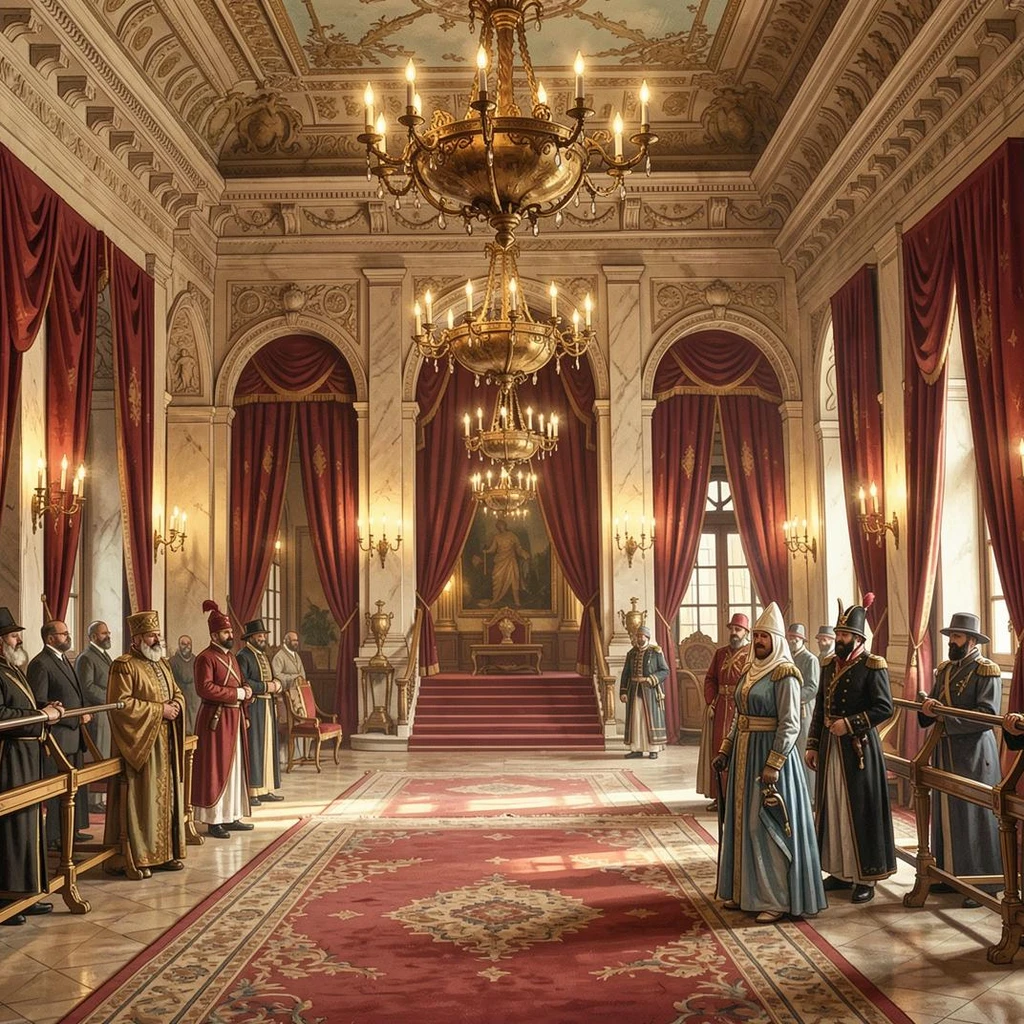
The room at Bardo Palace had been prepared with care. Three large French flags hung from the walls, each fastened with brass tacks that left small holes in the plaster. A table covered in green velvet dominated the center of the room — the same table where treaties had been signed for generations, where Ḥammūda had received delegations, where power had changed hands without blood.
The treaty document lay on the velvet. Forty pages of text in French and Arabic, the signatures ready, the spaces for seals marked with small squares. The inkwell was open, the pen freshly dipped.
Muhammad al-Sadiq Bey sat at the table.
He was sixty-eight now. His health was failing — his breathing labored, his hands trembling slightly. Cataracts clouded his eyes, making the world appear through a veil of gray. He looked at the document before him but did not read it. He could not have read it even if he tried.
“Your Highness,” the French representative said.
Paul Cambon stood across the table. Forty years old, clean-shaven, dressed in a black morning coat with a white waistcoat. His French was formal. His Arabic was adequate. He had been preparing this moment for years — not the loans, not the debt, not the slow accumulation of French power. Those had been prepared by others. Cambon had prepared the moment itself. The room. The flags. The velvet.
“The treaty is ready for your signature,” Cambon said.
Muhammad al-Sadiq Bey did not move.
His hands rested on the velvet. His rings were heavy — the ruby, the emerald, the sapphire, each a gift from a different decade, each a marker of a different bargain. The Bey looked at the French flags on the wall. He looked at the door, where French soldiers stood guard. He looked at the window, where the gardens of Bardo Palace caught the afternoon light.
The official justification had been delivered that morning: the Kroumirie tribes, who lived in the hills near the Algerian border, had been raiding French settlements. The French army had crossed the border in April to suppress the raids. They had not left. Now they demanded guarantees — treaties, protectorates, the legal right to remain.
But the real reason had been accumulating for decades. The debt. The loans. The interest payments that consumed two-thirds of the Regency’s revenue. The French company that now owned one hundred thousand hectares of Tunisian soil. The weakness of a government that could not pay its debts, could not defend its borders, could not say no to the power that had financed its decline.
Kheireddine was not in the room.
He was in Istanbul, thousands of kilometers away, serving as Grand Vizier of an empire that was also dying. The Sultan had forbidden his return. The Ottoman Empire could not risk war with France — not over Tunisia, not when the Russians threatened from the north, not when the British watched from Egypt, not when the Empire was already falling apart.
The same Bey who had dismissed Kheireddine four years earlier now reached for the pen.
Muhammad al-Sadiq Bey’s fingers closed around the pen.
His hand trembled. The pen touched the paper. The ink flowed onto the page — Arabic script, spelling out his name in the space where the French had marked it.
Muhammad al-Sadiq Bey.
He did not read what he was signing. Article 1: The government of Tunisia agreed to carry out reforms necessary for the security of French interests. Article 2: A French resident-general would be appointed to oversee these reforms. Article 3: French troops would be stationed at La Goulette to ensure the execution of the treaty.
He signed them all.
The seal was impressed next to the signature.
The red wax bore the symbol of the Husaynid dynasty — the gate, the sword, the crescent. The same seal that Ḥammūda had used. The same seal that Ahmad had used. The same seal that Muhammad had used.
Cambon took the document. He checked the signature. He checked the seal. He nodded to the soldiers at the door.
“The treaty is concluded,” Cambon said.
Muhammad al-Sadiq Bey stood slowly. His joints were stiff. He looked at the French flags on the wall. He looked at the green velvet table where he had just signed away the sovereignty his family had held for 127 years.
He walked to the window. Looked out.
Outside the window, olive trees caught the afternoon light. Their silver leaves lifted in the breeze. Their roots went deep into the soil — Ḥammūda’s trees, planted sixty years ago, still bearing fruit, still standing, indifferent to the names of their owners.
In the waiting room of the French administration, a young man stood.
He was twenty-two, dressed in a simple jacket, carrying a leather satchel. Behind the counter, a French official sat reviewing paperwork.
“Name,” the official said.
“Ahmed ben Omar,” the young man said in French. The son of a merchant in Tunis, the grandson of a farmer from the Sahel.
“Business?”
“I am here to dispute the tax assessment on my father’s shop,” Ahmed said. “The assessment lists his income as double what he declared. The French inspector did not account for the damaged inventory from the fire last year.”
The French official looked up. “Your father cannot come himself?”
“He is unwell. I am his son.”
“You speak French well.”
“I studied at Sadiki College,” Ahmed said. “For six years.”
The official’s expression changed — recognition, perhaps, or simply adjustment to the unexpected fluency.
“Let me see the assessment,” the official said.
Ahmed opened his satchel. Removed a document — not the tax assessment, but a printed copy of the inventory report, signed by three witnesses, with the French translation attached below the Arabic.
“I prepared this myself,” Ahmed said. “My father cannot read French. The inspector would not accept his testimony in Arabic.”
The official reviewed the document. The inventory was detailed. The translation accurate. The witness statements clear.
“The assessment will be revised,” the official said. “Tell your father to pay the corrected amount.”
“Thank you,” Ahmed said.
He gathered his papers, placed them in his satchel, and left. The official watched him go, then returned to his work.
Ahmed walked out of the administration building and into the medina.
In the souk of the perfumers, a French inspector moved between the stalls. He was young, clean-shaven, dressed in a light colonial suit that marked him as an administrator. He carried a clipboard and a measuring device.
The inspector stopped before a stall where an old perfumer waited, his face weathered like the limestone walls of the medina. He had sold jasmine and orange blossom and rose oil here for forty years.
The inspector tested a bottle of rose oil. Held it to the light. Made a notation on his clipboard.
“Labeling violation,” the inspector said in Arabic. “The bottle does not show the origin. New regulations require all products to display their source.”
“The roses are from the gardens of Testour,” the perfumer said. “Everyone knows this.”
“The regulations do not care what everyone knows,” the inspector said. “They care what is written. Label the bottles correctly. Fine: five francs.”
The perfumer did not argue. He opened his cash box, removed the coins. The inspector took them, made another notation, moved to the next stall.
Ahmed watched the exchange, then continued walking.
The arched windows of Sadiki College caught the afternoon light in the distance. Through the open windows, he could hear the sound of students reciting — Arabic and French in the same air, the languages of his father’s generation and the new reality.
He paused at the college gate. His hand rested on the stone pillar.
The courtyard was empty. The students were inside. The tile floor reflected the sky. This was where he had learned to read both languages, where he had learned the history of his country, where he had learned what his father’s generation had tried to build.
The courtyard remained.
Ahmed did not go in. He had work to do. The assessment was revised, but there were others — other fathers, other shops, other disputes. The French administration needed Tunisians who could speak the language, who could navigate the system, who could protect what could be protected.
In his satchel, beneath the tax assessment, lay a worn copy of Aqwam al-Masalik — the book his father had given him, the book Kheireddine Pasha had written in exile, the book that would still be read when the next generation faced choices Ahmed could not imagine.
The satchel was heavy with the weight of what remained.
He turned and walked toward the French consul’s office.
Behind him, the arched windows of Sadiki College caught the afternoon light.
The funeral was simple. No grand procession. No official honors. The Sultan sent no representative. The Porte issued no statement.
But the people came.
Men who remembered the burning of the paper money in Bayazit Square. Soldiers who had received their first pay in gold under his brief tenure. Scholars who had read Aqwam al-Masalik and recognized a mind that belonged to no single nation. Circassians who claimed him as their own — the slave boy who had risen to govern empires.
They gathered at the cemetery on the hill above the Bosphorus, where the stones looked out over the water toward the Black Sea. The cypresses stood dark against the winter sky.
Kamer Hanım stood by the grave.
She was thirty-eight now, a widow with two sons. She wore black — the Circassian custom, the universal color of mourning.
Her sons stood beside her. Ali, six years old. Mahmud, four. They would not remember their father. They would only know what others told them.
The Imam spoke:
“In the name of God, the merciful, the compassionate. Every soul shall taste death. Then to Us you shall be returned.”
The words were Arabic. The meaning was universal.
Kheireddine’s grave was simple.
A stone marker. An inscription in Arabic and Ottoman Turkish.
Here lies Kheireddine Pasha, son of Hasan Leffch of Circassia. Minister of Navy of Tunis. Prime Minister of the Regency of Tunis. Grand Vizier of the Ottoman Empire.
He served justice. He planted trees.
Qabadu’s message arrived by ship three weeks later.
The old Sufi was ninety-two now. He lived in retirement in Tunis, his body weak, his mind still clear. He had written a single line on a scrap of paper.
“The trees are still standing.”
Kamer placed the paper on the grave.
The mourners dispersed.
The sun set over the Bosphorus. The water caught the last light. The minarets of Istanbul called the faithful to prayer.
Kamer Hanım stood at the grave a little longer. Her sons pulled at her hands, asking to leave.
“One moment,” she said.
She looked at the grave. At the inscription. He served justice. He planted trees.
She thought about the man she had married. The Circassian like herself, the slave who had risen to power, the reformer who had tried to save his country.
She thought about the paradox — that his own property sale had helped create the invasion he had tried to prevent. That the land he had sold to protect from political seizure had become the instrument of domination.
It was a tragedy. But it was not the whole story.
She knelt by the grave.
Placed her hand on the stone.
“You planted trees,” she said. “I will tend them.”
She stood.
Her sons took her hands. They walked down the hill toward the water, toward the city below, toward the future that was unwritten.
Behind them, the grave stood silent. The stone marked the place where a gardener lay.
Kamer looked back once.
The stone was gray against the dark cypresses. The city below was beginning to light its evening lamps. The minarets were calling the faithful to prayer. The Bosphorus carried its ships toward the sea.
Her sons pulled at her hands. She turned. They walked down the hill together, toward the city, toward the evening.