Mustafa Khaznadar sat in his private study, surrounded by the tokens of his forty years of service to the Husaynid Beys. The room was lined with books — French histories, Ottoman biographies, Arabic poetry. On the walls hung maps of Tunisia, of the Mediterranean, of the world beyond.
He was sixty years old. His hair was white, his face lined, his eyes still sharp with the intelligence that had carried him from a Circassian slave to the most powerful man in Tunisia.
His granddaughter played on the carpet.
Little Fatima, six years old, the daughter of his son Muhammad. She arranged ivory chess pieces in rows, speaking to them in the French she learned from her governess.
Khaznadar watched her. She would grow up in a different world than he had known. A world of steamships and telegraphs, of French schools and Turkish uniforms, of a Tunisia that was neither Ottoman nor European but something new.
Something that he was building.
“Jaddi,” Fatima said, holding up a knight. “Does the knight ever lose?”
Khaznadar looked at the ivory piece in his granddaughter’s hand.
“All knights lose eventually,” he said.
Fatima arranged the piece on the carpet, facing a row of pawns. She did not look up.
“Does it matter why they lost,” she asked, “or only that they lost?”
Khaznadar was silent.
Something crossed his face — a flicker of recognition, quickly suppressed.
Fatima did not notice. She had moved on, arranging the pawns in a line, speaking to them in French.
He picked up the knight. Turned it over in his palm. Set it beside the line of pawns she had made.
“He fights,” he said, “for the future.”
The future.
Khaznadar looked at the maps on the wall. The map of Tunisia showed the roads he had built, the ports he had expanded, the telegraph lines he had strung across the country. The map of the Mediterranean showed the French colonies in Algeria, the British presence in Malta, the Italian ambitions in Tripoli.
Tunisia was caught between them all. Small. Weak. Vulnerable.
He remembered 1837.
The year he had become Prime Minister. Tunisia had been a medieval kingdom then — no roads beyond the camel tracks, no ports beyond the harbors where dhows unloaded by hand, no army beyond the Mamluk guards who dressed like Ottoman janissaries but fought like tribal warriors.
The world had not waited. The French had conquered Algeria in 1830. The British had occupied Alexandria in 1807. The Russians were advancing into the Caucasus. The old world was dying, and the new world was stronger, faster, more dangerous.
Khaznadar had made a choice.
He could not stop the French. He could not defeat the British. He could not turn back time to the days when the Mediterranean was a Muslim lake.
So he had done the only thing he could: he had bought time.
He had borrowed money from French banks. He had hired French engineers to build the port at La Goulette. He had brought French officers to train the army. He had sent Tunisian students to Paris to learn modern science.
The debt had grown. The interest had mounted. The loans had become a chain around Tunisia’s neck.
But the country had changed.
Tunis had street lamps now. The telegraph connected the capital to the coast. The port at La Goulette could handle steamships from Marseille. The army had uniforms from France, rifles from England, artillery from Prussia.
Was it worth it?
Khaznadar looked at his granddaughter. Fatima would not survive in the old Tunisia. She needed schools. She needed hospitals. She needed a country that could defend itself against the Europeans.
The debt was the price.
Someone had to pay it. The farmers could not pay — they were already poor. The merchants could not pay — they would flee to Algiers or Tripoli. The Bey could not pay — he needed money for his palaces, his ceremonies, his dignity.
So Khaznadar had made another choice: he would take the money where he could find it. He would take commissions on the loans. He would take percentages on the contracts. He would take whatever was necessary to keep the state functioning.
His eyes went to the chess pieces on the carpet. The knight, standing guard over the pawns.
“Jaddi,” Fatima said again. “Who will the faris fight?”
Khaznadar looked at his granddaughter.
“He will fight,” Khaznadar said, “so that you can grow up in a Tunisia that is strong enough to choose its own future. Not a Tunisia that is swallowed by France or ruled by Turkey or forgotten by history.”
“Is that a good thing?”
Khaznadar smiled — a rare expression, softening his face.
“That,” he said, “is the only thing that matters.”
He heard the door open.
His son Muhammad entered, followed by Kheireddine.
Khaznadar’s face hardened. The grandfather vanished. The Minister of Finance returned.
“Your Excellency,” Muhammad said. “The Council is waiting. The vote on the doubled tax.”
Khaznadar stood. His joints ached. Sixty years of service had worn down the body even as it had built up the country.
“I am coming,” Khaznadar said.
He looked at Fatima one last time. She was arranging the chess pieces again, speaking French to the ivory knights.
Khaznadar walked to the door.
Kheireddine stood aside to let him pass. The two men did not speak. They had not spoken privately since the confrontation over the constitutional courts. They would not speak again until after the uprising.
But in the silence between them, everything was said.
The chamber was the same, but the mood had changed. The optimism of 1861 had evaporated. The men around the table sat farther apart. Eyes avoided each other.
Kheireddine sat in his place as President of the Grand Council, forty-two now. His burly frame had thickened with age. His dyed black hair showed no gray. His face had grown heavier, the “somewhat heavy countenance” that European diplomats would note.
Muhammad al-Sadiq Bey did not sit at the head of the table.
The Bey was sixty-three now. The constitutional moment had been too much for him. The weight of decisions had crushed whatever capacity for judgment he had once possessed.
In his place: Muhammad Kaznadar, the Bey’s private secretary, who spoke for his stepfather-in-law Mustafa Khaznadar, who spoke for the French banks, who spoke for the loans.
“The matter before the Council,” Kaznadar said, “is the budget deficit. The loans from 1861 have come due. The interest payments have increased. The army must be paid. The port modernization must continue. There is not enough revenue.”
Kheireddine spoke:
“The revenue problem exists because the investment fund was never properly funded. The agricultural expansion program was delayed. The processing facilities for wool and olive oil were never built. We are paying interest on loans that were supposed to generate growth, but the growth never came because the money was diverted to other purposes.”
Kaznadar’s face remained impassive.
“The past is not at issue,” Kaznadar said. “The question before us is: how do we pay the debts that are due now?”
“The answer,” Kheireddine said, “is not to borrow more. The answer is to restructure the debt. To negotiate with the French banks. To extend the payment terms.”
“The French banks have refused,” Kaznadar said. “They demand payment in full. They have suggested that if payment is not made, they will call in their government to intervene.”
“A threat,” Kheireddine said. “Nothing more. The French government will not go to war over a debt dispute.”
“The French navy is in La Goulette harbor,” Kaznadar said. “They are conducting ‘exercises.’ Does that look like a bluff?”
Khaznadar looked at the Council members.
He saw their discomfort. He knew what they called him — corrupt, a thief, a man who plundered the treasury.
They did not see what he saw: the French ships in the harbor, growing more numerous each year. The British in Malta, the Italians in Tripoli, the Russians in the Caucasus. Tunisia was small, surrounded, and without the loans that corruption brought, there would be no army, no modernization, no future at all.
He would be the villain. He would be the thief. He would be the man who did what was necessary — so that Fatima inherited a country, not a colony.
“The tax is necessary,” he said, and did not let himself wonder if he was lying.
A voice from the back of the room:
“Then we must pay.”
Kheireddine turned. A man he had seen before but never spoken with. A member of the Supreme Council, one of the notables from the interior. A man whose lands were extensive, whose tenants were numerous, whose loyalty was to himself first.
“How do we pay?” Kheireddine asked.
“We double the head tax,” the man said. “The mejba. It is the only tax that reaches everyone. Every adult male. Every household. If we double it, we can meet the debt payments.”
“The head tax is already too high for what the countryside can bear,” Kheireddine said. “If it is doubled now, it will break what remains.”
“Let it break,” the man said. “The debt must be paid.”
Kheireddine looked around the room. The notables from the interior nodded. The merchants of Tunis looked away. The Mamluk officers were silent. Only the ulama — Qabadu, now gray and frail — met his eyes.
“This tax,” Kheireddine said, “is not constitutional. The Constitution of 1861 requires that taxes be approved by the Grand Council. The Constitution requires that taxes be proportionate to income. A doubled head tax on poor farmers while the wealthy pay nothing — this is not proportionate. This is not just.”
“The Constitution,” Kaznadar said, “allows the Bey to suspend its provisions in times of emergency.”
“This is not an emergency,” Kheireddine said. “This is a debt problem caused by mismanagement. The Constitution was designed to prevent exactly this kind of arbitrary taxation. If we approve this tax, we are not a constitutional government. We are a collection of men seizing whatever we can from those who cannot defend themselves.”
Qabadu spoke:
“President Kheireddine is right. The sharia prohibits unjust taxation. The Prophet, may God bless him and grant him peace, said that the imam who takes unjust taxes will be among the first to enter the Fire. How can we, as Muslims, approve a tax that we know to be unjust?”
Another voice:
“Shaykh Qabadu speaks of theology. But we are discussing survival. If the debt is not paid, the French will intervene. If the French intervene, there will be no Tunisia. There will be no sharia. There will be no Islam. There will be only a colony.”
The room divided. The notables argued. The merchants calculated. The ulama protested. Through it all: Kheireddine watched, knowing what was coming, knowing that he could not stop it.
The vote was called.
The Supreme Council approved the doubled head tax. The Grand Council was not consulted. The Constitution was not invoked.
The chamber was silent. Dust motes floated in the light from the windows. The marble floor reflected the empty space where Kheireddine stood alone.
The news traveled faster than the tax collectors.
First to the mosques, where the imams read the announcement after Friday prayers. Then to the markets, where merchants whispered that this time the Bey had gone too far. Then to the farms, where the men who had survived the doubled tax of 1861 now heard that it had been doubled again.
In the Sahel region:
Ali al-Ghardaqwa, the landowner who had spoken in the Grand Council in 1861, rode to his tenants’ farms. He found them gathering in the courtyard of the local zawiya — a small building attached to a Sufi lodge, where the shaykh had taught his students for forty years.
“The tax is impossible,” al-Ghardaqwa said. “I told them in Tunis. I told them that the farmers could not pay.”
The shaykh of the zawiya was an old man, his face weathered like the limestone walls around the building. He had studied under a student of a student of Ahmad al-Tijani, and his lineage went back to the Shadhiliyya through chains of initiation that men like Kheireddine traced in books and men like the shaykh traced in their bodies.
“What did they say?” the shaykh asked.
“They said the debt must be paid,” al-Ghardaqwa said. “They said the French are in the harbor. They said the alternative is colonization.”
“Colonization,” the shaykh said. “Is that what this is? We are being taxed to pay the French, so that the French will not conquer us? Is there a difference?”
The men around the courtyard shifted. They were farmers, shepherds, men whose hands were calloused from labor, whose backs were bent from fields. They were not men who spoke of politics. But they knew when they were being crushed.
“The Prophet,” the shaykh said, “forbade the imam from taking more than the zakāt. He forbade unjust taxation. He commanded that the wealth of the community be used for the benefit of the community, not sent to foreign creditors.”
He looked at the men around him.
“Do we obey an unlawful order? Or do we resist?”
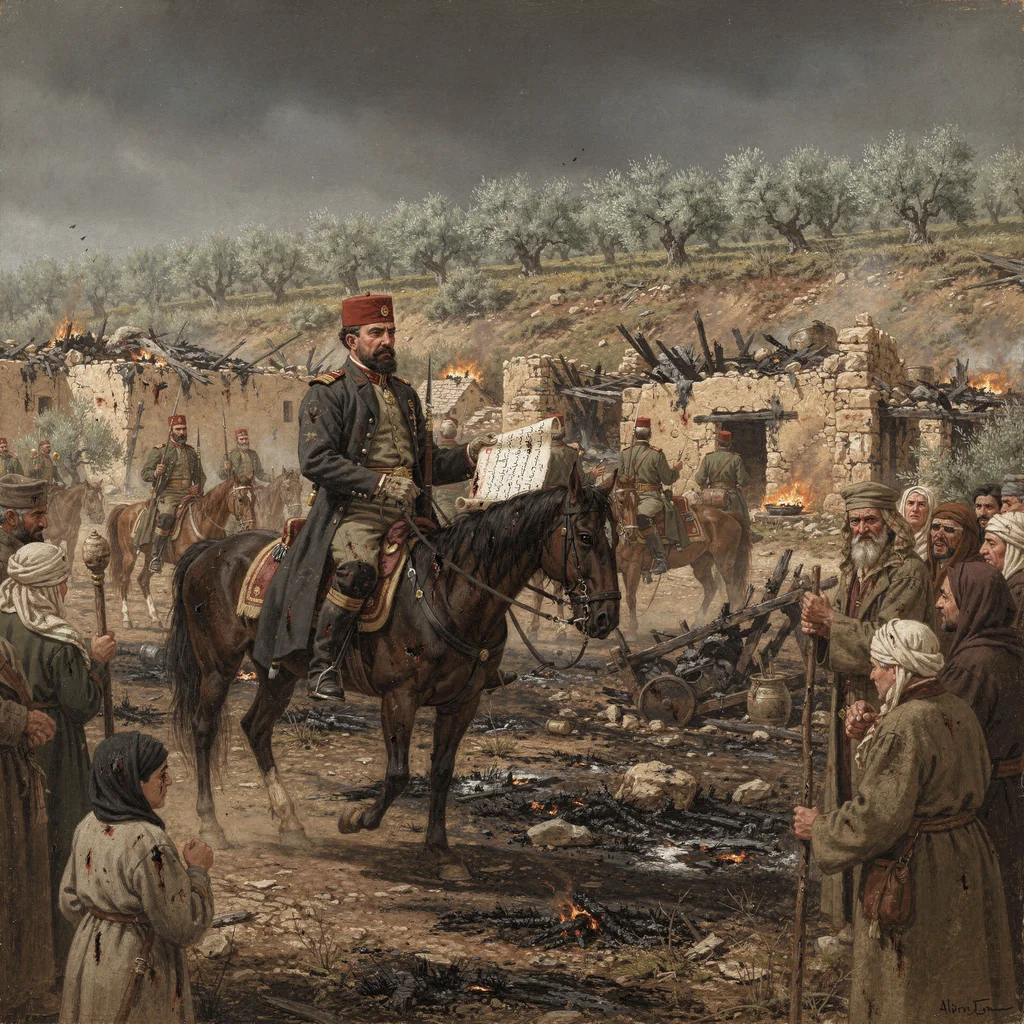
The first stone was thrown in the town of Kairouan.
The tax collector arrived with his guards. The people refused to pay. The guards drew their swords. The people responded with stones, with farm tools, with anything that could be used as a weapon.
The tax collector fled.
From Kairouan, the uprising spread.
To Sfax, where the fishermen heard the news and refused the tax. To Gafsa, where the miners laid down their tools. To the tribal territories of the interior, where the nomads had never accepted the head tax and would not start now.
In Tunis:
Kheireddine stood at the window of his office in the Naval Ministry. The harbor was visible in the distance, the French ships at anchor, their smoke rising in the clear sky.
He had written to Muhammad al-Sadiq Bey. He had written to Khaznadar. He had written to the Grand Council. He had warned them. He had pleaded with them.
Now the warning had become reality.
The camp was in the hills west of Kairouan, where the cultivated land gave way to the stony plateau of the interior. Tents made of wool and goat hair. Cooking fires burning. Men cleaning rifles, sharpening swords, preparing for a fight that everyone knew was coming.
Kheireddine, observing from a rise beyond the camp, counted the banners.
There were fifteen, each marking a different tribe or sub-confederation. He recognized the green banner of the Hamama, their distinctive diamond pattern visible even in the dust — coastal plains families, historically loyal to the Husaynids but now alienated by a tax that broke their farmers. Near the central fire, men in the white wool cloaks of the Ounifa prayed together, their prostration synchronized by a rhythm they had learned in the same zawiya, their connection through the Shadhiliyya order stronger than blood.
Kheireddine saw the red-threaded weave of the Majer tribesmen from the mountains near El Krib, their pattern marking them as the families most directly affected by the tax doubling. Beyond them, tents from the Awlad Sidi Abid — the religious network centered on the saint’s shrine that had issued fatwas against the mejba, citing the very Quranic prohibitions on unjust taxation that Qabadu had quoted in the council.
A boy no older than ten walked past Kheireddine’s position, carrying a water skin toward the camp. On his shoulder he wore the patterned weave of the Majer, the red thread marking him as one of the mountain families. The boy did not look up at the Circassian observer on the ridge. He walked toward the fire, where men from three different tribes now prayed together, their foreheads touching the same dust, their allegiance given to the law that exceeded the Bey’s decree.
Ali ibn Ghadhahum sat in the largest tent, surrounded by his commanders.
He was not a tribal shaykh. He was not a religious scholar. He was a farmer — a man who owned land in the interior, who had paid the doubled tax of 1861, who had watched his neighbors lose their farms, who had heard the stories of men imprisoned for debt, women widowed when their husbands could not pay, children sold into servitude when the tax collector came.
“We are not rebels,” ibn Ghadhahum said. “We are not against the Bey. We are against the tax.”
“The tax is unconstitutional,” one of the commanders said.
“The tax is un-Islamic,” another said.
“The tax is impossible,” a third said. “My farmers cannot pay. If I try to collect, they will attack me. If I do not collect, the Bey will attack me. What would you have me do?”
Ibn Ghadhahum looked at the men around him. They were landowners like himself. Men who had benefited from the old system, who had served as local notables, who had mediated between the government and the people.
Now they were caught in the middle. The government demanded taxes they could not collect. The people demanded relief they could not grant.
“What do we want?” ibn Ghadhahum asked.
“The abolition of the doubled tax,” a commander said.
“The restoration of the Constitution,” another said.
“The removal of Khaznadar,” a third said.
Ibn Ghadhahum nodded.
“These are our demands,” he said. “We are not traitors. We are Muslims. We are Tunisians. We are defending the sharia against unjust taxation. We are defending the Constitution against arbitrary rule. We are defending the people against plunder.”
A scout entered the tent.
“The Bey’s army is marching from Tunis. Three thousand soldiers. Mamluk officers. French artillery.”
The tent grew quiet.
“How many men do we have?” ibn Ghadhahum asked.
“Six thousand,” the scout said. “Eight thousand. More coming every day. The tribes are answering the call. The zawiyas are sending men. The farmers are leaving their fields.”
Ibn Ghadhahum looked around the tent.
“They have French artillery,” he said. “We have old rifles and faith.” He rubbed his face with a rough hand. “They have money. We have nothing. If we don’t fight now, there won’t be anything left to fight for.”
He stood.
“Prepare the men. We fight at dawn.”
Kheireddine’s horse picked its way through the dust, the morning sun already hot on his neck. Behind him, the palace receded into the haze. Ahead, the road to Kairouan wound through the hills toward the rebel camp.
He had argued for this mission. He had pleaded with the Bey. He had written memos, spoken in council, insisted that someone must go to speak with ibn Ghadhahum before the shooting started.
The Bey had agreed.
Khaznadar had not.
Kheireddine reined in his horse at the crossroads. Two paths diverged here — one toward the rebel camp, one toward a small villa where Khaznadar was resting before the battle. Kheireddine had sent word ahead, requesting a meeting to discuss the peace proposal he had drafted.
He turned toward the villa.
The villa was a whitewashed building behind a stone wall. A servant met him at the door, showed him to a garden where Khaznadar sat with coffee and maps, already dressed for travel in the uniform he wore when he wished to remind everyone that he had once been a soldier.
“President Kheireddine,” Khaznadar said. He did not rise. “You are riding toward Kairouan.”
“I am,” Kheireddine said. “With authority from the Bey to negotiate.”
“Are you?” Khaznadar sipped his coffee. “I had heard the Bey authorized you to observe. There is a difference.”
Kheireddine stood in the dust of the garden path. His boots were coated with the white earth he had ridden through for three hours. Khaznadar’s boots were polished, resting on a stool beneath the table.
“The rebels have demands,” Kheireddine said. “They are not unreasonable. The doubled tax — it can be suspended. The Constitution — it can be restored. This can end without blood.”
Khaznadar set down his cup. The china made a small click against the table.
“You know what happens if we suspend the tax,” Khaznadar said. “The French demand their payment. If we cannot pay, they seize the customs. If they seize the customs, they control the trade. If they control the trade, they control us.”
“And if we kill our own people to pay the French?” Kheireddine said. “What do we control then?”
Khaznadar was quiet. He poured more coffee, the stream dark and steady into the cup.
“These people,” Khaznadar said, “are not your concern. You are the President of the Municipal Council of Tunis. You oversee the streets and the markets and the harbor. The rebellion is in the interior. The army is under my authority. The negotiations are under my authority.”
“I have the Bey’s permission to speak with ibn Ghadhahum.”
“You have permission to travel,” Khaznadar corrected. “You have permission to observe. You do not have permission to negotiate. You do not have permission to offer terms. You do not have permission to speak for the government.”
Kheireddine felt the dust in his throat, the heat of the morning, the weight of the papers in his saddlebag — the peace proposal he had written, the compromise he had crafted, the solution that would end this before men died.
“Khaznadar,” Kheireddine said. “Men will die. Three thousand soldiers against eight thousand rebels. The French artillery will fire. Tunisians will kill Tunisians. This can be stopped.”
Khaznadar stood. He smoothed his uniform. He looked at Kheireddine with eyes that had seen every rebellion from 1837 to this one, eyes that had survived three beys and five uprisings and the slow erosion of everything he had built.
“Kheireddine Pasha,” Khaznadar said. “You are a good man. You are an honest man. You believe that reason can prevail against fear, that compromise can satisfy those who feel they have nothing left to lose.”
He walked to the garden gate. Beyond it, the road split in two directions — toward Kairouan, toward the villa.
“But you are not Prime Minister,” Khaznadar said. “You are not the Minister of War. You are not the Grand Vizier. You are a man riding a horse toward a battle that has already been decided, carrying papers that no one has agreed to read.”
He opened the gate. The metal latch clicked.
“If you go to Kairouan,” Khaznadar said, “you go as a private citizen. You have no authority to negotiate. You have no authority to offer terms. You have no authority to speak for this government except what I choose to grant you.”
He stepped back into the garden.
“And I choose to grant you nothing,” Khaznadar said.
The gate closed between them.
Kheireddine stood in the road.
The dust coated his boots. The sun beat down on his neck. The villa was silent behind the wall.
He could ride toward Kairouan. He could find ibn Ghadhahum’s camp. He could show them the papers, explain the proposal, tell them that compromise was possible.
He had no authority. He had no mandate. He had only the certainty that men would die and that he had been prevented from stopping it.
He turned his horse back toward Tunis.
Behind him, on the road to Kairouan, the dust rose where the army was already marching.
The ridge smelled of dust and fear. Kheireddine stood on the slope, watching through field glasses. The distance was too great to see faces, only shapes — the Bey’s artillery positioned on the heights, the Mamluk cavalry formed in ranks below, the rebel lines scattered across the ridges like dry stones.
He could not be there. Khaznadar had seen to that. Khaznadar had feared that Kheireddine would negotiate, that he would find a way to end the uprising without bloodshed. So Kheireddine watched from a distance, powerless.
The first cannon shot came without warning.
The sound arrived before the smoke — a crack that split the air, then the boom rolled across the valley. On the ridge, a gap appeared in the rebel line where men had stood.
Kheireddine lowered the field glasses. His hands were trembling.
The second volley.
More smoke, more gaps. The rebel line held, but Kheireddine could see the ripple of movement — men shifting, men hesitating, men asking themselves if faith was enough against French steel.
The cavalry charged.
Kheireddine watched through the glasses. The Mamluk officers rode forward, their swords catching the sun, their uniforms precise, their horses disciplined. Behind them came the Tunisian infantry — men who had been given uniforms, given guns, given orders to shoot their own people.
The rebels had no cavalry. The rebels had no training. The rebels were farmers with old rifles and swords and the desperation of men who had been pushed too far.
From the ridge, Kheireddine could not see the faces.
But he could imagine them. The farmer who had planted wheat three months ago, now leveling a rifle at men he had once served. The shepherd who had tended flocks on the hills, now standing on ground that had fed his sheep, waiting for a charge that would kill him. The merchant’s son who had studied at Zaytuna, who knew the sharia forbade killing Muslims but had come anyway because the tax had doubled again.
The cannon fired again.
This time, Kheireddine saw a man fall. Through the field glasses, the figure was small, a dark speck against the dust. One moment standing, the next gone.
The man had a name. The man had a mother. The man had children who would wait for him in a village that would never see him again.
Kheireddine did not know the name. He only knew the mathematics of the moment: one cannon ball, one life, one family destroyed. And the cannons were many.
The rebels fired back.
Rifles from the ridges, smoke puffs marking each shot. The bullets fell short, dropping harmlessly into the plain between the armies. The rebels had no artillery. The rebels had no training. The rebels had only courage and old guns and the certain knowledge that they would die.
The cavalry closed the distance.
Kheireddine watched through the field glasses as the horsemen reached the rebel line. He could not see the impact. He could not see the swords cutting through flesh, the horses trampling men, the screams that would have carried across the valley if the distance had not been too great.
He saw the line break.
He saw men running.
He saw the rebellion collapsing into individual terror, each man fleeing for himself, each man trying to survive, each man learning what Kheireddine had learned years ago in Paris: that the enemy was not always foreign.
The dust settled slowly.
The ridge was empty. The rebels had scattered, fleeing toward the interior, toward the Algerian border, toward anywhere that was not this field of death.
The artillery fired one more volley, not at soldiers but at the empty ridge — a final statement of power, a final reminder that this could happen again, that this would happen again, that resistance was futile.
The gunners had trained under French officers at La Goulette, and the cannon bore French foundry marks, but the men behind them were Tunisians, ordered by Tunisian commanders.
Kheireddine lowered the field glasses.
The battlefield was a plain between the hills and the sea. The ground was scarred. The air was thick with smoke and the smell of death.
Far away, a single horse stood riderless near the ridge, its coat stained, its head hanging low.
The battle was over.
The council chamber was silent. The men who had voted for the doubled tax sat with their eyes on their hands. The men who had opposed it sat with their faces closed.
Muhammad al-Sadiq Bey entered.
He looked older than he had three months ago. The crisis had aged him.
“The uprising is crushed,” he said. “Ibn Ghadhahum has fled. The rebels have scattered.”
He looked around the room.
“But the rebellion revealed something. The Constitution — this experiment of 1861 — it has failed. It created confusion. It gave people false expectations. It made them think they could challenge the Bey’s authority.”
Muhammad al-Sadiq Bey stood.
“The Constitution is suspended,” he said. “Effective immediately.”
The lock clicked.
A knock at the door.
Mahmud Qabadu entered. The old Sufi was seventy-two now. His beard was white. His body was frail. But his eyes were still clear.
“President Kheireddine,” Qabadu said.
“Shaykh Qabadu.” Kheireddine stood. “I was not expecting you.”
“I came to ask what you intend to do.”
Kheireddine gestured toward the resignation letter on his desk.
“I cannot serve a government that suspends its own constitution. I cannot be part of a system that crushes its people to pay foreign creditors.”
Qabadu nodded.
“I have written to the Bey,” Qabadu said. “I have told him that suspending the Constitution is a sin. That it violates the sharia.”
“What did he say?”
“He did not read my letter. Khaznadar read it for him. Khaznadar told him that I am an old man whose mind is failing. The Bey nodded and asked if the locks on the palace doors had been checked.”
Kheireddine was silent.
“I am resigning,” he said. “From the Grand Council. From the Naval Ministry. From every position I hold.”
“Then what?” Qabadu asked. “What will you do?”
“I will write,” Kheireddine said. “I will make the argument. I will explain why the Constitution was necessary, why it failed, and what must be done to restore it.”
Qabadu placed a hand on Kheireddine’s shoulder.
“I will help you,” the old Sufi said. “I have connections. Men who still remember Ḥammūda’s method. We will build a network. We will prepare. We will wait.”
“Do not leave Tunis,” Qabadu said. “Khaznadar would like that. He would like you to go into exile. Stay. Be present. Be a reminder that there is another way.”
The old Sufi’s hand on Kheireddine’s shoulder was light, but his voice carried the weight of seventy-two years in Tunis.
“I know what exile does,” Qabadu said. “I watched the ulama of Algerois scatter when the French came. The men who left became voices in the wilderness. The men who stayed became the resistance.”
When Qabadu was gone, Kheireddine looked at his desk. A note had been left there — delivered by a palace runner while Qabadu spoke. The handwriting was smaller than most men’s, as if economy of word was a practice extended to every surface.
From Ahmad ibn Abi Diyaf, the note read. I have been to the interior. I have seen what was done. I have recorded what was done. The Constitution’s suspension will join the uprising in the chronicle. History does not require that it was well done. It requires only that it was recorded.
Kheireddine folded the note. Slipped it into his pocket.
The resignation letter lay on the desk, unsigned.
The clerk was a man who had worked in the palace for forty years. He had served Ḥammūda Pasha. He had served Husayn Bey. He had served Ahmad Bey. He had served the Constitution, and now he served its suspension.
In his hands: the Constitution of 1861.
The document was bound in leather. The pages were edged in gold. The seal of the Regency was impressed on the cover. It looked like a Quran. It looked like something sacred.
The clerk rolled the document carefully. He placed it in a leather tube. He capped the tube with a bronze lid.
He walked through the palace corridors, past the council chamber where the Grand Council had met, past the room where the Constitution had been signed, past the garden where the paths were overgrown with weeds.
He reached the archive room.
The room was lined with shelves. On the shelves: documents from centuries of rule. Land grants. Tax records. Correspondence with foreign powers. Treaties with the French, the English, the Italians. Decrees from beys whose names were forgotten.
The clerk found an empty space on a high shelf. He climbed the ladder. He placed the leather tube containing the Constitution in the empty space.
He climbed down. He closed the archive room door. He locked it.
The key turned in the lock. The clerk placed it on his ring.
The room was quiet. The servants had been dismissed. The door was closed.
Kheireddine sat before the mirror. The glass was French, the frame Turkish silver, the reflection showing a man he did not always recognize.
He was forty-two now.
The dye was on the table.
A small ceramic bowl. A brush. The mixture — henna and indigo and walnut shell, prepared by the servant who knew the recipe, who understood that this was a ritual that required privacy.
Kheireddine dipped the brush. The dye was dark, black as ink, black as the night sky over the Bosphorus where he had been born.
He began to apply it.
The motion was practiced.
He had been dyeing his hair for five years now. Since Paris. Since the French court where he had appeared as the representative of Tunisia, where the judges had seen his gray hairs and dismissed him as a man past his prime.
The dye changed everything. The judges saw a man in his thirties, dark-haired, vigorous. They saw someone who might still have a future. They did not see a man who had aged before his time.
He worked the dye into his hair.
The brush moved from temple to crown, from crown to nape. The black color spread across the gray, hiding the evidence of stress, of sleepless nights, of the weight of trying to save a country that did not want to be saved.
Kheireddine watched himself in the mirror. The face looking back was familiar — the heavy countenance, the burly frame, the eyebrows that met across the bridge of his nose. But the hair was wrong.
It was too black. Too dark. Too perfect.
The vanity of it.
He knew it was vanity. The Prophet had forbidden dyeing the hair black, except for jihad — and Kheireddine was not fighting a holy war. He was fighting a political war, a bureaucratic war, a war of ledgers and loans and treaties.
The dye was not about faith. It was about power.
Men with gray hair were seen as men of the past. Men with dark hair were seen as men of the future.
Kheireddine needed to be seen as a man of the future.
He finished the application.
The dye covered every strand. The gray was gone. The black was complete.
He waited for it to set — ten minutes, no more, no less. The ritual had its timing. Too soon, and the dye would wash out. Too late, and it would stain the scalp, leaving the skin dark for days.
He sat in the quiet room. The mirror reflected a man with black hair, a man who might be thirty, a man who might have decades ahead of him.
The mirror lied.
Janina.
She had never seen him without the dye. She had never seen the gray. She had never known the man beneath the black hair.
Would she still love him if she knew? If she saw the aging hair, the receding hairline, the man who was not the vigorous figure he presented to the world?
He did not know.
He did not want to know.
The ten minutes passed.
Kheireddine stood. Went to the basin. Poured water over his head. The black dye rinsed away, leaving behind the color that would remain for weeks.
He dried his hair with a rough cloth. Stepped back to the mirror.
The man in the mirror was dark-haired, vigorous, powerful. A man who might be thirty. A man who might lead a nation.
Kheireddine touched his face. The skin around his eyes was lined. The forehead was creased. The jaw showed the first signs of loosening, the flesh beginning to sag.
The hair lied. The face told the truth.
He dressed for the council.
The Turkish coat, embroidered with silver thread. The sash of office. The seal of the Grand Council on his finger.
He looked like a man who could still win. A man who could still fight. A man who had not yet been defeated by time or corruption or the weight of a world that did not want to be saved.
The mirror reflected confidence. Power. Authority.
Kheireddine blew out the candle.
The room went dark. The mirror vanished.