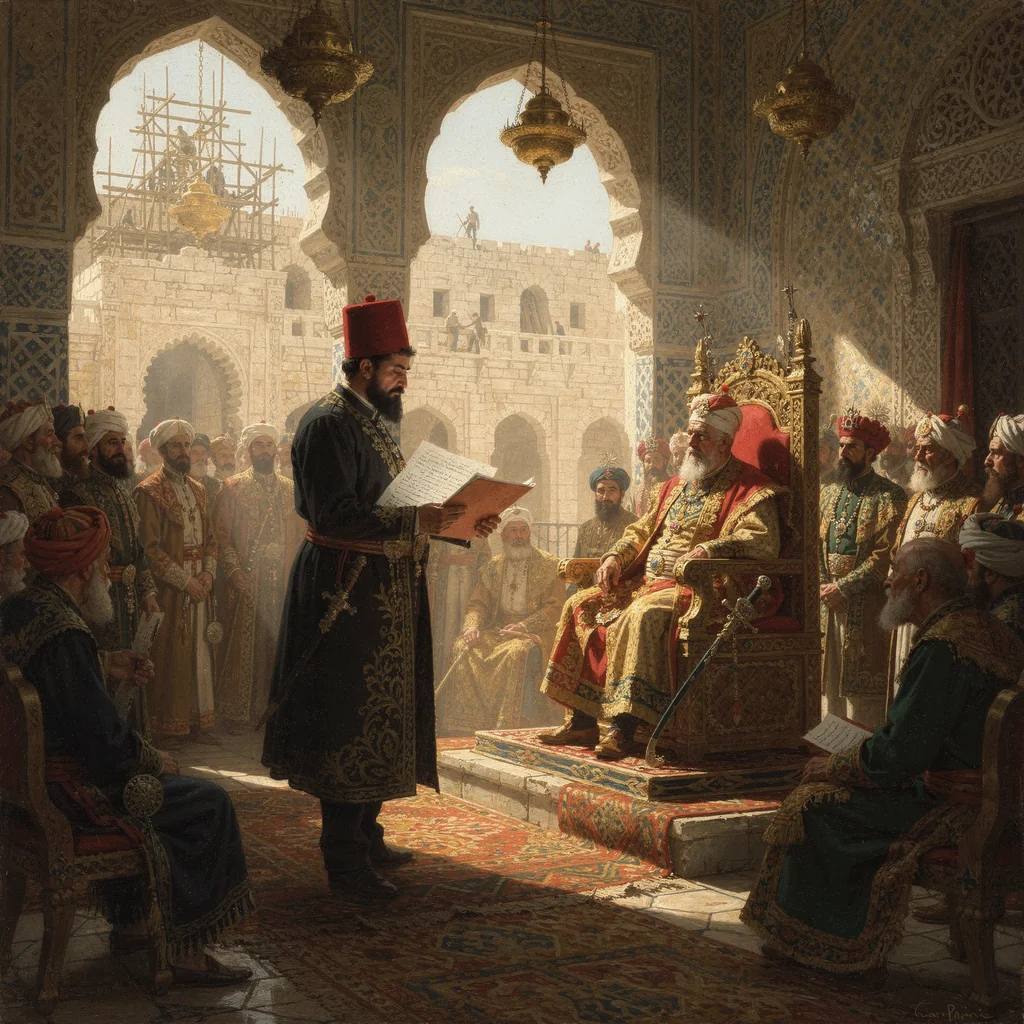
The Bey walked alone in the gardens. Kheireddine followed at a distance, giving the Bey his privacy, waiting to be summoned.
The Bey stopped before an olive tree. He touched the bark. His fingers were thick, his rings heavy, but his touch was gentle.
“You see this tree?” Muhammad al-Sadiq Bey said. He did not turn around.
Kheireddine approached. “I see it, Your Highness.”
“My grandfather planted it. Ḥammūda Pasha. Sixty years ago.” The Bey traced a line in the bark. “It has survived droughts. It has survived storms. It has survived the incompetence of his descendants.”
Kheireddine remained silent.
The Bey turned. His face was heavy, his eyes weary, but his gaze was sharp.
“Do you know why I have not removed Khaznadar?”
“Because he is your wife’s father.”
“Because he is a wall,” Muhammad al-Sadiq Bey said. “A wall between me and the French. A wall between me and the Italians. A wall between me and the British.”
The Bey walked to a stone bench. Sat heavily. His joints were stiffening with age.
“Khaznadar has made deals with all of them. The French banks. The Italian merchants. The British consul. They all accept him because he pays them. He gives them concessions. He gives them loans. He gives them access.”
The Bey looked at Kheireddine.
“If I remove him, what happens? The French demand their money immediately. The Italians stop supplying grain. The British send warships to ‘protect their interests.’”
“You would be free of corruption,” Kheireddine said.
“I would be free of one corrupt man,” Muhammad al-Sadiq Bey said. “And I would inherit a crisis he created. The debt is one hundred million francs. The interest is eight million. The revenue is twelve. Do the mathematics, Kheireddine. If I remove Khaznadar, I must still pay the debt. If I cannot pay, the French seize the customs houses. If they seize the customs, they control the trade. If they control the trade, they control me.”
The Bey was quiet for a long time.
“I am not a weak man,” Muhammad al-Sadiq Bey said. “I am not a stupid man. I know what Khaznadar is doing. I know what he has done. But I also know that removing him does not solve the problem. The problem is the debt. The problem is the Europeans. The problem is that we are too small to resist them.”
He looked at the olive tree again.
“My grandfather understood this. He played the Europeans against each other. He gave concessions to one to deny concessions to another. He kept them divided so they could not unite against him.”
“Ḥammūda had strength,” Kheireddine said.
“Ḥammūda had options,” Muhammad al-Sadiq Bey corrected. “He ruled before the French invaded Algeria. He ruled before the British occupied Alexandria. He ruled before the Suez Canal was even dreamed of. The world has changed, Kheireddine. The Europeans are stronger now. Their hunger is greater.”
The Bey stood. His joints creaked.
“One day,” Muhammad al-Sadiq Bey said, “you will be Prime Minister. You will sit where Khaznadar sits. You will face the same choices I face. And you will learn that the choice is not between corruption and integrity. The choice is between bad options and worse options.”
He walked toward the palace. Stopped. Turned back.
“Prepare yourself,” Muhammad al-Sadiq Bey said. “The collapse is coming. Khaznadar cannot hold the wall forever. When it falls, it will fall on you.”
Kheireddine watched the Bey disappear into the palace.
The garden was quiet. The wind moved through the branches.
The winter of 1869 had been hard on the countryside. The doubled tax, the poor harvest, the debt collectors — they had all combined to create a crisis that could no longer be delayed.
The news arrived in the morning. Khaznadar’s private secretary entered the council chamber, his face gray, his hands trembling.
“The French banks,” the secretary said. “They have refused the new loan.”
A councilor started to speak. The secretary continued, his voice rising.
“They have also called in the existing loans. They demand immediate payment of all outstanding debts. They say that if payment is not made within thirty days, they will seize the customs houses as collateral.”
Kheireddine stood up before he meant to.
Caught himself. Sat down.
He was no longer President of the Grand Council, no longer Minister of Navy, just an observer who had been pushed aside but could not stay away.
He had warned them. In 1864, he had warned that the doubled tax would crush the countryside. He had warned that the loans were unsustainable. He had warned that the Europeans would lose patience.
Now the warning had become reality.
Muhammad al-Sadiq Bey spoke. His voice cracked on the first word.
The Bey had taken the throne in 1855, after Ahmad Bey’s death. He was fifty-six now. His face was heavy, his body thickened by age, his eyes weary from twelve years of watching Khaznadar plunder the treasury.
He looked at Khaznadar. For a long time, no one spoke.
“One hundred million francs,” the Bey said at last. As if naming it made it real. “And twelve in revenue.”
The chamber was silent.
“Two-thirds of our revenue goes to interest,” Kheireddine said from his seat. “Before one soldier is paid. Before one school is funded. Before one road is built.”
“What do you propose?” Khaznadar asked. His voice was cold.
“Negotiate,” Kheireddine said. “Extend the payment terms. Reduce the interest. Offer partial payment now and the rest later. Show the French that they will get more money by working with us than by seizing our property.”
“And if they refuse?”
“Then we default,” Kheireddine said. “We stop paying. We use the revenue for internal needs. We rebuild the economy. We make ourselves less dependent on European loans.”
“The French will send warships,” Khaznadar said.
“Let them send warships,” Kheireddine said. “What will they do? Shell Tunis? Occupy the customs houses? They can do that anyway. The question is whether we surrender before they arrive, or whether we maintain some measure of dignity.”
The Bey looked from Kheireddine to Khaznadar.
For the first time in twelve years, the Bey seemed to actually see what Khaznadar had done. The debt. The loans. The plunder. The systematic destruction of the Regency’s financial independence.
“Khaznadar,” the Bey said. “Leave us.”
The Minister of Finance stood. His face was unreadable. He walked to the door. Turned back.
“Your Highness. I have served this Regency for twenty-three years. I have managed its finances through wars, through droughts, through European pressures. The debt is not my fault. The debt is the price of modernization.”
“You stole the money,” Kheireddine said.
Khaznadar’s eyes flickered.
“Prove it,” Khaznadar said. And he left.
By October 1873, four years had passed since the bankruptcy. Four years of negotiations, of partial payments, of French pressure, of mounting crisis.
Kheireddine had watched from the sidelines. He had written his book. He had built his network. He had waited.
Now the moment had arrived.
He stood before Muhammad al-Sadiq Bey in the private audience chamber.
The Bey was sixty now. His health was failing. His eyes were clouded with cataracts. He sat heavily in his chair, his body thickened by age, his face weary.
Muhammad al-Sadiq Bey did not ask why Kheireddine had come. He knew.
“Khaznadar,” the Bey said.
“Khaznadar,” Kheireddine agreed.
Muhammad al-Sadiq Bey was silent for a long time. He looked at his hands. They were resting on the arms of the chair, the fingers thick with rings.
“He was my wife’s father,” the Bey said.
“He is destroying the Regency.”
“He arranged my marriage.” Muhammad al-Sadiq Bey’s voice was distant. “He has been part of this palace for forty years. He has served four beys.”
“He has served himself,” Kheireddine said.
The Bey was quiet.
“The European consuls,” Muhammad al-Sadiq Bey said. “They support him.”
“Not anymore,” Kheireddine said.
“Are you certain?”
“I am certain.”
The Bey nodded slowly. He looked at the window, but he did not see the gardens. He saw something else — the weight of decisions he did not want to make.
“And Istanbul?”
“Istanbul wants him gone,” Kheireddine said.
“Because they care about Tunisia?”
“Because they care about the Empire.”
The Bey nodded again. A small, tired movement.
“You,” the Bey said. “You want to be Prime Minister.”
“I want to save the Regency.”
“They are the same thing.”
“No,” Kheireddine said. “They are not.”
Muhammad al-Sadiq Bey was quiet for a long time.
“The debt,” he said. “How much?”
“One hundred twenty million francs.”
“Interest?”
“Ten million.”
“Revenue?”
“Twelve.”
The Bey was silent. The numbers were clear. The mathematics did not work.
“Khaznadar has offered me a deal,” Muhammad al-Sadiq Bey said. “He will resign. If I grant him immunity. If I allow him to keep what he has.”
“He has stolen millions,” Kheireddine said.
“He wants to live out his life in dignity,” the Bey said. “Is that so much to ask?”
“Immunity for corruption,” Kheireddine said, “is the message that corruption is acceptable.”
“Perhaps it is,” Muhammad al-Sadiq Bey said. “Perhaps corruption is the price of governance. Perhaps Khaznadar understands this, and you do not.”
Kheireddine was silent.
The Bey looked at him. His eyes were clouded, but his gaze was direct.
“You are a hard man, Kheireddine.”
“I am a man who has watched this Regency decline for thirty years,” Kheireddine said.
“Thirty years,” the Bey repeated. “And in those thirty years, how many beys have you served? How many ministers? How many schemes have you watched fail?”
“Many.”
“And yet,” Muhammad al-Sadiq Bey said, “you believe that this time — this time — you will succeed.”
“I believe,” Kheireddine said, “that something must break. And it should not be Tunisia.”
The Bey was quiet for a long time. He looked at his hands again. At the rings that had been gifts, that were bribes, that were the tokens of a system that had sustained him for decades.
“Then act,” Muhammad al-Sadiq Bey said. “Remove Khaznadar. Take the position. Save what can be saved.”
He looked up.
“But know this: when you fall, as you will fall, no one will grant you immunity.”
“I expect no immunity,” Kheireddine said.
“You expect nothing,” the Bey said. “And that is why you will fall.”
Kheireddine walked to Khaznadar’s office.
The Minister of Finance had a suite of rooms near the council chamber — a suite he had occupied for twenty-three years, through four beys, through wars and droughts and loans. The door was carved cedar, inlaid with brass. Kheireddine knocked.
“Enter.”
The voice was thick with age but still sharp. Kheireddine opened the door.
Mustafa Khaznadar sat behind his desk.
He was seventy now. His face was heavy, his body thick with years of indulgence. But his eyes were clear — and watchful. He had been expecting this moment. He had known it was coming since the bankruptcy, since the negotiations failed, since the Europeans turned against him.
On his desk lay the state papers — the debt ledgers, the customs receipts, the correspondence with French banks. And beside them, smaller things: a brass inkwell, a silver seal, a ring with a ruby the size of a pigeon’s egg.
“Kheireddine,” Khaznadar said. He did not stand. “Come to gloat?”
“I have come,” Kheireddine said, “from the Bey.”
Khaznadar’s eyes flickered.
“He has agreed,” Kheireddine said. “You are to resign.”
The old Minister of Finance was quiet. He looked at the papers on his desk. He looked at the ring with the ruby. He looked at Kheireddine.
“Resign,” Khaznadar repeated. “Just like that.”
“Effective immediately,” Kheireddine said. “The Bey has appointed me Prime Minister.”
Khaznadar laughed — a dry, cracked sound.
“Prime Minister,” he said. “You wanted this for a long time.”
“I want to save the Regency.”
“You want what I had,” Khaznadar said. “Do not pretend otherwise.”
He stood slowly. His joints were stiff. He walked to the window, looked out at the gardens of Bardo Palace.
“Do you know,” Khaznadar said, “how you came to be in this palace?”
Kheireddine waited.
“I bought you,” Khaznadar said. He turned back. “Do you remember? The slave market, 1840. A Circassian boy, seventeen years old. I saw you there. I saw something in your face. I told the Bey’s agent to buy you.”
Kheireddine was silent.
“I brought you to Bardo,” Khaznadar said. “I had you educated. I taught you Turkish. I taught you French. I arranged your first military commission. I arranged your first government position.”
He walked back to the desk. Rested his hands on the papers.
“When my daughter needed a husband,” Khaznadar said, “I chose you. When the council needed a president, I recommended you. When the navy needed a minister, I proposed your name.”
The old man looked at Kheireddine.
“Everything you are,” Khaznadar said, “I made you.”
“And everything I am,” Kheireddine said, “you tried to destroy.”
Khaznadar’s face hardened.
“I tried to destroy you?” He laughed again. “Who sent you to Paris in 1860? Who gave you the commission to study European militaries? Who authorized the budget for your research?”
“You did,” Kheireddine said.
“And who,” Khaznadar asked, “sabotaged that mission? Who told the French that you were unreliable? Who whispered to the Bey that you were dangerous?”
Kheireddine was quiet.
“You did,” Khaznadar said. “Yes. I sabotaged you. I blocked your promotions. I undermined your authority. And do you know why?”
Kheireddine waited.
“Because you were dangerous,” Khaznadar said. “You believed in principles. You believed in institutions. You believed in things that cannot survive in the world we actually live in.”
He walked to the door that led to the inner chamber — the private office where he kept his personal accounts, the bribes, the stolen wealth.
“I am corrupt,” Khaznadar said. “I admit this. I stole from the treasury. I made deals with the French. I became a wealthy man while the Regency declined.”
He turned back.
“But I kept the Regency alive,” Khaznadar said. “I paid the debts. I managed the Europeans. I prevented the collapse for twenty-three years. Can you say the same?”
“I will not pay the debts with stolen money,” Kheireddine said.
“Then how will you pay them?” Khaznadar asked. “With principles? With institutions? With the strength of your character?”
He shook his head.
“You are a child,” Khaznadar said. “A child playing at government. You think that if you are good, the world will be good. You think that if you build institutions, men will respect them. You think that if you serve the Regency, the Regency will survive.”
The old Minister walked to the desk. Picked up the ring with the ruby. Slipped it on his finger.
“My daughter forgave you,” Khaznadar said. “Janina. She forgave you for leaving her. She forgave you for the divorce. She said you were a good man who had to do hard things.”
He looked at Kheireddine, and for the first time, his voice cracked.
“I do not forgive you,” Khaznadar said. “You humiliated my daughter. You humiliated me. And now you sit in my chair.”
Kheireddine felt the weight of it — the daughter he had married for political alliance, the marriage that had ended in silence and distance, the father whose blessing he had sought and then betrayed.
“I am sorry about Janina,” Kheireddine said.
“You are not sorry enough,” Khaznadar said.
He walked to the desk. Opened a drawer. Removed a single document — the resignation letter he had prepared years ago, knowing this day would come.
“I signed this in 1869,” Khaznadar said. “After the bankruptcy. I knew then that my time was limited. I just did not think it would be you who replaced me.”
He laid the document on the desk between them.
“The resignation is signed,” Khaznadar said. “Effective immediately. I leave the palace today.”
Kheireddine looked at the document. It was already signed — the signature clear, the seal affixed, the date blank. Khaznadar had been ready to fall for years.
“There is one thing,” Khaznadar said, “that you must understand.”
Kheireddine waited.
“The Europeans,” Khaznadar said. “They supported me because I was predictable. I could be bought. They know the price of everything, and they were willing to pay it.”
He walked to the door.
“You,” Khaznadar said, “cannot be bought. And that makes you dangerous. The Europeans will not support you. They will undermine you. They will wait for you to fail.”
He opened the door.
“And you will fail,” Khaznadar said. “Because you are alone. You have no family. You have no tribe. You have no faction. You have only principles. And principles do not pay debts.”
Khaznadar walked out.
Kheireddine stood alone in the office. On the desk lay the signed resignation, the state papers, the ring with the ruby where Khaznadar had left it.
The ruby caught the light. Red against the dark wood.
The news came on a cold morning. A messenger from Zaytuna Mosque, wrapped in a wool cloak, his face pale from the winter wind.
“Ibn Abi Diyaf,” the messenger said. “He died this morning. The fever took him in his sleep.”
Kheireddine stood at the window of his study at La Manuba. The winter garden was bare, the branches dark against the gray sky.
He had not seen the old chronicler in years. Not since the early days of his research, when he had gone to Ibn Abi Diyaf’s house near the mosque, when the old man had opened his archives and shared his memories.
“I wrote what I saw,” Ibn Abi Diyaf had said, his hands trembling as he turned the pages of his chronicle. “I wrote the reign of Ahmad Bey. I wrote the reign of Muhammad. I wrote what they did. I did not write what they should have done.”
Kheireddine had taken those chronicles. He had read them. He had learned from them. The old man’s careful accounting of battles and reforms, of gifts and grants, of the small decisions that shaped a reign.
“He was seventy-two,” the messenger said.
Kheireddine nodded. Seventy-six years of recording the history that others would forget. The chronicler of the Husaynid Beys, the man who had documented the rise and the coming fall.
“Did he leave any message?” Kheireddine asked.
The messenger shook his head. “He was too weak to speak at the end. But his daughter said — he was reading your book when the fever took him. Aqwam al-Masalik lay open on his table.”
Kheireddine was quiet.
The book lay open on the dead man’s table. The pen beside it, still inked.
“He will be buried at Zaytuna,” the messenger said. “The funeral is tomorrow.”
“I will come,” Kheireddine said.
The messenger left. Kheireddine stood alone in the study. On his desk lay his own books — the French constitutions, the Ottoman reports, the Islamic histories. And on a nearby shelf, the chronicle of Ibn Abi Diyaf, bound in leather, its pages filled with the careful handwriting of a man who had believed that recording the truth mattered.
He walked to the shelf. Removed the chronicle. Opened it to the first page.
“In the name of God, the merciful, the compassionate. This is the account of what I witnessed, what I heard, what I verified to the best of my ability.”
Kheireddine closed the book. Set it down on his desk. Beside it lay his own book — The Surest Path, published seven years ago, when the chronicler was still alive, when the collapse was still coming.
The old man had not lived to see the reforms implemented. He had not lived to see the schools open. He had not lived to see whether the path Kheireddine had mapped would lead anywhere.
But he had recorded the world that was ending. And Kheireddine was trying to build the world that would come after.
He sat at his desk. Opened his inkwell. Dipped his pen.
The chronicler was gone. The work remained.
A boy entered the carpet shop — fifteen years old, a student from Zaytuna, carrying the leather zakat bag and the ledger.
“Effendi Yusuf,” the boy said. “The zakat is due.”
Yusuf nodded slowly. He opened his ledger to the page he had prepared.
“I have calculated my wealth,” Yusuf said. “Wool: six thousand francs. Carpets: four thousand. Cash reserves: two thousand. Total: twelve thousand francs. The zakat is three hundred francs.”
He placed three gold coins on the counter.
The boy picked up the first coin. Weighed it in his hand.
“Effendi,” the boy said. “The assessment from last year listed your inventory at sixteen thousand francs.”
“There was a fire in March,” Yusuf said. “The warehouse burned. I lost four thousand francs of wool.”
The boy hesitated. He had studied the zakat rules, but no one had taught him how to judge a merchant’s honesty.
“I must ask the imam,” the boy said.
“Ask him,” Yusuf said. “He will tell you that fire is loss. That the zakat is on what remains.”
The boy returned an hour later.
“The imam says fire is loss,” the boy said. “If you can prove it.”
Yusuf opened his cash box. Counted out three more gold coins. Added them to the three already on the counter.
“Six hundred francs,” Yusuf said.
The boy blinked. “Effendi?”
“The assessment said twelve thousand,” Yusuf said. “Even with the fire, I have done better than I thought. God has been generous.”
He pushed the six coins across the counter.
The boy counted. Six hundred francs. Two hundred more than the assessment.
“May God accept your fast,” the boy said.
“And yours,” Yusuf said.
The boy walked back to the mosque, the coins heavy in his bag.
He did not understand why the merchant had paid extra. He only knew the coins were real.
Ali placed the document on the desk. The letter was in French, on crisp white paper, the seal of the Société Générale impressed in red wax.
Kheireddine read the amount: 1,200,000 francs. Semi-annual interest on the outstanding debt.
Every six months. For debt that Khaznadar incurred.
“Prepare the payment order,” Kheireddine said.
Ali took a blank form. Wrote the amount, the recipient, the date.
Kheireddine took the pen. Signed.
Ali applied the Prime Minister’s seal — the red wax impressed with the official insignia.
Ali gathered the papers and went out the door. The payment order was signed, sealed, gone.
Kheireddine woke before dawn.
The water was cold — no heated water in the mornings, even for the Prime Minister. The ceramic basin was rough against his palms. These discomforts were intentional. Kheireddine had refused the luxuries that Khaznadar had enjoyed.
He prayed in the small room he had converted to a prayer space.
The prayer rug was simple wool, woven in Tunis. The mihrab — the niche pointing toward Mecca — was marked only by a slight depression in the wall where his forehead pressed each day.
He recited the Fatiha. Then the Quran. Then the supplications for wisdom, for justice, for guidance.
The ride to Qabadu’s home in the madina took twenty minutes.
The carriage was open, the air cool in the morning. The streets of Tunis were waking — merchants opening their shops, the call to prayer rolling from the minarets, the smell of fresh bread and baking clay.
Qabadu’s house was old — a traditional courtyard home near Zaytuna Mosque, where the old scholar had lived for fifty years. The door was worn wood, the threshold smoothed by generations of footsteps.
Kheireddine knocked. A servant admitted him.
Qabadu waited in his reception room. The old Sufi was eighty-two now. His body was frail, but his mind was still clear. He sat in his customary chair, the one he had occupied for decades, surrounded by the books that were his life.
“Kheireddine Pasha,” Qabadu said. “You honor my house.”
“It is I who am honored,” Kheireddine said. “To visit the man who taught me what reform means.”
Kheireddine set the reports he had brought on the low table between them — six months of records, the ledger pages still bearing the ink from the customs houses and tax offices.
He walked to the window. Looked out at the courtyard where the old scholar had taught for fifty years. The fountain was dry. The vines needed pruning.
Qabadu lifted the first report. The paper crinkled as he turned the page. His lips moved as he scanned the numbers — agricultural yields, customs revenues, tax receipts. The physical evidence of what Kheireddine had accomplished.
“A million hectares,” Qabadu said. “I remember when Khaznadar said it was impossible.”
“It was not impossible,” Kheireddine said, still looking out the window. “It was just not profitable for him. Farmers who own their land do not need moneylenders. Farmers who can keep what they grow do not need to borrow from the state.”
Qabadu turned another page. The customs figures. The new stamp on the ledger — the one that meant something different now.
“The French are watching,” Qabadu said.
“They are watching,” Kheireddine said. “They see the debt being serviced without new loans. They see the economy recovering. They see a country that is no longer easy prey.”
Qabadu set the report down. Picked up the next one. The school records. Sadiki College under construction. The Al-Abdaliyah library founded.
“And Tahar?” Qabadu asked.
Kheireddine turned from the window.
“He is at the college,” Kheireddine said. “In his third year.”
“He writes to you?”
“He writes.” Kheireddine was quiet for a moment. “I answer. But I wonder what the boy learns from teachers who do not know his father’s mind.”
Qabadu was quiet. His fingers rested on the report.
“He has his mother’s family,” Qabadu said.
“The Khaznadars,” Kheireddine said. “The enemy’s house.”
“The enemy’s daughter,” Qabadu corrected. “A marriage you should not have made.”
Kheireddine did not answer.
Qabadu closed the report. Stacked the pages carefully. His hands were trembling slightly — age, or something else.
“You have done more than anyone else,” Qabadu said. “More than Ḥammūda could do in his time. More than I could do in mine.”
“It is not enough,” Kheireddine said.
“It never is,” Qabadu said. “That is why the work continues. That is why you built schools. That is why you trained men to carry it after you.”
He stood slowly. His joints were stiff. He had been sitting in that chair for decades, and his body remembered every year of it.
“You will come again?” Qabadu asked.
“I will come,” Kheireddine said.
Qabadu walked him to the door. The corridor was long, the stone floor cool beneath their feet. The old scholar’s steps were slow, measured. He moved like a man who knew how much time was left to him.
At the door, Qabadu stopped. He did not offer his hand — he was too old for that now, and Kheireddine was too young to understand what the gesture would have meant.
“Go well,” Qabadu said.
“And you,” Kheireddine said.
Qabadu watched from the doorway as Kheireddine walked down the street, toward the carriage that would take him back to Bardo, back to the council chamber, back to the work that would never be finished.
The door clicked shut. The latch caught. The old Sufi turned back toward his books, toward the chair where he had sat for fifty years, toward the quiet work of waiting for the next visitor who might not come.
The building was new. French architecture adapted to Tunisian tastes. Arched windows. Tile floors. A courtyard where students could gather between classes.
Kheireddine stood at the gate.
He was fifty-three now. His hair was still dyed black. His face was heavy, his manner still somewhat haughty. But today there was something different in his expression. Something like hope.
The boys arrived.
They were nine, ten, eleven years old. They came from the notable families of Tunis. From the beldi bourgeoisie. From the merchant class. From the families that had read Aqwam al-Masalik and understood what Kheireddine was trying to do.
They wore European coats but Tunisian caps. They carried books in French and Arabic. They were the first generation of the new Tunisia — the generation that would bridge the old world and the new.
Kheireddine spoke to them.
“You are the first,” he said. “But you will not be the last. This school will produce generations of men who understand both worlds. Who can read the Quran and read the French newspapers. Who can serve Tunisia without surrendering to Europe.”
He looked at their faces. Young faces. Open faces. Faces that had not yet learned the bitterness of compromise.
“Welcome to Sadiki College,” Kheireddine said. “Study well. Learn from your teachers. Build the future.”
He looked for his son.
Tahar was there, near the back of the crowd. Thirteen years old, dressed like the others in a European coat and Tunisian cap. But there was something in his face — a directness in the way he met Kheireddine’s gaze, a pride in the set of his shoulders, a certainty that Kheireddine recognized.
The boy’s hands were clasped behind his back. In them he held a small leather notebook — the kind scholars use for marginalia, for notes, for thoughts too important to trust to memory alone. Kheireddine had seen that gesture before, in mirrors. He had stood that way himself, at that age, holding knowledge like a shield against uncertainty.
Tahar did not wave. He did not call out. He only nodded once, a small acknowledgment between father and son that said nothing and said everything. Then he turned and followed the other boys toward the arched entrance.
Kheireddine’s gaze shifted to the edge of the crowd.
A man stood apart from the Tunisian families — taller, paler, dressed in the coat of a Lebanese notable, come to Tunis on merchant business, his family from the mountains of the Shuf. Beside him stood a boy, younger than the others, perhaps six or seven years old. The boy watched the entrance with an intensity that made Kheireddine look twice.
The father noticed Kheireddine’s attention and inclined his head — the respectful nod of a Druze shaykh acknowledging a Muslim dignitary. Kheireddine returned the gesture.
The boy did not nod. The boy only watched, his dark eyes fixed on the college entrance as if he could see through the stone walls to the classrooms beyond, to the knowledge waiting there.
The father placed a hand on the boy’s shoulder. The boy leaned into the touch but did not look away.
Kheireddine watched them for a moment longer.
The boy was too young for enrollment. But his father had brought him here anyway. The boy watched the other students file through the arched entrance, his dark eyes fixed on the doorway as if memorizing it.
Kheireddine walked to the doorway of the first classroom.
Through the arch, he could see the lesson already in progress. A Tunisian teacher stood at the front, a map of the Mediterranean stretched across the wall behind him. The teacher pointed to the Strait of Gibraltar — al-Jaziral-Khadra in Arabic, le détroit de Gibraltar in French — and the students repeated both names, their voices finding different sounds for the same place.
In the next classroom, a French teacher wrote mathematical equations on the blackboard while students copied them into notebooks, the Arabic numerals familiar from Quranic verse now applied to the calculation of trajectories and interest rates. The door stood open, and through it Kheireddine could hear a third room where the old Zaytuna professor was teaching nahw — Arabic grammar — using Ibn Khaldun’s Muqaddimah alongside a French history of the Caliphate, the two texts open on the same desk.
A boy in the hallway carried books in both languages, balancing a French grammar manual atop a Quranic commentary, the modern and the ancient stacked in his arms as if they weighed the same.
The boys went inside.
Kheireddine watched them go. Watched them enter the classrooms where French teachers waited with lessons in physics and mathematics. Watched them enter the study hall where Arabic teachers waited with lessons in Quran and fiqh.
Qabadu joined him at the gate.
“They are young,” the old Sufi said.
“They are young,” Kheireddine agreed. “That is the point. By the time they are ready to serve, I will be gone. But they will remain. The school will remain. The knowledge will remain.”
Qabadu nodded slowly.
“This is your legacy,” the old Sufi said. “Not the reforms. Not the debt reduction. Not the agricultural expansion. Those can be reversed. The school cannot be reversed. Once students learn to think for themselves, they cannot be untaught.”
Kheireddine looked at the building.
“I wish Ḥammūda could see this,” he said.
“Ḥammūda planted the trees,” Qabadu said. “You are building the school. The relay continues.”
Kheireddine looked at the courtyard one more time — the tile floor reflecting the sky, the arched windows filled with light, the sound of students reciting Arabic and French drifting through the air.
The office was empty. The clerks had gone home. The guards stood at their posts outside. Only Kheireddine remained at the desk, surrounded by the papers that never seemed to diminish.
The candle burned low. The clock on the wall showed midnight.
Kheireddine rubbed his eyes.
They were tired eyes. The eyes of a man who had not slept through the night since becoming Prime Minister. Every decision was weight. Every signature was responsibility. Every day brought new crises.
He looked at the papers on his desk.
Petition from the governor of Sfax: The drought had returned. Farmers were losing their olive trees. They needed tax relief.
Letter from the French consul: The French government was concerned about the debt payments. They wanted assurances that Tunisia would honor its obligations.
Report from the Finance Minister: The budget deficit had returned. The reforms had generated revenue, but the Bey’s household expenses had increased faster.
Message from the Ottoman Sultan: Istanbul was watching. If Tunisia could not govern itself, the Empire would send a governor.
Kheireddine touched each paper.
Each paper was a problem. Each problem required a solution. Each solution created new problems.
The weight was crushing.
He stood and walked to the window.
Tunis slept below him. The white houses climbed the hill toward the Casbah. The minarets rose above the rooftops. The harbor beyond was dark, but Kheireddine knew the French ships were there, riding at anchor, waiting.
He had been Prime Minister for one year.
In that year, he had accomplished more than Khaznadar had in twenty-three years. He had expanded agriculture. He had founded a school. He had reformed the customs. He had protected the awqaf.
And yet the problems grew faster than the solutions.
Kheireddine returned to his desk.
He dipped his pen in the inkwell. Began to write.
To the governor of Sfax: Tax relief approved. The farmers will keep half their harvest this year. The state will absorb the loss.
To the French consul: Payment will be made on schedule. Tunisia honors its obligations.
To the Finance Minister: The Bey’s household budget will be reduced. The surplus will fund the school.
To the Ottoman Sultan: Tunisia is grateful for the Empire’s concern. Tunisia is governing itself well.
One problem at a time.
That was how it had to be done. One signature at a time. One day at a time. One year at a time.
The candle flickered.
Kheireddine worked until dawn.
The Bey’s private secretary entered the Prime Minister’s office. The man looked nervous.
“The Bey wants to use the awqaf funds,” the secretary said. “To pay for the new palace at La Marsa.”
Kheireddine looked up from his desk.
“The awqaf funds are religious endowments,” Kheireddine said. “They are for mosques, for schools, for the poor. They are not for the Bey’s palaces.”
“The Bey says otherwise,” the secretary said.
“Then the Bey is wrong,” Kheireddine said.
He stood. Walked to the door. “Show me the order.”
The document was on the Bey’s desk.
A decree transferring one hundred thousand francs from the awqaf treasury to the palace construction fund. The Bey’s seal was already impressed on the paper.
Kheireddine went to the Bey.
Muhammad al-Sadiq Bey was sixty-seven now. His health was failing rapidly. His eyes were clouded with cataracts. His hands trembled. But his vanity was intact.
“You cannot take this money,” Kheireddine said.
“It is my Regency,” Muhammad al-Sadiq Bey said. “The awqaf are under my authority.”
“The awqaf are under God’s authority,” Kheireddine said. “The sharia forbids their diversion to private purposes. If you take this money, you violate the law you are sworn to uphold.”
“The law allows the Bey to use awqaf funds for the public benefit,” Muhammad al-Sadiq Bey said. “What is more beneficial than a palace that honors the Regency?”
“A palace honors you,” Kheireddine said. “It does not honor the Regency. A school honors the Regency. A hospital honors the Regency. A mosque honors the Regency. Your palace honors only your ego.”
He picked up the decree.
“I will not allow this transfer.”
“You are the Prime Minister,” Muhammad al-Sadiq Bey said. “You serve at my pleasure. If you defy me, I will dismiss you.”
“Dismiss me,” Kheireddine said. “But the awqaf funds will remain where they are. I have instructed the treasurer to refuse any withdrawal order that does not meet the sharia requirements. The treasurer has agreed.”
“The treasurer serves me,” Muhammad al-Sadiq Bey said.
“The treasurer serves God,” Kheireddine said. “And he knows that I will replace him if he obeys an unlawful order.”
Muhammad al-Sadiq Bey’s face darkened.
“You think you are the guardian of this Regency. You think you are the only one who understands what must be done. You think Ḥammūda’s trees need a gardener.”
“The trees need a gardener,” Kheireddine said. “And the awqaf need a guardian.”
He walked to the door. Turned back.
“The awqaf remain where they are.”
He left the room.
Outside, he burned the decree.
The Bey summoned him in the afternoon.
The Prime Minister’s office was the same. The Bey sat behind Khaznadar’s old desk. But the mood had changed.
“You are too economical,” Muhammad al-Sadiq Bey said.
The words were rehearsed. Kheireddine had heard them before.
“You are too rigid,” the Bey continued. “Too intransigent in defense of the state’s integrity. You refuse to authorize expenditures that are necessary. You block the use of awqaf funds. You limit the Bey’s household budget.”
Kheireddine stood in silence.
“I have found a new Prime Minister,” Muhammad al-Sadiq Bey said. “Mustafa ben Ismail. He understands that the Bey needs resources. He understands that the government must serve the ruler, not the other way around.”
“He will plunder the treasury,” Kheireddine said.
“He will serve me,” Muhammad al-Sadiq Bey said.
“He will destroy what I have built,” Kheireddine said.
“What you have built?” Muhammad al-Sadiq Bey’s voice sharpened. “You canceled the tax arrears. You expanded the cultivated land. You founded a school. These are good things. But you did not make the Bey rich. You did not build palaces. You did not give the court the luxuries it expects.”
“I served the Regency,” Kheireddine said.
“You served your conscience,” Muhammad al-Sadiq Bey said. “There is a difference.”
The Bey stood. Walked to the window. Looked out at the gardens. The stone walls had crumbled in places. The paths were overgrown. The gardens were not what they had been under Ḥammūda.
“Ḥammūda once told me something,” Muhammad al-Sadiq Bey said. “He said: the Bey is not the state. The Bey is temporary. The institutions are permanent.”
“He was right,” Kheireddine said.
“Perhaps,” Muhammad al-Sadiq Bey said. “But the Bey is the one who must live in the present. The Bey is the one who must deal with the French consuls, with the Ottoman sultan, with the courtiers who want positions and pensions. The Bey cannot live on institutions alone.”
He turned from the window.
“You are dismissed, Kheireddine. Your reforms will continue. The school will remain open. The tax policies will stay in place. But you will no longer be Prime Minister.”
“Mustafa ben Ismail,” Kheireddine said. “He will adopt the same conduct as Khaznadar. He will thirst for power and money. He will destroy everything I have built.”
“Then perhaps,” Muhammad al-Sadiq Bey said, “you should have been more flexible. Perhaps you should have allowed the Bey some luxuries. Perhaps you should have understood that integrity does not survive if it is too rigid to live.”
Kheireddine was quiet.
He had been dismissed. He had expected this. He had known it was coming.
He walked to the door.
He left the room.
The gate of Bardo Palace closed behind him.