Chapter 1: Two Foundations
Scene 1.1
Monastir, August 1913
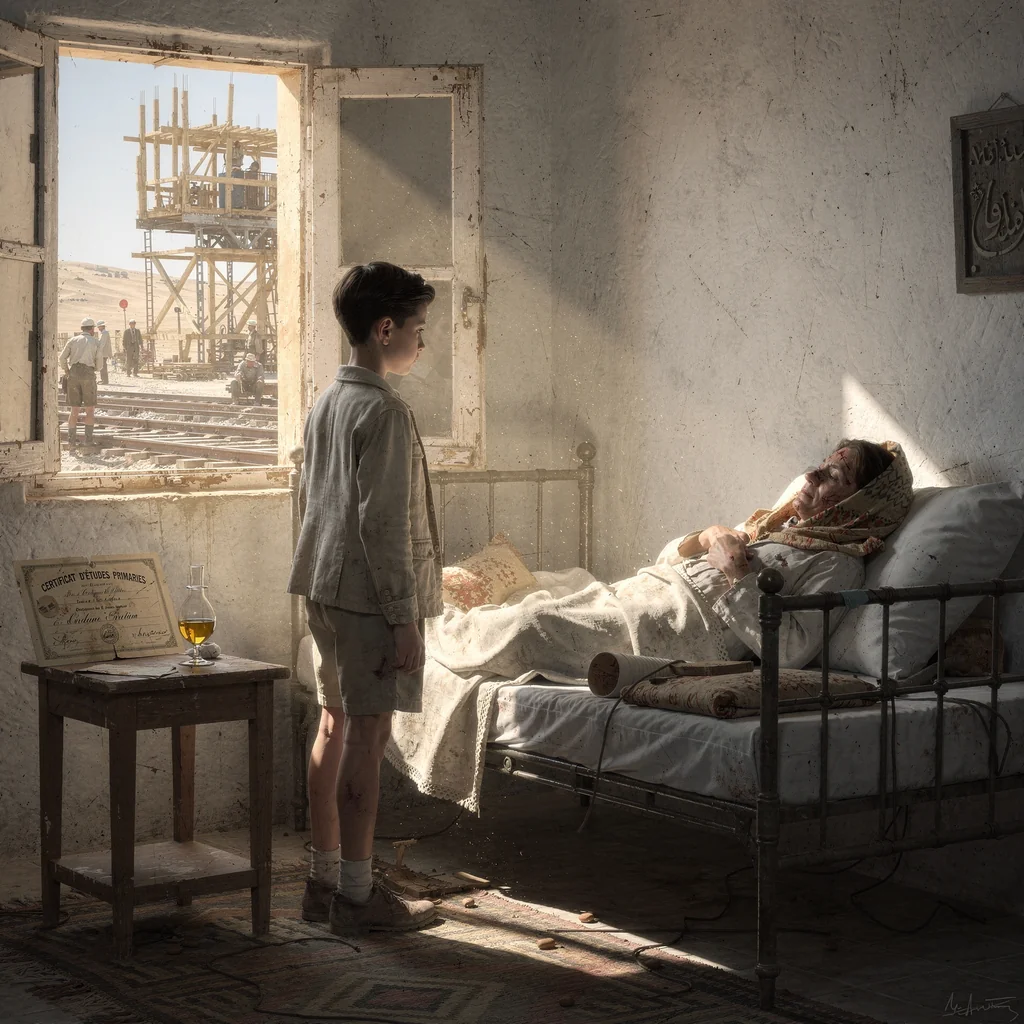
The certificate lay on the table, its edges curling slightly in the heat. Arabic script flowed across the page, interspersed with French: Certificat d’Études Primaires. The signature of the school director sprawled across the bottom in black ink that had already begun to fade.
He faced the window, his back to the room, looking through the wooden shutters. The August sun pressed against the whitewashed walls. Beyond the window, the alleyway shimmered in the heat. A vendor passed below, calling out something about melons, the voice drifting upward like smoke.
Behind him, the breathing continued.
Each inhale was a struggle. Each exhale a long, thin whistling sound, like air through a cracked reed.
The room smelled of olive oil and sickness. The two scents had fought each other for weeks now. The oil was losing.
He turned from the window to face the bed.
It occupied most of the room. A wooden frame, a mattress stuffed with wool that had grown thin with years. Sheets, once white, now a pale gray that no amount of washing could restore. She lay against the pillows, her face turned toward the door. Her breathing did not change when he moved.
She was forty-three years old. The neighbors had whispered about it when she had fallen pregnant again at forty-two. Another child, at her age. It wasn’t decent. It wasn’t safe. Everyone knew that.
The baby had lived three days.
That had been in May. Now it was August, and she was still here, still breathing, still fading by degrees.
His father had not returned from the barracks. The sergeant-cheff was occupied with the arrival of a new commandant, some business with the tramway line that was being extended from Sousse to Monastir. There were reports to file, inventories to maintain, French officers to placate. The family waited.
The certificate sat on the table where he had placed it that morning. Certificat d’Études Primaires. Primary school certificate. He had passed the examinations. The director had shaken his hand. His father had said nothing, had simply nodded once before leaving for the barracks.
Seven brothers and sisters. Six still living. He was the seventh. They had all gone to the kuttab, all learned to read the Quran, all worked in the fields or the house when they could be spared. He was the first to be sent to the French school in Monastir.
The school in the rue du Marron. The French teachers, the Tunisian assistants, the uniform they wore. He had worn it for six years. Now he had the paper that said he was done.
His father had made the choice. In Monastir, where French settlers bought land and built schools, where the tramway line from Sousse had just been extended, where the European quarter grew wider each year, a French education opened doors. His father had seen it. The sergeant-cheff had seen how the French administrators favored those who spoke their language, how the jobs in the colonial administration went to the graduates of the French schools.
In Djerba, where the old ways held, where French settlers were few, where the olive groves had belonged to the same families for six hundred years, the kuttab remained.
He had gone to the French school. He had learned to read and write in both languages, to calculate in the French manner, to recite the history of France’s kings and emperors and republics. He had learned about Napoleon’s conquest of Egypt, about the railway from Tunis to the coast, about the telegraph lines that carried messages across the sea in minutes.
He had also kept going to the kuttab in the afternoons. The sheikh had approved. A boy should know the Book. A boy should learn the prayers.
So he had learned both.
Her breathing changed tempo. A faster inhale, a longer pause before the exhale. She closed her eyes again.
He remained beside the bed. His hand hovered over hers, then withdrew.
They did not speak of her age. They did not speak of the baby that had lived three days in May. They did not speak of the whispers in the alleyway, the glances from the women at the well, the tightening of lips when she passed with her belly swelling again at forty-two.
His mother’s sister, his aunt Fatma, had come in June and stayed three weeks. She had sat in this room, fanning her sister, feeding her soup with a wooden spoon, speaking in low voices when they thought the children were asleep. He had heard fragments through the thin curtain that divided the room.
Another pregnancy. At her age. The doctor in Sousse said it was dangerous. They should have been more careful. A woman of forty, what was she thinking. It was the husband’s duty too. These men, they don’t understand what it does to a body.
He had not understood all of it. He had been twelve. But he had understood enough.
The certificate on the table was his achievement. The school in Monastir, the French director, the examinations in arithmetic and French grammar, Arabic dictation and history of France. He had studied at night while his brothers and sisters slept, by the light of a lamp that burned olive oil his father purchased from the cooperative store.
Now the certificate was complete.
Now his mother was dying.
The room grew hotter as the afternoon passed. The sun moved across the floorboards. Shadows lengthened from the window.
Somewhere in the house, a door opened. Footsteps in the hallway. His brother Mahmud, perhaps, returned from the market. Or his sister Nejiba, back from the well. The house was full of people. Six children still living, plus the father when he was not at the barracks. The aunt had departed in June, but other relatives came and went. Neighbors brought food, sat in the courtyard, spoke in hushed tones.
The breathing continued.
He remained at the foot of the bed, watching the rise and fall of the blanket. A thin woolen blanket, even in August. She said she was cold.
The certificate. The French school, the director’s handshake, the neat rows of desks where he had sat for six years. The kuttab where he had gone before, the sheikh with his gray beard and his switch, the other boys chanting verses they did not understand.
Two educations. Two worlds.
His father had made the choice. Send one son to the French school. Not the eldest—that was Mahmud, who would inherit the sergeant’s position when the time came, or what remained of it. Not the daughters—they would be married. But the seventh child. The one born when his mother was thirty-six, when she had already buried two children in infancy.
The choice had been made.
Her breathing grew shallower.
A rattle in the throat. A long pause. A shallow gasp.
He moved closer to the bed. Her hand lay outside the blanket, the fingers curled slightly. The skin was paper-thin, translucent over the bones. The veins stood out like blue threads.
He took her hand.
It was cold. Not the cold of a well-water jug in summer, not the cold of January stone. A different cold. The cold of something that was fading.
Her fingers did not close around his. They lay still in his grasp.
Her eyes opened again. They focused on him slowly, as if coming from a distance.
“The certificate,” she whispered.
“I have it.”
“Show me.”
He did not let go of her hand. He turned toward the table. The certificate lay where he had placed it that morning.
“It is there.”
She tried to lift her head. The effort was visible in the cords of her neck, in the way her breath caught. She could not rise.
“Bring it,” she said.
He released her hand. The imprint of her fingers remained on his palm, a ghost of warmth.
He crossed the room to the table. The certificate was lighter than it should have been, a single sheet of paper that somehow carried the weight of six years. He picked it up and carried it back to the bed.
She could not raise her head to see it. She could not turn her face toward the light.
He knelt beside the bed. He held the certificate where she could see it.
Her eyes moved across the page. She could not read the French parts. She could read the Arabic, the words Certificat d’Études Primaires, the date, the name.
“Habib,” she whispered. His name.
“Yes.”
“You passed.”
“Yes.”
She closed her eyes. The effort of seeing, of understanding, had exhausted her.
“Your father will be proud,” she said.
Her voice was fading now. The words came softer, each one a small stone placed carefully in a stream.
“He has not said,” the boy said.
“He will be.”
Her breathing grew shallower. The pauses between inhale and exhale lengthened.
He knelt by the bed, the certificate still in one hand, her cold hand in the other.
Outside the window, the call to prayer drifted across the city from the Great Mosque. The voice of the muezzin, thin in the heat, summoning the faithful to maghrib. The sun had set behind the houses. The sky was the color of bruised figs.
His father would return from the barracks soon. The family would eat the evening meal together, all except her. She had not eaten solid food in a week. She took only water now, and that with difficulty.
In the market, the price of grain had risen again. His brothers spoke of it at dinner—the famine in the south, the villages where whole families had died, the grain ships that sailed to Marseille while Tunisians went hungry. He did not understand all of it. But he understood hunger. He had seen it in his mother’s face for months, in the way she pushed her plate toward the children and said she had already eaten.
The certificate in his hand represented a future. The French school was finished. What came next? The lycée in Sousse, perhaps. The collège in Tunis. There were scholarships for the brightest boys. His father had spoken of it once, in the marketplace, when a French official had passed and nodded in greeting.
My son, his father had said, with a note of pride that the boy had rarely heard. He goes to the French school.
The official had nodded again. Très bien.
That was all. But in that nod, in those two words, something had been decided.
He knelt beside the bed and watched his mother’s chest rise and fall. Each rise was shallower than the one before. Each fall was less complete.
The call to prayer ended. The evening quiet settled over Monastir.
Her fingers twitched in his hand.
“Habib.”
“Yes, mother.”
“The certificate,” she whispered.
“It is here.”
“Put it away.”
He rose and crossed to the table. The certificate settled on the wooden surface as he smoothed the curled edges with his palm. The ink was faded but legible. The signature of the director, the seal of the school.
He turned back to the bed.
Her eyes were closed. Her breathing was so shallow now that he had to lean close to see the movement of her chest.
He waited at the foot of the bed, watching.
Outside, in the alleyway, a donkey brayed. Someone shouted back. The sounds of the city continued, indifferent.
The certificate. The French school, the lycée in Sousse, the scholarships that might be available. The kuttab, the sheikh, the verses he had memorized as a smaller child.
His father would return soon. The family would eat. There would be talk of the certificate, of what came next, of the future that opened before the seventh child.
He remained at the foot of the bed, watching his mother’s breathing grow shallower, still shallower, until the air itself seemed to hold its breath.
Her chest moved. A small movement, barely visible.
Then it did not move again.
The house filled with people.
Neighbors, relatives, women from the alleyway, men from the barracks. They came through the door, they stood in the courtyard, they spoke in low voices or did not speak at all. The body was washed, wrapped in white cotton, carried to the cemetery before the sun had fully risen.
The funeral prayer was said at the Great Mosque. The imam recited the words over the shrouded form. The grave was dug in the old cemetery where her parents lay, where two infants lay, where her husband’s first wife lay.
The boy stood with his brothers and sisters near the grave. His father stood apart, his face like stone.
The earth was shoveled back into the hole. The grave was filled.
They returned to the house. The neighbors had brought food. There was couscous, there was bread, there was tea. The men sat in one room, the women in another. The children moved between.
The boy sat with his brothers. Mahmud, the eldest, spoke of the barracks, of the new commandant, of the work that remained to be done. The other brothers listened or did not listen. The sisters served tea.
No one spoke of the certificate. No one spoke of the French school or what came next.
Late in the afternoon, his father called him into the small room that had been his parents’. The body was gone. The bed was stripped. The room felt larger and emptier than before.
His father stood at the window, looking out at the alleyway. The sergeant-cheff’s uniform was rumpled. There was dust on his boots.
“The certificate,” his father said.
“It is on the table.”
His father turned from the window. He crossed the room and picked up the paper. He held it to the light. He read the Arabic parts slowly. He did not read the French.
“You passed,” his father said.
“Yes.”
“The director spoke well of you.”
“He shook my hand.”
His father nodded. He placed the certificate back on the table.
“You will go to the lycée in Sousse,” his father said. “In September. There is a place for you.”
The boy said nothing.
“You will live there,” his father said. “There is a room for students from outside. You will study.”
“Who will pay?”
“The state,” his father said. “For the brightest. The director arranged it.”
The French school, the director’s handshake, the way the official in the marketplace had nodded. Très bien.
“You earned this,” his father said.
The boy looked at the certificate on the table. Certificat d’Études Primaires. The director’s signature sprawled across the bottom in faded black ink.
His father’s eyes were on him. The sergeant-cheff’s face was lined, the mustache gray, the eyes red from lack of sleep. The man had not cried. The man had not spoken of the wife he had buried that morning.
“Your mother,” his father said. The words stopped there.
The boy waited.
“She wanted this for you,” his father said. “She wanted you to study. To learn.”
His mother in the bed, the thin fingers, the parchment skin, the way she had asked him to show her the certificate.
“She saw it,” the boy said.
“She saw?”
“This morning. Before she died. I showed her.”
His father nodded. There was a long silence. Outside the window, the sounds of the city continued. A vendor called out. A child laughed. The world went on.
“You will go to Sousse,” his father said. “You will study. You will learn what the French know. Then you will come back, and you will serve your country.”
The kuttab, the sheikh, the verses chanted in unison. The French school, the arithmetic, the history of France’s kings.
“Your mother,” his father said again.
His father turned away. He walked to the window and looked out at the alleyway. His shoulders were rigid beneath the uniform.
The boy stood alone in the room.
The certificate lay on the table. The bed where his mother had died was stripped to the mattress. The window admitted the last light of the afternoon.
His mother’s hand, cold in his grasp. The certificate, warm from his palm. The lycée in Sousse, the room for students from outside, the state that would pay.
His mother had wanted this. His father had arranged it. The director had shaken his hand.
The boy turned from the room. He walked through the house, past the neighbors who still sat in the courtyard, past the brothers and sisters who still spoke in low voices, past the aunts who still brought food from their own kitchens.
He walked to the door and stepped out into the alleyway.
The August heat rose from the stones. The sun was setting behind the houses. The sky was the color of dried blood.
He stood alone in the doorway.
The certificate lay on the table inside. Certificat d’Études Primaires. The ink was faded. The edges curled slightly in the heat.
From the Great Mosque, the evening call to prayer began.
Scene 1.2
Tunis, October 1915
The olive trees in the courtyard cast their shade across the stone pavement, forty years of footfalls worn smooth. From the second-floor window, Mzali could hear the boys’ voices during recess, a low murmur that would end when the bell rang.
The bell rang.
He turned to the blackboard. The wooden desks stood in rows behind him, thirty of them, their tops scarred with decades of knife marks and ink stains. The blackboard covered the entire front wall, divided vertically into two sections.
At the front of the room stood a young man no older than twenty. He wore a European suit, the jacket unbuttoned, the collar unbuttoned at the throat. His name was Mohamed-Salah Mzali. He had graduated from Lycée Carnot the year before. He had been hired to teach at Sadiki when the French professors were called away to the war.
Now the classroom was his.
Thirty boys sat at the desks. They were fourteen, fifteen, sixteen years old. They wore uniforms—tunics and trousers of dark wool, the collars stiff, the buttons brass. Most were from Tunisian families of means, the makhzen aristocracy, the merchant class, the landowning families of the Sahel.
One boy sat in the third row.
His name was Habib Bourguiba. He was twelve years old, officially. He had been born in 1903, according to the civil register, though some said he was older, that his birth had been registered late. It did not matter. He was here now.
He watched the teacher.
Mzali moved to the blackboard. He picked up a piece of white chalk. He wrote on the left side of the board, his hand forming Arabic letters with the ease of long practice.
Education.
Then he turned to the right side of the board. He wrote in French.
L’instruction.
He turned back to the class. His eyes moved over the rows of boys.
“What is the difference?” he asked.
The room was silent. Thirty boys in uniforms sat at wooden desks. No one raised a hand.
Mzali walked along the rows. He stopped at a desk near the front.
“You,” he said. “What is your name?”
The boy stood. “Mahmud, monsieur.”
“Mahmud what?”
“Mahmud El Materi.”
Mzali nodded. El Materi. He knew the family—land in the Sahel, a cousin at the Bey’s court. The boy would inherit his father’s position, as his father had inherited it before him.
“Tell me, Mahmud,” Mzali said. “What is the difference between ta’līm and instruction?”
The boy hesitated. The Arabic word was familiar. The French word was familiar. The difference was not.
“Ta’līm is what we learn at the kuttab,” Mahmud said finally.
“And instruction?”
“What we learn here.”
Mzali nodded. He walked to the next desk.
“Your name?”
“Slimane, monsieur.”
“Slimane what?”
“Slimane Ben Slimane.”
Mzali nodded. Ben Slimane. Trade money. The family had made their fortune in the ports—Marseille, Livorno, Malta. Not a name that appeared in the old registers.
“Tell me, Slimane,” Mzali said. “What is the difference?”
Slimane stood. He thought for a moment.
“Ta’līm is learning the Book,” he said. “Instruction is learning to read the newspapers.”
The class stirred. A few boys chuckled.
Mzali did not smile. He gestured for Slimane to sit.
“And you?” Mzali said, moving to the third row.
The boy stood.
“Your name.”
“Habib, monsieur.”
“Habib what.”
“Habib Bourguiba.”
Mzali looked at the boy. Dark hair, serious eyes, a face still soft with childhood but beginning to sharpen at the jaw.
“Bourguiba,” Mzali said. “From Monastir?”
“Yes, monsieur.”
“Your father is…”
“The sergeant-cheff, monsieur.”
Mzali nodded. Monastir. He knew the type—the minor officials who sent their sons to Sadiki, hoping the education would lift the family’s standing. Not wealthy, not aristocratic. But ambitious enough to try.
“Tell me, Habib,” Mzali said. “What is the difference between ta’līm and instruction?”
Habib stood straight. His uniform was clean, his brass buttons polished. His father had made sure of that before he left for Tunis.
“Ta’līm is what the sheikh teaches,” Habib said. “Instruction is what you teach, monsieur.”
The class was silent.
Mzali looked at the boy. He looked at the Arabic word on the left side of the blackboard, at the French word on the right.
“And am I teaching you ta’līm?” Mzali asked. “Or instruction?”
Habib did not answer immediately.
“Both,” he said finally.
Mzali raised an eyebrow. He turned to the blackboard. He wrote under the Arabic word:
Ta’līm al-Qur’an — Learning the Quran.
Under the French word, he wrote:
Les sciences modernes — The modern sciences.
He turned back to the class.
“What do these have in common?” he asked.
The boys looked at each other. No one raised a hand.
“They are both learning,” a boy in the back row said.
Mzali nodded. “Yes. They are both learning. But what is the difference?”
Again, silence.
Mzali walked to the front of the room. He stood before the divided blackboard, Arabic on the left, French on the right.
“The difference,” he said, “is that ta’līm forms the soul. And instruction forms the mind.”
The boys looked at the blackboard. They looked at the teacher.
“A man needs both,” Mzali said. “A man needs a soul formed by the Book, formed by the knowledge of where he comes from and who he is. And a man needs a mind formed by the sciences, formed by the knowledge of how the world works, of what can be built, of what can be known.”
He picked up the chalk again. He drew a line connecting the two words.
Ta’līm = L’instruction.
Education equals instruction.
“But they are not the same,” Mzali said. “Are they?”
No one answered.
“Tell me,” Mzali said. “If a man has instruction but no ta’līm, what is he?”
“He is educated,” a boy said.
“But does he have a soul?”
“He has a soul,” the boy said. “Everyone has a soul.”
“Then what is the difference?” Mzali asked. “What is the difference between a man who has only instruction and a man who has only ta’līm?”
The class was silent.
Mzali looked at Habib Bourguiba.
“What do you think, Bourguiba?”
Habib stood again. He had been thinking about this question since he walked into the classroom in September. He had been thinking about it in the French school in Monastir, where he had learned to count in French, to read French history, to recite the names of French kings.
“A man with only instruction,” Habib said, “can build things. But he does not know what to build.”
Mzali nodded. “And a man with only ta’līm?”
“He knows what to build,” Habib said. “But he does not know how.”
The class was silent.
Mzali looked at the boy. He looked at the serious face, the dark eyes that took in everything, the uniform that was slightly too large, as if the boy had not yet grown into it.
“Sit down, Bourguiba,” Mzali said.
Habib sat.
Mzali turned back to the blackboard. He wrote in the center, between the two words:
Independence.
Or: La liberté — Freedom.
“This is what we are building toward,” Mzali said. “A man who has both ta’līm and instruction. A man who knows who he is, and knows how to build what he wants to build.”
He turned to the class.
“This is what Sadikiya is,” he said. “The synthesis. The meeting point. The place where the two worlds become one.”
The boys looked at the blackboard. They looked at the Arabic word, the French word, the word that bridged them.
Mzali walked to his desk. He opened a book. The lesson for the day was arithmetic—fractions, decimals, the calculation of percentages. The boys opened their notebooks. They prepared their pens.
Mzali taught in Arabic. He taught in French. He moved between the two languages as if they were the same, as if the distinction did not exist.
Habib Bourguiba copied the problems into his notebook. He wrote the Arabic numerals, he wrote the French calculations. His handwriting was neat, precise. Each digit was exactly where it should be.
The class continued.
The bell rang.
The boys stood. They gathered their books, their pens, their notebooks. They moved toward the door.
Mzali stood at the front of the room. He erased the blackboard. The Arabic word disappeared, then the French word, then the word that bridged them. The board was clean, a surface of black wood ready for the next lesson.
“Bourguiba,” Mzali said.
Habib stopped at the door. He turned.
The other boys filed past him into the courtyard. The room emptied.
“Yes, monsieur?”
Mzali walked to where he stood. The teacher was not much older than the students he taught. There were lines of exhaustion around his eyes—the war had been difficult for everyone, even here in Tunis where the fighting was far away.
“Your father,” Mzali said. “How is he?”
“He is well, monsieur.”
“And your mother?”
The question was unexpected. Mzali had not met Habib’s father. He did not know the family. He should not have known about the mother.
Habib’s face did not change.
“She died, monsieur. In August. Two years ago.”
Mzali nodded. His face did not change.
“You passed the examinations,” Mzali said.
“Yes, monsieur.”
“You came to Tunis.”
“Yes, monsieur.”
“You will learn,” Mzali said. “You will learn ta’līm and you will learn instruction. You will learn who you are, and you will learn how to build what you want to build.”
Habib said nothing.
“When you leave this place,” Mzali said, “you will have both. You will have what no one before you has had.”
He paused.
“You will have the tools,” Mzali said. “What you build with them will be up to you.”
Habib stood in the doorway. The courtyard was visible behind him, the olive trees, the stone pavement, the other boys walking in groups toward the gate.
“Go,” Mzali said. “Recess is ending.”
Habib turned and walked out into the courtyard.
Mzali stood alone in the classroom. He looked at the blackboard, clean and black. Two hundred students over the past two years, since the French professors had left for the war.
Most would inherit what their fathers had built. They would occupy the positions prepared for them. They would serve in the administration, in the courts, in the businesses their families had owned for generations.
A few would do something else.
Bourguiba. The boy from Monastir, the son of a sergeant-cheff, serious beyond his years, neat and precise in everything he did.
Mzali picked up the chalk. He wrote on the left side of the blackboard, in Arabic:
Formation.
He wrote on the right side, in French:
La formation.
Then he drew a line between them, connecting them, making them one.
He stepped back and looked at what he had written.
The boys would return from recess in five minutes. They would take their seats. They would open their notebooks. They would copy what he wrote.
They would copy both sides.
They would copy the connection.
They would copy the synthesis.
The chalk dust settled in the light from the window. Arabic on the left, French on the right, the line between them still visible.
In the third row, Bourguiba’s notebook lay open on his desk—the homework from that morning, the Arabic numerals and the French calculations, each digit in its proper place.
The bell rang in the courtyard below. The sound of boys’ feet on the stairs.
| Scene | Year | Location | POV | Words |
|---|---|---|---|---|
| 1.1 | 1913 | Monastir | Young Bourguiba (10) | 2,400 |
| 1.2 | 1915 | Tunis, Sadiki | Mzali (19) | 1,550 |
| Chapter Total | 3,950 |