Chapter 6: The Assassination
Scene 6.1: Sabbat Dhalam, Tunis, 1958-1960
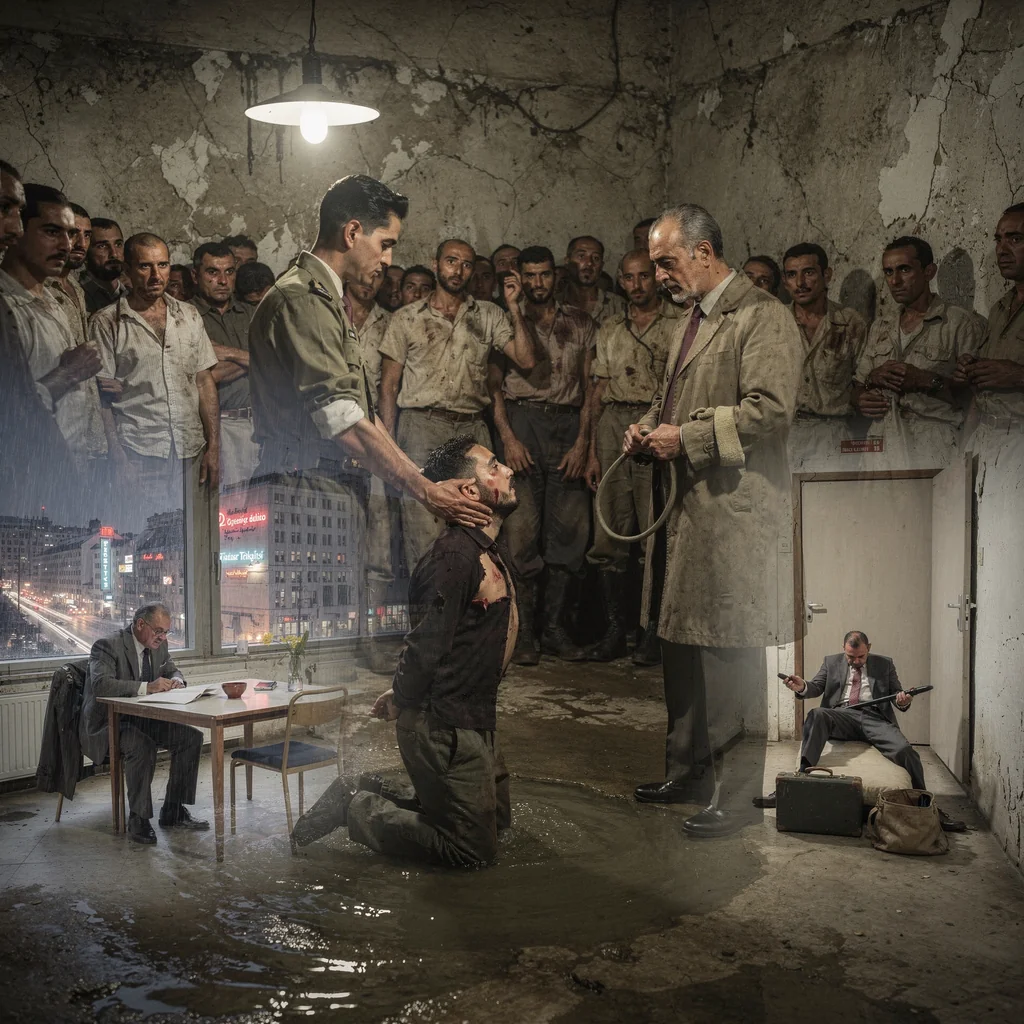
The building at Rue Sabbat Dhalam had once been a cellule du parti—a Neo-Destour office in the Medina of Tunis, where activists gathered, where pamphlets were distributed, where the struggle for independence had been organized, room by room, neighborhood by neighborhood.
Now the rooms held screams.
Ahmed Massoudi had known this office when it was theirs—the meetings, the debates, the energy of men and women who believed that independence would bring freedom, that the end of colonialism would mean the end of oppression.
The letters had come first—the threats, the warnings: Revenir au bureau politique du PDL sinon on serait châtiés sévèrement, on ne joue pas avec la mort. Return to the Political Bureau of the Democratic Liberation Party or you will be severely punished, we don’t play with death.
He had fled to Dhiba. Others had stayed. The office they had transformed into a place of torture and detention.
Now he was back.
The door opened at midnight. Guards dragged him in—Tunisian guards, speaking Arabic, men who might have been his colleagues in another time, in another Tunisia, in the world that should have existed after independence.
“Name,” the guard said.
“Ahmed Massoudi.”
The guard nodded. He knew the name. They all knew the names. Yousséfistes. Ben Youssef supporters. Men and women who had opposed the internal autonomy, who had rejected the French collaboration, who had believed that independence should mean independence, not replacing one master with another.
The guard pushed him into a room. Forty men already there—forty to fifty prisoners per room, no mattresses, the floor covered in stagnant water, the air thick with the smell of sweat and fear and excrement.
A man in the corner recognized him. Ahmed nodded. He couldn’t speak. His throat was dry from fear.
The door opened again. Taieb Sahbani entered—the supervisor of Sabbat Dhalam, the man who answered to Taieb Mhiri, the Minister of Interior. Behind him: Hassan Ayadi, the main supervisor of Lijen Erryaya, the vigilance committees that hunted Yousséfistes across Tunisia.
Massoudi had seen Ayadi before. Before independence, Ayadi had been a resistance fighter. Now he carried a truncheon in the same corridors where they had once distributed pamphlets together.
“So,” Sahbani said. “Ahmed Massoudi. The cellule du parti secretary.”
Massoudi said nothing.
“You thought you could flee to Dhiba.” Sahbani’s voice was conversational. “You thought you could hide.”
“We were threatened,” Massoudi said.
“Threatened.” Sahbani laughed. “You received letters. And instead of returning to the party, instead of serving Tunisia, you ran.”
“I serve Tunisia,” Massoudi said. “Not Bourguiba.”
The room went silent. The wrong words—the fatal words.
Sahbani nodded to Ayadi.
The beating began.
They used clubs—matraques, wooden truncheons designed to break bones without breaking skin. They beat his back, his legs, his ribs. They beat him until he collapsed, until he couldn’t stand, until he curled on the floor covering his head with his arms.
Then the real torture began.
Salt in his food. Salt in his water. Every swallow a punishment, every meal a test of endurance. The salt made him thirsty. The water made him sick. The cycle continued, day after day.
Then the pesticides.
They sprayed them on his head, on his body—chemicals meant for insects, for crops, for anything but humans. His skin burned. His eyes watered. He choked on the fumes.
“Confess,” Sahbani said. “Confess and it stops.”
“Confess what?”
“That you received money from Ben Youssef. That you coordinated with Cairo. That you plotted against the state.”
“I received no money,” Massoudi whispered. “I coordinated nothing.”
The beating resumed.
Massoudi lost track of time—days, weeks, months. The prisoners were moved between torture centers—Sabbat Dhalam in Tunis, Beni Khalled in Cap Bon under Amor Chachia, Zaouiet Sidi Issa, Houareb at Kairouan, Bir Taraz at Rades. A network of pain, a system of silence.
In the cell next to his, a Zeitouna student—weeping, broken, confessing to anything, to everything, to nothing at all. They had broken him in three days. The young man who had memorized the Quran, who had studied Islamic law for seven years, who had believed that knowledge was sacred.
Now he sat in the corner, his forehead pressed to the wet floor, his lips moving without sound.
In another cell, a Yousséfiste fighter from Tataouine—one of the survivors of Djebel Agri, captured after the battle where French-Tunisian forces had killed fifty-three of his comrades. He had survived the mountain only to die here, slowly, piece by piece, salt and pesticides and the darkness of a room with no windows.
Massoudi lay on the floor, his body broken, his mind clouded with pain and exhaustion. The letter—on ne joue pas avec la mort.
We don’t play with death.
He slept. He woke. The stagnant water lapped at the wall. The darkness did not change.
Scene 6.2: Frankfurt, August 12, 1961
The Hôtel Royal de Kaiserstrasse rose six stories above the street. A German hotel—clean lines, efficient service, signs in a language Salah Ben Youssef didn’t speak. He’d arrived two days earlier, seeking treatment for an illness that wouldn’t heal. Tunisia’s hospitals were closed to him. Cairo’s doctors had recommended Germany.
He stood at the window of room 317. Below, Kaiserstrasse stretched—German shops, German pedestrians, German traffic. An ordinary Friday in late summer. The sort of day when nothing happens.
Ben Youssef turned from the window. The room was small but clean. A bed. A desk. A chair. The Arabic newspapers he’d brought from Cairo lay on the desk—Al-Ahram, Al-Ahram al-Misri. The headlines spoke of Tunisia, always Tunisia. The waqf nationalized, the Zaytuna dissolved, the Ramadan fast challenged on television. The dismantling proceeding without him.
He touched the papers. The ink was dry. The words were set. What remained to be said?
A knock at the door.
Ben Youssef checked his watch—4:30 PM. Béchir Zarg El Ayoun was due. The mediator who had carried messages between Tunis and Cairo, who had promised safe passage if Salah would return. Who had brought the offer: meet in Frankfurt, neutral ground, discuss reconciliation.
Salah opened the door.
Béchir stood in the corridor, face pale. He held no papers. He extended no hand.
“Si Salah.” Béchir’s voice was low.
“Enter.” Salah stepped back.
Béchir didn’t move. “Si Salah, there is someone else.”
“Who?”
“From Tunis.” Béchir’s eyes shifted to the corridor behind him.
Salah looked.
A man stood twenty feet down the hallway. Dark suit. Fair hair. European face, not Arab. He carried nothing—no briefcase, no papers, no medical bag. Just his hands at his sides.
“Who is that?” Salah asked.
“I don’t know.” Béchir’s voice cracked. “He asked at the desk. Which room was Salah Ben Youssef staying in.”
The man in the corridor began to walk.
Salah watched him come. Each step measured. Each step ordinary on the German carpet. The hotel corridor absorbed sound—the footsteps soft, the air still.
“Béchir.” Salah didn’t turn. “Close the door.”
“Si Salah—”
“Close the door.”
Béchir stepped into the room. Salah pushed the door shut. The lock clicked.
The footsteps continued in the corridor. Coming closer.
Salah moved to the desk. He picked up his passport—Tunisian citizen, born in Maghoura, the place called Oppression, died—no, not yet. The passport was open to the photograph page. His face looked back from the paper, younger than the face in the mirror.
The footsteps stopped outside the door.
Silence.
Then the knock.
Three raps. No more, no less.
Salah looked at Béchir. The mediator’s face was the color of ash. His hands trembled at his sides.
“Don’t open it,” Béchir whispered.
The knock came again.
Salah set down the passport. He walked to the door. His hand found the knob. The metal was cool against his palm.
He could call out— Polizei, Hilfe, anything. His German was limited to bitte and danke, but scream was universal. He could lock the door again, push the desk against it, call Cairo from the telephone, reach for Soufia’s voice one last time.
The footsteps in the corridor had stopped. The man stood on the other side of the door. Salah could feel him there—the presence, the waiting.
He turned the knob.
The door opened.
The man stood in the corridor. European face, blue eyes, hair the color of winter wheat. His right hand was raised at chest level. Something black in the grip.
Salah looked at him. Not with surprise. Not with fear. With recognition.
This was the price.
The gun fired.
The sound was smaller than Salah expected—a sharp crack, like a branch breaking in winter. He felt nothing at first. Then the heat spread through his chest, then the cold. His knees buckled. The carpet rushed up to meet him.
He fell.
The ceiling came into view—white plaster, a light fixture, a smoke detector. Ordinary hotel ceiling. The sort of ceiling he’d woken under two mornings ago, not knowing.
The door opened wider. Boots on carpet. The man stood over him. Another shot—this one into the chest, already broken, already done.
The footsteps retreated. Down the corridor. The elevator dinged. The doors opened and closed.
Silence.
Salah lay on the carpet. The blood spread beneath him—warm, then cooling, seeping into the German fibers. His face pressed against the floor. The texture was rough against his cheek. The smell was industrial—cleaning chemicals, dust, the ghost of a thousand travelers.
He could not lift his head. Could not reach for the passport on the desk. Could not call for Béchir, who had pressed himself against the wall, who had not moved.
The blood continued to spread. A dark pool widening, reaching toward the door, toward the desk, toward the passport that said who he was.
Maghoura. The name surfaced, then sank. The place called Oppression. Home.
The ceiling receded. Light through the smoke detector. The fixture dimming.
Below, in the corridor: wheels on carpet. A room service cart. The ordinary sounds of an ordinary hotel.
The door—the open door—the corridor beyond—the elevator—everything narrowing, dimming, gone.
Somewhere in the room, a telephone began to ring.
Scene 6.2B: Frankfurt, August 12, 1961
Béchir Zarg El Ayoun could not move. The gunshots still echoed in his ears—two sharp cracks, then silence. Salah lay on the carpet, the blood spreading, the face turned toward the door. The eyes were open, staring at nothing.
The telephone continued to ring.
Béchir’s hands trembled. He had brought Salah here. He had carried the messages from Tunis. He had promised safe passage. He had believed—or wanted to believe—that reconciliation was possible. That two visions of Tunisia could find common ground.
The blood reached Béchir’s shoe. He stepped back.
The telephone rang a third time.
Béchir crossed the room. He picked up the receiver. His hand shook so badly he nearly dropped it.
“Allô?” The voice was cracked, broken.
“Front desk.” A woman’s voice, German-accented English. “Everything okay, Mr. Zarg El Ayoun? We heard—”
Béchir couldn’t speak. The words caught in his throat like stones.
“Mr. Zarg El Ayoun?”
“Send—” Béchir swallowed. “Send police. Send ambulance. Room 317.”
“What happened?”
“Everything.” Béchir let the receiver drop.
He turned back to the body. Salah lay still now. The spreading blood had stopped widening. The pool was dark, soaking into the carpet, soaking into the floor beneath. The passport lay on the desk, the photograph staring toward the ceiling, toward the body, toward the door that the assassin had walked through.
The door that Béchir himself had opened, at the assassin’s knock.
Béchir backed away from the body. His legs felt hollow. The room tilted. He reached for the wall, missed, found the doorframe.
In the corridor, footsteps hurried. Hotel staff. German voices. Polizei, someone shouted. Ambulance.
Béchir slid down the doorframe. He sat on the floor, back against the wall, legs extended. The door to room 317 was open. From this angle, he could see inside—see the body, see the blood, see the passport on the desk.
He would carry this to his grave. The knowledge of what he’d done. The knowledge of who he’d served.
The German police arrived first—two officers, uniforms, service weapons holstered. They saw the body, saw the blood, saw Béchir on the floor. They saw the open door, the assassin’s path of exit, the passport on the desk.
“Was ist passiert?” one officer asked.
Béchir couldn’t answer. He didn’t speak German. He didn’t speak Arabic anymore. He didn’t speak at all.
The ambulance arrived five minutes later—paramedics, a stretcher, equipment. They checked for a pulse, found none. They covered the body with a sheet. The fabric settled over Salah’s face, over the blood, over the carpet that had absorbed the last minutes of a life.
Béchir watched them lift the body onto the stretcher. Watched them carry it out the door. The sheet was white, unstained, hiding everything. Hiding Maghoura, hiding Cairo, hiding the vision of Tunisia that died in a Frankfurt corridor.
One of the paramedics paused in the doorway. He looked at Béchir, still sitting against the wall. He said something in German— Are you all right? Do you need help?
Béchir shook his head.
The paramedic nodded. He followed the others out.
The room was empty now. The blood remained on the carpet—dark pool, drying now, soaking in. The passport remained on the desk. The Arabic newspapers remained scattered across the surface. The telephone receiver dangled from its cord, swinging slightly.
Béchir pushed himself up the wall. His legs held him. He walked into the room.
The passport lay open. Salah Ben Youssef, born October 11, 1907, in Maghoura, Djerba. Tunisian citizen. Exile. Martyr.
Béchir closed the passport. He picked it up. The leather was warm from his hand. He would need to notify Soufia in Cairo. He would need to tell her that Salah would not return. That the Frankfurt hotel corridor was the end of the road. That the reconciliation was never real.
The German police were waiting in the hallway. They would want a statement. They would want to know who had fired the shots, which way the assassin had gone, who had booked the room, who had made the telephone call to the desk.
Béchir had answers to none of these questions.
He walked to the door. The police looked up. One of them held a notebook. Another held a camera. They were efficient, methodical, German. They would document everything. They would photograph the bloodstains. They would fingerprint the doorframe. They would question the witnesses.
Béchir stepped into the corridor. The door to room 317 remained open behind him. Through the gap, he could see the desk, the newspapers, the bloodstained carpet. The room was already becoming a crime scene—evidence, documentation, procedure.
Béchir followed the police down the corridor. The elevator dinged. The doors opened. He stepped inside, the passport in his hand, its leather warm against his palm.
The doors closed. The elevator descended.
Somewhere in the hotel, a telephone began to ring.
Scene 6.2A: Cairo, Apartment on Sharia Adly, August 12, 1961
The telephone rang at 8:15 PM Cairo time.
Soufia Ben Youssef stood at the kitchen counter of the apartment on Sharia Adly, near the Egyptian Museum. Through the windows, the Nile carried dark water reflecting Cairo’s lights—the bridge at Qasr el-Nil, palm trees along the corniche, the steady glow of hotels and embassies. The air conditioner hummed in the window, fighting the August heat.
Chedly sat at the dining table, fifteen years old, bent over a history textbook. Lotfi, thirteen, lay on the sofa, reading a comic book. Neither looked up when the telephone rang.
Soufia wiped her hands on her apron. She walked to the telephone in the hallway. The receiver hung on the wall, the cord coiled like a snake.
“Allô?”
The line crackled. Long distance. Static.
“Soufia?” A man’s voice—familiar, unclear.
“This is Soufia.”
“Soufia, it’s Béchir. Zarg El Ayoun.”
The name meant nothing for a moment. Then she placed it—the mediator. The man who had arranged the Frankfurt meeting. The man who had promised safe passage.
“Béchir.” Her hand tightened on the receiver. “Is Salah there? Did he—”
The silence on the line lengthened. Static hissed.
“Soufia.” Béchir’s voice broke. “There was… there was an incident. At the hotel. In Frankfurt.”
She did not speak. The kitchen clock ticked. The air conditioner hummed.
“Someone came to the room. Two shots. Salah…” Béchir’s voice cracked. “Salah is dead.”
The words meant nothing. Dead. Frankfurt. Two shots. They were just sounds, just syllables, just air through a telephone line.
“Soufia? Are you there?”
She was still holding the receiver. Her hand was still gripping it. The plastic was warm against her palm.
“Soufia, I’m sorry. I tried to—I didn’t know—”
“When?” The word was not hers. Someone else had spoken it.
“This afternoon. 4:35 Frankfurt time. The police came. The ambulance. There was nothing—” Béchir’s voice cracked again. “I have his passport. I’ll bring it to Cairo. I don’t know when. There’s an investigation. The German police—”
Soufia did not hear the rest. The receiver slipped from her hand. It dangled from the cord, swinging slightly, Béchir’s voice still speaking from the dangling end.
She walked back to the kitchen.
Chedly looked up from his textbook. “Umm? Who was it?”
Lotfi rolled over on the sofa, the comic book forgotten. “Is Baba coming home?”
Soufia remained in the kitchen doorway. The air conditioner hummed. The clock ticked. Beyond the windows, the Nile flowed past, dark water reflecting Cairo lights.
“Umm?” Chedly stood up. “What happened?”
Soufia’s throat was dry. She could not form the words. They were too large, too heavy, too impossible to speak.
“Your father.” The voice was not hers. It was someone else’s voice, thin and dry and distant. “Your father has been killed.”
The room was silent.
Chedly remained by the table, his history textbook open to a page about the French Revolution. Lotfi sat up on the sofa, the comic book sliding to the floor. Soufia filled the doorway, her hands empty, her face dry.
“How?” Chedly asked. “How was he killed?”
“Frankfurt.” The word fell into the room like a stone. “Someone came to his hotel room. Two shots.”
Chedly did not move. Lotfi did not move. The air conditioner hummed. The clock ticked.
“Who?” Lotfi asked.
“We don’t know.”
“When?”
“This afternoon. 4:35.”
Chedly looked down at his textbook. The page showed a picture of the Bastille being stormed. A crowd with pitchforks and guns. A prison falling.
“Are you sure?” Lotfi asked.
Soufia could not answer. She crossed to the window. The street below was empty. A car passed, its headlights sweeping the buildings across the way. The night was warm and still.
Behind her, Chedly closed the history textbook. The cover was blue, the title stamped in gold: A History of the Modern World. He placed it on the table, aligning the edges with the table edge, perfectly centered.
Lotfi rose from the sofa. He crossed to the dining table and stood beside his brother, looking at the closed textbook, at the perfect alignment, at the room that was the same room it had been five minutes ago—before the telephone rang.
“Umm?” Lotfi asked. “What do we do now?”
Soufia did not turn from the window. A taxi honked on the corniche below. Somewhere in the building, a door closed.
“We go on,” she said.
Chedly picked up the history textbook. He opened it to the page about the French Revolution. He read the first paragraph again. The Bastille had fallen. The old order had collapsed. A new world had begun.
The telephone receiver dangled from the wall in the hallway, Béchir’s voice still speaking from the dangling end, a voice that had traveled from Frankfurt to Cairo, carrying words that changed everything and nothing.
Behind her, Chedly and Lotfi stood by the table, not moving, not speaking.
The air conditioner hummed.
The clock ticked.
The Nile flowed.
The next morning, Soufia woke before dawn. She stood at the window, watching the Nile turn gray as the sky lightened. The bridge at Qasr el-Nil was still orange from the streetlights. The palm trees along the corniche stood still in the dawn air.
Chedly and Lotfi still slept. Chedly in his bed, the history textbook on his nightstand. Lotfi in his bed, the comic book on the floor.
Soufia walked to the kitchen. She filled the kettle with water. She placed it on the stove. She struck a match. The gas burner flared blue.
The water began to heat.
She opened the refrigerator. She took out eggs, bread, tomatoes. She placed them on the counter. She took a knife from the drawer. She sliced the tomatoes. The juice ran onto the cutting board.
The water began to boil.
She turned off the burner. She made tea. She placed the teapot on a tray. She placed cups on the tray. She placed sugar on the tray.
She carried the tray to the dining table.
The apartment was quiet. The air conditioner was off. The windows were open. The Cairo morning flowed through the screens—smell of the Nile, smell of exhaust, smell of bread from the bakery downstairs.
Chedly’s door opened. He walked into the dining room, fifteen years old, his hair mussed from sleep, his eyes still full of dreams.
“Umm?” His voice was thick with sleep.
“Good morning.” Soufia poured tea into his cup.
Chedly sat at the table. He looked at the tray—tea, eggs, tomatoes, bread. The same breakfast he ate every morning. The same table. The same chair. The same window overlooking the Nile.
“Is it true?” he asked.
Soufia did not pretend to misunderstand. “Yes.”
Chedly nodded. He picked up his cup. He took a sip of tea. He placed the cup back on the saucer.
Lotfi’s door opened. He walked into the dining room, thirteen years old, rubbing sleep from his eyes.
“Baba called?” he asked.
The question was innocent. The hope was naked.
Soufia looked at him. “No.”
The hope in Lotfi’s face died. He sat at the table. He looked at the tray—tea, eggs, tomatoes, bread. The same breakfast. The same table. The same chair.
“He’s not coming back,” Lotfi said.
“No.”
The three of them sat at the table. The tea steamed in their cups. The eggs cooled on their plates. The tomatoes released their juice onto the cutting board. The bread lay in the basket, crusty and white.
Outside the window, the street filled with light. A vendor pushed his cart along the sidewalk, the wheels rattling on the stones.
“What happens now?” Chedly asked.
Soufia looked at her sons—fifteen and thirteen, old enough to understand, young enough to hope, old enough to know that hope was dangerous.
“We stay in Cairo,” she said. “You go to school. I work.”
“Who called?” Lotfi asked. “Last night?”
“Béchir Zarg El Ayoun. The mediator.”
“Is he coming here?”
“He has the passport. He’ll bring it.”
Lotfi nodded. He picked up a piece of bread. He tore off a piece. He placed it in his mouth. He chewed slowly.
Chedly picked up his fork. He speared an egg. He placed it in his mouth. He chewed slowly.
Soufia picked up her cup. She took a sip of tea. She placed the cup back on the saucer.
They ate breakfast. They drank tea. They did not speak.
Outside the window, the Nile flowed past. The bridge at Qasr el-Nil carried traffic—cars, buses, trucks, people going to work, people going to school, people going forward into the day.
The sun rose over Cairo. The palm trees cast long shadows. The bakery downstairs opened. The smell of fresh bread filled the apartment.
Chedly stood up. He cleared his plate. He placed it in the sink. He washed it. He dried it. He placed it in the cabinet.
Lotfi stood up. He cleared his plate. He placed it in the sink. He washed it. He dried it. He placed it in the cabinet.
Soufia stood up. She cleared the tray. She washed the cups. She dried them. She placed them in the cabinet.
The kitchen was clean. The table was clear. The breakfast was over.
“I have to go to school,” Chedly said.
“Yes.”
“I’ll be late.” He looked at the clock on the wall—7:30 AM. School started at 8:00.
“Take your books.”
Chedly walked to his room. He returned with his schoolbag—history textbook, notebook, pens. He walked to the door.
He stopped. He looked at Soufia. He looked at Lotfi, still sitting at the table.
“Will Baba be buried in Tunis?” Lotfi asked.
“We don’t know yet,” Soufia said. “The German authorities—”
“I want to go,” Lotfi said. “If there’s a funeral. I want to go.”
“We’ll see.”
Lotfi nodded. He stood up. He walked to his room. He returned with his schoolbag. He walked to the door.
Chedly was already in the hallway, putting on his shoes. Lotfi put on his shoes. They opened the door.
“Goodbye, Umm,” Chedly said.
“Goodbye, Lotfi,” Soufia said.
The door closed.
The apartment was quiet.
Soufia stood alone in the dining room. The table was clear. The kitchen was clean. The dishes were put away. The breakfast was over.
She crossed to the window. The corniche was filling with traffic—cars, buses, trucks, the ordinary movement of a city waking up. The sun climbed above the rooftops.
Below, on the street, boys walked to school—Chedly, fifteen, walking tall, carrying his books; Lotfi, thirteen, walking beside his brother, carrying his schoolbag. They did not look back. They did not look up. They walked forward into the day.
Soufia watched them until they turned the corner. Then she turned from the window. She walked to the hallway. She picked up the telephone receiver, still dangling from the wall. She placed it back on the cradle.
The line was dead.
She walked to the bedroom. She opened the closet. Salah’s clothes hung there—jackets, shirts, trousers. She touched the sleeve of a jacket. The wool was rough under her fingers. She left the closet open.
She walked to the dresser. Salah’s brush sat on the top—dark hair still tangled in the bristles. She left it there.
She walked to the bedside table. Salah’s watch sat there—gold face, leather strap, stopped at 4:35.
She left the watch where it was.
The light from the bedroom window fell across the dresser, across the brush with its tangle of dark hair, across the jacket sleeve pushed slightly forward on the rod in the open closet.
The apartment was quiet.
Scene 6.3: Tunis, Presidential Palace, August 12, 1961
The telegram arrived at 5:15 PM Tunis time.
Habib Bourguiba sat at his desk in the Presidential Palace at Carthage. Through the window, the Mediterranean stretched—blue, flat, empty. French warships anchored off Bizerte, twenty miles north. The crisis had begun July 19—French troops fortifying positions, Tunisian forces responding, the world watching. Independence was only five years old, and already the test.
The palace was quiet. Advisors had departed for the evening. Secretaries had gone home. Bourguiba remained at his desk, reading reports from Bizerte, tracking French naval movements, planning Tunisia’s response.
A messenger entered—young man, nervous, holding a telegram.
“Mr. President.” The messenger’s voice was low.
Bourguiba looked up. “What is it?”
“Telegram from Frankfurt.” The messenger extended the paper.
Bourguiba took it. The paper was thin, the ink smudging slightly from humidity. He didn’t open it immediately. Frankfurt meant Salah. Salah meant the mediation, the reconciliation talks, the possibility of—
He broke the seal. He unfolded the paper.
FRANKFURTER NEWSPAPERS REPORT: SALAH BEN YOUSSEF ASSASSINATED HOTEL ROYAL KAISERSTRASSE 1635 LOCAL TIME UNKNOWN GUNMAN TWO SHOTS TO CHEST DEAD AT SCENE.
The room contracted.
Bourguiba read the words again. Then again. Each word distinct, separate, incomprehensible. Assassinated. Frankfurt. Two shots. Dead.
The messenger still stood in the doorway, waiting.
Bourguiba looked up. “Who sent this?”
“Foreign Ministry monitoring service, Mr. President. They picked up the German wire reports.”
Bourguiba nodded. “Leave the telegram on the desk.”
The messenger hesitated. “Shall I—shall I call anyone? The ministers? The palace press—”
“No.” Bourguiba’s voice was level. “Leave the telegram. Go.”
The messenger placed the paper on the desk. He bowed slightly. He left.
The door clicked shut.
Bourguiba sat alone. The telegram lay before him—black ink on white paper. Outside, the Mediterranean reflected the afternoon sun. The French warships off Bizerte rode at anchor.
He stood. He walked to the window. The sea was blue, calm. Somewhere in Frankfurt, Salah lay on a hotel corridor floor. The blood cooling. The police documenting.
He turned back to the desk. He walked to the wall where a map of Tunisia hung. His finger traced the coastline—Bizerte, Tunis, Sousse, Sfax, Gabès. Then inland—Kairouan, Gafsa. The cities where the Neo-Destour had organized. Where he and Salah had organized, together.
His hand dropped from the map.
He returned to the desk. He picked up the telegram. The paper was thin between his fingers—fragile, tearable.
He carried it to the fireplace in the corner of the room. He struck a match. The flame caught the paper. The telegram curled, blackened, burned.
The paper dissolved into ash.
Outside the window, the Mediterranean darkened. The French warships off Bizerte rode at anchor in the night. The palace was silent. Bourguiba stood alone, watching the ash settle in the fireplace.
A seagull passed—white wings beating against the Mediterranean sky, crying once as it flew toward the open water.
Bourguiba watched it go. Then he turned from the window, leaving the ash in the grate, the telegram burned.
Scene 6.3A: Henchir al-Turki, Cap Bon, September 1965
Hafedh al-Damerji walked the perimeter of the grove. The September sun was hot on his neck, the dust rising with each step. Forty-five years old, and this was the first time he had walked these trees alone.
His father had died two weeks ago.
Tayeb al-Damerji had been eighty-two. The death had been quiet—a long decline, a final fading, the breath stopping in a room in Tunis while the family waited. Hafedh had been at the bedside. His brothers and sisters had been there. They had buried their father in the family plot in Tunis, then returned to their homes.
Now Hafedh was here. At Henchir al-Turki. The olive grove.
The trees stood in rows that his grandfather had planted, that his father had tended, that he had climbed as a boy. Some were old—gnarled trunks, branches thick with decades of growth. Others were younger—saplings his father had planted, trees that Hafedh remembered planting himself as a child.
He counted the trees. Three hundred. Maybe more. He had lost count as a boy, when the grove had seemed endless.
The cooperative inspector had come last month. A young man from the Ministry of Agriculture, carrying a clipboard and a government order. The state was consolidating small holdings into cooperatives. The state was modernizing agriculture. The state required that Henchir al-Turki join the collective.
Hafedh had listened. He had nodded. He had taken the inspector’s card and promised to respond.
Now he walked the grove alone. His father was gone. The decision was his.
He reached the small building at the edge of the trees—his grandfather’s storage room, his father’s office. The lock was new—he had replaced it after the funeral, after bringing his father’s papers back from Tunis.
Hafedh unlocked the door. The room smelled of dust and olives, of old wood and dried leaves.
His father’s desk was against the wall. Hafedh lit the lantern—no electricity here, not yet. The light filled the small room.
He opened the desk drawer. Papers spilled out—deeds, receipts, letters, the accumulated paperwork of a lifetime. His father had been organized in business, less so with personal correspondence.
Hafedh sorted through the pile. The deed to Henchir al-Turki, dated 1883. His grandfather’s purchase. Tax receipts from the 1920s, 1930s, 1940s. A letter from the Ministry of Agriculture, dated 1964, demanding inventory of olive trees.
And at the bottom of the drawer, an envelope. Yellowed with age, postmarked Cairo, 1960.
Hafedh opened it. The letter was in Arabic, the handwriting neat and precise.
To my friend Tayeb al-Damerji,
I write from Cairo. You will have heard—the waqf seized, the Zaytuna closed, the Ramadan fast challenged on television. What we built together, Tayeb. Gone in months.
The cooperatives are coming. The state will demand your trees. They will say it is modernization. They will say it is efficiency. They will say it is progress.
You and I sat in the same classroom at Sadiki. We read the same texts. You understand what I understood, even before we disagreed about the method.
Keep the grove. Keep the trees standing. Whatever they offer, whatever they threaten—hold.
I am writing to others. We are organizing. But each man must hold his own ground.
Your friend,
Salah
September 1960
Hafedh read the letter again. Five years old, and his father had never responded. The letter had been tucked away in the desk, unread, unanswered.
His father had never joined the opposition. Had never spoken against Bourguiba publicly. Had tended his trees, paid his taxes, lived quietly.
And the cooperative inspector had come anyway.
Hafedh refolded the letter. He placed it on the desk.
Outside, the wind moved through the grove. The branches swayed, leaves rustling together. The sound was like the ocean, like waves breaking against a shore.
His grandfather had planted these trees. His father had tended them. He had grown up in their shade, climbed their branches, harvested their olives.
The state wanted the trees. The state wanted efficiency, modernization, progress.
Hafedh stood. He walked out of the small building, into the grove.
He walked to the oldest tree—the one his grandfather had planted in 1883, the trunk thick as a man’s torso, the branches reaching toward the sky. Hafedh placed his hand on the bark. The wood was warm from the sun.
The wind moved through the leaves. The sound of the ocean, of waves breaking, of time passing.
He did not remove his hand.
Scene 6.4: Beirut, Lebanon, March 10, 1965
Nadim Haddad sat in the press section, third row, notebook open on his knee. L’Orient-Le Jour had sent him to cover the Tunisian president’s lecture at the Lebanese Parliament. The auditorium was full—diplomats, scholars, students from the American University of Beirut. The lecture was titled: “The Philosophy of Modernization in the Islamic World.”
Bourguiba stood at the podium. Sixty-two years old. A practiced speaker—he moved across the stage before he began, establishing the space, claiming it.
“Distinguished guests,” Bourguiba said. “Ladies and gentlemen. I speak to you today about the necessity of permanent reform. About the imperative of change. About the danger of nostalgia.”
He paused. The hall was silent.
“Nostalgia,” Bourguiba said, “is a state of decline of vital forces. It is the retreat into a past that never existed, the refusal to engage with a present that demands action, the fear of a future that requires courage.”
Nadim wrote: Bourguiba opens with attack on nostalgia. Confident. Unapologetic.
“I have been accused,” Bourguiba continued, “of destroying Tunisia’s Islamic heritage. Of dismantling its institutions. Of betraying its traditions. These accusations are wrong—not because they are false, but because they misunderstand what heritage is, what tradition means, what Islam requires.”
He stopped at the podium. His hands rested on the wood.
“Islam is not static. Islam is dynamic. Islam is the perpetual motion of civilization toward justice, toward knowledge, toward the improvement of the human condition.”
He leaned forward.
“Very rare are, among our ancient historians, those who have envisaged events in their necessary relationship with time and space, considering them not as simple receptacles or framework enclosing the facts of History, but rather as constituent elements, in some way, of historical reality. It seems that such a view of things was the fact only of Ibn Khaldoun alone.”
The name rippled through the hall. Nadim underlined it twice in his notebook. Ibn Khaldoun. The Tunisian.
“Ibn Khaldoun taught us that civilizations are born, grow, reach maturity, decline, and die. This is the cycle. This is the law. What rises must fall. What grows old must die. What refuses to change must perish.”
Bourguiba’s voice hardened.
“But Ibn Khaldoun also taught us that renewal is possible. That decline is not inevitable. That civilizations can reinvent themselves—if they have the courage to break with the past, to question tradition, to reform the institutions that once served but now constrain.”
He walked across the stage again.
Nadim’s pen paused. He looked around the hall. A Syrian diplomat in the front row nodded slowly, rhythmically, like a man at prayer. Behind him, a woman from AUB—American University of Beirut, Nadim could see the logo on her satchel—leaned forward, her eyes bright. In the row ahead of Nadim, an older man in a wool suit sat rigid, his hands flat on his knees, his jaw tight.
“I have learned from many teachers. From Ibn Khaldoun, the theory of civilizations. From Toynbee, the cyclical nature of history—the rise and fall of twenty-one civilizations, each learning from the last, each failing in its own way. From Heraclitus, the principle that everything flows—panta rhei—that permanence is illusion, that only change is real.”
Nadim wrote: Cites five authorities. Ibn Khaldoun, Toynbee, Heraclitus, Valéry, Morin. The intellectual framework of the dismantling. He underlined dismantling twice.
“From Paul Valery, I learned that nous autres civilizations maintenant savons que nous sommes mortelles—we other civilizations now know that we are mortal. That civilization is not eternal. That what we build can be destroyed. That what we value can be lost.”
The older man ahead of Nadim shifted in his seat. His hands moved from his knees to the armrests. The knuckles whitened.
“And from Edgar Morin, I have learned the complexity of our moment—the ‘planetary iron age’ in which we live, the age of globalization, of interconnection, of systems that transcend borders, transcend traditions, transcend the old ways of being.”
Bourguiba returned to the podium.
“Tunisia stands at a crossroads. Behind us: the past. Before us: the future. The past is known—traditional, comfortable, familiar. The future is unknown—modern, challenging, necessary.”
“Some say I have destroyed the past. They are wrong. I have liberated Tunisia from the past.”
“The waqf system—a medieval economic architecture that trapped wealth in unproductive trusts, that prevented development, that served the interests of the few rather than the needs of the many. We nationalized it. We redirected that wealth to education, to health, to development.”
The older man in front of Nadim exhaled sharply through his nose.
“The Zaytuna University—a medieval institution that taught theology but not science, that memorized texts but did not question them, that produced scholars who could recite the past but could not engage the present. We dissolved it. We created the University of Tunisia—modern, secular, capable of producing doctors and engineers and scientists.”
The AUB woman was writing fast now, her pen barely lifting from the page. The Syrian diplomat had stopped nodding.
“The Ramadan fast—a personal obligation that became a public obstacle, a tradition that prevented productivity, that made it impossible for Tunisia to compete in the modern world. I challenged it. I proposed reform. I said: the state cannot afford to lose hours of work each day to fasting. The doctors agreed. The economists agreed. Only the traditionalists objected.”
Nadim’s hand cramped. He switched the pen to his left hand, flexed the right. The notebook was almost full—three pages of dense writing, the ink still wet where his palm pressed against it.
Bourguiba looked across the hall. His eyes passed over the press section. Nadim looked down at his notebook.
“They call me a destroyer. They call me a Westernizer. They call me a traitor to Islam.”
He paused.
“I am none of these things. I am a modernizer. I am a reformer. I am a Tunisian who loves his country enough to change it.”
The audience applauded—diplomats first, then scholars, then students. The applause grew, filled the hall.
“We must stop living in the imagination,” Bourguiba said, his voice cutting through the applause. “We must adopt a prudent and reasoned strategy. We must build a Tunisia that is modern without losing its soul, that is secular without losing its morality, that is independent without losing its connection to the world.”
He raised a hand.
“This is the task. This is the challenge. This is the future I am building for Tunisia.”
The applause swelled. Bourguiba stood at the podium, smiling.
Nadim watched the president raise both hands. The applause swelled. Diplomat hands. Scholar hands. Student hands. A hall filled with the sound of approval.
Bourguiba lowered his hands. He picked up his notes from the podium. He folded the paper once, twice. He placed it in the inside pocket of his jacket. He buttoned the jacket. He smoothed the lapel. He turned from the podium.
The applause followed him down the stairs from the stage, across the auditorium floor, to the double doors at the back of the hall.
He pushed through the doors.
The applause was cut off. The hall was silent. Nadim closed his notebook. He gathered his coat from the back of the chair.
Through the glass doors at the end of the corridor, he could see Bourguiba’s sedan waiting at the curb. The driver held the rear door open. Bourguiba slid inside. The door clicked shut.
The sedan moved into traffic. Through the rear window, the parliament building was visible for a moment—the columns, the flag—and then a truck passed and blocked it, and when the truck had passed, there was only the street, and other cars, and the ordinary afternoon of Beirut going about its business.
The sedan turned a corner. The parliament disappeared.