Chapter 5: The Dismantling from Cairo
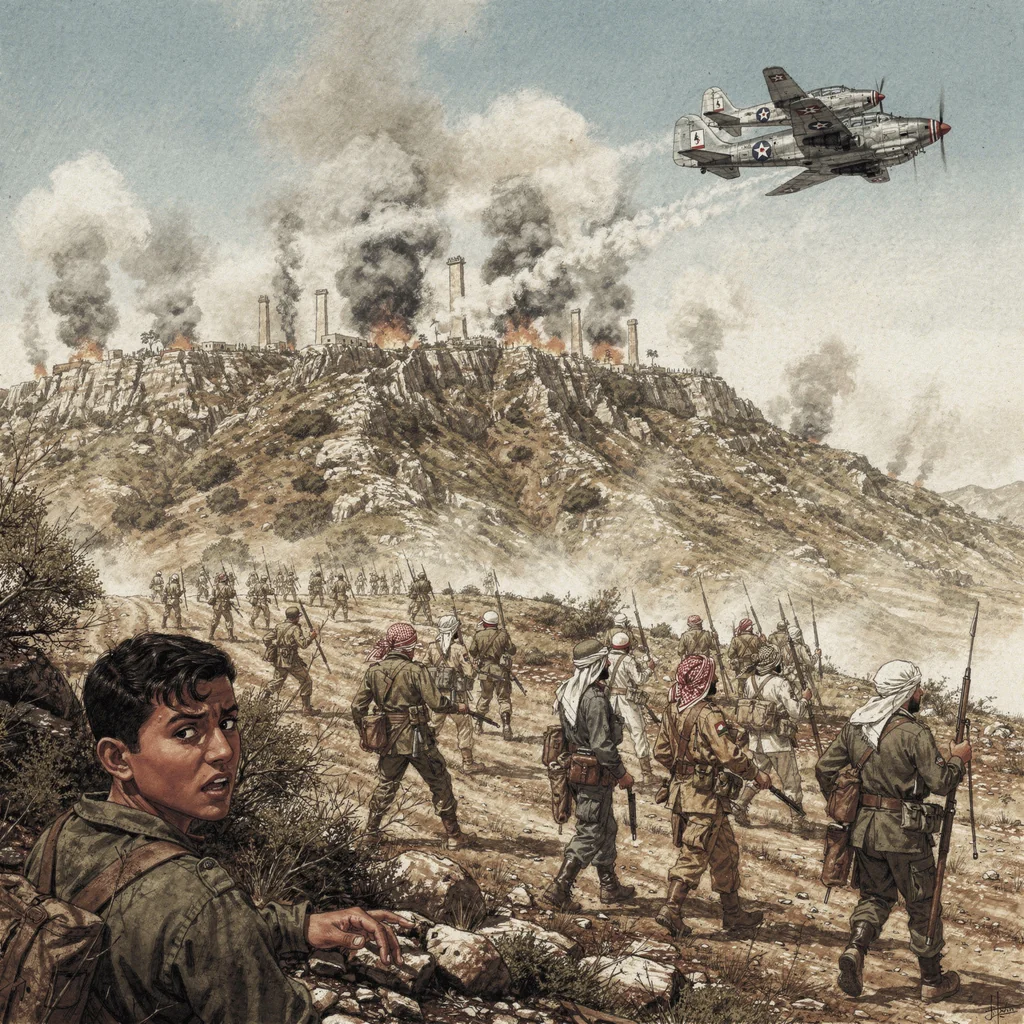
Scene 5.1: Djebel Agri, Chenini Region, May 29, 1956
Nacer Madani stood on the ridge of Djebel Agri, the mountain rising above Chenini like a fist against the sky. Below him, the valley stretched toward the Algerian border—rock, thorn, the hidden ravines where resistance moved like water through stone.
The ridge ran three hundred meters east to west, a spine of limestone overlooking the Chenini road. Madani had placed his men at intervals: five on the western approach, where the track wound up from the village; eight in the center, where the ridge broadened into a small plateau; twelve on the eastern spur, overlooking the main valley approach. Each man knew his position, each man knew the fallback route down the northern face, where a goat path led to the hidden ravines below.
Twenty-five fighters. Ten rifles between them—three French MAS-36s captured in 1954, four old Italian rifles from the war against the Axis, three hunting rifles. The rest had knives, the old pistols their fathers had carried against the Italians.
“Commander.” Laajimi Lemdaouar approached, face lined with dust and exhaustion. “Aircraft spotted. Two French planes, circling from the south.”
Nacer Madani looked up. Two Morane-Saulnier MS.500 Criquets, slow-moving observation planes that had served since Vichy times, now painted with the tricolor and Tunisian markings both. They circled at two thousand feet, too high for rifle fire. They were spotting for the artillery that would follow.
Madani had expected this. Since March—the internal autonomy, the French recognition of Bourguiba’s government—the French had changed tactics. They were no longer fighting colonization. They were fighting Bourguiba’s enemies. Independence declared March 20. And now, May 29, French planes bombing Tunisian resistance with Bourguiba’s permission.
“Take position,” Madani said. “Scatter. Use the rocks. When they come, let them get close.”
The fighters moved—silent, practiced, men who had learned to fight the French in the southern mountains, men who had learned that the French would bomb them whether or not Bourguiba approved. Laajimi scrambled west, toward the outcrop of limestone where he could cover the approach road. Two fighters moved into the small cave that dotted the ridge face—poor cover against artillery, but invisible from the air. The rest found what cover they could: boulders, crevices, the low thorn bushes that offered concealment if not protection.
At 11:00 AM, the first bombs fell.
Nacer Madani watched from the ridge. The planes swooped like hawks, dropped their eggs, climbed again. Smoke rose from the ravine. Screams followed.
Then the ground assault began.
Madani saw them through the dust—first, the Legion sahraouie advancing from the south, forty Moroccan mercenaries in turbans and khaki uniforms, moving in two skirmish lines. Behind them, French officers in kepis directed the advance with gestures. From the east, along the main valley road, came two trucks of Goumia auxiliaries—Algerian loyalists to France, armed with rifles and submachine guns. From the west, on the track from Chenini, came Mkhaznia constables in Tunisian uniforms, dark blue trousers and light blue shirts, moving cautiously behind their French commander.
The encirclement was complete. Below, on the valley floor, two French 75mm field guns were already being positioned. The crews worked quickly, loading shells, adjusting elevation.
Artillery fired from the valley floor. The first shell landed twenty meters from Madani’s position, spraying rock shrapnel across the plateau. The second shell found the small cave. Madani heard the screams of the two fighters who had taken cover there.
Then the barrage lifted, and the infantry advanced.
The Legion sahraouie moved up the southern face, firing from the hip as they climbed. The Goumia auxiliaries approached from the east, their submachine guns chattering. The Mkhaznia constables advanced from the west, firing controlled bursts from their rifles.
Madani fired his MAS-36, working the bolt, aiming at the officers he could see below. But what were ten rifles against artillery, against planes, against the coordinated assault of French and Tunisian forces?
The melee descended into chaos. Hand-to-hand fighting on the ridge. Knives against rifles. The sound of steel on stone, steel on bone.
By noon, it was over.
The Legion sahraouie mercenaries moved through the fallen, finishing the wounded with efficient cruelty. Ahmed Ben Omrane watched from beneath a dead comrade, playing dead, breathing shallow, heart hammering against his ribs.
He saw them—Moroccan mercenaries of the “légion sahraouie,” executing the wounded one by one. A bullet to the head. A knife to the throat. The work of men who had learned that killing was efficient when done without mercy.
They came to Nacer Madani, still breathing, chest shattered by artillery. They questioned him—the French officer asking in broken Arabic, why did you fight, who sent you, who supplies you.
Madani spit blood. “For Tunisia. Against the French. Against those who serve them.”
The officer nodded. “Take him. Bourguiba will want to question this one.”
The mercenaries dragged Madani down the ridge, his boots scraping a trail through the dust and stone. Ahmed Ben Omrane watched from beneath his dead comrade, breathing shallow. He saw the legs of the mercenaries pass, heard Madani’s breathing—ragged, wet—then the sound faded down the mountain.
The mercenaries moved on. Twelve fighters lined up on the ridge. Nine executed. Three survived, playing dead like Ahmed Ben Omrane, waiting for the silence that would mean the killers had moved on.
At 4:00 PM, Said Ben Abdallah Tounekti was among those lined up on the ridge. Sixteen hundred hours. His father would later write it down in his own hand, the testimony of a man who lost his son: My son named Said Ben Abdallah was killed on May 29, at sixteen hundred hours, after being interrogated by the French authorities among twenty-five detainees, of whom they selected twelve who were aligned in a firing squad, of whom nine were executed and three survived… they were shot at a distance of five meters by four machine guns and two pistols.
The testimony of a father who would find his son’s body days later, bones scattered on the mountain, recognizable only by the amulet his mother had given him.
When the French-Tunisian force withdrew, they left the bodies on the ridge. Fifty-three martyrs. Perhaps a hundred. The exact number would never be known—the bones scattered, the bodies burned by the sun, the wolves coming at night to feed on what the French had left.
He survived. Belkacem Sdiri survived. Three survivors from a unit of twenty-five.
He would testify later: They aligned us on the crest of the mountain. After questioning him on the reasons for his participation in the battle, they began to machine-gun him in bursts… Most of the resistance fighters did not die under the bombardments. A brigade of Moroccan mercenaries from the ‘légion sahraouie’ executed the wounded.
He would name the forces. But for now, Ahmed Ben Omrane crawled from beneath his dead comrade as darkness fell over Djebel Agri. The wind moved through the rocks. Below the ridge, the valley darkened. Somewhere in the ravine, a jackal cried once, then was silent.
Scene 5.2: Ghar Jani, Dahar Mountains, June 1, 1956
Three days after Djebel Agri, Nacer Madani led his remaining unit—twenty-five fighters now—into the ravines of Ghar Ejjani, the Dahar mountains rising like the spine of the world around them.
The ravine was a box: two hundred meters long, forty meters wide at its broadest point, walls of red sandstone rising eighty meters on both sides. A single entrance at the eastern end, where a dry creek bed had cut through the rock over centuries. A single possible exit at the western end, a steep scramble requiring ropes and climbing skill that most of the fighters lacked. Between them: flat ground, some scrub brush, a few boulders, and the absolute silence of the deep desert.
They had buried their dead where they fell. They had honored the martyrs with prayers whispered in the dark, with the promise that their sacrifice would be remembered, that their families would be told, that history would record what had happened on Djebel Agri.
Now they moved east, toward the Algerian border, seeking safety in the deeper mountains, seeking refuge in the terrain that had always sheltered resistance.
“We should rest,” Belkacem Sdiri said. He was young—nineteen, with the smooth face of a boy who should have been in school, not carrying a rifle through mountains.
Madani looked at him. “No rest here. The French know these ravines. They’ll follow.”
“We’re twenty-five men,” Sdiri said. “We have twenty rifles now. We found supplies in the village. We can fight.”
Madani shook his head. “Not against what’s coming.”
He touched the bandage at his ribs—the wound from Djebel Agri, still seeping through the cloth. Sdiri looked at the bandage, then at Madani’s face.
“They knew exactly where to find us three days ago,” Madani said. “They’ll know again.”
They made camp in the center of the ravine, where the walls were too steep for climbing but far enough from both entrances to give warning of approach. Madani posted sentries—two at the eastern entrance, hidden behind boulders fifty meters inside the ravine mouth; one on the north ridge, requiring a twenty-minute climb to reach a position overlooking the approach from that direction; one on the south ridge, the same climb from the opposite face; one roaming the ravine floor, checking on the others. They would rotate every two hours.
At dawn, June 1, 1956, the sentries died silently.
Madani woke to the sound of bodies falling—thud, thud, thud. He rolled from his sleeping blanket, reached for his rifle, and saw them.
They were encircled.
On the southern ridge, silhouetted against the dawn sky, Madani saw French soldiers in helmets, at least thirty of them, already setting up a machine gun position. On the northern ridge, the turbans of Legion sahraouie mercenaries—twenty, perhaps thirty, moving with the precision of men who had tracked them before. At the eastern exit, the dark blue uniforms of Tunisian Garde nationale mobile, two trucks parked behind them, blocking the only easy way out. And on the western approach, the civilian clothes and hunting rifles of Lijen Erryaya vigilantes—local men who knew the terrain, who had guided the French to the ravine, who stood now at the only possible escape route.
They had come in the night, guided by someone who knew exactly where the resistance would camp. The sentries had been eliminated quietly, one by one.
No way out.
“Stand!” Madani whispered to his men. “Stand and fight.”
They stood—twenty-one men now, four sentries already dead. They stood on the narrow floor of the ravine, rifles raised, faces toward the ridges above.
The firing began.
From the southern ridge, the machine gun opened up—a French FM 24/29, its distinctive rhythmic cough sending tracers stitching across the ravine floor. From the northern ridge, Legion sahraouie rifles fired in coordinated volleys. From the eastern exit, Tunisian Garde nationale mobile added their fire to the killing ground.
The ravine became a box of crossfire. No cover worth the name. The boulders that had seemed adequate protection became death traps—ricochets splintering stone, fragments spraying in every direction. Men fell. Blood sprayed on stone. Screams rose to the sky.
Madani fired until his rifle clicked empty. Then he drew his pistol. Then his knife.
He saw Belkacem Sdiri fall—a bullet through the left thigh, the boy collapsing with a cry, crawling toward the ravine wall where a shallow overhang offered minimal cover. Madani moved to cover him, crossing ten meters of open ground, and took a bullet in the right shoulder, spinning, falling, his pistol sliding from his grip.
The firing continued.
When it stopped, silence fell over the ravine. The French and Tunisian forces waited, then descended—careful, watching for movement, finishing the wounded with methodical efficiency.
Belkacem Sdiri played dead. He had seen this on Djebel Agri, had learned how to slow his breathing, how to still his heart, how to let his body go limp as death.
He watched through half-closed eyes as the mercenaries moved through the fallen, shooting the wounded, looting the bodies. He saw them reach Nacer Madani—still breathing, chest shattered, shoulder bloody—and shoot him through the head.
He saw them finish the last survivor—a boy named Ahmed, who cried out for his mother before the bullet silenced him.
He lay still, barely breathing, as the French and Tunisians looted the rifles, the ammunition, the meager supplies the resistance had carried.
He lay still as they withdrew, leaving the bodies in the ravine, twenty-four martyrs whose bones would join the fifty-three from Djebel Agri, scattered across the southern mountains, recognizable only by amulets, by clothing, by the mothers who would walk these ravines searching for sons who would never return.
When silence returned—real silence, no boots, no voices, no aircraft—Belkacem Sdiri crawled from beneath his dead comrade.
He was alone. Twenty-four men dead around him. Commander Nacer Madani dead. The entire unit destroyed.
Only one survivor.
He would testify later: All were killed except me. The entire unit of twenty-five men, destroyed in the ravine of Ghar Jani, June 1, 1956.
He would name the forces: French air force bombing, French artillery, Tunisian Garde nationale mobile, Legion sahraouie mercenaries, Lijen Erryaya vigilantes.
With clear and frank support of the independence government led by Habib Bourguiba.
Belkacem Sdiri crawled toward the ravine wall. His hands found the first handhold in the sandstone. The rock was cool against his palms. Above him, the stars came out over the Dahar mountains. Behind him, the ravine was silent.
Scene 5.3: Tataouine Prison, June 18, 1956
The prison at Tataouine was a fortress of mud brick and limestone, built by the French in 1930 to hold Saharan rebels. Four wings arranged around a central courtyard, each wing containing four cells. The cells measured six meters by four, barred windows looking out onto the desert, iron doors that locked from the outside. The prison held 125 men—forty to a room, no mattresses, stagnant water on the floor, minimal food: dry bread, sometimes soup, the air thick with heat and despair.
Among them: Yousséfiste fighters captured after Djebel Agri and Ghar Jani. Men from the south who had resisted the French, then resisted the collaboration, now imprisoned by the independent Tunisian government.
The door opened at 10:00 AM. Sunlight flooded the corridor. Guards entered—not French guards now. Tunisian guards. Men who spoke Arabic, who prayed like them, who served the government that had imprisoned them.
“Out,” the guard said. “Everyone. Now.”
They filed out—emaciated, weakened, some supporting others who could no longer walk. Three months of detention. Three months of interrogation. Three months of salt in their food, salt in their water, pesticides sprayed on their heads and bodies when the guards felt like teaching a lesson.
Outside, the courtyard blazed with sunlight—white stone reflecting the desert sun, heat radiating from the walls, the air shimmering with the promise of summer.
A car arrived through the arched gateway—a black Citroën Traction Avant, government plates gleaming in the sun. It pulled into the center of the courtyard, brakes squeaking, engine idling.
The man who emerged wore a suit and tie—the French-cut suit he had worn in Paris, the suit of a modern leader, a progressive leader, the man France had chosen to lead independent Tunisia. He adjusted his cufflinks, smoothed his hair, and turned toward the prisoners.
Habib Bourguiba.
The prisoners stood in the courtyard—125 men, weak, broken, waiting. Some recognized him from the posters, from the newspapers, from the photographs of independence.
Bourguiba walked among them, looking, nodding, the modern leader surveying the remnants of the resistance his government had helped destroy.
“111 of you will be freed today,” Bourguiba said. His voice was calm, reasonable. “The state of Tunisia grants you amnesty. You may return to your families. You may rebuild your lives.”
A murmur spread through the courtyard. Freedom.
“But,” Bourguiba continued, “14 of you will remain in detention. You are considered dangerous. You will be held until the state determines you no longer pose a threat.”
The guards began calling names. 111 names. Men who stepped forward, weeping, embracing comrades who would remain.
The process took two hours. When it ended, 111 men stood outside the prison gate—free, disoriented, weak from months of detention but alive.
Inside, 14 men remained.
Ahmed Ben Omrane—the survivor of Djebel Agri and Ghar Jani, the man who had walked away from both massacres—tried to walk to the center of Tataouine, where his family waited. The distance was three hundred meters along the main road—a road he had walked a thousand times before, a road that had once taken five minutes.
Now he collapsed after sixty meters. His legs would not hold him—muscles atrophied from three months in a cell, from standing in one place for hours each day, from the minimal food, the salt in their water, the pesticides the guards sprayed when they felt like teaching a lesson. He sat on the roadside, gasping, chest heaving, heart hammering against ribs that showed through his shirt.
He rested for two minutes, stood, walked another forty meters, collapsed again. The dust of the road coated his sweat-stained face. Five times he sat to rest before reaching the center of Tataouine, where his mother wept to see what three months had done to her son.
Inside the prison, the 14 who remained heard the cars leave. The gate clanged shut. The courtyard was silent.
Then the guards returned to their rounds. Boots on stone. The echo of metal keys.
Through the high barred window of his cell, one of the fourteen watched the dust the government cars had raised still settling in the afternoon light over the road to Tataouine.
Scene 5.4: Cairo, March 31, 1956
The apartment in Cairo looked out on minarets. From the window, Salah Ben Youssef could see the mosques, the madrasas, the living tradition of Islamic civilization—Al-Azhar, where scholars had studied for a thousand years; the Sultan Hassan Mosque, where the call to prayer still sounded five times a day; the streets where sacred time still structured the city.
On the table behind him, Tunisian newspapers spread like wounds.
Le Populaire. Action Tunisienne. L’Action. Papers he had sent from Cairo, papers that arrived weeks late, ink-smudged from the journey. His fingers blackened from reading. Soufia had placed a cup of tea beside him, cold now. She hadn’t spoken. She knew what the papers said.
Ben Youssef picked up Le Populaire, dated March 31, 1956.
LOI ORGANIQUE DU 31 MARS 1956
L’ÉTAT NATIONALISE LES HABOUS
The ink blurred before his eyes. He read again.
The Organic Law of March 31, 1956
The State Nationalizes the Waqf
Twelve centuries of endowments—mosques, schools, hospitals, orphanages, soup kitchens—dissolved in one sentence. Nationalized. Centralized. State-controlled.
Ben Youssef’s hand trembled. The tea spilled across the table, staining the newspaper.
Gone.
Ben Youssef stood, walked to the window. Outside Cairo, the minarets rose against the sky. The call to prayer sounded from Al-Azhar, followed by the Sultan Hassan Mosque, followed by the mosque around the corner, one after another, overlapping, the sacred time of Islam binding the city in a web of sound.
In Tunis, he knew, the call to prayer would still sound. But the funding—no longer from below, no longer distributed, no longer independent. From above now. From the state. The same state that would decide who received, who didn’t, who obeyed, who didn’t.
The telephone rang. Soufia answered, spoke quietly in Arabic, hung up.
“Nasser’s office,” she said. “They are asking if you need anything.”
Ben Youssef nodded. The Presidential Palace in Cairo, Gamal Abdel Nasser—the man who had spoken of Arab unity, of liberation from colonial rule, of a single nation stretching from the Atlantic to the Gulf. The Arab Nationalist Movement, the Liberation Rally, the circles of exiles and intellectuals who gathered in Cairo coffee shops to debate the future of the Arab world. Salah had moved among them for two years—Syrians fleeing the Ba’ath, Algerians fighting the French, Iraqis plotting against the monarchy. Each movement convinced it alone held the key. Each leader certain his vision would prevail.
Ben Youssef turned from the window. “Tell them thank you. Tell them we are fine.”
Soufia hesitated. “Salah—I read the paper. I know what it says.”
He looked at her. She had aged in the months since Tunis. The escape, the journey to Libya, the flight to Cairo, the uncertainty of exile, the children asking when they would go home, the silence of her family in Tunis—no one called, no one wrote, no one dared.
“What does it say?” Ben Youssef asked.
“It says the waqf is nationalized.” Soufia’s voice was calm, the calm she had maintained through escape, through exile, through everything. “The state will manage all religious endowments now.”
She picked up the stained newspaper, smoothed it with her hand.
“The soup kitchen near the mosque in Djerba,” Soufia said. “The one my aunt took me to as a girl. They fed anyone who came. No questions. No paperwork.”
She set the paper down. “Who decides now? A minister in Tunis decides who eats?”
Ben Youssef was silent.
“The state today,” he said. “A different man tomorrow. Who controls the waqf, controls the mosques. Controls the schools. Controls who eats and who doesn’t.”
Soufia was silent for a long time. Then she said, “You replace everything.”
Ben Youssef looked up.
“You asked me once—when we left Tunis—what I would do if we lost everything, if the state took our property, if we could never go home.” Soufia’s voice didn’t waver. “I said: Yaâich Rassek Ya Si Salah, Inti illi Taâoudhou el Kollou—May God preserve you, Si Salah, you replace everything.”
She touched his hand. “I still mean it.”
Ben Youssef covered her hand with his. The newspaper lay open on the table beside them, the ink smeared where the tea had spilled.
But her hand was warm.
Scene 5.4A: Cairo, September 1958
The landlord knocked at 8:00 AM. Three sharp raps, the sound that had come to mean trouble in the Cairo apartment.
Soufia opened the door. Monsieur Habib stood in the hallway—a small man with a mustache that twitched when he was angry. He was angry today.
“Madame Ben Youssef.” He spoke in French. “We must discuss the rent.”
Soufia stepped aside. “Please. Come in.”
Monsieur Habib removed his shoes, stepped onto the mat. “Two months, Madame. Two months in arrears.”
Salah was at the table, surrounded by newspapers from Tunis. He looked up, then returned to the papers. The rent was not his concern today.
Soufia gestured to the chair. “Please sit.”
The landlord sat. “I cannot wait longer, Madame. My own obligations—”
“I understand.” Soufia opened a drawer, took out a small notebook. She had been recording expenses since their arrival in Cairo. Every pound accounted for.
“The Tunisian government has not sent funds,” Soufia said. “The accounts are frozen—”
“This is not my concern, Madame.” Habib’s mustache twitched. “My concern is my own landlord expects payment.”
Salah looked up. “Soufia—”
She raised a hand. “I am handling it, Salah.”
He returned to the papers. The news from Tunis grew worse each week. Salah lived in the newspapers, lived in a country he could no longer enter.
Soufia lived in Cairo. Soufia paid the rent.
“How much?” Soufia asked. “Today. To settle what is owed.”
“Three hundred pounds. Two months’ rent, plus utilities.”
Three hundred pounds. Nearly everything they had. The gold bracelets she had sold in Alexandria had bought them three months. The remainder would buy them two more.
“One hundred pounds on the first of each month, in advance,” Habib said. “No arrears. If you cannot pay—there are others who can.”
“Three hundred today,” Soufia said. “And one hundred on the first. For six months.”
“Six months? You can guarantee six months?”
The children would wake soon. Chedly had school—École du Sacré-Cœur, the French school, the only one that would accept a Tunisian refugee child without Egyptian papers. The tuition was due in October.
“Six months,” Soufia said.
Habib stood. “Very well, Madame. Three hundred pounds today, the apartment yours until June 1959.”
Soufia walked to the bedroom, opened the safe hidden behind clothing in the wardrobe. Gold dinars, Tunisian francs, some Egyptian pounds acquired through discreet channels.
She counted. Three hundred pounds Egyptian. The remainder: two hundred pounds.
The money would not last until June. Chedly’s tuition—eighty pounds per term. Lotfi’s registration next year—fifty. Food, clothing, utilities.
Soufia returned to the main room, placed the money on the table. Monsieur Habib counted it, nodded, placed it in his pocket.
“Pleasure doing business, Madame.” He bowed slightly and left.
The door closed. Salah looked up. “How much is left?”
“Two hundred pounds.”
“Two hundred.” He did the calculation. “That will not last until June.”
“No.”
A knock at the door.
Soufia opened it. Madame Rashid, from the apartment downstairs—Egyptian, middle-aged, dressed in a simple cotton dress.
“Madame Ben Youssef. I heard the landlord.” She spoke Arabic, Egyptian dialect. “Is everything well?”
“The rent is paid.”
Madame Rashid’s face relaxed. “Good.” She hesitated. “My brother-in-law has a shop. Textiles. He needs someone who speaks French. For the customers. The pay is small, but…”
Soufia was silent. Work. She had not worked since marrying Salah. In Tunis, she had been the wife of a minister, the hostess of a villa.
Here, she was the wife of an exile, the manager of a dwindling budget, the mother of children who needed tuition.
“I can speak French,” Soufia said.
“The shop is Downtown. Near Tahrir. Ask for Mahmoud.” Madame Rashid smiled. “He would be pleased.”
She left. Soufia closed the door.
Salah looked up. “Who was that?”
“Madame Rashid. From downstairs.”
“What did she want?”
“She wanted to know if the rent was paid.” Soufia walked to the kitchen. “Egyptians are curious.”
She woke the children. Chedly was eight now. Lotfi was six. They spoke Arabic with Egyptian accents. They asked when they would go home.
She walked Chedly to École du Sacré-Cœur, ten minutes from the apartment. The nuns at the gate nodded. Chedly ran to join his friends, calling out in French.
Then she took Lotfi’s hand and walked toward Downtown Cairo.
Mahmoud’s Textiles, near Tahrir. A small shop, bolts of fabric arranged in the window. A middle-aged man in a gallabiya looked up from behind the counter.
“Madame?”
“I am looking for Mahmoud.”
“I am Mahmoud.” He smiled. “And you are?”
“Soufia Ben Youssef. Your sister-in-law, Madame Rashid—”
“Ah! The Tunisian lady.” Mahmoud’s face lit up. “Please—come in.”
He showed her around the shop. Fabrics from Egypt, from Syria, from Europe.
“You speak French?” Mahmoud asked.
“Yes. And Arabic. And some English.”
“Excellent. I need someone for the French ladies. They come, they want fabric, they want advice. My French—” He shrugged.
“The pay,” Soufia said.
Mahmoud named a figure. Small. But it would cover tuition. It would extend the two hundred pounds.
“Nine to two. Saturday to Thursday. Friday closed. Home before the children return from school.”
“I will start tomorrow,” Soufia said.
Mahmoud hesitated. “Your husband? He is…?”
“He was a minister. Before the government changed. Before the exile.”
Mahmoud nodded. Egypt was full of exiles—Palestinians, Syrians, Iraqis, now Tunisians.
“You will do well here, Madame. I will see you tomorrow at nine.”
Soufia left the shop, took Lotfi’s hand, and walked home.
That evening, after the children were asleep, Soufia sat opposite Salah at the table. She placed her notebook on the table—the household accounts, the budget she had managed since their arrival.
“Salah.”
He looked up from the newspapers.
“I found work.” Soufia’s voice was calm. “A textile shop. Downtown. The owner needs someone who speaks French.”
Salah stared at her. “Work? You cannot—”
“I am the manager of this household.” Her voice didn’t waver. “And the household needs money.”
She opened the notebook, showed him the numbers. Two hundred pounds remaining. Rent one hundred per month. Tuition for Chedly eighty per term. Lotfi’s registration fifty.
“Two hundred pounds is not enough for two months,” she said.
Salah was silent. He looked at the notebook, at the calculations, at the reality he had been avoiding.
“I should be providing—”
“You are providing for us, Salah.” Soufia reached across the table, took his hand. “You are fighting for Tunisia. I am managing Cairo. We each do what we must.”
Salah looked at her—really looked at her, for the first time in months. The lines around her eyes. The strain in her mouth. The strength that had carried them through escape, through exile, through everything.
“Soufia—” His voice broke.
She stood, walked around the table, gathered him into her arms. “No tears. We survive. We adapt. We endure.”
He buried his face in her shoulder. She smelled of the Cairo street, the dust of the textile shop still in her hair. Her arms were strong around him.
She pulled back, pressed her palm against his chest. “The state can take our property. The state can take our country.” Her hand pressed harder. “They can’t take this, Salah. Not this.”
She walked to the window. The scent of the textile shop still clung to her dress—cotton, wool, the dust of fabric that passed through Egyptian fingers.
“I work tomorrow,” Soufia said. “You write your articles. We each do what we must do.”
She turned toward the kitchen.
Salah picked up his pen. From the kitchen came the whistle of the kettle, the sound of Soufia moving through the evening.
Scene 5.4B: Cairo, October 15, 1958
Salah Ben Youssef sat at the table with his sons. Chedly was eight now, tall for his age, his face still soft with childhood. Lotfi was six, smaller than his brother, with their mother’s calm eyes and their father’s serious mouth.
They were doing homework—Arabic grammar, assigned by the tutor Salah had hired. An Egyptian scholar, recommended by Nasser’s office, a man who understood that exile children still needed their roots.
“Write the sentence,” Salah said. “From the board.”
Chedly copied from the blackboard: “The Arabic language is the language of the Noble Quran.”
Lotfi copied more slowly, his handwriting less neat: “The Arabic language is the language of the Noble Quran.”.
“Good,” Salah said. “Now explain what it means.”
Chedly spoke first. “It means that Arabic is the language of God’s book. That we must preserve it, even when we live in foreign lands.”
Salah nodded. “And why is this important?”
“Because if we lose Arabic,” Chedly said, “we lose the Quran. And if we lose the Quran, we lose ourselves.”
Salah looked at his older son. Chedly had an Egyptian accent now, slight but noticeable in certain words. He spoke French like a Parisian. He moved through Cairo like he belonged here.
“What about you, Lotfi?” Salah asked. “What does the sentence mean?”
Lotfi thought. “Arabic is the language of God. That’s what the sheikh at the mosque says. But baba—I have a question.”
“Ask.”
Lotfi hesitated. He looked at Chedly, then back at his father.
“When we go to school,” Lotfi said, “the other boys—they ask where we are from.”
“What do you tell them?”
“I tell them we are Tunisian.” Lotfi’s voice was uncertain. “But they say—what is Tunisia? They ask if it’s in Libya. They ask if it’s in Algeria. They don’t know.”
Salah was silent. His sons had been seven and five when they left Tunis. Chedly remembered—the house, the neighborhood, the cousins. Lotfi remembered nothing. Tunis was a story his father told, not a place he had lived.
“Tunisia is a country,” Salah said. “It is north of Libya, east of Algeria. It is on the Mediterranean Sea.”
“But where is it?” Lotfi asked. “Is it near Egypt?”
“No,” Salah said. “It is far. Across the sea.”
Lotfi thought about this. “Can we go back?”
Salah’s hand tightened around his pen. “Not yet.”
“When?” Chedly asked. “You said—inshallah, we will return. When is inshallah?”
Salah looked at his sons. Chedly’s jaw was set, his eyes fixed on the table. Lotfi’s face was open, unguarded.
“I don’t know,” Salah said. “I don’t know when.”
“Are we Egyptian?” Lotfi asked.
“No,” Salah said. “You are Tunisian.”
“But we live here,” Lotfi said. “We go to Egyptian schools. We speak Egyptian. When we play in the street, the other boys—they say we are Egyptian. So are we?”
“You are Tunisians living in Egypt,” Salah said. “There is a difference.”
“What difference?” Chedly asked. “What does it mean—to be Tunisian in Egypt?”
Salah was silent for a moment.
“It means,” Salah said, “that we carry our country with us. Even when we are not in it.”
He pointed to the blackboard. “That sentence—‘The Arabic language is the language of the Noble Quran’—that is Tunisia. The Quran is Tunisia. The Arabic language is Tunisia. The olive trees are Tunisia. The beaches and the mountains and the cities—Tunis, Sousse, Sfax, Gabès—these are Tunisia.”
He touched his chest. “And this is Tunisia too. The memory. The love. The hope of return.”
“But baba—” Chedly’s voice cracked. “The boys at school—they say Bourguiba is the president now. They say Tunisia is independent. So why can’t we go back?”
Salah was silent.
“Lotfi,” Salah said. “Read the sentence again. Aloud.”
Lotfi looked at the blackboard. He read: “Al-lugha al-arabiyya lughatu al-qur’an al-karim.”
The vowel was Egyptian—the qaf pronounced as a glottal stop, not the Tunisian q. Cairo, not Tunis.
Salah said nothing.
“Again,” Salah said.
Lotfi read it again. The same pronunciation. The same glottal stop.
Salah closed the grammar book.
“That is enough homework for today,” Salah said. “The two of you—go play.”
Chedly and Lotfi gathered their books. They walked to the door, then turned back.
“Baba?” Chedly said. “Can I ask something?”
“Yes.”
“When we go back—” Chedly hesitated. “When we go back to Tunisia, will I still have my accent?”
Salah heard it: the Egyptian pronunciation of certain vowels, the slight Cairo lilt that had crept into his son’s Arabic over two years of exile.
“You will speak Tunisian,” Salah said. “The accent will fade. You are young. You will adapt.”
“And my French?” Lotfi asked. “The boys at school say I speak French like a native.”
“Keep it,” Salah said. “French is useful. Your grandfather spoke four languages. It is good to know many tongues.”
The boys left. Salah heard them in the hallway—Chedly speaking French to Lotfi, Lotfi responding in Arabic, both of them shifting between languages as if the distinction didn’t matter.
Salah returned to his newspapers. The headlines from Tunis—waqf nationalized, Zaytuna dissolved—lay on the table before him.
But his sons were alive. They were learning. They were growing.
Later that evening, Salah watched his sons from the window. They played in the courtyard of their apartment building—a small space shared with other families, mostly Egyptian, a few other exiles scattered across the Arab world.
Chedly kicked a ball to an Egyptian boy. The boy returned it, laughing. Lotfi joined the game, running with the joy of movement, unconcerned with borders or politics.
Salah saw something in the game that made his chest ache.
Chedly kicked the ball. The Egyptian boy received it, then passed to Lotfi. Lotfi passed to another boy—Libyan, Salah thought, or perhaps Syrian. The ball moved between them, nationalities blurring in the pleasure of play.
They were just boys. They were just playing.
Salah turned from the window. The grammar book lay closed on the table.
Outside, the ball bounced on the courtyard stones. Chedly kicked it. Lotfi laughed. The Egyptian boy passed it back. Thud, laugh, thud—the ball moving between them, the sound carrying up through the open window.
Scene 5.5: Cairo, October 1, 1958
The newspapers from Tunis arrived late. Two weeks, three weeks, the mail slow, the censorship unpredictable. But the headlines were unmistakable.
1er OCTOBRE 1958
DISSOLUTION DE L’UNIVERSITÉ ZAYTOUNA
Ben Youssef read the date twice. October 1, 1958. One day. Twelve centuries dissolved in one day.
The Zaytuna—the Olive Tree, the university that had stood since the eighth century, the university that had produced Ibn Khaldun, the university that had educated generations of Tunisian scholars, the university that had maintained Islamic learning through famine, through invasion, through colonization—dissolved.
The article said the Zaytuna was being “integrated” into the new University of Tunisia. Its faculties “modernized.” Its curriculum “reformed.”
Ben Youssef knew what this meant. The Zaytuna wasn’t being integrated. It was being destroyed.
He knew because he had studied there. He knew because he had walked its courtyards, sat in its classrooms, argued with its scholars, absorbed a tradition that stretched back to the early caliphates.
The Zaytuna wasn’t just a university. It was a transmission architecture. Knowledge flowed from shaykh to student, orally, textually, through a system of commentary and super-commentary that had accumulated over centuries. A shaykh would explain Ibn Ashur’s commentary on the Maliki madhhab, explaining the text his teacher had explained, explaining the explanation his teacher’s teacher had explained, layers of interpretation spanning generations.
That was how Islamic knowledge worked. Not a book read alone. A chain of transmission. A living line from the Prophet to the present, passed hand to hand, voice to voice, presence to presence.
The Zaytuna held that chain.
Now the chain was broken.
Ben Youssef stood, walked to the window. The sounds of Cairo rose from the street—Egyptian Arabic, vendor calls, the neighborhood going about its evening. Al-Azhar still stood. The transmission still flowed.
In Tunis, the Zaytuna was closed.
Soufia entered with a tray—bread, olives, tea. The modest food of exile. She saw the newspaper, saw his face.
“What is it?” she asked.
“The Zaytuna.” Ben Youssef’s voice was hollow. “They dissolved it.”
Soufia set down the tray. “I didn’t study there. I don’t—what does this mean?”
Ben Youssef turned from the window. “It means they’ve destroyed the transmission architecture of Islamic knowledge in Tunisia.”
Soufia waited.
“The Zaytuna wasn’t just a school, Soufia. It was a line. From the Prophet, to the Companions, to the Tabi’un, through Baghdad, through Kairouan, through centuries of scholars, through famine, invasion, colonization, to the shaykhs who taught me, to me, to the students I would have taught.”
He picked up the newspaper. “That line is broken.”
Soufia was silent. Then she said, “Can they do that? Can the state just… break a line that old?”
“The state can destroy the institution,” Ben Youssef said. “The state cannot destroy the knowledge itself. But without the institution, the knowledge goes underground. Survives in secret. Or dies slowly.”
Soufia was silent for a long time. Then she said, “You studied there. Your teachers—who will teach now?”
“No one.” Ben Youssef’s voice was hollow. “Or the state will teach. The state will decide what Islam is, what Islam isn’t. The state will control the scholars, control the curriculum, control the knowledge.”
Soufia picked up the newspaper, smoothed it. Her hands were steady. “Salah—I don’t know what to say. I don’t know how to help.”
Ben Youssef covered her hand with his. “You already help.”
“How?”
He didn’t answer. He held her hand in both of his.
She gestured to the next room, where the children were playing—Chedly, eight now, Lotfi, six. They spoke Arabic with Egyptian accents. They asked when they would go home.
She squeezed his hand. Outside the window, the call to prayer sounded from Al-Azhar, followed by the Sultan Hassan Mosque, one after another, overlapping across the Cairo rooftops.
On the balcony next door, an Egyptian woman hung laundry—white sheets billowing in the evening breeze, the sound of the sacred time drifting through the fabric as she pinned it to the line.
Scene 5.6: Cairo, 1960
The television in the Cairo apartment was small, black-and-white, acquired second-hand from a neighbor. The reception flickered. The sound crackled.
But the image was clear.
Bourguiba sat at a table, surrounded by journalists. Cameras flashed. Microphones crowded the table. The date: Ramadan, January 1960. The holy month, when Muslims fasted from dawn to dusk, when the entire Islamic world suspended eating, drinking, smoking during daylight hours.
Bourguiba lifted a glass of orange juice. The cameras flashed.
“The fasting of Ramadan,” Bourguiba said into the microphones, “is an obstacle to productivity. We are building a nation. We cannot afford to lose hours of work each day to fasting.”
He drank. The cameras flashed.
Ben Youssef sat frozen in front of the television. Soufia stood in the doorway, the children behind her. None of them spoke.
Bourguiba continued: “I have consulted the doctors. Fasting is bad for health. I have consulted the economists. Fasting is bad for productivity. I have decided: Tunisia will modernize its practice of Islam. We will not be prisoners of the past.”
The journalists scribbled. The cameras flashed. Bourguiba smiled.
Ben Youssef stood, turned off the television. The screen went black.
“Salah?” Soufia’s voice was hesitant. “What was that?”
Ben Youssef turned to her. His face was pale. “That was the President of Tunisia breaking Ramadan on television.”
“I know that. But—what does it mean?”
Ben Youssef walked to the window. The television screen behind him was dark now, but the reflection remained—Bourguiba’s face, the glass of orange juice, the gesture that had shocked the Islamic world.
“He’s challenging spiritual authority,” Ben Youssef said. “He’s saying: the state decides what Islam is, not the scholars, not the tradition, not the Prophet.”
Soufia was silent.
“Do you understand?” Ben Youssef turned from the window. “The waqf nationalized—economic authority seized. The Zaytuna dissolved—intellectual authority seized. Now Ramadan challenged—spiritual authority seized.”
He walked to the table, picked up a pen.
Soufia was silent for a long time. Then she said, “Salah—what can we do? We’re in Cairo. We can’t go back. Our property is confiscated. Our friends won’t speak to us. What can we do?”
She turned from him, walked to the kitchen counter. She began to chop vegetables for dinner. The knife struck the cutting board—rhythmic, precise. The children watched from the doorway. She didn’t look up.
Ben Youssef looked at her. She was right. What could they do?
Then he had an idea.
“Tayeb Damerji,” he said.
“Your Sadiki friend?”
“My Sadiki contemporary.” Ben Youssef sat at the table, paper before him. “He’s still in Tunis. He still has property. The trees are still standing.”
“What will you tell him?”
Ben Youssef picked up the pen. “I’ll tell him what’s happening. I’ll tell him what they’re destroying. I’ll tell him: when you uproot the tree to count its rings, you have learned nothing and lost everything.”
The pen scratched on paper. Soufia watched, then went to the children. They were asking questions—what was on television, why was the fasting bad, why was the President drinking orange juice during Ramadan?
She would answer them later. For now, she let Salah write.
The letter took shape. The diagnosis. The warning. The plea.
My dear Tayeb,
I write to you from Cairo, where I follow the news from Tunisia with growing alarm. What is happening in our country is not modernization. It is dismantling. Not improvement, but destruction.
They nationalized the waqf on March 31, 1956. They destroyed the economic architecture of civil society. The state now controls all religious endowments. The state decides who receives charity, who doesn’t. The state decides which mosques are funded, which aren’t. The state decides which scholars are supported, which aren’t.
They dissolved the Zaytuna on October 1, 1958. They destroyed the transmission architecture of Islamic knowledge. Twelve centuries of learning, dissolved in one day. The university that produced Ibn Khaldun, the university that educated generations of Tunisian scholars, the university that maintained Islamic learning through famine, invasion, colonization—closed.
Now Bourguiba breaks Ramadan on television. He challenges spiritual authority itself. He declares that the state knows better than fourteen centuries of Islamic practice.
Tayeb, my friend—I know what you will say. You will say: what does this have to do with us? You will say: let them modernize, let them reform, let them build.
But hear me: when you uproot the tree to count its rings, you have learned nothing and lost everything.
The waqf, the Zaytuna, the Ramadan fast—these are not obstacles to progress. These are the foundations of our civilization. These are the structures that carried knowledge across generations, that distributed obligation without centralization, that maintained independence from state power.
When you destroy them, you destroy the capacity to rebuild. You destroy the embodied knowledge. You destroy the architecture that makes civilization possible.
I know you don’t see it yet. The groves are intact. You look at your land and you think: nothing has changed.
But everything has changed. The foundation has shifted. The soil is shallowing. One day, they will come for the trees themselves. And when they do, you will understand: when you destroy the architecture, you destroy the capacity to resist.
Your friend in exile,
Salah
Soufia returned from the next room. The children were asleep. She saw the letter on the table, saw his face.
“Did you write what you needed to write?”
“Yes.”
“Will he understand?”
Ben Youssef was silent. Then he said, “No. He won’t understand yet. He doesn’t see what’s happening.”
“Then why write?”
“Because one day, he will understand.” Ben Youssef picked up the letter. “One day, the trees will be gone. And he will remember: Salah warned me.”
Soufia was silent for a long time. Then she said, “And if he never understands? If he never reads the letter, or reads it and doesn’t believe you?”
Ben Youssef looked at her. “Then at least I said it. At least I warned him.”
He folded the letter along its creases and slid it into an envelope. On the front, in his handwriting: Tayeb Damerji, Henchir al-Turki, Cap Bon, Tunisia.
Scene 5.7: Cairo, June 1961
It was 11 PM and Ben Youssef could not sleep.
He sat at the table with the Egyptian newspaper—Al-Ahram, the Cairo daily that reported everything except what he needed to know. The headlines discussed Nasser’s speech, the Algerian war, the crisis in Congo. Nothing about Tunisia. Nothing about Bourguiba. Nothing about the road not taken.
He walked to the window. The neighborhood was settling into night—families finishing dinner, shops closing, the sounds of Cairo carrying through the open window.
The doorbell rang.
Not a knock. The bell—Egyptian style, the jarring electric buzz that Egyptian apartments used instead of the Tunisian knock.
Ben Youssef went to the door. He opened it.
Béchir Zarg El Ayoun stood in the hallway—coat unbuttoned, face pale, the look of a man carrying bad news.
“Si Salah.” Béchir’s voice was low. “May I come in?”
Ben Youssef stepped aside. Béchir entered, looked around the apartment—modest furniture, photos of Salah everywhere, the signs of exile. Soufia appeared from the bedroom, concerned.
“Béchir? What has happened?”
Béchir sat at the table, accepted tea from Soufia, then looked at Ben Youssef.
“I come from Tunis,” he said. “I come with news.”
Ben Youssef sat opposite him. “News?”
“Mediation.” Béchir’s voice was careful. “Bourguiba has sent me. He wants… reconciliation.”
Ben Youssef was silent.
“He says you can return.” Béchir leaned forward. “He says your property will be restored. He says you can have a position in the government. He says—”
“I know what he says.” Ben Youssef’s voice was flat.
“Then you will consider it?”
Ben Youssef stood, walked to the window. The apartment was quiet—Soufia in the doorway, Béchir at the table, the children asleep in the next room. Five years of exile. Five years of watching from afar as the waqf was nationalized, the Zaytuna dissolved, Ramadan challenged.
“Does he know what he’s destroyed?” Ben Youssef asked quietly.
Béchir was silent.
“The waqf—the economic architecture of civil society. The Zaytuna—the transmission architecture of knowledge. Ramadan—the spiritual authority of Islam itself.” Ben Youssef turned from the window. “Does he know what he’s taken?”
“Si Salah, he says he’s modernizing. He says—”
“I know what he says.” Ben Youssef returned to the table. “But modernization is not destruction. Progress is not dismantling. And you cannot build the future on the ruins of the past.”
“Then you won’t return?”
Ben Youssef looked at Soufia. She stood in the doorway, watching, listening, waiting. The children asleep in the next room. Five years of exile. Five years of uncertainty. Five years of asking: when can we go home?
“If I return,” Ben Youssef said, “I return as a subordinate. I return to serve the man who eliminated me. I return to witness the dismantling from inside, instead of from outside.”
He was silent for a long time. Then he said, “Can I say that in Bourguiba’s government? Can I speak the truth from a position he controls?”
Béchir was silent.
“No.” Ben Youssef answered his own question. “I cannot.”
“Then what will you do?”
Ben Youssef stood. “I will return. But not on his terms. Not as his subordinate. As a free man, speaking the truth.”
“Si Salah, that is dangerous.”
“Yes.” Ben Youssef’s voice didn’t waver. “But the truth is always dangerous.”
He walked to the window again. The refrigerator hummed in the corner of the room, a steady domestic sound that had become the background music of their exile. Five years of watching. Five years of warning.
“Béchir,” Ben Youssef said, his back to the room. “Tell Bourguiba: I will return. But not to serve him. To speak the truth.”
Béchir stood. “Si Salah, I fear for you.”
Ben Youssef turned. “I know. I fear for myself.”
Soufia crossed the room, took his hand. The two men looked at each other across the small table in the Cairo apartment.
“Tell him,” Ben Youssef said. “Tell him: Salah Ben Youssef returns. Not as subordinate, as witness.”
Béchir nodded, turned to leave. At the door, he stopped. “Si Salah—what will you do if he won’t accept you? What will you do if he won’t let you return?”
Ben Youssef looked at Soufia. Her hand was warm in his. The apartment was full of photos—Salah everywhere, as if she needed to make him visible, present, real. The children in the next room, speaking Arabic with Egyptian accents, asking when they would go home.
“Then I will try anyway,” Ben Youssef said.
Béchir left. The door closed. Soufia’s hand tightened around his.
“You’re going back,” she said.
“Yes.”
“Is it safe?”
Ben Youssef looked at her. “No.”
“Then why go?”
Ben Youssef walked to the window. The apartment was filled with the traces of their life—children’s drawings on the wall, Soufia’s sewing in the corner, the photographs of Salah everywhere, watching. Five years of exile. Five years of watching the dismantling from afar.
“Tunisia needs to hear the truth,” Ben Youssef said. “Even if they won’t listen. Even if they kill me for saying it.”
Soufia was silent for a long time. Then she said, “You replace everything.”
Ben Youssef turned to her. “Not this time. This time, I replace nothing.”
Soufia turned from the window. She reached out and straightened his collar, smoothing the fabric against his shoulders. Then she picked up the newspaper from the table and folded it.
Ben Youssef gathered her into his arms. Outside, the call to prayer sounded.