Chapter 4: The Split
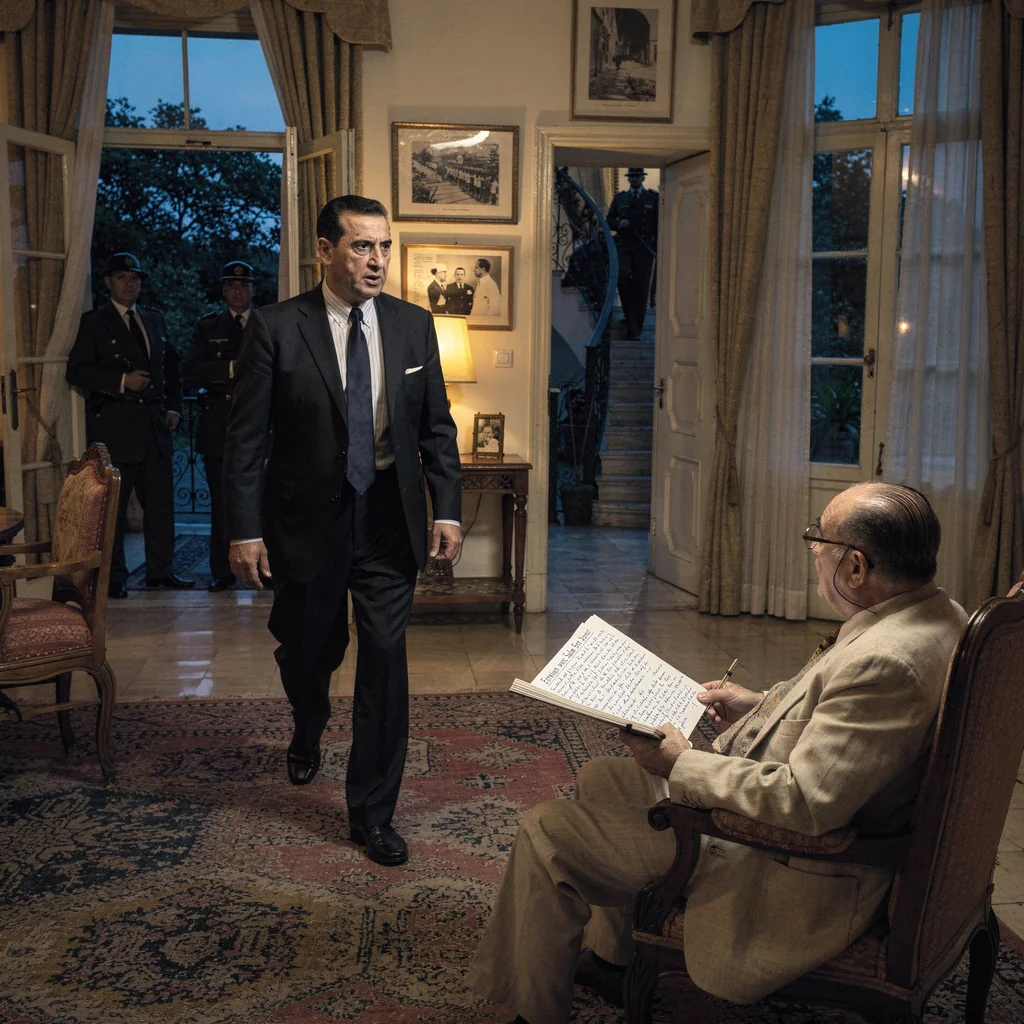
Scene 4.1: Ben Youssef Home, Tunis, January 23, 1956
The car wound through the Southwest confines of Tunis, twisting between unlit villas and black gardens. Charles Saumagne checked his watch: 6:28 PM. The meeting had been arranged at the last minute, through Bahri, who preferred it not take place at his own place. Political necessity, Saumagne thought. Everyone preferred their own distance these days.
The house appeared—a villa that had belonged to someone named Jamel, acquired when Salah Ben Youssef served as minister under the Chenik government. A loan of twelve million from Renaudin, slowly amortized. Saumagne knew these details. A scholar noticed numbers.
A guard emerged from darkness. The gate opened reluctantly.
Another guard at the landing. Then a third at the next landing. Bravi draped in darkness, recognizing Bahri and his clerk but suspicious of the Frenchman who climbed the narrow, dark staircase behind them.
At the top: a well-lit salon on the left.
Salah Ben Youssef stood waiting.
Saumagne had seen photographs, but photographs flattened men into two dimensions. The man before him was three-dimensional, alive. Short, broad. Thick bathrobe over pajamas—the intimacy of evening, of home. Two large circles of brown tortoiseshell around the eyes, striking in the salon’s electric light. Then a smile opened, as wide as two hands, quickly cordial.
“Monsieur Saumagne.” Ben Youssef gestured to a chair. “Please. You have come far tonight.”
“Five days before the end,” Ben Youssef said, “perhaps you have come to hear how it began.”
Saumagne opened his notebook. For two and a half hours, from 6:30 PM to 9:00 PM, Salah Ben Youssef spoke. Always smiling, sometimes serious. He beat the bushes conscientiously, answering questions, returning to themes, explaining what could not be explained. Only heating up when the image of Bourguiba appeared—when he spoke of Bourguiba’s saïdes and sbires, his henchmen and thugs.
“They invent my character,” Ben Youssef said, the smile gone for the first time. “They make me enemy No. 1 of France, of the Western world, of civilization. When I am the hunted man.”
He stood, walked to the window. Outside, the gardens slept. Villas whose owners had fled or waited or sharpened knives.
“The High Commissioner transfers to a political party the disposition of security forces. Helping a government that is fictitious. Hated by the masses. Giving them free use of a Praetorian guard, a Janissary guard. Whose crimes designate me, day by day.” He turned back to Saumagne. “Do you understand? I am not the terrorist. I am the one being hunted.”
Saumagne wrote. The pen scratched across paper.
“They say I lead the counter-mafia that organizes around my name.” Ben Youssef’s voice rose. “I too want order, peace, concord to reign. I have personally disavowed violence. But when hundreds and thousands of Tunisians rise—using counter-terrorism procedures learned from the anti-colonial struggle, joined by Algerian patriots—how can I prevent them? How can I disown what is only a replica to provocation?”
He paced the salon. The brown circles around his eyes seemed to darken.
“My position as opponent cannot deprive myself of this asset, of this support. I did not ask for violence. But neither will I turn away those who fight in my name while French planes bomb Tunisian villages.”
Saumagne asked about the Eastern connections. The money from Bandung. The coordination with Nasser. The Muslim Brotherhood.
Ben Youssef laughed, short and sharp.
“As for my Eastern mission, let’s not exaggerate. You know well in this regard what are my personal dispositions of mind.” He leaned forward. “I too want the Maghreb to acquire its international personality, but for its own account. Not for the account of this or that power, be it Afro-Asian or Arab-Muslim!”
He stood straighter, the orator’s voice.
“I know that the use the Maghreb must make of this personality reconquered, it is to associate it in some way to deliberate, to the destiny of France which made us, and that we can do nothing in the world without her and that we have the habit of France.”
Saumagne wrote. The pen moved quickly now.
“Why do you want me to prematurely declare my intentions and distort my chances in inevitable negotiations?” Ben Youssef’s eyes locked on Saumagne’s. “I keep them in my game. There will be a moment of choice when I will no longer need them, and where Tunisia, France, Morocco and Algeria will be the hinges of two worlds, and free and masters to play this great role.”
The clock showed 8:00 PM. Then 8:30.
“You see well that they are all out of breath to join my positions,” Ben Youssef continued. “To want to surpass them, to outdo me with escalations that are so many honest and hypocritical repudiations of the conventions. Bourguiba’s Sfax congress speech—flattery and flatulence toward the Arab-Muslim world. The congress motion amounted to repudiation of the conventions.”
He stopped at the window again. His reflection in the glass: short, broad, the bathrobe, the circles around his eyes.
“How France does not realize that Bourguiba and his own have already betrayed her!” His voice cracked with genuine outrage. “That they mock her while me, she can only reproach me for never having deceived her!”
Saumagne asked about Bourguiba directly.
Ben Youssef turned from the window. The smile returned, but smaller now.
“He refused. A mission sent by King Idriss tried to obtain from Bourguiba that he join his voice to mine—that by a common repudiation, we prove that between us there is only a disagreement of doctrine concerning the principles of independence and autonomy.” Ben Youssef shook his head. “He refused through verbal evasions, because he wants to support his credit through trouble and force and provocation. Under the protection of bombs and planes and two hundred thugs, armed to the teeth.”
The clock showed 8:45 PM.
“You will tell Bourguiba,” Ben Youssef said, the voice dropping, “that from now on, I will force him to mount a new hobby-horse every day until the last one breaks his back.”
He walked to the table where Saumagne sat. The French scholar looked up from his notebook.
“Another interview, Saumagne.” Ben Youssef’s hand rested on the chair back. “Constructive, if possible, that one, and concrete. They kill my friends every day and I am the assassin.” The smile returned, wide as two hands, quick and cordial. “No, Saumagne, there is better to do. A great and beautiful Maghreb, with its own soul, its politics, its traditional institutions, but modernized. Close to those of the West to which it has always belonged. France anticipates other powers to help us there…”
Saumagne closed his notebook. 9:00 PM. Two and a half hours of words, accusations, threats, visions. The hunted man who spoke like a hunter. The exile who still believed he could win from his Southwest confines, from his villa with twelve million in debt, from his narrow staircase and guards.
Outside, the black gardens waited. The unlit villas watched.
Salah Ben Youssef extended his hand. The grip was firm, dry.
“Seydoux knows I want to see him,” Ben Youssef said at the door. “I have besieged him with commissioners. You could be a useful intermediary, Saumagne. Push the conversation to the concrete. To the constructive.”
The French scholar descended the narrow staircase. Guards at landings. Bravi in darkness.
Ben Youssef watched from the well-lit salon. The brown circles around his eyes seemed darker now. The smile was gone.
Scene 4.2: The General Residency, Tunis, January 27-28, 1956
The clock on the wall of the General Residency showed midnight when Bourguiba arrived. The building was French—high ceilings, marble floors, portraits of French High Commissioners looking down from the walls. Twenty years of walking through these doors. Twenty years of negotiations, demands, imprisonment, release. Tonight felt different.
Seydoux rose from behind the mahogany desk. The French High Commissioner was in his fifties, gray hair, lined face, the weight of empire showing in the careful way he moved. He wore a European suit, perfectly tailored. No uniform—the man who held power didn’t need one.
“Monsieur Bourguiba.” Seydoux extended his hand. “Thank you for coming at such an hour.”
Bourguiba shook the hand. His grip was firm. “You said it was urgent.”
“It is.” Seydoux gestured to the leather chair opposite the desk. “Please. Sit.”
Bourguiba remained standing for a moment, looking at the chair, then at the window, then at Seydoux. He moved to the window first, looking down at the lights of Tunis before taking his seat. The chair was too soft, designed for comfort rather than dignity. Across from him, two other men: Colonel Bernachol, military advisor to the residency, and Abdalah Farhat, Bourguiba’s own chief of cabinet. Four men only. The door closed. No secretaries. No witnesses.
Seydoux walked to a side table, poured two glasses of cognac from a crystal decanter. “Cognac? It helps with late nights.”
Bourguiba accepted the glass but didn’t drink. He held it up to the light, watching the amber liquid catch the electric lamp. “I’ve been thinking about the French cabinet vote, Monsieur le Haut-Commissaire. Next week, was it?”
Seydoux paused, glass halfway to his mouth. “You are well-informed.”
“I have sources in Paris.” Bourguiba set the glass down on the coaster, precisely centered. “Socialist deputies who sympathize with our cause. Radical ministers who remember the Levantine demonstrations. The vote will be close. Edgar Faure’s government hangs by a thread—three-party coalition, divided on Algeria, divided on Tunisia. You need my recommendation. And I need yours.”
Seydoux sat behind the desk. For a moment, he said nothing. The silence filled the room. The clock ticked. The ice melted in the glasses.
“You understand the situation,” Seydoux said finally. “Tunisia stands at a crossroads. Independence is coming—this is no longer in question. The French government has accepted this. The question now is: WHO will lead independent Tunisia? And WHAT kind of Tunisia will it be?”
Bourguiba leaned forward, elbows on his knees. “Tunisia will be led by Tunisians. Modern Tunisians. Secular Tunisians. Tunisians who understand that the world has changed since 1881.”
“Of course.” Seydoux smiled, but his eyes remained calculating. “But WHICH Tunisians? That is the question.”
Seydoux rose, walked to the window. Outside, the lights of Tunis burned in the darkness. The city France would soon leave, but not before choosing its successor.
“You and Salah Ben Youssef,” Seydoux said, his back to the room. “Two visions of Tunisia. Two paths. You represent the modern, secular, Francophone Tunisia. A Tunisia that can work with France. A Tunisia that understands… nuance.”
He turned. “Ben Youssef represents something else. The Arab-Islamic bloc. Nasser, Algeria, anti-French sentiment. He will align with Cairo, not Paris. He will nationalize French investments. He will expel French influence.”
Bourguiba picked up the cognac glass, swirled it gently. “You’ve studied him well.”
“I’ve studied both of you.” Seydoux returned to his chair. “Monsieur Bourguiba, let me speak plainly. France cannot support an independent Tunisia that empowers Ben Youssef’s vision. The zawiyas, the waqf, the Zaytuna—these are not just religious institutions. They are networks. Networks that survived the Protectorate because they operated outside French control. Networks that will operate outside ANY state control.”
Bourguiba set down the glass. Hard. “And you want them eliminated.”
“I want Tunisia to be governable.” Seydoux opened a drawer, placed a document on the desk. An arrest warrant. Blank spaces waiting for names. “Ben Youssef cannot lead independent Tunisia. Not if France is to support that independence.”
Bourguiba stood and walked to the window. The lights of Tunis spread below them—a city that had survived Phoenicians, Romans, Vandals, Arabs, Turks, and now French. The weight of centuries in the limestone walls.
“Monsieur le Haut-Commissaire,” Bourguiba said, his back to the room, “you speak as if this is a choice between two equal options. As if Salah and I are simply… different paths to the same destination.”
He turned. His face was illuminated by the electric light—high forehead, the thin scar above his left eyebrow, the eyes that had seen prisons and negotiations and hunger strikes.
“We are not different paths to the same destination.” Bourguiba walked to the desk, rested his hands on the mahogany. “We are different destinations entirely.”
He picked up the warrant, studied the blank spaces. “What happens to the zawiyas? To the waqf? To the Zaytuna?”
“They become state property.” Seydoux’s voice was matter-of-fact. “As they should. As they must, if Tunisia is to have a modern government.”
Bourguiba nodded slowly. He walked to the window again. The city lights reflected in his eyes.
“I have studied France,” he said softly. “I lived in Paris. I walked the streets of the Quartier Latin, I sat in the cafés where students argued about revolution and progress. I saw what France had built. I saw the hospitals, the schools, the factories. I saw the power of the centralized state.”
He turned. “I also saw what France destroyed. The old guilds. The local courts. The charitable endowments that funded hospitals without state help. The networks of mutual aid that survived when the state failed.”
Seydoux said nothing. He watched Bourguiba, his expression unreadable.
“You see,” Bourguiba continued, his voice dropping, “I understand what you’re asking. You’re asking me to eliminate the alternative. To make the vision disappear. So that Tunisia can have… what exactly? One path forward?”
“Independence.” Seydoux leaned forward. “Complete sovereignty. The support of the French Republic. Economic aid. Technical assistance. A place in the modern world.”
“And Salah’s vision?” Bourguiba asked. “The Arab-Islamic path? The zawiyas, the waqf, the Zaytuna?”
“Obstacles, Monsieur Bourguiba.” Seydoux’s voice hardened slightly. “Obstacles to modernization. To progress. To the Tunisia you say you want to build.”
Bourguiba walked to the desk. He touched the document—the paper, the ink, the blank spaces where a name would appear.
“I know what they are.” His voice was barely a whisper. “I studied in them. I prayed in them. But…”
He looked up at Seydoux. “I have seen what happens to peoples who refuse to adapt. I have seen the maps in Paris—colonies redrawn, boundaries shifted, peoples who clung to the past waking up to find themselves… erased.”
Bourguiba walked to the side table, refilled his cognac glass. He didn’t drink. He just held it, watching the liquid settle.
“Then you understand the necessity.” Seydoux’s voice was gentler now.
“I understand that history does not wait.” Bourguiba turned from the table. “I understand that Tunisia must choose. Now. Not in some imaginary future when ‘reform’ and ‘tradition’ have somehow reconciled. Not in ten years, not in twenty. Now.”
He walked to the window again. The clock showed 1:00. Then 2:00.
“Salah and I,” Bourguiba said, his back to the room, “we built this movement together. We shared cells in Borj le Bœuf. We shared the same dream, once.”
He touched the scar on his forehead. “I do not hate him, Monsieur Seydoux. Despite what you may think. Despite what he may think.”
Bourguiba turned. His face was composed. The agony was visible in his hands—how they gripped the cognac glass, how his thumb rubbed the glass rim, over and over.
“But I love Tunisia more. And Tunisia cannot have both of us.”
Seydoux leaned forward. “You believe he would destroy what you hope to build.”
“I know he would.” Bourguiba’s voice was level. “Not from malice. From conviction. Just as I am convinced that his vision is wrong for Tunisia, he is convinced that mine is. He genuinely believes the Arab-Islamic path is viable. He genuinely believes that returning to our traditions will make us strong.”
Bourguiba returned to the chair. He looked at the warrant, at the blank spaces.
“The tragedy,” Bourguiba said softly, “is that we are both sincere. And sincerity is why this conflict will destroy us both.”
The clock ticked. The hour hand moved.
“You said there are three options.” Bourguiba looked up at Seydoux. “Imprisonment. Arrest. Exile.”
“Those are France’s options.” Seydoux opened his hands. “But the decision is yours, Monsieur Bourguiba. The independence of Tunisia depends on that decision.”
Bourguiba was silent. He looked at the document, at the blank spaces, at the power sitting on the mahogany desk between them.
“What if I refuse?” he asked.
“Then the negotiations fail.” Seydoux’s voice was flat. “Independence… waits. Perhaps indefinitely. Perhaps until another leader emerges. One more… amenable to French interests.”
Bourguiba nodded. He had expected this. He stood, walked to the window one more time. The lights of Tunis flickered below. The city that had survived everything.
“There is a fourth option,” Bourguiba said quietly. “The one no one speaks of.”
He turned. “The option where both of us die. Where the movement splits. Where civil war comes to Tunisia. Where French troops stay another decade, another generation, while we kill each other for the privilege of leading… what? Ruins?”
Seydoux said nothing.
Bourguiba walked to the desk. He picked up the pen. The clock showed 3:15.
Bourguiba looked at the warrant. “Tunisia needs factories and schools and hospitals.”
The pen hovered over the paper. Bourguiba’s hand trembled, then steadied. He looked up at Seydoux.
He brought the pen down. The ink touched the paper.
“The arrest must be at 4:00 AM. Is that correct?”
“That is the requirement.” Seydoux’s voice was neutral.
“And the charge?” Bourguiba asked, pen still hovering.
“Threatening state security.” Seydoux met Bourguiba’s eyes. “A charge that carries… weight.”
Bourguiba nodded. He looked at the blank spaces on the warrant—spaces where names would appear, where charges would be written, where a life would be rewritten by ink on paper.
“You understand.” Bourguiba’s voice was almost inaudible. “If I sign this… I am not just arresting Salah. I am arresting…”
He searched for the word.
“…a part of myself. A part I cannot get back.”
“That is the price of leadership, Monsieur Bourguiba.”
Bourguiba looked at the clock. 3:45. 4:00 approached.
“No.” Bourguiba shook his head slowly. “That is the price of history.”
He looked at Seydoux one last time. “The warrant must carry Tunisian authority. Not French. If I am to be responsible for Salah’s fate, let it be as a Tunisian, not as a French puppet.”
Seydoux nodded. He slid the paper across the desk.
Bourguiba signed. HABIB BOURGUIBA.
The stamp hit the paper. 4:00 AM.
The stamp hitting the paper at 4:00 AM. The ink drying on the warrant: ARREST SALAH BEN YOUSSEF for threatening state security. The signature below: HABIB BOURGUIBA. Bourguiba’s hand resting on the desk, the fingers pressed against the wood, the knuckles white. The clock ticked 4:01.
Scene 4.3: Ben Youssef Home, Tunis, January 28, 1956, ~2:00 AM
Mongi Slim stood on the street corner for twenty minutes before knocking.
He had left the General Residency at 1:30 AM, immediately after the meeting ended. Seydoux had shaken his hand, thanked him for his attendance, dismissed him with a nod. Bourguiba had remained behind, signing the warrant, the clock showing 4:00 AM approaching.
Mongi had walked out of the residency, walked through the streets of Tunis, walked toward the Ben Youssef home in the Southwest confines.
Then he had stopped.
He stood on the corner, the night air cold against his face, and thought about what he was about to do.
He was the Minister of Interior. He was Bourguiba’s cousin—second cousins through the Saaka family, their mothers’ line tracing back to Monastir. He had known Bourguiba since childhood. He had known Salah Ben Youssef since Sadiki, since they had studied law together, since they had defended nationalists together in French courts.
The nationalist movement was not two men, two visions. It was dozens of factions—Sahel elites like Bourguiba, southern notables like Ben Youssef, Djerban merchants, Sfax workers, Tunis intellectuals. The conservative ulema who wanted reform within tradition. The Young Tunisians who wanted complete rupture with the past. The fellagha fighters in the mountains who had never read either man’s manifestos. Each faction convinced it alone represented Tunisia.
He stood on the corner and thought about betrayal.
If he warned Ben Youssef, he betrayed his cousin. He betrayed the family. He betrayed the independence movement that had sacrificed everything for this moment.
If he did not warn Ben Youssef, he betrayed his colleague. He betrayed his friend. He betrayed the man he had broken bread with, the man whose children he had watched grow, the man who had trusted him with his life.
The cold had numbed his hands. He flexed his fingers inside his coat pockets, felt the fabric lining, the seam that had come loose on the left side. He had been meaning to have it repaired for weeks.
Mongi stood on the corner. Twenty minutes now. He could see his breath in the air, the mist of it visible against the dark. The street stretched empty in both directions.
There was no correct choice. There was only choice.
He had already made it when he left the residency. He had already made it when he walked toward this house instead of his own. He had already made it when he decided that some betrayals were necessary.
He knocked.
Three sharp raps, then silence.
Salah Ben Youssef opened the door. Mongi Slim stood in the darkness, coat unbuttoned, face pale with exhaustion. He looked over his shoulder, then stepped inside without waiting for invitation.
“Si Salah.” Mongi Slim’s voice was low, urgent. “Forgive the intrusion. It is past midnight, I know. But what I have to say cannot wait until morning.”
Ben Youssef closed the door. “Mongi? What has happened? Is it Bourguiba? Is he ill?”
“No.” Mongi Slim paced the small entryway. He checked the window, then the door again. He could not quite bring himself to say the words he had come to say.
“Si Salah, I come with news. You must listen.”
He stopped. “The warrant has been signed. Four o’clock this morning.”
Ben Youssef froze. “The warrant?”
“Roger Seydoux himself signed it. The charge: threatening state security. The penalty: imprisonment. Or worse.” Mongi Slim’s hands trembled. “The meeting was tonight. Midnight. Four men only: Seydoux, Bernachol, Bourguiba, and Farhat. I was not invited. Seydoux was—very cautious of me.”
The room seemed to contract around them. Ben Youssef leaned against the wall. “Bourguiba was there?”
“Si Salah, do not ask how I know this.” Mongi Slim stepped closer. “The French have chosen their partner. And their partner has… agreed.”
The silence stretched. Somewhere in the house, Soufia and the children slept.
“Bourguiba agreed,” Ben Youssef said. The words were not a question.
“He had no choice.” Mongi Slim’s voice cracked. “Independence next week. The French cabinet vote. The condition: Salah Ben Youssef must be removed.”
Mongi Slim looked at his hands. “I am his cousin. My wife’s cousin. We have struggled together. We have suffered together. I never thought…” His voice broke. “I never thought he would go this far.”
Ben Youssef pushed away from the wall. “I must speak to him. I must—”
“There is no time.” Mongi Slim grabbed Ben Youssef’s arm. “Si Salah, listen. The arrest is scheduled for 4:00 AM. ‘At the crack of dawn,’ Seydoux said. You have two hours.”
He released the arm. “There is a car waiting at the edge of town. Libyan plates. The driver is… discreet. If you leave tonight, you might reach the border before dawn.”
Ben Youssef looked toward the bedroom. Soufia. The children. “My family—”
“Cannot come with you. Not tonight.” Mongi Slim’s voice was gentler now. “Go to Cairo. Make arrangements from there. Send for them when it is safe.”
Ben Youssef stood silent. The house. The bed where he slept. The table where he ate with his family. The life he had built.
He turned to Mongi Slim. The moonlight through the door showed the exhaustion on his face, the torment in his eyes.
“You are warning me,” Ben Youssef said. “You are the Minister of Interior. You are warning the man you are supposed to arrest.”
Mongi Slim closed his eyes. “I will carry this to my grave. The knowledge of what I’ve done tonight.”
“Then why do it?”
Mongi Slim opened his eyes. The pain in them was visible.
“Because I stood at the corner for twenty minutes,” he said. “And I thought about what it means to be Tunisian. I thought about our families—the Saakas and the Slims and the Ben Youssefs, all mixed together through marriage and cousinship. I thought about our friendships—Sadiki classmates, law partners, prison comrades. I thought about Tunisia itself—not French, not Arab, but something mixed, something that contains contradictions.”
He took a breath.
“If I don’t warn you, I become the thing we are fighting against. I become the collaborator who destroys his friend for the sake of power. I become the man who sacrifices principle for position.”
Mongi Slim’s voice broke.
“I could not—” He stopped. “I could not let that happen. Even if it means betraying my cousin. Even if it means destroying my relationship with Bourguiba. Even if it means ending my career.”
Ben Youssef leaned against the wall. Five nights ago, he had sat in this same well-lit salon with Charles Saumagne. Two and a half hours of measured words, confident predictions, strategic explanations. I am the hunted man, not the terrorist. I have never deceived France. Bourguiba has betrayed her. I keep my Eastern assets in my game. I will break his back, hobby-horse by hobby-horse.
He had told Saumagne: Tell Bourguiba. Tell Seydoux. I can be useful. I can be constructive. I can be concrete.
Now the warrant was signed. Four o’clock approached.
The assets in the East meant nothing now. The leverage existed only in his mind. The hobby-horse he had prepared for Bourguiba—Bourguiba had already mounted it, and Ben Youssef was the one who would break.
He moved to the door. “Go, Si Salah. The car is waiting. Every minute that passes is a minute closer to dawn.”
Ben Youssef walked to the bedroom door, then stopped.
He could not wake them. Could not explain. Could not say goodbye.
He moved through the house in the pre-dawn dark. The floorboards creaked beneath his feet, sounds that would have woken her if she had not been deep in sleep. He stopped in the doorway of the bedroom.
Soufia breathed in the bed. The rhythm was steady—inhale, exhale, the small sounds that meant life. Chedly slept in the bed beside her, his face turned toward the wall. Lotfi was in the smaller bed across the room, his blanket kicked off, one foot hanging over the edge.
In the hallway, a schoolbag sat on the floor. Chedly’s—leather, worn at the corners, the strap frayed where it rubbed against his shoulder. Beside it, a wooden top, painted red, one of the chips missing from the rim. Lotfi’s favorite. Ben Youssef had bought it in the market two months ago.
He stood in the doorway for the duration of one breath.
Then he walked out.
He returned to the entryway. Mongi Slim held out his hand. Ben Youssef took it.
The two men stood together for a moment—colleague and friend, cousins by marriage, comrades in the struggle.
“You will tell him,” Ben Youssef said. “You will tell Bourguiba what you did.”
“I will return to the residency now. Seydoux will expect a report.” Mongi Slim’s voice was hollow. “I will tell him: You were warned. You escaped. I did my duty.”
“And the truth?”
“The truth will settle in my throat like stones.” Mongi Slim opened the door. “I will see you in Cairo, perhaps. Or perhaps never again.”
He stepped into the darkness, then turned back. “Si Salah… this night changes everything. The friendship between our families. The trust between colleagues. The possibility of Tunisia united.”
Mongi Slim’s face was pale in the moonlight. “I am sorry. More sorry than I can say.”
Ben Youssef watched him disappear into the street. Then he turned back to the house. Soufia slept. The children slept. The warrant was signed. 4:00 AM approached.
He could not wake them. Could not say goodbye. Could not explain that their lives had just been decided by four men in a French office, by ink on paper, by a signature at 4:00 AM.
Mongi Slim walked back to the residency. The streets were empty, the houses dark, the city sleeping. He walked slowly, his steps heavy, the weight of what he had done settling into his bones.
He had betrayed his cousin. He had saved his friend. He had destroyed his career. He had preserved his conscience.
The streetlights cast long shadows as he walked. Bourguiba’s face came to him—not the face from the meeting, hard and calculating, but the face from childhood in Monastir, fishing from the rocks, laughing at something Mongi had said. What would Bourguiba say when he learned? What would happen to his position as Minister of Interior? What would happen to the families—the Saakas and the Slims, intertwined through generations?
His footsteps echoed on the empty pavement. Each step a sound he could not take back.
He reached the residency. The guards nodded at him—familiar face, the Minister of Interior returning from a late night assignment.
Mongi Slim walked into the residency, his back straight, his face composed.
The car with Libyan plates waited at the edge of town. The engine idled. Ben Youssef climbed into the back seat. The door closed. The car moved toward the border.