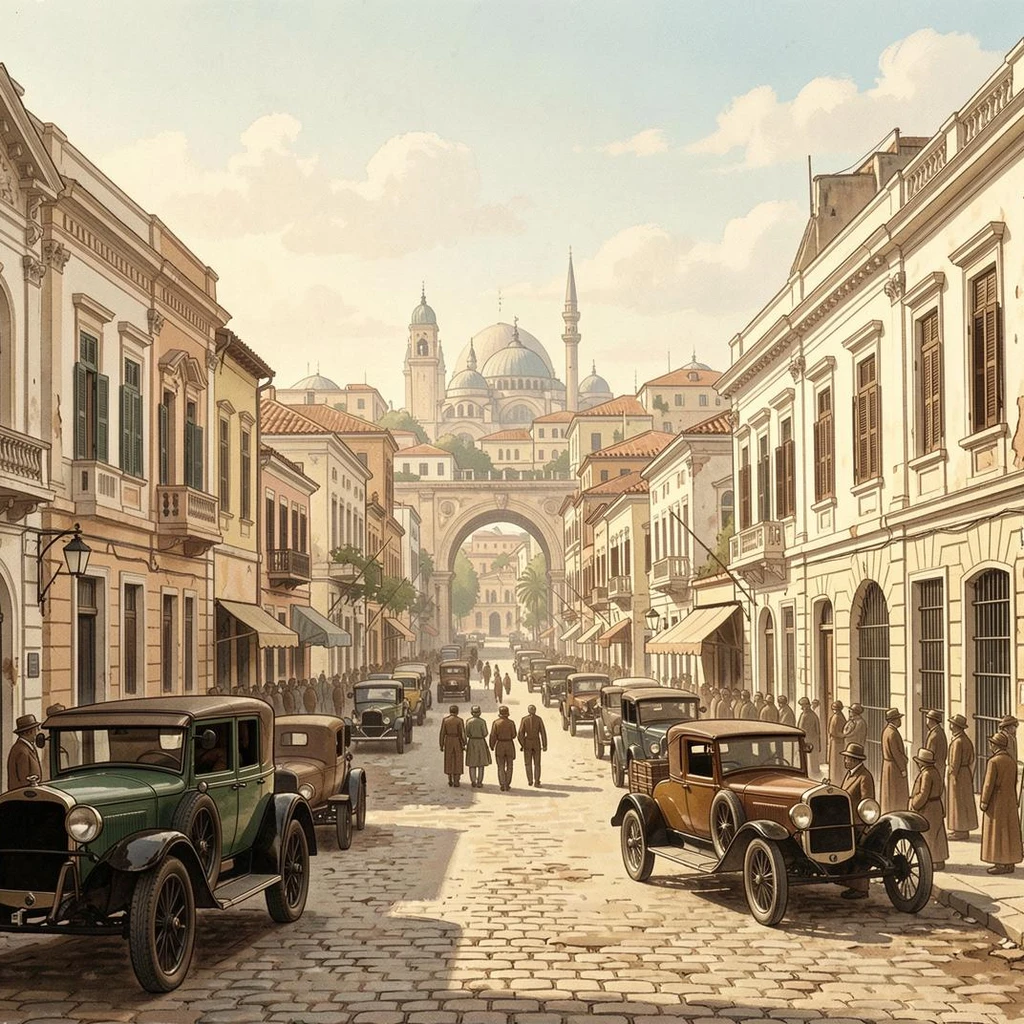
Prologue: Istanbul, January 1913
The Ministry of Finance rose six stories above the cobblestones of Istanbul—a stone building with high windows and a facade that had looked out on the same street for centuries. The clerk worked on the third floor, at a desk piled with ledgers from the provinces.
He was twenty-three years old. He had graduated from the Galatasaray Lycée three years earlier, fluent in French and Turkish, passable in Arabic and Greek. He had taken this job because his father knew someone who knew someone. The salary was adequate. The work was tedious but not difficult.
Today, the pile on his desk included a letter from Karachi.
The clerk picked up the envelope. The paper was thick, the handwriting elegant, the postmark faded but legible: early 1912. The letter had taken nearly a year to reach Istanbul.
He broke the seal. He unfolded the pages.
TO THE IMPERIAL OTTOMAN TREASURY,
WE THE UNDERSIGNED MERCHANTS OF KARACHI, hereby pledge the sum of 50,000 rupees toward the defense of the Caliphate. The funds will be transmitted through the banking house of Bombay upon receipt of acknowledgment.
The clerk’s eyes moved down the page. The letter continued—the language formal, the grammar precise, the handwriting flowing across the page in elegant Arabic script.
THE SITUATION IN THE BALKANS IS KNOWN TO US. The Ottoman Empire faces threats from all directions. The Caliphate requires funds to maintain its armies, to defend its territories, to preserve the dignity of Islamic civilization.
We are but a small community of merchants in distant Karachi. Our means are limited. But our loyalty is not. We pledge this amount as a token of our commitment to the Caliphate, to the Sultan, to the unity of the Ummah under Ottoman protection.
The clerk reached the bottom of the page. A postscript followed, written in a different hand—smaller, more cramped:
WE HAVE HEARD REPORTS THAT THE TREASURY IS EMPTY. We have heard that the armies are unpaid. We have heard that the European powers wait like vultures for the empire to fall. Let it be known that the Memons of Karachi stand ready to support the Caliphate, not because we are wealthy, but because we are grateful.
Grateful for what? The clerk wondered. For the protection? The trade? The something else?
He read the final line:
THE BUILDING IS STILL STANDING. But it has been built on the wrong foundation. They built on the sultan. We built on the Jamat. When the sultan falls, the building falls with him.
The clerk paused. He did not know what a Jamat was. He could not place the reference.
He set down the letter. The morning sun through the high windows caught dust motes floating in the air. The building was quiet—the scratch of pens, the shuffle of papers, the occasional cough from the next desk.
Outside, a shout.
Then another.
The clerk stood and walked to the window. The street below was crowded—horses, carriages, men in fezzes, women in veils. The shouts came from the direction of the Sublime Porte, the grand vizier’s office.
He couldn’t see what was happening. But he could hear.
“The Grand Vizier has resigned!” A voice carried up from the street. “At gunpoint!”
“The Committee has seized power!” Another voice. “Talat Pasha is in charge!”
“Enver Pasha! The War Minister!” A third voice. “Cemal Pasha! The Naval Minister!”
The clerk didn’t understand. The Committee of Union and Progress—the CUP—he knew the name. Everyone in Istanbul knew the CUP. They were the nationalists, the centralizers, the men who wanted to save the empire through modernization, through efficiency, through strength.
But a coup? In January 1913?
The shouts continued. The crowd below grew. The clerk watched from the window, his hands resting on the stone sill.
Three men were now in charge of the Ottoman Empire:
Talat — the Interior Minister.
Enver — the War Minister.
Cemal — the Naval Minister.
The door to the clerk’s office opened. His supervisor entered—a man in his fifties, gray-haired, gray-bearded, face pale.
“What is happening?” the clerk asked.
“The CUP has seized power.” The supervisor’s voice was low. “The Grand Vizier has been forced to resign. The Three Pashas are now in control.”
“The Three Pashas?”
“Talat, Enver, Cemal.” The supervisor walked to the clerk’s desk. He picked up the letter from Karachi. “What is this?”
“A pledge of funds.” The clerk pointed to the amount. “Fifty thousand rupees. From the Memons of Karachi.”
The supervisor’s eyes moved down the page. He read quickly. He stopped at the postscript.
“The building is still standing. But it has been built on the wrong foundation. They built on the sultan. We built on the Jamat.”
The supervisor didn’t understand the reference any more than the clerk had. He set down the letter.
“Send the acknowledgment.” The supervisor’s voice was flat. “Inform the merchants that their pledge has been received. Authorize the transfer through the Bombay banking house.”
“The new government?” The clerk hesitated. “The Three Pashas—they need the funds?”
“The empire needs every lira.” The supervisor turned toward the door. “The Balkans are lost. Libya is lost. The European powers circle like sharks. The treasury is empty. The armies are unpaid.” He paused at the doorway. “Send the acknowledgment. Transfer the funds.”
The clerk sat at his desk. He took a piece of paper from the drawer. He dipped his pen in the inkwell. He began to write:
THE IMPERIAL OTTOMAN TREASURY ACKNOWLEDGES WITH GRATITUDE the pledge of 50,000 rupees from the Memons of Karachi. The funds will be used for the defense of the Caliphate, the preservation of the empire, the unity of the Ummah.
He signed his name. He blotted the ink. He set down the pen.
Then he picked up the letter from Karachi. He reached for the stamp—the official seal of the Ministry of Finance, brass and heavy, heated from years of use.
He pressed the stamp into the ink pad. He pressed the stamp onto the letter.
INK ON PAPER.
The seal was red—the crescent moon and star of the Ottoman Empire, encircled by Turkish script: Ministry of Finance, Imperial Ottoman Treasury.
The clerk set down the stamp. He picked up the letter. The ink was still wet. He watched it dry—red fading into black, the seal setting into the paper.
Outside the window, the shouts continued. The crowd below grew. The news spread through Istanbul: the CUP had seized power, the Three Pashas were in charge, the empire would be saved.
He picked up the letter. The ink was dry now. The seal was set. He filed the letter in the drawer with the other correspondence from the provinces.
He returned to his tea. It was cold.
He drank it anyway.
The ink mark left by the treasury seal—red, drying on the Karachi letter, the crescent moon and star of the Ottoman Empire setting into the paper.