Chapter 3: The Partnership
Scene 3.1: Prison Partnership (1934-1945)
Borj le Bœuf, Southern Tunisia, September 1934
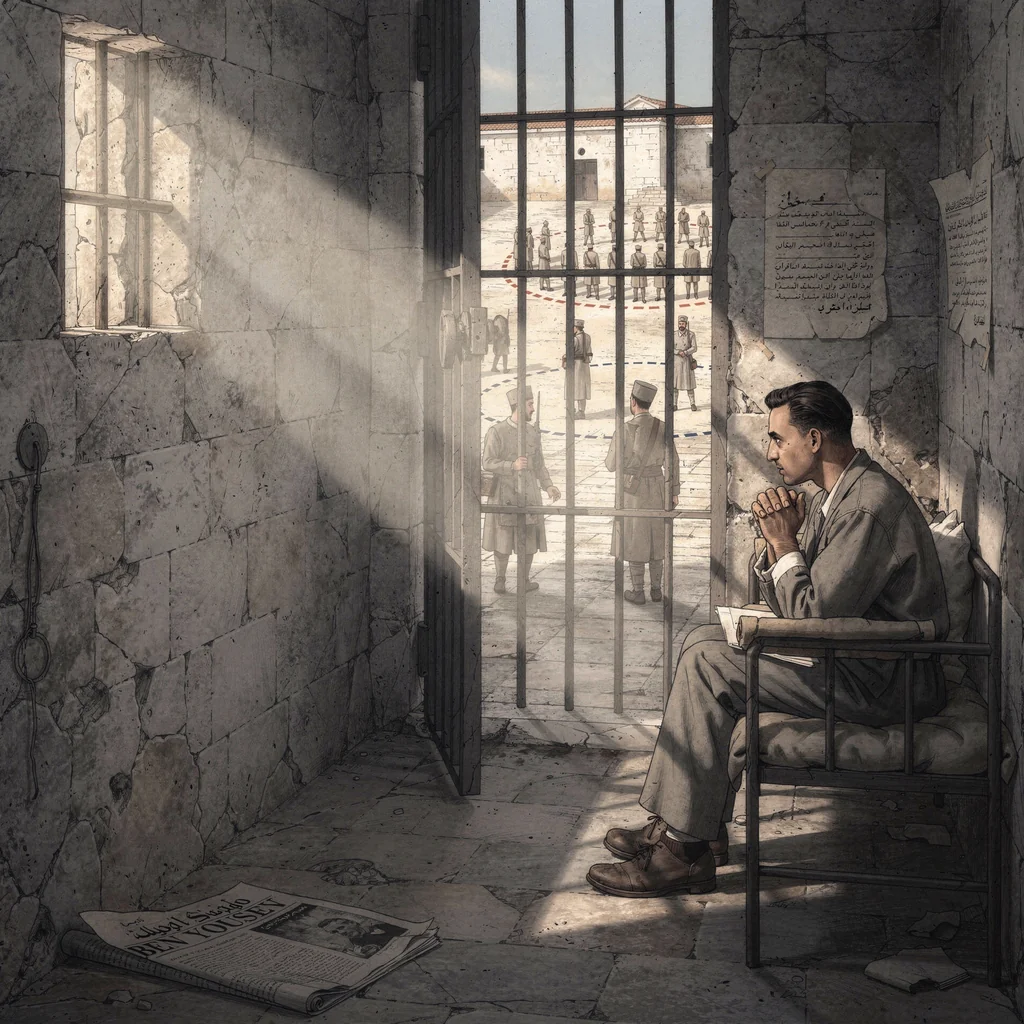
The cell was three paces long, two paces wide. The walls were stone, painted a color that had once been white but had faded to gray over decades of moisture and neglect. A single window, barred, looked out onto a courtyard where other prisoners exercised in circles under the watch of guards.
Salah Ben Youssef sat on the straw mat that covered the floor. He was twenty-seven years old. He had been married to Soufia for nearly six years. Chedly was three now; Lotfi had been born that spring. Soufia was raising them alone in Tunis while Salah sat on a straw mat. He had been arrested five months after the founding of the Neo-Destour, charged with incitement to violence against the French authorities.
The charge was false. He had not incited violence. He had spoken at meetings. He had written articles. He had demanded complete independence. But he had not called for violence.
The French did not care.
The door to the cell opened. A guard stood in the doorway, a key in his hand.
“On your feet,” the guard said in Arabic.
Salah stood.
“Follow me.”
Salah walked out of the cell. The guard led him down a corridor, up a staircase, into a room with a table and two chairs. A French official sat behind the table. A second guard stood by the door.
“Sit,” the official said in French.
Salah sat.
“You are Salah Ben Youssef,” the official said.
“I am.”
“You are a leader of the Neo-Destour.”
“I am the secretary-general.”
“You have spoken against French authority.”
“I have spoken for Tunisian independence.”
The official nodded. He wrote something on the paper in front of him.
“You will be held,” the official said, “until you renounce these activities. Until you swear that you will no longer oppose French authority in Tunisia.”
Salah said nothing.
“Do you understand?”
“I understand,” Salah said. “I will not renounce.”
The official looked up. His eyes were cold.
“Then you will remain here,” he said. “For as long as it takes.”
Salah was led back to his cell.
Weeks passed.
The cell was cold at night, hot during the day. The food was bread and water, supplemented occasionally by a thin soup. The prisoners were allowed into the courtyard for one hour each day, where they walked in circles under the watch of guards.
Salah spent the hour in silence. Soufia was at home, waiting. The law degree from Paris hung on a wall he could not see. The plans he had made sat in a drawer he could not open.
Bourguiba—free in Paris, writing articles, giving speeches, building the movement from afar.
One day, the guard came to Salah’s cell again.
“On your feet.”
Salah stood.
“You have a visitor,” the guard said. “Another prisoner. He will share your cell.”
Salah was led to a different cell—slightly larger, with two mats on the floor instead of one. The guard left him there.
Salah waited.
Minutes later, the door opened again.
A man entered. He was thirty-one years old, with dark hair slicked back, a mustache trimmed in the French style, wearing clothes that had once been fine but were now wrinkled and stained.
Habib Bourguiba.
Salah stood. The two men looked at each other.
“Bourguiba,” Salah said.
“Ben Youssef,” Bourguiba said.
They shook hands.
“I did not expect to find you here,” Salah said.
“I returned from Paris,” Bourguiba said. “I thought I could move freely. I was wrong.”
“You spoke at the meeting in Ksar Hellal.”
“I did.”
“They arrested you afterward?”
“They did.”
Bourguiba looked around the cell. He walked to the window, looked out at the courtyard where prisoners walked in circles.
“It is not Paris,” he said.
“No,” Salah said. “It is not.”
Bourguiba turned from the window. He sat on one of the straw mats. Salah sat on the other.
“How long have you been here?” Bourguiba asked.
“Three weeks,” Salah said. “You?”
“Two days.”
“They will offer you a deal,” Salah said. “They always do. Renounce the party. Renounce independence. Swear loyalty to France. They will let you go.”
Bourguiba shook his head.
“I will not renounce,” he said.
“They will keep you here,” Salah said.
“Then they will keep me here,” Bourguiba said. “I do not care. I will not renounce.”
There was a silence.
“I have thought about our approach,” Bourguiba said. “About what you said at the founding meeting. About complete independence, now, not later.”
“I still believe it,” Salah said.
“I know,” Bourguiba said. “But I have also thought about strategy. About what is possible, and what is not. The French are powerful. We cannot defeat them by force. We must negotiate. We must cooperate. We must build Tunisia slowly, step by step.”
Salah listened. He had heard this argument before. He had disagreed with it before.
“You speak of negotiation,” Salah said. “But what are we negotiating for? If we negotiate to remain a protectorate, then we are negotiating to remain dependent. If we cooperate to build French institutions, then we are building institutions that will keep us dependent.”
“You are too rigid,” Bourguiba said. “You see only two options—complete surrender or complete resistance. But there is a middle path. Gradual independence. Cooperation where necessary, confrontation where necessary.”
“And who decides what is necessary?” Salah asked.
Bourguiba didn’t answer. The stone walls held the silence.
“Then we are at an impasse,” Bourguiba said.
“We are not at an impasse,” Salah said. “We are in a cell. Together.”
Bourguiba looked at him. For the first time, he smiled slightly.
“You have a point,” Bourguiba said.
The guard brought food—bread, weak coffee, a bowl of soup.
Salah divided the bread in half. He gave the larger half to Bourguiba.
“Eat,” Salah said. “You will need your strength.”
Bourguiba took the bread. He did not argue.
They ate in silence. When the food was gone, Bourguiba leaned back against the wall.
“Tell me about Djerba,” he said.
Salah looked at him.
“Why?”
“Because I have never been there,” Bourguiba said. “And because I would like to hear something other than these walls.”
Maghoura. The place called Oppression. The olive trees, the merchant families, the island life different from Tunis.
“My grandfather tended olive trees,” Salah said. “Trees that had been in the family for six hundred years. He died when I was a boy. My father tends them now.”
“Six hundred years,” Bourguiba said. “That is a long time.”
“It is,” Salah said. “And the trees remember. They remember the soil, the climate, the pests that come each decade. They remember what to do when the rain is late. They remember how to survive.”
“That is what I want for Tunisia,” Bourguiba said. “Not olive trees. But memory. Continuity. A country that remembers who it is, even as it changes.”
The olive trees. The soil. The roots that went back six hundred years. Salah carried them with him, even here.
“You know,” Bourguiba said, “in Paris, I studied law. I read about the French Revolution, about the republics that rose and fell. I read about Napoleon, about how he created a new France from the chaos of revolution.”
“And what did you learn?” Salah asked.
“I learned that change is possible,” Bourguiba said. “That what seems impossible today can be possible tomorrow. That the world can be remade if we have the courage to remake it.”
“Perhaps,” Salah said. “But the French also destroyed their foundations. They tore down their institutions, executed their king, declared a republic—and then Napoleon crowned himself emperor. The revolution devoured its children.”
Bourguiba was silent.
The guard brought more food. Again, Salah divided the bread. Again, he gave the larger half to Bourguiba.
“Eat,” Salah said.
Bourguiba took the bread.
As they ate, the silence in the cell shifted. Not hostile. Not friendly. Something between.
And yet, here they were, together in a cell, sharing bread, speaking in whispers of the Tunisia they would build.
“You know,” Bourguiba said, “when we get out of here—”
“When,” Salah said.
“When,” Bourguiba said. “We will need to work together. You and I. The Neo-Destour needs both of us. Your followers—the Arabists, the Zitouna graduates, the men who distrust France. My followers—the Sadiki graduates, the modernists, the men who believe in cooperation.”
“You think they will follow you?” Salah asked.
“I think they will listen to me,” Bourguiba said. “And I think they will listen to you. Between us, we can unite the party. We can present a unified front. We can demand independence from a position of strength.”
“And if the French refuse?” Salah asked.
“Then we fight,” Bourguiba said. “Together.”
Salah looked at him.
“You would fight?” Salah asked. “You?”
Bourguiba hesitated.
“I would prefer not to,” he said. “But if necessary…yes. I would fight.”
Salah nodded.
“Then perhaps we are not so different,” Salah said.
“Perhaps not,” Bourguiba said.
They sat in silence as the light faded from the cell.
The months passed.
Autumn turned to winter, winter to spring. The cell grew colder, then warmer. The seasons changed outside the walls, but inside the cell, time stood still.
Salah and Bourguiba shared the cell, shared the food, shared the silence. They argued about strategy, about philosophy, about the future of Tunisia.
They talked of law, of history, of the great Arab civilizations that had flourished in Tunisia before the French came. They talked of Paris, of the Sorbonne, of the French Revolution and the Napoleonic Code.
They talked of their families.
Soufia. Chedly. Lotfi.
Bourguiba spoke of his mother—her death when he was ten, the trauma that had shaped him, the vow he had made to save women from suffering. He spoke of his father, the sergeant-cheff, proud of his son’s success but unable to understand his choices.
Salah listened. The words hung in the cell air—the mother, the boy, the grief turned to purpose.
“I understand why you fight for women’s rights,” Salah said. “I support it. The sheikhs will oppose you, but they are wrong.”
Bourguiba nodded. “I will fight them,” he said. “Just as I will fight the French.”
“Not all fights are won with weapons,” Salah said.
“Some are won with laws,” Bourguiba said. “Some with speeches. Some with schools.”
“And some with prisons,” Salah said.
Bourguiba looked at the stone walls, the barred window, the guards outside the door.
“Yes,” he said. “Some with prisons.”
One day, the guard came with news.
“There is a congress,” the guard said. “In Cairo. A pan-Arab congress. Delegates from across the Arab world. They want to send a representative from Tunisia.”
Salah looked at Bourguiba.
“You should go,” Salah said.
“You are the secretary-general,” Bourguiba said. “You should go.”
“I am in prison,” Salah said.
“So am I,” Bourguiba said.
“Then neither of us will go,” Salah said.
“Perhaps someone else will represent us,” Bourguiba said.
“Perhaps,” Salah said.
But both men knew that the party leadership—those who were not in prison—would decide who would represent Tunisia at the congress. And neither of them had a vote.
The years passed.
One afternoon in 1940, Salah received a letter from Soufia. The censor had blacked out entire lines, but the words that remained—Chedly asks about you every day—were enough. He folded the paper along its creases and pressed it flat beneath his sleeping mat.
The cell became home. The routine became familiar. Wake, eat, exercise, sleep. Argue, discuss, dream.
Chedly, now seven. Lotfi, now four. What were they doing? Was Soufia managing alone?
He wrote letters. The guards read them, then censored them, then sent what they allowed. Soufia wrote back. Her letters were censored too, but Salah could read between the lines.
The children are well. The business is managed. I wait for you.
He read those words and felt the weight of them.
Soufia was waiting. His sons were waiting. His freedom was waiting.
But not yet.
The guard came with more news in 1936.
“There is talk of new negotiations,” the guard said. “The French are considering reforms.”
Salah looked at the guard. “What kind of reforms?”
“New rights for Tunisians,” the guard said. “More representation in government. More Tunisian officials in the administration.”
“Independence?”
“No,” the guard said. “But it is something.”
Salah told Bourguiba.
“It is a trap,” Bourguiba said. “They offer us crumbs to keep us quiet.”
“Perhaps,” Salah said. “Or perhaps it is a step forward.”
“You are too optimistic,” Bourguiba said.
“You are too pessimistic,” Salah said.
They argued about the reforms, about what they meant, about whether to accept or reject.
But neither of them had a choice. They were in prison. The party leadership would decide.
The guard came with more news in 1938.
“There has been an agreement,” the guard said. “The Destour and the Neo-Destour have reached a deal. Both parties will work together. Both will support the reforms.”
“Both parties?” Salah asked.
“Both,” the guard said. “Including your faction.”
Salah told Bourguiba.
“It is a betrayal,” Bourguiba said. “The old Destour has sold out. They have accepted French reforms in exchange for a place at the table.”
“Or they have accepted a step forward,” Salah said.
“It is a trap,” Bourguiba said again.
“Perhaps,” Salah said. “Or perhaps it is a path.”
“You are too willing to compromise,” Bourguiba said.
Salah set down his bread. “And you are too willing to believe the French mean what they say.”
They argued through the night.
The years continued to pass.
Salah and Bourguiba grew older. The lines around their eyes deepened. Their hair began to gray at the temples.
The war came—1939, 1940, 1941. France fell to Germany. Tunisia remained under French control, but now the Vichy government ruled.
The guards changed. The conditions grew worse. The food became scarcer.
Salah and Bourguiba shared what they had. They divided the bread. They shared the hope. They shared the despair.
“We will get out,” Bourguiba said. “Someday. This war will end. The French will need us. They will need allies. They will have no choice but to negotiate.”
“Perhaps,” Salah said.
“You don’t believe me.”
“I believe that we will get out,” Salah said. “I do not believe that the French will need us.”
“You are too pessimistic,” Bourguiba said.
“I am a realist,” Salah said.
The war ended in 1945. The Allies won. Germany was defeated. France was liberated.
Tunisia remained under French control, but the new government in Paris could not afford to keep Tunisian nationalists in prison while claiming to fight for freedom. The pressure for independence grew. The negotiations began.
In late 1945, the guard came with a key.
“You are free,” he said.
Salah and Bourguiba stood. They gathered their few belongings. They walked out of the cell, into the sunlight, into a world that had changed while they were gone.
Soufia was waiting. Chedly and Lotfi were waiting. The Neo-Destour was waiting.
The leadership of the party met them at party headquarters in Tunis. There were speeches, there were celebrations, there were tears.
Salah saw Soufia for the first time in years. She was thinner than he remembered, her face more lined, her eyes still calm.
She did not cry. She simply took his hand.
“Welcome back,” she said.
Chedly and Lotfi stood behind her—tall now, strangers to their father.
Salah looked at each of them in turn, then at Soufia.
“You are home,” Soufia said.
Salah nodded.
He squeezed her hand. Her fingers were warm.
Scene 3.2: Cairo Congress (1946)
Cairo, September 1946
The congress hall was a cavernous space filled with delegates from across the Arab world—Syrians and Lebanese, Iraqis and Egyptians, Palestinians and Saudis, Tunisians and Algerians. The flags of a dozen nations hung from the rafters. The air was thick with tobacco smoke and the heat of bodies pressed together.
Salah Ben Youssef stood at the podium. He was thirty-eight years old. He had been out of prison for nearly a year, but the memory of the cell still lingered in his mind—the cold stone walls, the barred window, the bread shared with Bourguiba.
Now he stood in Cairo, surrounded by Arab delegates, speaking Arabic, exchanging greetings with men from Damascus to Algiers.
“Brothers,” Salah said. “Tunisia stands with you. Tunisia has suffered under French colonialism for sixty-five years. Tunisia has sacrificed for the cause of Arab independence. And Tunisia will continue to sacrifice, until the French are gone, and Tunisia is free.”
The delegates applauded.
Salah continued. He spoke of the scholars of Zitouna who had taught jurisprudence for a thousand years in the same courtyard, of the merchants whose families had traded across the Mediterranean since the Hafsids, of the men who had died in the uprisings of 1881 and 1906 and 1938.
“We are not alone,” Salah said. “We are part of a larger struggle. The Arab world is rising. From Iraq to Morocco, from Syria to Algeria, Arabs are demanding their freedom. We demand independence. We demand dignity. We demand the right to be ourselves.”
The delegates applauded again.
Salah looked out over the crowd. He saw Egyptian officials in military uniforms, taking notes. He saw Syrian and Lebanese delegates in suits, whispering to each other. He saw Palestinian delegates in traditional robes, listening intently.
In the back of the hall, a young Egyptian officer in military uniform watched Salah speak, a notebook in his hand, the pen moving across the page.
Salah felt the weight of the moment. He was not just speaking for Tunisia. He was speaking for a vision of the Arab world—a vision of unity, of solidarity, of common purpose.
He spoke of the need for Arab solidarity. He spoke of the importance of supporting the Palestinian struggle. He spoke of the dream of a united Arab world.
He spoke of Tunisia’s unique role in that world.
“Tunisia has always been a bridge,” Salah said. “Between East and West. Between Arab and European. We have learned from both worlds. We have absorbed both traditions. We can help the Arab world modernize without losing its soul.”
He paused.
“We can show that Islam and modernity are not enemies,” Salah said. “We can show that an Arab nation can be modern without becoming European. We can show that independence does not mean backwardness.”
The delegates applauded.
Salah stepped back from the podium.
He was surrounded by well-wishers—Egyptians and Syrians, Palestinians and Saudis, men who wanted to meet the Tunisian delegate who spoke so passionately of Arab unity.
He exchanged greetings with men from Damascus to Algiers. He spoke Arabic.
The closing ceremony. The delegates gathered for final speeches, for formal greetings, for pledges of support.
Salah stood in the crowd. The Egyptian delegate spoke of Arab unity. The Syrian delegate spoke of Arab solidarity. The Palestinian delegate spoke of Arab support.
In the back of the hall, the Egyptian officer stood watching. His notebook was closed now. His eyes met Salah’s across the room. The officer nodded once—a small, precise gesture.
Salah nodded back.
The hall emptied slowly. The flags of a dozen nations hung still from the rafters. The tobacco smoke settled in layers beneath the ceiling, the light from the high windows cutting through it in angled sheets.
Scene 3.3: The Divergence (1950-1954)
Tunis, Ministry of Justice, April 1951
Salah Ben Youssef sat at his desk. The office was grand—high ceilings, mahogany furniture, French windows opening onto a courtyard where civil servants hurried between buildings. He was Minister of Justice now, in the Chenik government. The first Tunisian government with actual authority, however limited.
On his desk: a stack of files. Court appointments. Judicial reforms. The routine work of governance.
But beneath the routine, something else was happening.
Salah opened a file. A request for funding—from the waqf of the Great Mosque of Kairouan. The waqf trustees wanted to restore the eastern minaret, damaged in an earthquake the previous year. The French colonial administration had denied the request. The trustees were appealing to the Tunisian Ministry of Justice.
Salah read the file. The French position was clear: the waqf was under colonial supervision. The French resident-general would decide whether the minaret could be restored.
The Ministry of Justice had no authority.
Salah closed the file. He opened another.
A petition from Zaytuna scholars. They wanted to expand the curriculum—to include modern sciences, to train students for careers in law and administration. The French had denied the request. The scholars were appealing to the Tunisian government.
Again, the French position was clear: education was under colonial supervision. The French director of public instruction would decide what Zaytuna could teach.
The Ministry of Justice had no authority.
Salah closed the file.
He stood at the window, looked out at the courtyard. The civil servants hurried between buildings—Tunisian men and women, serving a government that served the French.
This was internal autonomy. This was what the Neo-Destour had negotiated for. This was what Bourguiba called “step by step.”
Salah looked at the three closed files on his desk. Titles, offices, desks. The French had kept the authority.
He opened another file.
A request from a Tunisian businessman—permission to establish a textile factory in Sfax. The French had denied the request. The businessman was appealing to the Tunisian Ministry of Justice.
The French position: economic development required French approval. The French director of economic affairs would decide which factories could be built.
The Ministry of Justice had no authority.
Salah closed the file.
Bourguiba’s speeches, the articles in French newspapers, the negotiations in Paris—all spoke of gradual independence, of cooperation, of building Tunisia step by step.
The steps led nowhere. The cooperation was one-way. Tunisia cooperated with France. France did not cooperate with Tunisia.
He picked up his pen, began drafting a letter to Bourguiba.
The internal autonomy is a sham. The French retain control over everything that matters—waqf, education, economy, security. We have titles without authority. We have offices without power. We are ministers in name only.
He hesitated. Bourguiba would not want to hear this. Bourguiba believed in negotiation, in gradualism, in the French goodwill.
But Salah could no longer believe.
He finished the letter, sealed it, sent it to Bourguiba’s office in Tunis.
The response came three days later.
Patience, my friend. The French are testing us. They want to see if we can govern responsibly. If we prove ourselves, they will grant more authority. Step by step.
Salah read the response, then placed it in the drawer.
He did not respond.
Cairo, September 1952
Salah stood on the tarmac of Cairo International Airport. The heat was intense—the Egyptian summer lingering into September. Around him, Egyptian officials in military uniforms, Egyptian journalists with notepads, Egyptian well-wishers waving flags.
This was the first stop on his world tour.
Tunis → Cairo → Damascus → Baghdad → New Delhi → Jakarta → New York → Tunis.
A tour of the Arab world, the Asian nations, the United Nations. A tour to build support for Tunisian independence. A tour to prove that Tunisia was not alone.
Gamal Abdel Nasser approached. The Egyptian colonel was thirty-three years old, intense, charismatic. He wore a military uniform, his face shaped by the struggle against British occupation.
“Minister Ben Youssef,” Nasser said in Arabic. “Welcome to Cairo.”
“Colonel,” Salah responded. “Thank you for the welcome.”
They shook hands. The cameras flashed.
“We have followed your struggle,” Nasser said. “Tunisia’s fight is Egypt’s fight. The French are the enemy of all Arabs.”
Salah nodded. “The French are the enemy of independence. Everywhere.”
They walked to the waiting cars. The Egyptian journalists followed, shouting questions. Salah ignored them, focused on Nasser.
“I am here to ask for support,” Salah said. “Tunisia cannot fight France alone. We need Arab solidarity. We need the support of the Muslim world.”
Nasser nodded. “You will have it. Egypt will support Tunisia—in every forum, in every organization, at the United Nations and the Arab League.”
They reached the cars. Nasser opened the door for Salah.
“But I must ask,” Nasser said, his voice dropping. “What is your position on Bourguiba? The man speaks of negotiation, of gradualism. He speaks as if France is a partner, not an enemy.”
Salah was silent for a moment. This was the question everyone was asking. The gap between him and Bourguiba had grown, but they were still publicly united.
“Bourguiba and I agree on independence,” Salah said carefully. “We disagree on the path.”
“The path?” Nasser raised an eyebrow. “There is only one path to independence. Resistance.”
Salah looked at the Egyptian colonel. Nasser spoke with the certainty of a man who had already decided what had to be done—force was the only language the colonizers understood.
“Perhaps,” Salah said. “But Tunisia is not Egypt. We are smaller. We are weaker. We cannot fight France alone.”
“Then don’t fight alone,” Nasser said. “Fight with us. Fight with the Arab world. Fight with the Muslim world.”
Salah nodded. This was why he had come. This was why he was touring the Arab world.
“Tell me,” Nasser said. “Does Bourguiba know you are here? Does he know you are seeking Arab support?”
Salah hesitated. “He knows.”
“Does he approve?”
Salah said nothing.
Nasser smiled, but there was no warmth in it. “I see. The split is already there.”
“The split is not between Bourguiba and me,” Salah said. “The split is between two visions of Tunisia. One looks to France. The other looks to the Arab world.”
“And which vision will prevail?”
Salah looked at the Cairo skyline—the minarets, the mosques, the skyline of a city that had been the center of the Islamic world for a thousand years.
“I don’t know,” Salah said. “But I know which vision Tunisia needs.”
New Delhi, November 1952
Jawaharlal Nehru stood at the window of his office, looking out at the gardens of the Indian capital. He was sixty-two years old, his hair white, his face lined by years of struggle against the British Empire.
Salah sat across from him. The Indian prime minister had received him personally—a gesture of respect, of solidarity.
“Tunisia,” Nehru said, turning from the window. “I have read about your struggle. The French have been in your country since 1881. Seventy years.”
“Yes,” Salah said. “Seventy years.”
Nehru returned to his chair. “We fought the British for two hundred years. We know what it is to be colonized. We know what it is to be told that we are not ready for freedom, that we need the colonizer to guide us, that independence must come gradually.”
Salah leaned forward. “Prime Minister—how did you do it? How did you force the British to leave?”
Nehru was silent for a moment. “We fought them. On every front. Political, economic, cultural. We made India ungovernable. We made the cost of occupation too high.”
“Did you negotiate?”
“Of course,” Nehru said. “We negotiated. But we negotiated from strength, not weakness. We negotiated while the British were fighting World War II, while their resources were stretched, while they could not afford to hold India by force.”
He looked at Salah. “Your situation is different. The French are stronger in Tunisia than the British were in India. They consider Tunisia part of France—part of the French Union, part of the French empire.”
“That is what they say,” Salah said. “But Tunisia is not France. Tunisia is Arab. Tunisia is Muslim. Tunisia has its own history, its own language, its own institutions.”
“Yes,” Nehru said. “And the French will never accept that. Not unless you force them to.”
“How?”
Nehru stood, walked to a map of the world on the wall. He pointed to India, then to Tunisia.
“You are small,” he said. “India is large. But the principle is the same. You must make the cost of occupation higher than the cost of leaving.”
He turned to Salah. “Build an international coalition. Take your case to the United Nations. Put pressure on France from every side—diplomatic, economic, moral. Make the French question whether Tunisia is worth the trouble.”
“And if they refuse?”
Nehru’s expression hardened. “Then you make them regret it.”
Nehru was not advocating violence. He was advocating resistance. Making Tunisia ungovernable. Making the French question whether the cost was worth it.
“I will take your advice,” Salah said.
“Good,” Nehru said. “And I will give you my support. India will support Tunisia at the United Nations. We will vote for your independence. We will demand that the French negotiate in good faith.”
He paused. “But you must know: the French will not negotiate unless they have to. They will not leave unless they must. You must give them no choice.”
Salah nodded.
Bourguiba, in Tunis, negotiating with the French, speaking of step by step, of gradualism. Nehru was saying something else: give the French no choice.
Tunis, June 1954
Bourguiba returned from France to cheering thousands. Salah watched from the crowd’s edge.
Bourguiba found him, embraced him. “We did it. Independence is coming. Internal autonomy first, then full independence. Within two years.”
Salah pulled back. “I have met with Nasser, with Nehru. They support real independence—not internal autonomy, not gradualism. Complete independence. Now.”
“The people are watching,” Bourguiba said.
“They are cheering,” Salah said. “But are they listening?”
Bourguiba lowered his voice. “I earned the French trust. They will deal with me. They will not deal with you.”
“Because I demand what they will not give?”
“Independence takes patience. I have been patient,” Salah said. “I am done waiting.”
Bourguiba looked at him. “Two years. Give me two years. If the French refuse genuine independence—then we can discuss other approaches.”
“Two years,” Salah said. “If France has not granted independence by 1956—then we will fight.”
He turned and walked away. Behind him, the crowd chanted: Bourguiba! Bourguiba!
| Scene | Year | Location | POV | Words |
|---|---|---|---|---|
| 3.1 | 1934-1945 | Tunis, prison cell | Ben Youssef | 2,300 |
| 3.2 | 1946 | Cairo, congress hall | Ben Youssef | 1,600 |
| 3.3 | 1950-1954 | Tunis, Cairo, New Delhi, Tunis | Ben Youssef | 1,500 |
| Chapter Total | 5,400 |