Chapter 2: The Sadiki Years
Scene 2.1: Ben Youssef at Sadiki (1925)
Tunis, March 1925
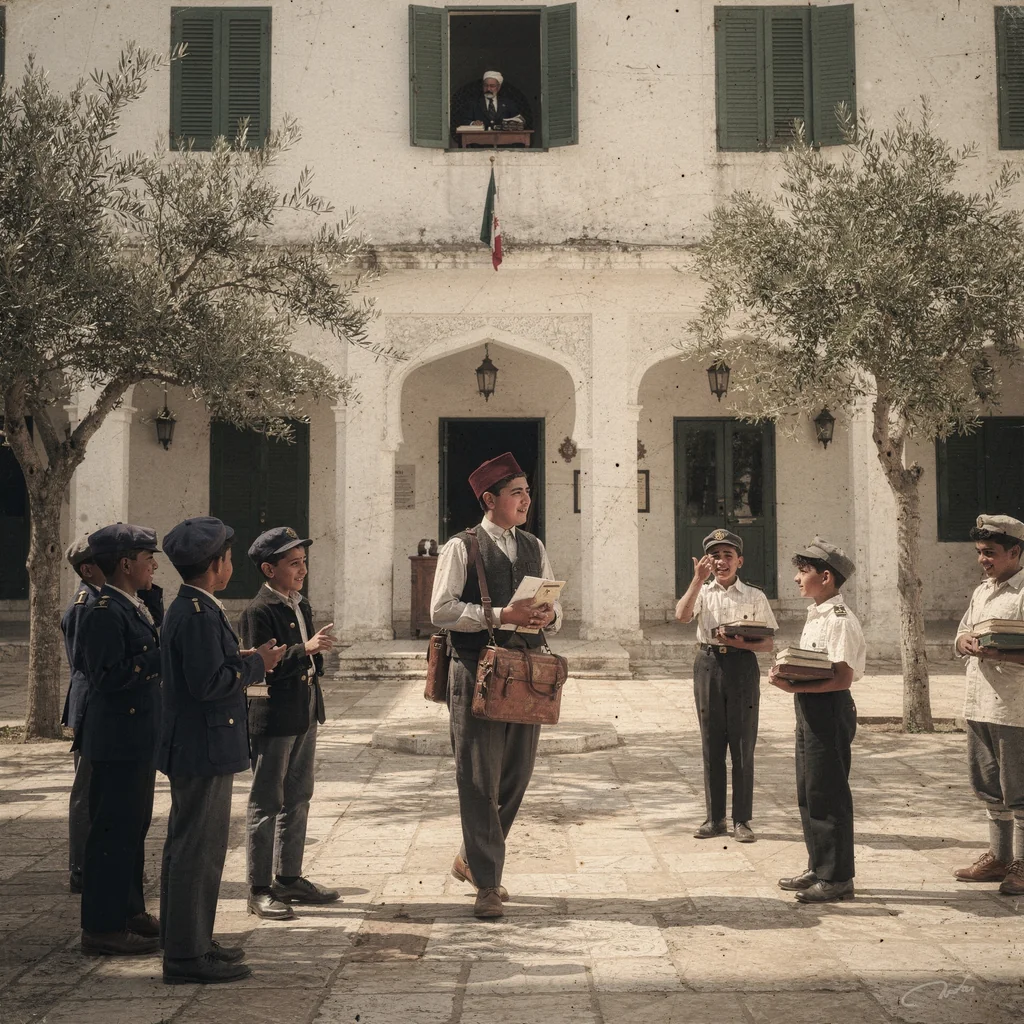
Salah Ben Youssef walked through the archway of Collège Sadiki for the first time. He was eighteen years old. He carried a leather satchel containing his books, his notebooks, the certificate from the kuttab in Maghoura, and a letter from his father to the director.
The courtyard was paved with stone worn smooth by generations of footfalls. Olive trees grew in the corners, their trunks thick and gnarled, their leaves casting dappled shade across the ground where the boys sat during recess. Salah had seen olive trees his entire life—on the family land in Maghoura, along the roads to the mosque, in the courtyards of relatives’ homes. But these olive trees were different. They were planted by the French when they founded the school in 1875. They were not as old as the trees in Maghoura, which his great-grandfather had planted, which his grandfather had tended, which his father still harvested each autumn.
These trees were younger. Their roots were not as deep.
Salah walked toward the main building. Boys in uniforms stood in groups—tunics and trousers of dark wool, the collars stiff, the buttons brass. They spoke French. They spoke Arabic. They spoke a mixture of both, switching between languages mid-sentence, as if the distinction did not matter.
Salah had learned French in the kuttab—his teacher had insisted that a modern Muslim must know the language of the occupier, must understand what was being said in the government offices, in the courts, in the newspapers. But Salah’s French was formal, book-learned, careful. The boys in the courtyard spoke French as naturally as they breathed.
The difference pressed against him like the weight of a hand on his shoulder.
He found the director’s office. He knocked. A voice called “Entrez” in French.
He entered.
The director sat behind a desk covered with papers. He was a Frenchman, middle-aged, with a mustache that had been waxed into precise curves. He looked up when Salah entered.
“You are the new student,” the director said in French.
“Yes, monsieur.”
“Your name?”
“Salah Ben Youssef.”
The director looked down at his papers. He found Salah’s file. He read it quickly.
“From Maghoura,” the director said. “Djerba.”
“Yes, monsieur.”
“Your father is…”
“A merchant, monsieur. Dates, olive oil, goods to and from the mainland.”
The director nodded. He made a note on the paper.
“You will be in Mzali’s class,” he said. “Third year. The students are your age. Some are older. Some are younger.”
“Thank you, monsieur.”
The director returned to his papers. Salah understood that he was dismissed.
He walked out of the office and down the hallway to the classroom. The bell rang. The boys in the courtyard dispersed, moving toward their classrooms. Salah followed them.
The classroom was on the second floor, its windows facing the courtyard. The walls were whitewashed, the wooden desks arranged in rows. A blackboard covered the entire front wall, divided vertically into two sections—Arabic on the left, French on the right.
Salah took a seat near the back. He placed his satchel under the desk. He took out his notebook. He waited.
The door opened.
A man entered. He was perhaps forty years old, with gray beginning to show at the temples of his dark hair. He wore a European suit, the jacket unbuttoned, the collar unbuttoned at the throat. His name was Mohamed-Salah Mzali. He had been teaching at Sadiki for more than twenty years.
Mzali walked to the blackboard. He picked up a piece of white chalk. He wrote on the left side, his hand forming Arabic letters with the ease of long practice.
Istiqlāl — Independence.
Then he turned to the right side of the board. He wrote in French.
La souveraineté — Sovereignty.
He turned back to the class. His eyes moved over the rows of boys. They settled briefly on Salah, the new student from Maghoura, before moving on.
“What is the difference?” Mzali asked.
The room was silent. Thirty boys in uniforms sat at wooden desks. No one raised a hand.
Mzali walked along the rows. He stopped at a desk near the front.
“You,” he said. “What is your name?”
“Mahmoud, monsieur.”
“Mahmoud what.”
“Mahmoud Bourguiba.”
Mzali nodded.
“Tell me, Bourguiba’s brother,” Mzali said. “What is the difference between istiqlāl and souveraineté?”
“Istiqlāl is freedom from France,” the boy said.
“And souveraineté?”
“Self-rule. Tunisians governing Tunisia.”
Mzali nodded. He walked to the next desk.
“And you?” he said. “Your name.”
“Salah, monsieur.”
“Salah what.”
“Salah Ben Youssef.”
Mzali looked at the boy. Dark hair, serious eyes, a face that showed his Djerban origin—the features of those who had lived on the island for generations, whose families had traded across the Mediterranean for centuries.
“From Maghoura,” Mzali said.
“Yes, monsieur.”
“You know what maghoura means?” Mzali asked.
The class stirred. A few boys chuckled. Maghoura — al-maghura, from the verb ghara, to oppress. The place of oppression.
“It is my village,” Salah said.
“Its name means ‘the oppressed place,’” Mzali said. “Do you know why it is called that?”
“No, monsieur.”
Mzali turned to the blackboard. He wrote in Arabic:
Oppression.
Then he wrote in French:
La colonisation — The colonization.
He turned back to the class.
“Maghoura was named for a reason,” Mzali said. “A long time ago, the people of the island suffered under a ruler who took more than his share. The memory was kept in the name.”
He paused.
“Now we have a new ruler,” Mzali said. “And the question is: what will we call our time?”
The room was silent.
Mzali walked to the front of the room. He stood before the divided blackboard, Arabic on the left, French on the right.
“What do these words have in common?” he asked, pointing to istiqlāl and souveraineté.
“They mean the same thing,” a boy in the middle row said.
“In meaning,” Mzali said. “But not in history. Istiqlāl is an Arabic word, with a history in Arabic civilization. Souveraineté is a French word, with a history in European civilization.”
He picked up the chalk again. He wrote under the Arabic word:
Freedom.
Under the French word, he wrote:
La liberté — Freedom.
“Both words mean freedom,” Mzali said. “But they come from different worlds. One world is the world of the Book, the world of the prophet, the world of the caliphs and sultans who ruled this land for thirteen centuries. The other world is the world of revolutions, of republics, of nation-states that rose and fell in Europe.”
He turned to the class.
“We are here to learn both worlds,” Mzali said. “We are here to take what is good from each, to build something new, something that is neither fully Arab nor fully French, but Tunisian.”
He looked around the room at the boys. They wore the same uniforms, sat at the same desks. But some raised their hands when Mzali asked questions in French—boys from the coast, from Cap Bon, from Sousse, from Monastir. Their French was natural, effortless, learned from childhood.
Salah’s French was formal, careful, book-learned. He did not raise his hand.
Other boys sat quietly during the French sections, the way he did. Boys from the south, from Tataouine, from Gabès. They raised their hands when Mzali asked questions in Arabic.
Same room. Different worlds.
Salah listened. He had never heard such teaching before. In the kuttab in Maghoura, the sheikh had spoken only of the Book, of the prophets, of the great scholars of Islamic civilization. He had not spoken of France, except to call it the occupier, the infidel power that had seized Tunisian land.
Here, in this classroom, France was not the enemy. France was a source of knowledge, a civilization with its own history, its own achievements, its own wisdom to be learned.
But Salah could not quite make the two worlds fit together in his mind.
Mzali continued the lesson. He spoke about the history of Tunisia—the Carthaginians, the Romans, the Byzantines, the Arabs, the Ottomans, the French. Each civilization had left something. Each had taken something.
“The question,” Mzali said, “is what we keep. What do we keep from the Arabs? What do we keep from the French? What do we keep from the Ottomans? What do we keep from the Carthaginians?”
He paused.
“What do we keep from ourselves?”
The boys looked at each other. No one had an answer.
Mzali wrote in the center of the board, between the two sides:
Identity.
Or: L’identité — Identity.
“This is what we are building,” Mzali said. “A Tunisian identity that contains all that came before, but is not trapped by any of it.”
He turned back to the class.
“Now,” he said. “Open your history books. Page forty-two. The French conquest of 1881.”
Salah opened his book. He read about the Battle of El Ksar, the treaty of Bardo, the establishment of the French protectorate. He read about the resistance that had followed—the rebellion of Ali Ben Ghedhahem, the battle of Sfax, the years of fighting that had finally ended in submission.
He read about the men who had led the resistance.
He read about the men who had signed the treaty.
The room was quiet except for the sound of pages turning. Mzali walked between the desks, correcting posture, answering questions, explaining the difference between what happened and what was written.
Salah copied the lesson into his notebook. His handwriting was neat, precise. He wrote in Arabic. He underlined the French terms.
He did not know what he would keep from the Arabs, what he would keep from the French. He only knew that he was from Maghoura, the place called Oppression, and that his grandfather had tended olive trees whose roots went back six hundred years.
The bell rang.
The boys stood. They gathered their things. They moved toward the door.
Mzali stood at the front of the room. He erased the blackboard. The Arabic word disappeared, then the French word, then the word that bridged them.
“Bourguiba,” Mzali said.
A boy stood. It was not the same boy from earlier—this was another brother. The Bourguiba family had many sons.
“Your brother,” Mzali said. “Habib. He is in Paris?”
“Yes, monsieur.”
“Write to him,” Mzali said. “Tell him what you learned today.”
“Yes, monsieur.”
The boy left.
Mzali looked at Salah.
“Ben Youssef,” he said.
Salah stood.
“You are from Djerba,” Mzali said.
“Yes, monsieur.”
“The island has a history of resistance,” Mzali said. “The Ibadites, the rebellions against the Bey in the nineteenth century, the refusal to pay taxes that were not just.”
Salah nodded. His grandfather had told him stories.
“Remember that history,” Mzali said. “But do not be trapped by it. We are building something new here. A Tunisia that contains the resistance of Djerba and the administration of Tunis, the faith of the mosques and the knowledge of the French schools.”
He paused.
“You will learn,” Mzali said. “You will learn what to keep. You will learn what to discard. You will learn what must be preserved and what must be changed.”
Salah stood in the doorway.
“Go,” Mzali said. “Recess is ending.”
Salah turned and walked out into the courtyard.
The olive trees cast dappled shade across the stone pavement. The boys stood in groups, speaking French, speaking Arabic, switching between languages as if the distinction did not matter.
Salah walked alone.
Maghoura. The olive trees his grandfather tended, the trees his great-grandfather had planted. The sheikh in the kuttab, speaking only of the Book, only of the prophets, only of the great scholars of Islamic civilization.
Mzali’s voice, moving between Arabic and French, between the worlds of the Book and the worlds of revolutions.
The blackboard, divided in two, connected by a word in the center.
He walked toward the gate.
Outside the archway, the street divided. To the left, the medina—the old city of Tunis, with its mosques and markets, its Arabic signs and Arabic sounds. To the right, the European quarter—the ville nouvelle, with its French cafes and French shops, its European architecture and European language.
Salah stood at the archway and looked both ways.
He walked toward the medina.
Scene 2.2: The Matchmaking
Tunis, October 1928
Salah Ben Youssef sat in a chair across from the senior magistrates in the law cabinet of Mustapha Kaak. Dark mahogany furniture, law books in French and Arabic lining the walls, the sounds of carts and automobiles rising from the rue de Yougoslavie below the window.
He was twenty-one years old. He had completed his legal studies at Sadiki. He had passed the examinations. He was now a lawyer, admitted to the bar, ready to begin his practice.
“You have done well,” one of the magistrates said. He was an older man, his beard white, his face lined with decades of service in the French courts. “Your father must be proud.”
“My father is pleased,” Salah said.
“And your mother?”
“My mother died when I was young.”
The magistrates nodded. They all knew this story. Many of them had lost mothers, wives, daughters in childbirth, in illness, in the summers when the heat killed as surely as any war.
“You are ready to marry,” the magistrate said. It was not a question.
Salah had been expecting this. He was twenty-one. He had a profession. He had an income from his father’s merchant business. He was of marriageable age.
“I am ready,” Salah said.
“Then we should speak of candidates,” the magistrate said.
The other magistrates leaned forward. They were the professional network of Tunis—the men who staffed the courts, who served as notaries and witnesses, who knew every family of means in the city and its surroundings.
“There is the daughter of Si Chédli,” one magistrate said.
“The Zouhir girl?”
“Yes.”
“What is she like?”
“She resembles her brother Fethi.”
The magistrates nodded. Fethi Zouhir was well known—a law intern at this very cabinet, a young man of good character, bright, serious, from a family of magistrates and judges.
“A good family,” one magistrate said.
“Old Tunisian,” said another.
“Respectable,” said a third.
They spoke in the way men speak when discussing a business arrangement, weighing the merits of a contract, assessing the value of property.
Salah listened. He did not know Fethi Zouhir well—he had seen him at the cabinet, a young man in a dark suit, carrying books, speaking to the senior lawyers with respect. But Fethi was not present in this conversation. The magistrates spoke of him as a reference point, a standard of quality.
“The daughter is called Soufia,” the older magistrate said. “She has been raised in a good household. Her father is a magistrate. Her mother is from the Ben Ayed family. There is no scandal, no suspicion of any impropriety.”
“She is educated?”
“She can read and write. She has been trained in household management. She knows the Quran.”
The magistrates nodded again. These were the standard requirements.
“And her appearance?”
“She resembles her brother,” the magistrate said again. “Calm. Dignified. Composed.”
“She has a good reputation?”
“Beyond reproach. There has never been any whisper of anything else.”
The magistrates looked at Salah.
“What do you think?” the older magistrate asked.
Salah considered. He did not know Soufia Zouhir. He had never seen her. He had never heard her voice. He knew only that she was the daughter of a magistrate, the sister of Fethi, a woman of good reputation and good family.
“Is she from Djerba?” Salah asked.
“She was born in Tunis,” the magistrate said. “Her family is old Tunisian—landowners, judges, scholars. They have been in the city for generations.”
Salah nodded. Djerba and Tunis were two different worlds. The island and the capital. The merchant families and the aristocratic families. The Arabic-speaking heartland and the French-speaking elite.
But he was not marrying a family. He was marrying a woman.
And the woman, according to the magistrates, resembled her brother Fethi.
“I accept,” Salah said.
The magistrates nodded. The decision was made.
“Then we will send a formal request to Si Chédli,” the older magistrate said. “Your father will be informed. The preparations will begin.”
Salah stood. He shook the hand of each magistrate. He walked out of the cabinet and down the stairs to the street.
Outside, the sun was bright. The street was busy—carts and automobiles, pedestrians in Arab robes and European suits, the sounds of Arabic and French mixing in the air.
Salah walked toward the medina.
Soufia Zouhir. The description the magistrates had given: the daughter of Si Chédli, the sister of Fethi, the woman who resembled her brother.
He did not know what she looked like. He did not know what her voice sounded like. He did not know if she was quick to laugh or slow to anger, if she preferred the company of books or the company of people, if she rose before dawn or slept until midday.
He knew only that she had a good reputation. That her family was respectable. That she resembled her brother.
He turned into the medina.
The sun beat down on the white stones. The smell of spices rose from the market stalls.
Scene 2.3: The Proposal
Tunis, November 1928
The Zouhir family home stood on a quiet street near the kasbah, within sight of the walls of the old city. It was a house of substance—two stories built around a central courtyard, with rooms for the family and rooms for guests, with a kitchen separate from the main building to keep the heat of cooking away from the living spaces.
Salah stood at the entrance. He wore a dark suit, his best clothes, purchased for this occasion. His father stood beside him, his uncle from Djerba on his other side. Behind them, two witnesses—magistrates from the law cabinet, men who would testify that the proposal had been made according to custom.
Salah knocked on the door.
A servant opened it. He showed them into the reception room—a space furnished with carpets and cushions, with shelves of books along one wall, with a window looking out onto the courtyard where a fountain played.
They waited.
Si Chédli Zouhir entered a few minutes later. He was a man in his sixties, his face lined with authority, his beard trimmed, his robes clean and pressed. He had been a magistrate for forty years.
He greeted them. He offered coffee. They declined—the coffee would be drunk after the agreement was reached.
“You are Salah Ben Youssef,” Chédli said.
“I am, Si Chédli.”
“Your father is a merchant of Djerba.”
“He is.”
“You have studied at Sadiki.”
“I have.”
“You are a lawyer now.”
“I am admitted to the bar.”
Chédli nodded. He had already known all of this. The magistrates who had arranged this meeting had sent word ahead.
“And you wish to marry my daughter,” Chédli said.
“I do.”
“You have never seen her.”
“I have not.”
“You do not know what she looks like.”
“I know that she resembles her brother Fethi. That is sufficient for me.”
Chédli’s face did not change. He had heard this before. Many marriages in Tunisia were arranged this way—the families knew each other, the professionals trusted each other, the contract was made before the couple ever met.
“Fethi speaks well of you,” Chédli said.
“Fethi is a good man,” Salah said. “I am honored by his approval.”
“You understand what this marriage is,” Chédli said. “It is a contract between families. You will provide for her. You will protect her. You will honor her. You will not raise your hand against her, nor your voice.”
“I understand.”
“You will be responsible for her household. You will be responsible for her children. You will be responsible for her honor and the honor of the family she carries.”
“I understand.”
Chédli looked at Salah’s father. The merchant from Djerba nodded once.
“Then we have an agreement,” Chédli said.
He stood. He extended his hand. Salah took it. The men shook hands.
The witnesses stepped forward. They testified that they had heard the proposal, that they had heard the acceptance, that they had heard the terms.
Coffee was brought.
They drank it in silence.
When the cups were empty, Salah and his family stood. They took their leave.
At the door, Salah turned back.
“May I ask,” Salah said, “when I will see her?”
Chédli’s face remained still.
“You will see her at the wedding,” he said.
Salah nodded.
He walked out of the Zouhir home, the agreement made, the contract settled.
He had never seen Soufia’s face. He had never heard her voice. He carried a professional contract, not a romantic memory.
The aristocratic door closed behind him.
Scene 2.4: First Sight
Tunis, December 1928
The room was prepared for the formal viewing—the meeting that would precede the wedding by a few weeks. The women of Soufia’s family sat on one side, the men of Salah’s family on the other. A curtain divided the room, allowing the couple to see each other without touching, without speaking without permission.
Salah sat on his side of the curtain. He could hear the women whispering, the rustle of fabric, the clink of jewelry. He could not see them yet.
A voice from the other side called permission.
The curtain was drawn back.
Soufia Zouhir sat on the other side, surrounded by her mother, her aunts, her sisters. She wore a simple dress, her hair covered, her hands folded in her lap. Her face was calm. Her eyes were dark and serious.
Salah looked at her.
The magistrates had been right. She did resemble her brother Fethi. The same calm expression, the same dignity in the posture, the same sense of stillness that suggested a person who did not move without purpose.
But she was not Fethi. She was not the magistrate. She was herself.
Salah saw this in the way she held her head, in the way her hands rested on her lap, in the way her eyes met his without looking away.
He saw something else too—something the magistrates had not mentioned, something no professional description could have captured.
She was present.
Not just physically present in the room, but fully there, in a way that few people were. She did not fidget. She did not glance around the room. She did not shift her attention. She was simply present, complete in herself, waiting to see what would happen.
His breath held. He released it slowly.
“You are Salah Ben Youssef,” she said. Her voice was calm, direct, without shyness or boldness.
“I am.”
“You are from Djerba.”
“I am.”
“You are a lawyer.”
“I am.”
She nodded. She had already known these things. She had been told what to expect.
“You have come to see if you approve,” she said.
Salah did not know what to say to this. He had been raised to expect that a woman would not speak so directly, that she would wait for the man to speak first.
But he was looking at her face, at the calmness in her eyes, at the way she sat completely present in the moment. And he found that he could not speak the expected words.
“I came to see you,” Salah said.
“You have seen me,” she said.
Her face did not change. There was no smile, no frown, no attempt to appear pleasant or unpleasant. She was simply there, waiting to see what he would do.
“Do you approve?” she asked.
Salah looked at her. The magistrates’ description: the daughter of Si Chédli, the sister of Fethi, the woman who resembled her brother.
The magistrates had been right about the resemblance.
They had been wrong about everything else.
“I approve,” Salah said.
Soufia nodded. There was still no smile, but the calm in her eyes seemed to deepen, as if a decision had been made that she was satisfied with.
“Then we will marry,” she said.
“Yes,” Salah said. “We will marry.”
The curtain was drawn forward again.
Salah sat with his family on his side of the room. He could hear the women whispering on the other side, the rustle of fabric, the sounds of approval.
Scene 2.5: The Wedding
Tunis, January 1929
The wedding hall was filled with people from both worlds—the merchant families of Djerba, with their dark robes and Arabic speech; the aristocratic families of Tunis, with their European suits and French education. They mingled in the center of the hall, around the tables where food was laid out, around the space where the couple would stand to exchange their vows.
Salah stood at the front of the hall. He wore a white jebba and a dark vest, his clothes new for this occasion, his hair oiled and combed. He could see the guests arriving—the men from Djerba in their turbans and burnouses, the men from Tunis in their European suits, the women in their finest garments, their faces uncovered in the mixed company of the wedding celebration.
His father stood beside him. His uncle from Djerba stood on his other side. The witnesses stood ready—the magistrates who had arranged the marriage, who would testify that the contract was valid.
The music began.
The door opened.
Soufia entered.
She wore a white dress embroidered with gold thread, her hair covered with a fine veil that allowed her face to show. Her hands were hennaed in intricate patterns. She walked with her father, Si Chédli, who led her to the center of the hall.
Salah saw her face as she approached—the same calm he had seen in the viewing room, the same presence, the same stillness. But there was something else now, something he had not seen before.
Each part of her face was in its proper place. Each detail served the whole. The gold thread of her dress caught the candlelight. Her hands, hennaed in intricate patterns, held a small Quran against her chest.
She reached the center of the hall. Her father stopped. He turned to Salah.
“Do you take this woman as your wife?” Chédli asked. “Do you promise to provide for her, to protect her, to honor her, to never raise your hand against her, nor your voice?”
“I do,” Salah said.
“Do you accept the responsibility for her household, for her children, for the honor she carries?”
“I do.”
The witnesses stepped forward. They testified that they had heard the vow, that they had heard the acceptance, that they had heard the terms.
Soufia stood beside Salah. He could smell the perfume she wore—rosewater and jasmine, the scent of Tunis in spring.
“Do you take this man as your husband?” the officiant asked her.
“I do,” she said.
“Do you accept his household, his protection, his honor?”
“I do.”
The witnesses testified again.
The contract was signed.
The music swelled.
The guests clapped. The men from Djerba clapped with both hands, the sound sharp and rhythmic. The men from Tunis clapped with measured approval. The women ululated—the sharp, trilling sound of celebration that rose above the music.
Salah and Soufia stood together. He from Maghoura, the place called Oppression, on the island of Djerba where his family had traded for generations. She from Tunis, the capital, the daughter of magistrates and judges.
The two Tunisas stood in one frame.
The guests came forward to offer their congratulations. The Djerban merchants spoke Arabic, praising God for the union, blessing the couple with many children and long life. The Tunisian aristocrats spoke French, praising the match, noting the good sense of combining two respected families.
Soufia received them all with the same calm presence. She smiled when appropriate, she nodded when appropriate, she thanked them for their good wishes. But underneath the social performance, Salah saw something else—a reserve, a stillness, a completeness that required nothing from anyone.
They moved through the hall, receiving the guests, accepting the congratulations. Salah watched Soufia as she spoke to his father, to the Djerban merchants, to the Tunisian magistrates. She spoke Arabic when appropriate, French when required. She moved between the two worlds as if they were the same.
He wondered if she saw what he saw—the division in the room, the Djerbans on one side, the Tunisians on the other, the two worlds that had come together for this one moment.
She looked at him. Her eyes moved from the Djerban side to the Tunisian side, then back to him. She said nothing.
The music continued. The food was served. The guests ate and drank and talked.
Late in the evening, Salah and Soufia stood together near the door, watching the guests begin to depart.
“The Djerbans think this is a good match,” Salah said. “The Tunisians think so too.”
“They both think it was their idea,” Soufia said.
Salah looked at her. There was a hint of humor in her voice, something he had not heard before.
“Do you think this is a good match?” he asked.
She turned to him. Her face was calm, but there was something in her eyes now—something new, something that had not been there in the viewing room, something that had not been there when they first stood together.
“I think,” she said, “that we will find out.”
She looked at the Djerbans leaving the hall, at the Tunisians saying their farewells. The two groups moved toward different doors, separate again.
The music played on. The candles in the hall burned lower. The rosewater and jasmine scent of Soufia’s perfume hung in the air between them.
Scene 2.6: Bourguiba at Vichy (1931)
Vichy, France, June 1931
The congress hall of the Ligue des Droits de l’Homme was filled with French human rights defenders—lawyers and academics, journalists and politicians, men and women who believed in the universal rights of man. They had gathered to discuss the problem of colonization, to debate whether the League should take a position on the colonies, to consider whether the rights of man extended to the peoples of Algeria, Tunisia, Indochina, Madagascar.
A young journalist from Le Petit Tunisie sat in the press section near the back, his notebook open, his pen ready. He had been sent to cover the congress for the Tunisian readership—the colonists, the administrators, the settlers who wanted to know what the humanitarians in Paris were saying about their project.
The morning session had been unremarkable. Reports on Indochina, on Madagascar, on the general principles of colonial administration. The journalist had written down the key phrases, the polite applause, the measured language of men who believed in justice but were not prepared to act on it.
Then the moderator announced the next speaker—a Tunisian lawyer, a certain Bourguiba, who would address the situation in the French protectorate of Tunisia.
The journalist straightened. He had heard the name. Habib Bourguiba. A graduate of the Sorbonne, admitted to the bar in Paris, a nationalist who had been writing articles in French newspapers about the Tunisian question. The settler community in Tunis spoke of him with the mixture of contempt and anxiety that colonizers reserve for the colonized who have mastered their language.
A man rose from the third row and walked to the podium. He was thirty-one years old, perhaps. He wore a European suit, well-cut, his hair slicked back, his mustache trimmed in the French style. He could have been a French lawyer addressing a French court. Only the features of his face—the brow, the nose, the set of the jaw—marked him as North African.
The hall quieted. They had not expected a Tunisian to speak. They had expected a French advocate to speak on behalf of Tunisians. The difference was visible in the delegates’ faces—a flicker of surprise, then curiosity, then the guarded attention of people preparing to judge.
Bourguiba began.
“The problem of colonization,” he said, “falls within the competence of the League of Human Rights from two points of view.”
His French was flawless. Not the careful French of a foreigner who has learned the grammar but missed the rhythm—this was the French of a man who had studied at the Sorbonne, who knew the cadences of French oratory, who could deploy the rhetorical structures of the French revolutionary tradition as naturally as any deputy in the National Assembly.
The journalist’s pen moved across the page. He noted the precision of the diction, the control of the voice, the way Bourguiba’s eyes moved over the hall—not pleading, not challenging, but measuring, as if calculating exactly how much truth the room could absorb.
“First,” Bourguiba said, “the League, defending the rights of all men, under all latitudes, cannot fail in its mission by remaining indifferent to these fragments of Humanity that are the colonies, where daily these ‘Rights of Man’ are violated.”
The delegates listened. Some nodded. Others frowned. A woman in the second row leaned forward.
“Second,” Bourguiba continued, “the League, proposing as its highest ideal the organization of Peace, must understand that there can be no serious, true, lasting peace as long as groups of men continue to coldly exploit and oppress other, weaker human groups, depriving them of all freedoms, all rights, and subjecting them to a regime worse than slavery.”
He paused. The hall was silent. The journalist’s pen kept moving.
“The condition of a serious and genuine peace,” Bourguiba said, “is not only the appeasement of minds and hearts between the peoples of Europe, but the bringing together, under the sign of equality and relations of solidarity, of all peoples, whatever they may be, great or small, weak or strong, and particularly between colonizers and colonized.”
He spoke of Tunisia—a country with its own language, its own institutions, its own traditions, its own history. A country that groaned under the weight of a complicated and illogical regime that threatened its very existence.
“A systematic policy of material impoverishment and moral degradation,” Bourguiba said, “tends manifestly toward its progressive disintegration and its complete disappearance, in order to leave the field free for integral exploitation of the country and to allow a few to enrich themselves quickly and cheaply on the backs of an amorphous, resigned population, incapable of reacting!”
The delegates shifted in their seats. The journalist glanced around the room. A professor from Lyon was scribbling furiously. A colonial administrator near the door had crossed his arms.
Bourguiba spoke of the repressive legislation—the special laws that stifled brains and brutalized consciences, the regime of the gag in all its hideousness, going so far as to prohibit, under penalty of prison, expressing one’s opinion even in a non-public place.
“These decrees,” Bourguiba said, “will bear for eternity before history the avenging name of décrets scélérats—wicked decrees!”
The word hung in the air. Décrets scélérats. The journalist underlined it twice. The colonial administrator’s jaw tightened.
Bourguiba continued. He spoke of the 600 million franc budget, paid for mostly by the indigenous population. He spoke of the famine that had followed the economic crisis—families dying, whole villages perishing.
“On a budget of 600 million francs paid in major part by the indigenous element,” Bourguiba said, his voice rising, “not one sou is provided to combat this scourge. The Government believes it has done its duty by distributing, thanks to Treasury funds, a few thousand quintals of maize on the ridiculous and officially admitted basis of 250 grams per person!”
He paused.
“250 grams,” he repeated. “Per person.”
The hall was silent. The journalist’s pen had stopped. He was watching Bourguiba’s face—the precision of the anger, the control beneath it, the way the voice never cracked even as the accusations mounted.
“This is what modern colonization comes to,” Bourguiba said. “Whole families, whole villages have died of hunger. And the government distributes 250 grams of maize per person.”
The delegates were not looking away.
“We are not asking for immediate evacuation,” Bourguiba said. “That idea is absurd, impractical, contrary to the true interests of both parties. But we may one day be for it—we may one day be for immediate evacuation—the day the Tunisian people, who suffer, come to despair of France.”
His voice softened. The journalist noted the shift—the way the orator modulated from accusation to appeal, from indictment to invitation.
“Today, we are convinced that if odious crimes against morality and the law of nations are committed everywhere under the cover of the French flag, it is because they are not sufficiently known to the French people. The best means, the most effective, is to shed light on them, to make them known, to put this capital question on the agenda of French public opinion, to enable the French people to assume their responsibilities.”
He finished with a call to the League—to facilitate contact between the people of France, who only wanted to know, and the enslaved, exploited Tunisian people, who only wanted to live in peace and on a footing of equality with all those who came to their country not to find easy prey and opportunities to enrich themselves cheaply, but a field of activity for their energies.
“It is through this constant contact,” Bourguiba concluded, “that you will put the problem of colonization on the agenda of French public opinion and that a rational solution can emerge. You will have contributed to putting more harmony among men, you will have destroyed a germ of war that could reduce all your work of peace and mutual understanding to nothing.”
The hall was silent for a moment. Then the applause began.
It was polite applause, measured applause, the applause of people who had heard something they had not expected to hear. Some delegates stood. Others remained seated. Some applauded enthusiastically. Others did not applaud at all.
The colonial administrator near the door did not clap. His arms remained crossed. His expression was unreadable.
Bourguiba stepped down from the podium. He walked through the delegates, past the press section, toward the exit. The journalist caught a glimpse of his face as he passed—no triumph, no relief, just the tight composure of a man who had said what he came to say and was already thinking of what to say next.
The journalist looked down at his notes. He would have to choose his words carefully for Le Petit Tunisie. The settlers would not want to read what this Tunisian had said. The administrators would not want it printed. But the words were on the page, in his handwriting, and they would appear in tomorrow’s edition regardless.
He closed his notebook. He walked out of the congress hall into the Vichy street.
It was June. The weather was mild. Visitors strolled along the boulevards, taking the waters, reading newspapers, discussing the events of the day as if the world were contained within the borders of France.
The wind carried the smell of mineral springs across the town.
Scene 2.7: Neo-Destour Founding
Tunis, March 2, 1934
The hall was a rented space on the rue de la Kasbah, large enough to hold two hundred people, with windows that looked out onto the street where the French police patrolled in twos and threes. The air inside was thick with tobacco smoke and the heat of bodies pressed together.
Salah Ben Youssef sat near the front. He was twenty-seven years old. He had been married to Soufia for five years. They had two sons now—Chedly and Lotfi. Salah had established his legal practice in Tunis. He had become involved in nationalist politics, attending meetings, writing articles, speaking against the French protectorate.
But this meeting was different.
This was the founding of a new party—the Neo-Destour. The old Destour, founded in 1920, had split. The leadership had been divided between those who wanted to work within the French system and those who demanded complete independence. The division had grown wider over the years. Now the split was final.
The old Destour was dead. The Neo-Destour was being born.
Salah looked around the hall. He saw men he knew—lawyers, teachers, merchants, students. He saw men who had studied in France, who spoke French as fluently as Arabic, who wore European suits and read French newspapers. He saw men who had studied at Zitouna, who spoke only Arabic, who wore traditional robes and read classical poetry.
The two Tunisas were in this room.
The door opened.
Habib Bourguiba entered.
He was thirty-one years old. He had returned from Paris in 1927, after completing his legal studies at the Sorbonne. He had been active in the Destour for years. He had written articles, given speeches, argued for a new approach—independence through negotiation, through gradualism, through cooperation with France where possible, confrontation only when necessary.
Bourguiba walked to the front of the hall. He stood before the crowd. He wore a European suit, his hair slicked back, his mustache trimmed in the French style. He looked like a man who belonged in Paris as much as in Tunis.
He began to speak.
“We are here,” Bourguiba said, in French, “to create a new movement. A movement for independence. A movement for modernity. A movement for the Tunisia of the twentieth century, not the Tunisia of the past.”
He spoke in French for several minutes, describing the need for a new approach, for a gradual path to independence, for cooperation with France where possible, for a modern Tunisia that would take its place among the nations of the world.
As he spoke, Salah watched the room.
The men who had studied in France nodded. The men who spoke French fluently nodded. The men who wore European suits nodded. They heard Bourguiba’s words and they approved.
But other men sat still. The men who had studied at Zitouna. The men who spoke only Arabic. The men who wore traditional robes. They did not nod. They did not approve.
Bourguiba finished his speech. He stepped back.
Another man stood to speak—a representative of the old Destour leadership, a man who had been part of the movement since the beginning.
He spoke in Arabic.
“We are here,” the man said, “to complete the independence of Tunisia. Not to negotiate with France. Not to cooperate with the protectorate. But to demand complete freedom, complete evacuation, complete sovereignty.”
He spoke of the Quran, of the caliphs, of the great Islamic civilization that had flourished in Tunisia before the French came. He spoke of the duty of Muslims to resist occupation, to fight for freedom, to reclaim what had been taken.
As he spoke, Salah watched the room again.
The men who had studied at Zitouna nodded. The men who spoke only Arabic nodded. The men who wore traditional robes nodded. They heard the man’s words and they approved.
But the men who had studied in France sat still. The men who spoke French fluently sat still. The men who wore European suits sat still. They did not nod. They did not approve.
Bourguiba stepped forward again. He spoke in Arabic this time, his accent evident, his words careful but not fluent.
“We must be realistic,” Bourguiba said. “France is powerful. We cannot defeat them by force. We must negotiate. We must cooperate. We must build Tunisia slowly, step by step, within the framework of the protectorate, until we are strong enough to stand alone.”
The Zitouna graduates shook their heads. They did not agree.
Another man stood—a young firebrand, a follower of the old Destour, a man who had been imprisoned by the French for his nationalist activities.
“We must not negotiate with the colonizer!” the man shouted. “We must not cooperate! We must resist! We must fight! Complete independence now, not later!”
The room erupted.
Men stood on chairs. Men shouted at each other. Men pointed fingers, accused each other of cowardice, of betrayal, of serving French interests.
Salah sat still. He watched the room divide.
On one side, the men nodding at Bourguiba’s French phrases—the Sadiki graduates, men who spoke French as naturally as Arabic, who believed that the path to freedom lay through cooperation with France.
On the other side, the men uncomfortable with Bourguiba’s European orientation—the Zitouna graduates, men who had studied the Book and the law, who believed that cooperation with France was betrayal, that the only legitimate path was resistance.
Bourguiba stood at the front, arms crossed, watching the argument, his expression unreadable.
Salah sat among the silent minority, feeling the crack open in the room.
Maghoura. The place called Oppression. The olive trees his grandfather tended, roots going back six hundred years. The sheikh in the kuttab, speaking only of the Book, only of the prophets, only of the great scholars.
Bourguiba’s speech in French—negotiation, cooperation, building slowly, step by step.
The other man’s speech in Arabic—resistance, fighting, complete independence now.
He stood up.
The room quieted as Salah walked to the front.
He was not a famous speaker. He was not a firebrand. He was a lawyer from Djerba, a man who had studied at Sadiki, who spoke both French and Arabic, who moved between both worlds.
He stood before the divided room.
“We are talking about two different things,” Salah said. He spoke in Arabic, with a formal classical accent that showed his kuttab education. “One side speaks of negotiation. The other side speaks of resistance.”
He paused.
“But what are we negotiating for?” Salah asked. “And what are we resisting?”
No one answered.
“If we negotiate for cooperation with France,” Salah said, “then we are negotiating to remain a protectorate. We are negotiating to remain dependent. We are negotiating to keep the French in our country, in our government, in our lives.”
He heard Bourguiba’s supporters shifting in their seats.
“And if we resist for the sake of resistance,” Salah said, “without building the institutions that will replace the French when they leave, then we are resisting for nothing. We will drive them out, and then what? We will have no government. We will have no army. We will have no economy. We will have chaos.”
He heard the old Destour supporters shifting in their seats.
“The question,” Salah said, “is not negotiation or resistance. The question is: what kind of Tunisia do we want? A Tunisia that follows the French model, with French laws and French institutions and French culture? Or a Tunisia that is rooted in Islamic civilization, with Arab governance and Arab culture and Arab identity?”
He paused.
“Or,” Salah said, “do we want a Tunisia that is neither fully one nor fully the other, but something new—something that takes the best of both worlds, something that is Tunisian, not French and not Arab, but itself?”
The room was silent.
Bourguiba stood. He spoke in French. “We cannot build something new if we isolate ourselves from the modern world. We need French education. We need French institutions. We need French cooperation. Otherwise we will be left behind, a backward country in a modern world.”
Salah responded in Arabic. “We cannot build something new if we destroy what we are. We need Islamic education. We need Arab institutions. We need Islamic identity. Otherwise we will be a colony in all but name, independent on paper but dependent in reality.”
Bourguiba responded again. “You speak of identity as if it is fixed. But identity changes. The world changes. Tunisia must change with it. We cannot remain trapped in the past if we want to build a future.”
Salah responded. “You speak of change as if it is progress. But not all change is progress. Some change is destruction. Some change is loss. We cannot move forward if we leave ourselves behind.”
The room divided further.
The men who had studied in France, who spoke French fluently, who wore European suits—they nodded at Bourguiba’s words. They heard progress, modernity, cooperation with France.
The men who had studied at Zitouna, who spoke only Arabic, who wore traditional robes—they nodded at Salah’s words. They heard preservation, identity, resistance to colonization.
The crack in the room grew wider.
Bourguiba and Salah continued to speak, back and forth, in French and Arabic, in the language of the colonizer and the language of the colonized. Neither man could convince the other. Neither man could see the other’s point of view.
The sun set outside the windows. The room grew dark. The argument continued.
Finally, the president of the meeting stood. He called for a vote.
“All those in favor of the Neo-Destour platform,” the president said, “raise your hands.”
Most of the hands went up.
“All those opposed?”
A minority raised their hands.
The Neo-Destour was founded. Bourguiba was elected as its leader. Salah was elected as its secretary-general.
A woman in the back of the hall wound yellow thread onto a spool. The fabric moved through her hands—inch by inch, the yellow thread disappearing onto the wooden spool, the fabric taking shape beneath her fingers as the room erupted in applause.
Scene 2.8: Three Men at a Café, Tunis, October 1934
The terrace of Café de Paris looked out on Avenue de France—where Tunisians in European suits walked past French soldiers, where the Arab world met the European world on the paved street of the colonial capital.
Salah Ben Youssef sat at a small round table with two other men. He was twenty-seven, dressed in a dark suit, a coffee cup before him. Across the table: Habib Bourguiba, thirty-one, his suit more expensive, his manner more assured. And between them: Mongi Slim, twenty-eight, smiling, his dark eyes taking in everything.
The three men had known each other for years.
Mongi was Salah’s colleague—a lawyer, like Salah, trained at Sadiki, admitted to the bar, practicing in the French courts of Tunis. They had worked on cases together, defended nationalists together, been arrested together in the protests of earlier years.
Mongi was also Bourguiba’s cousin—second cousins through the Saaka family, their mothers’ line tracing back to the same great-grandfather in Monastir. They had grown up together, played as children, studied in different schools but remained close.
“You’ve heard the news,” Mongi said. His voice was warm, animated, carrying the enthusiasm of a man who found politics exciting rather than dangerous.
“The French are considering reforms,” Bourguiba said. He stirred his coffee, the spoon clinking against the cup. “Internal autonomy. More Tunisian officials in the administration. More representation in the government.”
“Is this independence?” Salah asked.
“It’s a step,” Bourguiba said.
“Or a trap,” Salah said.
Mongi laughed—a short, genuine sound. “Always the pessimist, Salah. Can’t you see progress when it’s in front of you?”
Salah smiled. “I see what the French want me to see. The question is what they don’t want me to see.”
“And what is that?” Bourguiba asked.
“The trap,” Salah said. “They offer us titles, offices, authority. But they keep the power. We become ministers in name, servants in fact.”
Bourguiba set down his spoon. “You are too rigid, Salah. You see only two options—surrender or resistance. But there is a middle path. Cooperation where necessary. Confrontation where necessary. A Tunisia that is both modern and independent.”
“And who decides what is necessary?” Salah asked. “The French? Or us?”
Bourguiba didn’t answer.
Mongi looked between them—cousin on one side, colleague on the other. He saw the affection in both men’s eyes, but also the frustration. They had been arguing like this for years. They would argue like this for years more.
“You two,” Mongi said, shaking his head. “You’re like brothers who can’t stop fighting.”
“We are not brothers,” Bourguiba said. “We are colleagues.”
“We are friends,” Salah said.
“Are we?” Bourguiba looked at Salah. “Friends agree on the path. We don’t agree.”
“But we walk together anyway,” Salah said.
Bourguiba was silent for a moment. Then he smiled—a real smile, the warmth reaching his eyes. “Yes. We walk together anyway.”
The waiter approached—a young Tunisian in a white apron. “Monsieur Slim? Your wife is here. She asks if you need anything.”
Mongi turned. In the street below the terrace, a woman in a light dress stood waiting—his wife, Fatma, Bourguiba’s cousin on the Slim side.
“No,” Mongi said. “Tell her I’m fine. We’re finishing soon.”
The waiter nodded and retreated.
“My wife,” Mongi said, turning back to the table. “She worries. She says I spend too much time with politics. She says I should spend more time with the law.”
“The law is politics,” Salah said.
“Exactly,” Mongi said. “But she doesn’t see it that way. She sees cases and clients, contracts and courts. She doesn’t see the big picture—the liberation of our country.”
“What do you see?” Bourguiba asked.
Mongi considered. “I see both paths. I see Salah’s path—resistance, Arab identity, Islamic civilization. I see your path, cousin—negotiation, modernization, cooperation with France.”
“And which path do you choose?” Bourguiba asked.
“I choose both,” Mongi said. “I choose the path that keeps our families intact, that keeps our friendships alive, that keeps Tunisia from tearing itself apart.”
Salah looked at Mongi. “You think Tunisia can have both paths?”
“I think Tunisia must have both paths,” Mongi said. “Look at us. Three men at a table. One studied at Zitouna, one at Sadiki, one at both.” He gestured to each in turn. “We are all Tunisian. We all want independence. We just disagree on how to get there.”
“The disagreement is not small,” Bourguiba said.
“No,” Mongi agreed. “It’s not small. But neither is the friendship. Neither is the family.” He smiled. “My cousin Habib, my colleague Salah. How can I choose between you? How can I choose between family and friend?”
Salah looked at Bourguiba. Bourguiba looked at Salah.
Both men saw what Mongi saw—the warmth in his eyes, the genuine affection, the impossibility of choice.
“You are a diplomat,” Bourguiba said. “Always finding the middle ground.”
“Someone has to,” Mongi said. “You two are too busy being right to notice that you’re also both wrong.”
“Both wrong?” Salah asked.
“You think your path is the only path,” Mongi said. “You think resistance is the only legitimate response to colonization. But you’re wrong. There are other paths. Negotiation. Cooperation. Gradualism. They are not betrayal. They are not cowardice. They are different strategies for the same goal.”
He turned to Bourguiba. “And you think negotiation is the only rational path. You think resistance is doomed to failure, that it brings only suffering and death. But you’re wrong too. Sometimes resistance works. Sometimes the colonizer will not listen until forced to listen. Sometimes the only way to be heard is to speak with fire.”
Both men were silent.
Mongi sat back, satisfied. He had told them the truth as he saw it—not choosing sides, not declaring one right and one wrong, but affirming the complexity of their struggle.
“Coffee?” Bourguiba asked.
“Please,” Salah said.
Bourguiba signaled the waiter. Three more coffees arrived.
As they waited, a French patrol passed on the street below—three soldiers in khaki uniforms, rifles slung over their shoulders, speaking French among themselves.
The three Tunisians watched them pass.
“They look so comfortable here,” Mongi said. “As if they own the street. As if they own the city.”
“They do own the city,” Salah said.
“For now,” Bourguiba said. “Not forever.”
Mongi looked between them. Salah saw the French as permanent occupiers. Bourguiba saw them as temporary obstacles. Both men believed they were right. Both men believed Tunisia would be free.
The difference was the path.
And that difference would eventually tear them apart.
But not today.
Today, they sat at a café table on Avenue de France, three men who had known each other for years, drinking coffee, arguing about politics, joking about family, enjoying the warmth of friendship.
“Your father,” Mongi said to Bourguiba. “How is he?”
“Stoic as ever,” Bourguiba said. “Proud of his son the lawyer, even if he doesn’t quite understand what I do.”
“He understands,” Salah said. “Fathers always understand, in their way. They just don’t say it.”
Bourguiba’s face softened. “Yes. He understands. He just shows it differently.”
“And your family?” Mongi asked Salah.
“My wife is well,” Salah said. “The family grows. The work continues.”
He stopped, his voice catching.
Mongi reached across the table, touched Salah’s arm. “What is it?”
Salah composed himself. “Nothing. It’s just—they speak French now. Chedly, especially. He hears it in the streets, he hears it from the neighbors’ children. He comes home and mixes it with Arabic. I don’t know whether to correct him or let him be.”
“Let him be,” Bourguiba said. “French is useful. It opens doors.”
“But it is not our language,” Salah said.
“It is our language now,” Bourguiba said. “Like it or not.”
Salah said nothing. He drank his coffee, watching the street where French soldiers walked, where Tunisian children played, where the future was being negotiated in every conversation, in every classroom, in every home.
Mongi watched them both—cousin and colleague, one seeing the value in the colonizer’s language, one mourning the loss of his own.
“You know,” Mongi said, “my wife and I—we speak French at home. Not Arabic.”
Salah looked up. “You do?”
“We do,” Mongi said. “She is from a French-speaking family. Her father was a teacher in the French schools. We have more in common that way than with the old Arabic families.”
“And yet you defend Salah’s position,” Bourguiba said.
“I defend both positions,” Mongi said. “Because both are Tunisia. The French-speaking Tunisia and the Arabic-speaking Tunisia. The modern Tunisia and the traditional Tunisia. The Tunisia of the future and the Tunisia of the past.”
He smiled. “I am lucky. I have a foot in both worlds. I can see the value in each.”
“You are a diplomat,” Bourguiba said again.
“I am a Tunisian,” Mongi said. “That is all.”
The coffee cups emptied. The sun moved across the sky. The afternoon wore on.
“We should go,” Bourguiba said. “I have a meeting at the Neo-Destour office. There is talk of another protest. The French are nervous.”
“And you?” Salah asked Mongi.
“I have a client,” Mongi said. “A merchant in Sfax. He needs a contract reviewed. The work of a lawyer, not a politician.”
He stood. The other two men stood with him.
“Same time next week?” Mongi asked.
“Next week,” Salah said.
“I will be there,” Bourguiba said.
They shook hands—Mongi gripping Bourguiba’s forearm, then Salah’s. The warmth of his handshake, the genuine affection in his smile, made the moment feel complete.
“Go carefully,” Mongi said. “Both of you. The French are watching. They know who you are.”
“They know who we all are,” Bourguiba said.
Mongi laughed. “Yes. And that is the problem.”
He walked down the stairs from the terrace, onto the street. He waved once, then disappeared into the crowd.
Salah and Bourguiba watched him go.
“He is a good man,” Bourguiba said.
“He is,” Salah said. “And he is right. We are too rigid. We see only our own path.”
“But our paths are different,” Bourguiba said. “You know that.”
“I know,” Salah said. “But today—today we walked together.”
Bourguiba smiled. “Yes. Today we walked together.”
They descended from the terrace, onto the street, and went their separate ways—Bourguiba to the Neo-Destour office, Salah to his law practice, Mongi to his client in Sfax.
The street was busy. Tunisians in European suits walked past French soldiers. The afternoon sun moved across the sky.
| Scene | Year | Location | POV | Words |
|---|---|---|---|---|
| 2.1 | 1925 | Tunis, Sadiki | Ben Youssef (18) | 2,200 |
| 2.2 | 1928 | Law cabinet | Ben Youssef (21) | 1,400 |
| 2.3 | 1928 | Zouhir home | Ben Youssef (21) | 1,100 |
| 2.4 | 1928 | Zouhir home (viewing) | Ben Youssef (21) | 1,100 |
| 2.5 | 1929 | Wedding hall | Ben Youssef (22) | 1,800 |
| 2.6 | 1931 | Vichy, France | French journalist | 2,000 |
| 2.7 | 1934 | Neo-Destour founding | Ben Youssef (27) | 2,800 |
| 2.8 | 1934 | Café de Paris | Mongi Slim (28) | 1,500 |
| Chapter Total | ~10,100 |