The road from the highlands ended in the village square of Roshnik. The stone houses climbed the slope above them, smoke from morning fires still rising into the October sky. Seven-year-old Mehmed stood near the well. His mother’s hand was rough around his, calluses from the olive harvest, from the winter weaving, from the thousand tasks that kept the house standing through the seasons.
The highlands stretched in every direction — stone villages perched on slopes, olive groves climbing the hills, the roads that connected them worn smooth by centuries of feet.
The janissary officer sat on a horse at the edge of the square. He wore a blue coat with a brass button missing at the collar. He held a ledger in one hand, a reed pen in the other. He did not look like a man who took children. He looked like a man counting sacks of grain.
The mothers stood in a half-circle around the well. Some had brought sons. Some had not. All would pay the jizya this year, as they always did. The tax was permanent. The sons were not.
One mother held her son’s shoulders until the officer called his name. When she let go, her hands shook. Another mother stood alone, her son already taken the year before. She had come to watch, though she had no one to bring.
“My cousin’s husband fled to Italy after the hero died,” one mother whispered to another. “They say the Albanians there still speak the old tongue, preserved like honey in the comb.”
The boys who remained stood in a cluster near the well, avoiding the eyes of the mothers who had brought sons. The air was thick with things not said.
The officer called a name. A boy stepped forward. His mother did not let go until the janissary nodded. Then she let go. The boy walked toward the horse. He did not look back.
Another name. Another boy. The officer’s pen scratched in the ledger. The sound was loud in the square.
Mehmed knew what the devshirme was. Every boy in the highlands knew. The road to Istanbul. The road to another name. The road away.
His mother’s palm was sweating against his.
The officer called a third name.
Mehmed’s mother squeezed his hand.
He stepped forward.
The officer looked up from the ledger. He examined the boy’s face, his arms, his legs. He noted the strong shoulders, the clear eyes, the teeth that had grown straight without trouble. He made a mark in the ledger.
“Seven years from the highlands,” the officer said. “Good stock.”
He did not speak to the mothers directly. A local man beside him — Greek, from his face — relayed the names in a language the mothers could understand. The officer’s ledger was in Ottoman Turkish. The mark he made was in Arabic script.
Mehmed’s mother knelt. She straightened his collar. She smoothed the hair from his forehead. She did not say that she would pray for him, or that she would remember his face. She stood and her hand let go of his.
The shaking was slight. Only he felt it.
He walked toward the horse. The other boys stood in a cluster near the well. They watched him. He did not watch them. He watched the road that led out of the village, the road that climbed toward the pass, the road that descended toward Ohrid and Monastir and Thessaloniki and the city whose name he could not pronounce.
Behind him, his mother’s feet turned back toward the house on the slope.
The appointment came from Istanbul in a packet sealed with the tugra of Sultan Ibrahim. Mehmed was sixty-nine years old. He had spent a lifetime in provincial service — mirahor of the palace stables, administrator of this district, supervisor of that province. The letter in his hand appointed him beylerbey of Trebizond Eyalet, governor of the northeastern coast of the Black Sea.
The letter bore the signature of Kemankeş Kara Mustafa Pasha, Grand Vizier, an Albanian like himself. Mehmed had never met the man, but he knew the network. Albanians in the Ottoman administration — a web of patronage that stretched from the highlands to the capital, connecting men who spoke the same tongue, who came from the same stone villages, who understood what it meant to leave the mountains and serve an empire that had taken their names and given them new ones.
A second letter arrived the same week, carried by a courier from Hasan Ağa, Mehmed’s brother in Roshnik.
Your nephew is born. We have named him Hüseyin. He has your mother’s eyes. The road from the village is long, but the blood is short. We remember you.
Mehmed touched the letter. The paper was coarse against his fingertips, the ink faded where the courier’s sweat had smeared the Arabic script. He was sixty-nine years old. He had left Roshnik sixty-two years ago. He had never returned. The nephew he would never meet would grow to manhood without ever knowing the uncle who carried his name.
He packed what would fit on two mules — the caftan of office, the Quran his mother had pressed into his hands when the janissary officer counted him in the ledger, the small bag of coins from a lifetime of service. He rode toward the Black Sea through valleys that already smelled of snow.
Eğri, 1647. A farmer stood before Mehmed, two other farmers holding him back by the arms. They argued over a boundary stone, a line scratched in the earth, a harvest that belonged to no one and everyone. The dust of their dispute coated their boots.
In Istanbul, such a dispute would require bribes — to the scribe who recorded the complaint, to the chamberlain who scheduled the hearing, to the guards who allowed entrance. The farmer would spend three months’ income before seeing the governor. The justice of the capital was a gate that opened only for those who could pay.
In Eğri, Mehmed ruled without intermediaries.
“Show me the stone,” he said.
They rode to the field together — the governor, the farmers, a single guard. The stone stood where the farmer said it stood, weathered and lichen-covered, marking the boundary since before their grandfathers’ time. The other farmers admitted it. Mehmed ruled. The farmers accepted. No money changed hands.
Karaman, 1648. The tax collector demanded his percentage before forwarding revenue to Istanbul. Mehmed asked to see the ledgers. The collector refused. Mehmed dismissed him. The new collector did not demand a percentage.
One entry troubled him. The village of Akça, in the hills above the plain. The tax collector had recorded a payment of forty akçe — less than the village owed. Beside the entry, a note: Crop failure. The farmers have nothing. I took what they could give.
Mehmed read the entry again. The collector was dead. The village had paid its full assessment for three years since. But the entry remained in the ledger, a small mark of mercy in a book of numbers.
Mehmed sat with the ledger open. He did not dismiss the entry. He did not erase it. He closed the ledger and set it on the shelf.
The summons came in autumn, with the first chill on the wind. The Grand Vizier had fallen. Mehmed was called to Istanbul. He arrived at the palace to find the Divan assembled, the sultan a boy of twelve on a throne that swallowed him. The seal of Grand Vizier was placed in his hand — heavy, warm from the scribe’s fingers who had held it before him.
He held the seal for one week.
In that week, he saw what the empire had become. A treasury scribe demanded payment for processing a document — his palm open, his eyes dull with the repetition of extortion. A Janissary commander demanded a “present” for allowing troops to deploy, his hand already half-extended before he asked. A palace chamberlain demanded a fee for scheduling an audience, as if time itself were a commodity to be sold. The demands never ended. Each gate required a bribe to pass. The factional struggle was constant — the Sheikh al-Islam opposed the military commanders in the Divan, the Janissaries opposed the viziers in the streets, the harem factions opposed everyone from behind the curtain.
After one week, Mehmed was dismissed. The decree gave no reason. He had served seven days. He had seen enough.
He packed what would fit on two mules and rode east, toward the rising sun.
The village of Köprü stood in a valley of the Amasya province. The name meant “bridge.” Mehmed asked why.
“Yusuf Ağa built it,” the headman said. “Twenty years ago. The river flooded every spring. The crops drowned. Yusuf Ağa spent his own money to build the bridge. The village took his name.”
Mehmed sought out Yusuf Ağa. The voyvoda was older than Mehmed, his face lined like a walnut, his hands rough from holding reins and plow handles.
“A bridge serves,” Yusuf Ağa said, when Mehmed asked why he had spent his own money on public works. “A name endures.”
Mehmed stayed. He built a house on the edge of the village. He planted an olive tree in the garden.
He met Ayşe Hatun, Yusuf Ağa’s daughter. She was younger than him by decades. She spoke the Anatolian dialect of Turkish, read enough Arabic to recite the Quran, managed a household that fed a dozen workers at harvest time.
They married. It was not a political alliance. It was a provincial marriage — a man who had nowhere else to go, a woman whose father saw in the retired official a man of worth.
The olive tree had taken. The grave beneath it had settled into the earth, the stone at its head weathered by two winters of rain and snow. Mehmed Pasha sat on a bench beside the grave, his morning tea cooling beside him. His joints protested the movement — knees that had bent for sultans now struggled to rise from a garden bench. His hands, spotted with age, rested on his thighs. The fingers that had sealed grand vizierial orders now trembled when he reached for his tea, the tremor slight but present.
He had been in Köprü village for four years. The dismissal in 1652 had been abrupt, unexplained — a decree arrived, a signature required, a seal returned. He had packed what he could carry, dismissed the household staff, and ridden east into Anatolia with a single steward and two mules. He had found this village — a place named Köprü, Bridge — and he had built a house with a garden and an olive tree and his wife’s grave beneath it.
She had died two years after they arrived. The burial ground near the house was shallow, the soil rocky. He had planted the olive tree himself, digging the hole through stubborn clay, setting the sapling in the earth with his own hands. The steward had said the tree would not take, that the soil was too poor, that the altitude was wrong. The steward had been wrong about many things.
The village knew him as a former palace official. They did not ask which palace. They did not ask what office. They saw an old man with white hair and a stooped back who visited the grave every morning, who sat in the coffeehouse on Fridays and listened more than he spoke, who paid his bills on time and caused no trouble. They did not know that the old man in the faded caftan had once held the empire’s seal in his hands. He did not tell them.
Mehmed shifted on the bench. The October sun was warm on his face. The harvest was in. The village women were at the olive press, the laughter carrying across the fields. The sound reminded him of Crete, of the siege camp, of Albanian soldiers singing while the Venetian cannons fired. That had been thirteen years ago. It felt like another life.
He remembered the circle in the village square, on Fridays before the coffeehouse. The men of Köprü gathered in a rough ring — no throne, no raised platform, just the circle. They had governed themselves this way for three hundred years, since before the Ottomans came, since before the Byzantines fell, since the Romans first built the bridge that gave the village its name.
“The Haddad cousin’s son has not worked the grove this season,” the headman had said last Friday. “Yet he demands his share of the oil.”
The circle debated. Everyone spoke. No one shouted. When consensus emerged, it was not because someone had commanded it, but because everyone had been heard.
Mehmed had watched from the shade of the coffeehouse wall. The men did not always agree. But they always found a way forward.
The steward had asked, once, why he did not return to Roshnik. Why he did not go back to the Albanian highlands where he was born.
“There is nothing there for me,” Mehmed had said. It was not the whole truth. The steward had not asked for the whole truth.
A horse whinnied at the gate.
Mehmed turned his head. The gate was closed. Through the wooden slats, he could see a horse — lathered, dust-caked, a rider slumped in the saddle. The animal had been ridden hard.
Mehmed stood. His knees locked, then straightened. He walked toward the gate, one hand on the garden wall for balance.
The rider dismounted. He stumbled, caught himself on the gate. He wore the colors of the imperial courier service.
Mehmed opened the gate.
The courier saw an old man in a faded caftan, white hair uncombed, hands that had known labor these last four years. He did not see the Grand Vizier who had purged thirty-six thousand corrupt officials. He did not know who stood before him.
“I seek,” the courier said, his voice hoarse, “the residence of Köprülü Mehmed Pasha, former Grand Vizier.”
Mehmed looked at the courier’s dust-caked boots, at the horse’s heaving flanks, at the imperial seal on the leather pouch at the courier’s belt.
“You have found him,” Mehmed said.
The courier’s eyes widened. He had expected a palace, a household, guards at the gate. He found a garden, an olive tree, a grave, an old man who looked like any other Anatolian farmer.
The courier recovered himself. He bowed, awkwardly. He reached into the leather pouch and withdrew a packet sealed with the sultan’s personal seal — red wax, stamped with the tugra of Mehmed IV. The courier held it out with both hands.
Mehmed did not take it immediately. He looked at the seal. He had last seen that seal five years ago, on the decree that dismissed him. The same hand that had sent him away now summoned him back.
“Water,” the courier said. “For the horse. If it pleases the Pasha.”
Mehmed nodded toward the well. The courier led the horse toward it. Mehmed stood in the garden, the packet in his hand, the olive tree’s shadow across his face.
He broke the seal. The wax crumbled. He unfolded the letter. The handwriting was Valide Sultan Turhan’s.
Come.
The single word filled the top half of the page. Below it, in smaller script:
The empire is dying. The Janissaries mutiny in the streets. The treasury is empty. The fleet rots in the harbor while the Venetians blockade the Dardanelles. The provinces rebel. The Sultan is fourteen years old. I need a man who knows what death looks like and does not flinch.
Come.
Mehmed read the letter once. He refolded it. He set it on the garden bench, beside his wife’s grave. He sat.
The courier brought the horse from the well, water dripping from its muzzle. The animal drank greedily from a trough. The courier stood near the gate, uncertain whether to approach. He watched the old man sit in silence. The sun moved across the sky. The olive tree’s shadow lengthened.
Mehmed did not move.
He touched the caftan’s collar. The same gesture. He looked toward the road that led from Roshnik toward Ohrid and Monastir and Thessaloniki. The boy who had walked that road was gone. The man who remained held the empire’s seal in his saddlebag.
He prayed. Dhuhr passed. Asr came and went. The sun dipped toward the western hills. The steward brought food from the house — bread, olives, cheese. Mehmed did not eat.
He read the Quran. He opened to Surah Al-Baqara, to the verse about resilience, about how God tests those He loves. He read the words and did not taste them. He had read these verses before executions, before battles, before the purges that saved an empire. The words had not tasted sweet then either.
On the fourth morning, he stood. His knees cracked. The steward watched from the house doorway.
“Prepare the horses,” Mehmed said.
The steward hesitated. “Effendim?”
“The horses,” Mehmed said. “And send word to the courier. Tell him to ride ahead and tell the Valide Sultan that I am coming.”
He walked to the garden bench. He picked up the letter. He stood beside his wife’s grave for a long moment.
“Ya Allah,” he said.
He did not ask for victory. He did not ask for glory. He did not ask for honor. He asked only for clarity — the clarity to see what must be done, and the courage to do it without flinching.
He turned toward the house. The steward was already saddling the horses. The courier mounted his lathered horse, turned toward the road that led west, toward Istanbul, toward the city that was dying.
Mehmed Pasha, age eighty-one, dressed in the caftan he had not worn in four years. The fabric was moth-eaten at the cuffs. The color had faded in the Anatolian sun. He smoothed the collar. He checked that his Quran was in the saddlebag. He mounted his horse.
The olive tree’s shadow stretched across the path. The grave settled into the earth beneath it. The village of Köprü slept on, unaware that the old man who had lived among them for four years was the empire’s last hope.
Seven hundred kilometers westward.
The first day, his hips ached. The saddle felt harder than he remembered, the leather unforgiving against bones that had grown accustomed to the garden bench, to the soft earth of the olive grove, to the gentle pace of village days. The road remembered what he had forgotten.
The steward rode beside him, silent. The steward had packed food for a week, water skins, a blanket for the nights when they did not reach a caravanserai. The steward had not asked where they were going. The steward had known when he saddled the horses — when a man packs for a journey of weeks, the destination is written in the preparation.
They passed through fields of winter wheat, the green shoots just emerging from the Anatolian soil like hope itself. Farmers looked up from their plows, their faces weathered, their hands calloused. They saw an old man in a faded caftan, a steward, two horses carrying saddlebags weighted with something more than food and clothing. They did not know that the old man carried the empire’s fate in his saddlebag, beside his Quran, beside the letter that summoned him back to the city that had dismissed him.
The second night, they slept in a caravanserai outside Ankara. The courtyard smelled of roasted lamb and woodsmoke. The scent caught in Mehmed’s throat — the smell of the palace kitchens on feast days, the smell of the Divan’s reception hall after a banquet, the smell of empire. He had not smelled it in four years. It did not smell like memory. It smelled like warning.
He lay on a straw pallet in the corner of the courtyard. His hips throbbed. His knees would not straighten. The steward brought a bowl of hot water and cloth, washed the old man’s feet as if he were a child. Mehmed watched the steward’s hands move, and remembered the boy he had been in Roshnik, the mother’s hand letting go, the road that led away.
The third day, the mountains began. The road climbed toward the pass that descended into the coastal plain. The horse stumbled on a loose stone. Mehmed’s grip tightened on the reins. The pain shot through his shoulders, down his spine. He did not cry out.
They reached the pass at sunset. The mountains of Anatolia stretched eastward behind them, blue and distant in the fading light. The road ahead descended toward the sea. Beyond the sea: Istanbul.
Mehmed looked back toward the mountains they had crossed, and in the distance, toward the southern Albanian foothills of his birth. Stone villages perched on slopes. Olive groves climbing hills. Roads worn by feet.
The landscape produced men who left and returned as soldiers, as administrators, as men who carried the mountains with them wherever they went.
Mehmed stopped the horse. The steward stopped beside him.
“Effendim?”
“Look,” Mehmed said.
The steward looked. He saw mountains. He saw the road descending. He saw the first lights of villages on the coastal plain. He did not see what the old man saw.
Mehmed saw the highlands of Albania. The road from Roshnik. The janissary officer’s horse. The ledger in Ottoman Turkish. The mark in Arabic script. He saw the boy who had become Köprülü, the Köprülü who had become Grand Vizier, the Grand Vizier who had become an old man in a village named Bridge, sitting beside his wife’s grave, summoned back to the city that had dismissed him.
The boy on the road had not looked back. The old man on the mountain pass did not look back either.
The fourth day, they reached the sea. The road followed the coastline, the water stretching blue and endless to the north. The salt air coated Mehmed’s lips. He remembered Crete — the siege camp, the Albanian soldiers singing, the Venetian cannons firing. Twenty-one years of blood spent on an island that still flew the Venetian lion. His son would finish what he could not. The empire had dismissed him before the work was done.
They crossed a bridge over a river that emptied into the sea. The stone arches were Roman, repaired by Byzantine masons, maintained by Ottoman engineers. The water flowed beneath it, indifferent to empires.
Mehmed stopped the horse. He dismounted. His knees buckled. The steward caught him.
“I am well,” Mehmed said. He was not well. But he was not done.
He walked to the center of the bridge. He looked at the water flowing beneath the arches. He had crossed this bridge before, fifty years ago, when he was a young administrator riding toward his first provincial posting. The water had been flowing then too. It would be flowing when he was dead. He straightened his shoulders.
He mounted the horse. They rode on.
The fifth day, the outline of Istanbul appeared on the horizon. The minarets rose above the walls, needle-thin against the sky. The Hagia Sophia’s dome bulked larger, closer.
Mehmed’s heart hammered in his chest. He knew this city. He had governed it. He had saved it. He had been dismissed from it.
The courier met them at the city gates. The imperial banner flew above the gate. The guards stepped aside as the old man rode through.
They saw a white-haired man in a dust-covered caftan, his shoulders stooped from four years of garden work.
The city had changed in four years. Or perhaps Mehmed was seeing it clearly for the first time.
At the gate, a customs official stood beside a table stacked with coins — copper akçe, silver kurush, the small change of extortion. A merchant argued in Greek, his hands flying, pointing at a sack of grain that was not worth the tax demanded. The official shook his head, pointed to a sign that had not been there four years ago — wood newly painted, the words still bright. The merchant reached into his purse, counted out coins, pressed them into the official’s palm. The official nodded, waved the merchant through. The coins disappeared into his pocket like water into sand.
The tax had not existed when Mehmed was Grand Vizier. The official had invented it that morning, or perhaps yesterday, or perhaps the week before. Inventions became truth quickly in a dying empire. The merchant knew this. The official knew the merchant knew. Nothing was said. The coins changed hands.
Inside the walls, the streets were quieter than Mehmed remembered. Beggars sat where there had been none before — women with children, men with missing limbs, old men who had served the empire and been forgotten. Mehmed rode past them. He did not look away. He looked. He counted. He remembered.
A Janissary stood leaning against a wall near the bazaar, his Janissary coat unbuttoned, his cap tilted back. His eyes were closed. He was asleep at his post. Mehmed had executed officials for less. Now he rode past.
A horse-drawn cart blocked the street. The driver argued with a shopkeeper in Arabic. The argument was about nothing — a collision, a scratched wheel, an excuse to demand payment. A crowd gathered. No one moved the cart. No one cleared the street. The argument continued, circular and endless, while the city’s business choked around it.
The cart still blocked the street. The argument continued. The crowd watched. Mehmed’s horse shifted, impatient. The steward made to disperse the crowd. Mehmed shook his head.
They turned down a side street. The road to the palace.
The streets grew cleaner as they approached Topkapı. The beggars thinned. The Janissaries stood straighter. The city presented its best face to the seat of power. Mehmed had seen this before — the layers of appearance that concealed what lay beneath. He had stripped those layers once. He would strip them again.
But first he had to understand what he was stripping.
The palace gates loomed ahead. The imperial banner flew above them, snapping in the autumn wind. The guards stood at attention, their spears bright, their armor polished. They knew who was coming. They had been told to expect the former Grand Vizier, the man summoned from retirement to save an empire that was dying.
They saw a thin-shouldered man in a worn caftan, his face carved by eight decades, dismounting with the care of someone whose knees no longer trusted the ground.
Mehmed dismounted. His knees buckled. He caught himself on the saddle. The steward stepped forward. Mehmed waved him away. He straightened. He walked toward the palace gates.
The gates opened.
He walked through.
The morning light caught the dome of Hagia Sophia through the window, turning the gold into something that was neither color nor light but presence. Turhan Sultan stood at the casement, her hands folded at her waist, the silk of her sleeves catching the same light that illuminated the mosque across the gardens.
She was twenty-nine years old. She had been Valide Sultan for eight years, regent for five. She had ruled an empire from behind the curtain while her son was a child.
The crisis reports lay on her desk — three separate documents, each worse than the last.
The Venetian fleet defeated ours at the Dardanelles in May. They blockade the straits. Our army in Crete is cut off from supplies. The siege cannot continue without reinforcements. The siege cannot continue without food.
The Janissaries mutiny in the streets. They demand their pay. The treasury is empty. The provinces have stopped sending revenue. The governors have stopped sending tribute. The empire is bleeding from a thousand cuts.
A plot was discovered — the Grand Mufti himself involved, the Sheikh al-Islam who should have known better. They planned to unseat the Sultan. To replace him with a cousin more pliable, more controllable. The plotters are dead or exiled. The damage remains. The trust is broken.
Turhan touched the documents. Her fingers were smooth from the harem life, but the palms had grown calloused from rulership. She had learned that power was not held. It was wielded. And when you wielded it for the empire, the empire wielded you.
She remembered the snow.
Not the snow of Istanbul, which was rare and brief. She remembered the snow of her childhood — the endless white forests of a land whose name she had forgotten, whose language she had lost, whose memory remained only as cold and the sound of a language she no longer spoke.
She had been twelve years old when the slavers came. The Crimean Tatars, the Nogai raiders, the men who took girls from the snowy villages and sold them in the markets of Kaffa. She had walked in slave caravans across the steppe. She had been sold to Kösem Sultan, who raised her for the imperial role, who taught her that a woman could rule an empire if she knew how to wield power from behind the curtain.
She had come from the periphery to the center. She had crossed from the unknown to the unavoidable. The crossing had cost everything she was.
But the crossing was not made in a day. It was forged in fire, in humiliation, in the cold waters of marble pools.
She remembered September 1651. The mob at the palace gates. The rebels, the janissaries, the townspeople demanding heads. On a list of thirty-one names, the first had been hers. Her son — fourteen years old, weeping, pleading — “Spare my mother’s life.” The humiliation of being hunted like a doe. Four grand viziers in six months, each failing, each falling. The empire hurtling toward the abyss.
She remembered the bodies of her servants thrown from the palace walls. The sound they made when they hit the cobblestones below. The silence that followed.
She remembered the marble pool at Topkapı — the cold water, the sight of her son thrown into the depths by a father consumed with infatuation for another woman’s child. The moment her passion had faded, her jealousy dissolved, replaced by something colder and more durable.
She remembered the three years of shadow — 1648 to 1651, when Kösem dominated as regent and Turhan was “the junior valide,” a derogatory label, a phantom figure by the cradle of the boy Sultan. Her name absent from official documents. As if she did not exist.
Her silence had not been submission. She had learned to see everything — the weakness of Ibrahim, the iron grip of Kösem, the intrigues, the vulnerabilities no one else noticed.
Now she saw what others missed. The corruption that festered beneath the surface. The factions that plotted behind smiles. The weakness that presented itself as strength.
Now the empire was dying, and she could not save it alone.
She had tried. She had ruled as regent for five years. She had headed the imperial council, signed the decrees, controlled the treasury, appointed the viziers who came and went. Each had failed. Each had fallen to faction, to corruption, to the endless demands of men who wanted power more than they wanted to serve.
She needed someone who did not want power. She needed someone who knew how to wield it anyway.
Her informants had brought seven names. Six she had dismissed immediately — men who wanted the grand vizierate, men who would beg for the seal, men who would promise anything to hold power. The seventh name was different.
Köprülü Mehmed Pasha. Albanian origin, like the late Kemankeş Kara Mustafa. Eighty-one years old. Dismissed as Grand Vizier in 1652 after serving one week. Retired to a village named Köprü — Bridge.
The informant had hesitated before continuing. He purged thirty-six thousand corrupt officials. He refilled the treasury with their confiscated wealth. He was dismissed because he made too many enemies. The men who still remember him fear him. The men who never met him do not know why they should.
Turhan had read the report. She had read it again.
She understood what the informant did not say: The old man had been dismissed because he had done what needed to be done, and the empire had not been ready to survive the cure.
Now the empire was dying, and the cure was all that remained.
She walked to her desk. The imperial seal lay there — the seal of the Valide Sultan, the seal she had used to sign decrees, the seal she had used to condemn the Grand Mufti to exile, the seal she had used to protect her son’s throne through five years of regency.
The seal was hers. The power was hers. She had fought for it. She had killed for it — Kösem Sultan, the mother figure who had raised her and who had refused to relinquish power, who had plotted against her son, who had died by Turhan’s order because the empire could not have two mothers.
She had won. She held the seal. She was the most powerful woman in the empire.
And the empire was dying anyway.
She looked out the window again. The dome of Hagia Sophia caught the morning light. The mosque had been a church, would be a mosque again, had been both and neither, had survived empires and would survive this one too.
She understood what she had to do.
She reached for a fresh sheet of paper. She dipped the reed pen in the inkwell. She wrote in a hand that was steady, precise, the handwriting of a woman who had learned to rule because she had to.
Come.
The single word filled the top of the page. Below it, in smaller script:
The empire is dying. The Janissaries mutiny in the streets. The treasury is empty. The fleet rots in the harbor while the Venetians blockade the Dardanelles. The provinces rebel. The Sultan is fourteen years old. I need a man who knows what death looks like and does not flinch.
Come.
She did not offer the seal in the letter. She did not need to. The old man would know what was being offered. He would know that she was offering what no sultan had offered a vizier since the beginning of the dynasty.
Political rule without interference, even from the highest authority of the Sultan. Absolute authority over the life and property of the Ottoman government and people. Anyone who opposes you for any purpose may be executed for disobeying the order.
She read what she had written. She understood what she was giving away.
Five years of regency. Five years of ruling an empire from behind the curtain. Five years of wielding power that was hers by right, by struggle, by survival.
She was giving it away to an old man she had never met, because she could see no other way to keep the empire from dying.
Her hand hovered over the paper, over the space where she would sign her name. She remembered the snowy forests of her childhood, the journey in slave caravans, the fear of the harem, the decision to forget her past in order to survive in the present.
She had become a bridge — carrying something across her body, her life, her memory. She had carried the empire’s continuity across her son’s minority. She had carried the transfer of power from harem to divan.
Now she would carry it one step further.
She pressed the imperial seal into the wax. The red wax hardened, sealing the letter, sealing her decision, sealing the transfer of power.
The letter would go to the village named Köprü. The old man would read it. He would understand what she was offering. He would come.
And she would let him rule.
Her hand rested on the seal, feeling the wax cool and harden beneath her fingers. The morning light caught the dome of Hagia Sophia through the window, and for a moment she saw the arches of the aqueduct that carried water across the valley from the Thracian mountains, unseen and eternal.
The water kept moving.
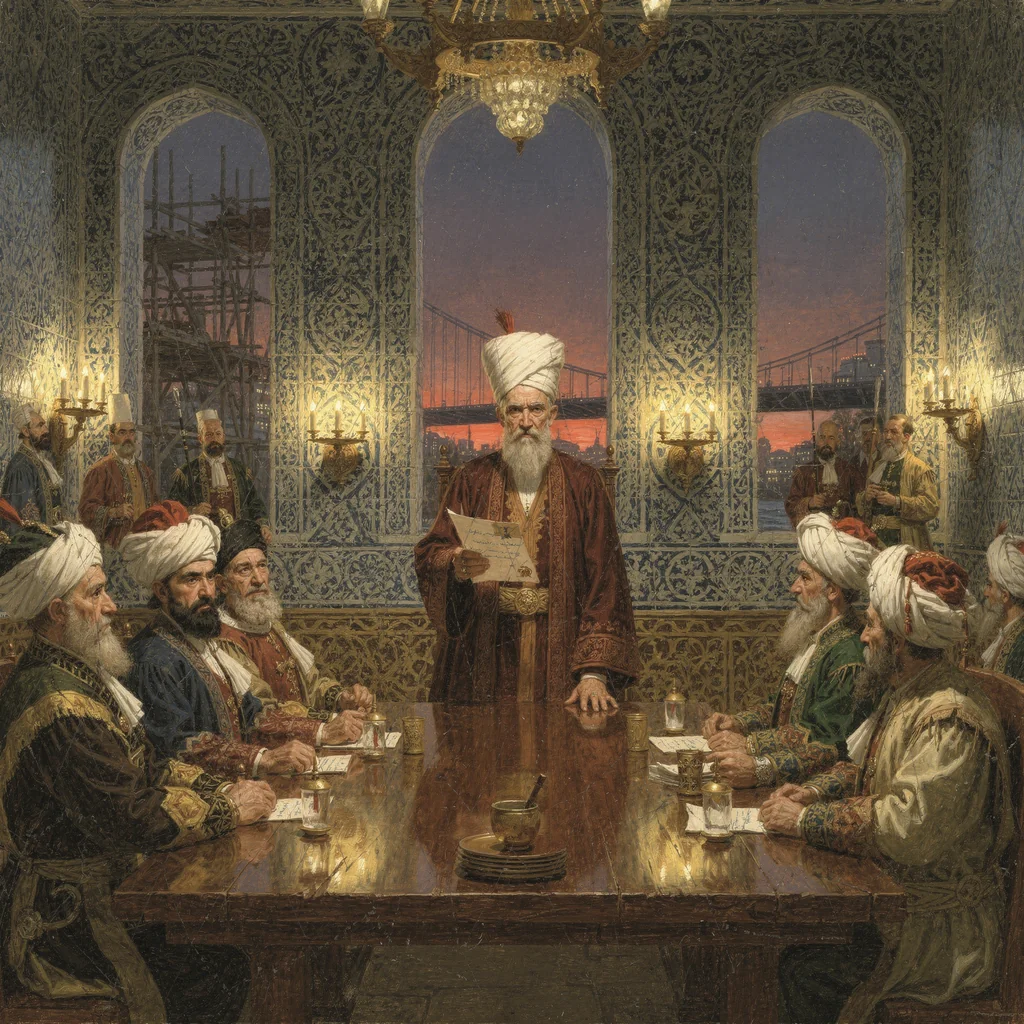
The throne room was vast, empty of everyone but the boy on the throne and the eunuchs standing against the walls like statues. Mehmed walked the length of the carpet, his footsteps muffled by the weave — the same carpet he had walked four years ago, when he was Grand Vizier for one week, when he had seen enough to know what must be done. The throne seemed larger than he remembered, the gold leaf brighter, the velvet cushions deeper. The boy sitting on it seemed smaller.
Sultan Mehmed IV was fourteen years old. He sat on the throne the way a child sits in a chair that is too large — carefully, hands on his knees, feet not touching the floor, aware that every movement is watched, every breath measured, every glance recorded by the eunuchs who stood like witnesses to a trial that had not yet begun. He wore the caftan of empire, the silk heavy with gold thread, the turban of the sultans on his head. The clothes made him look like a man. The face beneath the turban was still a boy’s — smooth, unmarked, frightened.
Mehmed stopped at the foot of the dais. He did not bow. He inclined his head. The inclination was slight. It said: I see the sultan. It also said: I am the man who will save what you cannot yet hold.
“Sultan Mehmed Khan,” Mehmed said. The voice was rougher than it had been four years ago, thinned by age and disuse. But the clarity was still there.
“Köprülü Mehmed Pasha,” the Sultan said. The voice had not yet deepened. It broke on the name. The Sultan cleared his throat, tried again. “You have come.”
“I have come.”
“The Valide Sultan said you would come.” The boy shifted on the throne. The movement was awkward. The throne did not forgive awkwardness. “She said you would save the empire.”
“The empire saves itself,” Mehmed said. “I only remove what prevents it from doing so.”
Behind the throne, a curtain shifted. Valide Sultan Turhan stood there, half-visible in the shadows. She had been the haseki sultan, the favorite, before her husband’s death. She was the Valide Sultan now, the queen mother, the power behind the throne until her son came of age. She had summoned Mehmed from retirement. She had written the letter. She would be the real negotiation.
“The Janissaries mutiny,” she said from behind the curtain. “The Venetians blockade the Dardanelles. The provinces rebel. The treasury is empty.”
Mehmed did not turn toward the curtain. He kept his eyes on the boy on the throne. The boy was the sultan. The curtain was the reality. Both needed to be acknowledged, in the correct proportion.
“These are symptoms,” Mehmed said. “Not the disease.”
“What is the disease?” The Sultan leaned forward. The throne creaked. He flinched.
“The disease,” Mehmed said, “is that the empire has forgotten how to obey. When no one obeys, no one governs. When no one governs, the empire dies.”
He looked at the boy. The boy looked back. The boy did not understand. The boy would understand, in time. The boy would learn, or the boy would die. The empire had no patience for slow learners.
“What do you require?” the Valide Sultan asked from the curtain.
Mehmed listed them. Not as demands. As conditions. As statements of fact, so simple they required no elaboration.
“Full vizierial power,” he said. “The seal in my hand. The authority to act without consultation.”
The curtain did not move. The boy on the throne did not speak. The eunuchs against the walls watched, their faces empty.
“Independence over appointments,” Mehmed said. “I choose the governors. I choose the commanders. I choose the scribes. No palace favorites. No factions. No bribes accepted, no petitions heard. My word is final.”
The boy’s hands tightened on his knees. The Valide Sultan’s silhouette shifted behind the curtain.
“No interference from the palace,” Mehmed said. “Not from you. Not from the Chief Black Eunuch. Not from the Sheikh al-Islam. Not from the harem, the treasury, the stables. I govern. You reign. The difference will be clear.”
The boy started to speak. The curtain moved. A hand emerged from the shadows, rested on the boy’s shoulder. The boy stopped.
“No reversal of my decisions without my consent,” Mehmed said. “What I do, I do because it must be done. What I undo, I undo because it must be undone. No second-guessing from the throne. No reconsideration from the curtain. Once I act, the act stands.”
Silence in the throne room. The silence stretched, long and heavy. The boy on the throne sat very still. The hand on his shoulder pressed down, a weight that was both comfort and warning.
The Valide Sultan stepped from behind the curtain.
She was younger than Mehmed had expected — no more than twenty-nine, her face still smooth, her hair still dark beneath the veil.
She had ruled as regent for five years. She had headed the imperial council, signed the decrees, controlled the treasury, appointed the viziers who came and went. She knew the numbers better than any of them — the treasury deficit from the war, the provinces that had stopped sending revenue, the corruption that no execution could cure.
She studied Mehmed with the same precision she brought to the ledgers each morning. His hands rested at his sides. He had not glanced at the seal on the desk. The men who had come before — Tarhuncu Ahmed Pasha with his budgets, Koca Derviş Mehmed Pasha with his compromises — had reached for it before the offer was made.
The four conditions he asked for — full vizierial power, independence over appointments, no interference from the palace, no reversal without consent — this was the power she had been exercising as regent. This was what she was giving away.
She had fought for this power. She had killed for it. And now she would give it away because she could see no other way to keep the empire from dying.
She walked to the edge of the dais. She looked down at the old man in the faded caftan.
“You ask for everything,” she said.
“I ask for what is required,” Mehmed said.
“You ask for power that sultans have not granted to viziers since the beginning of the dynasty.”
“Sultans have not faced what this sultan faces,” Mehmed said. “Empires do not die because their enemies are strong. Empires die because they have forgotten how to save themselves.”
The boy on the throne watched his mother. He watched the old man. He did not understand the words. He understood the tone. The tone was not negotiation. It was statement.
The Valide Sultan looked at her son. She looked at the empire crumbling around them. She looked at the old man who had done what was necessary and been dismissed for his trouble.
“Done,” she said.
The boy started. “Mother —”
“Done,” she said again. The word was final.
She turned back toward the curtain. She did not look at the old man again. She did not need to. She had made the bargain. She would live with it, or she would die with it. The empire would live with it, or the empire would die.
There were no other choices left.
Mehmed inclined his head. Not a bow. An acknowledgment. He turned and walked the length of the carpet toward the door. The eunuchs watched him pass. The boy on the throne watched him go. The curtain settled back into place, hiding the Valide Sultan who had just given away an empire’s worth of power because she could see no other way to keep the empire from dying.
Mehmed walked through the throne room doors. The guards closed them behind him.
He had what he needed. He had what he had come for.
He did not feel triumph. He felt only the weight of what he had just agreed to carry.
The Grand Vizier’s chambers had not changed in four years. The same desk, the same shelves, the same window looking out over the city. The seal on the desk was new — his seal, the Köprülü tugra, the weight of it heavier than he remembered.
Mehmed stood by the window. The shutters were closed. He opened them.
The city spread below him, roofs and minarets and the dark thread of streets between them. The Hagia Sophia’s dome bulked against the night sky, the moon catching the gold of the minarets. The Bosporus reflected the moonlight, a silver path stretching toward the dark.
He could not see it, but he knew it was there — the Valens Aqueduct, carrying water across the valley from the Thracian mountains to the cisterns beneath the palace.
Mehmed had never noticed it before. He had lived in this city for decades, had governed from this palace, had walked these streets and signed these decrees and purged these corrupt officials. He had never seen the aqueduct.
Now he saw it.
The stone arches stood somewhere in the dark, Roman-built, Byzantine-repaired, Ottoman-maintained. The water flowed through them, invisible in the darkness, carrying itself from the Thracian mountains to the cisterns beneath the palace.
Mehmed watched the water flow. He could not see it. He knew it was there.
He had been a boy on a mountain road in Roshnik. He had been a devshirme child in the palace kitchens. He had been a provincial governor, a palace official, a Grand Vizier who purged thirty-six thousand corrupt officials and refilled the treasury and been dismissed to a village named Bridge.
He was eighty-one years old. His joints ached. His hands trembled when he reached for his tea. His body was failing.
His mind was as clear as it had been when the janissary officer counted children in a ledger.
The aqueduct had been built by the Romans, repaired by the Byzantines, maintained by the Ottomans.
Mehmed touched the caftan’s collar. The same gesture. He looked out over the city where the Janissaries mutinied in the streets, where the Venetians blockaded the Dardanelles, where the provinces rebelled and the treasury stood empty.
He looked toward the window, toward the dark outline of the aqueduct, and remembered the road that led away from Roshnik — the janissary officer’s horse, the ledger in Ottoman Turkish, the mark in Arabic script, the mother’s hand letting go. The boy who had walked that road was gone. The man who remained stood at the window, eighty-one years old, the empire’s seal on his desk, the weight of it heavier than the gold itself.
The words that came to him were in Arabic.
There is no victor but God — dominion belongs to God, eternally.
He spoke the words aloud. His voice was rough, thinned by age and disuse, but the words were clear.
The aqueduct did not answer. It carried water across the valley, invisible in the darkness.