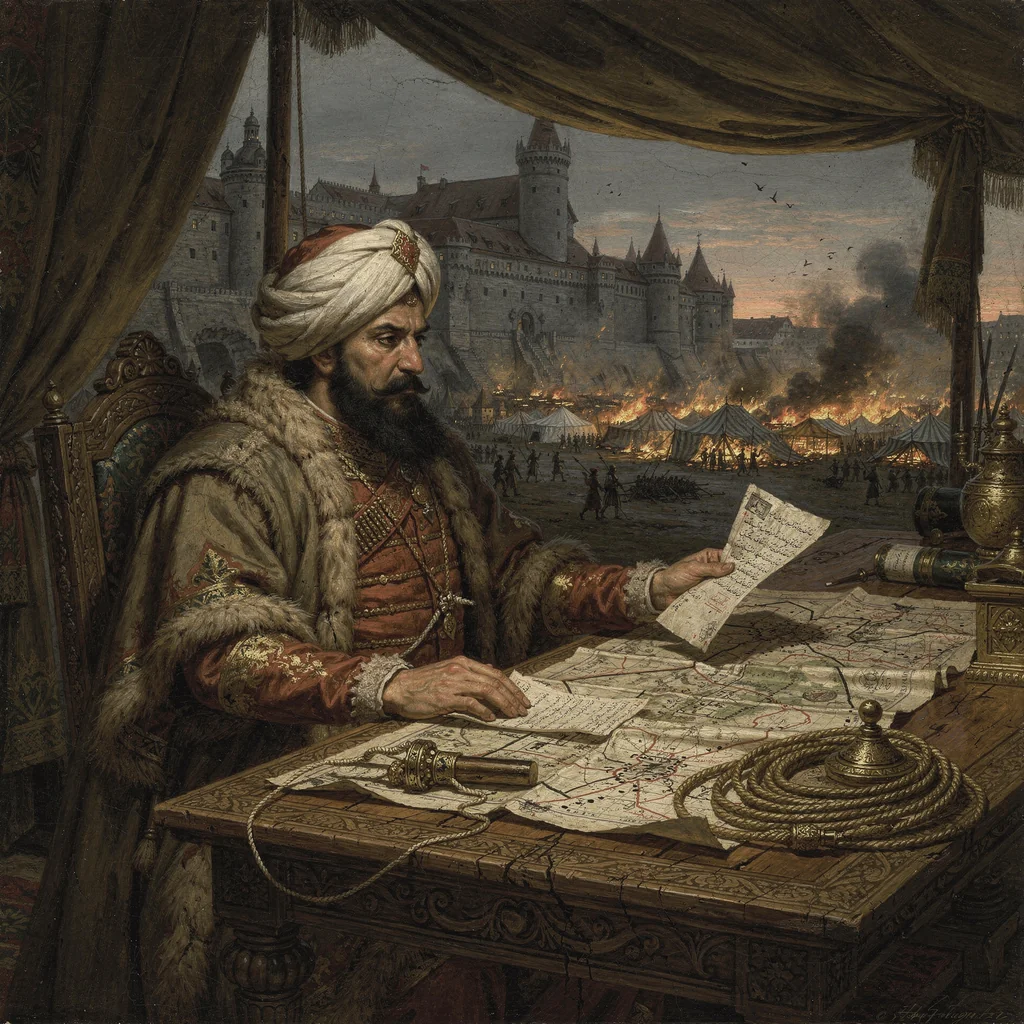
Vienna, July 1683. The grand vizier’s tent.
Kara Mustafa stood over the campaign table. The map showed the approach to Vienna — the same routes that Suleiman the Magnificent had taken in 1529, the same objective that had eluded Ottoman ambition for a century and a half.
The army outside was the largest ever assembled — over one hundred thousand men, janissaries and sipahis and Tatar cavalry and mercenary contingents from across the empire. The artillery train stretched for kilometers. The supply lines, organized by the Köprülü household network, functioned with flawless precision.
He had become Grand Vizier in 1676, after Fazıl Ahmed’s death. He had inherited the household network — the clients, the ağas, the scribes, the sons-in-law. He had inherited the institutional machinery.
He touched the seal on his desk. The Köprülü seal. He had earned the name through marriage into the household, through years of service, through the trust of Fazıl Ahmed who had brought him into the family. He had not earned it through blood.
He looked at the map. The supply lines that Fazıl Ahmed had built stretched from Belgrade to the Austrian frontier — every three days’ march, a stocked warehouse. Grain from Egypt, weapons from Istanbul, horses from the Anatolian farms. All coordinated by the Köprülü ağas.
Suleiman had failed at Vienna in 1529. Rain had bogged down the artillery. The siege engines were inadequate. The janissaries had mutinied. Winter had forced retreat.
But that was a different empire.
The janissary commanders worried about the Holy League — the Poles, the Duke of Lorraine, the relief force that would come to Vienna’s aid.
Kara Mustafa did not worry. He had calculated the ratios.
The Vienna garrison numbered eleven thousand men. Even with reinforcements, perhaps fifteen thousand. The Ottoman army was one hundred thousand strong. The ratio was seven to one.
The relief force might number forty thousand. Perhaps fifty. Even if they all came, the arithmetic favored the Ottomans.
If Vienna fell, the Holy League would shatter. The Habsburgs would sue for peace. The Ottoman frontier would be secured for a generation.
Mehmed Pasha had saved the empire through purges. Fazıl Ahmed had preserved it through patience.
Kara Mustafa would expand it. He would accomplish what Suleiman himself had failed to achieve.
He touched the map where Vienna was marked.
The city would fall. History would remember his name.
The council of war had gathered in June, in the grand vizier’s tent outside Belgrade. The map of central Europe lay on the table — Vienna at the center, the roads from Buda and Pest marked in red, the mountain passes from the south traced in ink.
Kara Mustafa stood at the head of the table. He was Grand Vizier of the Ottoman Empire, son-in-law of Fazıl Ahmed, bearer of the Köprülü name. He had assembled the largest army in Ottoman history — over one hundred thousand men, janissaries and sipahis and Tatar cavalry and mercenary contingents from across the empire.
The table fell silent as Fazıl Mustafa Pasha stood.
Fazıl Mustafa was Mehmed Pasha’s blood son — the true heir of the Köprülü line, not the adopted son-in-law who now led them. He was Kara Mustafa’s brother-in-law, his rival, his conscience.
He placed a document on the table. An intelligence report from the imperial spies in Vienna.
“The Holy League,” Fazıl Mustafa said.
His voice was quiet. The tent went quieter.
“They’re mobilizing at Kraków. Forty thousand cavalry. They’ll reach Vienna in thirty days.”
He looked around the table. “Before winter.”
Kara Mustafa looked at the map. He did not look at Fazıl Mustafa.
“The Duke of Lorraine,” Kara Mustafa said. “You fear him?”
“I respect him,” Fazıl Mustafa said. “As my father would have.”
The janissary ağa spoke. He was an old man, gray-bearded, survivor of a dozen campaigns.
“The supply lines through Hungary, effendi.” He gestured vaguely west. “The forage is scarce. The rains have been heavy.”
He paused. “If we lay siege to Vienna and the relief army comes before the city falls…”
He didn’t finish. He didn’t need to.
“We cannot retreat through the passes in winter.”
The artillery commander cleared his throat. “The walls. They’ve been strengthened.”
He waited for Kara Mustafa to look up.
“The modern bastions. The earthworks. Our heavy guns will need months.”
“We must be certain,” Fazıl Mustafa said to Kara Mustafa, “before we commit.”
Kara Mustafa finally looked up from the map. His eyes were bright.
“You speak of fear,” he said. “Of caution. Of waiting.”
He walked around the table to the map. His hand moved across the roads from Buda to Vienna.
“My father-in-law.” He didn’t say the name. “Twenty years to capture Crete. Twenty years of siege. Of blockade. Of men dying in the trenches.”
His hand rested on Vienna.
“He was patient. He was right.”
Kara Mustafa looked around the table.
“But I am not him. And this is not Crete.”
Fazıl Mustafa started to speak. “Brother —”
“I am not your brother in this.” Kara Mustafa’s voice was sharp. Not angry. Final. “I am the Grand Vizier. I am the bearer of the name. And I see what you cannot see.”
He touched the map at Vienna.
“The emperor is weak. The Holy League — the Poles will argue, the Germans will delay, the Austrians will falter. By the time they mobilize…” He shook his head. “Vienna will be ours.”
He looked at Fazıl Mustafa. “Weeks. Not months.”
“The relief army —” Fazıl Mustafa began.
“—will arrive to find the Ottoman flag flying over the cathedral,” Kara Mustafa finished.
He turned to the commanders. “The merchants who travel the routes. The spies who walk the streets of Vienna. The city is tired. The garrison is undermanned. The emperor is frightened.”
He didn’t say: They are waiting for us. He didn’t need to.
The artillery commander started. “Effendi, the walls —”
“The walls will fall.”
Kara Mustafa turned to the second commander, a veteran of the Hungarian campaigns who had opened his mouth to support Fazıl Mustafa.
He did not let him speak.
“Do not tell me what cannot be done.” His voice was flat. “I have seen what the household can accomplish when it is led with clarity.”
He looked around the table. Thirty-six thousand men purged in a week. Crete taken after twenty years of failure.
“I will take Vienna,” he said. “In two months.”
He said it with absolute certainty.
Fazıl Mustafa sat back in his chair.
One of the younger commanders — a man who had not yet served in a major campaign — started to speak. “The Grand Vizier’s plan —”
“The plan is decided,” Kara Mustafa said. There was no anger in his voice, only the finality of a man who cannot conceive of being contradicted. “We march for Vienna at first light. The army will be ready.”
He turned and walked out of the tent, leaving the council sitting in silence around the map.
No one spoke against him. No one dared.
Two months outside Vienna. The city held.
The siege camp smelled of unwashed bodies, of latrines dug too close to living quarters, of horses dying in the heat and the smoke from burning the carcasses. The air was thick with flies.
Kara Mustafa’s errors compounded. He did not fortify his position — shallow trenches that offered no real protection. He underestimated the relief army’s timetable — intelligence reports suggested October, not September. The mining operations proceeded slowly, pickaxes striking stone in the darkness beneath the city, tunnels collapsing as often as they advanced.
The ağas sent messages. The scribes recorded everything. The supply lines delivered grain and weapons on schedule. The machinery worked.
The machinery could not compensate for a commander who had chosen the wrong battle at the wrong moment.
And then the mining operations against the inner walls succeeded. The charges were laid. The breach was ready.
Kara Mustafa gave the order to hold.
The commanders looked at each other. The city was there. The inner gate could be taken. The relief army was still three weeks away.
Kara Mustafa gave the order again. Hold. Wait for the city to surrender intact.
The janissary ağa who delivered the message came back confused. “He says to wait, effendi. He says the treasury must not be harmed.”
Edirne Palace, July 5, 1683.
Turhan Sultan lay on the bed where she had spent the last two weeks. The windows were open to the gardens, bringing in the scent of high summer — ripe figs, cut grass, the dust that rose from the roads at noon.
She was fifty-six years old. She had been Valide Sultan longer than most sultans had reigned.
The illness had come in July. A fever that would not break. A weakness that spread through her body like water through cloth. She had known, when the fever did not recede after the first week, that this was the end.
She had made her peace with God. She had made her peace with her son. She had made her peace with the empire.
Now she made her peace with herself.
She lay in the bed and watched the light move across the ceiling. The room was quiet — the servants had been sent away, the physicians had withdrawn, the harem eunuchs stood at the door but did not enter. She had dismissed them all. The room was hers.
She thought of the snowy forests of her childhood. She had not remembered them in years — not the specific details, only the feeling of cold, the endless white, the language she had forgotten. But now, as the fever burned through her, the memories returned.
She remembered the village. She remembered her mother’s face. She remembered the morning the slavers came. She remembered the journey in the caravans. She remembered the fear.
She remembered the sale in the Kaffa market — the men inspecting her like a horse, the coins changing hands, the journey to Istanbul where Kösem Sultan waited.
She remembered the harem. She remembered the lessons — how to speak without being heard, how to see without appearing to look, how to wield power from behind the curtain. Kösem had taught her well. Too well. Kösem had not wanted to relinquish power. Turhan had been forced to kill the woman who raised her.
She still remembered Kösem’s face when the executioners came. The look of betrayal. The look of pride. The look of understanding — that this was what power meant, that this was what the harem produced, women who would do what must be done.
Turhan had ruled as regent for five years. She had transferred power to Köprülü Mehmed when she realized she could not save the empire alone. She had watched him purge thirty-six thousand corrupt officials. She had watched him refill the treasury. She had watched him die.
She had approved Fazıl Ahmed’s succession. She had watched him lose at Szentgotthárd and win at Crete. She had watched him build institutions that would outlast him.
She had built Yeni Mosque. She had commissioned the inscription: There is no victor but God.
She did not know what the chroniclers would say of her. They would call her the foundational pillar of the state. The empire would turn its concern immediately to matters of security and succession.
The army outside Vienna would receive the news with mourning — the same soldiers fighting under Kara Mustafa, never knowing they mourned her while following him to disaster.
She had done what she could.
The door opened. Her son entered — Sultan Mehmed IV, now forty years old, a man grown in the shadow of her protection. He had been a child when she ruled for him. He was a sultan now, ruling without the regency, without the curtain, without the mother who had made his throne possible.
He sat beside the bed. He took her hand. His palm was warm against hers.
“Mother,” he said.
She opened her eyes. She saw her son’s face. She saw the man he had become. She saw the sultan he would be.
“The empire,” she whispered. Her voice was thin, thinned by age and illness, but clear.
“The empire holds,” Mehmed said. “The treasury is full. The provinces are quiet. The army marches on Vienna.”
Vienna. She remembered the word from the reports — Kara Mustafa’s great campaign, the largest army in Ottoman history, the march on the Habsburg capital.
She did not know that Kara Mustafa would fail. She did not know that Vienna would hold.
She knew only that she had done what she could.
“Be just,” she whispered.
“I will,” Mehmed said.
“Be merciful.”
“I will.”
“Remember,” she said. “Power is not held. It is wielded. And when you wield it for the empire, the empire wields you.”
She had learned this from Kösem. She had learned it from herself. She had learned it the hard way — through purges and executions, through transfers of power and retreats from power, through the understanding that the throne is not a seat but a burden.
Mehmed kissed her hand. He pressed it to his forehead. The submission of a son to a mother, of a sultan to the valide, of the living to the dying.
She closed her eyes. The fever was rising again. The light on the ceiling was blurring.
The snowy forests where she began. The imperial palace where she ended. The stone arches that carried water across the valley, holding when nothing else held.
Her breathing slowed. The light on the ceiling faded. The scent of figs and grass and dust receded.
Her hand released her son’s. Her eyes closed.
The Holy League army arrived on September 11.
Eighty thousand men — Austrians and Poles and Germans and Lithuanians. The dust from their approach rose like a curtain across the horizon. King John III Sobieski of Poland led the relief force. The Viennese garrison, seeing the flags on the horizon, prepared to sally forth from the city gates.
Kara Mustafa saw it happening from his command position. The morning sun caught the polished steel of thousands of weapons, a glittering carpet of death spreading across the valley. He saw the relief army deploying. He saw the trap closing.
What he experienced in that moment was a clarity that had eluded him for months.
The ağa from Buda obeyed his orders. The ağa from Anatolia obeyed his orders. But the two ağas did not coordinate with each other. The sipahi cavalry charged without infantry support. The janissaries held their position when they should have retreated. The Tatar cavalry raided the enemy baggage train instead of attacking the relief army’s flank.
The battle began at dawn. The cannon fire was a continuous thunder that shook the ground beneath the tents. The screams carried across the valley — screams of men, screams of horses, the wordless shriek of meat parting from bone.
It was over by noon.
The rout began in the afternoon. Twenty thousand dead. The rest fled south, abandoning the artillery, the baggage train, the camp. Kara Mustafa rode with them — not fleeing, exactly, but moving with the current of disaster.
He had lost Vienna. He had lost the army. He had lost the Köprülü name’s invincibility.
What remained was the reckoning.
Belgrade, December 1683.
The sultan’s messenger arrived at dusk. The execution order was written in the sultan’s own hand — a rare thing, reserved for the gravest offenses.
Kara Mustafa received the news the way a man receives news he expected but hoped would not come. He was not surprised. He was not broken. He was, perhaps, finally clear-eyed.
He sat in his tent, alone with the messenger. The executioner waited outside. The tent flap stirred in the winter wind — the same wind that had blown across the plains of Vienna, across the Danube he had failed to cross. Now it carried the smell of snow and the distant smoke of campfires.
He asked the messenger a question: “The household accounts from Edirne — have they been settled?”
The messenger did not know.
Kara Mustafa nodded. He looked at his hands — the hands that had held the pen that signed the march orders, the hands that had accepted the surrender of commanders, the hands that had worn the seal of the Köprülü name for fifteen years. The ink stains were still there, faint on his left thumb.
The sultan’s messenger held the execution order. The executioner stood in the tent’s entrance with the bowstring — a silk cord of imperial blue, reinforced with leather.
Kara Mustafa heard the order read — the charges, the judgment, the sentence. The messenger’s voice was steady. This was not the first time he had read such words. It would not be the last.
When the reading finished, Kara Mustafa reached into his caftan. He withdrew the seal — the bronze disk that authenticated every order he had given as Grand Vizier, the same seal Köprülü Mehmed had worn, the same seal Fazıl Ahmed had pressed into wax on the Treaty of Vasvár. He held it out to the messenger.
“The seal returns to Edirne.”
The messenger took it. The bronze was warm from Kara Mustafa’s caftan.
Kara Mustafa stood. He removed the imperial caftan — the violet silk embroidered with gold thread, the garment that marked him as the sultan’s absolute deputy. He folded it carefully and placed it on the table beside the execution order. Beneath it, he wore simple linen, the kind any soldier might wear.
The executioner stepped forward with the bowstring.
Kara Mustafa turned his back. This was the way — the vizier did not face the executioner. He knelt on the carpet that had traveled with him from Vienna, the same carpet he had stood on when he received word that the siege had failed.
The executioner looped the cord.
Kara Mustafa thought of Vienna — the walls he had not breached, the prize he had not taken. He thought of the uncle who had adopted him, who had brought him into the household, who had given him the name. He thought of the cousin he had followed to the grave.
The cord tightened.
The seal was warm in the messenger’s hand.
Istanbul, December 1683.
The news arrived at dusk. A messenger from Belgrade — not an official courier, but a servant of the household who had been with the army, who had seen what happened, who had ridden south with the defeated army and then taken ship across the Sea of Marmara.
He stood in the women’s courtyard, his head bowed, dust from the road still on his boots.
Ayşe Hanım — Fazıl Mustafa’s wife, the daughter of an Anatolian governor, a woman who had managed the household’s inner affairs for fifteen years — received the news standing.
She did not sit. She did not weep. She listened.
“Kara Mustafa Pasha,” the messenger said. “Executed this morning. The sultan’s order.”
The women around her froze. There were twelve of them — wives, daughters, sisters of the Köprülü men. Some were blood Köprülü. Some were married in.
“The seal,” Ayşe Hanım said. “What happened to the seal?”
“Returned to Edirne, effendi. The messenger took it.”
She nodded. “The archive?”
“The scribes are securing the records. The household accounts are being copied.”
The women exchanged glances.
“We must decide,” Ayşe Hanım said.
She did not explain what they were deciding.
One by one, the women spoke. The wife of the Anatolia governor — she would continue receiving petitions in her husband’s absence. The sister of the Damascus commander — she would maintain the correspondence with the Syrian ulema. The daughter of the Belgrade pasha — she would manage the family’s waqf endowments, ensuring the income continued to flow even as the family’s political power collapsed.
Ayşe Hanım listened. She assigned each woman a task. Each task was a thread in the network. Each thread would be held.
“The men will grieve,” she said. “The men will rage. The men will try to restore the name through action.”
She looked at the women around her.
“We will hold what they cannot see,” she said.
She turned to the messenger. “You may go.”
The messenger bowed and left.
Ayşe Hanım walked to the chest where she kept the household records — the marriage contracts, the birth registrations, the waqf deeds, the correspondence that recorded the obligations of blood and marriage and clientage.
She opened the chest. She touched the documents. The ink was still legible.
Istanbul, January 1684.
The Köprülü family waited, watched, held itself still.
Fazıl Mustafa Pasha — Mehmed’s blood son, Kara Mustafa’s brother-in-law — knew the reckoning was coming. The family would be associated with Kara Mustafa’s failure even though he was not blood Köprülü. Public memory did not distinguish.
The Köprülü name had been invincible. Now it was stained.
A leather-bound ledger sat on the table, the household seal beside it. The scribe opened the ledger to record the stain: Kara Mustafa Pasha, executed December 1683. Beside the entry, he added a note in the margin: Amcazade Hüseyin Pasha, nephew, arrested same day. Fate unknown.
The nephew would survive — released from prison in 1684, exiled to provincial posts, returning in time to hold the seal that had cost his uncle his life. But the scribe did not know this yet. He only recorded what had happened, not what would be.
The letter arrived from Belgrade on a Tuesday.
Fazıl Mustafa read it once. He set it on the desk. He looked at the window.
His brother-in-law. The man who had worn the Köprülü name without the Köprülü blood. The man who had ignored the intelligence report. The man who had been right about his own greatness and wrong about the battle, and had died for confusing the two.
Fazıl Mustafa had been born with the name. He had grown up in its shadow. He had watched his father govern the empire and his adopted brother destroy what his father built.
He folded the letter. He placed it in the household archive.
He called his secretary. There were reports from the Hungarian frontier that required attention.
Outside the window, snow was falling on the Atmeydanı. The Valens Aqueduct stood dark against the January sky, the water moving through it as it had moved since before the Ottomans, before the Byzantines, before the name Istanbul existed. Fazıl Mustafa’s hand rested on the household ledger. The ink was dry.