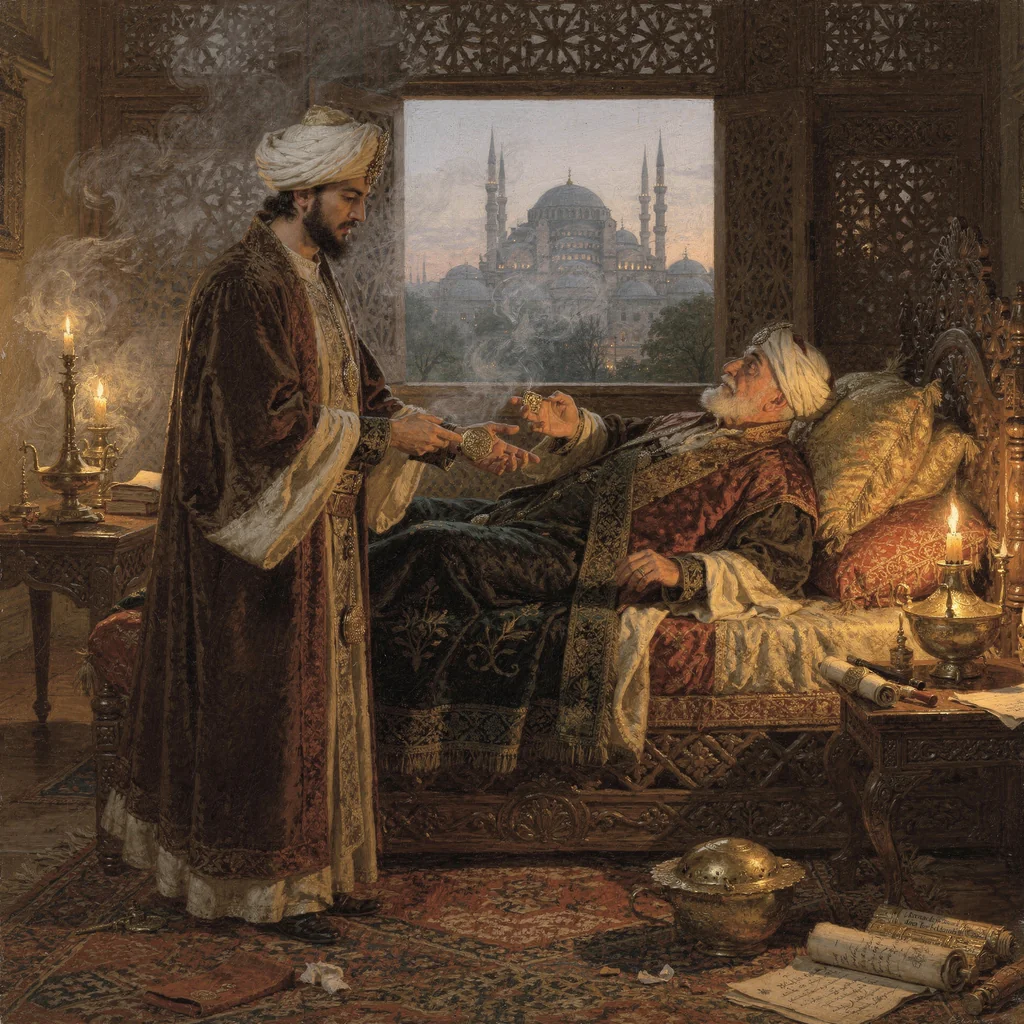
Istanbul, 1659. Two years before the death.
Süleymaniye Madrasa, third hour after dawn.
The madrasa was quiet except for the scratching of reed pens on paper. Light from the high windows caught dust motes floating above the students’ heads. Fazıl Ahmed stood at the blackboard. The equations in Arabic covered the surface — calculations for the inheritance distribution of a complex estate involving multiple wives, children, and grandchildren. The students watched from their mats. Twenty-three men, ages sixteen to twenty-four, all of them bound for careers in law, administration, or the ulema.
Fazıl Ahmed was twenty-four years old. He had been appointed müderris (professor) at an age when most men were still completing their studies. He lived in the shadow of a man who had saved the empire when he was younger than Fazıl Ahmed was now.
The students did not know this discomforted him. They saw only the grand vizier’s son — the young man with the clerical bearing, the pen-stained fingers, the soft voice that carried to the back of the chamber without needing to rise.
“The portion for the daughter,” Fazıl Ahmed said, pointing to the equation, “is half that of the son. But here we have a complication — the daughter predeceased, leaving children. How do we calculate?”
A student raised his hand. He was seventeen, from a provincial family in Bursa, bright but prone to overcomplication.
“The daughter’s share must be distributed among her children,” the student said. “But the grandchildren are not equal — one is male, one is female. Do we apply the daughter’s ratio, or do we return to the original calculation?”
Fazıl Ahmed looked at the equation.
He did not immediately answer.
The room waited. The grand vizier’s son was supposed to know. The grand vizier knew everything. The son must too.
But Fazıl Ahmed did not.
This was not humility. It was fact. The inheritance question as posed involved a legal ambiguity that the jurists of Medina had debated for three centuries without reaching consensus. He could have cited one authority, then another, then a third. He could have filled the air with names and opinions until the students nodded and wrote down whatever he said.
Instead, he said: “I don’t know.”
The room went quiet.
The students looked at each other. Someone had asked the professor a question he could not answer. This was not how it worked. The professor knew. The student learned.
“Bring the question again next week,” Fazıl Ahmed said. “I will consult the Medina commentaries. If they disagree, we will debate it together. If they agree, we will follow them.”
He moved to the next equation.
The students wrote. The incident passed.
The house was quiet. The servants had retired. The only light came from the lamp on his desk and the moon through the window.
Fazıl Ahmed sat with the books spread before him. A mathematical treatise from Baghdad. A legal commentary from Cairo. A collection of hadith from Medina. The books of a scholar, not a statesman.
His father had summoned him that morning — not to the palace, but to the private quarters. The old man had been coughing for weeks. The physicians had stopped coming. The body was failing.
The seal would pass to him soon.
He looked at the books on his desk. Equations, legal principles, the clear logic of scholarship. These were the tools he understood.
His father had done this for five years. Fazıl Ahmed had watched from the study, from the madrasa, from the distance of a son who loved his father but did not want to understand his work.
Now the work would be his.
He opened the mathematical treatise. The equations were clean, certain, perfect. If X equals Y, then Z must follow. No ambiguity. No consequences beyond the numbers on the page.
He closed the book.
Fazıl Ahmed had spent his life with books, not men.
He stood. He walked to the window. The moon caught the dome of Hagia Sophia, the minarets like silver needles against the sky.
He did not know if he could.
The lamp flickered. The oil was running low.
He returned to the desk. He extinguished the lamp. In the darkness, he could hear the city breathing — the call of the night watchman, the barking of a dog, the distant sound of the Bosporus against the shore.
Topkapı Palace, October 1661.
Mehmed Pasha lay in the bed he had not left for three weeks. His body had been failing for years — the stiff joints, the shaking hands, the fatigue that came from nowhere and stayed for days. But this was different. This was the end.
He was eighty-six years old.
Fazıl Ahmed sat at the bedside. He had come every day since the illness worsened, bringing papers, reading reports, holding the cup when his father needed to drink.
The steward stood in the doorway with a basin of warm water and a clean cloth. He had served the household for eleven years — since the village of Köprü, since he had dug the grave beneath the olive tree when the wife died. He had followed the old man from Anatolia to Istanbul, from the garden bench to the palace chambers.
The old man did not speak of death. He spoke of governance.
“The governor of Damascus,” Mehmed said, his voice thin but clear, “has served the household well. But his son is dangerous. Do not appoint the son. Confirm the father for another term.”
Fazıl Ahmed nodded. Mühürdar Hasan Ağa — the seal-keeper — sat in the corner, writing everything down.
“The janissary commanders in Buda,” Mehmed continued. “Three of them. Two are loyal to the household. The third — I have not decided. Watch him.”
“The kethüda in Egypt,” Mehmed said. “He has filed false reports for three years. I intended to remove him. You will need to finish it.”
The old man gave instructions like a man organizing a desk drawer.
Then, in the pause between instructions, Mehmed said the words that Fazıl Ahmed would remember for the rest of his life:
“Never deprive Hüseyun Pasha of your favor; he has served us very well and hence I confide him to you.”
He spoke the name as if it were any other instruction — the Damascus governor, the Buda commander, the Egyptian kethüda.
The steward’s grip tightened on the basin. He knew the name. Hüseyun Pasha had been with the household since the purges. The steward had carried messages between the governor’s mansion and the Divan more times than he could count.
The water in the basin rippled. The sound was loud in the quiet room.
The son nodded. He filed the name in memory.
The instructions continued until the voice stopped. The breathing grew shallow. Fazıl Ahmed sat at the bedside, holding the cup his father no longer needed. The old man’s eyes were closed. His lips moved once — a prayer, or a name, or nothing. The steward could not tell.
The breathing stopped.
Mehmed Pasha died on October 18, 1661.
The steward set the basin on the table beside the bed. He filled it with warm water from the pitcher. He placed the cloth beside it. Then he stepped back.
Fazıl Ahmed looked at the basin. He picked up the cloth. He dipped it in the water. He began the washing.
He washed his father’s face. He washed the hands that had signed thirty-six thousand death warrants. He washed the feet that had walked from Roshnik to Istanbul and back again. The water darkened.
He spoke no words. The washing spoke for him.
When he finished, he wrapped the body in the white shroud. He pressed his forehead against his father’s chest through the cloth. He stayed there for a long moment.
Then he stood. His hands were steady.
Fazıl Ahmed did not move.
He sat in the chair beside the bed. The dossiers on his father’s desk — Bursa, Egypt, Damascus — waited in the lamplight.
His hand began to shake. He pressed it against his knee.
He stood. The room tilted. He caught himself on the bedframe. His father’s hand was cold beneath his fingers.
The sun rose through the window. The call to prayer came from the Hagia Sophia.
He released his father’s hand. He smoothed the blanket. He composed his face.
The funeral was state. The sultan did not attend — that was not custom — but the viziers came, the pashas came, the ulema came, the janissary commanders came. The people of Istanbul lined the streets.
Fazıl Ahmed walked behind the bier.
He did not weep.
What he wanted was to return to the Divan and confirm Abaza Hüseyun Pasha as governor of Buda.
Because his father had asked him to.
Because that was how the household held.
The factions began moving the morning after the funeral.
They did not wait for the mourning period to end. They did not wait for the grave to settle. They began moving the moment the old man was in the ground.
The janissary commanders summoned their lieutenants. The rival viziers circulated in the coffeehouses and the bathhouses, testing alliances. The palace clique whispered in the ears of the sultan’s mother. The provincial governors sent letters to the capital, inquiring about the succession, declaring loyalty to whoever would be named.
Fazıl Ahmed watched from the sidelines. He had held two governorships in his life — total, two years of administrative experience. Every potential rival had twenty years more.
The whispers reached him within days:
Too young.
Too academic.
Too much his father’s son.
The last one was the one that stung, because he did not know if it was an insult or simply the truth.
He had spent his adult life being defined by his father’s shadow. The appointment as müderris at age twenty-three — his father’s influence. The governorship positions — his father’s protection. The respect he received in the Divan — his father’s authority reflected through him.
Who was Fazıl Ahmed without the old man?
The city waited. The empire waited. The sultan would decide. Until then, the whispers continued.
The messenger arrived at the harem gate before dawn. He was dust-stained, exhausted, the horse lathered from hard riding. The message he carried was brief, written in the precise hand of the Köprülü household steward.
Köprülü Mehmed Pasha died in the night. October 18, 1661. The son requests audience.
Turhan Sultan read the message once. She set it on the desk.
She was thirty-four years old. She had ruled as regent for five years. She had recalled the old man from retirement when the empire was dying, granted him the four conditions, watched him purge thirty-six thousand corrupt officials and refill the treasury.
She had expected him to die. She had not expected him to die this soon.
The old man was eighty-six. His hands had shaken when she last saw him, his breath whistled in his chest, his joints were stiff with age. But his mind had been clear, his instructions precise, his method unbroken.
The household said yes. The son was the heir.
The factions said no. The son was too young, too academic, too much his father’s shadow.
She sent word to the household: Bring the son.
He came that afternoon.
Fazıl Ahmed entered the harem reception chamber alone. He wore the black silk of mourning, the white turban of the ulema. He was younger than she had been when she became regent.
Turhan Sultan sat in the chair that had been hers since she became Valide Sultan thirteen years ago. She did not speak immediately. She looked at the son, seeing the father’s features in the younger face — the same brow, the same mouth, the same way of holding himself very still.
But the eyes were different. The old man’s eyes had been cold, clear, seeing without being seen. The son’s eyes were warmer, more hesitant, as if he was still learning how to look.
“Your father,” she said at last.
“Dead,” Fazıl Ahmed said. The word was flat. No grief, no drama, only fact.
“The household?”
“Holding,” he said. “For now.”
“The factions?”
“Moving,” he said. “As you would expect.”
She studied him. He did not posture. He did not beg. He did not claim to be something he was not. He answered precisely, with the economy of words that suggested he understood the value of silence.
“The ministers say you are too young,” she said.
“I am,” Fazıl Ahmed said. No denial. No defense.
“They say you are too academic.”
“I have spent my life in books,” he said. “This is true.”
“They say you are too much your father’s son.”
He was silent for a moment. “I do not know what this means,” he said at last. “If it means I carry his name, it is true. If it means I carry his method, I hope it is true. If it means I am him, it is not.”
Turhan Sultan nodded.
She stood. She walked to the window. The dome of Hagia Sophia caught the afternoon light.
She turned back to the son.
“The method,” she said. “Your father taught you?”
“He taught me to see,” Fazıl Ahmed said. “He taught me to cut through layers. He taught me that the empire dies when intermediaries multiply. He taught me that the governor must see the farmer without a scribe between them. He taught me that the decision must be made in the room where the dispute is heard, not passed up three levels of bureaucracy.”
“Did he teach you why?” she asked.
“He taught me that hierarchies must serve networks,” Fazıl Ahmed said, “not the reverse.”
Turhan Sultan said nothing. The old man had never said this in her hearing.
She turned back to him. She stopped in front of him, close enough that he could see her eyes, close enough that she could see his.
“Your father built a bridge,” she said. “He carried the empire across it. The bridge held.”
She paused. The afternoon light caught the white of her veil, the gold of the chamber, the dust motes floating between them.
“Now you will hold it,” she said. “Go to the Divan. I will speak to my son. The sultan will confirm you.”
Fazıl Ahmed bowed. Not a deep bow — a nod of the head, an inclination of the shoulders.
He turned toward the door. He stopped. He looked back.
“Valide Sultan,” he said. “Why me?”
“Because you know the household,” she said. “Because I will not watch the empire die again.”
Fazıl Ahmed nodded. He did not ask again.
He left the chamber. Turhan Sultan watched him go. The door closed behind him.
She returned to her desk. She sat in the chair that had been hers for thirteen years. She looked at the message from the Köprülü household steward, the announcement of the old man’s death, the request for audience.
She picked up her pen. She dipped it in the inkwell. She wrote to her son, the sultan:
Confirm the son. The method survives.
She sealed the letter. She called the messenger. She sent it to the Divan.
Then she walked to the window. The arches of the Valens Aqueduct stood dark against the sky, carrying water from the Thracian mountains to the cisterns beneath the palace.
Sultan Mehmed IV sat in the private audience chamber three days after the funeral.
The sultan was nineteen years old. He had been on the throne since age five, ruled first by his mother, then by the grand vizier his mother had appointed. He had grown into the role — not a great sultan, not yet, but not a puppet either. He understood the balance of power. He understood what the Köprülü household had given the empire.
Turhan Sultan sat behind the screen.
“The ministers suggest experience,” the sultan said. “They say the son is too young.”
“The son knows the household,” Turhan Sultan said. Her voice carried through the screen, clear and firm. “The household is the empire’s spine. Appoint the son.”
“The alternative is factional chaos,” the sultan said.
“The alternative is what we had in 1656,” his mother said. “Remember. Remember the janissaries in the streets. Remember the empty treasury. Remember the provinces stripping themselves bare while the pashas grew fat.”
The sultan was silent. He remembered. He had been a child, but he remembered.
“The son learned from the father,” Turhan Sultan said. “I have seen them together — the father speaking, the son listening.”
The sultan considered this.
“And if the son fails?” the sultan asked.
“Then we replace him,” his mother said. “As we replaced the others. But give him the chance to show what he learned.”
The sultan nodded.
He called the chamberlain. He gave the order.
Fazıl Ahmed Pasha was appointed Grand Vizier of the Ottoman Empire on October 31, 1661.
He was twenty-six years old.
The council chamber was full.
The viziers stood when he entered. The pashas stood. The judges stood. The room was silent.
Fazıl Ahmed walked to the head of the Divan table. He was the youngest man in the room. The youngest grand vizier in memory. His robes were new — the black silk of mourning, the white turban of the ulema. He did not look like a military commander. He looked like what he was: a scholar who had been pushed onto a throne he had not sought.
He sat.
The ministers sat.
He did not speak immediately.
He looked at the documents in front of him — the daily business of the empire, the petitions, the reports, the complaints. The paperwork never stopped. It had not stopped when his father lay dying. It would not stop now.
Then, without preamble, he looked up.
“Abaza Hüseyun Pasha,” Fazıl Ahmed said.
The room shifted. Hüseyun Pasha was a powerful governor — the commander of Buda, the fortress that guarded the empire’s western frontier. There had been rumors that the new grand vizier might replace him, that the appointment would signal a break with the old administration.
“Confirm him as governor of Buda,” Fazıl Ahmed said. “Extend his term for three years.”
The room shifted again.
The ministers who understood relaxed. The ones who didn’t relaxed too, but more slowly.
That night, Fazıl Ahmed returned to his father’s chambers.
The room was empty. The servants had cleared away the bed, the medicines, the rugs that had softened the old man’s final weeks. What remained was the desk, the chair, the shelves of account books, the window overlooking the Atmeydanı.
On the desk lay the seal.
The grand vizier’s seal — the bronze disk that authenticated every order, every decree, every appointment. It was heavy in Fazıl Ahmed’s hand. He turned it over. The wax still held the imprint of the last document Mehmed had sealed before his arm could no longer lift the weight.
A routine order. Something about grain shipments to a garrison.
Fazıl Ahmed did not know which garrison. It did not matter.
What mattered was that the old man had signed a grain shipment order when he could barely hold the seal.
Fazıl Ahmed heated the wax. He poured it onto the document in front of him — his first order, the confirmation of Abaza Hüseyun Pasha as governor of Buda. He pressed the seal into the wax. He waited for it to cool.
He lifted the seal.
The new impression sat beside the old one on the desk. Different hand. Same pressure. Same seal.
He looked out the window.
The Valens Aqueduct stood dark against the October sky. The water moved through it — as it had moved since the Byzantines built it thirteen centuries ago, as it would move after he was gone.
Fazıl Ahmed set the seal on the desk. His hand rested on it for a moment, not yet lifted.
A knock came at the door. One of the household scribes entered — a young man, newly appointed to the treasury, still finding his way among the account books and correspondence.
“Effendi,” the scribe said. “There is a scholar at the door. A historian from the Süleymaniye madrasa. He asks if he may pay his respects to the new grand vizier.”
Fazıl Ahmed nodded. The scholar entered — an older man, gray-bearded, with ink-stained fingers and the stoop of one who has spent his life over books.
“Grand Vizier,” the scholar said. “I served with your father in the Divan. I helped him compile the chronicles of the purges, the records of the reforms. He promised me something before he died.”
Fazıl Ahmed waited.
“He promised me access to his personal library,” the scholar said. “The books he collected from the cities he governed, the manuscripts he acquired from the estates of the corrupt officials he removed. He said the library should be open to scholars, not locked away.”
Fazıl Ahmed turned to the shelves behind his father’s desk. He had not looked closely at them before. They held books — hundreds of them. Histories, geographies, astronomical treatises, theological commentaries. The old man had collected them over decades, reading in the quiet hours between executions and purges.
Fazıl Ahmed pulled a volume from the shelf. A history of the Seljuk Empire, copied in Herat fifty years earlier, illuminated in gold and lapis lazuli. His father’s marginalia filled the margins — notes in Albanian, in Ottoman Turkish, in Arabic. The old man had read this book in the governor’s mansion in Silistra, in the grand vizier’s chambers in Belgrade, in this room in Istanbul.
The ink was faded in places where the old man’s hand had shaken. The last months.
Fazıl Ahmed placed the book in the scholar’s hands.
The historian opened the cover. He saw the marginalia. He saw the familiar handwriting of the man who had purged the corrupt and reformed the Divan, the man whose orders had rebuilt the empire’s discipline, the man who had given his name to an era.
The scholar’s hands trembled.
He turned pages slowly, reading the marginalia — the old man’s notes in Albanian, in Ottoman Turkish, in Arabic. Then he found the page where the handwriting trembled — the final months, when the hand was failing.
The scholar touched the faded ink with his fingertips. He did not speak. He simply held the book open for a moment, then bowed — the book still open in his hands.
Fazıl Ahmed said nothing.
“Come again,” Fazıl Ahmed said. “Bring your students.”
The scholar bowed and withdrew.
Fazıl Ahmed turned to the treasury scribe who stood in the corner, recording the day’s transactions.
“The name,” Fazıl Ahmed said. “In the household ledger.”
The scribe looked up. “The scholar’s name, effendi?”
“The library will be open to scholars,” Fazıl Ahmed said. “Record his name. Record who has access.”
The scribe wrote: Hafız Süleyman Efendi, historian. Access granted to the private library, indefinitely.
Fazıl Ahmed turned back to the window.
The seal on the desk. The new impression beside the old one. The water visible through the window — the aqueduct, dark against the October sky. The young man’s hand still on the seal, not yet lifted.