Listen to the reed, how it tells a tale of separations — from separations it speaks.
— Jalal al-Din Rumi, Masnavi, Book I (opening lines) Konya, c. 1258
Spring 1663. The Buda frontier.
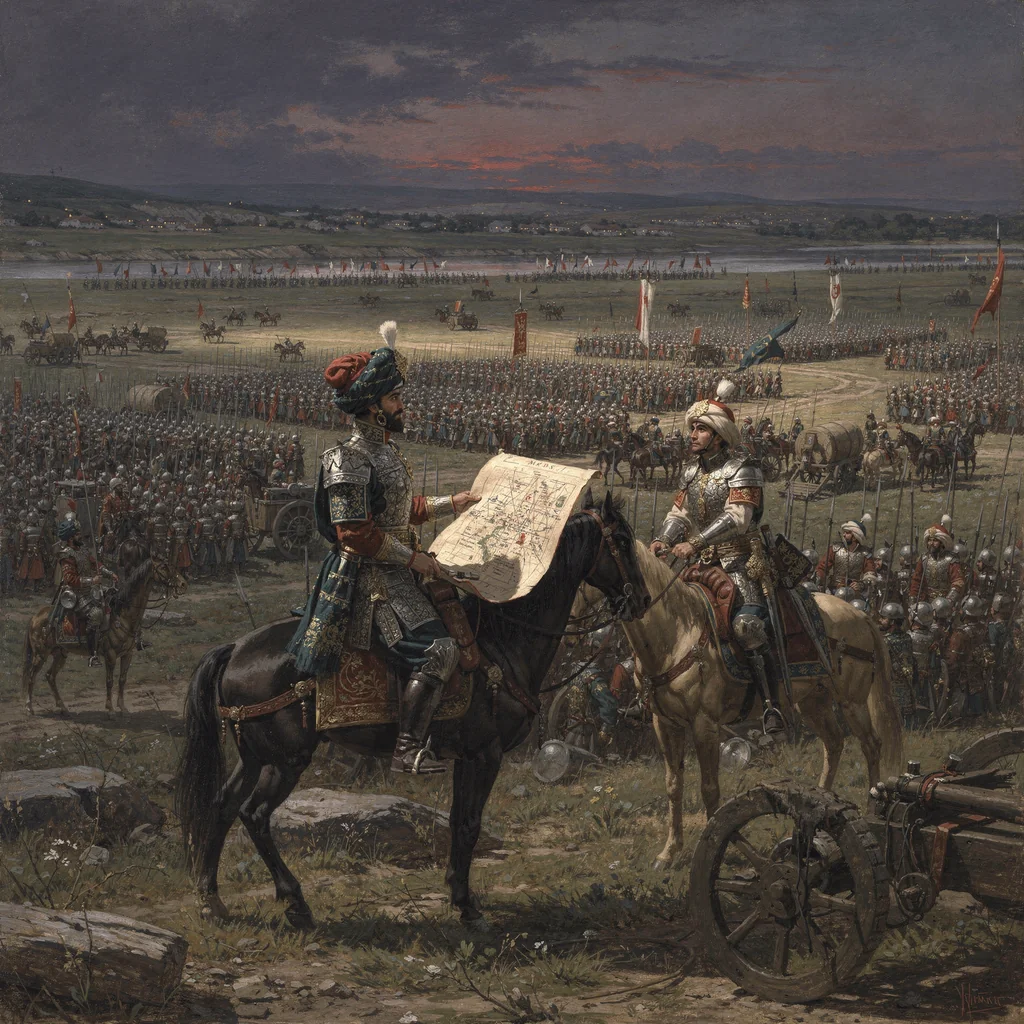
Fazıl Ahmed stood over the campaign table. The map showed the Habsburg frontier — fortresses, rivers, mountain passes. But what the map really showed was the household.
Eighty names written beside eighty positions.
Kaplan Mustafa commanding the right wing — his father’s son-in-law since 1658. Kıbleli Mustafa commanding the left — another son-in-law, another marriage alliance cemented into military authority. Gürcü Mehmed Pasha arriving from his governorship in Damascus with two thousand seasoned troops. Defterdar Ahmed Pasha arranging supply lines across three provinces, grain moving from Anatolia to the frontier as if pulled by invisible strings.
Four thousand mercenaries, mostly Albanian, recruited by Albanian ağas using personal connections from the highlands. The ağa from Mirdita bringing two hundred men. The ağa from Mati bringing three hundred. The ağa from Malësia bringing four hundred. They did not come for the sultan’s stipend — they came because their ağa called, and the ağa came because the grand vizier called, and the chain of loyalty was personal, not institutional.
Fazıl Ahmed surveyed the assembled household and saw what his father had built: a private administrative state inside the imperial state. A structure that could move, fight, govern, and communicate simultaneously because every person in it knew their role, chose it voluntarily, and was personally connected to the man at the center.
The chronicle note, which Fazıl Ahmed had read in Mühürdar Hasan Ağa’s compilation: Never before had so many relatives and clients participated in a single military campaign.
He touched the map.
Eighty names. Eighty bonds. One decision, and all of them moved.
Fasih Ahmed Dede sat in his tent, the lamplight flickering over the paper.
He was a Mevlevi poet — a whirling dervish who had found his way into the service of the Köprülü household through his skill with numbers. The treasury needed a scribe who could track grain shipments and salary payments across three provinces. The household needed a courtier who could compose verses for state occasions. Fasih Ahmed Dede was both.
He traveled with the campaign, and what he saw was not what the others saw.
The commanders saw troops. The vizier saw strategy. Fasih Ahmed Dede saw what happened in the spaces between.
One evening — three weeks before the battle — an ağa from Konya arrived at the camp’s edge as the light failed. He had ridden four days. His horse was finished. He carried no battle report, no supply manifest, no request for reinforcement. He carried a single letter: his commander had died the previous winter, in a garrison town near Ankara, leaving a son of eleven and a wife with no income and the commander’s debts still unpaid.
Fasih Ahmed Dede watched from the supply tent as the ağa was shown into the grand vizier’s presence. He was close enough to observe but not close enough to hear. He watched Fazıl Ahmed receive the letter. Read it. Set it on the table.
A pause. Then Fazıl Ahmed called the treasury scribe.
Fasih Ahmed Dede could not hear the words. He watched the scribe’s pen move. He watched the ağa’s face — the man standing in the tent entrance, still dusty from the road, watching the pen move and not yet understanding what was being written.
The scribe finished. He handed the paper to Fazıl Ahmed. Fazıl Ahmed read it once, then gave it to the ağa.
The ağa read it. He stood very still for a moment. Then he pressed the paper to his chest, over his heart, and bowed.
Fazıl Ahmed had already turned back to his maps.
That night, Fasih Ahmed Dede sat with his lamp and the blank page that had been waiting for three weeks. He had been trying to write a poem about the campaign — the usual thing, praising the vizier’s valor and the army’s discipline. The lines would not come. They were true but they were not the truth.
He wrote instead what he had watched: the four-day ride, the dead commander’s debts, the pen moving, the paper pressed to the chest.
He stopped. He set down the pen.
From somewhere in the back of his mind — from the long hours of sama’ in the tekke in Konya, from the years of rotating until the self dissolved and only the reed’s sound remained — a line came to him that was not his own:
Listen to the reed, how it tells a tale of separations.
The reed was cut from the reed bed and wept. Its weeping was its music. The separation was the instrument.
He wrote the line in the margin of his observation. Not as quotation. As diagnosis.
He filed the page with his other observations.
The lamp burned down. Outside, the campaign continued its ordinary noise — horses, fires, the distant sound of the night watch calling the hour.
He did not write a poem about valor that night.
Two weeks before the battle, Ali Bey of Karaman arrived at Fazıl Ahmed’s camp seeking a position for his brother.
Fazıl Ahmed received him. The notable dismounted. He approached with gifts — a yataghan sword, a gray mare.
Fazıl Ahmed received the gifts. He reached for the purse on his belt — perhaps fifty gold pieces — and placed it in Ali Bey’s hand. Then he reached for the robe of honor that lay across the campaign chest, a sleeveless vest of silk brocade embroidered with the Köprülü crest, and placed it over Ali Bey’s shoulders.
“Your brother will be considered for the cavalry,” Fazıl Ahmed said. “Present himself at the Buda garrison in the autumn. Mention your father’s name.”
Ali Bey bowed. The obligation would pass from father to son.
The ledger where the names were recorded lay open on the campaign desk. Fazıl Ahmed dipped his pen. He wrote:
Ali Bey of Karaman. Son of the governor who served with honor. Client of the household.
He closed the ledger.
And part of me wept over the other part of me, together.
— Ibn Zuhr (Avenzoar), physician, Seville, d. 1162 from the muwashshah Ayyuha al-Saqi
The battlefield was wet.
Summer rains had turned the ground to mud — thick, clinging mud that sucked at boots and hooves, that made every step a struggle. The Rába River was swollen, brown and churning, its waters spilling over the banks and adding to the mire. The air smelled of wet earth and horse dung and the metallic tang of gunpowder already fired.
Fazıl Ahmed had never commanded an army in battle before.
He had governed provinces. He had managed the Divan. He had directed the household network across three continents. But he had never stood on a field and given the order to send men into fire.
The cannon fire began at midday.
Fazıl Ahmed stood on the command rise. The ground beneath him vibrated with each shot — a deep thrum in the soles of his boots, in his teeth, in the hollow of his chest. He could see the whole field: the Ottoman lines advancing across the marshy valley, the Habsburg positions on the high ground beyond, the church of Szentgotthárd Abbey silhouetted against the sky like a prayer in stone.
The first volley fell short.
The second volley found its mark.
Fazıl Ahmed watched a gap appear in the Ottoman right flank. Not a retreat — a disappearance. Men had been there. Now they were not. The smoke cleared to show mud churned to red, bodies scattered like broken toys.
He could hear the screams from here. They carried across the valley, thin and high, carried on wind that smelled of sulfur and copper and bowels opened.
The sipahi cavalry charged.
They moved forward, three thousand horsemen, the thunder of their approach drowning out the cannons — a wall of sound that made the air shiver. They hit the Habsburg line. They pushed. For a moment, Fazıl Ahmed thought they would break through.
Then the Habsburg pikes lowered.
A forest of wooden shafts, each tipped with steel. The horses could not charge pikes. The momentum broke. The cavalry pulled back, reforming for another charge. But the mud was deep now, churned by cannon fire and horse hooves, and the horses stumbled — their legs going out from under them, riders tumbling into the muck.
The janissary infantry moved forward. They were the best soldiers in the empire. They had taken Belgrade, Athens, Baghdad. They did not know how to retreat.
But they had never fought a battle in a swamp.
The rain began at mid-afternoon — not a shower, a downpour, as if the sky had opened and tried to wash away what the men below were doing to each other. Cold rain streaming down faces, soaking through wool and silk, turning the battlefield into a brown churning mess. The mud grew deeper. The guns grew harder to move. The powder grew harder to keep dry.
Fazıl Ahmed watched the left flank collapse first.
He saw it happen in slow motion — the moment when the men could no longer hold their formation, when the discipline that made them invincible became the thing that trapped them in a breaking line. They stood when they should have run. They died because they would not retreat.
The order to withdraw came at dusk.
The army that had marched onto the field that morning was not the army that rode away in the rain.
The Habsburg commander had been fighting wars since before Fazıl Ahmed was born. He knew how to read a battlefield. He knew how to use terrain. He knew when to attack and when to wait.
The moment came when the lines broke.
Fazıl Ahmed saw it happen — not as a single event but as cascading failure. The right wing collapsed first. Then the center buckled. The left flank, unable to hold, fell back.
He saw the disaster before the orders could reach them. The ağas on the right were already moving — not retreating, but containing. Kaplan Mustafa’s men formed a rear guard. The sipahi cavalry covered the withdrawal.
The household held together because the household knew how to organize, how to communicate, how to move men and materium across broken terrain. But this was not the clean execution of a planned withdrawal. This was disaster contained.
The withdrawal continued through the night.
Kara Mustafa rode the flank lines, ensuring no unit was left behind, no wagon abandoned. He had organized the retreat in minutes — the moment the line broke, he had begun giving orders. A messenger to the left wing. Another to the right. The supply wagons to the rear. The artillery protected at the center.
Fazıl Ahmed watched from the command position. The withdrawal was disciplined. The household held. The army would fight again.
He watched his brother-in-law move along the flank lines, directing each unit with precision. Kara Mustafa could see the whole field at once, understand how each piece connected to the others. This was what he was brilliant at.
A messenger rode up to Kara Mustafa with a report from the reconnaissance scouts. The Holy League army was moving faster than expected. They would catch the Ottoman rear guard before dawn if something was not done.
Kara Mustafa did not wait for orders. He did not consult with Fazıl Ahmed. He turned to the commanders around him and began giving new orders.
“Send the sipahi cavalry to delay them. Sacrifice the baggage train if necessary. The army must escape.”
The messenger hesitated. “The grand vizier should —”
“There is no time,” Kara Mustafa said. His voice was sharp. “Do it.”
The orders were given. The sipahi cavalry rode out to delay the Holy League. The baggage train was abandoned to save the army. The retreat continued.
Kara Mustafa rode on. The army would survive.
Fazıl Ahmed watched him go.
The messenger who had brought the reconnaissance report found Fazıl Ahmed at the command tent. He was reviewing the casualty lists — the dead, the wounded, the missing.
The messenger hesitated, then delivered his report: the sipahi cavalry had been sacrificed to buy time for the army’s escape. The order had come from Kara Mustafa. The order had not come from Fazıl Ahmed.
Fazıl Ahmed read the report. He set it down.
He did not summon Kara Mustafa. He did not confront him. He did not remove him from command.
He marked the casualty list as complete. He returned to the work of governing an empire that had survived a defeat it should not have survived.
In 1664, on the road from Szentgotthárd, Kara Mustafa’s flaws had saved the army.
He said nothing.
The negotiations took place in a tent near the battlefield.
The Habsburg field marshal. Fazıl Ahmed for the Ottomans.
Fazıl Ahmed found he was good at this.
The Habsburgs wanted a victory to proclaim. The empire needed its position in Hungary. He gave them the first while keeping the second.
The Habsburgs took a small territorial concession — a fortress, a stretch of borderland. The Ottomans kept the rest of Hungary. Twenty-year truce.
Kara Mustafa watched from the corner. His brother-in-law was not his father.
Mehmed Pasha would have fought the battle differently. Mehmed Pasha might not have lost.
The treaty preserved Ottoman Hungary. The truce bought time. The household remained intact.
Kara Mustafa filed the thought away. He would need it later.
The map of Hungary lay on her desk, the edges curling in the summer heat.
Turhan Sultan had been watching the campaign from Istanbul for three months. The messages arrived weekly — dispatches from the household network, carried by couriers who rode the roads from Buda to Istanbul in relay, changing horses at posting stations, sleeping in the saddle.
She knew where the army was. She knew where the Habsburg forces were.
She was thirty-seven years old. She had been Valide Sultan for nineteen years.
The grain merchants came to her weekly. They brought reports from the Anatolian farms — the harvest was good, the wheat was threshed, the transport ships were ready to sail to the frontier if needed. She nodded. She approved. She did not tell them that the army had already lost the battle.
The harem informants came daily. They brought whispers from the bazaar — the people were worried, the prices were rising, the janissaries were restless. She listened. She recorded. She did not tell them that she had already sent orders to the palace guards to increase patrols.
The provincial governors sent letters. They asked for instructions, confirmed their loyalty, offered troops. She read them. She filed them. She did not tell them that she was holding the empire together while her son’s grand vizier fought for his life on a field she would never see.
The message from Szentgotthárd arrived on the third day of August.
Turhan Sultan read the report once. She read it again.
Defeat. The army withdraws. Casualties heavy. The household holds.
She set the report on the desk. She touched the map of Hungary. Her finger traced the line from the battlefield to Buda, from Buda to Belgrade, from Belgrade to Istanbul.
The army had lost. The empire had not.
She had spent eight years moving between cities — Edirne, Istanbul, summer pavilions on the Bosphorus. When she was in Edirne, she was closer to the frontier. When she was in Istanbul, she was closer to the centers of power. The fires and malaria epidemics dictated her itinerary.
She thought of her fortresses at the Dardanelles — Seddülbahir and Kumidülbahir. She had commissioned them herself, paid for them with her personal income, overseen their construction. Her name was cast in the stone, seen by every ship that passed through the straits. The fortresses would outlast her. The mosques she built would outlast her.
She reached for a fresh sheet of paper. She dipped her pen in the inkwell. She wrote:
The defeat is known in Istanbul. The people are calm. The treasury is secure. The grain ships sail next week. The provinces send their tribute. The home front holds.
Make peace. Preserve the strength. The empire survives.
She read what she had written. She pressed her seal into the wax.
She called the messenger. A young man — perhaps twenty, dust-stained from the road, exhausted from the hard ride from the frontier. He bowed.
“Take this to the grand vizier,” she said.
“Effendi,” he said. “The road is long. The Habsburgs patrol the border.”
“Ride,” she said. “The army needs to hear that the home front holds.”
The messenger took the letter. He bowed again. He left the chamber.
Turhan Sultan returned to her desk. She looked at the map of Hungary.
She touched the map. She touched the seal. She touched her own chest, feeling the steady beat of her heart.
Istanbul, October 1664.
The campaign was over. The treaty was signed. The household returned to the capital.
Fazıl Ahmed did not announce anything. He acted.
Provincial governors were placed — men of the household. Supply systems were reformed — Defterdar Ahmed Pasha tracking grain shipments with new precision. Treasury accounting was tightened — every akçe counted.
He redirected the household away from military campaigns. There would be no more ambitious offensives against the Habsburgs. The frontier would hold. The focus would be internal — consolidation, reform, preparation for the long campaign in Crete that his father had begun and that he would finish.
Szentgotthárd had taught him what he was not.
Now he needed to learn what he was.
The garden was empty except for the two brothers.
Fazıl Mustafa sat on the stone bench beneath the walnut tree. He was twenty-seven years old — two years younger than his brother, but he looked older. His face was weathered from campaigns in Anatolia, from the frontier where he had been fighting since he was eighteen. His hands were scarred — the marks of sword practice, of riding, of the work that men did when they were not born to be grand viziers.
Fazıl Ahmed stood at the garden’s edge, looking out toward the Golden Horn. The water was visible between the palace walls — gray and choppy in the autumn wind. Ships moved back and forth, carrying grain from Egypt, timber from the Black Sea, pilgrims returning from Mecca.
“You will not lead another army,” Fazıl Mustafa said.
It was not a question.
Fazıl Ahmed turned from the water. “No.”
“Because of Szentgotthárd.”
“Because of Szentgotthárd.”
Fazıl Mustafa nodded. He had expected this answer. He had seen his brother return from the frontier — seen the quiet in him, the way he moved through the palace now like a man who had learned something about himself that he did not want to know.
“Our father would have fought differently,” Fazıl Mustafa said.
“Father would have won,” Fazıl Ahmed said.
“Father would not have lost,” Fazıl Mustafa corrected him.
There was a difference.
“Our father was a soldier,” Fazıl Ahmed said. “He understood war.”
“You understand war,” Fazıl Mustafa said. “You do not understand defeat.”
Fazıl Ahmed did not answer.
Fazıl Mustafa continued: “There is a difference. A man can study maps. He can learn troop movements. He can master supply lines. But until he has stood on a field and watched men die because of an order he gave — until he has seen his own failures written in blood — he does not understand what it means to command.”
“You have commanded,” Fazıl Ahmed said.
“I have commanded companies,” Fazıl Mustafa said. “I have not commanded armies. But I have stood on the field. I have watched men die. I have given orders that killed them.”
He looked at his hands — the scarred knuckles, the calloused palms. “I do not sleep well.”
Fazıl Ahmed came closer. He sat on the bench beside his brother. For the first time, Fazıl Mustafa saw that his brother’s hands were not scarred. They were smooth — the hands of a scholar, a scribe, a man who had spent his life with books and account books and petitions.
“You will lead armies,” Fazıl Ahmed said.
“Yes.”
“You will win battles.”
“Yes.”
“And one day,” Fazıl Ahmed said, “you will lose.”
Fazıl Mustafa was silent.
“This is what Father never understood,” Fazıl Ahmed said. “He never lost. So he never learned what defeat teaches. He died thinking the method was perfect — that if a man did everything right, if he built the network, if he served the state, if he purged the corrupt — then victory would follow.”
He looked out at the Golden Horn. “But victory does not always follow. Sometimes a man does everything right and still loses. Sometimes the rain comes at the wrong time. Sometimes the enemy is stronger. Sometimes God wills something else.”
“What are you saying?” Fazıl Mustafa asked.
“I am saying that Father taught us how to rule,” Fazıl Ahmed said. “He did not teach us how to fail. And a man who does not know how to fail is a man who will destroy himself when failure comes.”
Fazıl Mustafa was silent.
“You think I am weak,” Fazıl Ahmed said.
“I think you are not Father,” Fazıl Mustafa said.
“I am not,” Fazıl Ahmed agreed. “I will never be what he was. I have accepted this.”
“Have you?” Fazıl Mustafa asked. “Or have you simply decided that you cannot win, so you will not try?”
Fazıl Ahmed turned to look at his brother. For the first time, Fazıl Mustafa saw the weight in his brother’s face.
“I will finish what Father began in Crete,” Fazıl Ahmed said. “I will reform the administration. I will build the networks. I will consolidate what we have. And when I die, you will succeed me.”
Fazıl Mustafa did not speak.
“You will lead the armies,” Fazıl Ahmed continued. “You will fight the battles I cannot fight. You will win the victories I cannot win. And one day, you will face a defeat that I never faced — a defeat that may destroy you, if you have not learned how to fail.”
“Why are you telling me this?”
“Because I love you,” Fazıl Ahmed said. “Because you are my brother. Because I do not want to see you destroy yourself the way Father would have destroyed himself, if he had lived to face what I faced at Szentgotthárd.”
He reached out and touched Fazıl Mustafa’s hand — the scarred hand, the hand that had held a sword since the age of eighteen, the hand that would one day hold the grand vizier’s seal.
“The method is not perfect,” Fazıl Ahmed said. “The household can fail. What matters is that we survive it.”
He stood. The autumn wind moved through the walnut tree, stripping the last leaves from the branches.
“I am building for the next fifteen years,” Fazıl Ahmed said. “For Crete. For reform. For consolidation. You must build for yourself. Learn from my mistakes. Learn from Father’s successes. And when the time comes — when you stand on a field and the outcome is uncertain, and the choice is between destruction and survival — choose survival.”
He walked toward the palace. Fazıl Mustafa remained on the bench. The bare walnut branches creaked above him.
Fasih Ahmed Dede returned to his duties in the treasury.
The campaign was over. The papers were filed. The account books were updated.
He took out the page from three weeks before — the ağa from Konya, the dead commander’s debts, the pen moving, the line in the margin about the reed. He read it once. He filed it with his other work, in the household archive.
He did not know that anyone would ever read it. He simply did his work.
The lamp burned down.
Campaign maps rolled and stored. The household’s account books open on the desk instead. The scribe’s lamp burning. Outside, the first autumn rain on Istanbul.