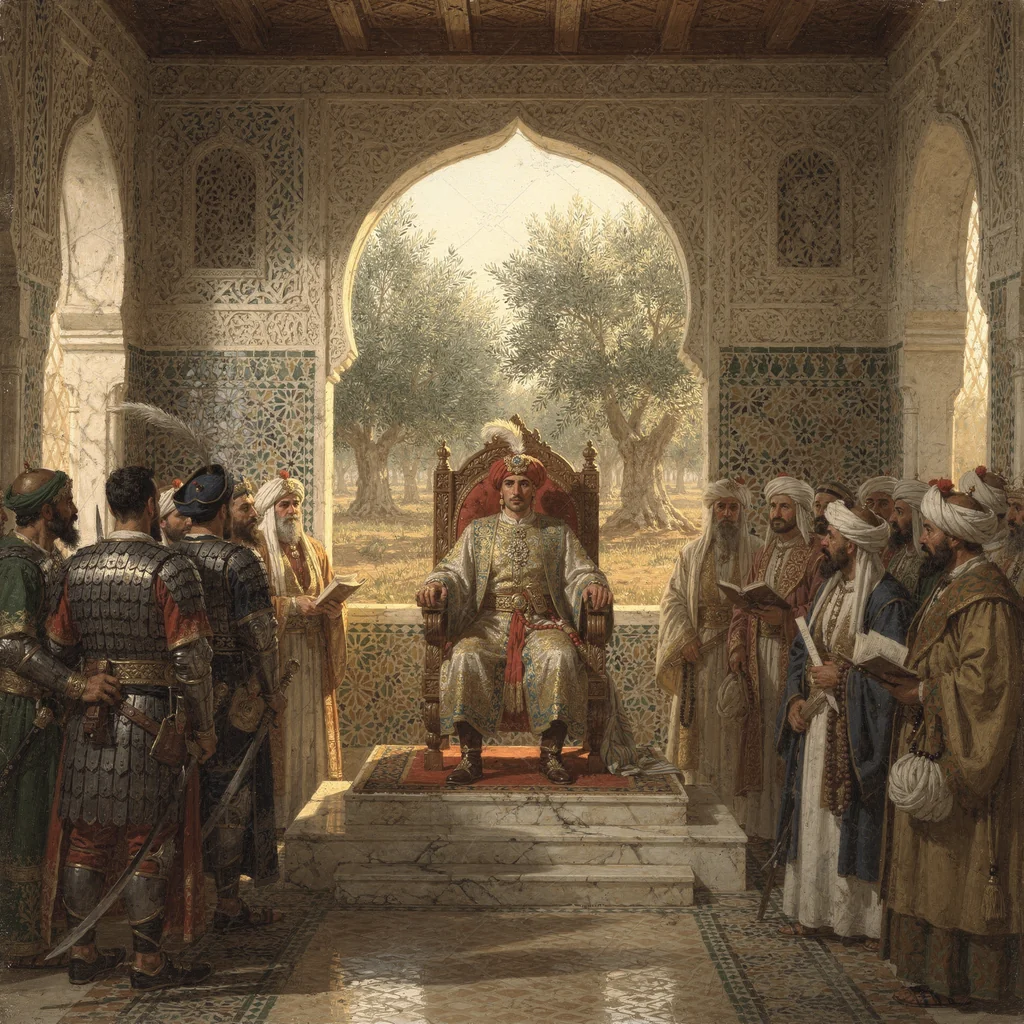
The grain merchant from Sfax arrived at first light, his robes dust-stained from three days of hard riding.
Ḥammūda ibn Ali Pasha sat at his desk in the reception room. The merchant placed a handful of withered wheat on the leather surface.
“Effendi,” the merchant said. “This is what remains of the Sahel harvest.”
Ḥammūda looked at the wheat — shriveled, gray, the harvest of a drought that had burned across the interior. Then he looked at the waqf accounts open before him — the ledgers showing revenues from two hundred pious foundations.
He was eighteen years old. His father Ali II Pasha had died five years before, in 1777. The Husaynid dynasty had ruled Tunis for seventy-two years — since Hussein I, his great-grandfather, had founded the beylik in 1705.
The revenues of two hundred pious foundations, flowing into mosques, schools, and Sufi lodges.
The clerk entered from the Zaytuna mosque-university with the daily report. “Thirty graduates received appointments this month, effendi. Twelve to your court, eight to provincial administration, ten to the qadi courts.”
Ḥammūda nodded. The graduates of Zaytuna had staffed the Husaynid dynasty since Hussein I’s time.
“The olive harvest from the western groves exceeded projections,” the clerk said. “The waqf revenues will fund the mosque operations for three years without drawing from treasury.”
A messenger arrived from the Qadiri lodge. The sheikh of the order — the same man who had mobilized his network during the recent famine crisis — requested a meeting.
“Send him in the afternoon,” Ḥammūda said.
The Albanian ağa entered — the commander of the coastal guard, his Turkish accented with the Greek of his birth in the Maghreb. He reported on the kouloughli families in his district: the children of Ottoman soldiers who had married Tunisian women, half-Ottoman, half-Tunisian.
“The families ask for recognition,” the ağa said. “Their sons want positions in the garrison. Their daughters want marriage contracts.”
“Recognize them,” Ḥammūda said. “Marry the daughters into good families. Commission the sons who prove themselves.”
Ḥammūda walked to the window and looked out at the palace gardens. Three generations of beys had sat in this room.
His father had taught him this room the way a mason teaches an apprentice: not with words, but by standing beside him while the work was done.
On the morning of his fourteenth birthday, his father had summoned him to the account room. He had placed the waqf register in front of him, open to a page from 1707.
“Read it,” his father said.
Ḥammūda read the entry. Hasan Agha’s name. The fifty gold pieces. The bond recorded.
“Now tell me what it means,” his father said.
Ḥammūda looked at the numbers. He looked at the entry for “services rendered.” He named what he saw: a payment, a record, a name.
His father shook his head. “It means the ağa’s son can walk into this room thirty years from now and say his father’s name. And we will know the name. And the door will open.”
His father closed the register. He set it back on the shelf.
“That is why we keep the accounts,” Ali II Pasha said. “Not for the treasury. For the names.”
Ḥammūda touched his pocket, where he carried a small portrait of his great-grandfather. A sharp face. Knowing eyes.
The crisis came on a Tuesday in September, three months after Ḥammūda inherited the throne.
A grain merchant from Sfax arrived at the palace with news: the harvest had failed across the Sahel region. The winter rains had not come. The olive groves were producing half their usual yield. The wheat fields were barren.
The merchant was not asking for help. He was warning: there would be famine if the bey did not act.
Ḥammūda was eighteen years old.
He called the council — not the military commanders, not the provincial governors, but the men who ran the networks that made Tunis function.
The sheikh of the Qadiri lodge arrived first. Then the Maliki qadi of the Zaytuna. Then the heads of the major waqf endowments. Then the ağas who commanded the Albanian troops — men who still spoke Albanian among themselves, the descendants of the soldiers who had served Hussein I seventy years before.
They gathered in the room beside the Zaytuna mosque.
Ḥammūda did not sit at the head of the table. He sat among them — as an equal.
“The grain harvest has failed,” Ḥammūda said. “I need to know what we have.”
He did not ask what the treasury could provide. He asked what the networks could mobilize.
The sheikh of the Qadiri lodge spoke first. He was a man in his sixties, with a face weathered by years of traveling between lodges in Sousse, Monastir, and Tunis. His hands were rough — the hands of a man who had worked in the fields before he found the Sufi path.
“Our houses in Sousse and Monastir can shelter five hundred families,” the sheikh said. “Our storehouses have grain from last year’s surplus. We can feed them for three months.”
He spoke in the matter-of-fact tone of a man who had managed famines before. The taste of dust was familiar to him. The smell of grain was familiar. The mathematics of survival were second nature.
The Maliki qadi nodded. He was a scholar, not a field worker — his hands were smooth, his robes pristine, his beard trimmed with precision. But his eyes had seen the same crises the sheikh had seen. The Zaytuna’s waqf revenues could support two hundred students and their families. The soup kitchens could open early this year.
The head of the olive grove waqf spoke next. He was a practical man — a farmer who had risen to manage one of the largest endowments in Tunis. “We have oil. The press is ready. We can distribute to the poor neighborhoods without cost. The endowment can cover it.”
One by one, the networks reported what they could provide.
Ḥammūda listened. He made notes on the paper before him — not commands, but questions. He did not give orders. He asked what was possible.
“Can the grain from Sfax reach the interior before the winter snows block the mountain passes?”
“The caravans are already moving,” the sheikh said. “Our ağas know the routes. They have been moving grain since before your great-grandfather’s time.”
Ḥammūda nodded. He knew the routes — the mountain passes that connected the coast to the interior, the roads that had been traversed by caravans for centuries. The ağas who commanded the Albanian troops knew these roads better than anyone. Their fathers had used them to move grain during the famine of 1750. Their grandfathers had used them during the drought of 1720.
“The waqf schools,” Ḥammūda said. “Can they take in the children whose families have lost everything?”
“The teachers are waiting,” the qadi said. “They know the children will come. They are preparing extra space.”
Ḥammūda sat back. The council waited.
There was a shepherd in the corner — a man who had come with the grain merchant from Sfax, representing the rural communities that would be hit hardest by the famine. He spoke now, his voice rough from years of calling to flocks in the hills.
“Effendi,” the shepherd said. “The wells are drying. The streams are low. If the winter rains do not come, the spring planting will fail. We need seed grain, not just food.”
Ḥammūda looked at the sheikh. The sheikh nodded. “The Qadiri lodges have seed grain. We can distribute it.”
A grain merchant spoke — a man from the commercial waqf who managed the market prices in Tunis. “Effendi, if we distribute free grain, the market will collapse. The merchants cannot sell. If the merchants cannot sell, they cannot buy next year’s harvest. The system breaks.”
The room went quiet. This was the tension at the heart of the crisis — how to feed the hungry without destroying the market that fed everyone.
Ḥammūda thought for a moment.
“There is one more thing,” Ḥammūda said. “The grain merchants from Sfax cannot sell at fair prices this year. If they sell, they lose their livelihood. If they do not sell, the city goes hungry.”
He looked at the head of the commercial waqf — the endowment that supported the merchants’ guild.
“Buy the grain at fair prices. Store it in the waqf warehouses. Distribute it through the soup kitchens.” Ḥammūda met each man’s gaze in turn. “The merchants are paid. The poor are fed. The networks hold.”
The head of the commercial waqf nodded. He did not need to ask how this would be funded. The endowment had reserves from seventy years of surplus.
The tension in the room eased. The shepherd nodded. The merchant nodded. The sheikh nodded.
Ḥammūda stood. The council stood with him.
“The crisis is not over,” he said. “But we will not face it alone.”
The sheikh of the Qadiri lodge placed a hand briefly on Ḥammūda’s shoulder.
Ḥammūda walked to the window and looked out at the Zaytuna courtyard. The students were moving between classes, their robes white against the stone. They did not know that a crisis had been averted this morning. They did not know that the networks had mobilized to protect them.
They only knew that the school was open, the soup kitchens would serve at noon, and the world continued as it should.
Ḥammūda stood at the window, watching the students. Three months ago, he had been a prince. Now he was the bey.
The sheikh stood beside him. “Your great-grandfather sat in this room,” the sheikh said. “He signed the founding deed at that table.”
Ḥammūda looked at the table — the scarred wood where Hussein I had placed his seal.
“Did he know?” Ḥammūda asked. “Did he know it would still be working seventy years later?”
The sheikh was silent for a moment.
“He built for the students in that courtyard,” the sheikh said. “He built for a time he would not see.”
The sheikh touched Ḥammūda’s shoulder.
“The endowment holds,” the sheikh said.
Ḥammūda visited the mosque school in the Bab Suwayqa neighborhood.
The building had been endowed by Hussein I in 1712 — sixty-five years ago. The waqf deed specified that revenues from an olive grove south of Tunis would fund twelve teachers, a soup kitchen for forty students, and an imam who would lead prayers in the neighborhood mosque.
Ḥammūda walked through the courtyard. The stone was worn smooth by sixty-five years of feet — teachers, students, parents, the neighborhood people who had passed through these gates since his great-grandfather’s time.
The school was functioning. The teachers were teaching. The soup kitchen was serving. The imam was leading prayers.
Nothing had changed in sixty-five years. Everything had changed.
Ḥammūda found the school’s director in his office — a small room off the courtyard, lined with shelves of books and account registers.
“Effendi,” the director said. He stood. He was an old man, perhaps seventy, with a white beard and eyes that had seen generations of students pass through this courtyard. “The Bey honors us.”
Ḥammūda gestured for him to sit. “I came to see how the school functions.”
The director hesitated. “There is nothing to see, effendi. We teach. We feed. We pray. This is what we have done since the founding.”
“Show me the accounts,” Ḥammūda said.
The director brought a leather-bound register — the accounts for the current year. Ḥammūda opened to a page at random. October 1777. The entries were precise:
Olive harvest from the grove south of Tunis: 3,200 liters. Sold at market price: 480 gold pieces. Teachers’ salaries: 120 gold pieces. Soup kitchen provisions: 200 gold pieces. Building maintenance: 80 gold pieces. Surplus: 80 gold pieces, invested in additional olive trees.
Ḥammūda read the numbers. He did the arithmetic. The surplus from this year alone would fund the planting of twenty new olive trees.
“Who manages the grove?” Ḥammūda asked.
“The imam of the neighborhood mosque,” the director said. “He visits the grove twice a year. He oversees the harvest. He negotiates the sale. He brings the revenue here. He has done this for thirty years.”
“Thirty years,” Ḥammūda said. “Since 1747.”
“Yes, effendi.”
“Before him?”
“His father managed the grove for the first twenty years of the endowment. From 1712 to 1732.”
Ḥammūda set the register on the desk. Sixty-five years. Three generations of imams managing the same grove, funding the same school, feeding the same students.
Ḥammūda stood. The director stood with him.
“Effendi,” the director said. “May I ask why the Bey came? There are many schools in Tunis. Many waqf endowments. Why this one?”
Ḥammūda looked at the courtyard, where students were moving between classes, their white robes bright against the stone.
“My great-grandfather founded this school,” Ḥammūda said. “I wanted to see if it still functions.”
“It functions,” the director said. “We have never stopped functioning.”
Ḥammūda nodded. He walked to the doorway. The students moved past him — boys who would become merchants, soldiers, administrators.
Ḥammūda visited a Sufi lodge in the Halfaouine neighborhood of Tunis.
The Qadiri order, whose lodge had been endowed by Hussein I in 1712.
The dhikr ceremony began at sunset.
Twenty men in the courtyard, swaying in unison, repeating the name of God. Allah. Allah. Allah.
Ḥammūda watched from the doorway.
The men came from different neighborhoods, different trades. A merchant from the gold souk. A weaver from the kasbah. A fisherman from the port. The son of a provincial governor.
The sheikh had explained it once: When everything else falls apart, the remembrance holds.
Ḥammūda watched the bodies move together, the voices merge together, the breath become one breath in the evening air.
When the dhikr ended, one of the men in the circle — an old man, a musician by his hands, the calluses on the fingertips that pressing strings leaves — took up an oud and began to play.
Not a dhikr melody. Something older.
Ḥammūda recognized the shape of it before the words came. His mother had hummed it when she worked, without knowing she was humming, the way a person carries a tune that came to them from somewhere behind memory. He had heard it in the zawiya in Testour, from the families who had come from Andalusia three generations before and brought their music with them the way the Zaytuna had brought its books — not as heritage, but as habit, because it was simply what you sang.
The old musician began to sing.
O you who draw near to the sanctuary of the beloved
Ḥammūda knew the next line before it came.
He stood in the doorway and did not move. The men who had been in the dhikr circle were sitting now, quiet, listening the way men listen when a song arrives at the right moment in the right place after a long time elsewhere.
The song moved through its verses. Ḥammūda did not follow the words consciously. He followed the shape — the turn at the end of each line, the resolution that opened rather than closed, the final verse arriving where it always arrived:
And some of them wept, over some of them, with me
The old musician held the last note. The oud strings went still.
No one spoke. The courtyard held the silence the way stone holds warmth after the sun has gone — not generating it, only keeping it a little longer than the air outside.
Ḥammūda walked home through the medina. The crisis was managed. The networks had held. The song was eight centuries old and had crossed a sea he had never crossed and arrived here before his dynasty did.
He thought of his great-grandfather, who had crossed a different sea.
The night air smelled of jasmine and the residue of the day’s fires.
He did not know who had written the song. He did not need to know.
The Zaytuna courtyard was full.
Three hundred students sat in rows on the stone floor, their white robes bright against the limestone. The families crowded the perimeter — mothers holding babies, fathers standing with arms folded, siblings pressed against the walls. The air smelled of incense and anticipation.
Ḥammūda sat in the place of honor. He was nineteen years old. This was his first graduation ceremony as bey.
The qadi of the Zaytuna stood at the podium. He was a man in his seventies, his beard white, his voice still strong after fifty years of teaching.
“Today,” the qadi said, “we send forth three hundred graduates. They will serve as judges, as administrators, as teachers, as imams. They will staff the courts, the mosques, the schools, the soup kitchens that make Tunis function.”
He paused. The courtyard waited.
“But I want to speak of one student in particular.”
All eyes turned to the front row, where a young man sat — perhaps twenty, his face thin, his robes worn at the cuffs. His name was Ahmed ibn Youssef.
“Ahmed’s father is a fisherman,” the qadi said. “His mother died when he was ten. His family had no money for books, no money for tuition, no money for the food a student needs to study.”
The courtyard was silent.
“But Ahmed’s teacher noticed him,” the qadi continued. “The teacher brought the boy to my office. He said: this one has the mind for law. This one will serve the community well. We must find a way.”
The qadi looked at Ḥammūda. “We went to the waqf endowment that Hussein I founded in 1712. The endowment that allocated olive revenues to support students who could not pay. We asked for a scholarship.”
The qadi turned back to the students. “The endowment paid for Ahmed’s books. It paid for his tuition. It paid for his food. It paid for the clothes he wears today.”
Ahmed ibn Youssef sat very still. His hands were folded in his lap. His eyes were on the ground.
“Today,” the qadi said, “Ahmed ibn Youssef graduates first in his class. He has been appointed to the qadi court of Sousse. He will serve as judge for the coastal communities — the fishing villages, the market towns, the families who live by the sea.”
The courtyard erupted in applause. The families cheered. The students smiled. Ahmed ibn Youssef looked up, his eyes bright.
Ḥammūda watched.
The qadi continued with the ceremony. He called each student forward. He announced their appointments. He handed them their certificates.
The graduates came from every background. The merchant’s son. The farmer’s daughter. The weaver’s nephew. The carpenter’s son.
When the ceremony ended, Ḥammūda stood. He walked to the front row, where Ahmed ibn Youssef stood with his certificate.
“Effendi,” Ahmed said, bowing.
Ḥammūda placed a hand on the young man’s shoulder.
“Your father is a fisherman?” Ḥammūda asked.
“Yes, effendi.”
“You will judge fairly,” Ḥammūda said. “You will know what the sea takes. You will know what the families need. You will serve them well.”
Ahmed ibn Youssef did not speak. He stood with his head bowed, the certificate in his hands, the bey’s hand on his shoulder.
The courtyard had emptied. The families had gone home.
Ḥammūda stood alone in the Zaytuna courtyard. The stone was warm beneath his feet. The arches stretched into the evening light.
In the distance, he could hear the port — the creak of ships, the shouts of dockworkers.
Ḥammūda walked to the courtyard gate. He stopped at the archway where the motto was carved in stone:
There is no victor but God.
Ḥammūda touched the inscription. The stone was warm from the sun. The words were clear after sixty-six years.
The sun set over Tunis. The arches glowed in the evening light.