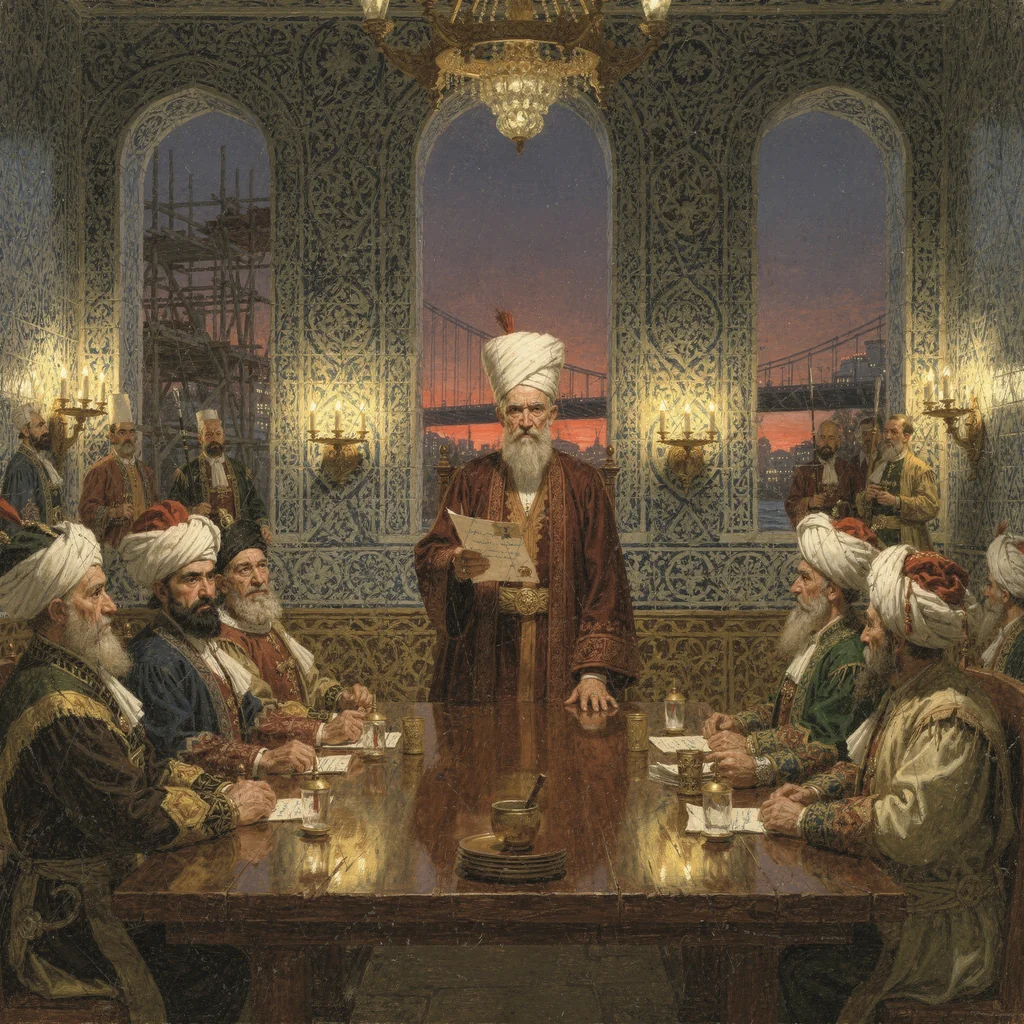
Two weeks after the proclamation, Hussein sat in the room beside the Zaytuna mosque. The walls were white plaster, cool to the touch, scarred where centuries of scholars had leaned their backs against them. The window looked onto the courtyard where students moved between classes, their white robes bright against the limestone.
Across from him: the Maliki judge. Two witnesses stood by the wall — one of them Ismail Agha, his father’s old comrade, the man who had placed the first hand on Hussein’s shoulder in the garrison courtyard. Between them all, the deed lay on the table.
Agricultural revenues from land Hussein controlled — olive groves south of the city, wheat fields in the interior, date palms in the oases — allocated permanently to the maintenance of the mosque, the school, and the Qadiri lodge.
The judge read the deed aloud. The Arabic was formal, the cadence of legal documents — each clause followed by the next, each endowment specified with the precision of a man who knew that imprecision would be exploited. The olive grove south of the city: three hundred trees, producing four thousand liters of oil per harvest, the revenue to fund twelve teachers and a soup kitchen for forty students. The wheat fields in the interior: two hundred hectares, the revenue to maintain the mosque building itself — the roof, the columns, the calligraphy above the prayer niche. The date palms: the revenue to support the imam who would lead prayers and the Qadiri sheikh who would hold the dhikr.
The words settled into the room like stones into water.
Hussein looked toward the door where his father’s ağas had stood. Ali Turki had died in 1676, when Hussein was one year old. He had never known the man, only his stories, only his network.
The judge finished reading. The witnesses signed. Hussein affixed his seal — a simple disk with his name in Arabic script. The first use of the Husaynid seal. The metal was cool against his palm, the impression sharp in the wax.
The deed was filed in the register.
Hussein touched the seal. The names his father’s ağas had carried across the water — Köprülü Mehmed. Fazıl Ahmed.
He was not one of them.
But the seal pressed into wax the same way.
Fasih Ahmed Dede sat at the chancery table, the waqf deed before him. He was seventy-eight years old. His hands shook when the inkwell was low, but the pen moved with the precision of a lifetime of practice.
He had been the Köprülü household’s treasury scribe in 1663, forty-two years before. He had watched Fazıl Ahmed confirm the son of a dead commander for the sake of the network. He had written a single word in the margin of his notebook then: Wafa — faithfulness.
Now he wrote for the Husaynid bey. The new dynasty required its records.
Fasih Ahmed Dede dipped the reed pen. He copied Hussein’s waqf deed into the register, word by word, line by line. The categories were familiar. The names were new.
He did not smile. He did not explain this recognition to the scribe who stood beside him. He simply wrote.
At the bottom of the entry, in the margin, he wrote one word in small script:
Beka — permanence.
He set the pen down. The ink dried on the page.
Fasih Ahmed Dede stood. His knees popped — the sound of an old man who has sat too long. He walked to the window and looked out at the Zaytuna courtyard.
The students were moving between classes. The waqf revenues would pay their teachers. The endowment would hold.
The word in the margin — beka — dried on the page.
The first year was the hardest.
Hussein sat in the Bardo palace — a modest building compared to the Topkapı his father’s ağas had described, but solid, functional, built around courtyards where lemon trees grew and the fountains ran with water from the aqueduct that the Romans had built and the Arabs had maintained. The palace smelled of plaster and lime — the workmen were still repairing the damage Sharif’s men had done to the reception halls.
The petitions arrived every morning. A stack of them, written on paper of varying quality — some on fine parchment from the Zaytuna scribes, some on rough brown paper from the provincial villages, some on the backs of old tax receipts, the original writing still visible beneath.
Hussein read them himself. He did not delegate the reading to a scribe. His father’s ağas had taught him this: the man who controls the information controls the decision. Sharif had let his viziers filter the petitions, and the viziers had sold the filtering — only the petitions accompanied by bribes reached the bey’s desk. Hussein would not make that mistake.
The first petition came from a village in the Sahel, thirty kilometers south. The farmers had planted olive saplings five years before, during Sharif’s reign. Sharif’s tax collectors had assessed the land at full productivity, even though olive trees take seven years to bear fruit. The farmers were paying taxes on income they did not yet have.
Hussein read the petition twice. He called the Maliki qadi who had witnessed the waqf deed.
“The assessment,” Hussein said. “Can it be adjusted?”
“The law permits adjustment for immature groves,” the qadi said. “The previous bey chose not to exercise the permission.”
Hussein wrote the order in his own hand. The tax assessment would be reduced to reflect actual production, not projected production. When the trees bore fruit, the assessment would rise. The farmers would pay what they could afford, not what the treasury wished they could afford.
He sealed the order. He called a messenger.
The messenger was a boy — perhaps fourteen, the son of one of the Albanian ağas who had served his father. The boy stood with his hands clasped behind his back, his posture straight, waiting.
“Take this to the tax office in Sousse,” Hussein said. “Wait for them to read it. Bring me their response.”
The boy bowed and left. Hussein watched him go. The boy’s father had placed his hand on Hussein’s shoulder in the garrison courtyard. Now the son carried orders that would protect farmers the boy had never met.
The network held.
The second petition was from the Andalusi quarter of Testour — the town Ali Turki had visited thirty years before. The elders wrote in the Arabic of Granada, preserved across two centuries of exile. Their complaint was simple: the water channel that fed their irrigation system had been diverted by a landowner upstream. The landowner was powerful — a cousin of Sharif’s former vizier. The Andalusi farmers had no protector.
Hussein read the petition. He set it down. He picked it up again.
He wrote to the landowner — not a summons, but a letter. He wrote in the formal Arabic of the Zaytuna scholars. He requested the landowner’s presence in Tunis to discuss a matter of irrigation. The word “requested” carried the weight of the seal pressed into the wax.
He wrote to the Andalusi elders separately. He told them to document the water flow — to measure the channel before the diversion, after the diversion, to record the dates and the witnesses. The documentation would be their evidence.
The Andalusi elder who received the letter rode to Kef to show it to the garrison commander. The commander — an old Albanian who had served under Ali Turki — read the letter and nodded. He sent two soldiers to Testour to ensure the documentation was completed without interference.
The landowner came to Tunis. He argued. He cited precedent. He mentioned his cousin.
Hussein listened. When the landowner finished, Hussein showed him the documentation from Testour — the measurements, the dates, the witnesses. The evidence was precise. The water channel had been diverted on a specific date. The diversion had reduced the flow to the Andalusi fields by forty percent.
“The channel will be restored,” Hussein said.
“The precedent —” the landowner began.
“The channel will be restored,” Hussein said again. He did not raise his voice. He placed his hand flat on the table, palm down, the gesture his mother had taught him — steady, grounded, the hand that does not shake.
The landowner looked at the hand. He looked at the seal on the desk. He looked at the two Albanian soldiers who stood at the door, not threatening, simply present.
The channel was restored within the month.
Winter came to Tunis. The rains fell on the medina, on the mosques, on the palace where Hussein sat at his desk, reviewing the accounts of six years of rule.
A messenger arrived from Istanbul.
Six years he had governed without the seal. The sultan — Ahmed III — had finally responded. The question was why.
The messenger was shown in. He was tired from the journey, dust-caked, road-weary. He carried a leather pouch with the imperial seal.
Hussein opened the pouch. He broke the seal. He read the document.
It was signed by the Grand Vizier. Baltacı Mehmed Pasha.
Hussein had heard of this man. Baltacı — the palace servant who had risen to become grand admiral, then grand vizier. A man of humble origins, like Hussein’s father.
The document recognized Hussein as Beylerbeyi — provincial governor of Tunis — with hereditary rights to succession and effective autonomy in exchange for loyalty.
Hussein read the decree twice. He set it down. He picked it up and read it a third time.
He called the messenger forward. “Tell me of this Grand Vizier. What manner of man is he?”
The messenger hesitated — a soldier, not a courtier — and spoke only what he knew.
“He was a palace servant, effendi. A baltacı — one who carried wood for the palace furnaces. He rose through household service to the fleet, and from the fleet to the seal.” The messenger glanced at the door. “They speak of the peace at the Pruth. The Tsar’s army was trapped — and released.” He stopped. “The treasury will know where the gain went, effendi.”
The messenger held Hussein’s gaze a moment too long — the look of a man who knew more than his commission required him to say.
Hussein let the silence stretch.
He touched the imperial seal. The wax was still warm from the messenger’s pouch.
Ahmed III’s tuğra pressed into the wax. The office that had executed Kara Mustafa after Vienna. The office that had exiled Amcazade Hüseyin to the islands. The office that now, under men like Baltacı, sold victories for gold.
He set the decree beside the waqf deed on his desk. The two documents lay side by side — one from Istanbul, granting power; one from Tunis, giving it away. The waqf deed was shorter. The waqf deed would outlast the decree.
He did not laugh.
He inked his pen and wrote his acceptance.
“Tell the Grand Vizier that Tunis accepts his recognition,” Hussein said. “Tell him that we will pray for the sultan’s health — and that we will send our annual tribute, as agreed.”
The messenger bowed and departed. Hussein sat alone with the decree.
The rain fell on the courtyard. The lemon trees dripped.
Hussein commissioned a mason in the summer of 1712.
He had written the words himself, in Arabic, on a piece of paper he had carried since the day the old soldiers first told him about the Köprülü viziers. The paper was worn soft at the folds from the years of handling. The ink had faded where his fingers had traced the letters.
“No victor but God”
The mason, a Greek convert from Sfax, looked at the words. His hands were rough — the hands of a man who worked stone, not paper. He turned the paper over, feeling the weight of it, then turned it back.
“Above which gate, effendi?”
Hussein looked at the Zaytuna courtyard. Students moved between classes, scholars sat in the shade of the arches, and the waqf revenues paid their salaries. Seven years since the founding. The endowment was holding. The olive grove had produced four thousand liters of oil that spring. The school had graduated its first class. The Qadiri lodge had held dhikr every Thursday evening without interruption.
“Above this one,” Hussein said. He pointed to the smaller gate that led from the teaching courtyard into the street. The gate that every student passed through, entering and leaving, twice a day.
The mason climbed his ladder with the chisel. He tested the stone — limestone, quarried from the hills above Carthage, the same stone that had built the Roman columns still standing in the courtyard. The chisel bit. Dust fell.
Hussein stood below, watching the first letter take shape. The wāw — the conjunction. The beginning of the inscription that his mother had taught him, that the old soldiers had repeated, that the Albanian ağas used at funerals and partings.
The mason worked through the morning. The sun climbed the courtyard wall. Students passed beneath the ladder, glancing up, then looking away, then glancing again. The sound of the chisel — tap, tap, tap — mixed with the sound of the fountain and the murmur of the scholars reading aloud in the shade.
By midday, the inscription was complete. The mason descended the ladder. He stepped back. The letters were sharp, clean, carved deep enough to catch the shadow.
Hussein looked at the words in the stone. He had carried them on paper for seven years. Now they were permanent — part of the building, part of the institution, part of what would remain after he was gone.
He placed his hand on the stone beside the inscription. The limestone was warm from the noon sun. The carved letters were cool in the shade of his palm.
The stone held the words. The students would carry them out and bring them back.
Hussein sat in his reception room in the Bardo palace. It was 1719. He was forty-four years old. He had ruled Tunis for fourteen years.
A merchant stood before him — a man who traveled the Mediterranean routes, carrying goods between Constantinople, Alexandria, and the ports of the Maghreb. The merchant had news from the east.
Hussein listened. The empire was always changing. Grand viziers fell. Sultans died. Wars were fought and lost. None of this was new.
Then the merchant said the name.
“Köprülüzade Numan Pasha. The last of them. He died in Heraklion.”
Hussein asked the merchant to repeat the name.
“Köprülüzade Numan Pasha. Grand Vizier for two months, in the summer of 1710. He was exiled to Crete. He died there, in the city your father served.”
Heraklion. Candia. The same city.
Hussein dismissed the merchant. He sat alone in the reception room.
Crete.
His father had been there. Ali Turki had stood in the siege of Candia as a young bölükbaşı, had watched the vizier pay for grain he could have seized, had seen the ağa’s hand on the soldier’s shoulder, had been promoted to agha and sent to Tunis because of what he had learned.
And now the last Köprülü Grand Vizier had died in the same city. The method had left Crete with Ali Turki in 1669. The last man to carry the Köprülü name had returned to Crete to die. The circle had closed.
Hussein walked to the window. The palace gardens stretched to the south, and beyond them the sea was visible from the highest towers — the same sea his father had crossed, the same water that carried ships between Crete and Tunis, between Istanbul and the Maghreb.
He thought of Fasih Ahmed Dede, who had died three years before at eighty-one — the same age as Köprülü Mehmed when he was recalled from retirement. The old scribe’s marginalia were still in the register. Wafa. Beka. Faithfulness. Permanence.
The olive trees in the garden moved in the afternoon wind. The leaves turned, pale undersides catching the light. Beyond the garden wall, he could hear the city — the call to prayer from the Zaytuna, the sound of the market, the clatter of hooves on stone.
Hussein stood at the window, watching the light on the sea.