The Grand Bazaar was full. The morning crowd pushed through the covered streets, merchants shouting prices, donkeys braying, the smell of spices and sweat thick in the air.
Janissary Commander Yusuf Agha stood at the entrance to the carpet sellers’ quarter. He wore his blue coat with the brass buttons unbuttoned at the collar. His cap was tilted back. He blocked the doorway.
The carpet merchant — an Armenian named Garabed — stood with a rolled carpet under his arm. He had already paid the entry tax. He had already paid the weight tax. He had already paid the Friday fee.
Commander Yusuf’s hand was out.
“The protection tax,” the commander said.
Garabed hesitated. “My lord, I paid on Tuesday.”
“This is Thursday.” The commander’s hand did not move. “The rate changed.”
Behind Garabed, three other merchants waited. They did not speak. They watched the carpet merchant’s face.
Garabed reached into his purse. He counted out coins. He pressed them into the commander’s palm.
Yusuf Agha bit each coin to test the silver. He nodded. He stepped aside.
The carpet merchant walked through. The next merchant approached. The commander’s hand went out.
The same morning, at the Imperial Treasury
Treasury Scribe İbrahim Çavuş sat at the high desk. The line of petitioners stretched to the door. A farmer from Thrace stood at the desk, holding a petition.
“My son’s tax payment was recorded incorrectly,” the farmer said. “I have the receipt here.”
İbrahim Çavuş did not look at the receipt. He did not look at the farmer. He dipped his pen in the inkwell.
“The correction fee is fifty akçe,” the scribe said.
“But my son overpaid by two hundred akçe. The correction will restore one hundred fifty to us.”
“The correction fee is fifty akçe.” The scribe’s pen hovered over the ledger. “Pay it, and I will correct the record.”
The farmer hesitated. He looked at the line behind him. He looked at the scribe’s face.
“Do you have children?” the farmer asked.
The scribe’s head snapped up. “What?”
“My son has three children. The overpayment came from their winter food money.”
İbrahim Çavuş’s face hardened. “The correction fee is fifty akçe. Pay it, or leave.”
The farmer stood for a long moment. Then he reached into his purse. He counted out fifty akçe. He placed them on the desk.
The scribe swept the coins into his pocket. He picked up his pen. He made a small mark in the ledger.
“Come back in three weeks,” the scribe said. “If the correction is approved.”
“If it is not?”
“Then file another petition. Another fee.”
The farmer turned and walked toward the door. His shoulders were bent. The coins in his purse would have bought flour for two weeks.
Silistra, on the Danube frontier (One week earlier)
Governor Ali Pasha of Silistra sat in the audience chamber of the governor’s residence. The delegation of farmers stood before him, twelve men with dust on their boots and fear in their eyes.
“The tax assessment is too high,” the eldest farmer said. “The harvest was poor this year. The rains came late.”
Ali Pasha did not look at the farmers. He looked at the ceiling, where a spider was spinning a web between the beams.
“The assessment comes from Istanbul,” the governor said. “I cannot change it.”
“But your share is forty percent,” another farmer said. “The law says fifteen percent.”
The governor’s eyes shifted from the spider to the farmers. “The law says fifteen percent of the assessed amount. The assessment from Istanbul accounts for normal harvests. This year was poor. I must adjust.”
“The adjustment is double the legal rate,” the eldest farmer said.
“Then you should have prayed for better rain.” Ali Pasha waved his hand. “The guards will show you out.”
The farmers did not move. “We have sent a petition to Istanbul,” the eldest said.
The governor laughed. “You have. And by the time it arrives, I will have been reassigned. The petition will be returned to Silistra. The new governor will be my cousin. He will tell you the same thing.”
“We have no more money,” the farmer said. “Our children are hungry.”
Ali Pasha stood. He walked to the window. Below, in the courtyard, the governor’s guards were unloading sacks of grain — the tax payments from the villages.
“Then let your children eat hunger,” the governor said. “It is bitter, but it is free.”
He turned back to the farmers. “Now get out. Or I will have you flogged for disrespecting the governor’s office.”
The farmers left. They walked through the courtyard where their grain was being loaded onto the governor’s private boats, boats that would carry it down the Danube to markets where the governor would sell it for his personal profit.
Istanbul, October 1656.
The dossiers arrived at dawn. Three runners from the imperial council, each carrying a leather satchel weighted with paper. They placed them on the desk in the outer office, where Mehmed Pasha’s private secretary sorted them by urgency and then by province.
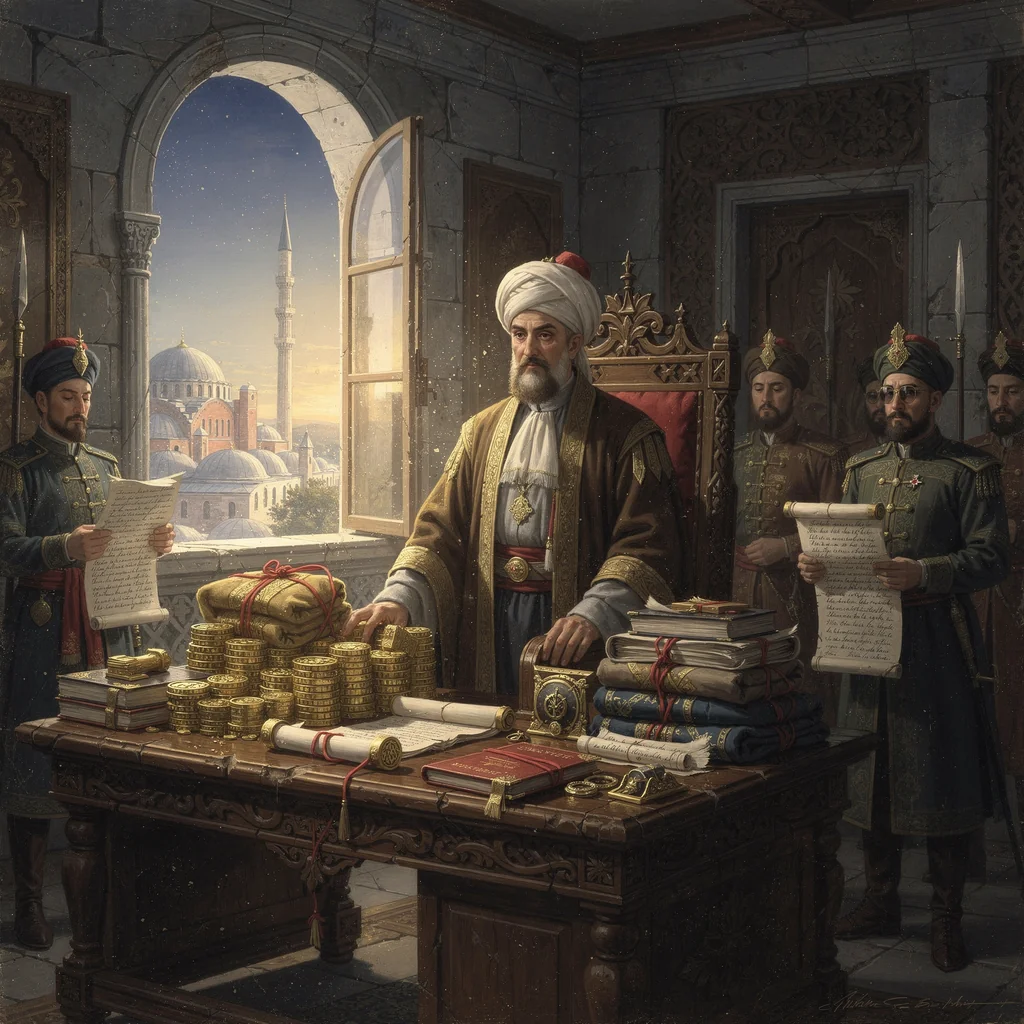
Mehmed sat at the desk in the inner chamber. He was eighty-one years old. His hands were spotted with age, his beard white as snow. He had been retired for four years, recalled from his village in Anatolia three weeks before because the empire was collapsing.
The first dossier was open.
Province: Bursa. Governor: İbrahim Pasha. Tax collection records show 400,000 akçe assessed from the tobacco merchants. Single tax receipt filed: 240,000 akçe. The remainder: unaccounted.
Mehmed lifted the page, examined the seal, set it aside.
Province: Egypt. Cairo Citadel garrison. Payroll lists 3,200 janissaries. Supply requisitions for 3,200 janissaries. Intelligence report: actual headcount, 2,400. Eight hundred salaries collected by the commander, split with the provincial treasurer.
Mehmed lifted the page, examined the seal, set it aside.
Province: Damascus. Grand Mufti appointments. Three positions vacant. Six applications received. Each application accompanied by a purse delivered to the kazasker (chief judge) in Istanbul. Purse contents: 8,000 akçe, 12,000 akçe, 15,000 akçe. The kazasker approved all three applicants. All three positions remain vacant. The mufti positions were never the point.
Mehmed lifted the page, examined the seal, set it aside.
He worked through the pile for three hours. The evidence was interlocking. Every corrupt official depended on every other corrupt official for cover. The governor who was stealing taxes depended on the janissary commander who was ghost-payrolling soldiers, who depended on the judge who was selling appointments, who depended on the palace clerk who was controlling access to the vizier.
The door opened. Fazıl Ahmed entered.
He was twenty-one years old, recently returned from his studies in Medina and Cairo. He had been appointed müderris (professor) at the Süleymaniye Madrasa.
“The runners are waiting,” Fazıl Ahmed said. “They want to know if there are more dossiers.”
Mehmed did not look up from the papers. “Tell them to return at the same time tomorrow.”
“There are more?”
“There will always be more.”
Mehmed placed another page on the growing stack. Province: Morea. The Venetian consul has been paying the sanjak-bey for not arresting pirates. The pirates Venetians. The payments recorded in the sanjak-bey’s ledger as “consular gifts.” The pirates take one in three ships passing through the Strait of Otranto. The consul takes none. The sanjak-bey takes two-thirds. The account is precise. The governor’s share is not listed.
Fazıl Ahmed pulled a chair to the side of the desk. He sat. He watched his father work.
A young scribe stood near the wall, recording the dossiers as Mehmed sorted them. His ink-stained fingers moved quickly across the page, his eyes taking in not just the facts but the weight of them — thirty-six thousand lives being decided in this room. He was Fasih Ahmed Dede, a Mevlevi poet attached to the household treasury, though Fazıl Ahmed did not know him yet. The scribe watched a death warrant being signed and wrote a single line in the margin of his notebook: The ink is wet. The hand is steady. The empire is dying.
Fazıl Ahmed noticed the scribe’s hand pause, saw the line being written, but said nothing.
Mehmed did not explain. He read. He sorted. He placed each page in one of three piles: executions, dismissals, investigations.
The pile for executions was the largest.
“What happens to them?” Fazıl Ahmed asked.
Mehmed did not answer. He picked up another dossier.
The new Sheikh al-Islam received them in a reception room off the courtyard of the Hagia Sophia. The walls were lined with shelves of leather-bound manuscripts — centuries of Islamic legal scholarship. The air smelled of old paper and incense. Light from the high windows caught dust motes floating above the floor.
The Sheikh himself was seventy years of a face that had seen five sultans and six grand viziers. His beard was dyed with henna, a bright orange against the white of his robes. His hands were spotted with age but steady when he lifted a manuscript from the shelf. He had been appointed only days before, after the previous Sheikh’s involvement in the plot against the Sultan had been discovered.
He did not ask them to sit. He did not offer tea. He stood by the window, looking out at the dome of the great church, while Mehmed spoke of the dying empire.
Mehmed came alone. Fazıl Ahmed remained in the anteroom.
“The empire is dying,” Mehmed said, without preamble. “I have read the evidence. The rot is systemic. It cannot be cut away piece by piece. It must be excised entirely, or the patient dies.”
The Sheikh al-Islam listened. He nodded. He asked questions about the scope of the corruption, the number of officials involved, the provinces most affected. Mehmed answered precisely. Thirty-six thousand officials. All core provinces. The empire itself.
“This is the question,” the Sheikh said. “Is it permitted to execute thirty-six thousand men to save the state?”
Mehmed waited.
The Sheikh drew breath. “The Quran permits execution for three crimes: murder, theft, and rebellion against the legitimate authority.” He listed the relevant verses. He explained the conditions under which each could apply. He spoke of the rights of the accused, the necessity of witnesses, the obligation of the ruler to act with mercy.
Mehmed listened.
When the Sheikh finished, Mehmed asked the question again. “The treasury is empty. The Janissaries are unpaid and uncontrollable. The provinces are being stripped by the very men appointed to govern them. The army cannot march because there is no money to pay them. The people are starving because the tax collectors take more than the law allows, and keep what they take. If I do not act, the state collapses. If the state collapses, the people die. Not thirty-six thousand men. Millions. Is it permitted to execute them all to save millions?”
The Sheikh considered this. He cited a hadith about the necessity of protecting the community from corruption. He explained the difference between those who rebel and those who enable rebellion. He spoke of the obligation of the ruler to maintain order.
Mehmed listened.
When the Sheikh finished, Mehmed asked the question a third time. “You have answered with theology and law. I am asking with necessity. If the state collapses, there is no law. There is no theology. There is only survival. Is it permitted to execute them so that millions may live?”
The Sheikh was silent for a long moment. Then he said: “The Imam al-Ghazali wrote that when the necessity of the community conflicts with the letter of the law, the necessity of the community prevails. But he also wrote that the ruler who acts from necessity must act with fear and trembling, knowing he will be asked to account.”
Mehmed nodded. “I am afraid.”
“Then you may proceed,” the Sheikh said.
Mehmed rose. He thanked the Sheikh. He turned toward the door, then stopped.
On the shelf beside the door, among the leather-bound manuscripts, his eye caught a spine he recognized — not the title, but the hand that had copied it. He had seen that particular script before, in the medical libraries of Cairo. Kitab al-Taysir. A physician from Seville, five centuries before.
Mehmed left without speaking of it.
“Sheikh,” he said. “Can a man serve the earthly city without losing the heavenly?”
The Sheikh was silent for a long moment. The question hung between them, unanswered.
“Some questions,” the Sheikh said at last, “are their own answer.”
Mehmed nodded. He turned toward the door.
“One question,” the Sheikh said.
Mehmed stopped.
“Do you know their names?”
“I have their names,” Mehmed said.
“Do you know their faces?”
“I have never met most of them.”
The Sheikh was silent for a moment. “Then be careful. The condemned include the innocent and the guilty, the corrupt and the compromised, the men who stole and the men who allowed the stealing because they were afraid to speak. You will execute all of them. God will ask you about each one.”
Mehmed nodded. “I know.”
He left the room.
The list lay on her desk, the ink still wet where the scribe had hurried to copy the names from the official register.
Turhan Sultan sat in the chair she had occupied every morning for three weeks. The list was the same each day: names, charges, locations, method of execution. The scribe copied them carefully, the Arabic script precise, each name recorded before the death occurred and after the sentence was pronounced.
She read the first name. Ali Pasha of Silistra. Governor. Charges: Illegal tax collection, theft from imperial treasury, abuse of office. Method: Beheading.
She touched the name. She did not know this man. She had never been to Silistra. She had never seen the Danube frontier. But she knew what he had done. She knew the farmers who had sent petitions to Istanbul, the ones whose children he had told to eat hunger.
The second name. İbrahim Çavuş, treasury scribe. Charges: Corruption, bribery, theft from petitioners. Method: Beheading.
She touched the name. She knew this man by reputation — the scribe who sat at the high desk in the treasury, who demanded fees for corrections that never came, who dipped his pen in ink while children went hungry.
The third name. Yusuf Agha, Janissary commander. Charges: Protection racket, extortion, abuse of authority. Method: Beheading.
She remembered this man. She had seen him in the bazaar once, standing at the carpet sellers’ quarter, his hand out for coins that merchants could not afford to pay. She had said nothing. She had been regent then.
Her fingers curled against the paper.
Her hand moved to the space above her heart. Meliki Hatun had nursed her son at her breast. Meliki Hatun’s body had been thrown from the palace walls in September.
Turhan had grieved then. She grieved now, watching these names on the list. But she did not stop them. She had given the old man the sword. She would not take it back.
She read on. Name after name, charge after charge, method after method. The list was three pages long. Each page represented a province. Each province represented a hundred villages. Each village represented a thousand people who had suffered while these men took what they wanted.
She touched the silk of her sleeves. The fabric was smooth against her fingers, softer than the rough wool she had worn in the snowy forests of her childhood, before the slavers came, before the sale to Kösem Sultan.
The paper on her desk was the proof.
She had given him the sword. He was using it.
The thirty-sixth name on the list caught her eye. Registrar of Mudanya, subprovincial. Charges: Falsification of land records, theft from imperial treasury, abuse of office. Method: Beheading.
She paused. The charge was technical, but the investigator’s note at the bottom of the page explained: Technically guilty. Functionally a victim. Recommendation: Dismissal, not execution.
The registrar had been executed anyway.
She touched the name. She did not know the man. She knew only that he had tried to protect farmers from a corrupt governor, and he had broken the law to do it, and he had died for it.
Her son was fourteen years old. He watched from behind the curtain as the lists arrived, as the execution reports accumulated, as the silence of the Hippodrome settled over the city.
The list continued. The ink was wet on some pages, dry on others.
Her hand moved from the seal to her belly. She felt nothing beneath her palm but the silk of her caftan and the steady beat of her heart.
The olive tree in the courtyard had dropped its leaves for the winter. The steward swept them into a pile near the wall, where they would dry and be used for fire kindling. He had been in Mehmed’s household for six years. He had dug the grave beneath the olive tree when the wife died. He had kept the house since.
A messenger arrived from Bursa — a boy on a donkey, carrying a cloth-wrapped packet from a clerk in the provincial treasury who owed the steward a favor.
Inside the packet: a folded note with no seal.
The note was brief. They say he has killed two thousand men in the provinces. The executions are happening everywhere. The bazaar is empty. No one speaks above a whisper in the streets.
The steward read the note three times. He folded it and placed it in his pocket.
He walked to the gate of the courtyard. From the gate, he could see the bridge that spanned the river — the stone bridge that gave the village its name. The old man had walked across that bridge every Friday for four years, sitting in the village circle with the farmers and shepherds, listening to their petitions, settling their disputes.
The messenger boy was still at the gate, waiting for a reply.
“Tell him the olives have been harvested,” the steward said. “The oil is in the jars. The winter will be hard, but we have enough.”
The boy nodded. He did not understand what he meant.
The steward touched the bridge post as the boy rode away. The stone was rough under his palm, worn smooth by years of hands passing through.
He returned to the house. He closed the gate. The sweeping continued.
The Bursa dossier sat on Mehmed’s desk for two days.
It was a small case. A subprovincial registrar in the village of Mudanya, responsible for recording land transfers and tax payments. The investigator’s report was clear: the registrar had been falsifying records for three years. The falsifications were small. A vineyard listed as two hectares instead of four. A tax payment recorded as 150 akçe when the actual payment was 300. The pattern was consistent but minor.
The investigator had interviewed the registrar. The man had confessed. He was forty-five years old, married with six children. He had served in the position for twelve years without prior incident. His explanation was simple: the subprovincial governor demanded a monthly cut of all recorded transactions. The cut was 30%. The registrar was recording the amounts received after the cut was taken, not the amounts that should have been recorded. The governor was keeping the difference.
The investigator’s note at the bottom: Technically guilty. Functionally a victim. Recommendation: Dismissal from office, not execution.
Mehmed read the report on the first day. He read it again on the second morning.
Fazıl Ahmed was in the room, reviewing the dossiers from Anatolia. He saw his father pick up the Bursa report. He saw him read it. He saw him set it aside.
The report went into the pile for executions.
That evening, Mehmed returned to his private chambers. Fazıl Ahmed had already retired. The palace was quiet. The old man lit a single lamp. He sat at his desk. He opened the Bursa report.
He read it again. He read the investigator’s note. Technically guilty. Functionally a victim.
Mehmed closed his eyes.
He thought of the vineyard. Two hectares recorded as two. Four hectares actual. The tax collector would have come anyway. The governor would have taken his cut. The registrar’s falsification had not cheated the empire. It had cheated the governor. The tax collector, following the falsified records, would have collected 150 akçe instead of 300. The difference of 150 akçe had gone to the farmer.
The registrar had tried to protect the farmer. He had done it clumsily. He had done it illegally. He had done it for three years.
He had six children.
Mehmed opened his eyes. He placed the report back in the execution pile.
He did not speak of it. He never spoke of it.
Fazıl Ahmed never learned the specifics of the Bursa case. But he noticed a change in his father’s face in the days that followed — a tightening around the eyes, a weariness that had not been there before. His father moved more slowly. His hands trembled slightly when he reached for his tea.
He proceeded anyway.
The executions began at dawn on the second day of November.
They did not take place in a single location. They happened across the empire: in the provincial capitals, in the district seats, in the subprovincial villages. The orders went out by courier on the first of November. By the tenth of November, they had all been carried out.
In Istanbul, the people heard the news before they saw the effects. The provincial governors had been recalled to the capital for consultation. They arrived in groups of five and ten, unaware that their colleagues in other provinces were already dead. They were greeted at the city gates by imperial guards, escorted to the Hippodrome, and executed there.
The sound carried across the city — the rhythmic thud of the executioner’s sword, carried on the wind from the Hippodrome to the Grand Bazaar, to the mosque courtyards, to the houses where people listened and counted the strokes and wondered who would be next.
Ali Pasha of Silistra arrived on the third day. He had ridden for six days from the Danube frontier, bringing with him a wagonload of personal possessions — carpets, silver, the accumulated wealth of twelve years of illegal tax collections. The dust of travel still coated his caftan, his boots were stained with the mud of the road. The twelve farmers who had sent the petition to Istanbul — the ones whose children he had told to eat hunger — stood at the Hippodrome gates. They watched him dismount, confused, until the guards seized his arms.
He protested. He demanded to see the Grand Vizier. He offered bribes.
The guards did not listen. They marched him to the executioner’s block.
The farmers watched the governor fall. They looked at each other. None of them spoke. They simply turned and walked toward the city, where they would find work and send money home to their children, and where a new governor would take Ali Pasha’s place.
The method was efficient. A scribe read the charges. The condemned was given a moment to speak. Most said nothing. Some protested their innocence. Some begged. Some cursed. Then the executioner stepped forward.
The Hippodrome became a grave. The earth of the spina was turned over and over again in the weeks that followed. The smell of blood and open graves rose over the city, mixing with the smell of roasting coffee and the sea breeze from the Golden Horn.
İbrahim Çavuş, the treasury scribe, was executed on the fourth day. The farmer from Thrace — the one whose son’s tax payment had been incorrectly recorded, who had paid fifty akçe for a correction that never came — stood among the crowd at the Hippodrome. He watched the scribe who had sat at the high desk, dipping his pen in ink while children went hungry, fall under the executioner’s sword.
The farmer did not cheer. He did not speak. He simply turned and walked toward the treasury building, where a new scribe would sit at the high desk, and where perhaps this time, the correction would be made without a fee.
The Bursa registrar was executed on the fifth day. He was a small man — the subprovincial registrar from Mudanya, the one who had falsified the vineyard records to protect the farmers from the governor’s illegal cut. He walked to the Hippodrome alone. His wife did not come. His six children did not come.
The registrar did not protest. He did not beg. He stood before the executioner with his hands at his sides and his eyes on the horizon beyond the walls.
The scribe read the charges: falsification of land records, theft from the imperial treasury, abuse of office.
The registrar listened. When the scribe finished, he spoke one sentence: “The farmers’ children ate this winter.”
Then he knelt. The sword fell.
Istanbul did not see the executions directly. What Istanbul saw was the silence.
On the morning of the third day, a merchant opened his stall in the Grand Bazaar at his usual hour. He laid out his carpets, arranged his copper vessels, waited for customers.
The bazaar remained empty.
He could hear the sounds from beyond the walls: the rhythmic thud of the executioner’s sword, carried on the wind across the city. He could hear the cries from the Hippodrome. He could hear the silence of the people who had gathered to watch and then could not look away.
An hour passed. Two hours. No customers came.
The merchant closed his stall. He went home. He told his wife: “Today is not a day for trade.”
On the morning of the fifth day, the water-seller who worked the Atmeydanı went to his usual place near the Hippodrome. He filled his buckets from the fountain. He arranged his cups. He called his price into the morning air.
No one answered.
The Hippodrome was empty except for the bodies. The executioners had finished their work and left. The gravediggers were waiting for permission to bury. The water-seller stood alone in the great square, calling his price to no one.
Slowly, the city began to understand.
The governors were dead. The judges were dead. The commanders were dead. The clerks and the registrars and the tax collectors were dead. Thirty-six thousand positions of authority, vacated in a single week.
Istanbul waited. The city had seen purges before. It knew how this worked. The executions would stop. The new men would be appointed. Life would return.
But the week passed, and the executions continued.
On the eighth day, the Janissary commanders were summoned. They came to the palace expecting to be consulted, perhaps arrested. They were not. They were executed in the courtyard of the Divan, in full view of the ministers who had been spared.
Commander Yusuf Agha was among them. The guards recognized him — the man who had stood at the carpet sellers’ quarter for years, collecting protection money on Tuesdays and Thursdays, changing the rate whenever he pleased. The merchants whose coins he had bitten, whose purses he had emptied, watched from the bazaar entrance as he was led to the courtyard.
The executioner’s sword fell.
The carpet merchant Garabed, watching from the crowd, did not cheer. He did not speak. He simply turned and walked back to his stall, where he laid out his carpets and waited for customers who would not come that day, or any day, until the purge was over.
On the tenth day, the executions stopped.
The city was quiet.
In the third week of November, Mehmed began building the replacement.
The dossiers of evidence had included the names of men who had opposed the corrupt officials. Men who had filed complaints and been ignored. Men who had refused to participate in the theft and been pushed aside. Men who were competent but not connected.
Mehmed summoned them.
They came from the Albanian highlands: ağas who had served under his father and grandfather, men who knew the meaning of loyalty. They came from the Mevlevi lodges: scribes and administrators who had been trained in the mystical orders and had learned to value service over power. They came from the provinces: minor officials who had maintained their integrity when their superiors had not.
He appointed them as governors.
He appointed them as judges.
He appointed them as commanders.
Each appointment was a risk. Many of these men had no experience in high office. Many had never commanded more than a dozen men. Some were illiterate. Some spoke no Turkish.
Mehmed bound them to him with a word: intisab. The obligation would pass from father to son.
Fazıl Ahmed watched his father receive the Albanian ağas in the Divan. They were mountain men, rough-hewn, with thick accents and simpler manners than the court officials they were replacing. They knelt and kissed the hem of his robe. They rose and stood awkwardly, unsure where to place their hands.
Mehmed received them with grave courtesy. He asked about their families. He asked about their villages. He asked about the crops.
Then he gave them their assignments.
“The province of Van needs a governor who cannot be bought,” he said to one. “You are from the Mirdita region. You know how to hold a line. Go to Van and hold it.”
The ağa looked confused. “My lord, I have never governed a province. I can barely read.”
“Then learn,” Mehmed said. “You have the support of the household. If you need help, send word. But do not steal from the people, and do not let others steal in your name. If you do, you will not like the consequences.”
The ağa swallowed. “I understand.”
“Go,” Mehmed said.
The man left. Fazıl Ahmed watched him go.
“Can he do it?” Fazıl Ahmed asked when the door had closed.
“He cannot,” Mehmed said. “But his cousin can. The cousin will manage the province while the ağa provides the face of authority. The cousin will be loyal to the ağa, and the ağa will be loyal to me. The province will be governed.”
Fazıl Ahmed considered this. “And if the cousin betrays him?”
“Then the ağa will kill him,” Mehmed said. “And the ağa will be executed, and I will appoint a new governor. But the cousin will not betray him. The cousin knows what the alternative is.”
Fazıl Ahmed was silent. He watched his father’s hands sort through the dossiers of the newly appointed. The old man moved slowly, purposefully, placing each name in its province, each province in its network.
By February 1657, the confiscations were complete.
The wealth of the condemned officials had been inventoried, cataloged, and deposited. The scale of it was staggering. Houses in Istanbul and Bursa and Cairo and Damascus. Land holdings in the provinces. Gold and silver and jewels. Carpets and tapestries and weapons. Libraries of books. Stables of horses.
The corrupt officials had stolen from the empire for decades. Now the empire was taking it back.
Defterdar Ahmed Pasha brought the final accounting to the Divan in late March. He was a small man, precise in his movements, with a beard that had been trimmed so recently that his skin still showed the marks of the razor. He had been appointed to his position three months before, replacing a man who had been executed for stealing the tax receipts of the entire province of Anatolia.
Defterdar Ahmed was a client of the household. He had been recommended by one of the Albanian ağas. He had served in the provincial treasury for twelve years, had been passed over for promotion seven times because he refused to pay bribes, had been ready to leave the service entirely when the messenger arrived with his appointment.
He would serve as finance minister for fourteen years.
Mehmed read the final accounting. The numbers were precise.
“Confiscated cash and movable assets: 4.7 million gold pieces.” “Confiscated property: 847 villages, 3,200 shops, 640 houses.” “Confiscated livestock: 12,000 sheep, 4,000 cattle, 800 horses.” “Total value: 12.4 million gold pieces, at current market rates.”
Mehmed set the ledger on the desk. He looked at Defterdar Ahmed.
“How much does the treasury need to operate?” Mehmed asked.
“Six hundred thousand gold pieces per year for the army,” Defterdar Ahmed said. “Three hundred thousand for the civil service. Two hundred thousand for the palace. One hundred thousand for emergencies. Total: 1.2 million per year.”
“And how much does the treasury currently contain?”
“Before the confiscations: forty-seven thousand gold pieces.”
Mehmed was silent.
“And now?”
“Now: 5.2 million gold pieces,” Defterdar Ahmed said. “After covering the salaries of the newly appointed officials and the costs of the confiscations and the executions, and after setting aside funds for the army’s winter campaign.”
“How much is left?”
“Four million gold pieces.”
Mehmed nodded. “Enough for three years.”
“Four years,” Defterdar Ahmed said. “If the campaign in Hungary succeeds, the war spoils will replenish the treasury. If it fails, we have enough to maintain the army through the winter and sue for peace in the spring.”
Mehmed picked up the pen. He signed the ledger. He handed it back.
“Keep the accounts current,” he said. “I want to know exactly where every coin is.”
“I will, my lord.”
Defterdar Ahmed gathered the ledgers. He moved to the door, then paused. He turned back, his hand on the doorframe.
“My lord,” he said. “If I may.”
Mehmed looked up.
“My daughter was born during the purge,” Defterdar Ahmed said, so quietly that Mehmed almost didn’t hear. “Three months ago, in Bursa, while the executions were underway. She will never know the empire we saved. She will only know the one we rebuilt.”
Mehmed was silent for a moment. “Then rebuild it well,” he said. “She will know it by its fruits.”
Defterdar Ahmed nodded. He bowed. He left the room.
Mehmed rose. He walked to the window of the Divan. Outside, the snow was falling on the Atmeydanı. The bronze horses of the ancient Hippodrome stood white against the gray sky.