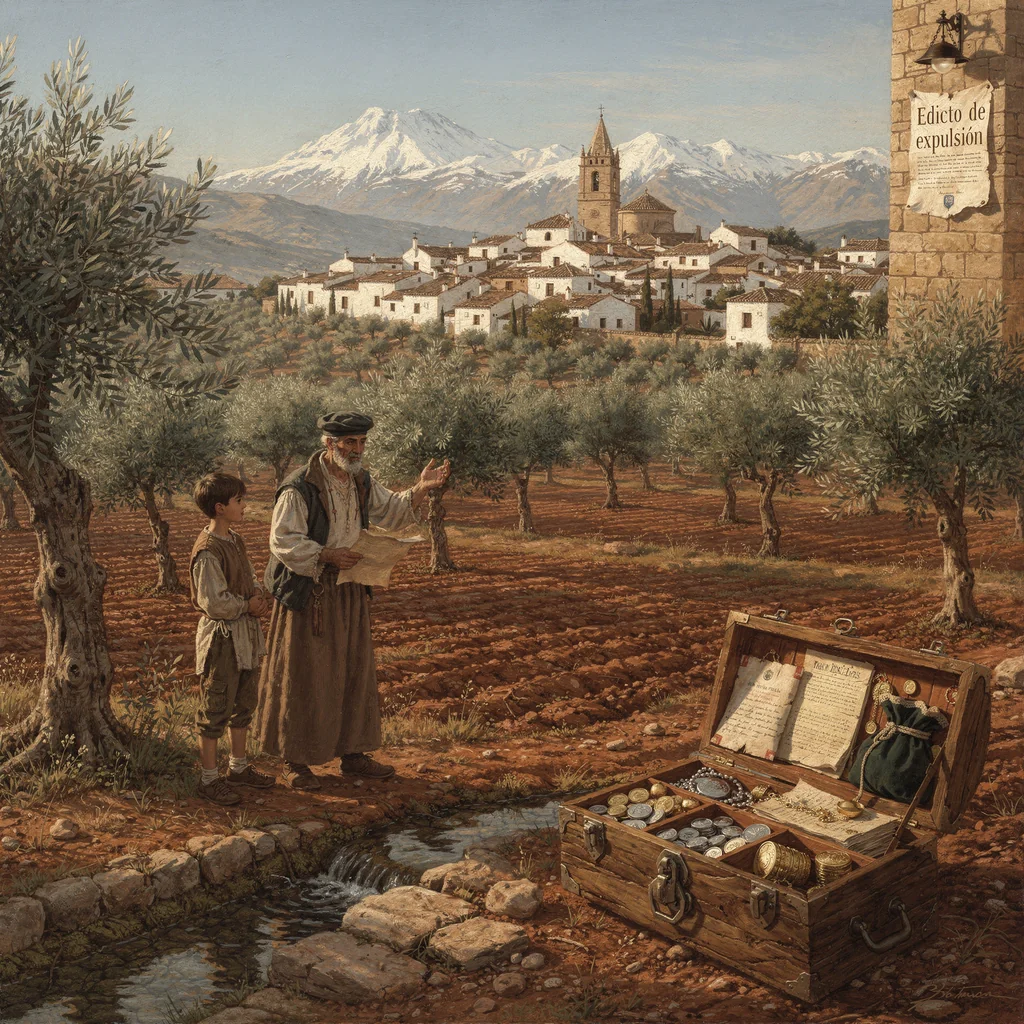
The olive trees formed a pattern his father had taught him to read.
The leaf curl meant the soil needed water. The yellow edge meant nitrogen was low. The branch that hung too low and pressed against the earth would rot where it touched.
Muṣṭafā moved between the rows, his hands checking the bark, his eyes noting what needed to be done before the harvest. He was sixteen years old. The Cárdenas family had worked the land near Baeza for as long as anyone could remember. Not that this mattered anymore. The order had come.
He found his father in the lower field, checking the irrigation channel. Water from the nearby spring ran through the ditch at the correct speed. His father straightened when he saw Muṣṭafā approaching.
“The southern slope,” his father said. “The leaves are curling.”
“The water’s not reaching there,” Muṣṭafā said. “The channel slopes two degrees too steep. The water runs too fast to soak in.”
His father nodded. This was the conversation they had been having since Muṣṭafā was old enough to walk the rows himself. Observation, diagnosis, solution. The olive tree did not lie. The tree revealed what was in the soil and what was missing from it.
They stood together at the edge of the field. The red earth of Andalusia stretched toward the village of Baeza, whose buildings rose white against the olive-dark distance. Beyond the fields, the Sierra Mágina rose white with snow in the distance. The same snow that melted into the springs, that watered the trees, that had paid the taxes for four generations of nominally Christian baptism.
“The notice is posted in the church,” his father said.
“I saw it,” Muṣṭafā said.
His father was quiet for a long moment, watching the water in the irrigation channel. Then he turned toward the house.
“Come with me,” his father said.
Muṣṭafā followed him to the counting room. The small room off the kitchen where his father kept the household accounts, where the tax records were stored, where the family’s wealth was measured in ledgers and coin.
Three ledgers sat on the shelf above the strongbox. The first tracked the olive harvest. Yield, press dates, oil quality, price per barrel. The second tracked the silk. Granada purchase price, Baeza finishing cost, Livorno sale margin. The third tracked neither harvest nor price. It tracked names.
His father unlocked the strongbox. A heavy iron chest that had belonged to his grandfather, who had brought it from the mountains when the family first planted these groves four generations ago. The lock clicked open, a sound that echoed in the small room.
Inside were not ledgers. Inside was wealth, condensed into portable form.
Gold doubloons. Venetian ducats. Spanish reales. Gems wrapped in cloth. The accumulated savings of four generations, converted into something that could be carried.
Muṣṭafā had never seen so much money in one place. His breath caught.
“We cannot take the trees,” his father said. “We cannot take the house. We cannot take the land. We can only take what fits in a cargo belt and a merchant’s chest.”
He began dividing the wealth into four piles.
“This pile,” his father said, pointing to the largest, “stays with us. Your mother and I will need it to survive the expulsion, to pay whatever bribes are necessary, to buy food when the prices rise.”
He pointed to the second pile, smaller. “This goes with your uncle in Bordeaux. If the French option becomes necessary, this will pay for our passage there.”
He pointed to the third pile. Substantial, but smaller than the first two. “This is for your younger brothers and sisters. When they come of age, they will need capital.”
He pointed to the fourth pile. The smallest, but still more money than Muṣṭafā had ever seen. “This goes with you.”
Muṣṭafā stared.
“You are sixteen years old,” his father said. “You can work. You can learn languages. You can read terrains and markets and ships the way you read trees. Your uncle in Livorno has agreed to hold this capital in trust until you arrive. He will forward it to Tunis when you send word.”
They were sending him away with capital. Enough to begin in Tunis without performing for authorities.
He tapped the smallest pile of coins.
He began transferring the coins into leather pouches, weighing them carefully, dividing them into smaller bags that Muṣṭafā could distribute across his body. Some in a belt beneath his tunic, some in hollows in his boots, some in the small leather bag he carried at his waist.
“Do not carry it all in one place,” his father said. “And do not trust it to a single ship.”
Muṣṭafā nodded.
The total weight across his body. Belt, boots, waist bag. Five kilograms.
Four generations of accumulated wealth, reduced to what a man could carry.
His father closed the strongbox. Locked it. The sound was final.
His hand rested on the iron lid. “The notice is posted in the church,” he said again.
“I saw it.”
“They say we have until September.”
Muṣṭafā had seen the notice himself that morning. It was not signed by the king. It was signed by the archbishop, the duke of Nájera, the city council. The expulsion of the Moriscos from the kingdom of Castile. All who refused to convert sincerely. And sincerity would be determined by examination. Must depart.
The Cárdenas family had been converting since the fall of Granada in 1492. One hundred and seventeen years of Mass. One hundred and seventeen years of confession. One hundred and seventeen years of looking like good Christians while saying Arabic prayers in the darkness before sleep.
One word had survived all of it. Not the prayers. The prayers had been shortened, simplified, performed in whispers or not at all. Not the rituals. The rituals had been adapted, disguised, abandoned. But the one word that needed no performance and no community and no darkness to say safely had traveled intact through every generation of performance. His grandfather had passed it to his father with a hand on the shoulder and no ceremony. His father passed it to him the same way.
The hand on his shoulder. The pressure of fingers. The breath synchronized.
Allah.
He had said it in Mass. He had said it in the fields. He had said it when the notice was posted in the church. It cost nothing. It required nothing. It could not be confiscated.
Now the performance was no longer enough.
“What will we do?” Muṣṭafā asked.
His father did not answer immediately. He watched the water in the irrigation channel. The water moved at the correct speed. The trees would have enough this season.
“Your uncle in Bordeaux has offered to sponsor us,” his father said. “He says he can arrange for us to appear as new converts in France. He says the French authorities are less concerned about these things.”
“And if they examine us there?” Muṣṭafā said.
“Then we move again.”
“If we move to France,” Muṣṭafā said, “we will plant new trees. In seven years, the French authorities may decide we are not French enough. And we will move again. And we will plant new trees again. And in another seven years, they may decide we are still not enough. And we will move again.”
“You have other ideas,” his father said.
“Not ideas,” Muṣṭafā said. “Just a question about what happens to the trees.”
They stood together in the silence of the orchard. The sun moved across the sky. The shadows lengthened. The work of the day called them. Checking the western slope, the northern fence, the storage sheds that needed repair before the harvest.
But neither of them moved.
“There are ships in Valencia,” Muṣṭafā said. “My cousin who went to Livorno last year said there are ships going to Tunis every week. He said the Ottomans do not care what you believe as long as you pay the tax. He said there are already Moriscos there. He said they have land.”
“Land for what?” his father said.
“For trees,” Muṣṭafā said. “For olives. For whatever the earth allows.”
His father watched the water. The water did not care who was Christian or Muslim, who was Spanish or Ottoman. The water watered what grew.
“And if we go,” his father said, “who will go? All of us? Who will speak for those who cannot leave? Who will protect the families who have no passage? Who will ensure our people are not forgotten in Baeza?”
Muṣṭafā had calculated this already. The family could travel. They had the means, they had the connections. But they were the tree that others sheltered beneath. In Baeza, in Úbeda, in the villages of the Guadalquivir, families looked to them. Their name opened doors. Their presence offered protection. If they left, who would remain?
He was sixteen years old. Not yet rooted. Not yet the tree that others needed. He would go first. A scout, an advance party, the first root in new soil. When he had found a place, when he had built what the family would need, when he could send word back that there was opportunity. Then the others would follow. Those who could not leave would still have his parents’ protection. Those who could leave would have his path to follow.
He had considered all of it. The weight of the decision was not money. It was duty.
“I will go first,” Muṣṭafā said.
His father did not argue.
“When will you leave?” his father asked.
“Soon,” Muṣṭafā said. “Before the deadline. Before the harbor becomes too crowded. Before the roads become dangerous.”
“What will you take?”
He could take clothes. He could take tools. He could take cuttings from the trees they grew here, scions that would carry the genetic memory of the Baeza soil to whatever soil they found themselves in.
“Myself,” Muṣṭafā said. “And the knowledge of what trees need.”
His father did not ask if this was enough.
His mother found him in the kitchen as he packed. She pressed a small cloth pouch into his hand. Seeds from her garden — mint, cumin, the bitter herbs for tea. A few dried leaves she said would settle the stomach at sea. She held his face in both hands, looked at him, and let go.
They walked together to the oldest tree in the lower orchard. The tree his grandfather’s grandfather had planted, four generations of Baeza soil in its roots. His father took a small knife from his belt and cut a single branch, young and green, with five leaves already formed. He wrapped the cutting in cloth, then in leather, and handed it to Muṣṭafā.
No words passed between them.
Muṣṭafā placed the cutting in his bag beside his mother’s seeds.
The road to Valencia took six days. Muṣṭafā rode alone, carrying small bags of gold distributed across his body, his clothes simple enough not to attract attention, his face calm enough not to invite questions.
He stopped the first night at an inn in Úbeda, where the innkeeper’s wife recognized his father’s name and gave him a room at the back, away from the road. She did not ask why a boy was traveling alone. She fed him well and sent him on with bread and cheese for the journey.
The second night he stayed with a merchant family in Albacete. People his uncle knew, families who had been preparing for this moment since before the expulsions began. They had a daughter his age who asked too many questions about where he was going. He answered vaguely and woke before dawn to avoid the conversation he could see coming.
The third day he crossed into territory he did not know, where the accents were strange and the roads felt hostile. He slept in fields, avoiding towns where Spanish officials might question a boy traveling alone.
He had been to Valencia before. The family maintained commercial contacts there. Merchants who traded in oil, in spices, in the goods that moved between the Mediterranean ports. This time, he was not here to buy.
He was here to observe.
The harbor was not large, but it was busy. Ships from Genoa, from Marseille, from Algiers, from Tunis. All riding at anchor or tied to the docks, their hulls rising and falling with the tide. Muṣṭafā moved through the crowd, watching.
He looked like a boy from the countryside.
The Spanish soldiers were searching passengers.
Muṣṭafā watched from the edge of the crowd. The soldiers were methodical. Checking papers, patting down clothing, opening small bags. When they found gold, when they found silver, when they found anything of value, they confiscated it. No receipt. No explanation. “Contraband,” they said, and the money disappeared into their pouches.
A merchant from Granada shouted as his sons’ passage money was taken. A woman from Córdoba wept as her life savings vanished into a soldier’s pocket. The soldiers did not stop. The Spanish authorities did not intervene.
Muṣṭafā’s hand went to the dagger at his belt. He felt the weight of the gold distributed across his body. He watched the merchant’s face as the soldiers took his sons’ passage money. He watched the woman’s hands as her life savings vanished into a soldier’s pouch.
He could step forward. He could speak. He could make himself visible.
His jaw tightened. Then relaxed. His hand moved away from the dagger hilt.
He turned back toward the shadows of the crowd.
He touched the cargo belt beneath his tunic, where his wealth was distributed in small bags across his body. Belt, boots, waist bag. His father’s caution was not about thieves. It was about the very people who were supposed to be protecting them.
He needed to leave from a port. But he could not leave from THIS port.
He turned away from the harbor. He would not sail from Valencia. He would not sail from any Spanish port where soldiers searched passengers and seized what they found.
He would ride north.
From Valencia, the road to Zaragoza took four days. He followed the routes his uncle’s merchant contacts had marked — families who had been preparing for this moment since before the expulsions began. In Teruel, a wool merchant asked no questions and gave him floor space behind the bales. He woke to the smell of lanolin and left before the merchant stirred.
From Zaragoza, he followed the secret route the Moriscos had been using for years. North through Huesca, then up into the Pyrenees toward the passes that led into France. The road was harder now, climbing into mountains where the air grew thin and the nights grew cold. He slept in barns, in stables, once in a cave where a goatherd showed him shelter and shared his fire. The firelight revealed hands scarred by rope burns, the fingers thick from gripping goat horns. The goatherd did not ask his name. He asked only which way Muṣṭafā was traveling.
“North,” Muṣṭafā said.
“Then follow the ridge,” the goatherd said. “The soldiers do not patrol the high places.”
Muṣṭafā followed the ridge across the border into France. The first French village he saw was Ustou, in the shadow of the mountains. The road descended from there into the valley of the Ariège, toward Toulouse, where the Duke of Montmorency’s protection began. Where French soldiers would not search him. Where French officials would not confiscate what he carried.
He sent word from the first French post. A message carried by merchants who moved between Spanish and French borders with letters hidden in bales of wool: Riding north to Toulouse. Safe passage secured. Will send word when I reach Tunis.
He watched the merchant disappear into the crowd, carrying the first words from his hand to his father’s since the olive orchard. The weight in his chest lightened, just slightly.
From Ustou, the road to Toulouse took two days by horse. Muṣṭafā rode through the French countryside, observing the differences. The crops were wheat and grapes where olives grew in Spain. The villages were built of stone where adobe was common in Andalusia. The language was French where Castilian was spoken at home.
He passed through the town of Pau, where French soldiers leaned on their pikes and watched the road with the flat eyes of men waiting for their shift to end.
Toulouse appeared on the horizon. A walled city where the road widened, a center of trade and administration.
He entered the city through the western gate.
The square inside the walls was crowded with refugees and their bundles. Muṣṭafā moved through the crowd, observing.
Near the center of the square, French officials were set up at tables, registering families, checking names, organizing the caravans to Agde.
Muṣṭafā joined the line.
When he reached the table, the official looked up.
“Name,” the official said in French.
“Cárdenas,” Muṣṭafā said in French. “Muṣṭafā de Cárdenas. Traveling alone.”
The official wrote this down.
“Destination,” the official said.
“Tunis,” Muṣṭafā said.
The official nodded. He wrote this down too.
“Next caravan to Agde leaves tomorrow morning,” the official said. “Military escort for protection on the road. The cost is ten ducats for passage. Ship fare from Agde is extra.”
Muṣṭafā calculated. Ten ducats was affordable. The ship fare from Agde would be more, but he had capital.
“I’ll join the caravan,” he said.
The official gave him a token. A small wooden disc with a number.
“Be at the eastern gate at dawn,” the official said.
Muṣṭafā took the token and moved away from the table.
He found a spot near the edge of the square and sat, watching the crowd.
Near the Hôtel de Ville, where the city officials conducted their business, a man stood apart from the refugees. Older, perhaps fifty, dressed in merchant’s clothing that marked him as different from the peasant families. He spoke French with the officials, Castilian with the refugees, Arabic with those who knew it.
Muṣṭafā watched him.
The man was organizing papers, checking lists, directing families to the correct registration tables. He moved efficiently, observantly, the way Muṣṭafā’s father moved through the orchard. Noticing what needed attention, addressing it before it became a problem.
Muṣṭafā waited until the man had a moment of relative calm, then approached.
“Excuse me,” Muṣṭafā said in Castilian. “Are you organizing the transit to Agde?”
The man looked at him. Sixteen years old, traveling alone, watching everything with sharp eyes.
“Some of it,” the man said. “My name is Joseph. I’m a merchant from Livorno. I’m here to help facilitate the departures.”
“Livorno,” Muṣṭafā repeated.
“The Grana community,” Joseph said. “Jewish families like mine, expelled from the same Iberian peninsula as you. We have connections in Livorno, in Tunis, across the Mediterranean. We help when we can.”
Muṣṭafā nodded. He had heard about the Grana. The Livornese Jews who had built commercial connections across the sea.
“I have an uncle in Livorno,” Muṣṭafā said. “He’s holding capital for me. A letter of credit.”
Joseph’s expression shifted slightly. The mention of capital changed the calculation.
“Your uncle’s name,” Joseph said.
Muṣṭafā told him.
Joseph nodded. “I know the name. The Livorno community is small. Your uncle is a respected merchant.”
He looked at Muṣṭafā with new interest.
“When you reach Tunis,” Joseph said, “find my colleague Shmuel at the harbor. He’ll be expecting you. He’ll help you process the letter of credit. The Livorno factor in Tunis will release the capital when Shmuel confirms your identity.”
“Thank you,” Muṣṭafā said.
“Don’t thank me yet,” Joseph said. “The sea crossing is dangerous. The ships are crowded. Not everyone survives.”
He paused. “You’re young to be traveling alone.”
“My family sent me ahead,” Muṣṭafā said. “To find opportunity. If I find it, they follow.”
Joseph nodded.
“You watch everything,” Joseph said. “That will serve you in Tunis.”
He returned to his work, organizing papers, directing families.
Muṣṭafā moved back to his spot near the edge of the square and watched.
The sun set over Toulouse. The square filled with families preparing to sleep. Blankets spread on the ground, children settling down, the murmur of many languages merging into one sound.
Muṣṭafā found a space near the wall, wrapped himself in his cloak, and tried to sleep.
He dreamed of olive trees. The trees in Baeza, the trees his grandfather had planted on the slopes of the Sierra Mágina, the trees he would plant somewhere else, in soil he had not yet seen.
He woke before dawn.
The caravan to Agde formed at the eastern gate of Toulouse at first light.
Thirty families. Three wagons. Two dozen soldiers on horseback. The Duke of Montmorency’s military escort, providing safe passage through French territory.
Muṣṭafā joined the caravan. He rode his horse alongside the wagons, carrying what he needed in his saddlebags.
The journey took four days.
The road was good. French roads, maintained better than the Spanish tracks he had ridden weeks earlier. The soldiers kept watch, riding ahead and behind, scouting for bandits or Spanish agents who might cross the border.
They passed through French villages. Farms, vineyards, small towns where the peasants watched the caravan pass. Some came out to sell food to the refugees. Others stared from doorways, curious about the displaced peoples riding through their land.
Muṣṭafā rode in silence. He observed everything.
The villages were different from Spanish villages. The architecture was different. The crops were different. Grapevines, wheat, vegetables that did not grow in the dry heat of Andalusia.
On the fourth day, the smell of salt reached him.
The sea.
Agde appeared on the horizon. A walled town on the coast, a harbor filled with ships, the end of the French transit route.
The caravan approached the town gates. French soldiers waved them through. Refugees who had been registered in Toulouse, who carried the Duke’s authorization, who were under French protection until they embarked.
The harbor was organized. Unlike the chaotic port of Valencia, Agde was controlled. French officials checking embarkation papers, merchants negotiating fares, ships loading under supervision.
This was the official French embarkation port. The Duke of Montmorency had designated Agde as the departure point for all Moriscos in the humanitarian corridor.
The family ahead of Muṣṭafā in the registration line discovered their papers were insufficient. The father had the permit. The mother’s was water-damaged, ink blurred where the seal should have been. The three children were undocumented entirely.
The official’s face did not change. “Next.”
The father began to beg. He offered coins. He offered the name of Joseph in Toulouse, who had helped them register. The official had already turned to the next person.
The father’s hand went to his daughter’s shoulder. He turned her toward the gate. They walked out without looking back.
Muṣṭafā watched. He did not intervene.
He moved through the crowd, observing.
On the dock at Agde, forty Granada merchants were loading their cargo onto a separate vessel. A larger ship, hired collectively. One man directed the loading with the efficiency of someone who had organized large shipments before. Muṣṭafā watched him for a moment and looked away. His father’s third ledger. The names.
Three vessels were tied at the dock, and two more were anchored in the harbor, taking on passengers through smaller boats that ferried people and cargo out to the larger vessels.
Muṣṭafā observed the loading process. The first ship was overcrowded. Cargo stacked on deck, people pressed into every available space. The second ship was better organized but still carried more than its capacity.
But Muṣṭafā did not calculate the angles of these ships. He did not need to.
The captain of the third ship stood near the gangplank, watching passengers board. He rejected a family with too many trunks. He rejected a merchant whose cargo looked too heavy. He was selective.
Muṣṭafā watched him.
The captain walked to the gangplank where an overweight merchant stood with two heavy trunks. The captain pressed the plank with his foot. It flexed too much.
“No,” the captain said.
The merchant began to speak, to offer more money. The captain had already turned away.
He watched Muṣṭafā for a moment.
The captain’s eyes flicked to the boy’s shoulders — the width of them, the way he stood balanced on the rocking dock.
“Can you work?” the captain asked.
Muṣṭafā nodded.
A loose line whipped in the wind. Muṣṭafā stepped forward, caught it, secured it to the cleat. Quick. Practiced.
The captain nodded once.
“I need passage to Tunis,” Muṣṭafā said. “I can work on deck. I can read the weather. I can help with the cargo. I don’t take up space below. I don’t get sick. I don’t cause trouble.”
The captain assessed him again. This time, not as a boy, but as a potential crew member.
“Do you know ships?”
“I know trees,” Muṣṭafā said. “I know how to read what they need. I know how to read what the weather is doing. I know how to notice what’s wrong before it becomes a problem.”
The captain watched him for a long moment.
“Can you steer?”
“I can learn what you teach me.”
The captain nodded once. “Sixty ducats for cabin fare. You work when I tell you to work. You sleep in your cabin, not on deck. You stay out of the way of the sailors. When we reach Tunis, you’re on your own.”
Muṣṭafā had calculated the offer. Sixty ducats was expensive, but cabin space was better than deck. He would have privacy for his gold, he would be safer in rough seas, he would arrive rested.
“Agreed,” Muṣṭafā said.
They shook hands. The captain’s grip was calloused, strong, the grip of a man who had hauled ropes and pulled anchors and wrestled with the sea in a way no landlubber ever had.
“Name?” the captain asked.
“Muṣṭafā,” he said. “Of the Cárdenas family.”
“Welcome aboard, Muṣṭafā of the Cárdenas family,” the captain said. “Don’t die on my ship. It’s bad for business.”
Muṣṭafā paid the sixty ducats. The gold changed hands. The captain gave him a cabin key. A small room forward of the main mast, narrow but private.
“You’ll work with the captain’s mate,” the captain said. “He teaches you navigation. Men who know shipping become men who move merchandise. Idle hands attract attention.”
He carried his small bag to the cabin, stowed his belongings, then returned to the deck.
The ship was loading rapidly. Cargo was being brought aboard. Crates, barrels, bundles. Passengers were embarking, finding their places, settling in for the journey.
Joseph the Grana appeared on the dock. He was organizing papers, checking manifests, directing families to the correct ships.
He saw Muṣṭafā on the deck of L’Espoir and nodded once.
Muṣṭafā nodded back.
A bell rang from the ship. The captain shouted orders. The sailors began casting off lines.
Muṣṭafā stood at the rail and watched the harbor.
The gap between the ship and the land widened.
He did not look back toward the road that led to Toulouse, to the Pyrenees, to Spain, to Baeza and the family orchard and the parents he might or might not see again.
He watched the horizon. He watched the sailors work. He noticed that the sailor who cast off the bow line did it with a quick, practiced flick of the wrist. The same gesture his uncle used when tying olive branches to the trellis.
The ship turned east. The sails caught the wind. France faded behind them.
The sea was not the land. Muṣṭafā learned this quickly.
In the orchard, the ground stayed still. On the sea, everything moved. The ship rose and fell. The horizon tilted left and right and back again. The sun moved across the sky differently.
The first night, he slept in his cabin, the small space rocking with the ship’s motion. The sky through the porthole was different. The stars were brighter, the constellations unfamiliar. He found the North Star, the one constant point, and watched it for a long time.
The same star that shone on the orchard in Baeza. The same star that would shine on wherever he was going.
The world was larger than Spain. The sky did not care about borders.
Some of the passengers became sick. Not Muṣṭafā. He had been prepared. His mother had given him herbs and instructions in the small pouch. Keep your eyes on the horizon. Don’t look down at the water. Breathe deeply when the air is still. Sleep when the ship is moving steadily.
He followed the instructions. He ate little. The dried food from his mother, supplemented by ship’s rations. He drank water sparingly.
On the second day, the captain’s mate found him at the rail.
“The captain says you’re to work with me,” the mate said. “He says you know trees. He thinks you can learn ships.”
“I can learn,” Muṣṭafā said.
“Then start learning,” the mate said.
For the next week, Muṣṭafā worked with the mate. He learned to read the sails. The curve of the canvas told him the wind strength. He learned to read the waves. The rhythm of the swell told him the sea state. He learned to navigate by the stars. The positions that changed with the season, with the latitude, with the ship’s course.
He learned shipping routes. The mate showed him the charts. The Mediterranean coastlines, the ports, the passages between islands. Tunis. Algiers. Marseille. Palermo. Genoa. Naples. Constantinople.
“You’re building a map in your head,” the mate said. “Good. A man who knows where he is can go anywhere.”
Muṣṭafā absorbed everything.
He learned wind patterns. The morning breeze from the land. The afternoon sea breeze. The storm winds that came from the north in winter, from the south in summer. The timing of the seasonal currents.
He learned port networks. Which ports had good harbors. Which ports had corrupt officials. Which ports were safe for a man with capital and which ports were dangerous.
Most of all, he learned that the water connected everything.
Valencia was connected to Tunis by the same sea that connected Marseille to Algiers, that connected Genoa to Constantinople. The Mediterranean was a single system of currents and winds and ports and merchants.
Standing at the rail in the darkness, he considered what name would be written in the Arabic register when he stepped onto Tunisian soil.
Cárdenas. The name his family had carried in Spain.
Or al-Qardanesh. The Arabic form.
He tested both sounds in his mind. One receded with the Spanish shore. The other waited for him in Tunis.
When Shmuel asked how to write his name, he would be ready.
On the tenth day, the lookout called from the crow’s nest.
“Land!”
Muṣṭafā had been awake since before dawn, watching the sky lighten in the east. He had seen the first hint of green on the horizon. The North African coast.
Now he could see it clearly. Mountains, rising from the sea. A coastline that curved north and south. The port of Tunis, a collection of white buildings in the distance.
The ship moved toward the harbor. The water changed color. From deep blue to turquoise, shallow enough to see the bottom near the shore.
The air was different than Spain. Hotter. Drier. Carrying a mineral smell. Salt, yes, but something else too. Earth dust. The smell of a land that had been under the sun for longer than Europe had existed.
The ship docked. The gangplank went down. The passengers began to disembark. Those who could walk, those who had family waiting, those who had nowhere to go but couldn’t stay on the ship any longer.
Muṣṭafā shouldered his small bag and walked down the gangplank.
His feet touched the dock. Wooden planks, worn smooth by thousands of footsteps over the years. The same wood that had felt the feet of merchants from Genoa and Marseille and Constantinople and Algiers and a hundred other places.
He stood for a moment on the dock, just breathing. The air tasted different. Mineral and hot and dry. The light was different. Brighter, harsher, casting sharper shadows.
The sound was different. Arabic everywhere, a language he didn’t speak yet, a language that sounded like the sea, constant and flowing.
He heard Castilian too. Andalusian Castilian, the dialect of Granada and Valencia and all the expelled places. He turned toward the sound.
A group of men stood near the port gate, greeting new arrivals. They were Andalusians. Muṣṭafā could tell by their faces, by their clothes, by the way they moved. Men who had been here long enough to establish themselves, who now helped the newly arrived find their footing.
One man in particular caught Muṣṭafā’s attention. Older, perhaps fifty, with the weathered face of someone who had crossed the sea himself decades ago. He was organizing arrivals, directing families to waiting carts, speaking Arabic with the officials and Castilian with the refugees.
The way he moved. Efficient, observant, calculating. Reminded Muṣṭafā of his father reading the trees. This was a man who noticed things.
It was Shmuel the Grana.
Muṣṭafā approached him.
“Are you Shmuel of the Livorno community?”
The older man nodded. “I am.”
“Joseph in Toulouse. He told me to find you here. He said you would be expecting me. My uncle is Solomon ibn Maruf.”
Shmuel studied him for a moment. “Joseph sent you?”
“He helped me register for the caravan to Agde.”
Shmuel nodded. “The Livorno community is small. Your uncle is a respected merchant.”
He looked at Muṣṭafā with new interest. “Come to my office tomorrow morning. We’ll process the letter of credit. The factor will release your capital when I confirm your identity.”
“How shall I write your name in the Arabic register?” Shmuel asked.
Muṣṭafā paused. He had been thinking about this for weeks. Ever since the Pyrenees, since the decision in the water.
“al-Qardanesh,” he said.
Shmuel nodded. “The Arabic version of your Spanish name.”
Muṣṭafā nodded. “The name I will use in Tunis.”
“Come,” Shmuel said. “The office is near the harbor. We’ll begin there.”
Muṣṭafā followed him through the port gate and into the city of Tunis.
The sun sank behind the port wall. Their shadows stretched long ahead of them into the streets of Tunis.