The road to Ras al-Tayeb took less than a day on horseback.
Muṣṭafā rode at the head of the procession. Twenty years old, on a horse he had purchased with capital from the Livorno account. Behind him came three families he had worked with in the souk—men and women and children, their possessions loaded onto carts and donkeys. Following him away from the crowded medina toward the red earth of Cap Bon.
One woman had questioned him until the last moment. Why leave the medina? Why trust empty earth? He had shown her the water channel calculations, the soil samples, the yield projections. Not vision. Evidence.
Sīdī Abū al-Ġayṯ rode beside him. The zawiya’s authority present without speaking. He had agreed to inspect the settlement—to observe, to advise, to return to Tunis unless the land proved viable.
Others would follow, if these first plantings survived. If the water held. If the first harvest came.
They reached the land by midday. Muṣṭafā’s olive grove. Three hundred trees planted the year before, waist-high saplings already toughening in the sun. They marked the northern boundary. To the south stretched the additional land he had purchased. More red earth waiting to be worked.
The families gathered in the shade of the olive trees. Muṣṭafā dismounted and spoke to them in Arabic.
“You’ve come because you have nothing in Tunis. You’re guests in someone else’s city. But here. This land will be yours.”
He had used more capital from Livorno to purchase additional tracts as mülk—freehold under Ottoman law. Now he parceled it out as long-term leases. One silver piece per year, symbolic. Each family held enough land for a house and a small grove. After twenty years, they could purchase the land from his heirs. The trees they planted would be theirs. The soil was good. The water was available. The location was close enough to Tunis for trade, far enough for independence.
One by one, he called the families forward. He showed them their boundaries. He explained where they would plant, where they would build, how the water system would work when they constructed it.
One man stopped him at the boundary marker. The site closest to the spring.
“This house,” the man said. “My family builds here.”
Another man stepped forward. “That site borders my grove. I need the water access.”
“The house site is smaller if you take the spring,” Muṣṭafā said to the first man. “But you have the water. The grove will be half the size.”
The first man looked at the spring. At the smaller plot. At his wife, who stood by the cart with the children.
“I take the spring,” he said.
The second man nodded. His hand tightened on the smaller deed. He would have the larger grove, farther from the water.
The old man from Granada touched the soil to his forehead. He said nothing. He rose.
Someone said the motto. Or no one said it. It was understood.
There is no victor but God.
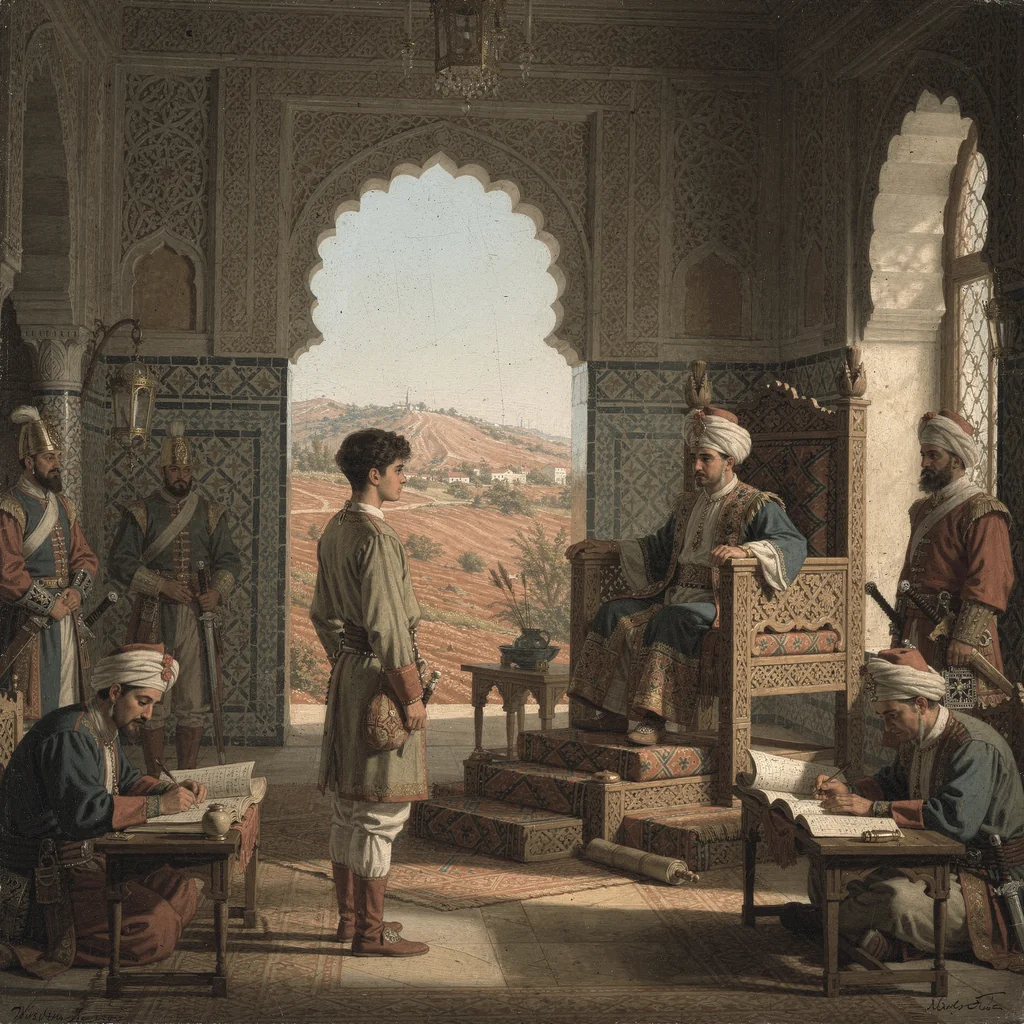
Two weeks later, an Ottoman scribe rode out from Tunis. He carried the defter—the land registry—and ink and the seal of the provincial governor. He examined the three houses going up. He examined the olive saplings planted.
“You lease to Moriscos,” the scribe said. “You are Morisco.”
“I am an Ottoman subject,” Muṣṭafā said. “They are Ottoman subjects. The land is mülk. The leases are registered.”
The scribe dipped his pen. He wrote each family’s name. He wrote the lease terms—one silver piece per year. He wrote the purchase option after twenty years.
“You keep the land,” the scribe said. “They keep the trees they plant.”
“Yes.”
The scribe blew on the ink. He pressed his seal to the parchment.
“It is unusual,” he said.
“It is recorded,” Muṣṭafā said.
The scribe rode back to Tunis. The paperwork was filed. The land was theirs by law.
The hammam went up first.
The community needed hot water for purification, for gathering, for the first night’s warmth in a place where nothing was built yet. The Granadan builder from the water channel project directed the construction. Muṣṭafā contributed the connections: the water channel routing, the heating chamber calculation, the wood quantity based on vault volume and ambient temperature.
“The flue angle?” the builder asked.
Muṣṭafā gave the calculation. The builder nodded.
Two men from the three families mixed mortar. The vault rose. The flues took shape.
Something in the earth’s smell caught Muṣṭafā’s attention. Mineral. Faint. The way air tastes before a storm.
The foundation stone was laid. When Sīdī Abū al-Ġayṯ indicated the stone, Muṣṭafā took the tool from his pocket—the wool-marking tool he had used since Baeza, the steel fitting his hand the way it had for a thousand bales. Together, sheikh and youth scratched the words into the limestone foundation.
There is no victor but God.
The letters were not elegant. They were not calligraphy. They were accurate. The mortar received them. The community watched. The stone was marked.
The first fire was lit at four in the afternoon. Muṣṭafā lit it, the builder watching. The first flames caught. The vault held the heat. The water heated.
Night came. One child cried for the Tunis medina—for the rooftops he knew, for the sounds of the souk, for the house that was not a tent. The mother made soft sounds. The father stood silent outside the unfinished wall, looking toward the dark shape of the olive trees that marked the northern boundary.
Muṣṭafā heard the crying. He said nothing. He walked to the cistern he had dug, checked the water level one more time.
The child slept. The night held.
The community gathered as the light failed. They came because the hammam was warm. Because the steam was rising from the heating platform. Because there was a building with hot water and a stone floor and a fire that someone lit and would light again tomorrow.
They entered the space one by one. The steam was already rising, thickening in the vault. The motto was visible on the foundation stone where the steam had not yet obscured it. There is no victor but God. Scratched into the limestone with a wool-marking tool, legible not beautiful. No one looked at it directly. The steam thickened.
Muṣṭafā stood in the anteroom. He could feel the heat through the stone floor. The mineral smell of the red earth was in his hands. The same smell he had noticed when they arrived, fainter now but present. He did not wash it off.
The fire continued in the heating chamber. The water continued to heat. The steam rose through the vaulted ceiling and out through the chimney in a single thin thread, straight as a plumb line, against the darkening sky.