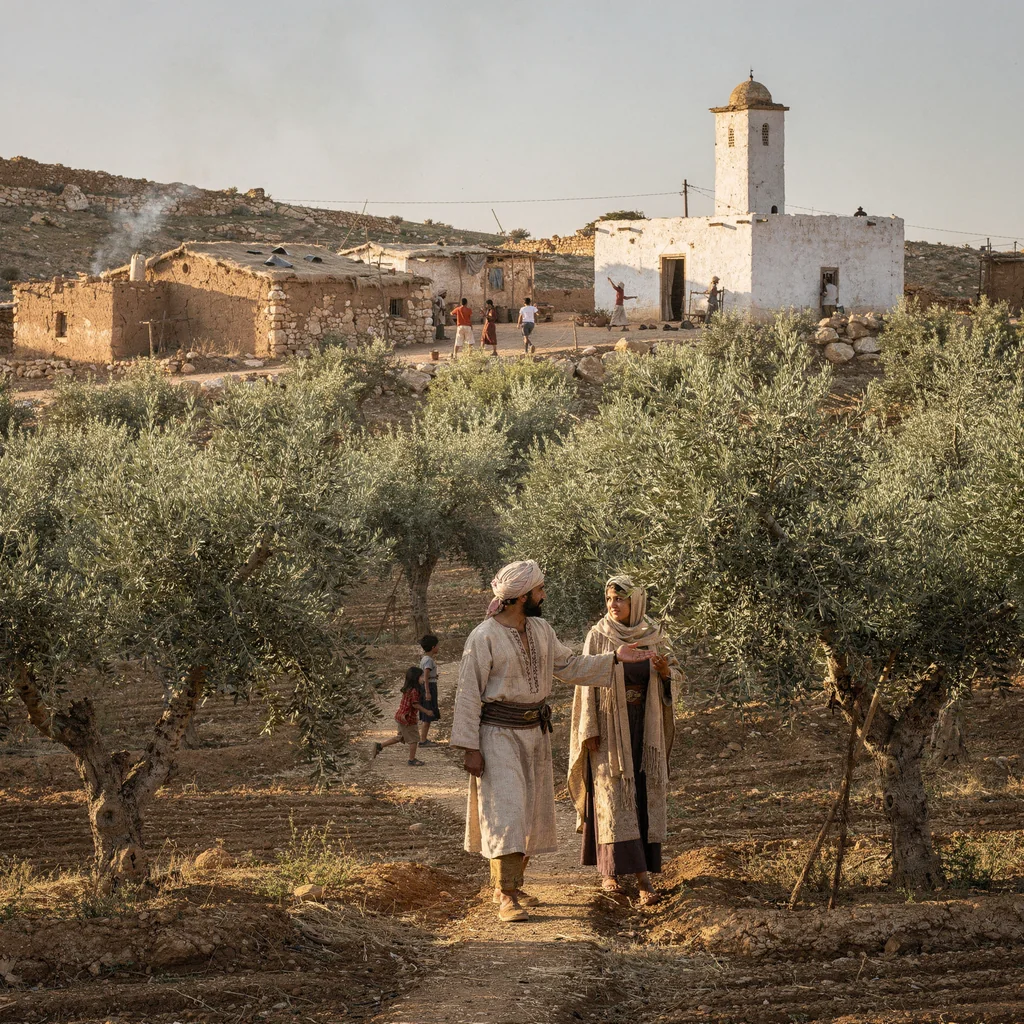
The road to Zaghouan rose into the limestone hills.
Muṣṭafā had been riding since dawn, following Sīdī Abū al-Ġayṯ’s direction. Not for water—Grombalia’s springs were sufficient—but for the community that struggled where water was abundant yet poorly shared.
He was twenty-three years old.
The mountain rose ahead. Djebel Zaghouan, the source. The spring emerged from the limestone at 1,295 meters. Mineral water that had filtered through the mountain for centuries. The Romans had built the aqueduct to capture it, carrying water to Carthage, forty kilometers north. He had read about the aqueduct in Leo’s Description of Africa. Now he was seeing it.
He found the Andalusian settlement where the mountain road forked. A cluster of stone houses. A mosque. Water channels that diverted flow from the main aqueduct. No sheikh. No leader. Only three extended families, gathered in the largest house, arguing.
They fell silent when he entered.
Muṣṭafā had seen divided communities before. In the souk, in the Andalusian quarter, in the years after the expulsion. But this division was different.
Three families from Granada wanted intensive plots, saffron and silk, hands in the soil every day. Two families from Valencia wanted what he had built: olives, patience, trees that outlasted rulers. One family from Aragon wanted to sell the land and return to Tunis, to trade, to forget agriculture entirely.
They showed him their channels. Stone-lined, Roman-era, sufficient for twice their current planting. But the Granada faction had blocked maintenance until their intensive plan was accepted. The Valencia faction refused to maintain what they might not control. The Aragon faction refused to invest labor in land they intended to sell.
Muṣṭafā walked the channels for two days. He said little. He observed where water pooled, where it ran wasted, where limestone seepage reduced flow.
On the third day, an old man from the Valencia faction pointed south, past the spring, to where the mountain rose behind the settlement.
“Up there. Two hours’ walk. There is a cave.”
Muṣṭafā waited.
“Al-Shādhilī stayed in that cave. Before he went to Egypt. Before the order spread. He came here. We show it to visitors.”
Muṣṭafā looked at the mountain.
The cave was two hours up the mountain.
Muṣṭafā climbed alone, leaving the settlement at dawn. The path was steep. A goat track winding upward through limestone outcrops and wild olive trees. The air grew thinner as he climbed. The Roman aqueduct arched below him. A thin line of stone across the valley floor.
He reached the cave by midday.
It was not large. A hollow in the limestone, deep enough to shelter one man sitting, wide enough for one man to lie down. The stone floor was worn smooth by centuries of human presence. The walls bore scratches where others had carved before him.
Muṣṭafā entered the cave.
He sat with his back against the limestone wall. He took from his pouch the bread and olives he had brought. The same meal Ibn Tufayl’s Hayy ibn Yaqzan had eaten on his island.
He ate slowly. He watched the light move across the cave floor.
For two days, he stayed in the cave. He did not speak. He did not pray in the formal sense. He sat. He watched. He listened.
The first day, his mind was full. The Zaghouan factions. The channels they would not maintain. The disagreement they would not resolve. He thought about Grombalia, about the trees, about the three families who depended on him for land and leadership.
The second day, the thoughts began to slow. The silence of the cave entered him. He noticed things he had not noticed before. The way the light changed when the sun moved. The sound of wind through the limestone cracks. The smell of the mountain itself. Mineral. Ancient. Patient.
On the third day, Muṣṭafā stood. He stretched his limbs, stiff from two days of stillness. He walked to the cave entrance.
Djebel Zaghouan spread below him. The ridge. The valley. The aqueduct arching toward Carthage. The Mediterranean glinting in the distance. The red earth of Cap Bon was visible to the northeast.
He could not decide for them.
He descended toward the settlement.
He gathered the factions in the largest house. Spoke briefly:
“Your water is sufficient. Your channels are sound. Your disagreement is not technical. You have not decided whether you are farmers or merchants. Decide that. Then build. I cannot decide for you.”
He rode back to Grombalia.
The mineral smell of the spring faded behind him as the road climbed.
The water system improvements took two years.
Muṣṭafā implemented the improvements at Grombalia. The three families shared maintenance labor. They arbitrated disputes through Sīdī Abū al-Ġayṯ.
He hired workers from the three families. They dug new cisterns deeper. They lined them with stone and clay to prevent seepage. They built channels with precise gradients, following the contours of the land.
He built catchment basins above the groves to store winter rain. He taught the workers to read the soil moisture the way he had been taught. Testing the earth. Observing the leaves. Adjusting the flow.
By late 1617, the improved system was working.
The first channel ended in a stone basin. Smaller channels radiated outward like tree branches, serving each section of grove.
The trees had been waiting.
The first plantings were four years old now. Knee-high saplings that had survived the drought of 1615. The trees grew stronger. The leaves were brighter. The root systems established themselves deep in the red earth.
Muṣṭafā walked the groves every morning. He checked the water flow, adjusted the sluice gates, tested the soil moisture. The red earth was limestone-based, well-draining, perfect for olives.
He was building something his grandfather in Baeza would have recognized.
The French consul came to the souk in 1618.
Muṣṭafā was negotiating with a Genoese merchant. Discussing the price of oil, the quality of this year’s press, the shipping arrangements for the Marseille fleet. His workers stood behind him with the samples, but Muṣṭafā handled the negotiation himself.
The consul watched him.
The French had a consulate in Tunis now, representing French commercial interests. They documented shipping. They noted who was buying what, who was selling to whom.
Muṣṭafā had seen the consul before. Had nodded in the street. Had not stopped to talk.
“You are Mustafa de Cardenas.”
Muṣṭafā continued sorting.
“Al-Qardanesh.”
“The Arabic form. I have heard the name. In shipping manifests. You export oil to Marseille.”
Muṣṭafā placed a particularly large olive in the curing pile.
“You purchased property in the Ras al-Tayeb peninsula.”
Muṣṭafā said nothing.
“You appear to have significant capital for a recent arrival.”
Muṣṭafā paused.
The French documented the Morisco diaspora. They tracked wealth movements. They noted who was becoming powerful, who might become a trading partner.
Muṣṭafā finished sorting the olives. He wiped his hands on his apron. He turned to face the consul.
“I have investors.”
The consul waited.
“Family capital, liquidated in Spain.”
The consul studied him.
“You are building something in Ras al-Tayeb. Thousands of trees now. A community growing around them.”
Muṣṭafā waited.
“Who funds your planting?”
Muṣṭafā said nothing.
The consul noted the deflection. He would report: uncommunicative, possibly significant.
He turned to leave.
Then stopped.
“One question. The Moriscos who came before you. They work as laborers. They beg in the streets. They struggle to survive. You do not struggle. Why?”
Muṣṭafā had been asking himself that question since 1610.
“I did not come alone. I came with capital.”
The consul waited.
“My family had wealth in Spain. Four generations of accumulation. We liquidated everything in 1609. Vineyards, property, savings. Converted to portable form. I carried it to Tunis.”
“Most families could not.”
“Most families waited too long. They believed the expulsion would not happen. They believed they could negotiate. They believed they could buy time. By the time they realized, it was too late. Their wealth was trapped.”
He glanced at the Genoese merchant, who was waiting patiently for the negotiation to resume.
“My family did not wait. We liquidated early. We sold below value. We accepted the loss. We got the capital out.”
“Smart.”
“Expensive. We lost half our wealth in the conversion. But we kept the other half.”
The consul nodded.
“And you invested it.”
“I invested it. Not in houses. Not in shops. In land. In trees. In water. In things that cannot be confiscated.”
The consul’s eyes sharpened.
“You expect confiscation?”
Muṣṭafā touched the cargo belt at his waist. The habit of a man who had learned to carry wealth distributed across his body.
“I plan for the worst. I hope for the best.”
The consul nodded again.
“I will note that in the report. That you are cautious. That you understand risk.”
He walked away.
Muṣṭafā turned back to the Genoese merchant.
“Where were we? The price for the Marseille shipment.”
He married in 1620.
Her name was Fatima al-Zarqali. She was twenty years old, from a family of astronomers in Seville who had fled to Tunis in 1610. Her grandfather had been the court astronomer to the Sultan of Granada before the fall. Her father taught mathematics at the Zaytuna mosque.
They met in the souk.
Muṣṭafā was negotiating with a spice merchant. The price of saffron had risen, and the merchant was demanding more than Muṣṭafā wanted to pay. Muṣṭafā was calculating the profit margin on each jar, comparing it to the price in Marseille, the shipping cost, the risk of spoilage.
“You are reading the merchant’s hands.” A woman’s voice.
Muṣṭafā turned.
She stood behind him. Dark hair. Dark eyes. A basket of figs in her arms. She wore the simple blue dress of the Andalusian quarter.
Her free hand hovered over the figs for a moment before she lifted the basket. Checking the weight. Measuring.
“I am reading the price.”
“You are reading the merchant’s hands. His fingers are trembling. He needs this sale more than you need his saffron.”
Muṣṭafā looked at the merchant’s hands. They were trembling.
He looked at her.
“How do you know this?”
“I watch people. My father taught me to observe. To measure. To confirm what I see.”
“Who is your father?”
“ʿAbd al-Rahman al-Zarqali. The mathematician.”
She said the name the way Muṣṭafā said Baeza. A place that had made her.
Muṣṭafā noted this as he noted good soil. Andalusian families who had brought books with them in 1610, who had preserved what they could of the libraries of Granada and Córdoba.
“You are Fatima.”
“I am. You are Muṣṭafā al-Qardanesh. The planter. The one who founded Grombalia.”
“The one who reads merchants’ hands.”
She smiled. It changed her face.
“My father says you bought land in Ras al-Tayeb. Red earth. Limestone soil. Good drainage.”
“He knows agriculture?”
“He knows everything worth knowing. Mathematics. Astronomy. Agriculture. History. He says you are planting trees you will not live to harvest.”
Muṣṭafā had heard this before. From the workers in the groves. From the merchants in the souk. From the sheikh at Zaghouan.
“Someone will harvest them.”
“Your grandchildren.”
“I do not have children yet.”
“You will. The name continues. The trees continue. The work continues.”
She shifted the basket of figs.
“My father taught me to read the sky. To notice the patterns. To predict what the weather will bring. He says you read the land the same way.”
“I read what is there.”
“You read what will be there. That is different.”
She walked away, toward the spice stalls. Muṣṭafā watched her go. Then turned back to the saffron merchant.
“I will pay your price. But I expect quality.”
The merchant nodded.
They were married three months later.
The wedding was held in the Andalusian quarter, a simple ceremony attended by family and friends. Muṣṭafā did not invite the Ottoman authorities. He did not want the marriage to become a political event.
But the community came anyway.
Hundreds of Andalusians. From Granada, Córdoba, Seville, Valencia, Aragon, Castile. All the places they had left, all gathered now in Tunis to celebrate the marriage of the young planter who had bought land, who had built water channels, who had planted trees that would outlast them all.
Sīdī Abū al-Ġayṯ came, though his health was failing. He was eighty years old now. The lines on his face had deepened since Muṣṭafā first met him in the souk. He placed his hands on Muṣṭafā and Fatima’s heads.
Muṣṭafā read the room. Ottoman officials present. Hafsid scholars from the Zaytuna. Grana merchants from the port.
The Ottoman tax collector stood beside the Hafsid scholar. Both watched Sīdī Abū al-Ġayṯ’s hands on their heads.
“The trees you plant will feed your grandchildren. The water you bring will sustain your community. The name you carry will be remembered.”
They built a house in Grombalia, not in the Andalusian quarter of Tunis.
Muṣṭafā needed to be close to the groves. The trees required his attention. He walked the rows every morning, checking every tree, adjusting the water flow, noticing what the soil needed.
Fatima walked with him.
She learned to read the trees the way he did. She learned to notice what the land was saying. She learned to predict the harvest from the angle of the sun, the timing of the rains, the pattern of blossoms.
“My grandfather taught me the stars.” She spoke one evening, walking between the rows of young trees. “He said the sky is a clock. If you read it correctly, you know what time it is. Not the hour. The season. The year. The era.”
She stopped at one of the young olive trees they had planted together. She placed both hands on the bark. Palms flat. Fingers spread. Checking the texture the way her father checked an astrolabe before an observation. Measuring. Confirming.
She moved on. The touch was a measurement.
“These trees are also a clock. Seven years to fruit. Fifteen to full maturity. You are planting for 1635. For 1643.”
“For 1670. For 1680.”
“You will be seventy-seven in 1670.”
“If I live that long.”
“You will live. And you will see what you planted.”
She was pregnant already. They had not announced it yet. Too early. The first trimester was uncertain. But Muṣṭafā knew. He saw the way she rested in the afternoons. He saw the way she ate. The nausea coming in waves. The specific cravings for olives and for salt.
He had done the calculations. Conception. Late 1620. Birth. Late summer 1621.
A son, perhaps.
He filed it and said nothing.
He did not tell Fatima he knew. She would tell him when she was ready.
Instead, he planted another row of trees. Thirteen saplings, purchased from a nursery in Testour. He planted them in the same spacing he had used in 1615. Seven paces, six and a half, six, seven. Reading the soil, planting into what the land required.
Fatima watched him work.
“My grandfather in Seville planted an orange tree in the courtyard of our house. I was six years old. I asked him when we would eat the fruit.”
“What did he say?”
“He said. Not you. Your children. Not your children. Their children.” She paused. “I did not understand then. I understand now.”
Muṣṭafā pressed the soil around the thirteenth sapling.
“Your grandfather was from Zarqa. The village near Seville.”
“Yes.”
“Al-Zarqali. From the place.”
“And you are al-Qardanesh. The Arabic of your Castilian name.”
He stood. He wiped his hands on his tunic.
“And our son will be both.”
The son was born in August 1621.
They named him ʿAbd al-ʿAzīz.
After Muṣṭafā’s father. After the grandfather who had divided the strongbox in Baeza, who had sent Muṣṭafā away with capital and instructions. Build. Plant. Put down roots.
The boy was small, but healthy. Fatima recovered quickly. By autumn, she was walking the groves again, the baby strapped to her chest in a sling of woven wool.
She stopped at the first tree they had planted together. One hand supported the baby’s head. The other hand touched the bark. Checking, confirming. She stood there for a long moment. The child against her heart. The tree beneath her palm.
Muṣṭafā watched from the edge of the row.
ʿAbd al-ʿAzīz al-Qardanesh.
The trees were five years old now. Six years from fruiting. Nine years from full maturity.
Muṣṭafā was twenty-eight years old.
He had been in Tunis for twelve years. He had improved the water systems at Grombalia. He had planted thousands of trees. He had married into a family of scholars. He had a son.
The French consular reports noted the olive oil exports. Barrels per season, destinations, prices. They noted less often the silk thread moving in the other direction. From the Cap Bon mulberry groves through the medina workshops to the Ottoman trade routes east. The chechia craftsmen in the souk near Bab Souika took his thread and said nothing about where it came from. He said nothing about where it went. This was the correct arrangement.
The trees stood in their rows. The mineral water ran through the channels from the mountain. The boy slept in the room above the courtyard. The light moved across the red earth.