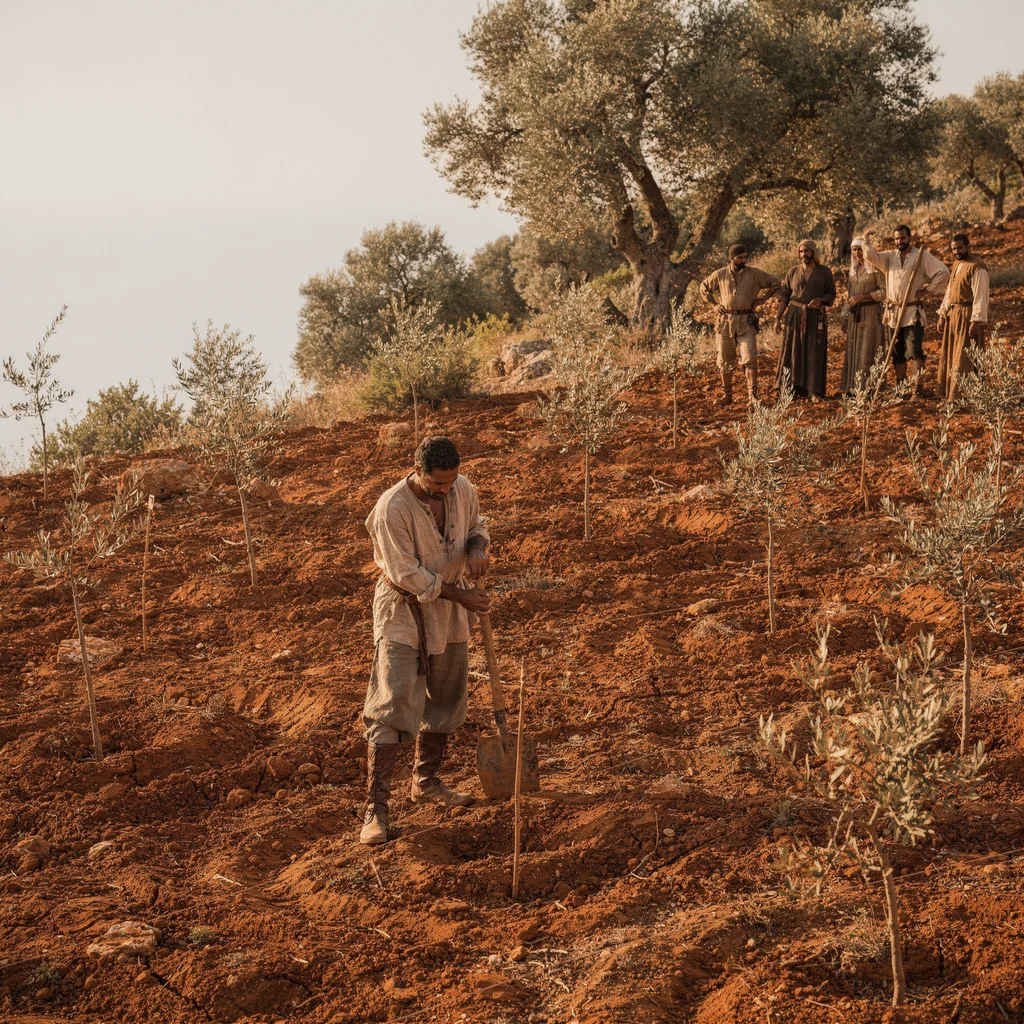
Two years had passed since the foundation stone. The three families from the first planting had built their houses along the northern ridge. One family had returned to Tunis after the first harvest—the soil was different than they expected. The other two remained, and three more joined from the coastal villages after seeing the trees survive the first summer. Smoke rising from hearths each morning. Children playing in the spaces between the houses. The call to prayer five times a day from the small mosque where Sīdī Abū al-Ġayṯ led the community.
Now Muṣṭafā was planning the next phase.
The earth was red. The slope angled toward the sea, though the water was not visible from here. The rain had come two days before. The soil still held it.
Muṣṭafā drove the spade into the ground. The blade bit deep. He lifted the earth, turned it, broke the clods with the spade’s edge. The smell rose. Mineral. Sharp. The limestone from the mountain range carried down in sediment.
He had walked this ridge for two years since the foundation stone. He knew where the water lingered after rain. He knew where it ran off too fast. He knew where the soil was thin and where it was deep enough to hold what the sky would give.
The workers stood at the edge of the cleared field. Three men. He had not asked their names. He needed their work.
He marked the first row with stakes and string. The line ran northeast to southwest. The sun would strike both sides of the canopy. The wind from the sea would pass between the trunks without tearing branches. He had calculated this. The calculations were correct.
The first hole. The spade bit, lifted, turned. He tested the depth with his forearm. The soil was correct. The water would drain but would not run off. The root ball would sit in moisture that would hold through the dry months.
Yūsuf from the coastal village, who had worked the September harvest, brought the sapling. Another held it upright while the third returned the amended soil. Muṣṭafā checked the alignment. The trunk was vertical. The root flare was at the surface. The graft union would be above the soil line when the earth settled.
Yūsuf nodded toward the varying spacing. “Seven paces here, six there.”
“Shallow soil,” Muṣṭafā said. “The roots need less competition where the water runs off.”
Yūsuf nodded again.
He pressed the soil around the roots with the heel of his hand. The pressure was correct. No air pockets. The root hairs would make contact.
The second tree. The spacing between them was seven paces. The canopies would touch in fifteen years. The roots would intertwine beneath the earth, sharing the moisture. He planted at the spacing the soil required. The soil had told him. Seven paces. The soil was correct.
The third tree. He adjusted the spacing to six and a half paces. The earth here was shallower. The limestone shelf was closer to the surface. The roots would need to compete less for water. He planted. The spacing was the information.
The fourth tree. The slope steepened. He adjusted to six paces. The drainage was faster here. The trees would need to be closer to hold the moisture in the root zone between them. He planted. The angle of the slope was the information. He read it and planted accordingly.
The fifth tree. He paused. The soil was deeper here. The water had lingered longest after the rain. He returned to seven paces. The soil was telling him something different. He adjusted. The soil was correct.
The sixth tree. A hum rose in his throat and stopped. Two notes, the second lower than the first, falling at the end like a question without the rise. He did not notice he had done it. The workers did not notice. The spade continued into the earth. The planting continued.
Later, some would say this was how the old songs survived. In 1615, it was only a hum that stopped.
The seventh tree. The row was half complete. He could see the pattern emerging. Seven paces, six and a half, six, seven, seven, six and a half. The spacing was the soil’s handwriting across the ridge.
The eighth tree. The sun had moved. The shadows lengthened. The workers were sweating. He was sweating. The work continued.
For a moment, the red earth reminded him of Baeza. The way his grandfather had walked the rows there. Checking the soil, testing the drainage, planting each tree where the earth required it. The spade continued into the earth. The planting continued.
The ninth tree. He checked the alignment. The row was straight. The string line had guided them. The string was a tool. The soil was the information.
The tenth tree. The slope leveled. The soil deepened. He returned to seven paces. The water would hold here. The roots would have room. The trees would grow wide. He planted. The soil was correct.
The eleventh tree. He could see the end of the row from here. Ten trees in the earth. The eleventh going in. The row would be complete.
The twelfth tree. He planted without pausing. The rhythm had entered his hands. The spade bit, lifted, turned. The sapling went in. The soil was pressed. The spade moved to the next marked point. The instrument was working.
The thirteenth tree. The last hole. The last sapling. The last pressing of soil around roots. The last checking of alignment. The row was complete.
He stood at the end of the row and looked back. Thirteen trees in a line northeast to southwest. The spacing varied. Seven, six and a half, six, seven, seven, six and a half, seven, six and a half, seven, seven, six and a half, seven. The pattern was not random. The row was correct.
He looked at it the way he looked at cargo in a ship’s hold. The comparison came unbidden. He did not correct it.
The mulberry trees at the ridge edge would need attention before spring. The silkworms were not patient the way olive trees were patient. They ate continuously, exclusively, urgently, and they could not wait. He had calculated the leaf yield against the cocoon harvest. The margins were different from olive oil. Faster. More demanding. More vulnerable to a single bad season. He would tend both. The olive for what would last. The mulberry for what would pay while the olives grew.
He turned toward the second row.