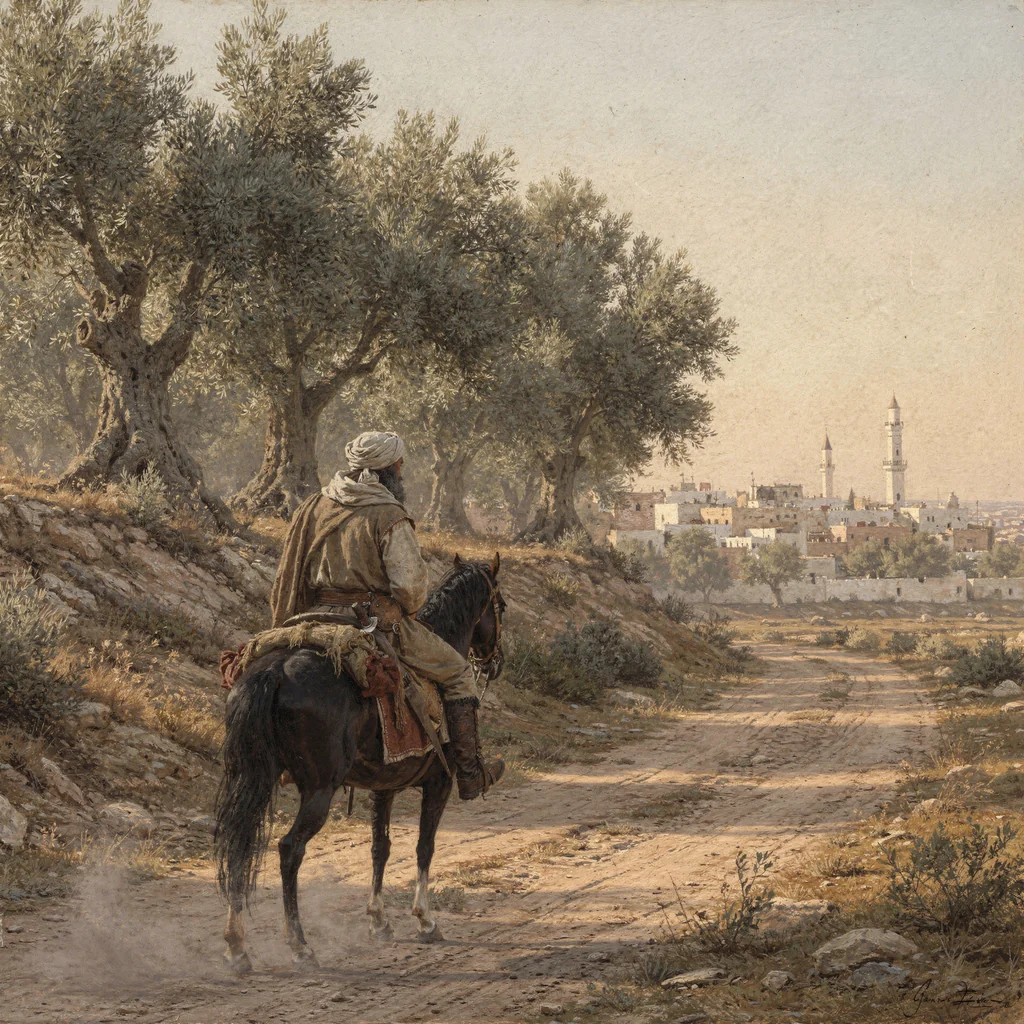
The workers had gone. The sun had set. Muṣṭafā walked the rows alone.
He had walked these rows for forty-one years. He knew every tree. He knew every stone. He knew where the water pooled after rain and where it ran off too fast.
The palace glowed in the distance. The Andalusian courtyard, the shaded arcades, the fountain that recirculated mineral water.
The mineral smell of the spring rose from the hammam, the same smell that had filled the steam the morning the motto was carved.
His home. The community’s home.
He walked toward it.
A man stepped from the shadows near the gate.
Muṣṭafā stopped.
He recognized the face—the son of the spice merchant in the souk, the one who carried messages for the Grana factors when they needed discretion.
“The network sends me.”
Muṣṭafā said nothing.
“The network has heard something. The Bey has sent soldiers. They are coming tonight.”
Muṣṭafā continued walking toward the palace. The messenger walked beside him, keeping pace.
“To arrest you?”
“To arrest you. To try you for treason, to confiscate everything. The trial will be fixed. The sentence will be death or exile. Either way, you lose.”
They reached the palace gate. The fountain splashed in the courtyard.
“Why?”
“You have become too powerful. The French consul has written reports. The Bey has read them. He has decided that you are a threat.”
Muṣṭafā unlocked the door. He stepped inside.
“Thank you.”
“The network will hide you. We can get you to a ship. We can get you out of Tunis before dawn.”
“No. Thank the network. I will handle this myself.”
The messenger nodded. He disappeared into the darkness.
Muṣṭafā walked to the study. He opened the floor panel beside the document chest—not the chest itself, but the smaller compartment hidden beneath the tiles.
Three letters, sealed with red wax, addressed to factors in Livorno, Genoa, Marseille. The Grana network had held his core capital for forty years, released in stages when he needed it, reinvested when he didn’t. The palace strongbox held working capital—ten thousand dirhems, perhaps. The network held ten times that. Accessible by letter. Not seizable by Ḥammūda.
He placed the letters in the satchel.
Then he opened the chest where he kept the documents.
The Sublime Porte seals from the 1627-28 peace negotiations. The waqf endowment papers. The account books proving fair payment. The tax records.
He had gathered them in 1650. He had kept them ready.
He placed the documents in the leather satchel with the Grana letters. He added water and bread for the journey.
He did not pack clothes. He did not pack the strongbox gold. He packed what Ḥammūda could not find: paper that activated wealth elsewhere.
Fatima appeared in the doorway. She had heard the messenger’s voice through the window. She had heard the words. Tonight. Arrest. Treason. Fixed trial. Death or exile.
She was fifty-four years old. Her hair was white now. Her face was lined with decades of reading the sky.
“The children stay with you.”
“The children stay with me.”
“ʿAbd al-ʿAzīz will manage the shipping. Aisha will manage the household. You will manage the community.”
Fatima nodded.
“The Bey cannot confiscate what belongs to God.”
“The waqf endowments remain. The endowed trees belong to Sidi Abū Marwān mosque. Even the Bey cannot take them.”
“He will try.”
“He will fail.”
He looked at his wife of thirty-four years.
“I will go to Constantinople. The Sublime Porte has honored my services before. They may grant me protection again.”
He paused.
“Then Annaba.”
Fatima knew of Annaba. The Algerian city on the coast, three days east of Tunis. Ottoman territory. Beyond the Bey’s reach.
“Then Annaba.”
“I will plant again. I am sixty-one years old. I am too old to start over. But I will start over anyway.”
He buckled the satchel closed.
“Come home when you can.”
“I will come home.”
He walked to the stables. He saddled his horse. A strong Arabian, black as night, fast and sure-footed.
He mounted the horse. He looked at the palace one last time. The courtyard, the fountain, the shaded arcades.
Then he turned the horse toward the road.
He did not look back.
The soldiers arrived at dawn.
Ḥammūda Bāšā rode at the front of the column. Two hundred men, armed and mounted, the dust of their passage rising from the road to Grombalia. They had come in the darkness. They had expected to find a sleeping Sheikh. They had expected to drag him from his bed. They had expected a body before breakfast.
They found an empty palace.
Fatima stood in the courtyard. She had dressed before dawn.
The soldiers dismounted.
Boots struck the courtyard stones—two hundred men, the sound of occupation. Fatima had walked these arcades for thirty-four years. She knew the way the morning light caught the fountain’s curve, the way the mineral smell rose from the water, the way the shaded corridors cooled the summer air. Now strangers moved through it all.
Men in the courtyard. Men in the arcades. Men in the doorways of rooms where her children had slept, where she and Muṣṭafā had made a home in exile.
She watched them. She did not move.
While the soldiers moved through the courtyard, Fatima stepped to the fountain basin. She dipped her hand in the water, touched the small channel that carried it to the olive trees. The flow was correct. She wiped her hand on her tunic and stood straight.
They searched the stables. They searched the warehouses. They searched the groves.
They found no one.
Ḥammūda walked into the courtyard. He looked at Fatima. He looked at the empty palace. He looked at the Andalusian courtyard, the shaded arcades, the fountain that recirculated mineral water.
“He is gone.”
“He is gone.”
“Where?”
“I do not know.”
Ḥammūda studied her face.
“Where are the children?”
“They are Tunisian. They stay with me.”
The wife and children were citizens. The husband was the Spaniard. Only the Spaniard leaves.
“Seal the palace.”
The soldiers moved through the courtyard. They barred the doors. They posted guards at the gates.
Then the flag went up.
The Bey’s banner climbed the pole above the Andalusian roof—red fabric with the crescent. Fatima watched it rise.
Now it flew above her home.
Her hands did not move from her sides. Her spine did not bend.
Workers had gathered at the edge of the courtyard. Men who had tended the trees, harvested the olives, pressed the oil. They stood in silence, watching. They did not have weapons. They had only their tools.
Yūsuf al-Garnāṭī stood at the front. He was fifty years old now, his blacksmith’s arms thickened by decades of farm work, his face weathered by sun and wind. He was a foreman. One of the dozen permanent workers who knew each tree, who taught the younger men, who had learned from Muṣṭafā himself.
He remembered arriving in 1627, remembered the wrongness in his hands, remembered Muṣṭafā kneeling beside him in row six, teaching him that soil breathes. He had walked differently since. The farmer’s reading step, eyes on the ground. He had taught others to walk the same way.
Now he watched Ḥammūda’s soldiers take the palace where Muṣṭafā had taught them all.
“Confiscate the groves.”
“The trees are endowed. They belong to Sidi Abū Marwān mosque. They are waqf. They belong to God.”
Ḥammūda looked at her. He knew religious law. He knew what could be taken and what could not.
“The endowed trees remain. The rest is confiscated.”
“The trees need water today,” Yūsuf said.
Ḥammūda looked at him. “Confiscated means mine.”
“Means the trees die without care,” Yūsuf said. “You want dead trees?”
Ḥammūda turned away. He mounted his horse without answering.
“The water channels.”
“Confiscated.”
“The warehouses.”
“Confiscated.”
“The shipping contracts.”
“Confiscated.”
Ḥammūda turned toward his horse. He mounted. He looked at the palace one last time.
“Find him.”
The soldiers nodded.
“If you find him, bring me the body.”
The column rode back to Tunis.
Fatima stood in the courtyard. She listened to the hoofbeats fading. She looked at the barred doors. She looked at the guards at the gates.
The palace was confiscated. The groves were confiscated. The water channels were confiscated.
The trees that belonged to God remained.
He rode through the spring of 1654.
The road from Tunis to Constantinople was long. He would ride south along the coast through Sfax and Sousse, then across the border into Tripoli, where the ships crossed the Mediterranean. He could not sail from Tunis — the port was controlled by Hadj Mustapha Laz Dey, the fifth ruler he had served as intermediary, and the Dey would not let an exile leave without questioning. Tripoli was beyond the Dey’s reach.
He rode alone.
He had no guards. He had no servants. He had only the horse, the satchel with the documents, and the clothes on his back.
He stopped in caravanserais along the way. He paid for food and lodging with the few coins he had brought. He slept in rooms with strangers, listening to their stories, telling none of his own.
He passed through Sfax three weeks after leaving Tunis. The olive groves there were not as grand as Grombalia, not as extensive, not as well-tended. But they were olive trees. He rode on.
The ship from Tripoli docked in the Golden Horn in July 1654.
Muṣṭafā had never seen Constantinople. He had heard stories. The great city on the Bosphorus, the capital of the Ottoman empire, the center of the Islamic world. He had represented the empire in negotiations, but he had never seen the city itself.
Now he saw it.
He rode through the streets toward the Sublime Porte.
He carried the leather satchel with the 1627-28 peace negotiation papers, the Sublime Porte seals, the documents proving his services to the empire.
He was sixty-one years old.
He had come to Constantinople with nothing but papers and the name he carried.
He spent three months in Constantinople before the Sublime Porte granted him audience.
He stayed in a caravanserai near the Grand Bazaar, paying for food and lodging with the last of his Tunisian coins. The Grana letters remained in his satchel, unopened—emergency capital, not daily bread.
He petitioned minor officials. He waited in antechambers. He watched younger men with better connections move ahead of him in the queue.
Then Derviş Mehmed found him.
The Ottoman official was seventy years old, his face lined with decades of imperial administration. He had served in the provincial government of Tunis in the late 1620s. He had been present at the 1627-28 peace negotiations between Tunisia and Algeria. He remembered the Andalusian representative who had served as fourth secretary.
“You signed the treaty,” Derviş Mehmed said. “I remember your face.”
“You were there.”
“I was a clerk then. Now I am a man who knows where the doors are.”
Derviş Mehmed advocated for him. The official vouched for his services, verified his signature on the treaty, brought his name before the Grand Vizier’s secretaries.
Muṣṭafā waited another two weeks.
Then the summons came.
In the corridor outside the Divan-ı Hümayun, waiting for his audience, Muṣṭafā saw a younger Ottoman official passing—perhaps thirty-five years old, sharp-eyed, moving with purpose. The man was not yet important. Muṣṭafā did not know his name.
He filed the face: a Turk named Köprülü, perhaps, or something similar.
The guards opened the doors to the Imperial Council hall.
The Sublime Porte received him in the Divan-ı Hümayun. The Imperial Council hall.
Muṣṭafā had expected to meet a minor official, a clerk who would process his petition and perhaps grant him an audience with someone important.
Instead, he was brought before the Grand Vizier himself.
The Grand Vizier was a man in his sixties, with a gray beard and sharp eyes that had seen decades of imperial administration. He wore the robes of his office. Silk and fur, rich but austere.
“Muṣṭafā al-Qardanesh.”
“I am a farmer.”
“You are the Sheikh of the Andalusians. We know your name. We know your services.”
He opened a file on the table before him.
“You served on the peace negotiation committee between Tunisia and Algeria in 1627 and 1628. Fourth from the top. Your signature is on the treaty.”
He opened another file.
“You have been mentioned in thirty-eight French consular reports. You have built thirty thousand olive trees in Ras al-Tayeb. You have employed three hundred workers. You have constructed a palace. You have founded a community.”
He looked at Muṣṭafā.
“You are a remarkable man.”
Muṣṭafā said nothing.
“And now, you are here to petition for justice against Ḥammūda Bāšā Bey.”
“He has confiscated everything. The palace. The groves. The water network. The shipping contracts. Everything I built in forty-one years.”
“He claims you became too powerful.”
“I became too wealthy.”
“Is wealth a crime?”
“It is a crime to be too rich. It is a crime to be too powerful. It is a crime to be a threat.”
The Grand Vizier nodded.
“You understand the law of power.”
“I do.”
The Grand Vizier opened another file. The 1627-28 peace negotiation papers, with the Sublime Porte seals. He examined them carefully.
“These documents bear the seal of the Sublime Porte.”
“They do.”
“This proves that you served the empire. This proves that you have earned our protection.”
He closed the file.
“We grant it.”
Muṣṭafā had been expecting this. He had hoped for it.
“We grant you Ottoman protection. We grant you the status of a loyal servant of the empire who has been wrongfully punished by a provincial governor.”
He opened a drawer. He took out a document. Already written, already sealed, bearing the tugra of the Sultan.
“This document confirms your protection. It confirms that Ḥammūda Bāšā exceeded his authority. It confirms that you are entitled to compensation.”
He pushed the document across the table.
Muṣṭafā took it. He read the words. The Ottoman calligraphy was elegant. The tugra of Sultan Mehmed IV, the seals of the Grand Vizier, the signatures of the imperial clerks.
“You have also earned a pension. The empire provides for those who have served it well.”
He named an amount. Two hundred akçe monthly.
“Enough for modest living. Lodging. Food. Dignity. Not enough for thirty thousand trees.”
Muṣṭafā was silent.
“And land. The empire grants land to those who have served. We have properties in Anatolia. Fertile valleys, good soil for olive trees. We can grant you a farm.”
He waited for Muṣṭafā to respond.
“I thank the Sublime Porte for its generosity. I accept the protection. I accept the pension. I cannot accept the land.”
“Where will you go?”
“Cairo. Or Annaba. Or perhaps back to Tunis, when Ḥammūda Bāšā dies.”
The Grand Vizier considered this.
“Cairo is far from Tunis. Annaba is closer. But Tunis is closed to you. Ḥammūda Bāšā will not permit your return.”
“He will die. All men die.”
“True. But his son will succeed him. His son will remember the confiscation. Your name will remain on the list of the exiled.”
“If not Tunis, then where?”
“Annaba.”
“It is Ottoman territory.”
“It is.”
“The Tunisian Bey cannot touch you there.”
“He cannot.”
“Then Annaba it is.”
The Grand Vizier leaned forward. His voice dropped.
“But understand. This document protects you from Ottoman officials. It does not protect you from Ḥammūda’s knives in dark alleys. Annaba is Ottoman, yes—but distant. The Bey’s reach is long. You will watch. You will wait. You will not return to Tunis while he lives.”
“I will not return.”
He signed the protection document. He added the seal of the Sublime Porte.
“Go with God.”
“Go with God.”
He walked out of the Divan-ı Hümayun. He walked through the streets of Constantinople with the protection document in his satchel.
The Sublime Porte pension—two hundred akçe monthly—would cover lodging, food. The Grana letters would cover planting, partnership, rebuilding.
He spent a month in Constantinople.
He stayed in a caravanserai near the Grand Bazaar. He walked the city every day, examining the soil, testing the water, observing the agriculture.
He saw that Anatolia was fertile. The valleys were green, the rivers were full. But the soil was not the red earth of Ras al-Tayeb. The limestone was different. The drainage was different.
Annaba. He had heard the soil was similar to Ras al-Tayeb. Red earth. Limestone foundation. Good drainage.
In Tunis, he was al-Qardanesh.
Al-Grombali. The man from Grombalia.
At the end of the month, he made his decision.
He would settle in Annaba.
The ship from Constantinople to the Maghreb coasted along the southern shore of the Mediterranean, stopping at ports along the way. Izmir, Rhodes, Cyprus, Beirut, Tripoli.
Muṣṭafā stayed on deck for most of the journey. He watched the coastline passing. The mountains of Anatolia giving way to the coasts of Syria, then Lebanon, then the great desert of Libya.
He had seen deserts before. He had crossed the Sahara with his father’s stories. He had crossed the Sinai in his imagination.
But he had never seen the Mediterranean like this. As a road, as a connection, as a way that people and goods and ideas moved from one place to another.
The ship reached the Maghreb coast in September 1654.
Muṣṭafā disembarked at the port of Annaba.
The city was beautiful. A natural harbor, surrounded by hills, with red earth stretching toward the interior. The soil was familiar. The limestone was familiar. The drainage was familiar.
Mulberry trees on the northern slope. White mulberry, the same variety as Cap Bon. He noted this. Silk was possible here. It would take three years to establish the worm cycle properly. He filed it for later.
He walked through the streets of the Andalusian quarter. He saw the faces of the people. Granada, Córdoba, Seville, Valencia. He heard the accents of home.
He found a room to rent. A small house near the mosque, owned by an Andalusian family from Granada who had arrived in 1612.
“Welcome.”
“Thank you.”
“You are a traveler.”
Muṣṭafā did not answer. He adjusted the water pitcher on the table, centering it precisely above the catchment basin.
“You have the look of a man who has lost everything. But you carry yourself with dignity.”
Muṣṭafā said nothing.
“You are welcome to stay. The room is yours for as long as you need it.”
He paid them from the pension the Grand Vizier had granted him. It was more than enough.
The next morning, he walked to the hills above the city.
He examined the soil. He tested the water. He observed the sun exposure. He noted the drainage patterns.
The earth was red limestone. The water was mineral-rich. The sun was generous. The drainage was excellent.
It was perfect for olives.
He drove his staff into the ground.
It went into the red earth and stood.
For a moment, he did not speak. He only read what the land was telling him. The soil composition, the water table, the microclimate, the elevation.
“Here.”
He was sixty-one years old.
He began the work.
He did not have the capital he had brought to Tunis in 1609. He did not have the family wealth that had launched his first groves. He had only the pension from the Sublime Porte and the protection document in his satchel.
He started small.
He purchased a small plot of land on the edge of the city. Perhaps one hundred trees’ worth, enough to begin but not enough to attract attention. He paid in gold from his pension.
He hired workers. Local men, Andalusians and Arabs, men who needed work. He paid them fairly. He taught them how to plant.
He planted the first trees in October 1654.
He was sixty-one years old. The trees would take seven years to fruit, fifteen years to reach full maturity.
He would be seventy-six when the first harvest was profitable. He would be seventy-eight before the investment returned.
He did not expect to live long enough to see the profit.
He planted a few trees every day.
By midday, his back forced him to stop. He sat between the rows, breathing, waiting for the spasm to pass. The workers noticed. They said nothing.
The trees continued to grow. One hundred trees became two hundred, became three hundred, became five hundred. The grove expanded slowly, organically, as new capital became available.
He built a water channel from the hills above the city. He tested the water flow. He adjusted the gradient. He made sure the drainage was correct.
The Andalusians of Annaba watched him work.
They had heard stories of the Sheikh of the Andalusians in Tunis. They had heard of the thirty thousand trees, the three hundred workers, the palace, the water network, the shipping contracts.
They saw an old man planting trees with his own hands, working alongside the workers he hired.
He met Fatima’s family in the souk.
He had not known that any of Fatima’s relatives had settled in Annaba. But the al-Zarqali family. The astronomers from Seville. Had established themselves here in the 1620s, part of the Andalusian diaspora that had scattered across the Maghreb.
He recognized the face. The nose, the eyes, the bone structure. Fatima had the same eyes.
“You are from the al-Zarqali family.”
The merchant—Fatima’s cousin, twice removed—looked at him in surprise.
“You know my family.”
“I married Fatima al-Zarqali in Tunis.”
The merchant’s eyes widened.
“The Šayḫ al-Andalusīyīn.”
“You are the Sheikh. We have heard of you. The Bey confiscated everything.”
“He did.”
“And now you are in Annaba.”
“I am in Annaba.”
“You are planting again.”
“I am planting again.”
The merchant looked at the small plot of land, at the hundred trees taking root in the red earth.
“You will build again.”
“I will build again.”
“How will you pay for it? The Bey took everything.”
“The Sublime Porte granted me a pension. Two hundred akçe monthly. Enough for modest living.” Muṣṭafā paused. “I also have letters to factors in Livorno, Genoa, Marseille. The Grana network has held my capital for forty years. I could release it through Marseille, begin slowly—smaller grove, slower expansion. The funds exist.”
“But?”
The merchant considered this.
“The al-Zarqali family has capital. We have been in Annaba for thirty years. We have done well. We would be willing to invest.”
“Invest?”
“In olive trees. In water systems. In the infrastructure. We know what you built in Tunis. We have heard of your success. We would be willing to partner with you here.”
“You would be investors.”
“We would be partners. We provide the capital. You provide the knowledge. We share the profit.”
Muṣṭafā considered this.
He had never had partners before. In Tunis, he had been the sole owner of everything. The groves, the palace, the water network. He had employed workers, but he had not had partners.
But he was sixty-one years old. His back forced him to stop by midday. The workers noticed.
He could build alone with the Grana funds—slower, smaller, waiting for the capital to clear through Marseille.
Or he could build with partners. Faster. Larger. While his body still allowed him to work.
“I accept.”
The merchant extended his hand.
“Then we are partners.”
Muṣṭafā shook his hand.
The grove expanded faster with the al-Zarqali capital.
Within a year, Muṣṭafā had planted a thousand trees. Within two years, two thousand. Within three years, five thousand.
He built a water channel from the hills above the city, following the same principles he had used in Grombalia. Gravity flow, mineral-rich water, precise gradient, perfect drainage.
He hired more workers. He trained them in the planting methods he had developed in Tunis. He taught them to read the soil, to adjust the spacing, to notice what the land needed.
The workers planted. He directed, tested, adjusted.
The Andalusians of Annaba watched.
They began to come to him for advice.
Farmers asked him to examine their soil. Merchants asked him to mediate disputes. Families asked him to resolve conflicts.
He became the Sheikh of the Andalusians in Annaba without ever claiming the title.
It accumulated over time, the way it had accumulated in Tunis. First families came to him for advice. Then the Ottoman authorities began dealing with him as a representative. Then the community began looking to him for leadership.
The Andalusians called him al-Grombali. The man from Grombalia. He did not correct them.
Muṣṭafā walked the perimeter of the land he had purchased. Five hectares near Annaba, red earth, limestone outcrops, good drainage.
He knelt. He tested the soil with his fingers. Crumbled it, smelled it, tasted the mineral content. Good soil. Olive soil.
He stood. His knees popped. His back stiffened.
He walked to the center of the five hectares. He drove his staff into the red earth.
“Here.”
The red earth held the staff.