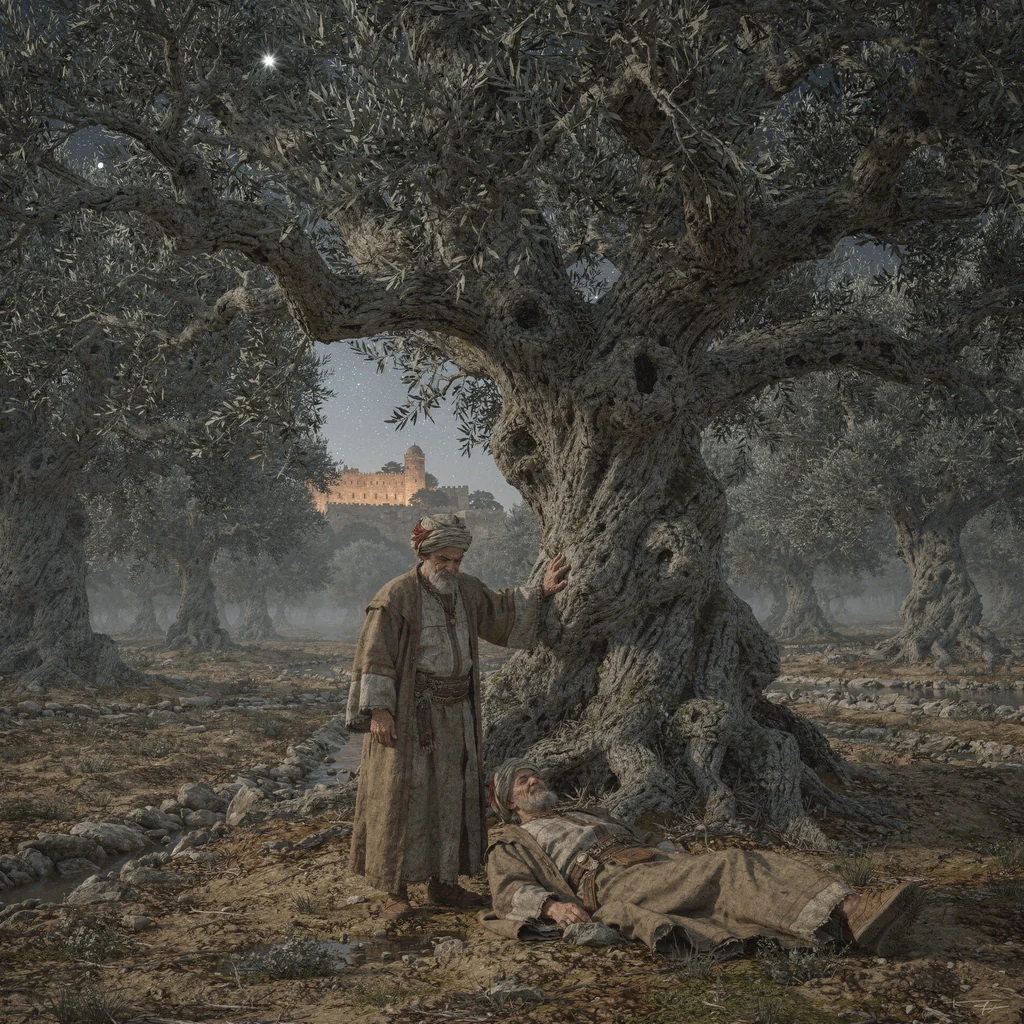
He was seventy-seven years old.
The old scars on his hands had faded to white lines against the darkening skin. The ladder fall from 1628, the grafting knife slip of 1635, the pruning saw catch of 1649. His knuckles were swollen now. The joints that had gripped thousands of saplings, had turned tons of soil, had opened the earth for forty years, were stiff in the morning cold.
The predawn silence of Annaba was different from the predawn silence of Grombalia. In Grombalia, the silence carried the sound of the Zaghouan wind in the distance, the rustle of leaves that were his life’s work. In Annaba, the silence was denser. There was only the stone of the palace, the distant murmur of the sea, and the mineral smell of water that reminded him of the grove he had lost.
He woke in the predawn darkness.
His breath was shorter this morning. The body was slowing. The merchant’s eye that had read terrains and markets and people for seventy-seven years was ready to close.
He dressed in the simple white caftan he wore for working in the groves. He wrapped the black turban of the hajj he had made thirty-five years ago.
He did not wake the household.
He had refused the physician three days prior. When the community elders came to sit with him, to recite the yā sallam and the ḥizb al-baḥr, he had thanked them and asked to be alone. “The word I need,” he told Ḥamdī, “is not in the books. It is in the bark. In the water. In what I have touched with these hands.” They had protested—this was not the Shadhiliyya way, not the way of the community he had built.
He walked out of Sarāyā al-Grombali alone.
The predawn air was cool. The stars were still visible in the dark sky. The North Star, the same stars that had guided him since he was a boy in Baeza reading constellations with his father.
He walked to the grove.
The workers would not arrive for hours. The grove was silent. The trees were shadows against the predawn sky.
As he walked, the mineral smell of water rose from the irrigation channels. Salt and sulfur, the taste of the mountain springs dissolved over centuries, carried from the springs he had discovered when he first explored the hills above Annaba. The smell was fainter here than in Grombalia, but it was present. It reminded him of the grove he had lost. He smelled the water and did not wash it off.
He walked to the first ridge. The ridge where he had planted the first trees in Annaba sixteen years before.
The trees were enormous now. Their trunks were thick. Their canopies touched. The roots went deep into the red earth.
He walked along the row, checking the trees. He tested the soil moisture with his fingers. He adjusted a water channel here, cleared a fallen branch there.
The work was familiar. His hands knew what to do.
He reached the end of the row.
He stopped. He turned around. He looked back at the palace of Sarāyā al-Grombali, rising white against the dark hills of Annaba.
Fatima was in Tunis. She was seventy years old. She would manage the endowed groves. She would protect the community.
ʿAbd al-ʿAzīz and Aisha. Five grandchildren he had never seen.
The workers would tend the trees. The jawk would sing.
He walked to the oldest tree in the grove.
It was the first tree he had planted in Annaba, sixteen years before. It was not as old as the trees at Henchir al-Turki, the grove he had lost in Grombalia — now owned by the waqf, protected from confiscation, belonging to God.
But this tree was old enough. Its trunk was thick. Its canopy was wide. Its roots went deep into the red earth.
He placed his hand on the bark.
The bark was rough against his palm. The tree was alive. The tree would survive without him.
For a moment, he hummed.
It was the nūba in the mode of Ṣīkāh. The melody he had composed in the years after the confiscation, when he was building again in Annaba soil. The ṭarīq al-Andalus, passed from hand to hand, from oud to oud, without name or institution.
He sang it quietly, his voice softer than it had been, the breath of a man who had lived for seventy-seven years, but still clear.
He sang the love verses first:
ḥusn al-ḥabīb fāyiq wa-dhakī wa-l-mabsam sakrat ʿuyūnī
The beauty of the beloved. Surpassing, brilliant. And that smile, it has intoxicated my eyes.
He sang of the sleepless nights, the wound of beauty, the heart filled by the one who poured the cup.
Fatima was in Tunis. She was alive. He had not seen her face in sixteen years. The song was about her face. He sang it at the base of the oldest tree in the first light before dawn.
He sang the yalalal refrain. The sound where the words stopped.
He sang the exile defiance:
mā nmūtš ġarīb fī bilād al-saḥāba
I will not die a stranger in the country of the clouds.
He had not died a stranger. He was here. The red earth was under him. The Annaba light was coming over the Mediterranean. Hard white light, not grey.
He sang the flowers:
yā ward al-shām wa-qarnafal ʿanāba
O rose of Damascus, carnation of Annaba.
He removed his hand from the tree.
He sat at the base of the trunk. The bark supported his back.
He said nothing more. The song was done.
He said the one word.
Not aloud. The breath formed it and released it. Allah. The same word his grandfather had passed to his father and his father had passed to him with a hand on the shoulder and no ceremony. The word that had traveled intact through 117 years of Mass, through the Pyrenees, through the Mediterranean crossing, through forty years of building and one confiscation and sixteen years of building again.
The mineral smell of the water was in his nose. The bark was at his back. The grove was around him.
He said it again. And again. Without counting. Without effort.
The way the water flows.
He watched the sunrise.
The sun rose over the Mediterranean. White light moved across the red earth, the olive trees, the palace.
The workers would arrive soon. The harvest would begin. The oil would flow.
He closed his eyes.
The mineral smell of the water was in his nose.
The rough bark pressed against his spine.
The workers found him at midday.
He was sitting at the base of the oldest tree, his back against the trunk, his hands folded in his lap.
They stood in silence. They did not touch the body. They did not move him.
They read the body.
One worker ran to the palace. He found Ḥamdī Bannānī and Jāb Allāṣ and Āl al-Sannānī, the core of the jawk. He found the Imam of the mosque. He found the al-Zarqali family.
“The Sheikh has joined his ancestors,” he said.
They walked to the grove together. The musicians carried their instruments. The oud, the darbuka, the violin. The Imam carried the burial shroud. The family carried the spade.
They found him at the base of the oldest tree, peaceful, complete.
Ḥamdī Bannānī knelt. He placed his ear to Muṣṭafā’s chest. He listened for breath, for heartbeat. He heard silence.
“The Sheikh has returned to God,” Ḥamdī said.
The Imam began the funeral prayer. The musicians began the song he had composed.
They sang the love verses. The sleepless nights, the wound of beauty. The yalalal refrain. Then the exile line:
“I will not die a stranger in the country of the clouds.”
The workers joined in. They had sung it at weddings and funerals, at births and circumcisions.
Then Ḥamdī sang the flowers:
“O rose of Damascus, carnation of Annaba.”
The song filled the grove. It moved through the rows of trees, carried by the wind.
When the song ended, the Imam said the final prayer.
Ḥamdī Bannānī stood. He addressed the workers, the family, the community.
He looked at the body, then at the grove, then at the community.
“The trees will survive,” he said. “The workers will survive. The song will survive. The Sheikh has given us everything we need.”
He paused.
“Now he has joined the ancestors,” Ḥamdī said. “He has returned to God. He has returned to the roots.”
The al-Zarqali family patriarch stepped forward. He held the spade.
“We will bury him beneath the oldest tree,” he said. “As he requested when he endowed the grove.”
The workers nodded.
They dug the grave beneath the oldest tree. The soil was red limestone, soft from centuries of mineral accumulation. They dug deep enough to protect the body from animals, shallow enough to connect with the roots.
They wrapped the body in the burial shroud. They placed him in the grave.
The al-Zarqali patriarch spoke the words:
“You planted trees for grandchildren you would not meet. They are meeting you now.”
“Go to God in peace, Sheikh al-Grombali.”
They filled the grave. They marked the spot with a simple stone. No name, no dates, only the words:
There is no victor but God.
Three and a half centuries later.
The grove was still there. The trunks were thick now, some requiring two men to reach around. The branches spread wide, shading the red earth beneath. The water still ran through the channels. Mineral and sulfur, the taste of limestone dissolved over centuries.
The palace was a ruin. The foundations of the courtyard visible as a rectangle of compacted earth. The fountain basin cracked but still holding winter rain. The outline of the qibla wall, its stucco fallen away to show the Roman bricks beneath.
The oldest tree stood at the center. Beneath it, a stone. No name, no dates.
There is no victor but God.
In the evenings, sometimes, the workers hummed.
The trees are still standing.