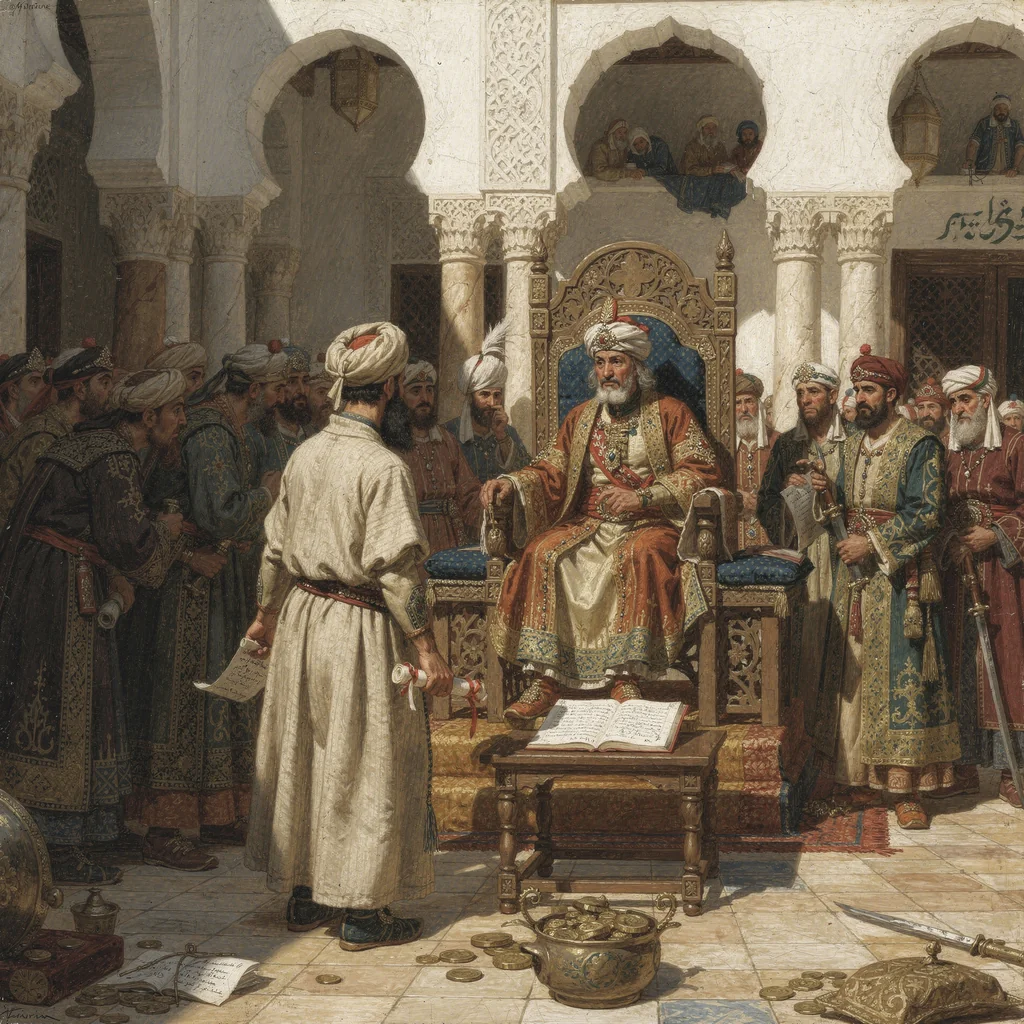
The tax collector’s hand did not shake when he wrote twelve percent.
He had not looked at Muṣṭafā when he entered the room. He did not look now. He simply wrote the figure, dipped the seal, and pushed the paper across the desk.
“The legal tenth is ten percent.” Muṣṭafā’s voice was quiet.
“The Bey’s requirement is twelve.” The collector stood. He walked out without a bow.
Muṣṭafā was fifty-seven years old.
He had been Sheikh for twenty-eight years.
Ḥammūda Bāšā had taken full control of Tunis three years earlier.
The French consul came to the souk in 1648.
He was not the same consul who had visited in 1618. This was a younger man, new to Tunis, eager to prove his value to Marseille and Paris. He found Muṣṭafā at the zawiya, reviewing the community accounts.
He opened a notebook. He read from it. A long pause. Then he looked up.
“The Muradid governor has taken full control. Yet your community operates as if he does not exist.”
“I am growing trees.” Muṣṭafā turned back to the ledger on the desk before him, running a finger down the column of figures.
The consul asked about the Sidi Rajab exchange. The Venetian merchant traded for the Andalusian slave three years before.
“You purchased a name.” The consul spoke, after Muṣṭafā had explained.
“I purchased it back.”
The consul nodded. He wrote something in his notebook.
“It will be in the report. That you value names over economics. That you are not a rational actor.”
He walked away.
The qāḍī of Tunis came to the zawiya after sunset. He did not send a messenger. He came alone.
Muṣṭafā was reviewing the ṣundūq accounts when the qāḍī entered.
The qāḍī’s hands were trembling.
Not a full shake. A tremor at the fingertips.
He sat. He placed his hands on the table. The tremor continued.
“The Bey has asked about your groves,” the qāḍī said.
His voice was steady.
Muṣṭafā waited.
“He asked how many trees. How much oil. What the shipping contracts are worth.”
The qāḍī’s thumb tapped the table. Once. Twice. Three times.
“He did not ask about the waqf,” Muṣṭafā said.
“No.”
The qāḍī’s hands stopped.
“He asked about the trees.”
The waqf protected the endowed groves. The remaining trees were visible. Countable. Vulnerable.
The qāḍī stood. His hands were steady now.
“I did not hear you ask,” the qāḍī said. “I did not see you here.”
He walked out.
Muṣṭafā returned to the accounts.
He calculated. Half the trees endowed. Half exposed.
He needed to endow more.
In 1649, Muṣṭafā began making preparations.
The work had begun after the madrasa endowment in 1625. Ḥammūda’s consolidation in 1647 had accelerated what was already in motion.
He had endowed the groves. He had distributed the documents. The chest was beneath the floor, locked with three keys. The copies were in the Zaytuna mosque, with the Grana factor, with Fatima’s father. He had prepared.
He did not speak of any of it to Fatima. But she watched him work.
“You are preparing for your exile.”
They were in their private rooms.
“I am preparing for the community’s survival.”
“You will not be here.”
“Not forever.”
He looked at Fatima.
“The Bey can take what he can see. He cannot take what is documented. He cannot take what is endowed. He cannot take what is distributed.”
“You have seen this before.”
Muṣṭafā had spoken of it rarely. Valencia harbor, 1609, a family screaming while a ship sailed away.
“I have seen it.”
“And you have been preparing for it ever since.”
“I have been planting.”
He walked to the window. He could see the olive groves from here.
“I am fifty-seven years old. I have spent thirty-five years building what you see from this window.”
He turned back to Fatima.
“If the Bey comes, he will take the palace. He will take the land titles. He will take the shipping contracts. He will take everything that is documented and confiscate-able.”
He paused.
“But he will not take the trees. The endowed trees belong to God. He cannot take what belongs to God.”
“He will not take the workers. They know their jobs. They can tend the groves without you.”
“He will not take the knowledge. The workers know how to plant. They know how to prune. They know how to harvest.”
He looked at her.
“He will not take the community. The elders can lead. The merchants can negotiate. The Imam can speak to the authorities.”
Fatima was silent.
He walked to the door.
“Where will you go?”
“I do not know. Constantinople, perhaps. Cairo. Annaba. The Sublime Porte has honored my services in the past. They may grant me protection again.”
He stopped at the door.
“You will stay here. You are Tunisian now. The children are Tunisian. Only I am the exile.”
She walked to him. She took his hands.
“You have built what survives.”
“I have built what I cannot take with me.”
“‘Planting,’ you say.” Fatima’s voice was sharp. “But you are digging up what you planted. Dividing. Hiding. Preparing to leave. This is not planting. This is…”
She could not find the word.
“This is pruning.” Muṣṭafā finished her thought. “The tree bleeds. The cut heals. The growth continues.”
Fatima was silent for a long time.
“That is what survives.”
She kissed his hands.
“We will be here when you are gone. The trees will be here. The workers will be here. The community will be here.”
She looked up at him.
“Come home when you can.”
“I will come home. To the place where I can plant again.”
In 1651, Ḥammūda Bāšā began the military campaigns.
The Bey led expeditions against dissident tribes in the northwest and south of Tunisia. He brought order through force. He crushed resistance. He established control.
The Andalusians watched.
The army Ḥammūda was building. The weapons he was gathering. The way he treated those who opposed him.
Muṣṭafā watched too.
He read the reports that came to the palace. Dispatches from Ottoman officials, rumors from the souks, whispers from the servants who worked in the Bey’s palace.
Ḥammūda was not just a ruler. He was a warrior. He was a corsair’s son, and he ruled like one.
The elders came to Muṣṭafā in the courtyard.
“He is testing his power.” One elder spoke.
“He is establishing control.”
“He will come for us.” Another elder spoke. “We are too wealthy. We are too independent. We are too Andalusian.”
Muṣṭafā was fifty-eight years old.
He had been Sheikh for twenty-nine years.
“The groves are endowed. The documents are distributed. The keys are with the guardians.”
“We know this. We are asking what comes next.”
“What comes next is the Bey.”
The elders were silent. Men from Granada, Córdoba, Seville, Valencia. Men who had lost everything once before.
“What he can see, he will take. What he cannot see will remain.”
In 1652, the tension became visible.
Ottoman officials who had once treated Muṣṭafā with respect began looking through him as if he were not there. Tax collectors demanded more than the legal tenth. The Dey’s court cancelled audiences without explanation.
Valencia. The years before the expulsion. The cooling. The cancelled meetings. The officials who stopped meeting your eye.
Then the accusations. The investigation. The confiscation. The exile.
Muṣṭafā found Fatima at the window of their room in the palace, both hands flat on the sill. She had been there for some time. He did not disturb her.
She spoke without turning.
“Saturn has entered the house of wealth.”
Muṣṭafā waited.
“The drought will come within two years. The rains will fail. The harvests will diminish. The Bey’s tax revenue will fall.”
She turned to him. Her face was calm. Her voice was certain.
“When the revenue falls, the Bey will look for wealth he can take quickly. Wealth that does not require armies. Wealth that is already here.”
She looked toward the olive groves spreading from the palace.
“He will come for the trees.”
“You have seen this in the stars.”
“I have seen it in the numbers my father taught me to track. The positions repeat. The consequences follow.”
She opened a small box on the table. She took something out. Small, specific, unremarkable to the eye. A measuring tool Ibrahim had used. Brass, worn smooth where his thumb had rested for thirty years.
She placed it in his hand.
He took it without asking.
“Carry it.”
He placed it in the pouch at his belt.
“Good. You know what is coming. The stars have told you when. Your heart must tell you how to accept it.”
The brass tool pressed against his hip. Through the window, the olive rows disappeared into the darkening plain.