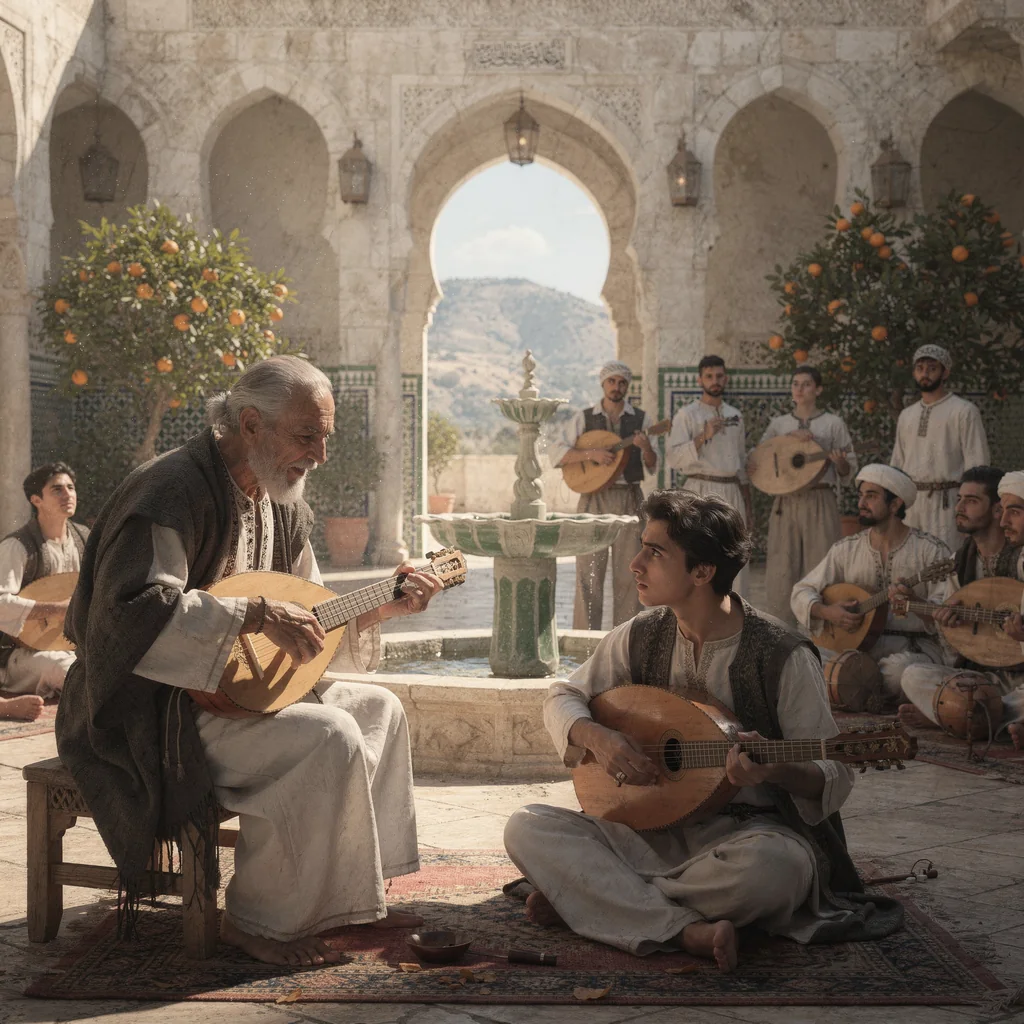
The jawk formed in 1666.
Muṣṭafā was seventy-three years old. The malouf song had been performed in the community for three years. The melody had spread beyond Annaba. To Constantine, to Tunis, to the Andalusian settlements scattered across the Maghreb.
Young musicians came to Annaba to learn from the Sheikh.
They were Andalusians. The grandchildren of the original expellees, born in North Africa but carrying the music of their ancestors. They wanted to learn the modes, the rhythms, the way of performing the songs.
Muṣṭafā taught them.
He sat with Ḥamdī Bannānī in the courtyard of Sarāyā al-Grombali. The morning was cool. The best time for music, before the heat made the wood swell, before the humidity changed the strings.
Muṣṭafā placed the oud on his knee. His hands were stiff now. The joints swollen from decades of work, the fingers thickened from gripping tools, pruning shears, pens. He was seventy-three years old. The body was no longer the primary instrument. The knowledge was.
He only moved his hands.
He struck the lowest string. The heavy brass string that grounded the mode. A low G, deep and resonant.
Then he placed his fingers on the higher strings. He did not hurry. His left hand formed the position. The index finger on the D string, the middle finger on the G sharp, the ring finger hovering above. He pressed. The sound came. Not fast, not showing off, just clear. Four notes descending from the high A to the low E.
Then the return. The same four notes ascending.
Then a pause. Empty space, breath held.
Then one note alone. The high A again, sustained. Then released into silence.
He played the phrase once more. Slow. Deliberate. Each note exactly the same as the first time.
“This is the māyā mode,” Muṣṭafā said. “The mode of loss. The māyā flattens the third. Not the major third of joy. Not the minor third of ordinary sorrow. The neutral third. The third that holds both. Listen.”
Ḥamdī placed his fingers on the strings. He was twenty-three years old. His hands were quick. The fingers slender, the joints loose. He had learned the positions from his grandfather in Granada, from the court musicians who remembered the old way.
He struck the low G. He played the four descending notes.
He was too fast. The notes blurred together.
“Again,” Muṣṭafā said.
Ḥamdī played again. Still too fast. He was rushing toward the end. He was thinking ahead to the next note, not hearing the one he was playing.
“Listen,” Muṣṭafā said.
He did not say what to listen for. He only waited.
Ḥamdī played again. Slower this time. The notes separated. But the timing was wrong. The pause between the descent and the ascent was too short. The breath was not held.
Muṣṭafā did not correct him with words. He reached over. He placed his own hand on Ḥamdī’s wrist. Not gripping, not forcing, just resting there. He felt the tension in the boy’s arm. The wrist was too stiff. The forearm was gripping the oud like it would run away.
Muṣṭafā pressed his thumb into the soft flesh below Ḥamdī’s wrist bone. He pressed until he felt the muscle release.
“Relax,” he said.
Ḥamdī’s wrist softened.
Muṣṭafā moved his hand to Ḥamdī’s shoulder. He felt the tension there too. The boy was hunching forward, tightening his shoulder to control the speed.
Muṣṭafā pressed his thumb into the shoulder muscle. He felt it release.
“Breathe,” he said.
Ḥamdī took a breath. His shoulders dropped. His spine straightened.
“Your wrist is a hinge,” Muṣṭafā said. “Not a clamp. The finger is a striker. Not a hammer. The note is already in the string. You do not force it out. You let it emerge.”
Ḥamdī looked at him.
Muṣṭafā demonstrated again. His left hand formed the position. His right hand held the risha. The eagle quill pick. Between thumb and forefinger. He struck. The note emerged. Clear. Sustained. Released.
Ḥamdī’s wrist was fluid. Muṣṭafā’s had begun to click.
He played the phrase again. Four notes down. Pause. Four notes up. Pause. One note alone. Silence.
The third note hovered between major and minor, neither resolving.
The phrase lasted twenty seconds. It felt like a lifetime.
“Your turn,” Muṣṭafā said.
Ḥamdī placed his fingers. He checked his wrist. Relaxed now. He checked his shoulder. Down now. He took a breath.
He struck the first note.
It was good.
He played the four notes descending. They were clear. He reached the bottom note. He paused.
He waited.
He played the four notes ascending. He reached the top note. He paused again.
He held the silence. Then he played the final note. The high A, sustained.
He let it ring. He let it fade into silence. He did not stop it too soon. He did not cut it off.
When the sound was gone, the silence remained.
Ḥamdī sat without moving. His hands were still on the strings. His eyes were closed.
Muṣṭafā watched him. He did not nod. He did not smile. He did not say “good” or “correct” or “you have learned.”
He only waited.
Ḥamdī opened his eyes. There was something different in his face. Something that had not been there before.
“What did you feel?” Muṣṭafā asked.
Ḥamdī shook his head. He did not have words for it.
“That is the māyā mode,” Muṣṭafā said. “The mode of loss. Your grandfather knew this mode. His grandfather knew it. It has been in your hands since you were born. Now you know it too.”
The jawk took shape around the core of experienced musicians and the new students Muṣṭafā taught.
There was Ḥamdī Bannānī, a young man from Annaba whose grandfather had been a court musician in Granada.
“You have your grandfather’s hands,” Muṣṭafā said.
Ḥamdī was surprised. “You knew my grandfather?”
“I knew men like him in Granada,” Muṣṭafā said. “Men who carried the music of the courts.”
He looked at Ḥamdī’s hands on the oud.
“Your grandfather taught you well,” Muṣṭafā said.
“He died before we left Spain,” Ḥamdī said. “He taught me what he could. The rest I learned from others.”
Muṣṭafā nodded.
“I will teach you the rest,” he said.
Others joined him. Jāb Allāṣ of Constantine, a man who stood with his weight always forward, as ready to climb the steep streets of his city. His powerful baritone had filled the Valencia mosques for years. Āl al-Sannānī of Tunis joined them, a vocalist who sat with his back straight as a minaret, the Zaytuna discipline visible in his stillness before singing. His voice carried the clarity of the mosque where he had trained.
The core formed around Ḥamdī on the oud and the others he assembled.
They were joined by others. Violinists. Percussionists. Dancers. Poets.
The jawk required permission from the qāḍī of Annaba. Muṣṭafā obtained it through the al-Zarqali connection—one final service before partnership dissolution. The qāḍī demanded review of lyrics. Muṣṭafā showed him the love verses, not the exile line.
The qāḍī read the page three times. His finger paused on the word “exile.” He looked up. Then he dipped the seal.
Permission granted.
The grove surpassed Grombalia in 1668.
Muṣṭafā was seventy-five years old.
The count was thirty-five thousand trees. More than he had planted in Grombalia, more than he had ever imagined possible when he began in Annaba.
The trees were mature, their canopies spreading wide, their olives producing oil of exceptional quality. The water network was complete. Channels bringing mineral-rich water from the hills, the limestone springs, mineral-scented like those he had known in Tunis.
The workers moved through the rows without direction.
The al-Zarqali partnership was dissolved by mutual agreement. The capital had been returned with interest. The profits were divided according to the partnership agreement.
Muṣṭafā was wealthy again.
He endowed the grove as waqf. A religious endowment belonging to God, managed by the mosque of Annaba, protected from civil authorities.
The endowed trees could not be confiscated.
The trees belonged to God now.
The students came from across the Maghreb.
They heard about the jawk of Annaba. They heard about the malouf song that carried the history of the Andalusians. They came to learn.
Muṣṭafā taught them.
He was seventy-six years old. His hands were stiff with age. His fingers could no longer play the oud with precision.
The students learned.
They returned to their cities. To Constantine, to Tunis, to Tripoli, to Cairo. They formed their own jawks. They taught their own students.
The music spread.
Ḥammūda Bāšā Bey died in 1666.
Muṣṭafā was seventy-three years old.
He received the news from a merchant traveling from Tunis. The Bey who had confiscated everything, who had exiled him from Tunis, who had taken the palace and the groves and the shipping contracts, was dead.
Ḥammūda’s son would succeed him. The Muradid dynasty would continue.
Muṣṭafā stood in the courtyard. The fountain continued. Beyond the walls, the trees stood in their rows.