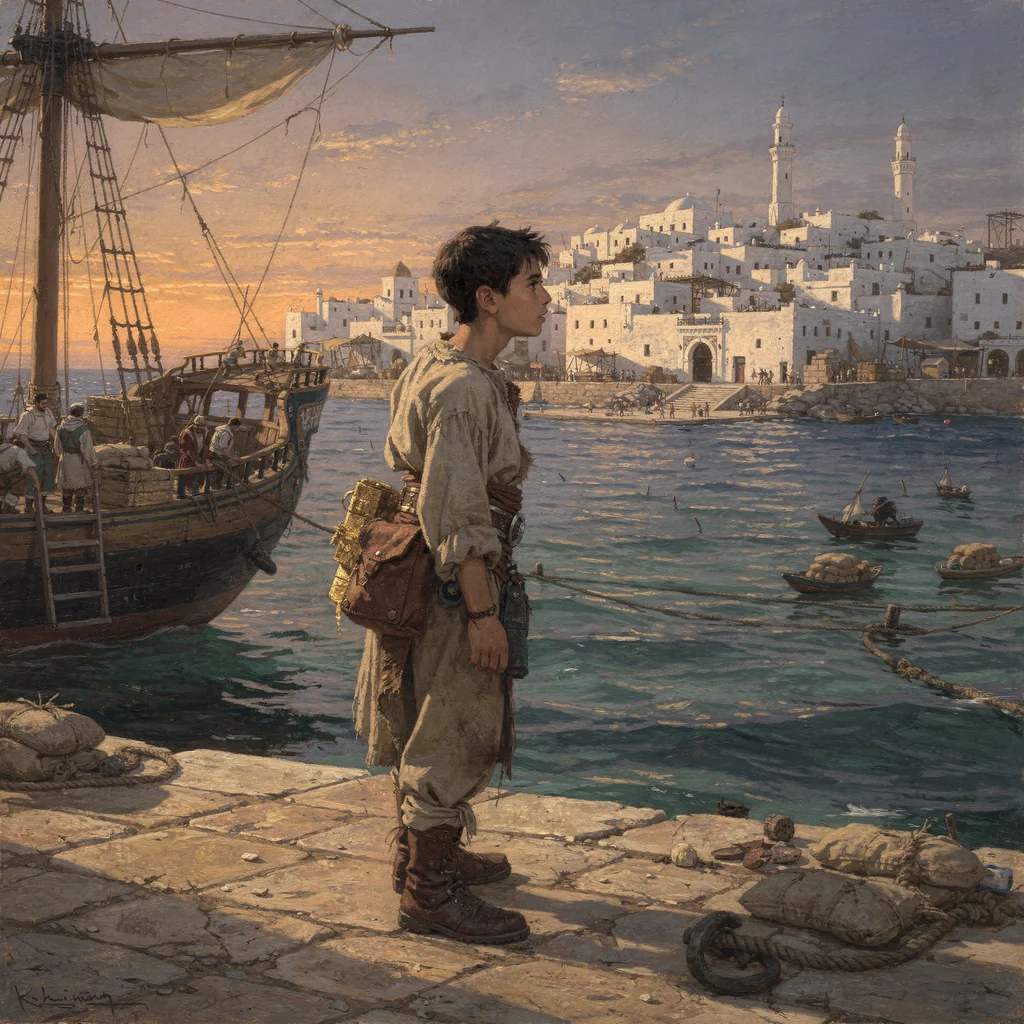
The Livorno factor’s office was near the harbor. A single room with a desk and a ledger and a window that looked out toward the sea.
Shmuel closed the door behind them. The room was quiet. Sealed off from the noise of the port.
“Sit.”
Muṣṭafā sat. Shmuel took the chair behind the desk and opened the ledger.
Shmuel had processed forty-three letters of credit since the expulsions began. He knew which families had prepared and which had not. The Cárdenas letter was clean. Properly drawn. Correctly witnessed. The Livorno factor’s seal intact. A family that had been planning this for years.
“Your uncle’s letter of credit. The Livorno factor is holding capital in your name. We need to process the paperwork, verify your identity, and arrange the transfer.”
He dipped a pen in ink and looked up.
“Your full name as it appears on the letter.”
“Muṣṭafā al-Qardanesh bin ʿAbd al-ʿAzīz.”
Shmuel wrote this in the ledger.
“Your father’s name?”
“ʿAbd al-ʿAzīz al-Qardanesh. He remained in Baeza with the rest of the family.”
Shmuel nodded. He continued writing. Recording the arrival, the Livorno reference, the amount of capital being held.
“The Livorno network has been holding this capital since before the expulsion. Your uncle established the account years ago, anticipating what was coming. Smart man.”
He looked at Muṣṭafā.
“Do you know how much he’s holding?”
“I have an approximate idea. My father told me the approximate sum before I left Baeza.”
“And?”
“Seven hundred fifty ducats. Approximately.”
Shmuel nodded.
“Seven hundred eighty-three ducats, to be precise. The Livorno factor will release the full amount when I sign the transfer papers.”
He dipped the pen again.
“But I’m not releasing all of it to you now.”
Muṣṭafā did not react. He had calculated this possibility.
“The Livorno capital travels as a qirād,” Shmuel said. “Your uncle provides the capital. You provide the labor. I am the muqārid who witnesses the contract. The profit is yours after the capital is returned, but the risk of loss is shared. If the grove fails, you owe nothing, but the capital returns to Livorno. If it succeeds, we discuss the next qirād.”
Muṣṭafā nodded. The terms were clear.
“I’ll release two hundred ducats immediately. That’s enough to find lodging. Enough to live for several months while you learn the city. Enough to begin looking at land.”
“And the rest?”
“The remainder stays in the Livorno factor’s keeping. When you’re ready to make a substantial purchase — land, equipment — you come to me. We’ll discuss the next qirād.”
“Agreed.”
Shmuel wrote rapidly in the ledger. When he finished, he blotted the ink and stood up.
“Come with me.”
They walked out of the factor’s office into the street. Andalusians were arriving daily now. Entire families with bundles and children, exhausted from the journey. Muṣṭafā watched from the doorway.
The ones without coin were being directed toward a street beyond the mosque, where men in simple robes stood writing names in ledgers. The ones with capital. With pouches at their belts. With letters of credit in their hands. They were being pointed toward the notary office, the land registry, the merchants near the harbor.
The zawiya was sorting them. Reading what each carried before they spoke.
He watched the men at the gate. They checked hands before faces — looking for calluses that meant workers, softness that meant merchants who would need the notary, emptiness that meant charity cases for the soup pot.
Muṣṭafā noted the pattern and followed Shmuel into the medina. The old city. The walled city. The labyrinth of narrow streets and white-washed buildings and blue doors that opened into courtyards.
The Andalusian quarter was near the center of the medina, not far from the Zaytuna mosque. The streets wound in patterns that made no sense to newcomers but carried the memory of cities left behind.
Muṣṭafā heard the accents immediately.
Granada. Córdoba. Seville. Valencia. All the cities of the old Al-Andalus. All the accents of the expelled peoples. All present in the voices calling from windows, bargaining in the souk, greeting neighbors in the street.
“I can hear where everyone comes from.”
“But you can’t hear where we’re going.”
Muṣṭāfā looked at him.
“That’s the question everyone asks. What are we in France? Refugees. What are we in Tunis? Moriscos? Andalusians? Something else? No one has an answer.”
He stopped in front of a building with a blue door, two stories high, with a small window above the entrance.
“This building belongs to a widow. Her husband died last year. She has rooms to rent. She speaks Arabic and Castilian. She’s fair with the rent.”
He knocked on the door.
The door opened. An old woman stood in the entrance. Her face was lined with years. Her eyes were sharp.
“Shmuel.” She spoke in Arabic.
“Fatima.” Shmuel spoke in Arabic. “This is Muṣṭafā al-Qardanesh. He’s looking for a room.”
She looked Muṣṭafā up and down. Seventeen years old. Traveling alone. Carrying a small bag.
“Andalusian?” she asked in Castilian.
“From Baeza.”
She nodded.
“Baeza. I know people from Baeza. Olive country.”
She opened the door wider.
“Come in.”
The room was small but clean. A bed. A table. A window that looked out onto a courtyard. The rent was reasonable. Two silver pieces per month, paid in advance.
Muṣṭafā paid the first month’s rent from the two hundred ducats Shmuel had released to him. He stored his belongings in the room. The small bag with clothes. The cloth bundle with seeds from Baeza. The leather pouch with dried food from his mother.
Then he began learning the city.
The souk was a ten-minute walk from Fatima’s building. Muṣṭafā went there the next morning and began observing.
The souk was organized by trade. Spices in one alley, copper in another, textiles in a third. The olive sellers were near the eastern gate, close to where the farmers brought their harvest in from the countryside.
He passed the silk stalls without stopping. He knew silk. His father’s second ledger. The shimmer test. The difference between Granada velvet and Levantine raw thread. But silk in Tunis required connections he did not yet have. Olives required only the soil, which he already knew how to read.
Muṣṭafā moved through the crowd, watching.
He saw how the olives were sorted. Green olives for early harvest, black olives for later, the bruised ones set aside for oil. He saw how prices were negotiated. The opening offer, the counter-offer, the final agreement struck in the space of three breaths. He saw which merchants had steady customers and which merchants sold to whoever passed by.
He found a spot near one of the sorting tables and watched.
An old merchant was sorting olives, his hands moving quickly, separating the good from the bad, the large from the small, the green from the black. He worked without looking, his hands knowing the difference by touch alone.
“You’ve been standing there for an hour.” The merchant spoke in Arabic without looking up.
Muṣṭafā didn’t reply. He didn’t speak Arabic well enough yet.
The merchant looked up. He saw a seventeen-year-old boy, watching with focused attention, not looking away, not fidgeting, just observing.
“Andalusian?” The merchant asked in Castilian.
“Yes.”
“Olive country?”
“From Baeza.”
The merchant nodded. He returned to sorting olives.
“You can work. You can help with the sorting. You can carry the crates. You can learn.”
He pointed to the stool next to him.
“Sit.”
Muṣṭafā sat.
For the next six months, he worked in the souk. Sorting olives, learning Arabic, observing how trade worked in Tunis.
He earned three silver pieces a week. Not much. But enough to buy food. Enough to save a little. Enough to live without touching the capital Shmuel was holding for him.
He learned Arabic by listening. The dialect of the souk. The technical language of trade. The greetings and the negotiations and the arguments over prices.
He absorbed everything.
“You’re planning something.” The old merchant spoke one day, as they sorted olives together.
“I’m planning to buy land. When I know enough. When I’ve learned enough.”
The merchant nodded. He had seen this before. The ones who planned, who waited, who learned before acting. The ones who survived.
“Where will you buy?”
“Not in Ariana.” The merchant spoke before Muṣṭafā could answer. “Too close to Tunis. The plots are too small, too expensive. You need to go farther out — Grombalia. The soil is good for olives. Large tracts available, and affordable if you have the capital.”
“You’ll need capital.”
“I can get capital. When I’m ready.”
“Smart. Capital that doesn’t exist can’t be confiscated.”
Muṣṭafā nodded.
The Livorno letter came six months later, in the spring of 1611.
Muṣṭafā was in the souk when he saw Shmuel approaching through the crowd.
“The letter has arrived from Livorno. Your uncle has sent confirmation. The capital is ready for release. All of it.”
Muṣṭafā followed him to the factor’s office.
Shmuel opened a drawer and took out a sealed letter. The Livorno seal. The signature. The official confirmation of funds.
“Seven hundred eighty-three ducats. Plus interest earned over two years. The total is eight hundred twelve ducats.”
He looked at Muṣṭafā.
“How much do you want released?”
Muṣṭafā had calculated this carefully. He had spent six months learning the Tunisian markets. He knew what land cost. He knew what slaves cost. He knew what tools cost.
“I want to purchase land in Grombalia. Good land. Red earth. Limestone soil. Good drainage. Near water but not in the flood path.”
Shmuel raised an eyebrow.
“You’ve been researching.”
“I’ve been planning.”
“How much land?”
“As much as eight hundred ducats will buy.”
Shmuel was quiet for a long moment. He looked at the eighteen-year-old who had spent two years working in the souk for three silver pieces a week. Who had saved carefully. Who had learned Arabic. Who had watched and waited and planned.
“You’re not like the others. The ones who arrived before you. They spent their capital on houses in the medina. They opened shops. They lived well. Now they have nothing left to invest.”
“Visible wealth is vulnerability.”
“Exactly.”
Shmuel nodded. He opened his ledger and began writing.
“I’ll release the remaining six hundred ducats now. Combined with the two hundred you saved from your first release, that gives you eight hundred for the purchase.”
Muṣṭafā agreed.
They walked to the Ottoman administrative office together, where land deeds were registered and property taxes were collected.
The Ottoman official was bored. Processing paperwork for yet another Andalusian refugee purchasing land. But when eight hundred ducats in gold went onto the table — Muṣṭafā’s savings added to Shmuel’s release — the official’s expression changed.
Eight hundred ducats was substantial capital. Enough to purchase good land. Enough to build something that lasted.
“Where do you want to buy?”
Muṣṭafā turned to Shmuel.
“One of the growers I worked with in the souk told me about it. Good flat land, good soil, water available. Less than a day’s journey from Tunis. The place is called Henchir al-Turki, in the Ras al-Tayeb region near Grombalia. I’ve been there to see it. I walked the property. The area is green. It reminded me of home.”
Shmuel nodded.
“You’ve done your research.”
Muṣṭafā turned back to the official and gave him the parcel coordinates. The exact boundaries as they were recorded in the Ottoman land registry. The location south of Tunis, near Grombalia.
The official pulled out his map and verified the location.
“How much?”
“Six hundred ducats for the land. Two hundred ducats for the registration fee, the stamp tax, and the expediting payment that ensures the deed is processed this month rather than next year.”
Muṣṭafā calculated. Eight hundred ducats total. His savings and the Livorno release together.
“Done.”
The official began the paperwork. Deed registration. Tax records. Ottoman stamps. The process took two weeks.
When it was finished, Muṣṭafā held a paper that said he owned land in North Africa.
The paper was heavy. Vellum, stamped with the Ottoman seal. He felt the embossing under his thumb. The ink was still damp.
The coastal tract.
Red earth near the sea.
Shmuel walked with him to the city gate.
“The first rains are coming. Plant before them.”
Muṣṭafā nodded. He had plans.
The journey to Grombalia took one day on horseback.
Muṣṭafā rode with two friends he had met during his two years in Tunis. Fellow Andalusians he had come to know at the zawiya where they prayed and studied together. They had offered to accompany him on this first journey, to help him mark the boundaries and assess the land properly.
They followed the ancient Roman aqueduct that carried water from Zaghouan to Carthage, riding alongside the stone arches that had stood for sixteen centuries, following the path of water toward the land Muṣṭafā would now work.
The soil changed as they rode. From the sandy soil near Tunis to the red earth of the Grombalia plain, the limestone soil that drained well, the soil that olives loved.
They reached the land by evening.
The land was exactly as he remembered it. Red earth. Limestone outcrops. Good drainage. The land sloped gently toward the coast, open to the sea breeze.
In the distance, he could see mountains on the horizon. The Zaghouan range, forty kilometers south. The source of water that would one day reach this land if he built the channels right.
Muṣṭafā walked the perimeter of his land. He tested the soil. He crumbled it in his fingers. He tasted it. He felt the texture. Red earth with limestone fragments. Good drainage. The kind of soil that would not hold water and rot the roots.
He found the spring. A small water source that emerged from the limestone, not much now but enough for a beginning. He could build a cistern to store water. He could dig channels to distribute it. He could bring more water from Zaghouan when he had the capital.
He stood in the center of the land and looked in all directions.
To the south, the open plain waiting to be claimed. To the north, the sea. To the west, the road back to Tunis. To the east, more of the peninsula.
The land was empty now. Just red earth and limestone and silence.
But Muṣṭafā could see what was not there yet.
He could see the olive trees. He could see the water channels. He could see the house he would build, the workers’ quarters, the storage sheds for the harvest.
He stayed on the land for three days, sleeping under the stars, eating the dried food he had brought, watching the sun move across the sky, learning the patterns of wind and light.
On the third day, he rode back to Tunis, the red earth dust still on his boots.
The harbor had a different market from the souk.
Near the warehouses, in the yard of a factor he had learned to use, European captives were held. Sailors from Italian ships. A fisherman from Sicily. A Marseille merchant taken with his cargo.
Muṣṭafā walked through and read them the way he read everything. Who had family that would pay. Who had trade connections. Who was worth holding and who was worth exchanging.
He was not the only Morisco doing this.
The Andalusians of Tunis had built an informal network. Those with capital buying. Those with connections brokering. The Grana merchants financing the transactions.
What moved through this network was information.
He found a corsair captain holding a Sicilian fisherman. The man’s family in Palermo would pay eighty ducats for his release. The captain wanted forty now, not trusting the ransom to arrive.
Muṣṭafā calculated. If the family paid, he would exchange the ransom right through the Grana network for a Morisco held elsewhere. The accounting was complex. The risk was real. If the Palermo family refused, he lost forty ducats.
He would not hold the man himself. He would not operate a prison.
He signed the paper. Forty ducats exchanged for a ransom claim.
Weeks later, a family arrived at Sīdī Abū al-Ġayṯ’s zawiya. An Andalusian father, mother, and three children. Their passage was arranged from a Christian port where they had been held.
Shmuel’s ledger recorded only the capital expended.
Later that month, Muṣṭafā witnessed the lesson from the other side.
A commotion near the French consul’s office drew his attention. A Morisco family was screaming at a man in French merchant’s clothing. The captain of a ship that was already pulling away from the dock.
“He stole it!” The woman shouted in Castilian. “Two thousand ducats! Twenty years of my husband’s labor, gone!”
Muṣṭafā froze.
Two thousand ducats.
He calculated quickly. A skilled craftsman earned perhaps one hundred ducats in a year. Two thousand ducats was twenty years of labor. Enough to destroy a family that had rebuilt itself from nothing.
The French consul was recording the complaint, writing rapidly in a ledger. The ship’s captain was shouting back. He knew nothing about any ducats. He was a simple transporter. These people were trying to cheat him.
Muṣṭafā walked to the consul’s table. The older merchants were already there. Men with gray beards and strongboxes, filing their complaints. Muṣṭafā was eighteen, but he stepped forward with the same practiced rhythm he had used in Valencia.
He stated his name. He stated what he had seen. The consul recorded it without looking up. Another complaint in a ledger that would never be read.
Muṣṭafā watched the consul write. He watched the ink dry on the page. He watched the ship sailing away.
He returned to his room and divided the remaining capital into three pouches. One he buried beneath the floorboards. One he hid in the hollow of the bed frame. One he kept at his waist.
Two months later, Muṣṭafā returned to Grombalia alone.
He carried tools and supplies and the seeds from Baeza that his mother had given him when he left.
When he reached the land, he stood in the empty red earth and said nothing. He had seen land like this before. He knew what work was required.
Muṣṭafā marked where to dig. The first cistern, near the spring. They needed water storage before they could plant anything.
He hired three workers from a nearby village and worked alongside them, digging with his own hands, learning how the limestone layers lay, learning where the water was, learning by doing.
In two weeks, they had dug the first cistern. Five meters deep, lined with stone, covered to prevent evaporation. The spring filled it slowly, drop by drop, but by the end of the second week, there was enough water to begin.
Muṣṭafā returned to Tunis to find workers.
He found a man in the souk. An Andalusian from Granada who had been a master builder in Spain. The man had fled with nothing, but he carried his knowledge in his hands and his head.
“I need someone who knows water systems. Canals. Cisterns. Distribution channels.”
The man looked at him. Eighteen years old. Owning land. Hiring workers. Building something.
“I built irrigation systems in Granada. Before the expulsion.”
“Can you build them in Grombalia?”
“Anywhere there’s water.”
“Come see the land.”
They walked to Ras al-Tayeb together. The Granadan builder examined the spring, tested the water flow, calculated the volume.
“The spring is enough for a beginning. But for a serious grove, you’ll need more. There are springs in the mountain to the north. We can build channels to bring that water by gravity. The Andalusians did it in Spain. You can do it here.”
He pointed toward the ridge where the hills rose.
“And you’ll need a majen. An Andalusian cistern to catch rainwater from the roof of the house you’ll build. In Spain, we stored winter rain in these cisterns for the dry summer. You’ll need the same here.”
“How much?”
The builder named a price. Muṣṭafā returned to Shmuel and requested another release of capital from the Livorno account.
Shmuel approved the request. He saw what Muṣṭafā was building. Not just a grove, but a system. Water, land, labor, all integrated.
Muṣṭafā funded the construction from his souk savings and a new qirād against the land. Shmuel released capital in stages — enough to begin the channels, more when the cistern was built, the rest when the trees were in the ground.
Muṣṭafā returned to Grombalia with the capital and the builder. The construction began.
Winter rains stopped construction. Muṣṭafā returned to Tunis, working the souk through the cold months. When the spring thaw opened the mountain passes, they resumed work.
The water from the mountain arrived the following spring.
It came through a channel the builder had designed. A stone-lined aqueduct that followed the contour of the land, bringing water from the mountain springs to the cistern at the grove.
The water was cold. It carried the same mineral smell he had noticed in the air when he first arrived — the taste of Zaghouan mountain dissolved over limestone, the scent of the earth he was learning to read.
Muṣṭafā touched the water and felt the smell on his hands.
With water secured, he could begin planting.
The builder had prepared the soil during the months of construction. Clearing rocks, breaking up the hard earth, adding organic matter to improve fertility. Now the soil was ready.
Muṣṭafā had used his connections from two years in the souk to find the best olive growers in the region. He obtained cuttings from trees in the Carthage region, known for their oil quality. For six months he tended them in the nursery bed near the cistern, watching which cuttings developed strong roots, which survived the transplant shock.
The scion from Baeza was among them, rooted alongside the others.
He planted the first sapling himself.
He dug the hole with his own hands, placed the young tree carefully, covered its roots with soil, tamped the earth down around the base. He watered it from the cistern, watching the water soak into the red earth.
The sapling was small. A thin trunk with a handful of leaves, but its roots were strong, already trained to seek water and nutrients.
He would watch this one. He would protect it. He would learn from it.
Then he hired seasonal workers from the nearby villages. Free men who came for the planting season, paid by the tree. Muṣṭafā worked alongside them, planting in the rows, demonstrating the spacing and depth. They planted one hundred olive saplings in the first month, positioned to maximize sunlight and drainage.
They planted almonds between the olives. Smaller trees that would produce faster, giving income while the olives matured.
They planted vegetables in the spaces between the trees. Tomatoes, peppers, eggplants. Crops that would sell in the market.
Muṣṭafā walked the rows every morning, checking every tree, adjusting the water flow, removing the few weeds that dared to grow.
He noticed which trees were thriving and which were struggling. He noticed which parts of the land drained well and which held too much water. He noticed how the wind moved through the grove, creating sheltered spots and exposed spots.
He adjusted everything.
He moved three trees that were not getting enough sunlight. He added more stones to the drainage channel around a patch of soil that was too wet. He planted a windbreak of quick-growing shrubs to protect the young trees from the sea breeze.
The seasonal workers watched him.
The meeting with Sīdī Abū al-Ġayṯ al-Qaššāš happened a week later.
Muṣṭafā was in the souk, buying tools for the grove, when an older man approached him. The man was perhaps sixty, with the weathered face of someone who spent time outdoors, with the white beard of a religious scholar, with the calm presence of someone who had seen too much to be easily surprised.
“Shmuel says you’re buying land in Grombalia.” He spoke in Arabic.
Muṣṭafā turned.
“I’ve bought land. I’m planting now.”
“Olives?”
“Olives. And almonds. And vegetables between the rows.”
The man nodded.
“Smart. Diversified income while the trees mature.”
“You know trees.”
“I know people who plant trees. I know what they’re thinking when they plant. I know what they’re hoping for.”
He held out his hand.
“I am Abū al-Ġayṯ al-Qaššāš. People come to me for advice. About business. About family. About spiritual matters.”
Muṣṭafā had heard the name.
“What kind of advice do they seek?”
“All kinds. Some ask about business — is this venture halal? Is this investment wise? Some ask about family — should I marry my daughter to this man? Should I send my son to this school? Some ask about spiritual matters — how do I pray in a land that is not my home? How do I remember God when I’ve forgotten where I belong?”
Muṣṭafā was quiet for a moment. He had been asking himself that last question for three years.
“What do you tell them?”
Sīdī Abū al-Ġayṯ did not answer immediately. He was watching two men carry a sack of grain into the zawiya’s kitchen. He gestured, and they set a portion aside for the poor who would come that evening. Another portion for travelers. The rest for the community’s own table. The proportions were precise.
“I tell them to build,” he said. “What they build is between them and God.”
He looked at Muṣṭafā.
“What are you building, Muṣṭafā al-Qardanesh?”
Muṣṭafā did not answer immediately.
“Something that cannot be taken. In Spain, they took everything. The trees. The land. The houses. They could take it because we were performing a role, not building a life. I’m done performing.”
“Should I endow the grove as waqf?”
“Not yet. First, build. Plant. Establish. Let the trees grow. Let the income flow. When you have enough, then endow what you can spare.”
Muṣṭafā nodded.
“Come to the zawiya. When you’re in Tunis. Pray with us. Eat with us. You’re building for this world, but you need to build for the next world too.”
Muṣṭafā agreed.
He began visiting Sīdī Abū al-Ġayṯ’s zawiya near the Andalusian quarter, where men gathered for prayer and study and community.
In his first week, Muṣṭafā sat in the courtyard and watched. An Ottoman official came with a document about tax collection. Sīdī Abū al-Ġayṯ listened, nodded, wrote a note, sent the man away with what he needed. Then an Andalusian elder came asking about marriage arrangements for his daughter. Sīdī Abū al-Ġayṯ listened, nodded, wrote a different note, sent the man away with what he needed.
Then a man came in. Not seeking an audience, only taking a seat in the corner of the courtyard. He opened a small notebook and began writing. Arabic script, but Muṣṭafā could hear him murmuring the words in Castilian as he wrote. Prayers. Not translations. Original prayers, composed in the language of Andalusia, written in Arabic script.
Muṣṭafā watched him. The man was perhaps thirty, with the weathered face of someone who had crossed the sea alone. He wrote slowly, carefully, as if each word mattered.
Sīdī Abū al-Ġayṯ noticed Muṣṭafā’s attention.
“Ibrāhīm Ṭaybilī.” He spoke quietly. “From the Jabal al-Ḫiṣāl region of Tlemcen. He came to Tunis three years ago. He writes prayers in the language he left behind.”
Sīdī Abū al-Ġayṯ passed Ṭaybilī on his way to the next petitioner. He set a hand briefly on the man’s shoulder without breaking stride.
Muṣṭafā nodded. He understood.
Then a Grana merchant came asking about a dispute over a debt. Sīdī Abū al-Ġayṯ listened, nodded, wrote a third note, sent the man away with what he needed.
The same man. The same room. The register was different with each. The language shifted, the posture shifted, the need shifted. Muṣṭafā watched the quality of attention. Reading what each person required before they spoke, the way he read soil before planting.
By the end of 1612, Muṣṭafā had established himself in Tunis.
He was nineteen years old.
He stood in the souk one day, watching the merchants negotiate. A scattering of Andalusians. Some with land, some with shops, some with skills. But all alone. All unprotected.
He returned to the land and walked through his olive grove, checking each tree, adjusting the water flow, touching the bark to feel how the trees were growing.
The first trees he had planted were now waist-high. The leaves were green. The bark was toughening. The roots were reaching into the red earth, finding the water, claiming the soil.
They would not produce olives for another five years. But they would survive.
Muṣṭafā placed his hand on the trunk of the first tree. The scion from Baeza.
“Grow.”
The tree did not answer.