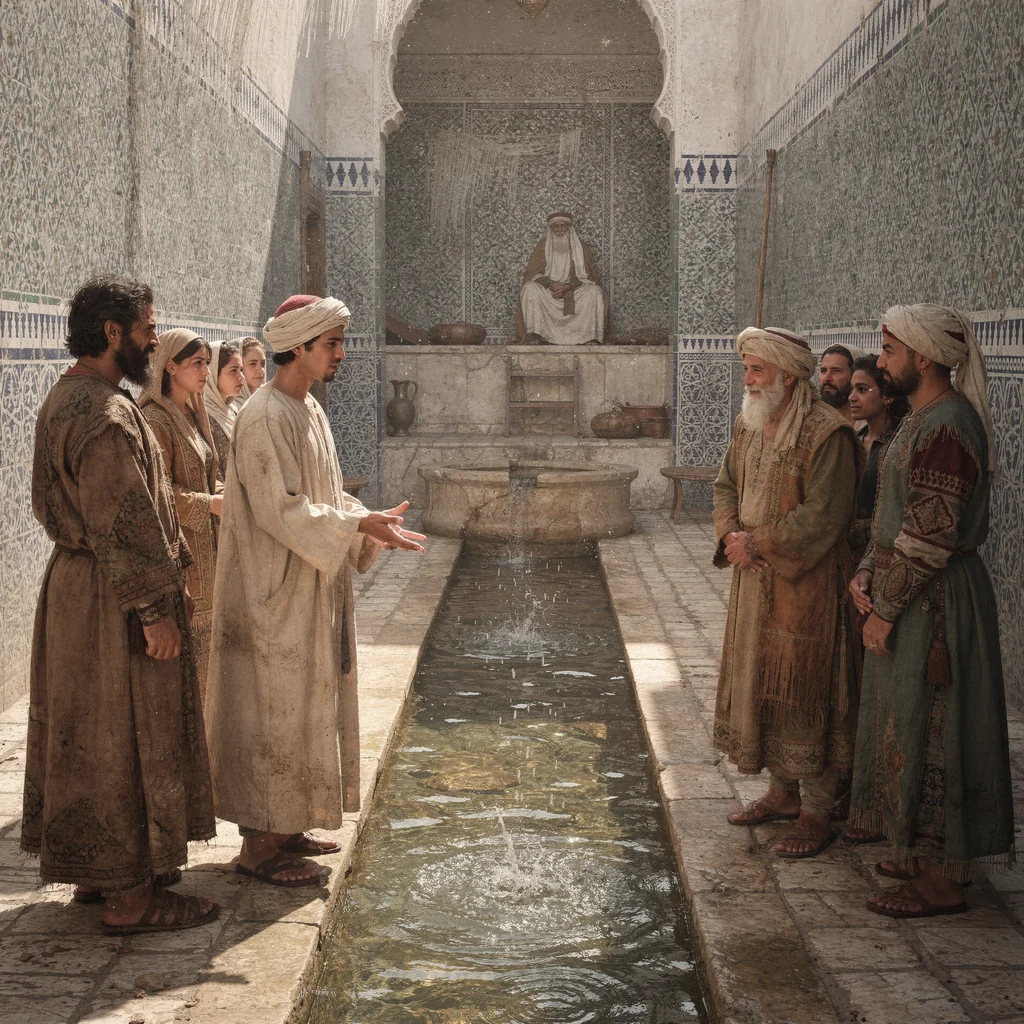
The dispute had been going on for three weeks.
Two Andalusian families. One from Granada, one from Córdoba. Arguing over a water channel in the souk. The Granadan family claimed the Córdoban family was diverting water that had always flowed to their quarter. The Córdoban family claimed the water was shared and always had been.
The Ottoman official who managed the souk was tired of hearing about it. He had threatened to shut off the water to both quarters if they didn’t resolve the dispute themselves.
Muṣṭafā stood between the two families, listening.
He was twenty-nine years old. He had been in Tunis for twelve years. He owned land in Ras al-Tayeb now. Three thousand olive trees producing harvest. Enough wealth to build a house in the Andalusian quarter if he wanted. But he still rented rooms in Fatima’s building. He still spent most of his time in Grombalia with the trees.
The families had come to him because they had heard about his judgment. He had resolved three disputes in the last year. Each one quietly. Without Ottoman involvement. Each solution holding.
“My grandfather dug this channel.” The Granadan patriarch spoke. “In 1492, when we left Granada, he brought the knowledge of how water moves. He dug this channel with his own hands.”
“My grandfather watered his trees from this channel.” The Córdoban patriarch spoke. “In 1502, when we arrived. It was shared water then. It is shared water now.”
Muṣṭafā walked to the channel. He tested the water flow with his hand. He observed the gradient. He noted how the water divided at the branching point.
He saw what both families were saying was true.
“The channel was dug by your grandfather.” Muṣṭafā spoke to the Granadan. “But the water that flows through it comes from the spring system improved by our community, maintained by Andalusians together. The water is shared. The channel is yours.”
He looked at both men.
“The Granadan family owns the channel. They have the right to maintain it, to repair it, to direct its flow. But they do not own the water that passes through it. The water is shared according to the proportions established in 1502. Three parts to the Granadan quarter, two parts to the Córdoban quarter.”
He showed them the branching point where the water divided.
“Three parts flow here. Two parts flow here. This division was made with stones that have been in place for a hundred years. Neither family has moved these stones. The division has held.”
Both men looked at the stones. They saw what Muṣṭafā was showing them. The old stones, worn smooth by water, positioned exactly as he said.
“How did you know this?” The Granadan asked.
“I read the water. The water remembers how it was divided. The stones remember where they were placed. You only needed to look.”
Both families accepted the judgment. The dispute was resolved.
In the month after Sīdī Abū al-Ġayṯ al-Qaššāš died, the elders came to Muṣṭafā at the zawiya.
They stood in a row. Three men whose families had known Sīdī Abū al-Ġayṯ. Whose fathers had arrived in Tunis under his protection. The community of eighty thousand Andalusians in Tunisia and the Maghreb had no formal hierarchy. It was a community of exiles, not a state. But it had a center of gravity, and that center had died.
“You should receive it.” The eldest spoke. “What he carried.”
Muṣṭafā continued reviewing the accounts for the ṣundūq al-Andalusīyīn. The charity fund that assisted poor Andalusians.
“I am a farmer.”
“You are what he made you.” The elder spoke.
Muṣṭafā’s hands stilled.
“He did not make me anything.”
“He opened the door. In 1610. He negotiated with the Dey. He received the Moriscos. He carried the silsila from Spain. From Sīdī Abū Madyan in Seville, from the order that your grandfather’s grandfather knew. That silsila needs a holder now.”
Muṣṭafā closed the account book.
“I am not a Sufi master.”
“No. You are a farmer. That is what the silsila needs now.”
He looked at Muṣṭafā’s hands. The ink stains from the ledger. The soil still under the nails from the morning’s walk through the groves.
“Al-Shādhilī descended from the mountain. He did not stay in the cave. He came down into the markets. Into the courts. Into the life of the world. The silsila has always needed people who would carry it in their hands.”
The elder set his hand briefly on Muṣṭafā’s shoulder.
Muṣṭafā returned to the accounts.
“What does it require?”
“Only what you are already doing.”
The account review continued. Muṣṭafā’s hands moved through the ledger pages, separating entries by category, by urgency, by intended action. The same reading, the same care he brought to the community’s resources.
He said nothing more.
But from that day, the Andalusian community watched him differently. They had seen the elder’s hand on his shoulder. They began to speak the title before the document made it official.
Muṣṭafā stood before the mirror in his room in Fatima’s building.
He was wearing the white turban of his father, the hajj wrap that had crossed the Pyrenees with him in 1609.
He removed it.
From a wooden box on the table, he took the chechia. Red felt, stiff with sizing, the black tassel hanging heavy.
He placed it on his head.
The weight was different. Lighter than the turban. The brim caught against his hair in a way the turban never had.
He looked at himself in the mirror.
The man in the mirror was not his father.
He walked to the souk.
The spice merchant he had bought saffron from for three years looked up, then paused.
“The Sheikh,” the merchant said. “Wearing Tunis.”
Muṣṭafā said nothing. He placed his copper coin on the scale.
In the years that followed, the house in Grombalia filled with children. ʿAbd al-ʿAzīz was the first, born in 1621. Then came Aisha in 1623, then Ibrahim in 1625.
Word spread through the Andalusian quarter.
The man from Baeza, the one who owned the olive groves in Ras al-Tayeb, had settled the Granadan-Córdoban dispute. He had looked at the water and the stones and seen what no one else had seen.
More families came to him.
A merchant from Seville came to him at the zawiya. His name was Aḥmad al-Išbīlī. Joseph the Sevillian, though he used the Arabic now. He had been in Tunis seven years. He traded in leather and saffron, importing from Morocco and exporting to Livorno. He was forty-five years old. He had a soldier’s posture. Shoulders forward, head ducked, as if still expecting blows.
“He cheated me.” Aḥmad placed a leather-bound ledger on Muṣṭafā’s table.
Muṣṭafā did not open the ledger. He looked at Aḥmad’s hands. Calluses on the thumbs and forefingers. The grip of a man who had held a sword once, now held a pen.
“Who cheated you?”
“Yūnus al-Tūnisī. A spice merchant in the souk. I purchased saffron from him in June. Three hundred dirhems. Three pounds of the finest grade, he said. When I received it in Livorno, the Italians weighed it. Two pounds. They laughed at me. They said Tunisian merchants cannot be trusted.”
Muṣṭafā waited.
“I confronted Yūnus. He said I was lying. He said the Italians were lying. He said I must have stolen the saffron myself. He went to the Ottoman judge. The judge believed him. Yūnus is Tunisian. I am Andalusian. The judge took his side.”
Muṣṭafā opened the ledger.
He read slowly. His finger traced each line of Arabic script, each number. He did not read the words. He read the spacing between the words. He read the pressure of the pen on the page. Heavy where the writer had pressed down. Light where he had hesitated.
“Write the numbers again. The transaction. Exactly as you remember it.”
Aḥmad took a scrap of paper. He wrote:
Saffron, 3 pounds, 300 dirhems Payment in full, June 12, 1622
Muṣṭafā looked at Aḥmad’s handwriting. The numbers were cramped. The letters slanted upward. A man’s hand when he is angry, when he is writing something he does not want to forget.
“Come with me.”
They walked to the souk. The midday heat was rising. The spice merchant’s stall was near the entrance, where the air moved through the arches. Yūnus al-Tūnisī sat on a rug behind a table piled with mounds of cumin, coriander, paprika. He was thick-waisted, with a merchant’s smooth hands and a merchant’s quick eyes.
Yūnus saw Muṣṭafā. He saw Aḥmad. His face changed.
“The Andalusian troublemaker.”
“Aḥmad al-Išbīlī says you sold him saffron in June. Three pounds. Three hundred dirhems.”
“I did. The finest saffron in Tunis.”
“Show me the saffron.”
Yūnus hesitated. He reached beneath the table. He brought out a small wooden box. He opened it.
Muṣṭafā looked at the saffron. Dark red threads, dry and brittle. He picked up a pinch. He rolled it between his thumb and forefinger. He brought it to his nose.
“Good quality.”
“The finest.”
“Show me your scale.”
Yūnus hesitated again. He brought out a brass balance scale. Two pans hanging from a central beam, weights in a leather pouch.
Muṣṭafā picked up the scale. He tested the beam. It moved freely. He tested the pans. They hung level.
“Three pounds. Weigh three pounds.”
Yūnus placed a one-pound weight in the left pan. He began scooping saffron into the right pan. The scale dipped. The saffron weighed more than the weight. He added more saffron. The scale rose. He adjusted until the pans hung level.
“One pound.”
Muṣṭafā watched his hands. Quick, confident. The hands of a man who had done this a thousand times.
“Again. Two more pounds.”
Yūnus added the weight. He added the saffron. The pans leveled.
“Three pounds. Exactly as I sold the Andalusian.”
Muṣṭafā did not touch the saffron. He touched the weights. He picked up each one. One pound. Two pounds. He held them in his hand. He frowned.
“These weights are heavy.”
“They are Ottoman standard. Certified by the market inspector.”
“Show me the inspector’s mark.”
Yūnus turned the weights over. Each one had a small stamp. The tughra of the Ottoman authorities, the seal of the Tunis market.
Muṣṭafā examined the stamps. They were clear, deep impressions in the brass.
“When were they certified?”
“Last year. 1621.”
Muṣṭafā placed the weights back on the table. He did not put them back in the leather pouch. He lined them up in a row.
“Three pounds of saffron using these weights. Weigh it again.”
Yūnus looked at Muṣṭafā. He looked at Aḥmad. He looked at the weights lined up on the table.
“I have already weighed it.”
“Humor me.”
Yūnus sighed. He placed the saffron back in the right pan. He placed the three one-pound weights in the left pan. The pans hung level.
“Now take the saffron out. Leave only the weights.”
Yūnus removed the saffron. The left pan sank. The weights were heavier than the standard.
“These weights are not Ottoman standard. The stamp is Ottoman. The metal underneath is not.”
He picked up the one-pound weight. He scratched the bottom with his fingernail. Brass filings came away. Underneath was lead.
“Brass-plated lead. Heavier than brass. Heavier than the standard. When you use these weights to sell, the buyer gets less. When you use them to buy, you pay more.”
Yūnus’s face had gone still.
“Aḥmad al-Išbīlī purchased three pounds of saffron. But he paid for three pounds measured with your weights. He received two pounds measured with honest weights.”
Muṣṭafā looked at Yūnus.
“You have cheated twelve Andalusian merchants that I know of. Probably more. Aḥmad is the first who came to me.”
The souk had gone quiet. Merchants from nearby stalls were watching. Customers had stopped.
“I will report this to the market inspector. I will show him the lead under the brass. I will show him Aḥmad’s ledger. I will ask him to find every Andalusian who has traded with you. They will all be refunded.”
Yūnus said nothing.
“Or. You can refund Aḥmad now. With interest. And you can use honest weights with every Andalusian from this day forward. If I hear that you have cheated one more Andalusian, I will go to the Dey himself. I will show him the lead. I will show him your ledger. I will ask him to calculate how much tax you have cheated the Ottoman treasury out of using false weights.”
Yūnus looked at the weights. He looked at the saffron. He looked at Muṣṭafā.
“Aḥmad will receive his refund. Today.”
“With interest.”
“With interest.”
They walked back to the olive grove in silence. Aḥmad’s shoulders had come back from their forward hunch. He walked taller.
“Why did you scratch the weight? How did you know?”
“You wrote the numbers tightly. You pressed the pen into the page. You were writing something you had counted in your head, something you had verified yourself. But when I looked at the saffron, I saw it was good quality. Three pounds of good saffron is a lot of saffron. It would fill a man’s hands. Yūnus did not have that much saffron on his table. He had only small samples.”
Aḥmad was silent.
“And when he weighed it, the pans moved too easily. The weights were too heavy for their size.”
“You saw that?”
“I felt it. When I held them.”
They walked the rest of the way in silence. When they reached the olive grove, Aḥmad stopped.
“Thank you.”
“Go to the other Andalusians. Tell them what happened. Tell them to bring their ledgers. Anyone who traded with Yūnus will be refunded.”
Aḥmad nodded. He walked toward the Andalusian quarter, his steps quick, his shoulders straight.
Muṣṭafā walked back through the souk. He passed a chechia workshop. The traditional red felt caps that Tunisian men wore. An apprentice was working at a table, trimming the felt with a sharp knife.
Muṣṭafā stopped. He watched the boy work.
The apprentice was perhaps fourteen, the son of an Andalusian family, learning the trade. He was trimming the brim, but his hand was unsteady. The cut was uneven.
Muṣṭafā stepped into the workshop. The boy looked up, startled.
“You’re holding the knife at the wrong angle.”
He took the knife gently from the boy’s hand. He showed him the grip. Thumb on the side, fingers curled around the handle. He demonstrated the cut. The felt fell away in a perfect circle.
“The felt has memory. If you cut it correctly, it keeps the shape. If you force it, it resists.”
He handed the knife back.
The boy tried again. His hand was steadier this time. The cut was better.
Muṣṭafā nodded once. He did not say “good.” He only walked out.
The master craftsman appeared from the back room. He had seen the correction.
“Thank you, Sheikh. The boy learns slowly. But he remembers.”
“He will learn. The knowledge is in the hands. Not the head.”
He continued through the souk.
Muṣṭafā returned to the zawiya. There were two more disputes waiting. A group of workers from Aragon who had not been paid for construction work. A widow from Valencia whose son had been arrested by Ottoman soldiers. He would settle those quietly too.
Each case settled quietly. Each solution holding.
The Sufi authority had been the community’s bridge to the Ottoman world. His spiritual legitimacy giving him access to the Dey’s court. His network of relationships across the Mediterranean giving him leverage in disputes. When he died, that bridge collapsed.
The Andalusian community was left without a representative.
The families who had come to Muṣṭafā for judgment came to him now with a different request.
“We need a leader. Someone who can speak to the Dey. Someone who can protect us from the tax collectors. Someone who can represent us to the Ottoman authorities.”
Muṣṭafā refused.
“I am a farmer. I grow trees. I read the land. I am not a politician.”
“You are already doing the work. You have resolved more disputes in the last year than Sīdī Abū al-Ġayṯ resolved in five. The Ottomans respect you. They know you have capital. They know you have connections. They know you cannot be bribed.”
Muṣṭafā continued to refuse.
Then came the tax incident.
The Dey Yūsuf Dāy had imposed a new tax on the Andalusian community. An avâriz levy, he called it. A wartime irregular tax, necessary for the defense of Tunis against European attacks. The levy was twice what the community could pay. The community protested. The Dey’s soldiers arrested the protest leaders.
Muṣṭafā went to the Dey’s court alone.
He brought no bribe. He brought no army. He brought only the account books from his own olive groves in Ras al-Tayeb, showing what he paid in ʿushr (tithe on harvest), showing that he already paid more than his fair share.
The Dey looked at the books. He looked at the Andalusian standing before him. Twenty-nine years old. Dressed simply.
“You are Šayḫ al-Andalusīyīn. Sheikh of the Andalusians. I have heard of you.”
Muṣṭafā did not respond to the title.
“You are the leader of eighty thousand people. Whether you claim the title or not. They look to you. They follow your judgment. They come to you when they need help.”
The Dey leaned forward.
“The tax remains. But I will release the prisoners. And you will collect the tax from your community and bring it to me. You will guarantee that it is paid.”
The Dey was giving him a choice. Refuse, and the prisoners would remain in jail. Accept, and he would become the official representative of the Andalusian community to the Ottoman authorities.
He accepted.
The prisoners were released.
Muṣṭafā collected the tax. But he collected it fairly, according to what each family could afford, not according to the Dey’s demands. He paid the difference from his own capital.
The Dey accepted this. He had what he needed. A leader who could control the Andalusian population, who could deliver the tax, who could keep the peace.
Two weeks later, the Dey’s kātib (scribe) came to the zawiya with the berat (imperial patent).
The document was on heavy paper, Arabic script in black ink, Ottoman Turkish annotations in red. The tughra seal of the Ottoman Sultan at the top, the seal of the Dey of Tunis below.
The kātib read the terms aloud.
“Muslims, payers of ʿushr (one-tenth of harvest) to the bayt al-māl (public treasury). Exempt from jizya (poll tax on non-Muslims) as this is a Muslim community. The Šayḫ al-Andalusīyīn shall collect the ʿushr and the avâriz (irregular levies) from the Andalusian cultivators and deliver them to the Dey’s treasury. In return, the Šayḫ al-Andalusīyīn and his household are exempt from avâriz taxation.”
Muṣṭafā read the document himself. He noted the specific obligations. Eight thousand akçe annually in ʿushr collection. The tax collection responsibility. The exemption for his household.
He noted something else: the position was waqf-protected. A religious endowment office, not personal property. The sheikhdom could not be confiscated with his private estate.
The kātib placed the document on the table. He pointed to the space for Muṣṭafā’s signature.
Three witnesses stood nearby. The elder who had transmitted the silsila. The imam of the zawiya. A representative of the Dey.
Muṣṭafā signed where the scribe indicated.
The witnesses signed below him.
The kātib rolled the document and sealed it with the Dey’s wax.
“The Šayḫ al-Andalusīyīn is now recognized by the Ottoman state.”
The elder who had placed his hand on Muṣṭafā’s shoulder weeks earlier stepped forward. He set both hands on Muṣṭafā’s shoulders now, pressed down briefly before releasing.
Muṣṭafā was now Šayḫ al-Andalusīyīn.
He was twenty-nine years old.
He would remain Sheikh for thirty-two years.
In 1623, Muṣṭafā became commercial agent to Yūsuf Dāy.
Before the appointment was finalized, he met with ʿAlī Ṯābit. Yūsuf Dey’s right-hand man, rich merchant, manager of the regency’s finances. They sat across a table covered in account books. Shipping manifests, agricultural output figures, tax calculations.
ʿAlī Ṯābit was Tunisian, Ottoman-aligned, independently wealthy. He did not need this position.
“You speak the language of accounts.” He did not offer friendship. He offered structural alignment.
Two men assessing each other across the table. In that language they were fluent.
Muṣṭafā understood what ʿAlī Ṯābit needed: stable revenue for the Dey’s treasury, predictable taxes from a population that paid on time.
ʿAlī Ṯābit understood what Muṣṭafā needed: protection from arbitrary confiscation, access to Ottoman decision-making, the ability to mediate for his community.
In 1624, a French merchant demanded an exclusive contract for Andalusian olive oil. He offered the Dey a premium. Muṣṭafā refused—the contract would harm smaller Andalusian producers who depended on diverse buyers.
The Dey was inclined to accept the French offer.
ʿAlī Ṯābit intervened. “The Andalusians sell to Livorno, to Genoa, to Marseille. If you force them to sell to one buyer, the other buyers will go elsewhere. The prices will fall. The tax revenue will fall.”
The Dey reconsidered. He rejected the exclusive contract.
ʿAlī Ṯābit said nothing to Muṣṭafā about the intervention. Muṣṭafā said nothing about the ledgers he had shown ʿAlī Ṯābit, proving that diverse buyers meant higher prices and higher taxes.
The structural alignment held.
The position gave him access to the Dey’s court. It gave him insight into Ottoman decision-making. It gave him the ability to protect Andalusian commercial interests.
He managed the Dey’s investments in olive oil. He negotiated shipping contracts with French and Italian merchants. He mediated disputes between the Dey’s officials and the Andalusian community.
In 1625, Muṣṭafā and three other Andalusian merchants stood before the qāḍī of Tunis.
The waqfiyya (endowment deed) was spread on the table. The qāḍī read it aloud.
“A former synagogue in the Jewish quarter of the medina, purchased and converted. A teaching institution for poor Andalusian students, regardless of origin city—Granada, Córdoba, Seville, Valencia, all may study.”
The qāḍī continued reading. “Four donors, joint responsibility. Muṣṭafā al-Qardanesh, largest contribution. Aḥmad al-Išbīlī, Yūsuf al-Qurṭubī, ʿUmar al-Balansī. A rotating mutawalli (administrator) among the donors, each serving three years.”
The qāḍī looked up. “The contribution is specified?”
Muṣṭafā spoke. “Money for the building purchase. And labor.”
He explained what he would provide: “The water channel. The ablutions fountain. The hydraulic engineering to ensure reliable flow, Zaghouan-quality, for the students’ purification before prayer.”
The other merchants had contributed gold. Muṣṭafā contributed gold and knowledge.
The qāḍī nodded. “The waqf is valid. The building belongs to God now. It cannot be sold, cannot be confiscated, cannot be divided. It endures.”
He stamped the document with his seal. The registration was complete.
The madrasa belonged to the Andalusians collectively, not to any one man. But Muṣṭafā’s name was first on the deed, and the water that flowed through its fountain came from the channels he had built.
In 1627, the peace negotiations began between Tunisia and Algeria.
The two provinces had been fighting for decades. Border raids, maritime attacks, territorial disputes. The Sublime Porte in Constantinople had demanded a settlement. The Dey of Tunis and the Bey of Algiers had agreed to negotiate.
Muṣṭafā was named to the negotiation committee.
He saw the list. ʿAlī Ṯābit’s name was first. The Dey’s representative. Muṣṭafā’s name was fourth. The positions on the list were not accidental. The committee reflected the alliance that had been building for four years.
Above him were the Dey Yūsuf Dāy, the Grand Vizier of the Dey’s court, and the commander of the Tunisian navy. Below him were the lesser officials, the record-keepers, the messengers.
Muṣṭafā was there because he represented the Andalusian community. The eighty thousand Moriscos who had settled in Tunisia since 1609, who had become an economic force, who could not be ignored.
But he was also there because he had commercial networks across the Mediterranean. He knew the shipping lanes. He knew the merchants. He knew how trade flowed between Tunis, Algiers, Marseille, Genoa, Livorno.
The negotiations lasted eight months.
Muṣṭafā sat in the session after session, listening, observing, speaking only when necessary. He watched how the Dey’s delegates argued. He watched how the Algerian envoys responded. He learned how power was negotiated in the Ottoman world.
The final agreement bore the Sublime Porte’s seal.
Muṣṭafā kept his copy of the document.
He did not know why he kept it. He only knew that it might be useful someday.
The olive groves expanded.
What had been three thousand trees in 1620 became five thousand trees by 1625, became eight thousand trees by 1630. Muṣṭafā purchased more land in Ras al-Tayeb, acquired failing groves from Andalusians who could not make them productive, hired more workers, built more water channels.
The consuls counted what they could count. The barrels of oil, the shipping contracts, the palace construction costs. They did not count the silk. They did not count the names in the third ledger, which had grown from one page to seven since his father had kept it in Baeza.
One of the new workers was Yūsuf al-Garnāṭī. Joseph the Granadino. He had arrived in 1627, expelled with his family when the renewed edicts in Spain targeted even the grandchildren of Moriscos. He was twenty-three years old. He had been a blacksmith’s assistant in Granada, not a farmer.
The work was wrong in his hands. He planted trees with too much force, driving the saplings into the earth as if hammering iron. He dug irrigation ditches with straight walls that collapsed in the first rain. He carried water channel stones on his shoulder instead of using a cart, the weight leaving him exhausted by midday.
Muṣṭafā watched him for three days.
On the fourth day, Muṣṭafā walked to where Yūsuf was planting. Row six, tree twelve. The boy knelt in the dirt, sweating, his blacksmith’s arms straining against the work.
Muṣṭafā knelt beside him.
“You are forging the tree.”
Yūsuf froze.
“The soil is not iron. It breathes. It opens when you are gentle. It closes when you are hard.”
Muṣṭafā dug his fingers into the earth. He loosened the soil. He showed Yūsuf the texture. Aerated, soft, ready to receive.
“Try again.”
Yūsuf dug. His fingers were still stiff, still used to gripping iron. But he tried to gentle them. He loosened the soil.
“Better.”
He showed Yūsuf how to test the moisture. Press the dirt, watch it hold together or fall apart. He showed him how to read the leaves. Curling meant too dry, yellowing meant too wet. He showed him how to check the graft union where the sapling joined the rootstock, feeling for the swelling that meant the tree was taking.
Yūsuf watched. His hands learned. By the end of the season, he could plant a tree without forcing the earth. He could dig an irrigation channel with sloped walls that held. He walked differently now. Not with the blacksmith’s heavy stride, but with the farmer’s reading step, eyes on the ground, testing each footfall before committing weight.
Muṣṭafā said nothing about the change. He only nodded when he saw Yūsuf working in row nine, planting the trees correctly, checking the soil moisture before watering, carrying the stones on a cart he had built himself.
The workers lived on the land he owned. They were fed from the vegetable gardens between the trees. They were paid fairly, according to the harvest.
Some saved their wages and bought their own land. Muṣṭafā helped them negotiate the purchase, showed them where to buy, how to register the deed, how to begin.
The palace in Grombalia was built in 1628.
It was not a palace in the Ottoman style. Not domes and minarets and ornate tiles. It was an Andalusian courtyard house, built around a central garden, with rooms opening onto shaded arcades, with a fountain in the center that recirculated mountain water, limestone-filtered, carrying the mineral scent he had learned in Zaghouan.
He built it because he needed a place to meet with the community, to resolve disputes, to plan the expansion of the groves. The house in the Andalusian quarter of Tunis was too small. The olive groves were too far to walk every day.
The palace became the center of Andalusian life in Ras al-Tayeb.
Community meetings were held in the courtyard. Disputes were settled under the arcade. Weddings were celebrated in the garden.
The Ottoman officials came too. Tax collectors, judges, military commanders. They came to see the Sheikh of the Andalusians, the man who controlled eighty thousand people, the man who owned thousands of olive trees, the man who could mobilize labor and capital at will.
Muṣṭafā received them politely. He served them food from his own gardens. He showed them the olive groves. He explained the irrigation systems.
The officials left him alone to govern his community as he saw fit.
The 1630s were the height of his power.
By 1632, Muṣṭafā read the change in ʿAlī Ṯābit the way he read the change in a tree whose roots were compromised. From the surface, from what the leaves showed. The Tunisian merchant was slowing. The hands that had moved across account books with such precision now hesitated. The mind that had calculated tax implications in moments now paused before speaking.
Muṣṭafā did not speak of it. He filed it.
He began to think differently about the document distribution. The preparations began earlier than the timeline suggested.
In 1634, ʿAlī Ṯābit died. Muṣṭafā noted the death as a merchant notes a shift in the market.
The exposure was immediate.
The new khāzin (treasurer), a man from Ḥammūda’s corsair faction, demanded that Muṣṭafā prove his tax payments for the last decade. “The records are incomplete. You may have underpaid.”
Muṣṭafā went to his archives. He retrieved the ledgers ʿAlī Ṯābit had kept, the copies of payments made, the receipts from the bayt al-māl.
He brought them to the new khāzin.
“Every payment. Every akçe. Witnessed by ʿAlī Ṯābit himself. The records are not incomplete. They are in three copies. One here. One in the Dey’s palace. One in the Zaytuna mosque.”
The new khāzin examined the ledgers. The signatures were clear. The receipts were complete. The tax payments were exactly as required.
He said nothing. He returned the ledgers.
But the message was clear: the protection was gone. The faction that saw Muṣṭafā as too rich, too foreign, too powerful now controlled the treasury.
Muṣṭafā began accelerating the preparations.
By 1635, the olive groves numbered fifteen thousand trees. By 1640, twenty thousand. By 1645, twenty-five thousand. By 1647, thirty thousand.
The harvest was enormous.
Eight thousand barrels of oil each year. The oil was exported to Marseille, to Genoa, to Livorno. The merchants knew the quality. Ras al-Tayeb oil, pressed from trees that grew in red limestone soil, watered by mountain springs that carried the mineral scent of Zaghouan’s geology, tended by Andalusians who had been expelled from Spain.
Eighty thousand Andalusians lived in Ras al-Tayeb now. They worked in the groves. They worked in the pressing facilities. They worked in the shipping trade.
They called him Šayḫ al-Andalusīyīn. Sheikh of the Andalusians.
The French consular documents noted his activities. Thirty-eight mentions between 1618 and 1650. The consuls reported his growing wealth. They reported his growing influence. They reported that he was becoming too powerful.
Peyssonnel, the French consul who would serve decades later, would write. “It is a very serious crime here to be too rich.”
Muṣṭafā read the French reports. He had sources in the consulate. He knew what was being written.
He began making preparations.
By 1640, the grove employed three hundred workers at harvest. Free men from the Morisco quarter and from the villages of Cap Bon, contracted for the November pressing season, returning year after year.
The permanent core was smaller. A dozen foremen who knew each tree, who had learned the spacing from Muṣṭafā himself and would teach their sons.
The men he had negotiated with in the early years of the Sheikh’s tenure were no longer where they had been. The prosperous Morisco merchants of the 1620s. The Granadan who had bought land in Testour, the Cordoban who had opened a shop in the souk, the Valencian who had traded with Livorno. Were gone. Not dead. Absent. Absorbed, eclipsed, or failed.
Muṣṭafā read the market and noted the absence.
The French consular reports noted this too. They recorded the workforce. Three hundred men at harvest, free laborers contracted for the pressing season, the permanent core of foremen who lived near the estate year-round.
ʿAbd al-ʿAzīz held the shears. He was fourteen years old.
“Here.” Muṣṭafā pointed to a branch on the middle tree. Row four.
The boy hesitated.
Muṣṭafā took the shears. He positioned the blades below the node. One clean cut.
The branch fell.
“The wound will heal,” Muṣṭafā said. “Cut above, it rots.”
He handed the shears back.
ʿAbd al-ʿAzīz moved to the next tree. He found the branch. He positioned the blades.
He cut.
Muṣṭafā watched. The cut was clean.
They moved down the row. The boy’s hands grew confident. The rhythm established. Cut, drop, step. Cut, drop, step.
The pile of branches accumulated behind them.
In 1635, fever took Ibrahim.
He was ten years old. The middle child, named for the astronomer lineage, the one who had planted trees with his mother when he was small. The fever came in autumn. The doctors came. The prayers were said. The boy died.
That night, Muṣṭafā found Fatima in the palace courtyard.
She was sitting on the stone bench by the fountain. The moonlight caught her face. She was weeping. Not the sobbing of a woman in public, but the quiet weeping of a mother who thought herself alone.
Muṣṭafā stood in the shadows. He did not speak. He did not approach.
He watched her shoulders shake. He watched her wipe her eyes with the back of her hand. He watched her press her hands to her face, the gesture she had used a thousand times to read the sky, now reading only her own grief.
He walked away. He did not disturb her.
The day after the burial, dawn, she was in the grove alone.
She moved through the rows of young trees. The ones Ibrahim had helped plant, the ones he had watered, the ones he had watched grow from saplings to waist-high. She did not pray aloud. She did not call his name. She moved.
She stopped at one tree. The one he had planted with his own hands in 1630, the one he had checked every morning for water, for pests, for growth. The one where he had misjudged the spacing, planting too close to the channel, and she had shown him how to read the soil’s moisture, how to let the earth tell him what it needed.
She knelt. She checked the soil moisture at its base. Dry. The water channel had shifted during the rains.
She reached to adjust the channel. Her hands were shaking. She misjudged the flow. Too much water poured onto the roots.
Muṣṭafā stepped forward from the edge of the grove.
“Less,” he said gently. “The soil is still wet.”
Fatima nodded. She did not look at him. She corrected the channel. The flow slowed. The water would seep, not drown.
She stood. She wiped her hands on her tunic.
“The roots go deep.”
She walked back to the palace without looking at the other trees.
Muṣṭafā watched her go. He did not follow.
Ten harvests had passed since the madrasa endowment. The wrinkles around his eyes had deepened. The boy’s death had carved itself into his face.
In 1647, Ḥammūda Bāšā Bey came to power.
The son of Murad I Bey and a Corsican odalisque, Ḥammūda had grown up around corsairs. His father had been a pirate. His father’s friend Usta Murad had captured nine hundred ships and twenty thousand prisoners, selling them in the Tunis slave markets.
Ḥammūda understood power.
He understood seizure. He understood violence. He understood that the law was what the powerful said it was.
In 1647, at the height of his power, he appointed all officials. He gained control of the janissary force in Tunis. He became the true ruler of Tunisia, the Dey reduced to a figurehead.
The Andalusian community watched these developments with concern.
They remembered Spain. They remembered how the authorities had turned on them there. The cooling, the cancelled meetings, the officials who stopped meeting their eye. Then the accusations. The investigation. The confiscation. The exile.
The elders came to Muṣṭafā in the palace courtyard.
“He is a corsair.” One elder spoke. “He takes what he wants.”
“He controls the army.” Another spoke. “He controls the janissaries. He controls the officials.”
“He will come for us.” A third spoke. “He will come for the trees. He will come for the palace. He will come for the Sheikh.”
Muṣṭafā was fifty-four years old.
He had been Sheikh for twenty-five years. He had built something extraordinary in Ras al-Tayeb. And something invisible beneath it.
“I have prepared.”
The elders waited.
“I have endowed the groves to Sidi Abū Marwān al-Sharīf al-Būnī mosque. As waqf. Religious endowment. The trees belong to God now. They cannot be confiscated.”
The elders nodded.
“I have distributed the documents. The land deeds, the tax records, the workers’ contracts. Copies are in the Zaytuna mosque, in the Grana merchant’s house, in Fatima’s father’s keeping. The chest with the originals is beneath the palace floor, locked with three keys. All three must agree to open it.”
He looked at the elders.
“If Ḥammūda comes for me, the groves will remain. The workers will remain. The documents will remain. What can be seen will be taken. What cannot be seen will survive.”
One elder spoke.
“You have prepared for your exile.”
“I have prepared for the community’s survival.”
The 1650s passed in tension.
Ḥammūda Bāšā did not come immediately. He consolidated his power first. In 1659, the Ottoman Sultan named him Pasha of Tunis. He controlled everything. The army, the navy, the officials, the courts.
But he watched Muṣṭafā.
The French consular reports note the watching. The spies in Ḥammūda’s court noted the watching. The Andalusian community felt the watching.
In 1649, Ḥammūda confiscated the estate of Aḥmad al-Išbīlī, the spice merchant Muṣṭafā had helped years earlier. The accusation: tax evasion. The evidence: falsified ledgers. Aḥmad was imprisoned, his property seized, his family reduced to poverty.
Muṣṭafā went to the Dey—who was now only a figurehead, powerless against Ḥammūda’s faction.
He went to Ḥammūda directly.
“The man is innocent. I have his ledgers. I witnessed his transactions.”
Ḥammūda looked at him. “The court has found him guilty. The property belongs to the state now.”
Muṣṭafā understood. This was not about justice. It was about wealth transfer. Aḥmad was wealthy. Ḥammūda wanted his wealth.
The waqf registration had been contested. The qāḍī resisted. Ḥammūda’s people pressured him. Muṣṭafā had brought the waqfiyya to the Zaytuna imam. The religious courts recognized what the civil courts would not. The qāḍī stamped the document.
The watching continued.
Ḥammūda was a corsair’s son.
In 1653, he met with Sīdī ʿAlī al-Khaḍār al-Andalusī in the hammam.
The Sufi vegetable seller turned holy man, the first Andalusian Sufi recognized in Tunis. They sat in the steam together, the mountain water carrying its mineral scent through the heat.
“You are a state within a state.” Sīdī ʿAlī spoke.
Muṣṭafā had heard this before. The French consul had written it. The Ottoman officials had whispered it. Now the Sufi said it aloud.
“I am a farmer.”
“The Bey fears what you have built.”
“The Bey can take what he can see.”
“And what he cannot see?”
“What cannot be seen will remain.”
Sīdī ʿAlī was silent.
“You have prepared.”
“I have planted.”
Sīdī ʿAlī nodded.
They sat in the steam until the water cooled. Then they moved to the warm room, then the cool room, following the sequence of the hammam. The heat opening the pores, the warmth relaxing the muscles, the cold closing them again.
When they dressed, Muṣṭafā smelled the mineral water on his skin. He did not wash it off.
He walked Sīdī ʿAlī to the zawiya gate.
“The Bey will come.”
“Soon.”
Muṣṭafā mounted his horse. He rode toward Grombalia.
Behind him, the steam from the hammam chimneys rose into the cold air, carrying the mineral smell of mountain water.
The summons came in early 1654.
Not a confrontation. Not a scene.
A message from the Bey’s palace. “Šayḫ al-Andalusīyīn is required at court. Today.”
Muṣṭafā was sixty-one years old.
He had been waiting for this moment since 1647. Since he first saw Ḥammūda consolidate power. Since he first heard the corsair’s name spoken with fear in the souks of Tunis.
He gathered the documents from the chest beneath the floor. The 1627-28 papers with the Sublime Porte seals. The proofs that he had served the Ottoman empire.
He did not gather clothes. He did not gather wealth. He gathered only what could not be confiscated. The knowledge, the documents, the name.
He said goodbye to Fatima.
“They will let you stay. You are Tunisian now. The children are Tunisian. Only I am the exile.”
“I will watch the trees.”
“The trees will watch you.”
He walked out of the palace. He walked through the groves. Thirty thousand trees, planted over forty years, row after row across the red earth of Ras al-Tayeb. He walked the water channels, mountain water, limestone-filtered, carrying the mineral scent he had learned in Zaghouan, flowing through the conduits he had built.
He did not touch the trees. He did not need to.
He mounted his horse. He rode to Tunis.