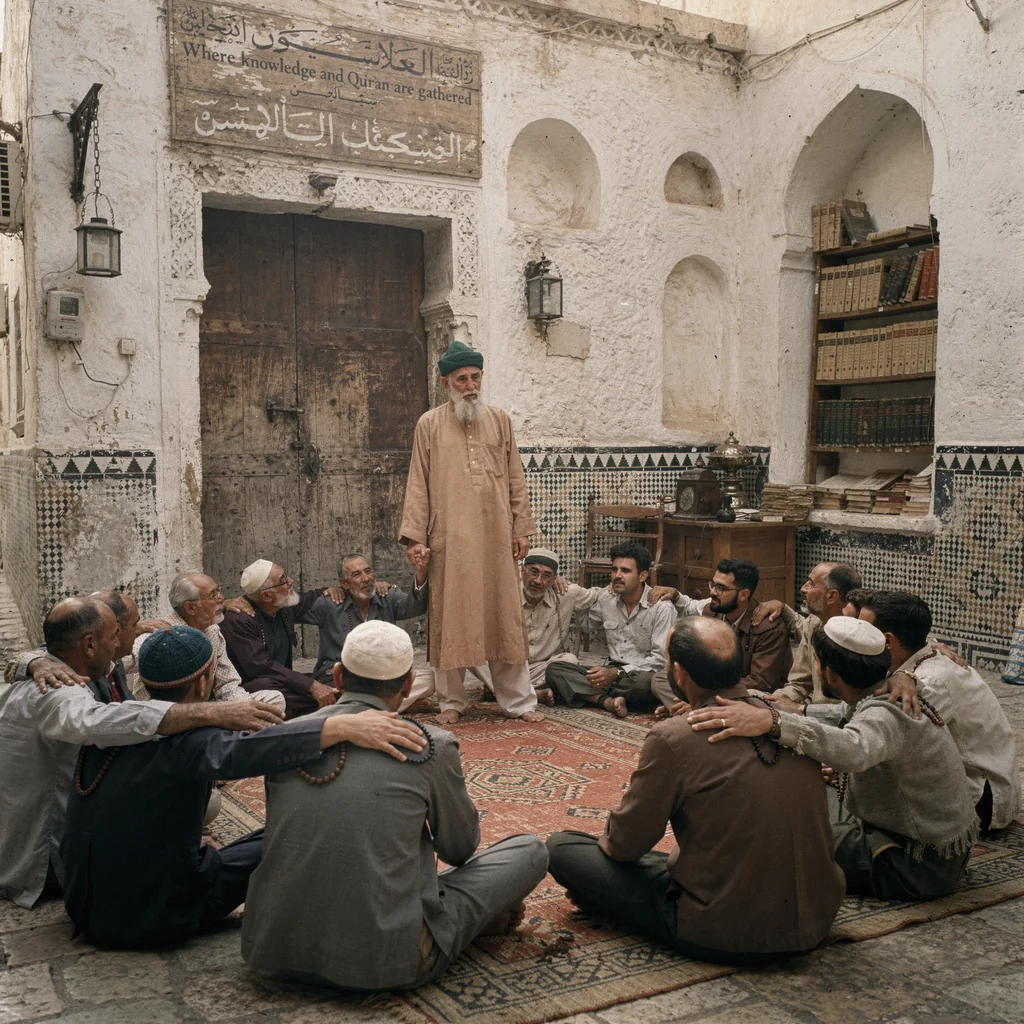
Tunis, 1972.
Karim was seven. His grandfather’s hand was large and calloused, enclosing his own smaller hand as they walked the streets of the medina.
The stone buildings rose on either side, whitewashed and weathered. The sun reflected off the walls. The air smelled of dust and olives and baking bread.
Where are we going? Karim asked.
To the zawiya, his grandfather said.
What’s a zawiya?
It’s a place, his grandfather said. Where we remember.
They turned a corner. The street narrowed. The buildings pressed closer together. The shadows lengthened. His grandfather’s breathing was labored on the hill — a sound Karim would not understand until he was old enough to recognize age in another man’s lungs.
There was a door ahead. Wooden, old, the paint peeling in places. Above the door, an inscription in Arabic:
Where knowledge and Quran are gathered
This is it, his grandfather said.
He pushed the door open.
Inside, the air was cool. The light was dim. The room was larger than it appeared from the street. A carpet covered the floor. Pillows were arranged around the walls.
The air smelled of things Karim had never encountered together: the sharp resin of olive wood, the must of old paper, the sweetness of dried mint, the faint perfume of incense that had been burned here for generations.
Men sat in a circle in the center of the room. There were a dozen of them, perhaps more. They wore simple clothes — cotton shirts, wool trousers. Some had caps on their heads. Some had gray beards.
One man sat at the head of the circle. He was older than the others. His beard was white. His face was lined with decades of sun and prayer. His eyes were closed.
His hand rested on the shoulder of the man beside him.
That man’s hand rested on the shoulder of the next.
And the next. And the next. All the way around the circle.
The chain of hands. The connection.
Karim’s grandfather led him to the edge of the circle. They sat on pillows. The carpet was rough under Karim’s legs — wool that had worn thin over decades of use, the geometric patterns faded to ghosts of red and blue. The fibers scratched against his skin, a reminder that he sat on something made by hand, something that had endured.
What are they doing? Karim whispered.
Dhikr, his grandfather said. Remembrance.
Remembering what?
Who we are, his grandfather said. Where we came from. What we owe.
Karim didn’t understand. He was seven. The words were too large.
But he felt something.
The room was quiet. The men were silent. Then the old man at the head of the circle began to chant.
La ilaha illa Allah.
There is no god but God.
The zawiya was cool. The stone floor was smooth from centuries of bare feet. The air smelled of olives and dust and old books — the scent of knowledge kept in dark rooms.
The men sat in a circle on carpets that had been worn thin by generations of knees. The patterns had faded to ghosts of flowers and geometries.
The chanting began. The voices blended together. The melody started low, in the chest of the old man, then rose — a single thread of sound that wound through the room. The words rolled together like water, one phrase flowing into the next, seamless and endless. The Arabic was formal, the grammar classical, but the feeling was immediate. The resonance vibrated in Karim’s chest, in his bones, in the hollow spaces of the room.
The old man’s voice cracked slightly on the repetition — the crack of age, the crack of truth. The younger voices joined in, softer, less resonant, but no less sincere.
The sound filled the zawiya. It pressed against the stone walls. It rose to the ceiling beams.
La ilaha illa Allah.
The old man’s hand squeezed the shoulder of the man beside him. His fingers were calloused, his palm rough with years of work. The grip was firm but gentle — the weight of a hand that had planted trees, that had built wells, that had held children and grandchildren.
That man squeezed the next shoulder.
The gesture passed around the circle. Hand to shoulder. Shoulder to hand. The transmission of something that could not be named.
Karim watched from his place beside his grandfather. He didn’t understand the words. But something shifted in his chest. A warmth that spread from his sternum to his throat. The room held him.
The chanting continued. Karim lost track of the minutes. The light in the room shifted as the sun moved across the sky. Dust motes danced in the light beams.
Then the old man opened his eyes. The chanting stopped. The silence returned.
The old man looked around the circle. His gaze landed on Karim.
And who is this? the old man asked.
My grandson, Karim’s grandfather said. Karim.
Welcome, Karim, the old man said. You are welcome here.
Thank you, Karim said. The words felt small in his mouth.
Do you know where you are? the old man asked.
Karim shook his head. No.
You are in a place where knowledge passes, the old man said. Hand to hand. Shoulder to shoulder. Generation to generation.
He gestured around the circle, his hand moving from one man to the next.
These men. Some are merchants. Some are artisans. Some are farmers. Some are teachers. But here, they are all the same. They are all links in the chain.
He looked at Karim.
Do you feel the chain?
Karim looked at the circle of hands. The old man’s hand on the next man’s shoulder. The next man’s hand on the next. All the way around.
Yes, Karim said.
Good, the old man said. The chain is real. It connects us to those who came before. It connects us to those who will come after. It connects us to something that does not end.
The old man looked around the circle. His gaze moved from face to face.
Everything important is transmitted this way, he said. Hand to hand. Shoulder to shoulder. When the circle breaks, the transmission stops. And when the transmission stops, something dies that cannot be named.
Karim didn’t understand — not fully. He was seven.
But the words settled in his chest. Heavy. True.
The transmission. The chain. The circle.
Hand to hand. Shoulder to shoulder.
Come, his grandfather said, standing up. It’s time to go.
They left the zawiya. The door closed behind them. The street was bright after the dim interior. The sun was warm.
Will we come back? Karim asked.
Yes, his grandfather said. Every week. Every Friday. Until you’re old enough to come without me.
And then?
And then, his grandfather said, you’ll bring your own children.
What if I don’t have children? Karim asked.
His grandfather stopped. He looked down at his grandson.
You will have children, he said.
What if I don’t? Karim asked.
His grandfather didn’t answer immediately. He took Karim’s hand.
Come, he said. Your mother will have lunch ready.
What if the zawiya closes? Karim asked.
His grandfather paused. He looked at the wooden door. The Arabic inscription above it.
The zawiya will not close, he said. It cannot. The chain is too old. The transmission is too strong. This place has stood for three hundred years. It will stand for three hundred more.
He took Karim’s hand. His grip was tighter this time.
Come, he said. We should go. It’s getting late.
They walked back through the medina. The same walls, the same dust. But the light had shifted — the sun lower now, the shadows reaching across the street.
But something had changed.
He had been inside the circle. The hand on his grandfather’s shoulder. The chanting in his bones. The taste of the air — resin, mint, old paper.
He was part of the chain now.
He didn’t understand what it meant. Not yet. He was seven.
They arrived at the apartment building. It was a modern building in the European quarter. The elevator worked. The water ran from the tap. The electricity was reliable.
Karim’s father, Hassen, was at home. He was sitting at the table, reading a document.
Where were you? Hassen asked.
At the zawiya, Karim’s grandfather said.
Hassen’s face hardened. The zawiya again.
Yes, his grandfather said. Every Friday. As we have always done.
Hassen stood up. Father, we’ve talked about this. Those places are backward. They teach superstition. They keep children from attending secular schools.
They teach belonging, Karim’s grandfather said. They teach connection. They teach the chain.
They teach backwardness, Hassen said. If Tunisia is to develop, if we are to become modern, these places must close.
They will not close, Karim’s grandfather said. The chain is too old.
We’ll see, Hassen said.
He walked into the bedroom. He closed the door.
Karim’s grandfather looked at Karim.
Your father, he said quietly. He means well. But he does not see.
See what? Karim asked.
What is lost, his grandfather said. When the transmission stops.
Will it stop? Karim asked.
His grandfather studied the closed bedroom door. He looked at Karim.
I hope not, he said. But the times are changing. The government wants to modernize. They want to be like France. They think the old ways are holding us back.
He looked at Karim’s hands, still small in his own.
They are wrong, he said. The old ways are not holding us back. The old ways are what keep us standing.
He took Karim’s hand.
Come, he said. Lunch.
Karim followed his grandfather into the kitchen. His mother was there. She was placing bread on the table. Olives. Tomatoes. Hard-boiled eggs.
Did you have a good time? she asked.
Yes, Karim said.
He sat at the table. The circle. The hand on the shoulder. The chanting. The belonging.
His father’s words: Those places are backward.
He didn’t understand the conflict. He was seven.
But the air in the kitchen was thick. His father’s door stayed closed. His grandfather’s jaw was tight.
He ate his bread. He ate his olives. He drank his water.
The chain was real. He had sat inside it.
He didn’t know yet that the chain could break.
August 1975.
Karim’s grandfather took them to Cap Bon. To Henchir al-Turki. To the olive grove that had been in the family for generations.
Omar came too. He was seventeen now. He had finished high school. He would start at IHEC in the fall. He talked about business. About economics. About the future.
Their cousin Tayeb had been here last summer, before his parents moved to Sfax. He had stood before this same tree and said nothing.
Karim was ten. He said nothing. He just watched.
The drive took an hour. The road wound through the countryside. The olive trees flashed past — silver-green in the summer sun. The heat was oppressive. August in Tunisia. The air shimmered above the asphalt.
They arrived at the grove. The gate was iron, rusted at the hinges. His grandfather unlocked it. The metal groaned.
Come, he said.
They walked into the grove. The ground was dry. The grass was brown. The drought had lasted two years.
Follow me, his grandfather said.
He walked deeper into the grove. Karim followed. Omar followed. His grandfather walked with a limp — his left leg dragged slightly, a reminder of the war against the French. He had been young then. He was old now.
They reached the center of the grove.
This one, his grandfather said.
He pointed to an olive tree. It was massive. The bark was thick, fissured, the color of old iron. The trunk was wider than a man could embrace. The branches spread outward, silver leaves catching the sun.
How old? Omar asked.
Planted in 1881, his grandfather said. The year the French protectorate was signed.
Karim looked at the tree. He tried to count the years. 1881 to 1975. Ninety-four years. It was here during the war. It was here when we gained independence. It will be here when we are gone.
Why? Karim asked.
Because, his grandfather said. The olive tree endures. It survives drought. It survives heat. It survives war. It survives everything.
He placed his hand on the bark. The wood was warm from the sun.
Feel it, he said.
Karim placed his hand on the bark. It was rough. It was warm. He felt something beneath the bark. A pulse. A life.
Omar placed his hand on the bark too. His fingers pressed into the grooves.
I feel something, Omar said. A heartbeat.
Yes, his grandfather said. The tree is alive. It has been alive for ninety-four years. It will be alive for ninety-four more.
He looked at both boys.
This tree outlasts empires, he said. It outlasts governments. It outlasts ideologies. It endures because it is rooted. It endures because it is connected to the earth. It endures because it does not rely on anyone but itself and God.
He looked at Omar.
You will go to IHEC, he said. You will study business. You will study economics. You will try to build something.
Yes, Omar said.
Remember this tree, his grandfather said. Remember that what endures is what is rooted. What is connected. What does not depend on the favor of governments or the whims of men.
He looked at Karim.
And you, he said. You will witness many things. You will see change. You will see decline. You will see things that should not happen.
I don’t understand, Karim said.
You will, his grandfather said. Someday, you will understand.
He placed his hand on Karim’s shoulder. Then he placed his hand on Omar’s shoulder.
Both of you, he said. Remember the tree. Remember that what endures is what is rooted.
Omar looked at the tree. He looked at the branches, the silver leaves, the olives hanging dark and heavy on the boughs.
I want to build things, Omar said. Hotels. Restaurants. Businesses. I want to modernize Tunisia.
Build what you want, his grandfather said. But remember the tree. Remember that what matters is not what you build, but how you build it. Whether you build on rock or on sand.
He turned and walked back toward the gate.
Karim and Omar stood before the tree. The shadows lengthened. The sun moved across the sky.
Do you feel it? Karim asked.
Feel what? Omar asked.
The life, Karim said. In the tree. It’s… it’s like it’s breathing.
Omar placed his hand on the bark again.
I feel something, Omar said. But I don’t know what it means.
I think it means we’re part of something bigger, Karim said. Something that was here before us. Something that will be here after us.
Omar looked at his little brother. Karim was ten. He believed everything. Omar was seventeen. He measured the world in what he could see and touch.
Maybe, Omar said. Or maybe it’s just a tree.
It’s not just a tree, Karim said.
What is it then?
Karim looked at the tree. He looked at the branches, the silver leaves, the olives.
I don’t know, Karim said. But it’s something.
Omar laughed. You’re too young to understand.
And you’re too old, Karim said.
Omar stopped laughing. He looked at his brother. He looked at the tree.
Maybe, Omar said. Maybe you’re right.
They stood together before the tree. The grandfather called from the gate.
Come! he shouted. Your mother will have dinner ready!
Karim and Omar walked back to the gate. They walked side by side. The sun was setting. The olive trees were silver in the fading light.
Will you come back? Karim asked.
To the grove? Omar asked.
Yes.
Of course, Omar said. It’s our family’s land. Of course I’ll come back.
But Karim heard something in his brother’s voice. A hesitation. A distance.
Omar would come back to the grove. But he would not come back to the tree.
The bark was still warm under Karim’s palm. Omar was already walking toward the gate.
Karim went back to the zawiya every Friday. For three years.
By 1974, the direction was clear. The young men who had once come were working instead — the government had withdrawn the small subsidies that had made Friday afternoons possible. The funding had not been cut in one stroke. It had simply stopped renewing.
Karim’s father was pleased. This is good, he said. The government is finally moving Tunisia into the modern era.
Karim’s grandfather said nothing. But his face was grave.
In 1975, Karim’s grandfather took him to the zawiya for the last time.
The door was open. The carpet was there. The pillows were arranged around the walls.
But the circle was smaller.
Only eight men sat in the circle. Some of the faces were missing.
Where are the others? Karim asked.
Gone, his grandfather said. The government reduced the funding. The young men cannot afford to come. They must work.
Will they come back?
His grandfather didn’t answer.
They sat on pillows. The old man at the head of the circle was there. His beard was whiter. His face was more lined.
Welcome, Karim, the old man said. You are welcome here.
The chanting began. La ilaha illa Allah.
The circle repeated the words. But the voices were fewer. The melody was thinner.
After the chanting, the old man spoke.
This place is struggling, he said. The government has cut our funding. The young men are not coming. The transmission is weakening.
He looked at Karim.
I want you to remember something, he said. He placed his hand on the boy’s shoulder. The circle. The chain. Do not forget.
The words settled in Karim’s chest like a stone.
Will the transmission stop? Karim asked.
The old man didn’t answer immediately. He looked around the smaller circle. He looked at the empty pillows.
I hope not, he said. But the times are changing. The government wants to modernize. They think the old ways are backward.
He looked at Karim.
They are wrong, he said. The old ways are not backward. The old ways are what keep us standing.
He placed his hand on Karim’s shoulder.
Remember this, he said. Remember the circle. Remember the chain. Remember the transmission.
I will, Karim said.
They left the zawiya. The door closed behind them.
As they walked away, Karim looked back.
The wooden door. The Arabic inscription above it.
Where knowledge and Quran are gathered
The words were still there.
But the absence was physical. Fewer voices. More empty space between the men.
He was ten now. He understood more than he had at seven.
He understood that something was at stake.
He understood that the chain could break.
In 1980, Karim’s grandfather died.
Karim was fifteen. He attended the funeral. The men who had sat in the circle were there. Some were dead now. Some had stopped coming.
The transmission was already broken.
Karim stood at the grave. The zawiya. The circle. The hand on the shoulder.
The old man’s words:
Everything important is transmitted hand to hand. Shoulder to shoulder. When the circle breaks, the transmission stops. And when the transmission stops, something dies that cannot be named.
Karim stood at the grave. The earth was fresh. The marble was white. He placed his hand on the headstone.
The stone was cold.
He remembered the zawiya. The carpet. The pillows. The hand on the shoulder.
He stood alone at the edge of the circle.
It was gone now.
He turned once to look back. The wooden door was still open. Above it, the inscription caught the afternoon light:
Where knowledge and Quran are gathered
End of Chapter 1