Two days before the departure.
Karim went to the supermarket. He wanted to buy something special for Amira’s last meal. Something she loved. Couscous with lamb. Her favorite dish.
The supermarket was in the European quarter. Upscale. Expensive. The kind of place that used to have everything.
Karim walked through the automatic doors. The cart had a wobbly wheel. It pulled to the left.
He went to the produce section.
The shelves were half empty. No tomatoes. No peppers. No cucumbers. No fresh fruit.
Wilted lettuce. Brown-spotted apples. Potatoes that had started to sprout.
Excuse me, Karim said to a stock boy. Where are the tomatoes?
The boy looked tired. No tomatoes. No imports. The border is closed.
The… what?
The Algerian border, the boy said. Closed. No imports. No exports either.
Karim looked at the empty shelf where the tomatoes should have been.
What about local produce? Karim asked.
The drought, the boy said. The crops failed. There’s nothing.
Karim walked to the meat section.
Empty.
No chicken. No beef. No lamb. No pork.
Only frozen fish. Expensive. Imported. The price made Karim wince.
And the fresh meat? Karim asked.
No fresh meat, the boy said. The farmers can’t afford feed. They’re selling their herds. There’s no meat.
Karim walked through the aisles. The shelves were bare.
He checked prices on the items that remained.
Milk: up 40% in three months. Bread: up 60% in the same period. Eggs: up 80%.
His pension: the same.
It bought half of what it had bought three years ago.
He saw an argument at the next aisle. Two women. One middle-aged, one elderly.
The last carton, the middle-aged woman said. I need the milk for my children.
I need it too, the elderly woman said. My grandchildren are hungry.
My children are hungry, the first woman said.
Both of my grandchildren are hungry, the second woman said.
They reached for the last carton at the same time.
A manager appeared. Ladies, please.
She took it first, the middle-aged woman said.
No, the elderly woman said. I had it in my hand first.
You dropped it, the manager said. It’s on the shelf now. First come, first served.
But she needs it, the middle-aged woman said. Her children are—
My grandchildren need it too, the elderly woman said.
The manager looked at both women. His face showed the exhaustion of someone who had this conversation ten times a day.
We’re out of milk, he said. This is the last carton. I can’t give it to either of you. I have other customers waiting.
But my children, the first woman said.
My grandchildren, the second woman said.
I’m sorry, the manager said. There’s nothing I can do. The supply chain is broken. The deliveries are unreliable. I don’t know when more will come.
The women looked at him. Then they looked at each other.
The manager reached for the carton. I’ll hold it at customer service. First come, first served when more arrives.
When will that be? the first woman asked.
I don’t know, the manager said. Maybe tomorrow. Maybe next week. I don’t know.
The women walked away. Empty-handed. Hungry.
Karim turned away. He couldn’t watch.
He went to the checkout with his meager purchases. Bread. Olives. Cheese. The basics.
The cashier scanned each item. The numbers appeared on the screen.
The total was higher than he expected. Much higher.
He did the math in his head. Pension minus groceries. Pension minus rent. Pension minus electricity.
He came up short.
He had to put something back.
The cheese, Karim said. I can’t afford the cheese.
The cashier watched him. No judgment. Just sad recognition. She’d seen this before. Hundreds of times.
I’m sorry, she said.
Me too, Karim said.
She removed the cheese. The total dropped. It was within his pension now. Barely.
He paid. He walked out with his bag of groceries.
Amira. Leaving for France. Building wind turbines. Building a future there.
He walked home. The sun was bright. The traffic moved. The city looked ordinary.
He carried the bag of bread and olives. No lamb for the couscous. No couscous at all.
His daughter was leaving.
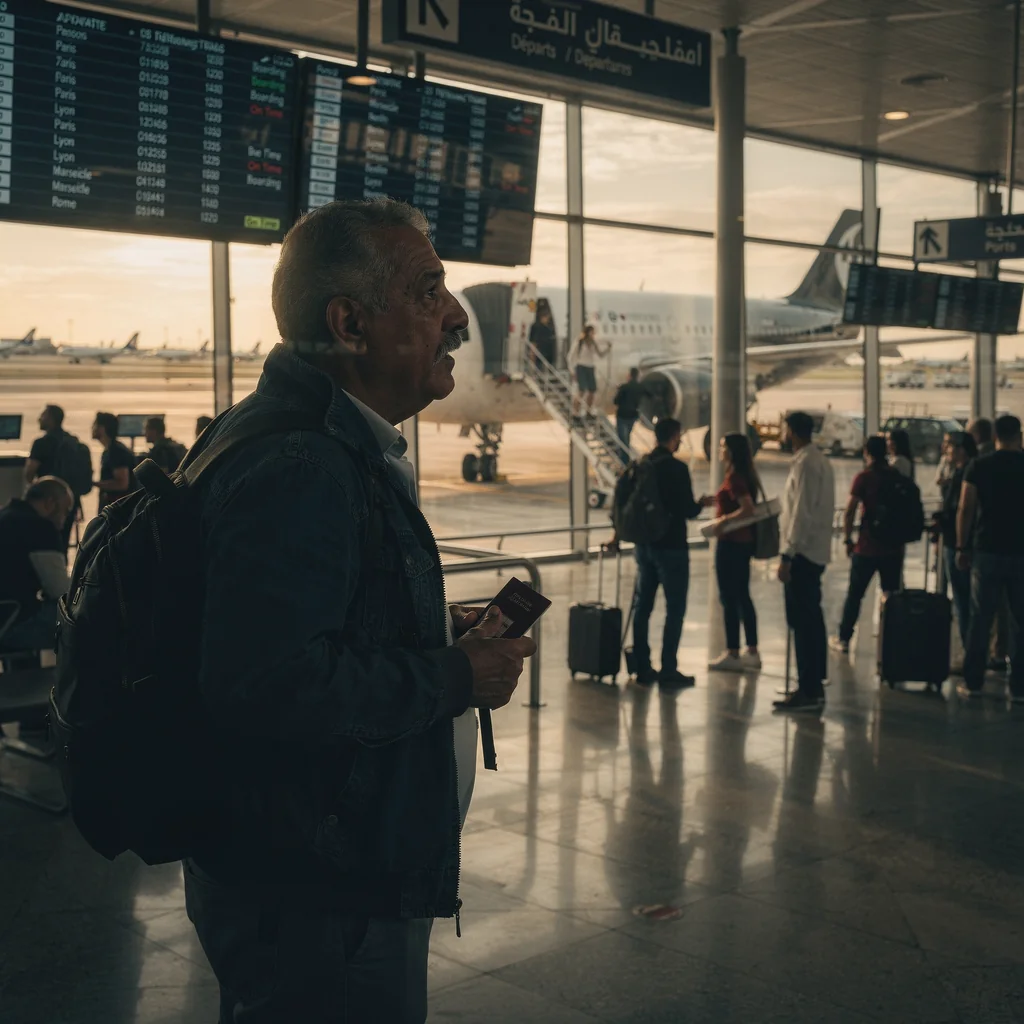
Karim stood at the airport departure curb. The car was parked behind him. Yasmine was in the passenger seat, crying quietly.
Amira stood on the sidewalk with her suitcases. Two large bags. A carry-on. A purse.
She was thirty years old. An engineer. Educated. Talented. Ambitious.
Unemployed in Tunisia. Employed in France.
The flight is boarding, Amira said.
I know, Karim said.
He looked at his daughter. The daughter he had raised. The daughter he had educated. The daughter he had tried to give a future to.
Are you sure about this? Yasmine asked from the car.
Yes, Amira said. I’m sure.
But France, Yasmine said. It’s so far.
Two hours, Amira said. Maybe three.
The language, Yasmine said. The culture—
I speak French, Amira said.
Karim studied his daughter’s face.
When will you visit? Yasmine asked.
I don’t know, Amira said. Maybe next year. Maybe the year after.
For Christmas? Yasmine asked.
I’ll be working, Amira said. They need engineers. They’re hiring.
But your family, Yasmine said.
You can visit me, Amira said. Paris is nice. You’d like it.
Karim heard what she didn’t say: You should visit me. Because I’m not coming back.
He had seen this before. In the hospital. In the maternity ward. The young women who left for France after giving birth. The young couples who moved because there was no future here. The families that fragmented because the economy had collapsed.
Now it was his daughter.
You have a degree, Karim said. You have skills. You have talent. You could build something here.
There’s nothing to build, Amira said.
There must be something, Karim said.
There isn’t, Amira said. You know there isn’t. You’ve seen it. You’ve witnessed it for forty years. The decline. The collapse. The stagnation.
She was right. He had witnessed it. He had watched the deliveries drop from 347 to 28. He had watched the cribs stack up in the corner. He had watched the young women leave for France.
Now his own daughter was leaving.
What about us? Yasmine asked. Your father? Me?
You can visit, Amira said. I’ll have a guest room. You can stay whenever you want.
It’s not the same, Yasmine said.
No, Amira said. It’s not.
She looked at Karim.
I’m sorry, she said.
Don’t be sorry, Karim said. Just tell me why.
Amira studied the terminal entrance. The travelers passing through. The security checkpoint. The duty-free shops.
Because, she said, I’m thirty years old. And I’m tired.
Karim waited.
I had a job, Amira said. At the firm. The internship.
Three months, Karim said.
No salary, she said. And when the position opened—
It went to—
The minister’s nephew, Amira said.
She looked away.
Your uncle, Yasmine said from the car. He can—
No, Amira said.
She looked at Karim.
I’m not asking, she said.
You wouldn’t have to ask, Karim said.
I would, Amira said. And you know it.
She was right. He did know.
Karim said nothing. He had heard this before. From Omar. From the businessmen who had been shut out. From the entrepreneurs who had given up.
France is different, Amira said. In France, merit matters. Skills matter. Education matters. I’ll get a job because I’m qualified, not because I know someone.
And if you don’t? Karim asked.
Then I’ll keep trying, Amira said. But at least I’ll have a chance.
She looked at her watch.
I need to go, she said.
Amira, Karim said.
She turned back.
Be careful, he said. France is not Tunisia. The values are different. The culture is different. You’ll be a stranger there.
I’m already a stranger here, Amira said. A stranger in my own country. A stranger in the place where I was born. A stranger in the place where I grew up.
How can you be a stranger here? Yasmine asked. This is your home.
Is it? Amira asked. I don’t feel at home. I feel… adrift. Like everyone is leaving. Like everything is collapsing. Like there’s no future here.
She looked at the airport terminal.
Maybe, she said, I’ll find a home in France. Maybe I’ll find a future there.
But your roots, Yasmine said. Your family. Your history.
I’ll take them with me, Amira said. I’ll still be Tunisian. I’ll still be your daughter. I’ll still have the history.
But you’ll be French too, Yasmine said.
Maybe, Amira said. Or maybe I’ll just be… me. A Tunisian in France. An engineer in Paris. A woman building a future somewhere else.
She looked at Karim.
I don’t want to go, she said. I want to stay. I want to build something here. I want to raise my children here. But there’s nothing to build. There’s no future to build.
We could build it, Karim said.
The revolution, Yasmine said. Things were supposed to change.
They didn’t, Amira said.
What will you do in France? Karim asked.
Engineering, Amira said. Wind energy. Renewable power. They’re building wind farms in the north. Offshore turbines. They need engineers.
Wind energy, Karim repeated.
Yes, Amira said. It’s the future. Clean energy. Sustainable power. Something real. Something lasting.
She looked at the airport terminal. The fluorescent lights. The travelers passing through.
You know, she said, when I was in engineering school, we studied the Tunisian wind potential. Cap Bon. The Gulf of Tunis. We have some of the best wind resources in the Mediterranean.
Karim hadn’t known that.
I wrote my thesis on it, Amira said. Wind farm feasibility for the Cap Bon region. I showed it to my advisor. He told me: ‘Great work. But don’t expect to build it here.’
Why? Karim asked.
Because, Amira said, to build a wind farm, you need permits. You need land. You need grid connections. And in Tunisia, all of that goes to the cronies. To the connected. To the people whose last names match the right people.
Her hands made fists.
My thesis was technically perfect, she said. The economics worked. The engineering was sound. But none of that matters. Because I’m not connected.
She looked at Karim.
So yes, she said. I’m going to France. I’m going to build what I can’t build here.
Karim thought of the olive trees. The trees that had been planted in 1881. The trees that were still standing.
Something lasting, he said.
Yes, Amira said. Something that will outlast me. Something that will serve future generations. Something real.
Not like Tunisia, Karim said.
No, Amira said. Not like Tunisia.
She looked at her watch again.
I really need to go, she said.
Amira, Karim said.
She turned back one more time.
If you change your mind, he said. If you want to come back. We’ll be here. We’ll always be here.
I know, Amira said. Thank you.
She looked at Yasmine in the car.
Take care of yourself, Mom.
You too, Yasmine said. Write to us. Call us. Every week. Every day if you can.
I will, Amira said.
She looked at Karim.
Goodbye, Baba.
Goodbye, my daughter.
She turned. She walked toward the airport entrance. She pushed her suitcases. She disappeared into the terminal.
Karim stood on the sidewalk. Yasmine cried in the car.
Karim walked back to the car. He got in the driver’s seat. Yasmine was crying quietly.
Yasmine stopped crying. She sat up straighter. She opened her purse, took out a small notebook, and wrote something down. She closed the notebook, returned it to her purse, and turned to Karim.
The students, she said. From my school. The ones who can’t afford university. I’m going to tutor them. On weekends. Free. No one knows yet.
Karim glanced at his wife.
That’s— Karim began.
It’s not enough, Yasmine said. But it’s something.
Yes, Karim said. It’s something.
The World Bank documents. The targets. The quotas. The incentives. The letter from the concerned doctor. The World Bank’s dismissal.
His father. Hassen ben Hadded. The true believer. The modernizer. The father who had helped implement the program.
It’s complicated, Karim said.
Is it? Yasmine asked.
Yes, Karim said. It’s the modernizers. The progressives. The people who believed that Tunisia had to become like France to be developed.
Like my father, Yasmine said.
Yes, Karim said. Like your father. And like mine.
Through the windshield, a woman pushed a suitcase toward the terminal entrance.
She’s building wind turbines, Karim said. In France. Renewable energy. Sustainable power.
That’s good, Yasmine said. That’s important work.
Yes, Karim said. Important work. In France.
Not here, Yasmine said.
No, Karim said. Not here.
He started the car. He drove away from the airport. He drove toward Tunis.
The road was empty. The sun was setting, painting the sky in streaks of orange and violet.
Amira. In France. Building wind turbines. He pictured her on a construction site, in a hard hat, holding blueprints, directing crews. He didn’t know if this was real. He only knew she wasn’t here.
He arrived home. The apartment was quiet. Yasmine was at her sister’s. He would be alone tonight. He would be alone tomorrow.
He went to the bedroom. He opened the closet. Amira’s old clothes were there — her school uniform, her first interview suit, the dress she wore for graduation.
He touched the sleeve. The fabric was soft. Cotton from the market in Tunis, bought when she was eighteen. She had worn it to her university graduation.
He stood alone in the bedroom. The closet was full of clothes she would never wear again.
Tunisia. The empty cribs. The declining deliveries. The young women leaving for France.
The olive trees. The trees that were still standing. The trees that would outlast them all.
He closed the closet door.
That evening, Karim sat in his office. He took out the delivery logs. He added one more entry:
December 2025: Amira ben Hadded, departed for France.
He placed the log back in the drawer. He turned off the light.
Karim sat in the dark. The office was quiet. The delivery log was in the drawer.
He stood up. He walked to the window.
The streetlights flickered on. The traffic moved below. A taxi drove past, carrying suitcases to the airport.
The bars of the crib cast shadows on the floor. Long shadows. Growing longer as the night deepened.
November 2028. A note from Tayeb, waiting for Karim when he arrived at the hospital.
Karim —
I’m writing this from Cairo. Waiting for my connection to Tunis.
I left Jakarta this morning. I don’t know when I’ll be back.
I found what I was looking for. Not a solution. Not a blueprint. Not a template Tunisia can copy and implement.
Something else.
I’ll tell you when I see you.
Meet me at the grove. The old tree. The one your grandfather showed us.
Bring your notebooks. Bring your evidence. Bring your memories.
I’ll bring mine.
— Tayeb
Karim read the note. He folded it. He placed it in his pocket.
The grove. The old tree. His grandfather’s tree.
End of Chapter 10