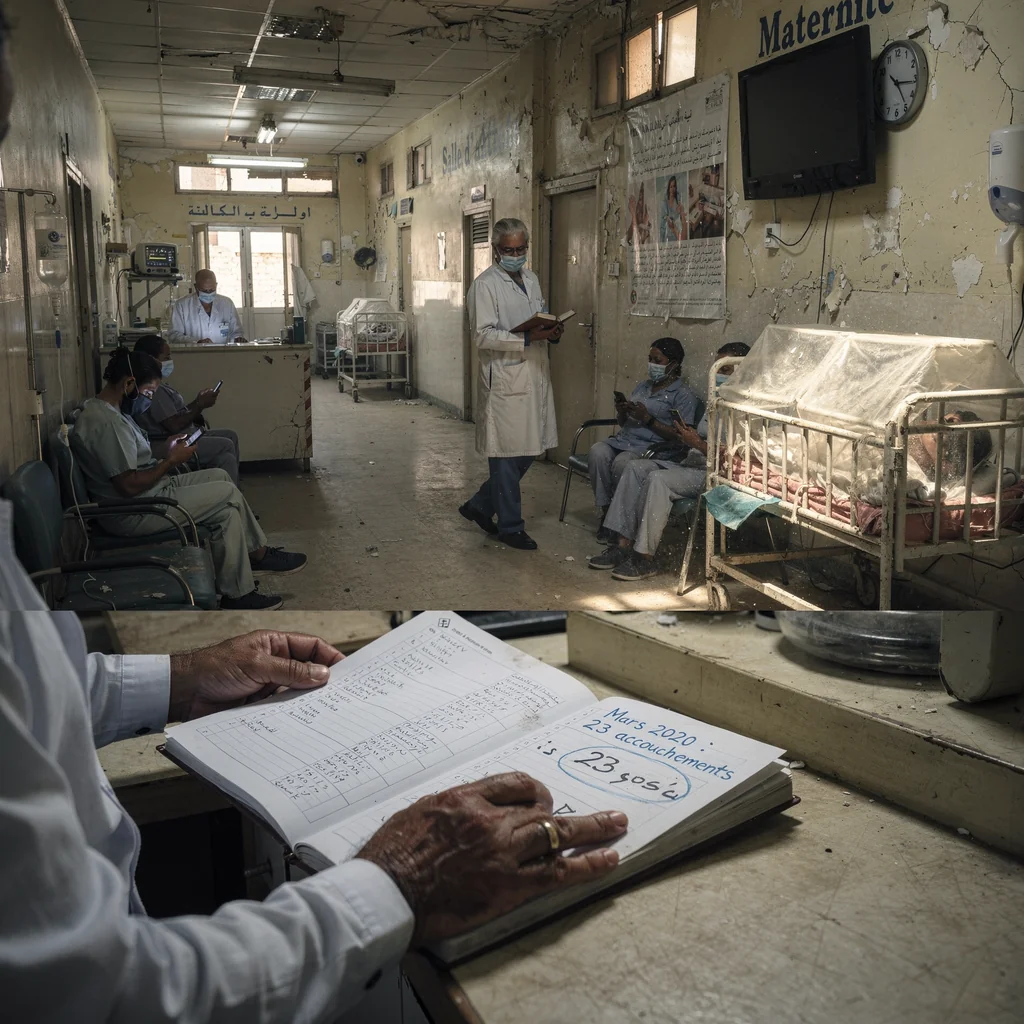
Tunis, March 2020.
The pandemic.
Karim worked in the maternity ward during the lockdown. The hospital was quiet. The streets were empty. The fear was everywhere.
Deliveries dropped to 2 that month.
He walked through the ward. The waiting room was empty. The nurses stood at the station, checking phones. The delivery rooms were dark.
He walked to the nursery. The cribs were stacked in the corner. Dust collected on the bars. He ran his finger along the top rail of a crib. The dust was thick, undisturbed.
The ward in 1987, when he was a resident. The cribs had been full. The babies crying. The nurses hurrying. The dust hadn’t had time to settle.
Now the silence was absolute.
He opened the delivery log. He wrote the numbers:
March 2020: 2 deliveries.
He closed the log.
Tunis, 2022.
The economic crisis.
Karim saw it in the waiting room. The women who came for consultations weren’t just worried about children. They were worried about rent. About groceries. About survival.
The prices, one woman said. Everything is more expensive. My husband’s salary buys half of what it bought last year.
Karim nodded. He had seen the invoices. The price of formula had tripled. The price of diapers had doubled.
And your husband? Karim asked. His work?
He’s a teacher, she said. The government hasn’t paid salaries in four months.
Karim opened her file. He picked up his pen.
What are you writing? she asked.
Postpone pregnancy due to economic hardship, he said.
His pen stopped above the page. He stared at the words. Then he finished writing.
Another woman came in. She was twenty-eight. An architect. Unemployed.
I want a baby, she said. But I can’t afford to raise one alone.
Your husband? Karim asked.
He left, she said. For France. He found work there. He sends money, but it’s not enough.
Will you join him?
I can’t, she said. My parents are here. My mother is sick. Someone has to take care of them.
She was crying. I’m trapped. I can’t have a baby here. I can’t leave here. I can’t live.
Karim studied the file on his desk. Families separating. Husbands in France, wives in Tunis. The young people leaving because there was nothing for them here.
Now it was happening in his own waiting room. To women he knew. To families he had treated for years.
Tunis, summer 2023.
The drought.
The hospitals reported water shortages. The power grid failed twice a week. The air conditioning turned off in the maternity ward.
The air smelled different now — not of antiseptic and formula, but of dry earth, of cracking soil, of dust that coated every surface. Karim could taste it in the back of his throat, a grit that no amount of water could wash away.
The women stopped coming. Not because they didn’t want children. Because they couldn’t afford to raise children in a country with no water, no power, no future.
Karim sat in his office. The delivery log was open. The pages were dry, the paper curling at the edges.
2020: 23 deliveries. 2021: 27 deliveries. 2022: 31 deliveries. 2023: 28 deliveries.
Amira. She was twenty-eight now. An engineer. Still unemployed. Still living at home.
Still hoping things would change.
They didn’t change.
The summer was brutal. The temperature reached 48 degrees. The power grid failed daily. The hospitals ran on generators. The generators ran out of fuel.
The maternity ward was dark. The fans didn’t turn. The air was still and hot.
Karim sat in his office. He sweated through his shirt. The fabric clung to his back, soaked through, heavy with damp. He could feel the heat radiating from the walls, from the floor, from every surface. The hospital had become an oven.
He was thirsty. His throat felt coated in dust. His tongue felt swollen. No matter how much water he drank, the thirst remained — a dryness that couldn’t be quenched.
His grandfather. The olive groves. The trees that had survived since 1881.
The trees were still standing.
One evening in July, the power failed at 8 PM.
Karim was at home. Yasmine was in the kitchen. The air conditioner had been running all day, fighting the 48-degree heat.
Then came the click. The hum died. The air conditioner stopped. The apartment went dark.
Power’s out, Yasmine called from the kitchen.
Karim went to the window. The whole neighborhood was dark. No streetlights. No apartment lights. The city had vanished into darkness.
The grid, he said. Again.
This was the third time this week. The power failures were becoming more frequent. The infrastructure was collapsing.
He went to the breaker box. He flipped the switches. Nothing. The main breaker was off. The whole building was dark.
He went back to the apartment. Yasmine was standing in the kitchen. The refrigerator hum was silent. The freezer was already beginning to thaw.
Everything will spoil, she said. The meat. The vegetables. The milk.
We’ll eat it, Karim said. Tonight. Before it spoils.
And tomorrow? she asked.
Karim had no answer.
They sat in the living room. The apartment was heating up. The 48 degrees outside was seeping in through the walls. The temperature was rising. 40 degrees. 42 degrees. Still climbing.
Karim opened the windows. No breeze. The air outside was still. The city was an oven. Everyone was inside, hiding from the heat, waiting for power that wasn’t coming.
Yasmine paced the room. My mother, she said. The oxygen machine. It needs electricity.
Does she have backup batteries? Karim asked.
For four hours, Yasmine said. It’s been six.
She reached for her phone. I need to call her.
The network is down, Karim said. The towers need power too.
She tried anyway. The screen showed: No Signal.
She put the phone down. Her hands were shaking.
I can’t reach her, she said. I don’t know if she’s okay.
She has neighbors, Karim said. Someone will check on her.
How do you know? Yasmine asked.
I don’t, Karim said.
They sat in the dark. The heat was oppressive. The air was still. The city was silent.
In the old days, Yasmine said, the zawiyas would organize this. Neighbors helping neighbors. People checking on the elderly. Communities taking care of each other.
The zawiyas are closed, Karim said.
I know, Yasmine said. That’s the point.
She looked at the dark apartment.
We have no one, she said. No network. No community. No one to call. No one to help. We’re alone in the dark.
Karim stood up. He went to the kitchen. He opened the cabinets. He found a bottle of water. Half full.
He brought it to the living room. He offered it to Yasmine. She drank. Then he drank.
They shared the water. A half-liter between two people. In 48-degree heat.
I’m thirsty, Yasmine said.
So am I, Karim said.
What about tomorrow? Yasmine asked again.
Karim had no answer.
They sat until the sun set. The darkness outside deepened. The stars appeared, bright and uncaring.
The power didn’t come back.
They went to bed early. There was nothing else to do.
Karim lay in the darkness. Yasmine’s mother. The oxygen machine. The hospitals. The women who would give birth tomorrow in the dark.
The trees. The olive trees that survived without water. That endured without power.
The next week, the water stopped too.
Not everywhere. Not all at once. But neighborhood by neighborhood, the water pressure dropped. Then stopped.
The city announced emergency distribution points. Five locations across Tunis. Residents could collect water there. Twenty liters per household. Per day.
Karim went to the nearest point. It was three blocks from his apartment.
He arrived at 8 AM. The line was already long. Hundreds of people. Men. Women. Children. Elderly people leaning on canes. Young people carrying containers.
The sun was already beating down. The heat was rising. 42 degrees by mid-morning.
Karim had brought containers. Two plastic jugs. Each held 20 liters. Together, 40 kilos. When full.
He took his place in line. The sun moved across the sky. The heat radiated from the pavement. From the building walls. From every surface.
The line moved slowly. Painfully slowly.
Karim stood in the sun. His shirt was soaked. His face was dripping. He could feel the heat in his scalp, in his eyes, in his pores.
How long have you been waiting? a woman asked behind him. Elderly. Maybe seventy. Gray hair. A simple cotton dress.
Two hours, Karim said.
Two hours? She shook her head. I’ve been here since six. They haven’t opened yet.
Karim looked at the front of the line. The water truck was parked there. The officials were setting up tables. The distribution hadn’t started.
This is the third day, the woman said. I’ve come every day. Every day, the line is too long. Every day, they run out before I reach the front.
I’m sorry, Karim said.
Don’t be sorry, she said. Be angry. Be angry that the system has failed us. Be angry that the infrastructure has collapsed. Be angry that we’re living like this in the 21st century.
Karim was silent. He had been witnessing the collapse for decades. The anger had worn him down.
Where is your family? Karim asked.
My granddaughter, the woman said. She’s at home. She’s disabled. She can’t walk. I’m getting water for both of us.
Can I help? Karim asked.
When I get the water, the woman said. I need someone to carry it to my apartment. Three blocks away. Second floor. No elevator.
I’ll help, Karim said.
You’re in line, she said.
I’ll come back, Karim said. When I have my water. I’ll carry yours to your apartment. Then I’ll go back for mine.
The woman looked at him. Why?
Because, Karim said. That’s what people do. They help each other.
The woman looked at him. You’re a doctor.
Yes.
My granddaughter, she said. She needs medicine. But I can’t afford the medicine without water. I can’t mix the medicine. I can’t give her the treatment.
What does she need? Karim asked.
Insulin, the woman said. She’s diabetic. Without refrigeration, the insulin doesn’t keep. Without water, she can’t take it.
The hospital. The power failures. The broken refrigerators. The spoiled medicine.
I’ll help, Karim said.
Thank you, the woman said.
Three hours later, Karim reached the front of the line.
The water truck was still there. The officials were still distributing. But the flow had slowed.
Twenty liters, the official said. Per household. Per day.
Karim filled his containers. The water was warm. It smelled faintly of chlorine.
He carried the containers back to the elderly woman. She was still standing. Still waiting.
They said they ran out, she said. The water for the elderly. They distributed it all in the morning.
I have extra, Karim said. I can share.
No, she said. I can’t take from you. You have a family too.
Yasmine, Karim said. My wife. We’ll manage.
The woman hesitated. Then she nodded. Thank you.
Karim poured water from his container into hers. Then he carried both containers — his and hers — three blocks in 48-degree heat. 40 kilos of water. The plastic handles cut into his fingers. The weight strained his shoulders. His back screamed.
They reached her apartment building. No elevator. Three flights of stairs.
They climbed slowly. One floor. Two floors. Three floors.
Here, he said. At your door.
Thank you, she said. I won’t forget this.
You don’t have to, Karim said.
I will anyway, she said. Because kindness is rare now.
Karim walked back to his apartment. He climbed the stairs. Three flights. His legs were shaking. His back was screaming.
He reached his door. He unlocked it. He went inside.
Yasmine was waiting. She looked at his face. She looked at his empty hands.
You gave it away, she said.
Some, Karim said. To an elderly woman. Her granddaughter is diabetic. Needs insulin. No water, no medicine.
Yasmine touched his arm.
What happened to us? she asked.
The World Bank documents. The targets. The quotas. The incentives.
We happened, Karim said.
Our parents, Yasmine said.
Yes, Karim said.
They thought they were building something better, Yasmine said. They thought they were modernizing.
They were, Karim said. That’s the tragedy. They did modernize. They did develop. And this is what it looks like.
And now, Yasmine said, we carry water like peasants in the 19th century.
Yes, Karim said. Like peasants. In the 21st century.
They looked at the empty water containers. They looked at each other.
I’m tired, Karim said.
I know, Yasmine said. Me too.
Karim walked to the hospital through the gathering dusk. In the courtyard of an apartment building, a fig tree grew against a stone wall. The heat had withered the leaves, the drought had cracked the earth, but the tree bore fruit regardless. Small figs, green and hard, clung to the branches. They would ripen or not. The tree made no promises.
Karim stopped. He looked at the fruit. Then he walked on.
One evening in August, the power failed at 8 PM. The hospital generator didn’t start.
A woman was in labor. Her third child.
Karim worked by flashlight. The beam cut through the dark, illuminating sweat on the woman’s forehead. The nurse held the light, her arm steady. The room was stifling. 48 degrees. No air conditioning. No ventilation. Just heat and darkness.
Push, Karim said.
The woman pushed. She screamed. She gripped the rails of the bed. Her knuckles were white.
The baby emerged.
Karim caught the child. The baby was slippery with fluid. The baby didn’t cry.
Karim rubbed the baby’s back. The baby coughed. Then the baby cried.
The sound was piercing in the silent hospital. The only sound in the darkness.
He’s alive, the woman said. That’s enough.
Karim wrapped the baby in a blanket. He handed him to the mother.
The baby coughed again. A weak sound in the darkness. The nurse shifted the flashlight; the beam wavered, casting long shadows that stretched and retreated across the walls like breathing.
Karim had delivered babies for thirty-five years. He had brought thousands of children into the world.
What kind of world was this?
Tunis, 2024.
Karim sat at his desk. He was fifty-nine years old. He had been head of the maternity ward for six years. He had witnessed the decline accelerate. The deliveries drop. The cribs empty. The young women leave for France.
But today was different.
Today he would see two patients. Two procedures. Two women. Two choices that should not have been choices at all.
The first patient was waiting.
Doctor? The nurse stood in the doorway. She’s here.
Karim stood up. He adjusted his white coat. He walked to the consultation room.
The patient was sitting on the exam table. She was twenty-six. A teacher. Her file said she was getting married in two weeks.
I’m here for the procedure, she said.
Which procedure?
The restoration, she said.
Karim looked at the medical file on his desk. He had performed this surgery dozens of times. More in the past five years than in his entire career before 2020.
Tell me about it, he said.
She didn’t look at him. She looked at her hands, folded in her lap.
I’m getting married, she said. His family is… they expect…
She didn’t finish. She didn’t need to.
Do you love him? Karim asked.
Yes.
Does he know? Karim asked. About your past?
No.
Will you tell him?
No.
She was crying now. Not loudly. Just the tears sliding down her cheeks.
His mother, she said. She came to our house. With her sisters.
Karim waited.
They asked questions, she said. About my childhood. My school. My friends.
And?
Then they asked about the others, she said. The men I’d known.
Karim studied the floor.
I told them there weren’t any, she said.
She looked at her hands.
My mother was there, she said. She nodded. She confirmed it.
She was crying.
I lied, she said. They all lied.
Karim had performed this surgery dozens of times. He would perform it dozens more.
He pressed his palm against his sternum.
Schedule the surgery, he said.
She left. Karim sat alone in his office.
The fertility rate: 1.35 and falling.
His daughters. One married, one not. Both pressured. Both judged.
The boarded zawiya. The broken transmission. The destroyed networks.
The second patient was waiting.
Doctor? The nurse stood in the doorway. She’s here.
Karim stood up. He walked to the consultation room.
The patient was sitting on the exam table. She was twenty-nine. A banker. Her file said she was married. She had one child. A daughter. Three years old. She breathed slowly, deliberately, the way people breathe when they have decided something and are waiting for themselves to say it.
I’m here for the procedure, she said.
Which procedure?
The termination, she said.
Karim looked at the window. The afternoon light slanted across the floor. He had performed this surgery hundreds of times. Thousands of times.
Tell me about it, he said.
I have a daughter, she said. She’s three. I love her. I can’t imagine life without her.
So why… Karim began.
Why don’t I want another child?
She was silent for a moment.
Because the world is burning, she said. Because the economy is collapsing. Because my husband’s salary buys half of what his father’s salary bought. Prices go up every year. The dinar keeps falling.
She took a breath.
And, she said, because I’m twenty-nine. If I have another child now, I’ll be thirty, thirty-one. My career will be set back years. Maybe forever. Everyone says: wait until you’re established. Wait until you’re secure.
She was crying now.
But I’m never going to feel secure, she said. The economy keeps getting worse. The politics keep getting worse. The future keeps looking darker.
The World Bank report from 1973. The language was careful. “Family planning.” “Reproductive health.” “Women’s empowerment.”
But the numbers were explicit.
Target: Reduce fertility from 7.0 to 2.0.
Mechanism: Abortion access, contraception promotion, incentives for medical providers.
Timeline: 20 years.
They had succeeded. Fertility had fallen from 7.0 to 2.0 by 1990.
But it hadn’t stopped there. It kept falling. 1.8. 1.6. 1.5. 1.35.
The World Bank had called it “development.”
I can do the procedure, Karim said. But you should know what you’re choosing.
I know what I’m choosing, she said. I’m choosing survival. For myself. For my daughter. For my marriage.
And what about the child? Karim asked. The one you’re carrying?
She didn’t answer immediately.
It’s not a child yet, she said. It’s… it’s a potential. A possibility. I can’t turn a possibility into a responsibility. Not now. Not in this world.
Karim had heard this before.
The language had changed. The act remained.
I’ll do the procedure, he said.
She left. Karim sat alone in his office.
The consultation room was empty. The afternoon light slanted across the floor. The sound of her footsteps faded down the hallway.
Omar. His brother had stopped talking about the years after 2011. We believed in the revolution, he had said once. We believed real change was possible. But the economy? The system? Nothing changed. It was all a lie.
He stood at the nursery window. The cribs were stacked in the corner. The two women — not their faces, but their hands: one pair folded in the lap, one pair gripping the armrests of the exam table.
Both pairs of hands. Both women. Both choices.
October 2024.
Amira came to Karim’s office. She didn’t knock. She just walked in.
I’m leaving, she said.
Karim looked up from his desk. France?
They offered me a job, she said. Wind energy. Renewable power. They’re hiring engineers.
Karim looked at his hands. When?
December, she said. After the wedding. If there is a wedding.
You’re getting married?
If he asks, she said. If his family approves.
The hymen restorations he performed. The double standard. The purity requirements.
What if they don’t approve? he asked.
Then I go alone, she said.
And come back?
To what? she asked. To unemployment? To the same corruption? To the same stagnation?
She was right. He had no answer.
I’ll visit, she said. You and Mom. I’ll come back. I promise.
She didn’t say: Often. She didn’t say: Regularly. She didn’t say: Ever.
Karim heard what she didn’t say.
It’s your life, he said. You have to do what’s right for you.
Thank you, she said.
She walked out. Karim sat alone in his office.
He opened the delivery log. He looked at the numbers:
January 2024: 2 deliveries. February 2024: 1 delivery. March 2024: 3 deliveries. April 2024: 2 deliveries. May 2024: 1 delivery. June 2024: 3 deliveries. July 2024: 2 deliveries. August 2024: 1 delivery. September 2024: 2 deliveries. October 2024: 1 delivery so far.
The ward was empty. The cribs were stacked in the corner. The dust collected on the bars.
Karim closed the log. He turned off the light.
He walked to the window. The street below was dark. The power was out again.
Far in the distance, he could see the lights of the airport. The planes taking off. Carrying people away.
His daughter would be on one of those planes soon.
He watched the lights flicker. He watched the planes rise.
December 2024.
One month before Amira’s departure.
Karim sat at the dinner table. Yasmine was cooking. Amira was setting the table.
The apartment was quiet. The power was out again. They ate by candlelight.
Are you packed? Yasmine asked.
Mostly, Amira said.
What about the winter clothes? Yasmine asked. France is cold.
I bought a coat, Amira said. And boots. And gloves.
Good, Yasmine said.
She was crying. Not loudly. Just the tears sliding down her cheeks.
Did I tell you? Amira said. About the project?
What project? Karim asked.
The wind farm, Amira said. In the north of France. Off the coast. They’re building fifty turbines. Each one is two hundred meters tall.
That’s tall, Karim said.
They’ll power a hundred thousand homes, Amira said. Clean energy. Renewable. Sustainable.
She looked at the candle flame.
I wish I could do it here, she said. I wish we could build wind farms in Tunisia. Solar farms too. We have the sun. We have the wind. We have everything we need.
Why don’t we? Yasmine asked.
Amira looked at her mother. You know why.
The corruption, Amira said. The cronies. The monopolies. The same system that destroyed everything else.
She looked at Karim.
So I’m leaving, she said. Because I want to build something. I want to create. I want to do work that matters.
You can do work that matters here, Karim said.
Can I? Amira asked. Really?
Karim couldn’t lie to her.
No, he said. Not here. Not now.
Then I have to go, Amira said.
The candle burned lower. The shadows stretched longer.
I’ll come back, Amira said. When things change.
They finished dinner in silence. Yasmine cleared the table. Amira went to her room. Karim sat alone in the living room.
The door to Amira’s room closed. The lock clicked.
Yasmine returned from the kitchen. She sat beside him. The candle flickered between them.
She’s really going, Yasmine said.
Yes, Karim said.
Our daughter, Yasmine said. Our only daughter.
Yes.
Then the tears came. Not a few sliding down her cheeks. A storm. A grief held back for months.
She’s not leaving because she wants to, Karim said. She’s leaving because she has to.
That doesn’t make it easier, Yasmine said.
No, Karim said. It doesn’t.
He reached across the space between them. He took her hand. Her fingers were cold. Her grip was tight.
The candlelight caught her face — wet with tears, lined by fifty-eight years of witnessing.
They sat together. The flame flickered.
The candle burned down to a puddle of wax. The flame danced. Then it died.
The apartment was dark.
Karim stood up. He walked to the window.
The street below was dark. The power was still out.
The flickering lights rose into the darkness, one after another.
End of Chapter 9