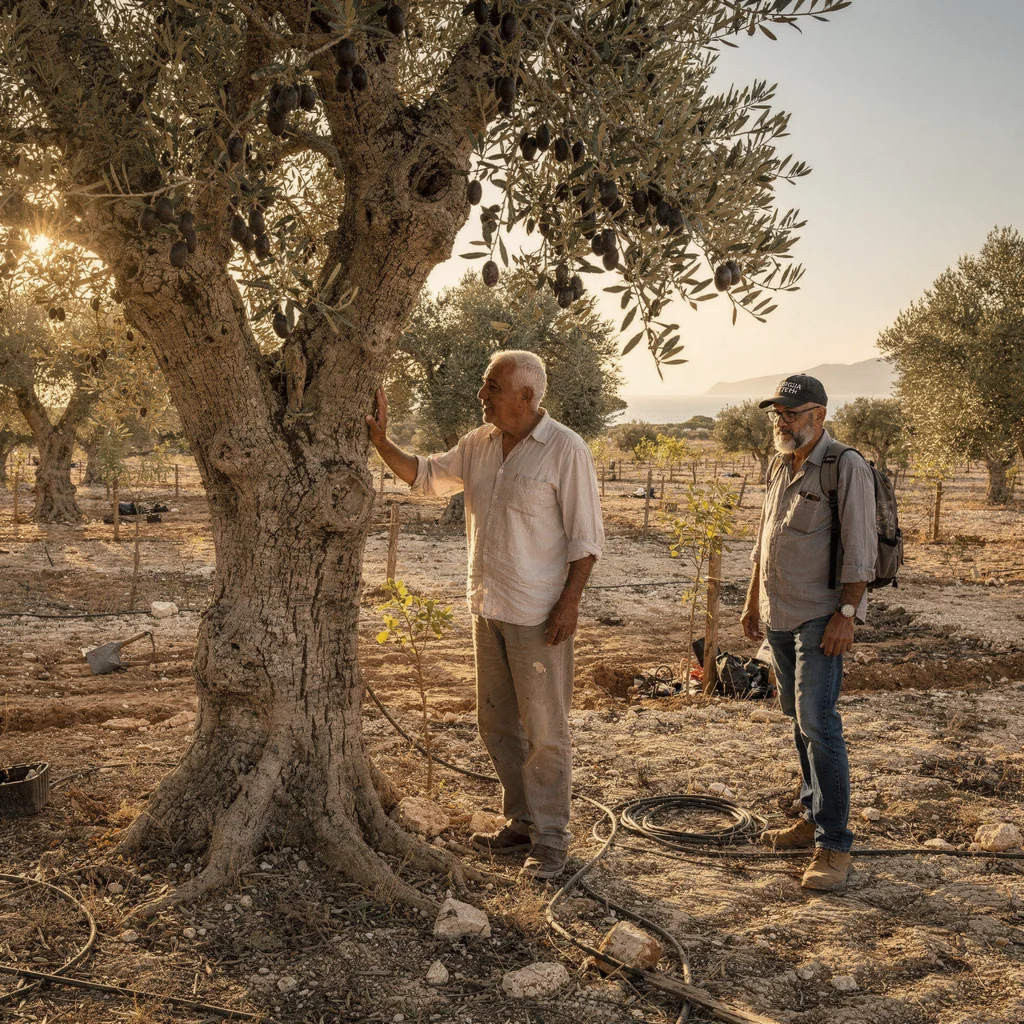
Cap Bon, 2035.
Karim stood at the edge of the olive grove. He was seventy years old now. He had been retired for nine years.
The grove was silent. The afternoon sun slanted through the branches. The olives hung dark and heavy on the boughs.
The air smelled different here than in the city — not of exhaust fumes or concrete, but of resinous earth, of sun-baked leaves. His grandfather’s hands, his grandmother’s kitchen, the taste of oil pressed from trees that had stood for generations.
He walked into the grove. The ground was dry. The grass was brown. The drought had lasted for years.
Karim walked deeper into the grove. He found the oldest tree. The one his great-grandfather had planted in 1881. The one his grandfather had showed him in 1972.
The tree was still there. The bark was thick, fissured like old leather, the color of weathered iron. The branches were gnarled, twisted by decades of wind. The leaves were silver-green in the sunlight, shimmering when the wind moved through them.
Karim placed his hand on the trunk. The wood was warm from the afternoon sun. He felt the texture — rough, deep fissures, the grain like rivers in an ancient landscape. The wood was warm. Alive.
The silence was complete. He was alone with the tree and the memory of his brother, buried five years ago in Sousse.
Then he heard footsteps behind him.
He turned.
A man stood at the edge of the grove. Seventy, perhaps. Gray hair. Glasses. Wearing a simple cotton shirt. A Georgia Tech hat on his head.
Karim knew who it was.
Tayeb.
Tayeb R. Damerji. His cousin. The one who had left for Atlanta in 1990. The one who had stayed in the United States while Karim had stayed in Tunisia.
Karim, Tayeb said.
They hadn’t seen each other in years. Decades. Not since the 1990s. Maybe the 1980s.
Tayeb walked into the grove. His step was uneven on the dry grass — one foot sure, the other catching slightly on the hard soil between the tree rows.
You came back, Karim said.
I came back, Tayeb said.
Why?
To rebuild, Tayeb said.
Karim studied his cousin. The man who had escaped. The man who had watched from Atlanta. The man who had missed the collapse.
You want to rebuild what? Karim asked.
The networks, Tayeb said. The institutions. The transmission.
Karim absorbed the words. The boarded zawiya. The empty cribs. The declining deliveries. The young women leaving for France.
Do you know what was destroyed? Karim asked.
Tayeb was silent. He looked at Karim. He looked at the olive grove. He looked at the oldest tree.
I think so, Tayeb said. I’ve read the histories. I’ve studied the patterns. But…
But what?
But I don’t know, Tayeb said. I only know the abstract version. I don’t know the concrete reality. What it felt like. What it looked like. What was lost.
He hesitated. The zawiya. I assume it was closed under Bourguiba, in the sixties?
It was, Karim said. But it reopened briefly. In 2011. After the revolution.
Tayeb was quiet. I didn’t know that.
You were in Atlanta, Karim said.
Yes, Tayeb said. I was… I was building things there.
Karim was quiet. Thirty-nine years of delivering babies that stopped coming. Thirty-nine years of watching the decline.
Then let me show you, Karim said.
They went to the hospital. La Maternité de la Rabta. The building was still there. But the ward was quieter now. The cribs were still stacked in the corner. The delivery logs were still on Karim’s old desk.
Karim showed Tayeb the logs.
1987: 347 deliveries. 1997: 211 deliveries. 2007: 89 deliveries. 2017: 41 deliveries. 2026: 28 deliveries.
Tayeb read the numbers. He calculated.
Ninety-two percent decline, Tayeb said. In forty years.
Yes, Karim said.
Why?
Karim opened the drawer. He took out the World Bank documents. The copies he had made in 2019. The targets. The quotas. The incentives.
He showed Tayeb the letter from 1971. Primary condition: Implementation of comprehensive family planning program with the goal of reducing total fertility rate from 7.0 to 2.0 within 20 years.
He showed Tayeb the annex. Annual targets for IUD insertions: 50,000 per year by 1975. Annual targets for abortion procedures: 15,000 per year by 1975, increasing to 30,000 per year by 1985. Incentives for medical providers: Bonus of 10 dinars per IUD insertion, 20 dinars per abortion procedure.
He showed Tayeb the funding breakdown. Total program cost: $47 million. World Bank contribution: $37 million (79%).
Tayeb read the documents. His face grew pale. His hands trembled.
This was not Tunisia’s agenda, Tayeb said. This was imposed.
Yes, Karim said.
This was a supply-driven agenda, Tayeb said. The World Bank wanted to reduce fertility. So they funded the supply of abortion. They created incentives for doctors. They set targets for regional directors.
Yes, Karim said.
They didn’t ask if women wanted abortion, Tayeb said. They assumed that if abortion was available, women would use it.
They were wrong, Karim said.
Tayeb kept reading. He found the letter from the concerned Tunisian doctor, dated 1983.
I believe we are manipulating these women. I believe we are coercing them. I believe we are doing something that will have consequences we cannot foresee.
He found the World Bank’s response. Thank you for your communication of September 14, 1983. We have noted your observations and they will be taken into account in our ongoing program evaluations.
Tayeb closed the file. He looked at Karim.
They knew, Tayeb said. They knew it was coercion. They didn’t care.
No, Karim said. They didn’t care.
They called it “development,” Tayeb said.
Yes, Karim said. They called it development. They meant control.
Tayeb said nothing. He sat in the chair. The chair where Karim had sat for thirty-nine years. The chair where Karim had witnessed the collapse.
My father, Tayeb said quietly. He helped implement this.
I know, Karim said.
Your father too, Tayeb said.
I know, Karim said.
They believed they were doing the right thing, Tayeb said.
Yes, Karim said.
They were wrong, Tayeb said.
Yes, Karim said.
They died before they saw the consequences, Tayeb said.
Yes, Karim said.
My father helped implement this, Tayeb said. I knew. Before I left. I was twenty-five. I saw the direction things were going. I told myself it was graduate school, opportunities, a better life. But I also knew I was leaving before the worst of it.
He looked at his hands. I’ve been based in Atlanta for forty-five years. Long stretches abroad — Jakarta, Cairo — but always returning to Georgia. I became an engineer. I built things. I told myself I was still useful.
Were you? Karim asked.
Tayeb considered the question. I built things, he said. Bridges. Drainage systems. A water treatment plant in Georgia that serves four hundred thousand people. I was good at it. I am good at it.
He looked at his hands.
I used to tell myself that engineering is the same everywhere. That what I built there I could have built here. That the work is the work.
He looked at the oldest tree.
But an engineer who builds only where it’s safe to build is not an engineer. He’s a contractor.
Karim did not answer.
I was doing important work, Tayeb said. Infrastructure. Water systems. Public works. These aren’t luxuries. People need clean water. They need drainage. They need treatment plants.
Karim didn’t answer. He simply waited.
Tayeb looked around the empty ward.
I built things, he said. But not here.
Karim placed his hand on the desk. The way a doctor sits with a patient who has just said something true.
They sat in silence.
What was destroyed? Tayeb asked. Specifically. Concretely.
Karim stood up. Come with me.
They went to the boarded zawiya. The wood was soft with rot. The last of the paint had long since flaked away. The Arabic inscription above the door was barely visible:
Where knowledge and Quran are gathered
Karim stood before the door. He placed his hand on the wood.
I came here with my grandfather, Karim said. 1972. I was seven. The sheikh’s hand was on my shoulder. The circle was complete. The transmission was alive.
He touched the boarded door.
Tayeb placed his hand on the wood. Beside Karim’s.
They stood together before the boarded zawiya. The wood was warm beneath both their palms.
They stood in silence.
What will you look for first? Karim asked.
Tayeb thought for a moment. The waqf. The endowments. I’ve been reading about the court cases. Other places kept them. Maybe here, something survived. Maybe there are records.
You’ve been thinking about this for a long time, Karim said.
Since I left Atlanta, Tayeb said. Since I realized that the United States was also collapsing. That the networks were also failing. That the transmission was also breaking.
You came back to rebuild, Karim said. Not just to remember.
Yes, Tayeb said. I came back to rebuild.
He looked at Karim. You remember, Tayeb said. When we were younger. The olive grove.
I remember, Karim said.
You asked about the tree, Tayeb said. You asked what it meant.
And you said, Karim said, it was just a tree.
I was wrong, Tayeb said. I was seventeen. I thought I knew everything. I thought the old ways were holding us back.
He looked at the oldest tree. The bark was fissured, the color of old iron.
I spent forty-five years in Atlanta, Tayeb said. Building things. Engineering things. I told myself I was making a difference.
He was quiet.
But I didn’t understand what I had left behind, Tayeb said. Until I came back. Until I saw the empty cribs. The boarded zawiya. The collapsed infrastructure.
He looked at Karim.
Tayeb placed his hand on the bark of the oldest tree. Beside Karim’s. Two palms against the same trunk.
His grandfather’s words: When the circle breaks, the transmission stops.
Not enough, Karim said. I remembered, but I couldn’t rebuild. I couldn’t recover.
That’s why I’m here, Tayeb said. Not to remember. To rebuild.
He looked at Karim. But I can’t rebuild alone. I need help. I need guidance. I need someone who remembers what was lost.
You need a witness, Karim said.
Yes, Tayeb said. I need a witness.
Karim looked at the oldest tree. The delivery logs. The declining numbers. The empty ward.
I’ll help you, Karim said. I’ll witness. I’ll remember. I’ll guide.
Thank you, Tayeb said.
But I can’t promise you’ll succeed, Karim said. I can’t promise the seeds exist. I can’t promise the transmission can be recovered.
I know, Tayeb said.
And I can’t promise you’ll stay, Karim said. You might get frustrated. You might leave again. You might give up.
I know, Tayeb said.
Then why try? Karim asked.
Tayeb looked around. The olive trees. The boarded zawiya. The dry, cracked earth.
Because, Tayeb said, the trees are still standing.
He looked at Karim.
And somewhere, Tayeb said, beneath the soil, the seeds are waiting.
Karim looked at the olive trees. The oldest tree. The tree his great-grandfather had planted in 1881.
Fine, Karim said. We’ll look for the seeds.
Together, Tayeb said.
Karim looked at the oldest tree. He did not answer immediately.
They walked out of the zawiya grounds. They walked toward the olive grove. The afternoon sun slanted through the branches. The olives hung dark and heavy on the boughs.
Do you remember, Tayeb asked, when we were children? When we used to play in this grove?
I remember, Karim said.
Do you remember what your grandfather told us? Tayeb asked.
Karim closed his eyes. 1972. The zawiya. The circle of men. The hand on the shoulder. The transmission alive.
Everything important is transmitted hand to hand, Karim said. Shoulder to shoulder. When the circle breaks, the transmission stops. And when the transmission stops, something dies that cannot be named.
Yes, Tayeb said. That’s what he told us.
They found the oldest tree at the center of the grove. The one planted in 1881, the year the French protectorate was signed. The bark was massive, fissured, the color of old iron. Karim placed his palm flat against it.
The wind moved through the branches above them. The silver leaves rustled — a sound like paper, like whispering, like thousands of voices speaking at once.
The wood was warm from the afternoon sun.
At the base of the trunk, where two roots pushed through the surface, a single green shoot had forced its way up through the cracked earth. No thicker than a finger. New leaves, still soft, silver-green, catching the last of the light.
Neither of them spoke.
End of Chapter 12
End of The Great Unraveling
End of Part III - THE END AND BEGINNING (2026-2035)