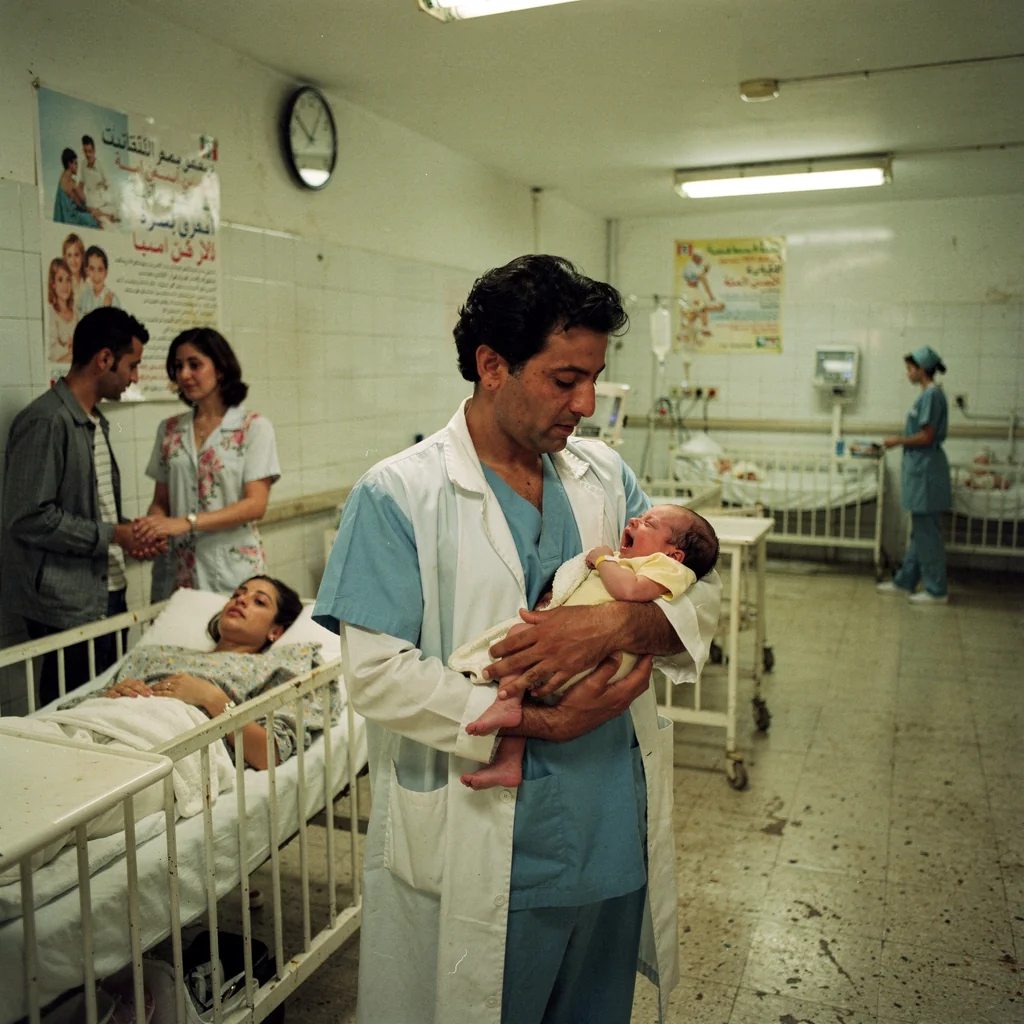
Kuala Lumpur, 1998.
Karim stood in the hotel lobby, disoriented. The air was wrong — thick, heavy, humid in a way that Tunis never was. Even inside, with the air conditioning humming, he could feel the moisture on his skin, a film of tropical dampness that made his clothes cling.
He looked up at the atrium. Glass and steel rose thirty stories above him. Palm trees grew in planters on every floor, their fronds drooping in the heat. The air was cool, dehumidified, smelling of expensive perfume, money, and something else — the sweet rot of tropical flowers, the musk of blooming orchids.
He was thirty-three years old. He had come to Malaysia for a medical conference — “Obstetrics in the Developing World: Best Practices and Future Directions.”
The humidity pressed on him. His shoes felt heavier. His shirt stuck to his back. In Tunis, the air was dry — you could taste the dust, you could smell the sea from kilometers away. Here, the air was wet, alive, oppressive.
The conference was fine. The presentations were competent. The speakers were knowledgeable.
But something was bothering him.
He had visited Hospital Kuala Lumpur that morning. The maternity ward. The delivery rooms.
The automatic doors had slid open with a soft chime. The air inside was cool and smelled of antiseptic and formula. The nurses wore scrubs of bright blue — not the faded white of Tunis. They moved with purpose, carrying charts, pushing equipment carts, answering pages.
The ward hummed. Monitors beeped. Women called out in labor. Babies cried. Doctors gave orders. The corridors were full of families — fathers, grandparents, siblings — all waiting, all present, all part of the transmission of life.
In Tunis, the ward was silent. The cribs were stacked in the corner, unused. The nurses moved quietly between empty beds.
In Kuala Lumpur, the cribs were full. Every single one.
He didn’t understand why.
Dr. Hadded?
Karim turned. A man stood behind him. Malaysian. Mid-forties. Gray hair, glasses, wearing a batik shirt.
Yes?
I’m Dr. Farid, the man said. We met this morning. At the hospital. You asked about the delivery numbers.
Of course, Karim said. Dr. Farid. Good to see you again.
Farid smiled. I was heading to the lounge for a drink. Care to join me?
Karim checked his watch. The conference dinner wasn’t for two hours. I’d like that.
They walked to the hotel lounge. It was on the mezzanine level, overlooking the pool. The evening sun slanted through the windows, casting long shadows across the water. Around them, a sound carpet of languages — Malay, Chinese, Tamil, English — a Babel of tongues. Against this chorus, the soundscape of Tunis — Arabic, French, nothing else — felt thin, uniform, small.
They sat at a small table. A waiter appeared.
Tea? Farid asked.
Please, Karim said.
Farid ordered tea for both of them. Teh tarik. Sweet.
The waiter departed. The lounge filled with the sounds of business — phone calls in a dozen languages, the clink of ice in glasses, the murmur of deals being struck.
Minutes later, the tea arrived. Not in small glasses like Tunis, but in tall mugs with frosted glass. The color was amber — the color of condensed milk, the color of caramel.
Karim lifted the mug. He smelled it first — no mint, no pine needles, no sharp herbs. Instead: the scent of black tea, condensed milk, palm sugar. Sweet. Rich. Unfamiliar.
He took a sip. The taste was shocking — sweeter than Tunisian tea, creamier, without the herbal bite of mint or the medicinal edge of pine. It tasted like comfort, like indulgence, like something meant to be consumed slowly in air-conditioned rooms.
Different, Karim said.
Malaysian style, Farid said. Teh tarik. Pulled tea. The froth comes from pouring it high between two containers — you’ll see the tea makers doing it outside. It’s an art.
Karim took another sip. His father’s tea — strong, bitter, mint-infused, drunk in small glasses that disappeared too quickly. This tea was meant to be savored. It was meant to linger.
It’s good, Karim said.
I’m glad you like it, Farid said. In Malaysia, tea is hospitality. Tea is connection. Tea is how we welcome strangers.
I noticed something today, Karim said. About your hospital.
Yes?
Your maternity ward, Karim said. It was full.
Farid nodded. Full? Yes. We’ve expanded twice in the past five years. And we’re still at capacity.
How many deliveries do you have… per month?
Farid thought for a moment. Last month? 847.
Karim absorbed the number. 847 deliveries per month. That was more than 200 per week. More than 30 per day.
And you? Farid asked.
Last month… Karim’s voice was low. Seventeen.
Farid put down his menu. In the whole ward?
Yes.
How many doctors?
Five.
How many obstetricians?
Three.
And seventeen deliveries a month? Farid was incredulous. For a population of 9 million?
Yes.
That’s… Farid began. That’s extraordinarily low.
It is, Karim said.
Why? Farid asked. What happened?
Karim looked at his hands. His father. The World Bank program. The family planning. The targets. The quotas.
We had a program, Karim said. Starting in the 1970s. Family planning. Funded by the World Bank.
We had that too, Farid said. In the 1950s. When we became independent.
What happened?
Farid turned his mug on the table. We made a different choice, I think. Instead of abolishing the traditional institutions, we brought them into the modern framework.
Karim was confused. What traditional institutions?
The waqf, Farid said. Islamic endowments. You know the word.
Karim knew the word. Bourguiba had nationalized the waqf in 1956, shortly after independence. The endowments had been seized by the state. The revenue had been redirected to the government.
We abolished the waqf, Karim said. In 1956. Bourguiba nationalized them.
I know, Farid said. We didn’t. We kept them.
How?
Farid sipped his tea. He gestured with his free hand, searching for the words. In 1957, when we became independent, we had the same debate your country had. The nationalists wanted to abolish everything traditional. The others wanted to keep everything. We found a middle path.
Which was?
Modernize the institutions, not abolish them, Farid said. We registered the waqf. We regulated their accounting. We set up proper management. It wasn’t perfect — the boards were captured by political families in the seventies. It took two decades to clean that up.
He gestured around the hotel. This hotel? Waqf-owned. The revenue funds the hospital. The hospital serves the community. The community donates to the waqf. It’s a cycle.
A cycle, Karim repeated.
Yes, Farid said. The waqf owns assets. The assets generate revenue. The revenue funds social services. The social services strengthen the community. The community gives back.
He looked at Karim. You broke that cycle. In Tunisia. You nationalized the endowments. The revenue went to the state instead.
The boarded zawiya across from the hospital in Tunis. The cribs stacked in the corner. The nurses moving between empty beds.
What happened to the zawiyas? Karim asked. The brotherhoods?
We kept them too, Farid said. We reformed them, we didn’t abolish them. The sekolah agama — the Islamic schools — are still here. The tariqas — the Sufi orders — are still here.
It wasn’t a clean story, Farid added. We had our own corruption. Our own scandals. But we kept the framework. The idea that the endowment belongs to God, not to the government. That much survived.
His father’s words. The state can provide services. The market can provide jobs. That’s more than the zawiyas ever did.
In Tunisia, Karim said, we replaced the networks with the state.
And how is that working? Farid asked.
Karim didn’t answer.
My ward is empty, Karim said. Yours is full.
Yes, Farid said. We kept what you abolished. That’s the whole answer.
They sat in silence. The sun dropped behind the skyline. The Petronas Towers caught the last light, then began to glow from within.
Can I ask you something? Farid said.
Of course.
Why did your father support it? Farid asked. The modernization project. The abolition of the networks.
Karim looked at his tea. His father. Hassen ben Hadded. The true believer. The modernizer. The father who had helped implement the World Bank program.
He believed he was building a better Tunisia, Karim said. He believed the traditional institutions were backward. He believed modernization meant progress.
And now? Farid asked.
Now he’s retired, Karim said. He looks back on his career with pride. He believes he helped build modern Tunisia.
Does he know? Farid asked. About the empty cribs? The declining deliveries?
No, Karim said.
What if he did? Farid asked.
Karim remembered the argument. 1992. Father, the ward is empty. That’s the goal. That’s success.
I don’t think it would change his mind, Karim said. He’s a true believer. He thinks the decline is temporary. He thinks the prosperity will come.
And will it? Farid asked.
No, Karim said. The prosperity isn’t coming. The fertility keeps falling. 1.8. 1.7. 1.6. The economy keeps stagnating. The young people keep leaving.
He looked at Farid. The World Bank promised development. They delivered population control. And they called it the same thing.
Farid turned his mug on the table. The tea was cold.
Your grandfather, Farid said. He knew the value of the circle. The hand on the shoulder. The transmission.
My grandfather died in 1980, Karim said.
But you remember, Farid said. The zawiya. The circle. The hand on the shoulder.
Yes, Karim said.
Farid leaned forward. Then something survived. And what survives can be rebuilt.
Can it? Karim asked. After thirty years?
Farid thought for a long moment.
I don’t know, he said. But as long as the trees are still standing, there is hope.
He stood up. It’s getting late. The conference dinner is starting.
Karim stood up too. Thank you. For the tea. For the conversation.
You’re welcome, Farid said.
They shook hands. Farid walked toward the conference hall. Karim walked toward the elevator.
He stood in the elevator, watching the numbers change. 5. 4. 3. 2. 1.
He walked out of the hotel. He stood on the street. The Kuala Lumpur night was warm. The air smelled of exhaust and rain.
He looked up at the Petronas Towers. The lights glowed. The steel rose into the sky.
He went upstairs. He stood at the window of his room. Thirty floors below, Kuala Lumpur glowed.
The ward in Tunis. The empty cribs. The nurses moving between beds that had no patients.
His father. Hassen ben Hadded. The true believer. The modernizer.
Karim took out his notebook. He wrote:
847 — Kuala Lumpur. 17 — Tunis.
The fertility rate in Malaysia was 2.0. The same target Tunisia had been aiming for. Malaysia’s hospitals were full. Tunisia’s were empty.
Farid’s words: “We kept what you abolished.”
The hand on his grandfather’s shoulder. The circle. The men reciting, the melody older than the words.
His daughter was three now. What would her generation know?
Thirty floors below, the Petronas Towers rose into the dark, their crowns catching the light. He did not call home.
August 2007. A phone call from Tayeb, calling from Jakarta.
Karim answered. Tayeb.
Karim, Tayeb said. I need to tell you something.
Karim waited.
I thought I understood what happened to Tunisia, Tayeb said. I thought it was Bourguiba. The education nationalization. The waqf confiscation. The zawiya closures. I thought those were the mechanisms.
They were, Karim said.
They were the mechanisms, Tayeb said. But they weren’t the cause.
What do you mean?
I’ve been studying the NU records, Tayeb said. Nahdlatul Ulama — the organization that runs the pesantren. They have archives. Meeting minutes. Correspondence. Debates. The whole history of their survival.
And?
And I found something, Tayeb said. In 1970. The Indonesian government — under Suharto — tried to introduce family planning. They targeted the pesantren. They offered incentives. They threatened funding. They did everything your government did.
And?
And the NU resisted, Tayeb said. Not with violence. With something else.
What?
With a theological argument, Tayeb said. They issued a fatwa — a religious ruling. It said that family planning was permissible only if it was voluntary. Only if it didn’t involve coercion. Only if it respected the agency of the family.
That’s it?
That’s not it, Tayeb said. That’s the beginning. In 1978, they established Waqfiyah NU — an independent endowment system. They collected waqf from millions of people. Small amounts. A few rupiah here, a few rupiah there. They pooled it. They invested it. They used the profits to fund the pesantren.
So they’re economically independent, Karim said.
Yes, Tayeb said. But that’s not the most important thing.
What is?
The most important thing, Tayeb said, is that they didn’t wait for the state to solve the problem. They didn’t wait for foreign aid. They didn’t wait for development experts. They built their own system. Their own funding. Their own institutions.
The World Bank documents on Karim’s desk. The foreign funding. The quotas. The targets.
We didn’t build our own system, Karim said.
No, Tayeb said. You accepted theirs.
Karim said nothing.
But here’s the thing, Tayeb said. Even now. Even with all the NU has built. Even with the economic independence. Even with the theological resistance. Even now, the fertility rate is dropping.
What?
Jakarta is at 1.8, Tayeb said. Below replacement. The pesantren communities are holding at 2.4. But the cities are collapsing. And the nationalists — Prabowo’s people — are already pushing for expanded family planning. “Balancing birth rates regionally,” they say. It hasn’t happened yet. But the direction is clear.
They’re following Tunisia, Karim said.
Yes, Tayeb said. Sixty years later. But they’re following the same path.
Then what’s the point? Karim asked. If Indonesia is collapsing too?
That’s what I’m trying to figure out, Tayeb said. I have six months left on my contract. I’m going to spend it finding out.
Find out what?
Find out what the difference is, Tayeb said. Between what survives and what doesn’t. Between what transmits and what breaks.
And if you can’t find it?
Then I’ll come home, Tayeb said. And we’ll figure it out together.
Karim looked at the World Bank documents on his desk. The foreign funding. The quotas. The targets.
Come home soon, Karim said.
I will, Tayeb said.
The call ended. The room was quiet. The delivery logs sat in the drawer. The World Bank documents sat on the desk. Outside the window, the night settled over Tunis.
End of Chapter 5