Tunis, January 2030.
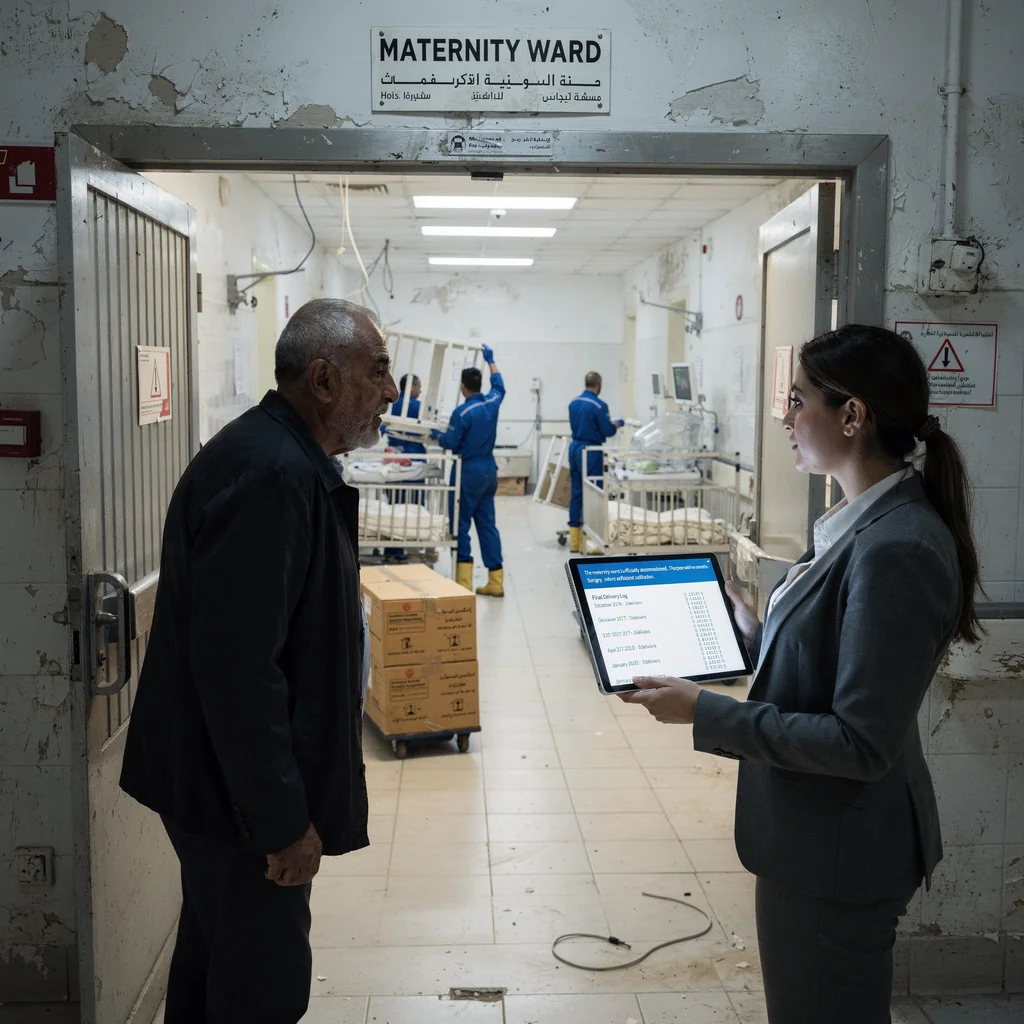
Karim stood in the doorway of the maternity ward. The corridor was quiet — quieter than it had ever been, even in the worst years of the decline. But this silence was different. It was permanent.
Workers in blue coveralls moved through the ward, dismantling what remained. The cribs were already gone. The incubators had been removed yesterday. The monitoring equipment was packed into crates labeled for storage.
A woman in a gray suit stood near the nurses’ station, checking items on a tablet. She was young — thirty, perhaps thirty-two. Born in 1998 or 2000. She had no memory of the ward when it was full. She had never heard the cry of thirty babies in a single night.
Dr. Hadded, she said. She didn’t look up from her tablet. Thank you for waiting.
Karim waited.
The transfer is complete, she said. As of today, the maternity ward is officially decommissioned. The space will be renovated for use by General Surgery. More efficient utilization of existing infrastructure.
Efficient, Karim said.
Yes, she said. It’s the future. Flexible spaces. Adaptive medicine. We can’t afford empty wards anymore.
No, Karim said. We can’t.
The woman finally looked up. Pleasant. Professional.
I have the final delivery log here, she said. For your signature. The archival transfer.
She held out a tablet. Karim looked at the screen.
The final log. The last record of babies born in this place.
December 2026: 2 deliveries January 2027: 1 delivery February 2027: 1 delivery March 2027: 2 deliveries April 2027: 0 deliveries May 2027: 1 delivery June 2027: 0 deliveries July 2027: 0 deliveries August 2027: 1 delivery September 2027: 0 deliveries October 2027: 0 deliveries November 2027: 0 deliveries December 2027: 0 deliveries
The zeros continued through 2028. Through 2029. Through today, January 2030.
In three years, there had been four deliveries.
Four babies, Karim said.
Yes, the woman said. That’s why we’re closing. Low volume doesn’t justify dedicated space.
Low volume, Karim repeated.
We’re redistributing the staff, she said. The nurses will transfer to Pediatric ward. You’ll retire next month — I see that in your file. So this is good timing.
Good timing, Karim said.
Yes, she said. Very efficient.
She swiped the screen. There. You’ve signed for the transfer. The logs will go to the National Archives. They’ll be available for research in 2075, pending security clearance.
2075, Karim said.
That’s the policy, she said. Medical records are sealed for forty-five years. Patient privacy.
Patient privacy, Karim repeated.
He looked at the empty ward. The space where the cribs had stood. The place where he had caught thousands of babies. The place where he had brought life into the world.
The woman had already turned back to her tablet.
Is there anything else, Doctor? she asked.
No, Karim said.
Then if you’ll excuse me, she said. I have to oversee the equipment removal. The surgical beds arrive on Thursday.
She walked away. Her heels clicked on the floor. The sound echoed in the empty ward.
Karim stood alone.
He had delivered babies in this ward for thirty-nine years. He had trained residents. He had taught generations of doctors. He had brought thousands of children into the world.
Now the ward was being converted to General Surgery.
He walked through the space one last time. His footsteps echoed on the empty floor.
He stopped at the place where the nursery had been. The cribs were gone. The wall was blank. Someone had painted over the scuff marks where the cribs had been pushed against the wall.
He placed his hand on the wall. The paint was fresh.
He remembered 1987. His first delivery as a resident. The baby’s cry. The mother’s exhausted smile. The weight of the newborn, warm and slick in his hands.
He remembered 2026. The year the deliveries fell below thirty. Two per month. Then one. Then none. The nurses had started calling it the quiet ward. The younger doctors had requested transfers. He had stayed.
Now he was back. One last time.
He removed his hand from the wall. He walked to the door.
Behind him, the workers dismantled the last of the equipment. The sound of tools. The sound of cart wheels on tile.
January 14, 2030.
Nineteen years since the revolution.
Karim walked down Avenue Habib Bourguiba. It was a cold morning. The wind came off the lake, cutting through his coat. He was sixty-five years old now. He felt the cold in his joints.
The street was quiet. No crowds. No protesters. No flags.
In 2011, this street had been packed. Thousands of people. Shouting. Singing. Demanding the fall of the regime.
Karim had been there. He had shouted with them.
The people want the fall of the regime!
The regime had fallen. Ben Ali had fled. The dictatorship had ended.
And then what?
Karim looked at the street around him. The same cafes. The same shops. The same buildings.
The police were still there. The checkpoints were still there. The security cameras — more numerous now — watched every movement.
The faces were different. Younger. But the system was the same.
He walked past the former headquarters of the RCD, the ruling party. The building was now a government ministry. Different name. Same function.
He walked past the spot where the young woman had cried in 2011. He’s gone! We’re free!
Where was she now?
Probably in France. Probably working. Probably building a life there.
Like his daughter.
Like thousands of others.
Karim kept walking.
Ahead, he saw it. A plaque on a building wall. Metal. Bronze. Installed in 2022, on the tenth anniversary.
He approached. He read:
In memory of the martyrs of the Jasmine Revolution. They died for freedom. 2010-2011.
Below the plaque, someone had left flowers. Plastic flowers. Dusty. Faded.
Karim read the inscription again. They died for freedom.
He looked around the street.
The cafes were open. The customers sat inside, drinking coffee. Looking at phones. Talking about work, about family, about the price of bread which had tripled again last month.
No one stopped at the plaque. No one read the inscription.
A group of young men walked past. Twenty? Twenty-two? Born after the revolution. They had never known Ben Ali’s Tunisia. They had only known this Tunisia — the one that came after.
They were arguing. Not about freedom. Not about democracy.
My phone is dead, one said. I can’t charge it. The power’s out again.
My building, another said. We haven’t had water for three days. The government says it will come back. But when?
My brother, a third said. He’s in France. He sends money. He says: Come join him. But my parents — they won’t leave.
The power. The water. The money. The departure.
The flowers by the plaque were plastic. Dusty. Fading.
Karim looked up at the building. Above the plaque, on the fifth floor, a window was open. A woman leaned out, smoking a cigarette. She flicked the ash onto the street. It fell onto the plaque.
The ash settled on the bronze. On the word freedom.
The woman didn’t notice. She didn’t look down. She finished her cigarette. She closed the window.
Karim stood before the plaque. The sun moved across the street. The shadow of the plaque stretched across the sidewalk.
He remembered 2011. The hope. The belief. This time will be different.
He remembered 2013. The assassination. The return of fear.
He remembered 2014. The new Constitution. The most democratic in the Arab world.
He remembered 2018. The investor asking: What has changed?
And the answer: Nothing.
Karim looked at the plaque one last time. They died for freedom.
He walked away. The plaque remained on the wall. The shadow lengthened across the sidewalk. People passed. No one stopped.
February 2030.
Karim drove to Sousse. The highway was empty. The toll booths were automated. The attendant booths were vacant. The power had been out for a week.
Omar’s apartment was on the third floor of a building near the beach. Karim parked on the street. He climbed the stairs. The elevator had stopped working years ago.
He knocked on the door.
Come in, Omar said.
Karim entered. The apartment was dusty. The windows were coated with grime. The light that filtered through was dim.
Omar sat in a chair. He was seventy-two years old. Thin. Frail. His breathing was labored — a whistling sound that Karim heard across the room.
You came, Omar said.
I promised I would, Karim said.
Yes, Omar said. You always keep your promises.
Karim sat across from his brother. Omar’s hands were trembling. The skin was translucent, showing veins beneath. The knuckles were swollen with arthritis.
How are you? Karim asked.
Omar considered the question. Alive.
Karim waited.
The ward, Omar said. I heard. It closed.
Yes, Karim said. This month.
Thirty-nine years, Omar said.
Yes.
And now nothing, Omar said.
Yes.
Omar coughed. Deep, rattling coughs that shook his frame. He reached for a glass of water on the table. His hand shook so much that water spilled onto the table. He didn’t seem to notice. He drank. The coughing subsided.
I tried to visit, Omar said. In January. When they closed the ward. But I couldn’t. I couldn’t climb the stairs.
It doesn’t matter, Karim said.
It does, Omar said. You’re my brother. You’re the only one who remembers.
Karim looked around the apartment. Photos on the wall. Hotels. Restaurants. Beach clubs. Businesses that no longer existed.
You built things, Karim said.
Omar followed his gaze to the photos. I built them on sand.
You tried, Karim said.
I compromised, Omar said. There’s a difference.
Omar was quiet for a long moment. Then he spoke.
I made a deal with Belhassen in 1992, he said. Fifty-one percent for him, forty-nine for me. I told myself it was business. I told myself everyone did it. I told myself there was no other way.
He coughed again. The sound was wet now. Deep in his chest.
I was wrong, he said. The deal wasn’t about business. It was about my soul. And I sold it cheap.
Karim had never heard his brother speak this way. In all their years, Omar had never confessed. Had never apologized. Had never admitted failure.
You were trying to survive, Karim said.
I was trying to thrive, Omar said. There’s a difference. I wanted to be somebody. I wanted to build something. And I was willing to pay any price.
And did you? Karim asked. Become somebody?
Omar looked at the photos. The hotels. The businesses.
For a while, he said. But it wasn’t real. It was borrowed. It was Belhassen’s. And when he was done with me, when he didn’t need me anymore —
He took it all, Karim said.
Yes, Omar said. He took it all. And I let him. Because I was never really building. I was always serving.
Omar leaned back in his chair. The effort of speaking had exhausted him.
I saw something in the archives, Karim said. In 2019. The World Bank documents. The targets. The quotas.
I know, Omar said. You told me.
They knew, Karim said. The people who implemented the program. They knew it was coercion. They knew they were manipulating women. A doctor wrote a letter in 1983. He said: I believe we are doing something that will have consequences we cannot foresee.
And? Omar asked.
They wrote back, Karim said. They said: Noted. No action required. Program continues as planned.
Omar absorbed this. They knew.
Yes, Karim said. They knew. And they continued.
Our father, Omar said. He implemented it. He believed he was helping.
He died believing, Karim said. He never saw the consequences.
And I, Omar said. I helped destroy the economy. I partnered with the clan. I enabled the corruption. I thought I was building something.
You were trying, Karim said.
I was lying to myself, Omar said. I knew. Even in 1987, when I signed that party card — I knew. But I told myself it didn’t matter. I told myself everyone did it.
He looked at Karim.
You didn’t, Omar said. You never joined the party. You never partnered with them. You never compromised.
I witnessed, Karim said. That’s all. I just witnessed.
It’s more than I did, Omar said.
The room was quiet. The dust motes danced in the light that filtered through the dirty windows.
I could have stopped, Karim said. In 2019, when I found the documents. I could have gone public. I could have spoken to journalists. I could have written articles.
Why didn’t you? Omar asked.
Because by then, no one would have cared, Karim said. The story was already written. The program was already complete. The babies were already gone. The transmission was already broken.
Omar nodded.
Omar looked at the photos on the wall. His hotels. His restaurants. All gone.
We should have tried harder, Omar said. Both of us.
Karim was quiet. The dust motes drifted between them in the afternoon light.
He coughed again. The coughing went on for a long time. When it stopped, he was pale. His breathing was more labored than before.
I’m tired, Omar said.
Rest, Karim said.
No, Omar said. Not that kind of tired. I’m tired of this. Of the collapse. Of the failure. Of watching everything fall apart.
You don’t have to watch anymore, Karim said.
Yes, Omar said. I do. I have to watch until the end. We both do. That’s what witnesses do.
Karim thought of his grandfather’s words. Everything important is transmitted hand to hand. Shoulder to shoulder. When the circle breaks, the transmission stops.
The circle is broken, Karim said.
Yes, Omar said. But we’re still here. We still remember.
For how long? Karim asked.
Omar thought about this. Until we die. Then who will remember?
No one, Karim said.
Then the transmission ends, Omar said. Truly ends. Not just broken. Ended.
Unless, Karim said.
Unless what?
Unless someone restarts it, Karim said.
Omar absorbed this. Who?
I don’t know, Karim said. But maybe — somewhere — someone is coming. Someone who remembers. Someone who can rebuild.
You’re talking about Tayeb, Omar said.
Maybe, Karim said. Or someone else. Someone who hasn’t been destroyed yet. Someone who still has hope.
Omar was quiet. The sun moved across the room. The dust motes danced.
I never had hope, Omar said. After 2008. After the bailout. After Belhassen — I never really had hope again. I just kept going. Because that’s what you do. You keep going.
I know, Karim said.
But you, Omar said. You kept hope. All these years. You kept believing that something could be rebuilt.
Did I? Karim asked.
Yes, Omar said. You kept coming to the zawiya. You kept visiting the olive grove. You kept the memories alive. You kept the transmission alive, even alone.
Not alone anymore, Karim said. You’re still here.
Not for long, Omar said.
The words hung in the air. Not for long.
I should come back next month, Karim said.
Omar didn’t answer. He didn’t promise. They both knew.
I’ll come anyway, Karim said.
Yes, Omar said. Come anyway.
Omar tried to stand. His hands gripped the arms of the chair. His knuckles were white. He pushed himself up. His legs trembled. The effort was visible in every muscle.
Karim reached for him. Let me help.
No, Omar said. Leave me. I need to do this myself.
Karim stepped back. He watched his brother struggle to stand. The trembling legs. The sweat on his forehead. The sheer effort of the simplest movement.
Omar stood. He was shaky. But he was standing.
I’m tired now, Omar said. I need to rest.
Lie down, Karim said.
In a moment, Omar said.
He walked toward the bedroom. His gait was uneven. He limped. He dragged one foot slightly behind him.
Karim watched him go. He didn’t follow. He didn’t help.
He stood in the living room. He looked at the photos on the wall. The businesses. The hotels. The life his brother had built. And lost.
He waited for Omar to reach the bedroom door.
Omar stopped. He turned back. His face was pale. His breathing was labored.
Karim, he said.
I’m here, Karim said.
The trees, Omar said. They’re still standing. Don’t forget.
I won’t, Karim said.
And the grove, Omar said. The one Grandfather showed us. In Cap Bon. The tree from 1881.
I remember, Karim said.
Go there, Omar said. When the time comes. Go to the tree. Wait there. Someone will come.
I don’t know who, Karim said.
You’ll know, Omar said. When you see him.
See who? Karim asked.
Omar didn’t answer. He turned. He walked into the bedroom. The door closed behind him.
Karim stood alone in the living room. He waited. He didn’t hear movement. He didn’t hear sounds.
He waited for ten minutes. Then twenty. Then thirty.
Finally, he walked to the bedroom door. He opened it.
Omar lay on the bed. His eyes were closed. His chest was still.
Karim stood in the doorway. He didn’t check for breathing. He didn’t check for a pulse. He didn’t need to.
His brother was gone.
Karim closed the door. He left the apartment. He walked down the stairs. Three flights. His own knees ached.
He walked out of the building. The street was quiet. The beach was visible at the end of the road. The Mediterranean stretched beyond. Gray water under gray sky.
Karim stood on the sidewalk. He looked up at the third floor. The window to Omar’s apartment. The curtain didn’t move. Omar wasn’t watching him leave.
Omar was already gone.
Karim turned toward his car. He stopped. He looked back at the building one last time.
Goodbye, brother, he said.
He got in the car. He started the engine. He drove back to Tunis.
Two weeks later. The funeral.
The cemetery in Sousse. The grave was already dug. The marble headstone was already in place.
Omar ben Hadded, 1958-2030. He built things.
Karim stood at the edge of the grave. He was alone. Omar had outlived his friends. His daughters had left Tunisia years ago. His grandchildren had never visited.
The imam recited verses. The words were beautiful. They were also empty. The imam had never met Omar. He was reciting by rote.
Allahu akbar. God is great.
Karim looked at the grave. The earth was fresh. The marble was white.
He built things, the inscription said.
And they had all fallen down.
The grave diggers waited. The imam waited. The cemetery workers waited. Everyone waited for Karim to step forward. To throw dirt on the grave. To say the final goodbye.
Karim stepped forward. He took a handful of earth. He let it fall onto the coffin.
Forgive me, he said.
That was all.
He stepped back. The grave diggers moved in. They filled the grave. They smoothed the earth. They planted flowers.
Karim watched. He didn’t speak again.
When it was over, he walked to his car. He didn’t look back.
Karim returned to his apartment in Tunis. It was quiet. Yasmine had been dead for three years. Amira was in France. Omar was gone.
The apartment was empty. The silence was absolute.
He walked to the bedroom. He opened the closet. Amira’s clothes were still there — her school uniform, her interview suit, the dress she wore for graduation. She had asked him to keep them. In case I need them, she had said. But I won’t.
He touched the sleeve of the interview suit. The fabric was soft. He remembered her leaving. The airport. The goodbye.
I’ll come back, she had said. When things change.
When will things change? Yasmine had asked.
Never, Karim had thought. But he hadn’t said it.
Now Amira was thirty-five. An engineer in France. Building wind turbines. Building a future there. Not here.
Karim closed the closet. He walked to the living room.
The apartment was quiet. The silence was heavy.
He sat at his desk. The World Bank documents were there — the copies he had made in 2019. The targets. The quotas. The incentives. The letter from the concerned doctor. The World Bank’s dismissal.
He had tried to share this knowledge. He had tried to tell people what had been done. But no one had cared. No one had wanted to know.
What can I do with this knowledge?
He could write a book. Who would read it?
He could give interviews. Who would broadcast them?
He could teach. Who would come?
He sat alone. The silence gathered around him. The sun moved across the floor. The shadows lengthened.
He thought of his grandfather’s words. Everything important is transmitted hand to hand. Shoulder to shoulder.
He thought of Omar’s final words. Go to the tree. Wait there. Someone will come.
Karim stood up. He walked to the window. The street below was empty. The power was out again. The traffic lights were dark.
He turned from the window. He walked to the door.
Tunis, March 2030.
Karim went to the zawiya.
The building was worse than ever. The wood was rotting through. The paint was entirely gone. The Arabic inscription above the door was barely visible:
Where knowledge and Quran are gathered
Karim stood before the door. He placed his hand on the wood. The surface was rough. The wood was soft with rot. The building wouldn’t last much longer. Another five years, maybe ten, and it would collapse. The inscription would be lost.
- The hand on his shoulder. The circle of men. The hum of voices in the dark room.
Everything important is transmitted hand to hand.
His fingers pressed into the rotting wood. The surface crumbled at his touch.
He removed his hand from the door. He stepped back. He looked at the building one last time.
The inscription above the door. The rotting wood. The boarded windows.
At the base of the wall, where the foundation met the street, a single root had cracked through the pavement. Silver-barked. Alive. Pushing through.
He turned. He walked away.
Behind him, the sun moved across the sky. The shadow of the building stretched across the street. The inscription caught the last of the light.
Where knowledge and Quran are gathered.
End of Chapter 11