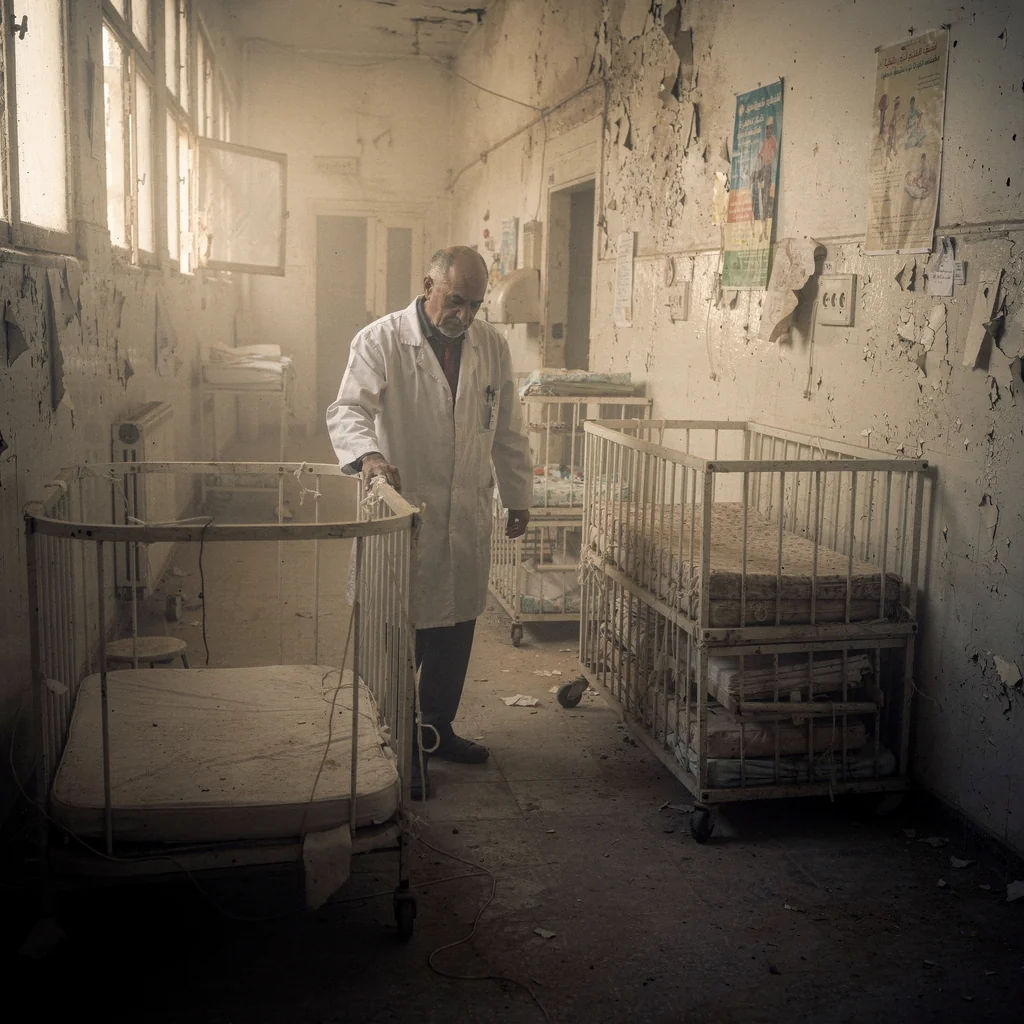
Tunis, 2019.
Karim stood in the reading room of the National Archives. The fluorescent lights hummed, a steady buzz that vibrated in his teeth. The air was dehumidified, stripped of moisture, smelling of old paper and binding glue.
Boxes lined the walls. Stamped with dates. Stamped with numbers. Stamped with the names of dead bureaucrats.
The archive room was silent. No one spoke. The only sound was the hum of the lights and the rustle of pages as researchers turned documents that had been sealed for decades.
He was fifty-four years old. He had been an obstetrician for thirty-two years. He had witnessed the decline. He had seen the deliveries drop from 347 in 1987 to 41 in 2017. He had seen the cribs stack up in the corner, unused. He had seen the women leave for France.
He knew the what. He had come for the why. The paper. The proof.
His brother had warned him. Nothing good comes of digging up the past, Omar had said when Karim mentioned the archives. Let it go. Focus on the present.
What present? Karim had asked. The collapse?
Omar’s face had hardened. The collapse is all there is. Digging won’t change that.
Karim had come anyway.
Can I help you?
An archivist appeared. She was in her forties, wearing a gray cardigan. Her name tag read: Fatima.
I’m looking for World Bank documents, Karim said. From the 1970s to the 1990s. The population program.
Fatima’s face tightened. That’s… a popular request these days.
Is it?
Since 2011, she said. Many researchers have come.
What do they find?
Fatima was quiet. She looked around the reading room. The other researchers were bent over documents, taking notes. No one was paying attention.
Follow me, she said.
She led him to the back of the reading room. She reached up to a high shelf. She pulled down a box.
World Bank Tunisia Population Program, she read. 1970-1995.
She placed the box on a table. This is what you’re looking for.
Thank you, Karim said.
Fatima nodded. She walked away. Karim was left alone with the box.
The documents were numbered. Some were stamped “DRAFT.” Some were marked “REVISED.” The annex — the one with the numbers — was marked “CONFIDENTIAL/DISTRIBUTION LIMITED.”
He opened the box.
The smell hit him first. Old paper. Dehydrated air. The smell of decisions made before he was born.
He took out the first document.
March 1969. Economic mission visits Tunis. Discusses family planning.
He turned the page.
September 1969. Minister of Planning requests Bank assistance.
November 1969. Identification mission.
May 1970. Appraisal mission.
December 1970. Briefing mission.
1971. Report published.
Karim sat with the timeline. They had been planning this for two years before he was born.
He turned to the annex.
The numbers were there in black ink.
IUD insertions: 50,000 per year by 1975. Abortion procedures: 15,000 per year by 1975. 30,000 per year by 1985. Incentives for medical providers: 10 dinars per IUD. 20 dinars per abortion.
Twenty dinars.
Karim did the math. During his residency, he had performed 47 abortions. He had received 940 dinars in bonuses.
He had not known it was a bonus.
He had thought it was recognition for good work.
He turned to the funding breakdown.
Total program cost: $47 million. World Bank contribution: $37 million. Tunisian government contribution: $10 million.
Seventy-nine percent.
He sat with the percentage.
He found, inserted between the funding annexes, an ONFP training circular — the kind distributed to regional health workers and clinic supervisors.
Karim read a paragraph. His eyes moved down the page.
Present the procedure as routine. Emphasize safety and simplicity. If a woman expresses concern about future fertility, reassure her. If she asks about risks, minimize them. If she mentions religious objections, return to the economic argument.
He closed his eyes.
He had been trained this way. During his residency. His supervisor had demonstrated the technique: Start with the medical facts, move to the economic pressure, offer reassurance about risks, return to the economics if she hesitates. Don’t let her leave undecided.
He had not known it had a document behind it.
It was not a World Bank document. It was Tunisian.
He opened his eyes. He kept reading.
He found the evaluation report from 1995. The World Bank’s own assessment.
Program success: Fertility reduced from 7.0 to 2.0 within 20 years. Targets exceeded.
Economic impact: GDP per capita increased during this period. However, other factors (oil revenue, tourism, remittances) contributed significantly. It is unclear whether fertility reduction caused economic growth or coincided with it.
Unintended consequences: Fertility continued to decline below replacement level after 1995. Currently at 1.8 and falling. Long-term demographic sustainability concerns.
The report was from 1995. Karim was reading it in 2019. Fertility was now at 1.2.
The World Bank had called it “unintended consequences.”
He kept reading.
He found one more document. A letter from a Tunisian doctor to the World Bank, dated 1983.
I am writing to express concern about the family planning program. I have been performing abortions for 10 years, incentivized by the bonuses. I have performed over 2,000 procedures. But I am seeing something that concerns me.
The women who come to me are poor. Rural. Uneducated. They are not choosing abortion freely. They are being pressured by their husbands, by their families, by the health workers who visit their villages and tell them that too many children is “backward.”
I believe we are manipulating these women. I believe we are coercing them. I believe we are doing something that will have consequences we cannot foresee.
I urge you to investigate. I urge you to review the program. I urge you to ensure that women are choosing freely, without coercion or pressure.
The letter was signed: Dr. Ahmed Ben Salem, Regional Health Director, Sousse.
The World Bank’s response was typed below — a two-sentence form letter, dated three weeks later:
Thank you for your communication of September 14, 1983. We have noted your observations and they will be taken into account in our ongoing program evaluations.
That was all.
Karim closed the file.
The fluorescent lights hummed. The other researchers read quietly. No one looked up.
His father. Dead fourteen years. The last time Karim had visited — six weeks before the end — Hassen had been sitting up in bed, surrounded by old ONFP reports. Re-reading them. Looking for mistakes.
Were there any? Karim had asked.
His father had shaken his head. We did what the data required.
He died three weeks later, still certain. Never saw the fertility rate drop to 1.2. Never saw the empty cribs. Never saw the young women leaving for France.
The women Karim had treated over thirty-two years. The hymen restorations. The abortions. The “reproductive choices.”
Dr. Ben Salem’s letter. Two sentences in reply. Three weeks.
The file lay closed on the table. The fluorescent lights hummed. Outside the reading room, the afternoon light was fading.
Karim took the documents to the photocopy machine. He copied everything. The letter from 1971. The annex with the targets. The funding breakdown. The training manual. The evaluation report. The letter from Dr. Ben Salem. The World Bank’s dismissal.
He paid for the copies. 215 pages. 43 dinars.
He placed the copies in his bag. He returned the original documents to the box.
Fatima appeared. Find what you were looking for?
Yes, Karim said.
She looked at the bag. The weight of the paper visible through the fabric.
My father was a regional health director, Fatima said. He evaluated doctors based on family planning metrics. He got bonuses for meeting targets.
She was quiet for a moment.
In 2013, she said. After the revolution. I found his files. His reports. His evaluations.
And?
My mother didn’t choose abortion, Fatima said. She was coerced.
Did he know? Karim asked. That it was coercion?
I don’t think so, Fatima said. I think he believed he was helping.
My father too, Karim said. He died in 2005. Re-reading his old reports until the end. Looking for mistakes. Finding none.
Fatima was quiet.
He never saw the cribs empty, Karim said.
Neither did mine, Fatima said.
Karim picked up his bag. Thank you. For your help.
Fatima nodded. She looked at the bag. The weight of two hundred fifteen pages.
Good luck, she said.
Good luck to you too, Karim said.
He walked out of the National Archives. He stood on the street. The bag of photocopies in his hand. He could feel the weight of the paper through the fabric.
He walked to the train station. He bought a ticket to Sousse.
The train left at four. He sat by the window. The bag on his lap. Two hundred fifteen pages pressing against his thighs.
Through the glass, the coast passed. The sea. The hotels. The half-built resorts, abandoned since 2008, their concrete skeletons gray against the evening sky.
Sousse. Evening.
Yasmine opened the door. She looked at Karim. She looked at the bag in his hand.
You came, she said.
I need to show you something.
She stepped aside. He entered the apartment. It was small — a living room, a kitchen, a bedroom. Her sister’s place. The walls were bare. The furniture was borrowed.
Yasmine had been here since 2017. Two years. She had left Tunis in October. Two suitcases. She had not come back.
She led him to the kitchen table. She cleared the exercise books — she was still teaching, at a lycée in Sousse now — and made room.
Karim placed the photocopies on the table. The bag rustled as he set it down.
She read them slowly. Her face grew pale. Her hands trembled.
This is… she began. This is coercion.
Yes.
This is not choice, she said. This is supply-driven. This is imposed.
Yes.
Seventy-nine percent foreign funding, she said. This wasn’t Tunisia’s agenda.
Karim was quiet.
She was quiet for a long moment. Then she looked up.
My literature teacher, she said. Mme. Bouazizi. Twelfth grade.
Karim waited.
She called me to her office once, Yasmine said. 1988. She told me my mother was being irresponsible. Having four children. In this economy. In modern Tunisia.
She was quiet for a moment.
I didn’t understand then, she said. I thought she was concerned. About us. About our family.
She looked at the documents on the table.
Now I know, she said. She wasn’t concerned. She was implementing policy.
Karim was silent.
I never saw her again, Yasmine said. After graduation. But I remember her voice. Telling me my mother was backward. Telling me four children was too many.
She picked up the letter from Dr. Ben Salem. The letter from 1983.
He knew, she said. This doctor. He knew they were coercing women. He tried to stop it.
And they ignored him, Karim said. Look at the response. “Thank you for your communication. We have noted your observations.”
Yasmine read the words. Noted your observations.
They knew, she said. Someone knew. And they didn’t care.
She put down the letter. She looked at Karim.
I’m angry, she said. I’m so angry.
I know.
They told us large families were backward, she said. They told us development meant fewer children.
Yes.
They lied, Yasmine said.
She stood up. She paced the room. She stopped at the window. She looked out at the city. The lights of Sousse flickered in the distance.
I trusted them, she said. I trusted the system. I believed that if I worked hard, if I got an education, if I followed the rules… things would get better. But they didn’t get better. They got worse.
Karim stood up. He walked to her.
We’re not alone, he said. The archivist at the National Archives. Fatima. Her father was a regional health director too. He got bonuses for meeting targets. Her mother was coerced.
Did she find the documents?
She found them in 2013. After the revolution. She showed me where to look.
Yasmine turned from the window. She looked at Karim. She looked at the documents spread across the table.
I’m glad you found them, she said. I’m glad you know.
Does it help? Karim asked.
No, Yasmine said. But it’s better than not knowing.
She looked at the documents. The targets. The quotas. The incentives. The letter. The dismissal.
We’re both witnesses now, she said. You at the hospital. Me at the school. We both see what was lost.
She reached across the table. She took his hand. Her fingers were cold. Her grip was tight.
You came all the way to Sousse to show me this, she said.
Yes.
Thank you.
They sat together. The documents lay between them.
Yasmine reached out. Her hand trembled as she turned a page in the file.
The next morning, Karim went to the hospital. He went to his office. He took out the delivery logs.
1987: 347 deliveries. 1997: 211 deliveries. 2007: 89 deliveries. 2017: 41 deliveries.
He placed the World Bank documents next to the delivery logs on his desk. Two stacks. Side by side.
He aligned the edges — the delivery logs on the left, the World Bank documents on the right — until they were parallel.
Through the window, the sun moved across the sky. The light shifted from white to gold to amber. On the desk, the shadows of the paper stacks lengthened, stretching across the delivery logs, across the World Bank documents, across the desk.
In the corner of the office, the unused crib cast its own shadow — the bars of the railing making dark lines across the floor.
End of Chapter 7
End of Part II - THE UNRAVELING (1998-2019)