CHAPTER 1 — AUGUST 2026: DECISION
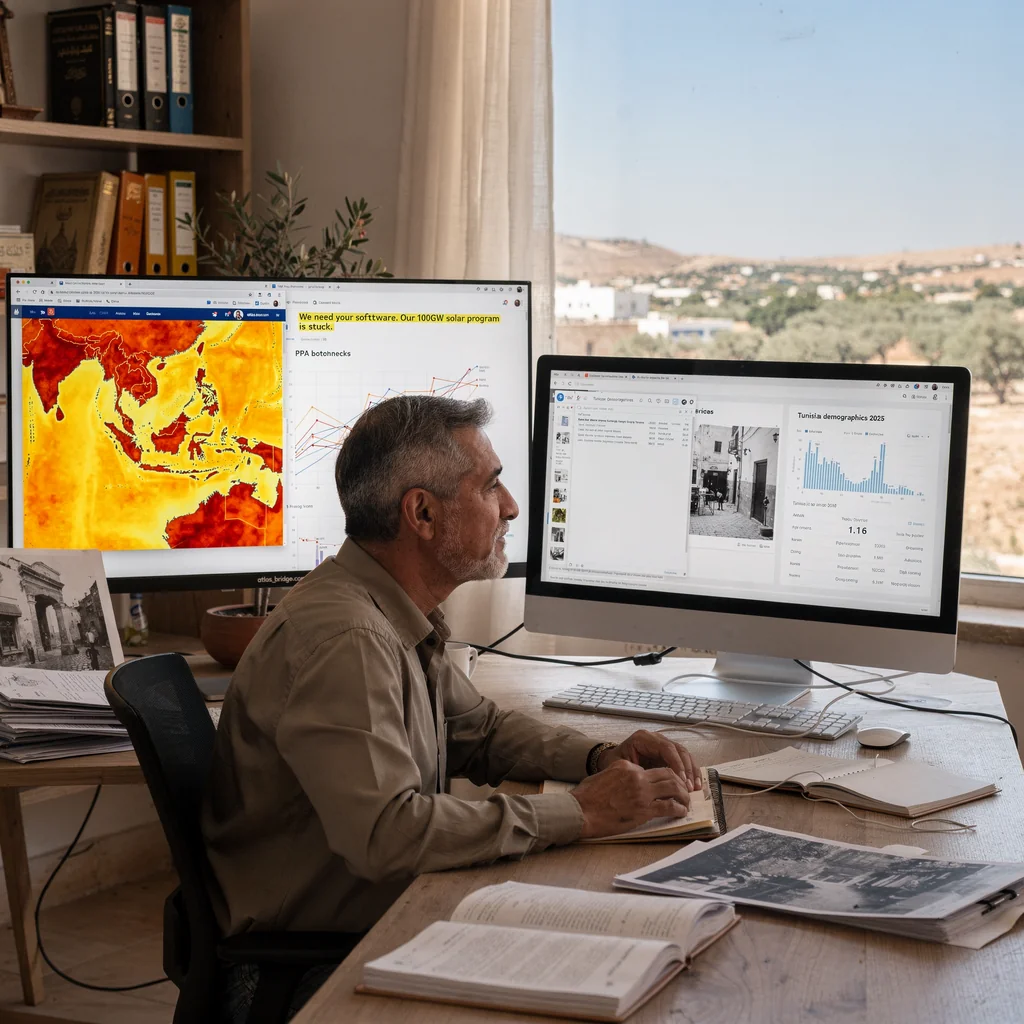
Tunis, August 2026. The office faced north, away from the sea, toward the olive groves that covered the Cap Bon peninsula. Light filled the room—Mediterranean, white-gold, the dust motes floating in the air shaft between the blinds.
Tayeb sat at his desk, the computer screen glowing. Solar irradiance maps for Indonesia. PPA bottlenecks. Grid connection failures. The data was red—alerts, warnings, system failures.
The email from Jakarta had arrived at 2:17 AM. He’d been awake anyway.
From: Bambang Sutrisno, Deputy Director for Renewable Integration, PLN Nusantara Subject: URGENT — 100GW Solar Program Stalled We need your software. Our PPAs are stuck in bureaucracy. Grid connections failing across Java and Sumatra. Village adoption in freefall. The 100GW target is receding—we need 5GW new capacity yearly just to stay on track. Can you help?
Tayeb had read it three times.
He knew the data. Indonesia’s 100GW program—announced in 2022, launched in 2023—stuck in permitting disputes and grid failures. The village adoption declining. The targets receding.
And atlas_bridge had the software to fix it. PPA pricing models. Grid integration tools. Demand forecasting. Twelve years of Mediterranean solar, compressed into algorithms that Indonesian planners needed.
He could help. That was not the question.
He opened a second window. Tunisia demographic data, 2025.
TFR: 1.6. Below replacement. Below survival.
Marriage rate: declining. Youth unemployment: 18%. The empty cribs—statistical now, but everywhere visible. The neighborhood mosque had announced three births this year. Five deaths.
The zawiya closed in 1961. The waqf abolished in 1957. The marriage covenant restructured in 1956—the mahr made symbolic, the community witness replaced by civil registry.
TFR 1.6. The trees were still standing. The children were not.
He closed the Tunisia window. Opened the Indonesia window again.
His grandfather’s voice came back to him, unbidden: The zawiya was in the old city, down the street from the mosque. Men gathered for dhikr on Thursday nights. You could hear the chant from our doorway—Allahu, Allahu, repeated until the words lost their meaning and became breath, became presence, became something you could feel in your chest.
That was in 1958. Tayeb was seven. The zawiya closed in 1961. By the time he was ten, the chant was gone, the building was a youth center, the men who gathered were scattered. His grandfather never spoke of it again.
The map filled the screen—thousands of islands, scattered like spilled beads across the equator. Java. Sumatra. Kalimantan. Sulawesi. Papua. Two hundred seventy million people. Two hundred thirty million Muslims.
And the networks: preserved.
The research he’d been reading for months said so. The pesantren—Islamic boarding schools, thousands of them across Java and Madura—still operated. The NU—Nahdlatul Ulama, ninety million members, the largest Islamic organization in the world—still governed their communities. The waqf system—Islamic endowments, property held in trust for community benefit—still funded schools and mosques and hospitals.
The pesantren gates: open. The waqf deeds: active. The NU leadership: accessible.
Not like here.
The door opened. Karim Ben Salem leaned in, thirty-two years old, atlas_bridge’s lead engineer.
“Bambang Sutrisno emailed again,” Karim said. “He’s offering three hundred thousand dollars for six months of consulting. All expenses covered. Business class.”
Tayeb didn’t turn from the screen.
“And?” Tayeb asked.
“And what? It’s excellent money. The software is ready. You know the PPAs are the bottleneck.”
“Not the PPAs.” Tayeb tapped the screen. “This.” The Indonesia map.
“The solar program?”
“The networks.”
Karim came into the office, leaned against the desk. “You’ve been reading about Indonesia for months. What is it?”
“The pesantren,” Tayeb said. “Islamic boarding schools. They’ve been operating since the 16th century. The NU—Nahdlatul Ulama—founded in 1926, ninety million members. The waqf system—endowments that fund schools, hospitals, mosques.” He turned to Karim. “They survived independence. They survived modernization. They survived dictatorship. They’re still there.”
“Unlike here.”
“Unlike here.”
Tayeb didn’t answer. The air conditioning hummed.
“So this isn’t about the solar,” Karim said.
“The solar is the cover.”
“The cover for what?”
“To learn how they did it. How they preserved what we destroyed. How they maintained autonomy when the modernizers came. How they kept the networks alive when the state demanded control.”
“And then what?”
“Bring it home.” Tayeb looked at the screen. “Figure out what can be rebuilt.”
Karim absorbed this. “Tunisia is not Indonesia.”
“No. Indonesia is not Tunisia. Different history. Different culture. Different networks.”
“So what makes you think there’s something to bring home?”
Tayeb didn’t answer. He opened a new browser tab. Pesantren Tebuireng. Jombang, East Java. Founded in 1899. The most prestigious pesantren in Indonesia. Students: 8,000. Curriculum: Quran, Arabic, Islamic jurisprudence, plus mathematics, science, English.
The website showed a courtyard. Students sitting cross-legged. A kyai—teacher, elder—speaking.
They looked like any university campus, anywhere in the world. Except the courtyard had a mihrab. Except the students wore kopiah. Except the knowledge being transmitted included what the modern universities had forgotten.
“The networks survived,” Tayeb said quietly. “That’s what matters.”
The phone rang. Karim answered, listened, covered the mouthpiece. “It’s Bambang Sutrisno. Calling from Jakarta.”
Tayeb took the phone.
“Tayeb Damerji.”
“Mr. Damerji, thank you for taking my call. Bambang Sutrisno, PLN Nusantara. We spoke by email.”
“The solar program.”
“The program is stalled, as you know from my email. We need your software. We need your expertise. We need you in Jakarta.” The voice was formal, urgent. “Three months minimum. Six months preferred. Three hundred thousand dollars. All expenses. Business class travel. Housing in Jakarta’s central district.”
“When would you need me?”
“As soon as possible. September. The grid connection failures are accumulating. Every month we delay, the 100GW target becomes more distant.”
Tayeb looked at the screen. The Indonesia map. The departure date: September 8, 2026.
“And after the consulting work?” Tayeb asked.
“You return home. Or we discuss an extension. The integration work will take years. But the initial contract is six months.”
Tayeb was quiet. The office filled with afternoon light.
“I’ll come,” Tayeb said. “But not just for the solar.”
“The solar is urgent—”
“The solar is what will bring me there. What I do while I’m there”—Tayeb looked at the pesantren website again—“is my own research.”
“What research?”
Tayeb hesitated. How to explain? How to say: I want to know how you kept what we destroyed. I want to know how the networks survived when the modernizers came. I want to know if there’s something—anything—that can be transplanted to Tunis. To the grove. To the empty cribs.
“Academic interest,” Tayeb said finally. “I’m researching network preservation in modernizing Muslim societies. Indonesia is a case study.”
“Case study for what?”
“A paper. Maybe a book.”
“Ah.” Bambang Sutrisno’s voice shifted—interest, curiosity. “And our pesantren networks are part of this research?”
“They are.”
“Then you’re welcome to study them. The pesantren are open to scholars. The NU leadership is accessible. I can make introductions.”
“I would appreciate that.”
“September 8th. Turkish Airlines, Tunis to Istanbul to Jakarta. I’ll send the booking details.”
“Thank you.”
“Thank you, Mr. Damerji. We’ve been waiting for someone who understands both the technology and the culture. I think you’re that person.”
The call ended. Tayeb placed the phone in the cradle.
Karim was still watching him. “September 8th. That’s three weeks away.”
“Yes.”
“You’re really going.”
“Yes.”
“For six months?”
“The return ticket is open.”
Karim shook his head, smiling slightly. “Sixty years old and you’re still looking for answers in other people’s countries.”
“The answers weren’t here,” Tayeb said. “The answers were destroyed.”
He turned back to the computer. Opened the flight booking interface. Turkish Airlines. Tunis to Istanbul to Jakarta.
The cursor blinked.
He entered the dates. September 8, 2026. Return: open ticket.
His finger hovered over the mouse.
The grove. The olive trees planted by his grandfather’s grandfather. The empty cribs in the village. The mosque announcements—three births this year, five deaths. TFR 1.6, falling.
Indonesia. The pesantren still operating. The NU still governing. The waqf still funding. The networks alive.
And the question that had driven him for decades, since he’d first understood what Bourguiba had done, what his grandfather’s generation had signed away, what his mother still boasted about: What survives when the institutions are destroyed?
He’d been looking for the answer in Tunis. In books. In archives. In the grove itself.
The answer wasn’t there.
The answer might be in Indonesia.
He pressed enter.
The screen refreshed. Booking confirmed. TK 661, September 8, 2026, Tunis to Istanbul to Jakarta. Return: open.
“Done?” Karim asked.
“Done.”
“Six months in Indonesia.” Karim pushed off the desk. “What are you going to tell people?”
“That I’m consulting on their solar program.”
“And the real reason?”
“The real reason is nobody’s business.” Tayeb stood up. “But you know.”
“I know.” Karim walked to the door. “Come home with something, Tayeb. The grove is waiting. The trees are still standing. But the children…” He didn’t finish.
The door closed.
Tayeb stood at the window. The olive groves covered the hillsides, silver-green against the limestone soil. The trees his grandfather had tended. The trees his grandfather’s grandfather had planted.
The grove owner’s chair stood empty at the table. His grandfather’s chair. His father’s chair. Five generations of Damerjis in the same seat.
He turned back to the computer. Opened a new document. Title: Indonesia Research Notes.
He typed the first entry:
August 14, 2026. Booking confirmed. TK 661, September 8, Tunis to Istanbul to Jakarta. Return: open.
Purpose: Solar consulting. And whatever else I find.
Question: What did Indonesia preserve that Tunisia destroyed? Can it be transplanted? Can it be rebuilt?
Assumption: I will find the blueprint. I will bring it home. I will save what can be saved.
He paused.
Alternative: There is no blueprint. Only questions.
He deleted the last line. Didn’t type it again.
The screen dimmed. His reflection looked back—sixty years old, gray hair, white beard, the face weathered by Mediterranean sun. The flight confirmation glowed: TK 661, September 8, 2026, Tunis to Istanbul to Jakarta. Return: Open.