CHAPTER 17 — NOVEMBER 2037: TRANSMISSION
One
November 2037. Nine years since returning from Indonesia. Nearly three years since the three young men began grafting in the courtyard. Almost two years since the contract with the Ministry was signed.
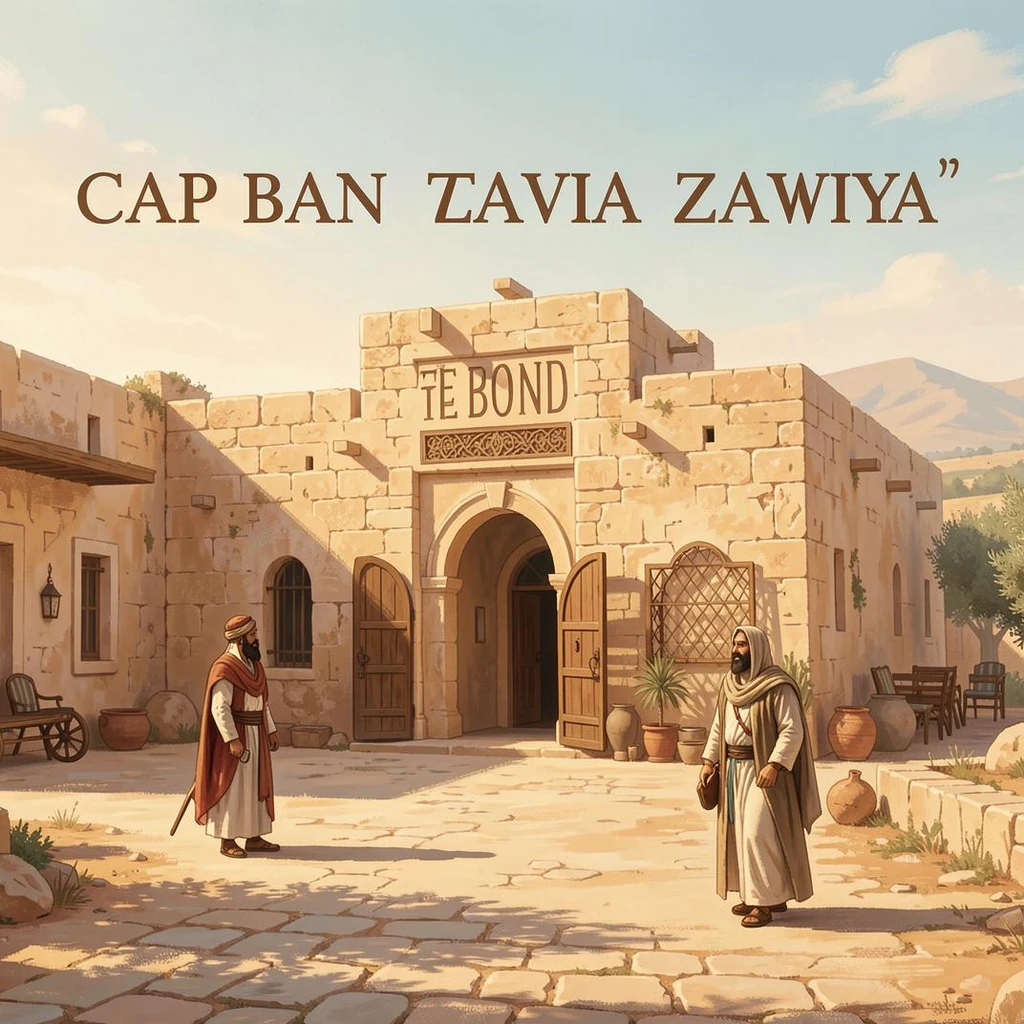
The Cap Ban zawiya was the first of the new zawiyas—not a reconstructed institution, not a restored building, but something new. A simple courtyard building on the road to Nabeul, whitewashed walls, a tiled roof, a well in the center. Not large, not old, not famous. Just a place where students gathered.
Tayeb stood in the doorway, watching.
The students were leading dhikr—the practice Tayeb had learned in Indonesia, the rhythmic chanting, the synchronized movement, the repetition of divine names. But their voices were different from the Indonesian recordings he had heard, different from the Tunisian recordings his father had played, different from the old way that had been destroyed.
The students’ voices were younger. Higher in pitch. Less polished. Less unified. But they were chanting. The sound carried.
There were twenty students in the circle, ranging in age from eighteen to twenty-five. The first generation—those who had never known the old networks, who had grown up with nothing, who had sought what had been lost and found something else instead.
They stood in a circle, hands clasped, bodies swaying, voices rising and falling in the rhythmic pattern of dhikr.
La ilaha illa Allah. There is no god but God.
The repetition continued for ten minutes, fifteen, twenty. The voices rose and fell, the rhythm steady, the practice enduring. Tayeb had taught them the pattern—the Indonesian way, the Javanese tempo, the repetitions that had been preserved in the archipelago while Tunisia’s networks had been destroyed.
But the students had changed the practice. Their tempo was faster. Their pronunciation was different—Tunisian Arabic, not Javanese-influenced. Their style was less formal, more spontaneous, more improvised.
It wasn’t the old way. It wasn’t the Indonesian way. It was something new—Tunisian students practicing Indonesian-learned techniques, adapted to local conditions, creating something that rhymed with both traditions but was identical to neither.
The dhikr ended. The students released their hands. The circle dissolved. They turned toward Tayeb in the doorway.
Tayeb noticed the changes since his last visit—new faces, different voices. Three of the original students had gone south to Sfax, where Sami now managed the zawiya they had planted two years ago. In their place were newcomers, young people who had found the foundation through word of mouth, through the growing reputation of the practice, through the quiet network of seekers.
Fatma was among them—the newest of the teachers, twenty-two, who had arrived from the Cap Ban circle before the Ministry contract. She had the quality Tayeb had come to recognize: she asked the question that was already in the room.
“Uncle,” she said. “Will you join us for tea?”
Tayeb nodded. He entered the courtyard. The students gathered around the well, sitting on mats they had spread on the ground. One of them poured tea—mint tea, the Tunisian way, small glasses, the steam rising in the November evening.
“How was the dhikr?” Tayeb asked.
“It was different,” said Omar—the youngest of the three original grafters, now twenty-seven, one of the foundation’s teachers. “Not the old recordings. Not the Indonesian way. Something new.”
“Is that a problem?” Tayeb asked.
The students looked at each other. Something passed between them—a question, a discussion, an agreement.
“We don’t think so,” said Yassin—the original Yassin, now thirty-one, the foundation’s program director, the one who had argued for partnership with the state. “The old way is gone. The Indonesian way is their way, not ours. What we’re creating—this practice, this community, this transmission—it has to be ours. It has to grow in our soil, not someone else’s.”
He looked at Tayeb. “Is that wrong? Is the practice different from the old way because we’re doing it wrong? Or is it different because we’re doing it differently?”
Tayeb sipped his tea without answering. The mint, the sugar, the warmth.
“The dhikr you practice,” he said. “Is it the same as what was practiced in the old zawiyas?”
“No,” said Fatma. “It’s different. We changed it.”
“Why?”
“Because the old way didn’t feel right,” she said. “The tempo was too slow. The repetitions were too many. We tried it—we practiced the old recordings, we imitated the Indonesian way, we did exactly what the manuals described. But it felt… borrowed. Like we were wearing someone else’s clothes.”
“So we changed it,” Omar said. “We sped up the tempo. We reduced the repetitions. We made it more spontaneous, more improvised. And it felt right. It felt like ours.”
Tayeb sipped the tea. The courtyard was quiet. The well held the last of the daylight in its water.
“What transmits?” he asked. “When the specific content is lost—what actually survives?”
Two
The evening deepened. The tea was finished. The students began to disperse—some back to their homes in Nabeul, some to the dormitory attached to the zawiya, some to the study room where they would prepare lessons for tomorrow.
“Stay,” Tayeb said to the three—Yassin, Omar, and Fatma. “I want to show you something.”
They waited while Tayeb went to his small room in the zawiya, where he kept his few belongings. He returned with a small device—a tablet computer, ancient technology from the 2020s, barely functional but still capable of playing audio files.
“I want you to hear something,” he said.
He sat on a mat against the wall. The three students sat with him. He activated the tablet, found the file, adjusted the volume.
An audio recording began—the sound of dhikr, recorded in Indonesia in 2027, ten years ago, at Pesantren Tebuireng. The voices were Indonesian, the tempo slow and steady, the pronunciation Javanese-influenced, the style formal and deliberate.
They listened for five minutes. The recording ended. The courtyard was quiet.
“That was the old way,” Tayeb said. “The Indonesian way. What I learned when I was there. What I brought back with me.”
He looked at the three students. “And now I want you to hear something else.”
He found another file. Another recording—this one from Tunisia, from the 1950s, recovered from archives, a recording of dhikr from a zawiya in Tunis before the abolition. The voices were Tunisian, the tempo faster than Indonesia but slower than the students’ practice, the pronunciation urban, the style formal but different.
They listened for five minutes. The recording ended. The courtyard was quiet again.
“That was the old way,” Tayeb said. “The Tunisian way. What was destroyed. What your grandparents never knew. What was lost before you were born.”
He looked at the three students. “Now I want you to hear something else.”
He activated a third recording. This one was from last month—recorded here, in this zawiya, during the evening dhikr. The voices were familiar—the students’ own voices, the practice they had just completed, faster tempo, Tunisian pronunciation, spontaneous style, improvised harmonies.
They listened for five minutes. The recording ended. The courtyard was quiet.
“That’s your way,” Tayeb said. “Not the Indonesian way. Not the old Tunisian way. Something new. Something that rhymes with both traditions but is identical to neither.”
He paused. “The question is: What transmits? Is it the specific practice—the tempo, the pronunciation, the style? Or is it something else?”
The three students were quiet. Three recordings, three versions of the same practice, different in every audible way.
“The third one sounds nothing like the first,” Omar said. “Different tempo. Different pronunciation. Everything.”
“Is it the same practice?” Yassin asked. “Or have we created something else?”
Fatma was quiet for a long time. She turned her glass of tea between her palms.
“I don’t think we can know yet,” she said. “We’ve been practicing for three years. The Indonesian tradition is centuries old. We’re still finding out what we’re doing.”
Tayeb looked at her. “What do I transmit to you? If not the specific practices, if not the Indonesian way—what do I actually give you?”
Yassin spoke first. “The framework. How to gather, how to decide, how to teach.”
“That’s part of it,” Omar said. “But it’s also the expectation that this is possible. The proof that recovery can happen.”
“You transmit the possibility,” Fatma said. “That this kind of gathering is still possible in Tunisia, in 2037. That’s what I didn’t know before I met you.”
“And when I’m gone?” Tayeb asked.
“I’ve been teaching Amina for three weeks,” Fatma said. “You haven’t been in the room once. Something is transmitting anyway.”
“But are you teaching what I taught you,” Tayeb said, “or what you’ve learned from doing?”
“Both,” Fatma said. “The practice isn’t what you gave us. It’s what grew here after you planted the seed. It’s already different from what you planted. And Amina’s practice will be different from mine.”
The tea was cold. The November air settled against the courtyard stones.
Tayeb looked at the three students—Yassin, Omar, Fatma. They had practiced without his guidance. They had created something new without his permission. And now their students were learning without him.
Three
The next morning, Tayeb sat in the courtyard watching Fatma teach.
She was working with a new student—Amina, nineteen, from a coastal village south of Nabeul. She had joined the zawiya three weeks ago, referred by a cousin who was already practicing in the Cap Ban circle. This was her first lesson on the dhikr practice.
Fatma sat on a mat across from Amina. The two women faced each other, knees touching, hands resting on their thighs.
“The practice begins with posture,” Fatma said. “Not because the position matters in itself, but because the body prepares the mind. When we sit this way—spine straight, hands open, shoulders relaxed—we create the conditions for the practice to emerge.”
Amina adjusted her position. She straightened her spine. She opened her hands. She relaxed her shoulders.
“Good,” Fatma said. “Now the breath. We begin with three deep breaths—inhale through the nose, exhale through the mouth. Slow. Deliberate. Not forcing, but allowing.”
She demonstrated. Amina followed.
“Now the voice,” Fatma said. “We’ll start with the simplest formula. La ilaha illa Allah. I’ll say it first. You listen to the rhythm, the tempo, the pronunciation. Then you repeat.”
She said the phrase—La ilaha illa Allah. Her voice was steady, the tempo moderate, the Arabic clear but Tunisian-accented.
Amina repeated. Her voice was hesitant, the rhythm uneven.
“Again,” Fatma said.
Amina repeated. Better this time.
“Again.”
They practiced for twenty minutes—phrase by phrase, repetition by repetition, until Amina’s voice gained confidence, until the rhythm steadied, until the practice began to feel natural.
Tayeb watched from the doorway. He remembered teaching Yassin, Omar, and Sami the same practice, seven years ago in the grove. He remembered the uncertainty in his own voice—the first time he had tried to teach something he had only recently learned, something he had never seen practiced in Tunisia, something that felt borrowed and tentative.
But Fatma’s voice was not tentative. She was not borrowing. She was teaching something she had practiced for years, something she had adapted to local conditions, something she knew in her body.
Tayeb noticed the differences. When Amina struggled with the rhythm, Fatma didn’t correct her immediately. She let Amina continue for three more repetitions, watching closely. “Your breath is shortening before the phrase ends,” Fatma said finally. “You’re rushing to finish. The practice is not about finishing. It’s about being present in the middle.”
When Amina’s posture slumped after ten minutes, Fatma didn’t tell her to straighten. “What are you noticing in your body right now?”
Amina thought for a moment. “My shoulders are tense. My chest feels tight.”
“What does your body need?” Fatma asked.
“To relax,” Amina said. “To breathe.”
“Then do that,” Fatma said. “The practice serves the body, not the other way around.”
“Now we add movement,” Fatma said. “The dhikr is not just voice. It’s voice plus body plus breath. The body sways—very slightly, very gently—forward on La ilaha, back on illa Allah. Not exaggerated. Just a small movement, like breathing.”
She demonstrated. Amina followed. The movement was uneven at first, jerky, uncoordinated with the voice.
“Again,” Fatma said.
They practiced for another twenty minutes—voice plus body, breath plus movement, until the coordination emerged, until the practice began to flow.
Tayeb noticed the differences from how he taught. He had taught the Indonesian way—the formal Javanese style, the precise movements, the exact repetitions. He had been careful to transmit exactly what he had learned, afraid that any change would lose something essential.
But Fatma was not teaching the Indonesian way. Her movements were less formal, more fluid. Her repetitions were fewer than what Tayeb had taught. Her style was adapted—not Javanese, not old Tunisian, but something new.
“The practice will feel strange at first,” Fatma said to Amina. “The words are Arabic, but the rhythm is unfamiliar. The movement feels artificial. The coordination doesn’t come naturally.”
Amina nodded. She looked frustrated.
“That’s normal,” Fatma said. “We all felt that way when we started. Even Yassin, even Omar—even they felt awkward when they first practiced.”
She smiled. “The practice is not about getting it right immediately. It’s about showing up. It’s about trying. It’s about allowing the practice to work on you, slowly, over time.”
Tayeb remembered saying something similar to Yassin, seven years ago. He had said: The practice is not about perfection. It’s about persistence. About showing up. About allowing the mechanism to work.
She had learned from him. And now she was teaching what she had learned—but adapted, changed, made her own.
“How long before it feels natural?” Amina asked.
“Weeks,” Fatma said. “Maybe months. For some of us, longer. The mechanism works differently for everyone.”
“What’s the mechanism?” Amina asked.
Fatma was quiet. She seemed to be considering how to answer.
“The mechanism is…” she said slowly, “the capacity to connect. To God. To each other. To something beyond ourselves.”
She looked at Amina. “The dhikr practice is just a technique. The words are just words. The movements are just movements. But when we practice together, when we sustain the practice over time, something emerges. A connection. A resonance. A bond.”
“How do you know it works?” Amina asked.
“You’ll know,” Fatma said. “Not right away. But eventually. There will be a moment—maybe during practice, maybe months from now—when something shifts. When the words become more than words. When the movement becomes more than movement. When you feel the connection.”
She smiled. “That’s when you’ll know. That’s when the mechanism operates. That’s when the bond transmits.”
Amina was quiet. She seemed to be absorbing this, considering it, wondering if it was true.
“Will you practice with me tomorrow?” Fatma asked. “Same time. We’ll continue.”
Amina nodded. “Yes. Thank you, Fatma.”
Fatma stood up. She saw Tayeb in the doorway, watching. She smiled—acknowledging his presence, inviting him to comment.
“She’ll be a good student,” Fatma said. “She has the quality. She asks the question that’s already in the room.”
“She does,” Tayeb said. “You taught her well.”
“Thank you,” Fatma said. “I learned from you.”
“You changed what you learned,” Tayeb said.
“I did,” Fatma said. “Is that wrong?”
Tayeb turned the tea glass in his hands, considering.
“No,” Tayeb said. “It’s not wrong. It’s necessary. The old form doesn’t fit the new conditions. The Indonesian way doesn’t fit the Tunisian soil. What you’re teaching—what you’ve created—is what fits.”
He looked at Fatma. “You’re not just transmitting what I taught you. You’re transmitting the capacity to create practices that fit. The capacity to adapt. The capacity to recover.”
“That’s the mechanism,” Fatma said.
“Yes,” Tayeb said. “That’s the mechanism.”
He looked toward the courtyard, where Yassin was meeting with another group of students—advanced students now, discussing the agricultural techniques they had learned from the old manuals, adapted to current conditions.
“And Yassin?” Tayeb asked. “What’s he transmitting?”
“The listening,” Fatma said. “The observation. The patience. He learned the grafting techniques from the farmers, but he’s teaching something more fundamental—how to pay attention. How to watch. How to listen to the soil, the trees, the conditions.”
“And Omar?”
“The deliberation,” Fatma said. “The collective decision-making. He’s teaching students how to discuss, how to disagree, how to reach consensus. Not by lecturing—by practicing. They deliberate together, and he guides them, and they learn by doing.”
Each of the three had made what they learned their own.
“You don’t need me,” Tayeb said.
Fatma was quiet for a moment. “Not to teach,” she said. “But we need you to witness. To remember what was lost. To connect what we’re creating to what came before.”
“The elder,” said Yassin. “The witness.”
“We needed you to start this,” Omar said. “But we can continue it now.”
Tayeb nodded slowly. The November wind moved through the courtyard, stirring the dust around the well.
Four
The students had all dispersed now. The courtyard was empty except for Tayeb and the three—Yassin, Omar, Fatma. The November night had settled, cold and clear, the stars appearing one by one in the sky above.
“What will you do now?” Yassin asked. “If you’re not needed to transmit, if you’re not needed to teach—what’s your role? What’s your work?”
Tayeb didn’t answer immediately. He had been asking himself this question for months, for years. What was his role now? What was his work?
“I think,” he said slowly, “that my role is changing. I’m not the teacher anymore. You’re the teachers now. I’m not the practitioner anymore. You’re the practitioners now. I’m something else.”
“What?” asked Omar.
“I’m the elder,” Tayeb said. “The witness. The one who remembers what was lost.”
“My grandfather planted the trees,” he said. “My father watched them tear the networks down. I tried to rebuild them. None of us got it right.”
He paused. “But the trees are still standing. And my role now is to witness. To remember what was here before. To help you see the connection.”
They sat with this. The cold settled into the stones.
“What do we call you?” Fatma asked. “Not teacher anymore.”
“Tayeb,” he said. “Or Uncle. Whatever feels right.”
“And what do we call ourselves?” asked Omar. “If we’re not restoring the old way, if we’re not copying the Indonesian way—what are we?”
“The old networks were zawiyas—buildings, property, legal recognition,” Tayeb said. “What we’re building isn’t zawiyas. It’s something more flexible.”
“So what are we?” asked Yassin.
“Circles,” Tayeb said. “The zawiya is the building, the legal entity. The circle is the practice. The zawiya can be co-opted. The circle cannot.”
“The zawiya is the shell,” Fatma said. “The circle is the core.”
They sat together in the courtyard as the night deepened, the stars multiplying above them, the cold settling into the stones.
“Will you lead dhikr tomorrow?” asked Fatma. “Or will you watch?”
“I’ll watch,” said Tayeb. “It’s your turn now.”
The three students nodded.
Five
They left the courtyard together, walking toward the dormitory building, when the sound began.
Voices. Chanting. Dhikr.
Tayeb stopped. The three students stopped. They listened.
It was coming from the study room—the students who had stayed after tea, who were practicing on their own, without teachers, without guidance, without oversight.
The voices were young. Inexperienced. Unpolished.
But they were chanting.
La ilaha illa Allah. There is no god but God.
The rhythm was unsteady. The pronunciation was imperfect. The harmony was inconsistent. But they were practicing.
Tayeb looked at the three students—Yassin, Omar, Fatma. They were smiling.
They stood together outside the study room, listening to the voices inside. The chanting continued, unpolished but steady. The students were practicing on their own.
The courtyard was dark now. The stars were bright. The dhikr from the study room had ended — the voices gone silent, the practice complete, the students dispersing to their beds.
Tayeb stood in the doorway. The three students stood behind him. The stars burned above the limestone wall. The trees stood in their rows.
The wind moved through the grove.