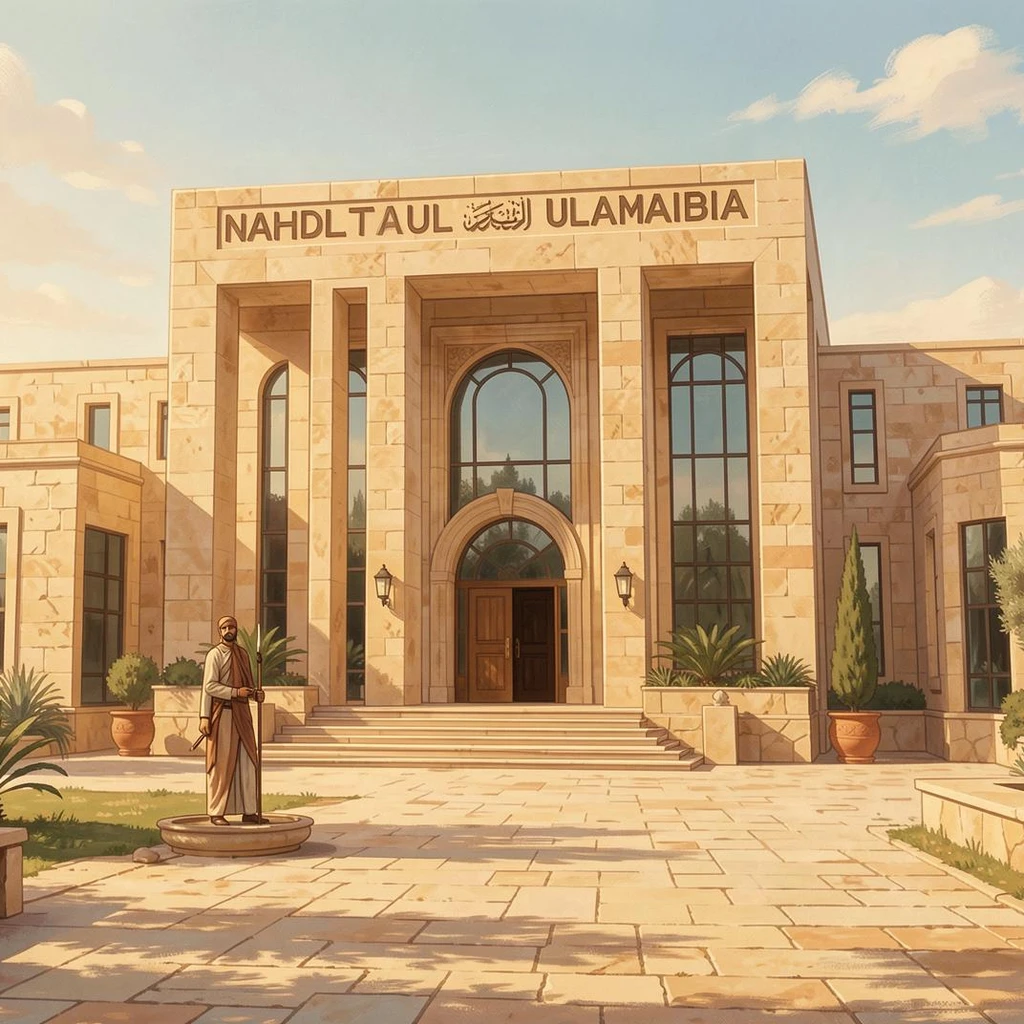
CHAPTER 4 — NOVEMBER 2026: NU HEADQUARTERS
Jakarta, November 2026. The NU headquarters occupied a twelve-story glass and steel building in central Jakarta, the NU emblem (star and crescent, rice stalk, shield) displayed over the entrance. November rain streaked the glass, the tropical downpour already turning the streets to rivers. The lobby was air-conditioned, marble floors so polished they reflected the fluorescent lights, walls hung with photographs of kyai and conferences stretching back decades. The air smelled of lemon polish and rain-damp wool, and beneath, the exhaust fumes that seeped even through the climate-controlled entry.
Kyai Abdullah led Tayeb through security and into the elevator. They rose to the eighth floor.
The organizational chart covered one wall: millions of members, thousands of pesantren, provincial branches, regional councils, the national board. A bureaucracy that rivaled any government ministry—a nation within a nation, existing since 1926.
“A nation within a nation,” Tayeb said.
“Independent,” Kyai Abdullah said. “Autonomous. But engaged.”
A man emerged from an office at the end of the hall. Fifty-nine years old, tall and thin, trim beard speckled with gray, thick glasses that magnified intelligent eyes. He wore a Western suit—dark blue, well-tailored—and a peci cap, the traditional black velvet that signaled both piety and modernity. Gus Yahya, Chairman of Nahdlatul Ulama.
“Tayeb Damerji,” he said. His voice was smooth, fluent English with a faint Javanese accent, the vowels rounded and soft. “Welcome.”
“Thank you for seeing me.”
Gus Yahya gestured toward his office. The office was spacious—floor-to-ceiling windows overlooking Jakarta, the November rain falling in sheets against the glass, the city blurred beyond. A desk of dark mahogany, leather chairs, photographs with presidents and prime ministers lined up on shelves. Through the window, the Jakarta skyline rose—glass towers reaching into gray clouds, the monsoon clouds heavy and low.
Gus Yahya sat behind the desk. Kyai Abdullah took a chair against the wall, his tasbih clicking softly in his lap. Tayeb sat opposite, the leather cool through his shirt. Below them, the traffic of Jakarta moved—honking, swarming, the endless motorbikes cutting through the rain.
“You have questions.”
“About the accommodation,” Tayeb said. “NU’s position on family planning.”
“Family planning has been Indonesian policy since the 1970s,” Gus Yahya said. “NU has affirmed its permissibility since the 1980s—jaiz, based on maslahah. What’s new is Prabowo’s acceleration: economic incentives rather than coercion.”
“And NU’s response?”
“Participation. Voluntary. Enthusiastic. We believe smaller families are stronger families—better educated, more prosperous.”
A young man appeared in the doorway—thirty, suit newer than his face, holding a clipboard. Ahmad, NU’s demographic policy advisor. His tie was already loosened at the collar, his jaw set tight. His eyes moved past Gus Yahya and fixed on Tayeb.
“Chairman. The meeting with Religious Affairs.”
“In ten minutes.”
“They’re asking if NU will issue a formal position on GDPK targets.”
“Tell them we’re considering it,” Gus Yahya said. “That’s what makes NU resilient. We consider, consult, decide, act.”
Ahmad hesitated, then turned to Tayeb. “You’re Damerji? From Tunisia? Here to study our networks?”
“Yes.”
Ahmad laughed—not kindly. “To learn from us? After what Tunisia achieved? After Bourguiba? After abolishing waqf and zawiya and the habouss system?” His hand went to his tie, pulled it loose. “You destroyed your networks. You modernized. And now you want to learn from the backward Indonesians?”
Tayeb was quiet. Rain tapped against the glass.
“My village, East Java,” Ahmad said, voice dropping. “My parents had seven children. My generation? Two. Maybe one. The clinic opened in 2015. The kyai started teaching two is sunnah. Now empty classrooms. No cousins for my nephews. The mosque is emptier.” He looked at Tayeb. “This is your future? This is what you want to copy?”
“Tunisia modernized,” Tayeb said. “And the future is uncertain.”
“So what’s the difference?” Ahmad demanded. “If both paths lead to the same outcome, then your modernization was at least—modern. We’re just backward with fewer children.”
“The difference is that the network can change its mind,” Gus Yahya said.
“Indonesia had incentives,” Ahmad cut in. “Economic pressure. The economy makes anything more than two impossible. That’s not force?”
“The path is everything,” Gus Yahya said.
“Philosophy doesn’t save nations,” Ahmad said. “The TFR is what determines whether a civilization survives. Choice doesn’t save it.”
He turned to Tayeb. “You’re looking for a blueprint. Something to copy.” He shook his head. “There’s nothing to copy.”
Gus Yahya spoke into the silence. “What’s transmissible is not the outcome. What’s transmissible is the method.”
“The method?”
“The network. The structure. The institution. The capacity to decide collectively, as a community, what is maslahah.”
“But if the network decides two children,” Ahmad said, “what’s the difference from the state deciding?”
“The state,” Gus Yahya said, “cannot change its mind without admitting it was wrong. The network can change its mind without losing face, without losing legitimacy, because the network’s authority comes from the community, not from being right.”
“Has the network changed its mind?” Tayeb asked. “About family planning?”
Gus Yahya shook his head. “Not yet. But it could. If the evidence changes. If the circumstances change. If the maslahah changes.”
“The state is not alive,” Tayeb said.
“The state is a machine,” Gus Yahya agreed. “It operates according to its program. It cannot deviate without admitting failure. But the network —” he gestured toward the organizational chart, the millions of members, the thousands of pesantren — “this can change. This can learn. This is… flexible.”
“Flexible,” Ahmad repeated. “Like a reed. It bends in the wind. But does it break?”
“That,” Gus Yahya said, “depends on what survives in the bending.”
Tayeb thought of Tunis. The zawiya closed. The waqf abolished. The habouss system dismantled. The networks hadn’t bent. They had broken.
“So what was preserved?” Tayeb asked. “The form? Or the substance?”
Gus Yahya was quiet for a long moment.
“That,” he said finally, “is what you must find out.”
Tayeb left the office. The halls were empty—polished floors reflecting fluorescent lights, photographs of kyai and conferences staring down from the walls. The elevators chimed. He descended to the lobby, stepped out into the November rain. A doorman handed him an umbrella. Motorbikes swarmed through the wet streets, their headlights cutting through the downpour, their engines whining. The city moved—endless, horizontal, alive. Through the glass doors above, the organizational chart remained on the wall. Millions of members. Thousands of pesantren. Numbers. Boxes. Lines.