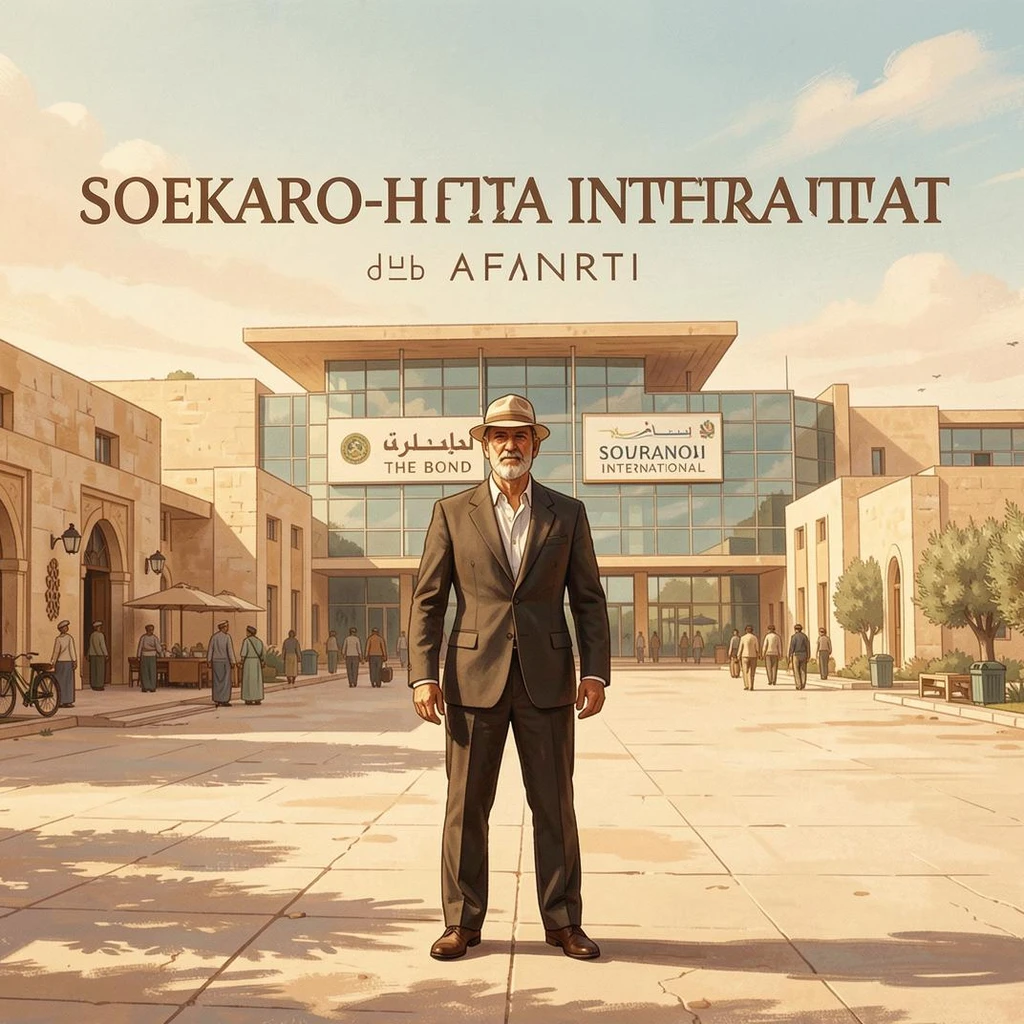
CHAPTER 8 — NOVEMBER 2028: JAKARTA DEPARTURE
Jakarta, November 2028. Soekarno-Hatta International Airport, Terminal 2, Departure Gate for TK 57. Istanbul.
Tayeb stood at the window, looking out at the motorbikes on the approach road. The terminal AC hummed cold against the back of his neck, but through the glass the heat pressed in — thirty-three degrees at midnight, the humidity visible as haze over the runway lights. Twenty-six months ago, that heat had hit him like a wall. Now it was just Jakarta.
Kretek smoke drifted from a cluster of men near the duty-free shop — sweet, clove-heavy, the scent that had saturated his clothes and his hotel room and his notebooks for two years. He would stop noticing it when it was gone.
The posters along the airport approach had faded. Two years of monsoon rain, tropical sun, exhaust. The families still smiled — father, mother, two children — but the colors had bleached to pastels, the slogans barely legible: Keluarga Berencana untuk Masa Depan Sejahtera. Family Planning for a Prosperous Future.
When he’d arrived, the paint had been wet.
He opened the final notebook. Yesterday’s entry — the last page of the last volume.
Sept ‘26 – Nov ‘28. Clinics in every district. Posters on every wall. Marriage delays continuing — 71% unmarried. Contraceptive inquiries up. TFR: declining at the same pace as before the program. No acceleration. No sudden drop.
The mechanism is visible. The outcome is not.
The kyai in Karangrejo — three generations on the same mat. His grandfather taught differently than his father. His father taught differently than him. The pesantren remained. The teaching changed.
The kyai can change his mind. The state cannot.
He closed the notebook.
He touched his left pocket. The seeds — wrapped in cotton, then a handkerchief, then a ziplock bag. Rice seeds from the pesantren in Karangrejo, Javanica varieties the kyai said had grown in those fields since before the Dutch. Given to him the morning he left, pressed into his palm without ceremony.
“If they grow in Tunis soil,” the kyai had said, “then something transmits.”
The seeds were a hypothesis. A question carried in his pocket.
Pak Damerji.
The voice behind him. Bambang Sutrisno, the PLN director who had brought him here twenty-six months ago, who had paid atlas_bridge.com three hundred thousand dollars for six months of consulting that stretched into two years.
“Bambang.”
“You’re leaving, ya.” Not a question.
“I’m leaving.”
“The solar work — finished.” Bambang stood beside him at the window, arms crossed, his batik shirt sleeves rolled to the elbows. “PPAs streamlined. Grid connections accelerating. Village adoption up again. Your software — alat yang bagus, good tool. We’re on track for the 100GW target.”
Tayeb nodded. He’d come for the networks. He’d stayed for the solar. Three hundred thousand dollars, and the solar work had succeeded — the optimization took hold, the grid integration worked, the program was unstuck. That part was real.
“And the other research?” Bambang asked, quieter now. “The network study. What did you find, Pak?”
Tayeb was quiet for a moment. The PA system crackled overhead — a boarding call for a Jakarta-Kuala Lumpur flight, Indonesian then Turkish then English, the syllables blurring into the terminal’s ambient hum.
“The networks survived,” Tayeb said. “They kept their autonomy. Their independence. They can adapt — change their teaching, revise their position, respond to what they see.”
“But they chose to accommodate,” Bambang said.
“They chose to accommodate.”
“So what’s the difference, Pak?” Bambang asked. “Accommodation, coercion — voluntary, imposed — if the outcome is the same? Two children either way?”
Tayeb looked out the window. A motorbike cut across three lanes of approach-road traffic, headlight swerving.
“If the network is wrong,” Tayeb said slowly. “If two children proves too few — if the TFR falls too far, if the cribs empty —”
“Then what?”
“Then the kyai can sit in his courtyard and say: Three is sunnah.” Tayeb gestured with one hand, the gesture sharp. “He can change. His father taught differently than his grandfather. He teaches differently than his father. The community gathers and decides.”
“And the state?” Bambang asked.
“The state cannot.” Tayeb turned from the window. “The state built a campaign around two children. Billboards, jingles, clinics, school programs. If the state reverses — what does that say? That progress was wrong? That the policy failed?” He shook his head. “The network serves the community. The network can change and still be the network. The state serves its own legitimacy. The state cannot admit it was wrong.”
Bambang uncrossed his arms, put his hands in his pockets. The PA crackled again — another flight, another gate.
“And when will the kyai change?” Bambang asked. “If he needs to?”
“When the evidence is undeniable,” Tayeb said. “When the cribs are empty. When the consequences are visible.”
“And if it’s too late by then?”
Tayeb didn’t answer. The question sat between them without resolution.
The call to prayer rose over the terminal — a tinny voice from the airport mosque speaker, then another from beyond the glass, outside, delayed by distance. The two calls layered over each other, slightly offset. After twenty-six months the dissonance had become familiar. He would miss the sound when it was gone.
“So what can Tunisia use?” Bambang asked. “What’s transmissible?”
Tayeb touched the notebook in his breast pocket.
“The capacity to decide together,” he said. “The network kept the ability of the community to determine maslahah — the public good — for itself. Not the state deciding for them. Them deciding for themselves.”
“And if they decide wrong?”
Tayeb looked at the faded posters through the window. The bleached families still smiling.
“Then they gather again,” he said. “And decide differently.”
Bambang studied him for a long moment. Then he nodded, once.
“Come home, Pak,” Bambang said. “Build something.”
The announcement board flickered: TK 57, NOW BOARDING. ISTANBUL.
Tayeb picked up his carry-on. One bag. Twenty-six months, and it still fit.
“Tayeb,” he said. “Call me Tayeb.”
“Tayeb.” Bambang extended his hand. His grip was firm, dry — the handshake of a man who closed deals in government ministries. “The grove is waiting. The trees are still standing.”
“But the children are not,” Tayeb said.
Bambang’s hand tightened once, then released.
“Then change that.”
Tayeb nodded. He walked toward the gate. The agent took his boarding pass. The scanner beeped. He stepped through.
Behind him, the terminal — the PA cycling through languages, the kretek smoke, the layered adhan fading into the distance. Ahead, the jet bridge narrowed toward the waiting plane. Turkish Airlines, red tail, white fuselage. Jakarta to Istanbul. Istanbul to Tunis. The long way home.
The seeds pressed against his thigh. The notebook pressed against his chest. The engines hummed through the jet bridge walls.