CHAPTER 5 — DECEMBER 2026: WAQFIYAH NU
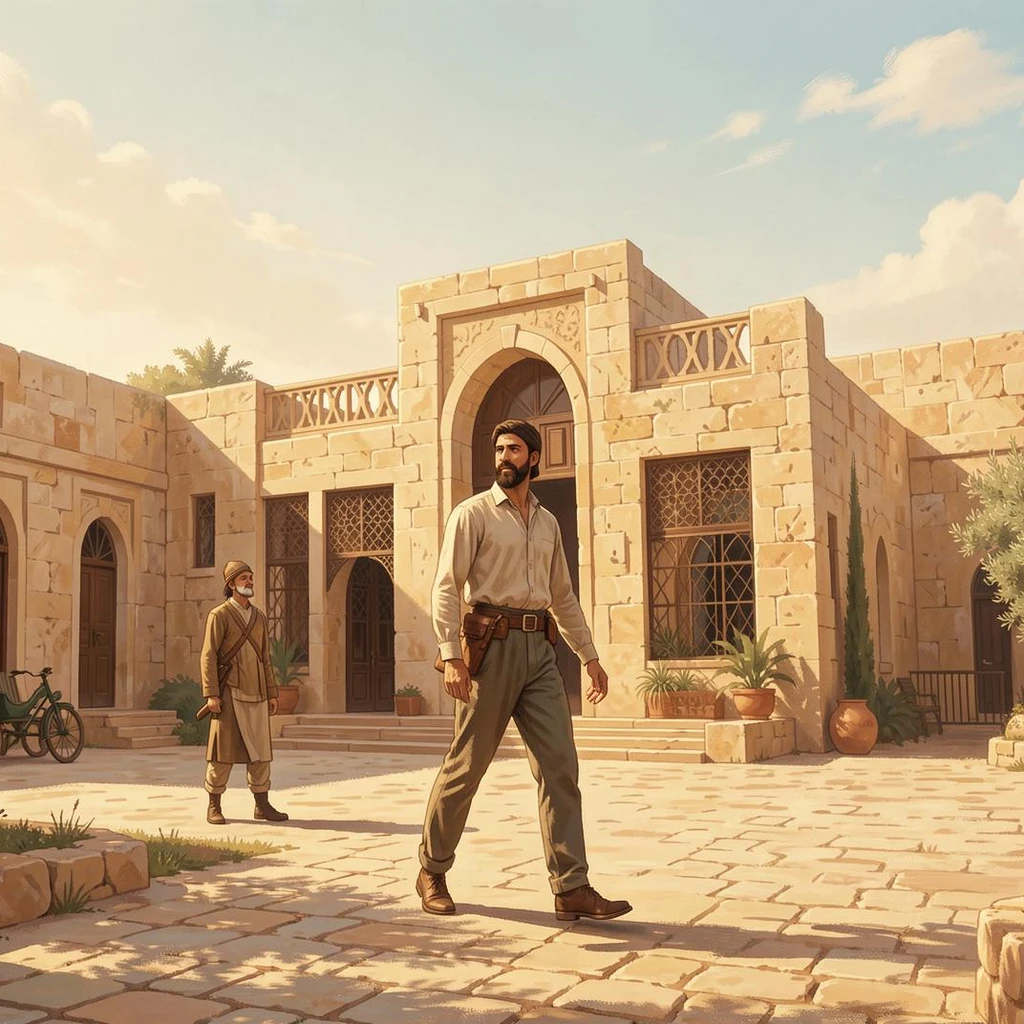
Surabaya, East Java. December 2026. The Waqfiyah NU regional office occupied a Dutch colonial building on Jalan-Jembatan — white plaster, red tile roof, carved wooden doors, the NU emblem mounted above the entrance. Not the national body — that was in Jakarta — but the East Java waqf desk, the one that managed Jombang district properties, the one closest to where the story had started. The building had survived the Japanese occupation, the Indonesian Revolution, the Sukarno era, the Suharto dictatorship, the Reformasi. Like the waqf it managed.
Kyai Abdullah led Tayeb inside. The interior was cool, high ceilings, ceiling fans rotating slowly. The walls were lined with maps — not political maps, but property maps. East Java, Central Java, West Java, Madura. Thousands of parcels shaded in green. NU property. Waqf property. Inalienable. Eternal.
“The waqf feeds the network,” Kyai Abdullah said.
“The network feeds the waqf,” said a voice from the back office.
A man emerged — fifty years old, Javanese, dark hair graying at the temples, wearing a short-sleeved button-down shirt with the sleeves rolled precisely to the elbows, trousers pressed sharp. A gold ring on his right hand, reading glasses on a chain around his neck. Hasyim, the waqf property manager. He carried a plastic folder in one hand and clicked a ballpoint pen with his thumb — click, click, click.
“My office,” Hasyim said. “The deed room.”
He led them down a hallway lined with framed photographs — pesantren under construction, ceremonial openings, kyai receiving awards from presidents. The photos were yellowed at the edges, some from the 1950s, some newer. Through a window at the end of the hall, December rain fell on the Surabaya street below, the monsoon runoff streaming along the gutters.
The deed room was at the back of the building. No windows. The smell hit Tayeb immediately — old paper, dust, ink, time. Floor-to-ceiling shelves lined every wall, stuffed with bound volumes, loose documents, folders, boxes. The air was still, the ventilation minimal. In the corner, a dehumidifier hummed, its LED display reading 52%. Rain tapped against the outer wall — the only sound besides the hum.
“East Java, 1920-1930,” Hasyim said, gesturing to one wall. “Central Java, 1940-1950.” He pointed to another wall. “Madura, 1950-1960. Each shelf holds the deeds for that decade, that region. Rice fields, mango groves, urban lots, shop buildings. Each one inalienable. Each one generating income. Each one bound by waqf covenant — cannot be sold, cannot be inherited, cannot be taken.”
He pulled a ledger from a drawer — heavy, bound in red leather, pages thick with handwritten entries.
“This month’s distributions,” Hasyim said. He opened the ledger. “December 2026. Pesantren Tebuireng: eight hundred million rupiah from the Jombang rice fields. Pesantren Denanyar: three hundred million from the mango groves. Pesantren Lirboyo: two hundred million from the Surabaya shop rentals.”
He turned the page. “The money doesn’t come to us. It goes directly to the pesantren. We process the deeds, we verify the properties, we collect the income, but we don’t control it. Each pesantren has its own waqf committee. Each committee decides how the income is used — salaries, maintenance, scholarships, expansion.”
He clicked his pen. “Last month, Pesantren Tebuireng used its waqf income to build a new dormitory. Three hundred students can now live on campus who couldn’t before. The state didn’t pay for it. The donors didn’t pay for it. The waqf paid for it. Property endowed in 1926, generating income in 2026, building a dormitory that will stand for fifty years.”
“Hasyim manages the endowment,” Kyai Abdullah said, his tasbih clicking softly. “He knows every property. Every deed. Every income stream.”
“How many properties?” Tayeb asked.
Hasyim smiled. “How many grains of rice?”
He pulled a volume from the shelf. Green binding, faded gold lettering: Waqf Deeds, Jombang District, 1926-1930.
He opened it on the reading table. The pages were yellowed, brittle, the handwritten Arabic script neat and precise. Deed after deed, property after property, each with the same formula: I, the undersigned, hereby endow this property — rice fields, orchards, buildings — in perpetuity, for the benefit of the Muslim community, to be managed by Nahdlatul Ulama, according to Islamic law. Income to fund pesantren, mosques, schools, hospitals. The property cannot be sold, cannot be inherited, cannot be alienated. It is waqf. It is God’s property on earth.
“1926,” Tayeb said. “The year NU was founded.”
“The first endowments,” Hasyim said. “The kyai who founded NU — they understood. Networks need resources. Independence requires funding. If the network depends on the state, the network is vulnerable. If the network depends on the community, the network is resilient.”
He turned pages. Rice fields in Jombang. Orchards in Pasuruan. A market building in Surabaya. Residential plots in Malang. All endowed in 1926, 1927, 1928. All still producing income. All still funding the network.
Hasyim stopped at a deed from 1927 — a rice field in Jombang, half a hectare, endowed by a kyai who had since died. His finger traced the signature, careful not to touch the ink directly.
“My grandfather,” he said quietly. “He endowed this field the year I was born. It has funded three pesantren. It sent me to university. It is sending my daughter to university now.” He looked up at Tayeb. “The deed is older than I am. But the rice is new every harvest.”
“How much?” Tayeb asked.
“How much what?”
“How much income?”
Hasyim hesitated. He didn’t like discussing numbers with outsiders. But Kyai Abdullah had brought this man from Tunisia, and the kyai had said: Show him everything. The networks must learn from each other.
“Annual revenue,” Hasyim said carefully, “is approximately three hundred billion rupiah.”
Tayeb did the conversion. Twenty million dollars.
“For what?” Tayeb asked.
“For everything,” Hasyim said. “The pesantren. The mosques. The hospitals. The scholarships. The orphanages. The disaster relief. The community organizing. The network itself.”
He turned to another volume. Waqf Deeds, Central Java, 1940-1950. More properties. More endowments. Each one a seed that kept giving, decade after decade.
“The Indonesian state,” Tayeb said, “tried to abolish the waqf?”
“They tried,” Hasyim said. “In the 1960s. The Sukarno government wanted to nationalize all charitable endowments. Bring them under state control. Standardize them. Modernize them.”
“But it didn’t happen.”
“NU resisted,” Hasyim said. “We went to court. We argued constitutional protection. We argued religious freedom. We argued that the waqf predated the Indonesian state — that some of these deeds were from the Dutch era, from the sultanates, from before Indonesia existed.”
He tapped the 1926 volume.
“The courts agreed. The waqf was protected. The property remained ours. The income remained ours. The independence remained ours.”
Tayeb touched the ledger’s leather cover. In Tunisia, these deeds had been confiscated — the waqf abolished in 1957, the property transferred, the courts dismissing all claims. The state had taken everything.
“Tunisia abolished waqf in 1957,” Tayeb said. “Nationalized the property. The networks lost everything.”
Hasyim looked up. The pen stopped clicking.
“And now?” Hasyim asked.
“Now the TFR is 1.6. Below replacement. The population is aging.”
Hasyim was quiet for a long moment. Rain tapped against the outer wall.
“The difference,” Hasyim said finally, “is not religious. It’s economic.”
He pulled a map from the drawer — East Java, overlaid with color-coded parcels. Green for NU waqf. Blue for private waqf. Red for government waqf. The map was a mosaic of endowments, a patchwork of properties that no one could sell, no one could inherit, no one could take.
He pointed to a green square near Jombang. “Rice fields. Fifty hectares. Endowed in 1926 by a merchant from Surabaya — Haji Ahmad Jaelani. He’d made his fortune in the textile trade, wanted to leave something that would keep giving after his death. The rice fields have produced three harvests a year for a century. Each harvest generates income. Each income funds students. The merchant died in 1932, but his waqf feeds Pesantren Tebuireng to this day.”
He pointed to a blue rectangle near the coast. “Mango grove. Endowed in 1952 by a farmer’s widow — she had no sons, didn’t want the property divided and sold. Made it waqf for the local pesantren. The trees have been replanted three times since then. Same rootstock, new trees. The income continues.”
He tapped the map — green, blue, green, blue. A patchwork of endowments across East Java.
“The pesantren,” Hasyim said, “are not dependent on the government. They don’t need government funding. They don’t need government approval. They don’t need to follow government policy. They have their own resources. Their own income. Their own independence.”
He traced a line of green properties — Jombang, Tebuireng, the surrounding rice fields. The green squares were clustered around the town, dense with endowments.
“Pesantren Tebuireng,” he said. “Eight thousand students. Operating costs: ten billion rupiah annually. Tuition income: two billion. Waqf income: eight billion. The pesantren survives because the waqf survives. The network survives because the property is inalienable.”
He clicked his pen. “And the legal framework protects it. Article 28 of the Indonesian Constitution — freedom of religion. Article 29 — religious communities may manage their own affairs. The Constitutional Court ruling, 2004 — waqf property is protected by law, cannot be nationalized without compensation, and even then, only for public purpose, not transfer to private ownership.”
“Tunisia,” Tayeb said, “had waqf too.”
“And?”
“And the state took it. In 1957, President Bourguiba abolished the waqf system. Nationalized all property. Transferred it to state agencies. The networks lost their economic base. The networks lost their independence. The networks died.”
Hasyim nodded. He understood.
“So what you’re looking for,” he said, “is not religious accommodation. It’s not voluntary acceptance of family planning. It’s not the difference between coercion and choice.”
“No,” Tayeb said. “It’s the money. Independence is money. Without it, the network depends on the state. With it, the network can choose.”
“Exactly,” Hasyim said. He looked at the shelves around them. “That is the difference.”
He returned the volume to the shelf. Dust motes hung in the light from the fluorescent tube above.
“But,” Tayeb said, “the networks survived. The waqf survived. The pesantren survived. And yet…”
“And yet?”
“And yet the fertility collapses anyway.”
Hasyim was quiet for a long moment.
“Ah,” he said finally. “That is the question.”
“The network is preserved,” Tayeb said. “The transmission continues. But what transmits? If the kyai teaches two children is sunnah, and the families choose two children, and the outcome is the same as Tunisia — then what was preserved? What’s the difference?”
Hasyim didn’t answer immediately. He turned the pen in his fingers — click, click — and looked at the shelves around them, the volumes, the decades of deeds.
“The difference,” he said finally, “is that the network can change.”
“Change?”
“The network can change its teaching. The network can revise its position. The network can adapt to new evidence, new circumstances, new understanding of maslahah — the public good.”
He turned back to Tayeb.
“The state cannot change its mind. The state built its legitimacy on two children. If it reverses, it admits failure.”
“But the network?”
“The network’s authority comes from the community. The kyai can say: we were wrong. Three children. Four. Whatever the community needs. He loses no face, because his authority is service, not correctness.”
Tayeb was quiet.
“The waqf preserves the network’s independence,” Hasyim said. “But independence is only valuable if the network is capable of learning. Of adapting. Of changing course when necessary.”
“Has the network changed course?” Tayeb asked. “On family planning?”
“Not yet,” Hasyim admitted. “The TFR is still falling. The teaching is still two is sunnah. But the network could change. The network has the capacity to change. That capacity — that flexibility — is what was preserved.”
He gestured around the deed room, the shelves of documents, the century of endowments.
“The waqf gives us money. Money gives us independence. Independence gives us the freedom to think for ourselves. To learn. To change.”
“And Tunisia?”
“Tunisia destroyed the waqf. The networks lost everything. They became extensions of the state. And the state cannot admit it was wrong.”
Tayeb looked at the deed in Hasyim’s hand. Brown ink, precise script. A century of income. A century of independence. And at home, the empty cribs.
“So what transmits?” Tayeb asked. “When the network survives — what actually survives?”
Hasyim smiled — a small thing, gone quickly.
“That,” he said, “is not in these deeds.”
He reached for another volume — Waqf Deeds, North Sumatra, 1955-1965. More properties. More endowments. More independence.
“I can show you the mechanism,” Hasyim said. “I can show you how the waqf operates, how the income flows, how the pesantren survive without government funding. I can show you the legal framework, the constitutional protections, the court cases that preserved our independence.”
He opened the volume. The deeds were crisp, the ink fresh, the signatures clear.
“But what survives in the mechanism,” he said, “what transmits through the structure — that is not visible in the deeds. That is not visible in the accounts. That is not visible in the property maps.”
He looked at Tayeb.
“The network transmits what it believes,” Hasyim said. “If it believes two children is sunnah, that’s what transmits. The structure survives.” He touched a deed on the shelf. “But what’s inside the structure? That I cannot show you.”
Tayeb stood in the deed room. The dehumidifier hummed at 52%. Rain tapped against the outer wall. On the shelf, the 1926 volume waited, green binding faded, gold lettering dim. Outside, Surabaya moved — motorbikes through the rain, street vendors under umbrellas, the wet season pouring down. Through the window, water ran in sheets across the motorbike park, the BKKBN poster peeling from the concrete wall, the colors bleeding into the drain.