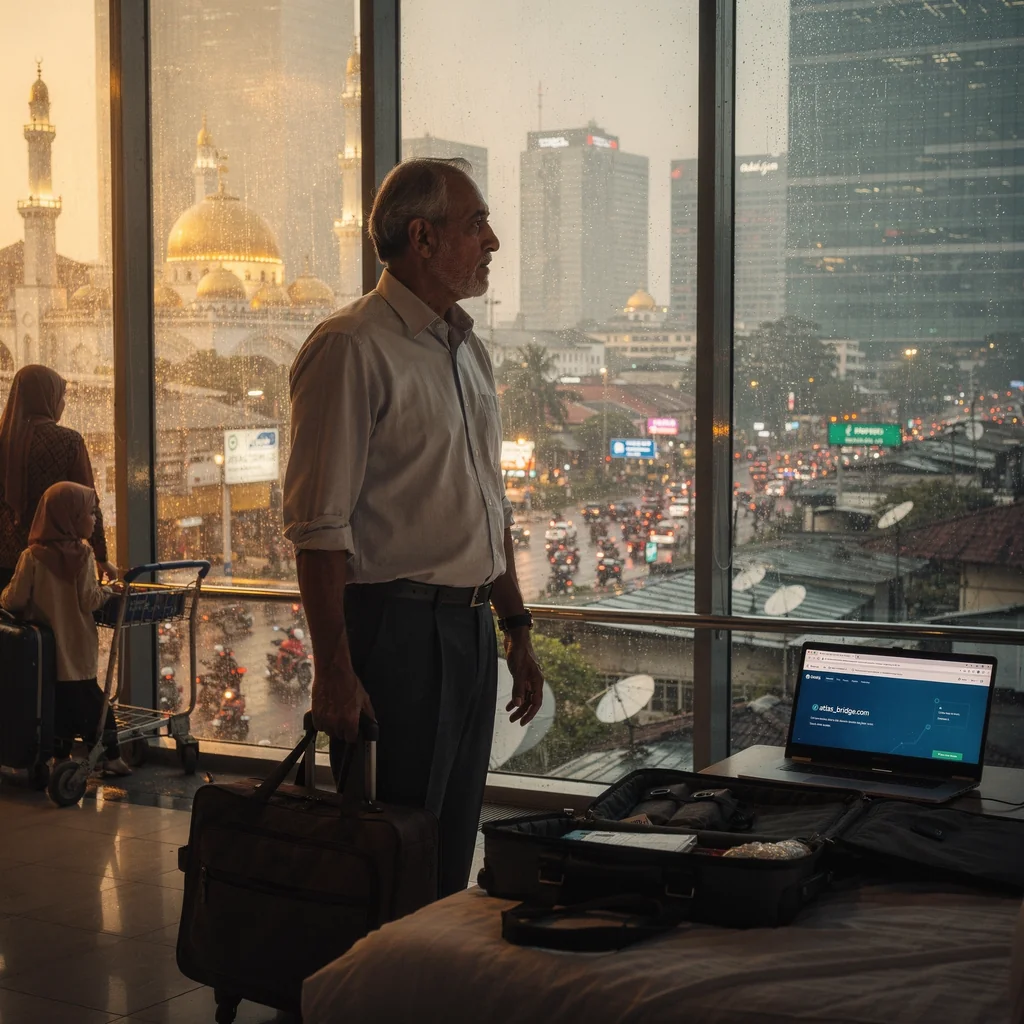
CHAPTER 2 — SEPTEMBER 2026: JAKARTA ARRIVAL
The doors opened.
The airport could have been anywhere—glass walls, polished floors, duty-free shops. But the humidity seeped through even here, a dampness on the skin between the air-conditioned zones. Immigration. Baggage carousel. A long walk toward the exit signs.
Then the doors opened again.
Heat—not Mediterranean dry, but heavy, wet, a weight that settled into clothes immediately. The air pressed against his skin like a wet towel, heavy enough that breathing felt like drinking water.
Then the sound. Motorbikes—thousands of them, a high-pitched whine like a hive of angry bees, punctuated by horns and shouts and distorted music from cheap speakers. Kretek smell hit next—clove cigarettes, sweet and pungent, mixed with exhaust.
They were everywhere—filling every lane, swarming like insects. They flowed around obstacles like water around stones. Families of four on one bike. A young woman texting while riding, her hijab flowing behind her. Delivery boxes strapped to the back—Gojek, Grab, ShopeeFood. A solid mass of metal and motion.
In Tunis, traffic moved in lanes. There was pattern, predictability. Here, there was only flow.
A taxi driver appeared at his elbow—small man, weathered face. “Mister? Taxi? Where you go?”
“The Hotel Indonesia Kempinski.”
“Ah, Kempinski. Good hotel. Very good.” The driver reached for his bag, led him toward a battered blue sedan.
They climbed in. The interior smelled of kretek, sharp and sweet, embedded in the upholstery. Underneath, something sweet and rotting, fermenting in the heat. The air conditioning rattled, blowing lukewarm air.
The driver pulled into traffic—no mirror check, no signal. A motorbike swerved around them, missing the bumper by inches. The driver shouted back, laughing.
The city unfolded outside—endless. Buildings pressed close to the road, pastels faded to gray. Billboards towered overhead—cigarettes, banks, soap operas. And everywhere the motorbikes.
“You come from where, mister?”
“Tunisia.”
“Ah, Tunisia!” The driver smiled in the rearview mirror. “Business?”
“Business.”
“Good, good. Indonesia good for business.” He gestured at the billboards, the endless motion. “Progress. Development. New Indonesia.”
And then he saw it.
Reflected in a shop window—bright colors, a family smiling, two children. Keluarga Berencana untuk Masa Depan Sejahtera. Family Planning for a Prosperous Future. The poster was faded, colors bleached from months of tropical sun, and underneath an older poster peeling away—faded KB materials from campaigns past, layered like sediment.
“Excuse me. What is that poster?”
“Ah, family planning. BKKBN program. Very important.”
“Is it new?”
“New? No, no. We have family planning since the 1970s. KB—Keluarga Berencana. Long time.” He gestured at the poster. “But this one? This is new government push. Acceleration program. Prabowo’s GDPK. More clinics, more poster, more… intensity.” He tapped the steering wheel. “Enough for prosperity. Enough for education. Enough for… how you say… modern life.”
Tayeb watched the poster recede. There were more—on bus stops, market walls, building sides. Every color, every design, but the same message: two children. Prosperous. Modern. Happy.
“You have children, mister?”
Tayeb hesitated. “No.”
“No? Why not?”
“It’s…” Tayeb searched for the word. “Complicated.”
“Ah. Complicated.” The driver nodded. “Yes. Children are blessing, but also… expense. In Jakarta, very expensive. Many fee. Two children is enough. Three is… difficult.” He laughed. “So we use family planning. Government help. Very good program.”
Tayeb looked away. His fingers found the wallet in his pocket, the photograph tucked behind his ID. A niece, a nephew. Three births this year in his neighborhood mosque. Five deaths.
“Has the program worked?” Tayeb asked. “The family planning. Has it… changed anything?”
“Maybe. Is hard to say. Families already choosing smaller, you know? Two children, maybe three—already normal. But government push harder now—more clinic, more counseling, more… pressure.” He shrugged. “People still use, but… is different now.”
They turned onto a larger avenue. Six lanes in each direction. Pedestrian bridges overhead. Shopping malls—glass and chrome. And everywhere the posters.
One caught Tayeb’s eye—a clinic poster with a mother holding a newborn, a midwife smiling. Konseling Keluarga Berencana. Gratis. Confidential. The poster was new, vivid colors, but Tayeb could see where it had been pasted over an older BKKBN notice—part of a word visible beneath, the faded blue of a previous campaign.
“Where is that clinic?”
“Ah, BKKBN clinic. Many clinic now. Government expand existing clinic, open new ones. Free counseling. Free… protection.” He waved a hand. “For family planning. Is acceleration—more services, more outreach.”
“Since when?”
“Long time we have clinic. But this expansion? Last two years. Prabowo’s program—intensify what already work.”
The hotel appeared ahead—white tower, glass and gold. The Hotel Indonesia Kempinski. Central Jakarta. Near the Ministry.
The driver pulled up to the entrance. A bellman appeared in a red uniform.
“Good luck, mister. Welcome to Jakarta.”
Tayeb paid. The driver pressed his palm to his chest—terima kasih, Pak—and pulled away.
The hotel lobby was cold. Air conditioning blasted. Marble floors. Chandeliers. Tayeb checked in. Executive floor. Bambang Sutrisno’s booking.
The elevator rose. The city fell away below.
The room was spacious—floor-to-ceiling windows, desk with laptop, fruit basket. Tayeb set down his bag, went to the window.
Jakarta spread out before him—endless, horizontal, a sea of buildings and roads and motorbikes, stretching to the horizon where hills rose in blue-gray haze. The sun was setting, painting the city in gold and pink.
And then he heard it.
The adhan.
Not one call. Five. Six. Seven. The sound floated up from everywhere—from minarets small and large, from neighborhoods rich and poor. The calls were seconds apart, layering over each other. One voice deep and resonant, another thin and reedy, a third young and clear. They overlapped, echoed, filled the air between the buildings.
Allahu Akbar. Allahu Akbar. Ashhadu an la ilaha illa Allah.
Tayeb stood at the window, listening. The sweat on his neck had cooled. The sound rose through the heat, through exhaust fumes and kretek smoke—voices layered, echoing between the buildings.
Then he saw it again.
Another poster on the building opposite—bright colors, happy family, two children. The slogan in red: Keluarga Berencana untuk Masa Depan Sejahtera. Family Planning for a Prosperous Future. The poster was fresh compared to others, but even this one showed signs of weathering—the edges curling, the colors already beginning to fade. And behind it, layers of older KB campaigns.
Tayeb’s chest tightened.
He touched the glass. Motorbikes swarmed below, headlights flickering on as the sun dropped behind the hills. The adhan continued, one mosque after another. The poster across the street caught the last light—bright colors, happy family, two children. The edges curled in the humidity. Beneath, older campaigns peeling through in patches of faded blue and yellow.